I was airlifted to the hospital unconscious. doctors called my parents, but my mom said: “just call when she’s out.” i might not survive surgery. my best friend drove 2 hours in the pouring rain to stay by my side. when my parents finally came looking for me, my apartment was empty. one note waited on their kitchen table. when mom read it, her knees buckled.
At 11:41 on a Tuesday night, a trauma nurse called my mother and told her I might not survive the surgery I was being wheeled into. My mother asked one question.
“Is she awake?”
The nurse said no. I had arrived by helicopter, with blood pooling somewhere inside my body where it wasn’t supposed to be, and surgeons were preparing to open me up within the next ten minutes. There was a pause on the line, and then my mother said, “Just call when she’s out.”
I didn’t hear that conversation. I was lying on an operating table with a surgeon’s hands inside me. I read it a week later, word for word, in my own medical chart because the nurse had written it down. At that same hour, my best friend Danny was driving down the interstate in pouring rain, her windshield wipers going as fast as they could, calling my phone for the ninth time.
My parents lived forty minutes from that hospital. They didn’t leave their house that night. They didn’t leave it the next day or the day after that, either.
And that wasn’t even the worst thing my family did that week. The worst thing happened two nights later, at 2:14 in the morning, when I came up out of the darkness and felt my brother’s hand wrapped around my thumb.
Welcome back to Calm Drama Stories. This is where we sit with the stories families would rather keep quiet: the late-night phone calls, the empty chairs, and the people who finally decide who gets to stay in their lives. Pour something warm, settle in, and stay with me until the end. Drop a comment, and be sure to subscribe.
Two Sundays before the crash, I sat at my parents’ kitchen table in Huntington and told my mother no.
I want you to see that table because it comes back at the end. It’s oak, heavy, older than I am, and near the corner where my father sits, there’s a round black burn about the size of a saucer. I made that burn when I was twelve. My mother had driven to Fort Wayne to watch my brother Kyle play in a travel baseball tournament, and my dad was working late. I’d decided to surprise everyone with dinner. Spaghetti, garlic bread, the whole thing. I set the pot straight down on the wood because I didn’t know you weren’t supposed to.
When my mother came home, she didn’t see the dinner. She saw the burn.
“Hannah, honestly,” she said, running her thumb over the mark as though it were a wound I’d given her.
Kyle went to bed happy because his team had won. I scraped three plates of cold spaghetti into the trash. Twenty-one years later, I still sat on that side of the table, and I still put a trivet under everything.
That Sunday, I’d driven down from Fort Wayne early, the way I always did. I brought a green bean casserole and a pie from the bakery my mother liked. I set the table. I’m the one in my family who knows where the extra chairs are. Kyle and his wife, Tessa, arrived forty minutes late, and my mother met them at the door with both arms open, the way she has met Kyle at doors his entire life.
Tessa was six months pregnant, her face pink from the cold. I liked Tessa. I still do, mostly. She hugged me in the hallway and whispered, “Sorry. He couldn’t find his keys,” then rolled her eyes. For a second, we were two people who understood something about Kyle together.
Halfway through the roast, Kyle took out his phone and passed it around the table. On the screen was a picture of a house. Three bedrooms, white siding, a little town called Rowan Oak, and a porch with a swing hanging from chains.
“That’s it,” he said. “That’s the one.”
My father nodded and chewed. My mother put her hand over her heart. Tessa looked at the picture the way I’d seen people look at photographs of someone they’d lost.
Then Kyle explained the problem. Their loan had been approved, but they still needed $40,000 for the down payment and closing costs. The closing was scheduled for the first week of November, their lease expired at the end of the month, and the baby was due in January. I told them it was a beautiful house. I meant it.
Then my mother turned toward me with the same smile she uses at church and said, in front of everyone, “Hannah has that house account just sitting there.”
I want to be exact about what that account was because being exact is my job. I’m a court reporter. I sit in depositions and courtrooms all over northeastern Indiana, typing every word people say on a stenotype machine. Then I go home and turn those keystrokes into transcripts, sometimes working until three in the morning.
For eight years, I’d moved part of every paycheck into a savings account at Heartland Valley Credit Union. By that Sunday, it held $46,200. I called it my house fund. I’d told my mother about it once at Easter, when she asked why I was still renting a one-bedroom apartment above a dentist’s office. I’d told her I was getting close, that I’d started looking at little houses with porches. I’d been proud of what I’d accomplished.
“It’s not just sitting there,” I said. “It’s for a house for me.”
“You’re single,” my mother replied. “You don’t need a yard.”
My father kept cutting his meat. Tessa looked down at her plate.
“It’d be a loan, Han,” Kyle said. “You’d get it back when we refinance.”
He said refinance the way people say a word they’ve only recently learned. I asked him when he thought that would happen.
“A couple of years, maybe. Maybe less if rates come down.”
“No,” I said.
I said it once, and I said it clearly. I’ve heard enough people in depositions try to take back words they never actually said. I’ve learned that when you mean something, you say it in a way that leaves no room for anyone to argue later about whether you did.
My mother set her fork down very carefully on the edge of her plate so it wouldn’t clink.
“Then I don’t know what kind of daughter I raised,” she said.
I left before the pie. I told them I had a transcript due, which was true, but it wasn’t the reason I was leaving. On the highway back to Fort Wayne, driving through the dark, I remembered something I hadn’t thought about in years.
When I was sixteen, my mother had taken me into the Huntington branch of the credit union and helped me open my first savings account. Both our names were on it. It was a joint account because I was a minor, and that’s how things were done. I’d used it throughout college to move money around. When I opened my own accounts, I simply stopped using it. There was $212 left in it.
Driving home that night, I told myself I should finally close it. I’d do it when things calmed down.
I didn’t do it.
I want you to remember that account.
The rest of my life before that week was small and good, and I liked it. I lived on the second floor of an old brick building near downtown Fort Wayne. I drove to county courthouses in places like Columbia City, Decatur, and Angola. I was good at my job because I was good at telling the difference between what people said and what they wanted you to think they’d said.
There’s a rule in my line of work: nothing is off the record unless everyone in the room agrees. I’d watched lawyers try to get around that rule throughout my career, and I’d never once thought about how it might apply to my own family.
And then there was Danny.
Danielle Okafor, technically, but nobody calls her that except her mother when she’s in trouble. We met when we were nineteen, in a math class at the community college, and became friends the night her car broke down on the interstate at midnight. I drove fifty minutes in my mother’s old Corolla to pick her up. She cried the entire way home, partly from relief and partly from embarrassment.
Before she got out of the car, she said, “I owe you.”
“No,” I told her. “Next time, I’ll just come get you again.”
That became our phrase. I’ll come get you.
We said it for fifteen years. When she moved to Indianapolis and opened her own salon two hours south of me, we said it over the phone. When I had a bad day, she’d text it. In my phone, her contact name was “Danny. I’ll come get you.”
I never changed it.
In my wallet, I carried one of those little emergency contact cards. On the line marked In Case of Emergency, I’d written Darlene Puit, mother. I’d written the same name on every form I’d ever filled out at doctor’s offices, at work, and on my insurance paperwork. I never thought about it. That’s what you write. You write your mother.
The crash happened on Tuesday, October 23.
I’d spent the afternoon in a deposition in Columbia City that ran late, two insurance lawyers fighting over a hailstorm, and it was almost ten when I finally got back to my car. The rain was coming down so hard that the parking lot looked as though it were boiling.
At 9:58, I texted Danny.
“Roads are awful. Call you in 40.”
She sent back a heart and a picture of her cat.
I remember State Road 9. I remember the rain against the windshield, the black road, and the white line I was watching as though it were the only thing holding me to the earth. Then I remember headlights where headlights should not have been. High ones. A pickup truck drifting across the center line toward me.
I remember turning the steering wheel. I remember a sound I don’t have a word for, and I have a lot of words.
After that, I only have pieces.
The airbag, white and burning against my face. The taste of pennies in my mouth. A firefighter’s voice asking me my name over and over, me telling him, and him asking again. Something cold being cut away from my body. A huge pounding noise above me, as though the sky were beating its fists. A ceiling with a white light moving across it.
Then nothing.
Everything I’m about to tell you about the next several hours, I pieced together afterward from three places: Danny, my medical chart, and, much later, my mother’s own mouth. I’ll tell you which is which.
The helicopter took me to Lakemon Regional Medical Center in Fort Wayne, a Level I trauma center. I arrived in the trauma bay at 11:20. My spleen had ruptured. My liver was torn. Three ribs were broken, along with my left wrist, which I’d apparently thrown up in front of my face. The scans showed so much blood in my abdomen that the trauma surgeon didn’t wait. They were taking me straight to the operating room.
My purse and phone had come with me in a clear plastic bag. While they worked on me, my phone kept ringing inside that bag. A nurse named Rosa Delgado finally answered because the same name kept flashing across the screen again and again.
Danny. I’ll come get you.
Rosa told me later that she’d answered because of that name. She said nobody puts something like that in their phone unless they mean it.
She told Danny I’d been in a car accident, that I’d been flown in, and that I was going into emergency surgery. She couldn’t say anything more over the phone.
“I’m coming,” Danny said, and hung up.
Rosa said she could tell from the sound of her voice that the woman was already putting on her shoes.
Then Rosa did what she was supposed to do. She called my emergency contact.
It was 11:41 p.m.
Rosa told my mother I’d been badly injured, that I was bleeding internally, and that I was being taken into surgery immediately. She made it clear how serious my condition was. She used the words nurses are trained to use when they need a family to understand that there might not be another chance.
She told my mother I might not survive the surgery.
My mother asked whether I was awake.
Rosa said no.
My mother explained that they had Kyle’s final walkthrough at the new house at eight the following morning, that Tessa wasn’t supposed to be under stress, and that they weren’t going to sit in a waiting room all night.
“Just call when she’s out,” she said.
Rosa asked her directly whether she wanted to come to the hospital.
“Call us when she’s out,” my mother repeated.
Then she hung up.
Rosa went to the computer at the nurses’ station and wrote down exactly what had been said, along with the time. She told me later she’d been a nurse for nineteen years and had written a note like that only four times.
Danny lived on the north side of Indianapolis. On a dry night, she could make the trip to Fort Wayne in two hours. That night, the rain fell so heavily that semitrucks threw walls of water across her windshield. Twice she had to slow almost to a stop because she couldn’t see the lane markings.
South of Marion, there was a low place in the road where water had collected across two lanes. She stopped at the edge of it with her hazard lights flashing and sat there for a minute, her hands trembling on the steering wheel.
Then she drove through.
She told me afterward that while she was in the middle of it, with water pushing against the car doors, she kept saying out loud, “I’m coming. I’m coming. I’m coming.”
As though I could hear her.
At 12:58 in the morning, while Danny was still on the road, my heart stopped.
I’d lost too much blood. For ninety-four seconds, there was no heartbeat on the monitor. A team of people I’d never met did the things they do to bring someone back from that place.
And they brought me back.
Nobody called my mother about it. She had asked them to call when I was out of surgery.
I wasn’t out yet.
Danny pulled into the hospital parking garage at 1:35 a.m. She ran through the rain to the emergency entrance, still wearing her salon clothes under a raincoat. They sent her to the surgical waiting room on the third floor.
It was empty.
One television was playing an infomercial for kitchen knives. Danny sat there alone for an hour and a half, watching a man slice tomatoes because there was nobody else to call.
At 3:10, the trauma surgeon came through the double doors. He looked around the room, and his expression changed when he saw only one person.
He asked if she was family.
Danny stood up.
“I’m what she’s got tonight.”
He told her I’d made it through surgery. He told her I was being transferred to the ICU. He told her the next twenty-four hours mattered.
He didn’t tell her about the ninety-four seconds. That came later, too.
My parents slept in their own bed that night, forty minutes away. In the morning, they went to Rowan Oak and walked through a house with a porch swing. I know because my mother posted a picture of the porch at eleven that morning with three heart emojis.
Danny saw it on her phone in the ICU waiting room. She turned the phone face down on her knee and didn’t tell me about it for a long time.
The breathing tube came out Wednesday afternoon. I don’t remember that happening. I don’t remember much of Wednesday at all, except voices and light and the sensation of being terribly heavy and very far down, as though I were lying at the bottom of a swimming pool.
They kept me on strong pain medication through a pump, and I drifted in and out. I’m told I asked Danny three times where my car was and once whether I’d finished the hailstorm transcript.
Danny stayed. She called her salon and rearranged her appointments. She slept in a chair. The nurses liked her because she brought them coffee and remembered their names.
At 11:10 on Wednesday night, my brother came to the ICU.
I didn’t know it then. Danny was downstairs in the cafeteria, and I was heavily medicated. According to hospital records I saw later, Kyle signed the visitor log at the desk and told the staff our mother had asked him to take my personal belongings home for safekeeping.
My purse. My wallet. My keys. My phone.
He signed for the bag and left.
He was in the building less than fifteen minutes.
He didn’t sit with me.
When Danny came back upstairs and saw the empty hook where the bag had been, the night nurse told her my brother had collected my things. Danny thought, Well, at least somebody from that family came.
She told me later she’d actually felt relieved. She’d thought maybe my family was simply bad at hospitals. Some people are.
Kyle came back the following night.
It was Thursday, October 25. Rosa had made Danny go lie down in the family lounge at the end of the hall. Danny had been awake for most of two days, and Rosa had told her, “Two hours flat on your back, or I’m calling security on you myself.”
So Danny went.
The ICU at Lakemon allowed family members to visit at any hour, which is a kindness almost all the time.
A little after two in the morning, Kyle walked past the desk and told the clerk that Mom wanted him to check on me.
I came up out of the medication slowly, the way you come up from deep water. The first thing I knew was cold. Something cold, flat, and smooth beneath the pad of my right thumb. Then warmth around my thumb, around my entire hand, fingers closing over mine.
Somebody was holding my hand and pressing my thumb down against something cold.
For one long, stupid second, I thought someone was comforting me.
Then I heard his voice, low and impatient.
“Come on, Han. Come on.”
I knew that voice. I’d known it since it was a baby’s voice.
I opened my eyes the smallest amount they would open. There was blue light on the ceiling, the light from a phone screen, and my brother’s face was illuminated from underneath.
He wasn’t looking at me.
He was looking at the phone.
He pressed my thumb against it again. The phone buzzed. He pressed it again and made a small, satisfied sound, like a man who had finally managed to open a stubborn jar.
My left wrist was in a cast. My right hand was the one with the fingerprint my phone recognized.
I tried to pull it away.
My arm didn’t move. It was like sending a letter to an address that didn’t exist anymore. I tried to say his name, but all that came out was “Ky,” and then nothing, because my throat was raw from the breathing tube.
He glanced at me for just a second. Then he looked back at the screen, pressed my thumb against it once more, harder this time, and held it there.
The door opened.
Light spilled in from the hallway.
Danny’s voice, still thick with sleep, cut through the room.
“What are you doing?”
Kyle let go of my hand. It fell onto the blanket.
“Getting her insurance stuff,” he said. “Mom needs it.”
“At two in the morning?”
Danny had a paper cup of vending-machine coffee in one hand. I watched her look at the phone, then my hand, then the phone again, with my thumb still near it.
She went for the phone.
She put the coffee on the counter and moved fast, reaching across the foot of my bed. Kyle twisted away from her and drove his shoulder into her chest.
It wasn’t the kind of push you give somebody to get them out of your way.
It was the kind of push you give somebody to knock them down.
Danny stumbled backward into the IV pole beside my bed.
The pole tipped.
I felt it before I understood what was happening: a hard yank against the back of my right hand, where the IV line went in, followed by a hot, wet feeling against the blanket.
The pump started screaming. Coffee spread across the floor.
Danny didn’t fall all the way. She caught herself against the bed rail, reached for Kyle’s sleeve, and got hold of it. He tore his arm away so violently that the edge of the phone in his fist caught her across the eyebrow.
I saw her head snap to the side.
Then he was gone.
The door swung shut. I heard his shoes pounding down the hallway, someone at the nurses’ desk shouting after him, and the heavy stairwell door banging open.
Rosa came in first, followed by a respiratory technician and another nurse. She took one look at the floor, the overturned pole, the blood on my hand, and the blood running down Danny’s face. Then she picked up the wall phone and called security.
By the time security reached the stairwell, Kyle was in the parking garage. By the time they reached the garage, he was gone.
Danny had a choice right then. She could have run after him. She told me later that every part of her body wanted to. She looked toward the door, then back at me, at my hand bleeding onto the sheet.
She came back to the bed.
She pressed her palm over the back of my hand where the IV line had torn out and held it there until Rosa took over. Blood from her eyebrow dripped onto my blanket. She didn’t wipe it away.
“I’m here,” she kept saying. “I’m here. I’ve got you.”
Over and over, the same way she’d talked to me in the floodwater south of Marion two nights earlier, when I couldn’t hear her.
They put a new IV line into my other arm above the cast because my right hand was too badly bruised. A security officer wrote a report. Danny went downstairs to the emergency room and received four stitches in her eyebrow.
When she came back up at four in the morning, I was already sinking back beneath the medication. I remember her face hovering over me, the white bandage, her mouth moving. I couldn’t hold on to the words.
I didn’t know yet what Kyle had done with my thumb.
I only knew he’d needed it more than he’d needed to look at me.
When I woke up properly, it was seven in the morning, during shift change, and the window was gray with rain. Danny had fallen asleep sitting upright in the chair beside me, still wearing her coat. Her hood was dark with rain that had dried in the shape of a map. A white bandage covered her left eyebrow, with a small rust-colored stain in the middle.
Her hand rested on the blanket near mine.
Not holding it. Just near it.
The way you leave a light on in a hallway for somebody.
I looked at her for a long time before I let myself look toward the door. I knew nobody else was coming through it. I knew it the way you know a step is missing when you’re walking downstairs in the dark. You don’t have to think about it. Your body simply knows the floor isn’t there.
I’d spent thirty-three years being the one who drove, the one who arrived early, the one who knew where the extra chairs and blankets were kept. And the one person who had come for me was asleep in a wet coat, two hours from her own bed, with stitches in her face because of my brother.
Danny woke when the nurse came in to check my vital signs. She rubbed her face, winced when her fingers brushed the bandage, and then told me everything that had happened since Tuesday night, in order.
I’d taught her that years ago. When something bad happens, tell it in order. Don’t skip around.
She told me about the rain, the empty waiting room, the knife infomercial, Kyle signing for my bag Wednesday night, and Kyle coming back. When she reached the part about the IV pole, her voice grew thin. She stopped, took a breath, and started again.
Then I asked the question I’d been holding in my mouth since I opened my eyes.
“Did Mom call?”
Danny hesitated.
She has never been able to lie to me, not even to be kind. I watched her decide she wasn’t going to start now.
She told me what Rosa had said about the phone call Tuesday night. Is she awake? The walkthrough. Just call when she’s out.
I didn’t cry.
I asked what time the call had happened.
Danny said Rosa had told her it was a little before midnight.
I nodded.
That was all I could do with it right then. Pin it to a time. Put it somewhere I could find it.
When Danny went out to get me ice chips, I cried.
Not the way people cry in movies. I couldn’t. Every breath felt as though somebody were sliding a knife between my ribs. I couldn’t sob. I couldn’t even let my chest move very much.
I lay there with tears running from the corners of my eyes into my ears, taking tiny, careful breaths in and out, because even grief had to take small breaths that morning.
When I heard Danny’s footsteps returning, I wiped my face with the edge of the sheet so she wouldn’t have to see it.
The surgeon came by at nine. He was a tall, tired man with gray at his temples, and he sat on the edge of the windowsill instead of standing over me, which I appreciated.
He told me they’d removed my spleen. He told me I’d need vaccinations and would have to take fevers seriously for the rest of my life. He said my liver would heal on its own.
“You were very lucky,” he said. “You lost a lot of blood on that table.”
He didn’t mention my heart.
I didn’t know to ask.
At 2:47 that afternoon, I called my mother from Danny’s phone.
I’d thought about it all morning. What I wanted from that call was small. I wanted her to ask whether I was hurting. I’d decided that if she asked me just once whether it hurt, I could hold on to everything else, at least for a while.
Danny held the phone near my face on speaker because my right hand was swollen and purple from the IV, and my left was in a cast.
My mother answered on the third ring.
“Oh,” she said. “You’re up. See? I told them you’d be fine.”
“Hi, Mom.”
“Do you know what those helicopters cost?” she asked. “Thirty, forty thousand dollars. I read about it. I hope your insurance is decent, Hannah, because I can’t help you with that.”
That was the second thing my mother said to me after I almost died.
I’m telling you exactly because exact was all I had.
I asked why nobody had come.
She said they’d had the walkthrough, and then the inspector had wanted to go over the furnace, and Tessa wasn’t supposed to be under stress with the baby.
“And anyway, you had Danny, didn’t you? You always have somebody.”
She said it lightly, as though it were a compliment. As though it were a reason.
“Kyle came,” I said. “Last night, he took my phone.”
“I asked him to keep your things safe,” she replied. “Hospitals steal. Everybody knows that.”
“Mom.”
I forced myself to speak slowly. My voice still wasn’t working properly, and I needed every word to land.
“He was holding my thumb on it while I was asleep. He was pressing my thumb against my phone.”
There was a silence on the line.
Two seconds.
I counted them.
In my work, you learn to notice silences because people reveal the most when they’re deciding what to say.
Then my mother spoke in a different voice, a flatter one.
“Don’t be dramatic. You’re on morphine. You don’t know what you saw.”
“Danny saw it. He hit Danny. She has stitches.”
“Well, I don’t know anything about that,” my mother said. “Rest. We’ll talk when you’re home.”
Then she hung up.
No goodbye. No I love you.
She’d never been someone who said I love you on the phone, but I think part of me had believed this would be the time.
The call lasted one minute and fifty-two seconds. I looked at the screen to check. It was the longest conversation my mother and I had had in a month, and she’d spent almost a third of it talking about the price of the helicopter.
I lay there for a minute. Danny didn’t say anything. She just waited, the way she always does.
Then I said, “Help me log into my credit union.”
She brought up the website on her phone. I gave her my username and password, which I’m not going to tell you, but which I’d used for years.
The screen paused, then displayed a message.
We’ve sent a verification code to your phone ending in 47.
My phone ended in 47.
My phone was in my brother’s pocket.
So I called the credit union instead.
Danny dialed and held the phone against my pillow with the volume turned low. A man with a friendly Midwestern voice answered. I told him I was in the hospital, that my phone had been taken, and that I needed to know what had happened to my accounts.
He walked me through the security questions. My mother’s maiden name. The street I’d grown up on. The make of my first car, which had been my mother’s old Corolla.
I answered every one.
Then he grew quiet.
I could hear him typing.
When he spoke again, he began reading information from my account.
At 2:14 on Thursday morning, October 25, there had been a transfer of $25,000 out of my personal savings account.
At 2:16, there had been another transfer of $21,200.
Both transfers had been made through the mobile banking app on my registered device. Both had gone into another savings account at the same credit union.
Then he read me the names on that account.
Darlene Puit.
Hannah Puit.
The account from when I was sixteen. The one with $212 in it. The one I’d meant to close.
He kept reading.
At 9:06 that morning, a joint owner of that account had walked into the Huntington branch and withdrawn $46,000 in the form of an official check.
The check had been made payable to Three Rivers Title Company.
“I didn’t do that,” I said. “The transfers. I was unconscious. I was in the ICU.”
He was kind about it. He said he was very sorry and explained that I could open a dispute regarding the two transfers from my personal account. He offered to start that process immediately.
Then he carefully explained, in the manner of someone who’d had to explain the same thing many times before, that the withdrawal was a different matter.
The other owner of a joint account had full access to the funds.
“That’s within her rights as an owner, ma’am,” he said.
My mother’s name, read to me over the phone like a line item.
Within her rights.
I asked him to change the phone number on file. He said changing contact information required me to visit a branch with a photo ID or make the change through the mobile app.
My ID was in my wallet.
My wallet was with my phone.
He apologized again. He said the dispute team would send a verification message to the number on file and that once the verification was completed, they would begin reviewing my claim.
When I hung up, Danny stared at me.
“Three Rivers Title,” she said. “That’s his closing.”
I nodded.
“That’s his closing.”
The following day, Friday, they moved me out of the ICU and into a regular room on the sixth floor.
At 4:30 that afternoon, a Fort Wayne police officer named Tran came to take my statement. Hospital security had filed a report about what had happened to Danny, and the report had made its way to him.
He was young, polite, and carried a little notebook. A body camera was fastened to his chest.
He asked questions and wrote down my answers. I did what I always do. I watched what he wrote and asked him to include the exact times.
When he wrote that my phone was missing, I said, “Could you write that it was taken? That my brother has it?”
He looked at me a little strangely, then wrote:
Victim does not currently have possession of her phone. States phone taken by brother Kyle Puit.
I thanked him out of habit.
Then he told me the truth, which I respected even though I hated it.
He said the part where my mother withdrew money from an account with her own name on it was probably going to be treated as a civil matter.
“Family money stuff,” he said. “Lawyers, not cops.”
The part involving Kyle, he said, was more interesting.
“Did you ever give your brother your passcode? Did he know how to get into your phone?”
“He didn’t need my passcode,” I told him. “He used my thumb.”
He wrote that down, too.
He said he’d forward the report to the detectives, but it could take a couple of weeks.
He left at 5:15.
At 6:20, I had Danny call the credit union again to check on my dispute.
A woman answered this time. She found my file and said, “It looks like that’s been resolved. Our records show you confirmed the transactions by text at 4:51 this afternoon. The dispute has been closed.”
The verification had gone to my phone.
Somebody holding my phone had read the message and typed back, Yes, I authorized this.
At 4:51, I’d been lying in a hospital bed answering a police officer’s questions. But the woman at the credit union didn’t know that. She didn’t know me. Her computer screen showed that the account owner had confirmed the transfers using the registered device.
I told her it hadn’t been me.
She said I could submit a new dispute in writing.
She gave me an address.
At 7:40, a hospital social worker knocked on my door. She was a soft-spoken woman with reading glasses hanging from a beaded chain. She sat down and told me she was just checking in.
Then she said gently, “Your mother called the unit today. She’s worried about you.”
I waited.
“She said you might be confused from the pain medication, and she’s concerned that your friend might be, well, influencing you. About money.”
I looked at Danny.
Danny stared at the wall, her stitched eyebrow above a jaw set so tightly I could see the muscles moving.
My mother had gotten to every door before me. The credit union. The hospital. Probably the church, too.
That night, Danny showed me a Facebook post from my aunt Carol, my mother’s older sister, asking everyone to pray for me.
Our sweet Hannah has been through so much, and she isn’t quite herself right now. Please keep her in your prayers, and pray for her mother, who is carrying a lot.
Forty-three people had liked it.
After the lights went down, I lay in the dark and thought about giving up.
I want to be honest about that.
I thought I could let it go. I could hire a lawyer once I got out, sue my brother in civil court, spend five years and half the money trying to recover the rest, and never speak to any of them again.
People do that.
It would be quieter.
Maybe it would hurt less.
Then I asked Danny something. She was half asleep in the recliner the nurses had brought in for her.
“If I’d died on Tuesday,” I said, “who do you think they’d have told everyone I was?”
She didn’t answer for a long time.
Then she said, “Somebody who wasn’t quite herself.”
Somewhere beneath all the medication, in the part of my brain that had spent an entire career listening for the one line that matters, I noticed something and set it aside.
Four fifty-one in the afternoon.
A police officer had been sitting in my room with me, taking my statement, from 4:30 until 5:15.
I didn’t know yet what that was worth.
I just noticed it, the way you notice a word in testimony that doesn’t fit.
Danny had to go back to Indianapolis on Saturday. One of her oldest clients was getting married, and Danny was doing hair for the entire bridal party. The appointment had been booked for a year.
She tried to cancel.
I wouldn’t let her.
“Twenty-four hours,” I said. “I’m in a hospital. What’s going to happen?”
Before she left, she wrote something on a strip of white medical tape with a Sharpie and stuck it to the rail of my bed, right where I could see it.
I’ll come get you.
She kissed my forehead and wrote her own phone number on the whiteboard in letters three inches high, so I could call her from the room phone.
Then she left.
Kyle came on Sunday at three in the afternoon.
I need you to understand where everything was in that hospital room because it matters.
My bed was in the middle, with its head against the wall. The window was on my left. The door was on my right, past the foot of the bed. On the right-hand rail was a gray call button attached to a long cord, the one you press when you need a nurse.
On the side of the bed near my hip was a yellow sticker.
The night before, a nurse named Joy had tapped that sticker twice with her fingernail.
“Don’t you get up without help, Hannah. This bed has an alarm. You put weight off it, the whole floor is going to hear about it.”
My surgical incision ran from just below my breastbone to beneath my belly button, held together with metal staples. I couldn’t sit all the way up without someone helping me. I couldn’t roll over without bracing myself against the mattress.
After what had happened in the ICU, you’d think Kyle wouldn’t have been allowed into my room.
I thought so, too.
But the security report was still sitting on somebody’s desk waiting to be reviewed, and my mother had called the hospital Saturday and spoken to someone in administration. She’d explained that the entire incident in the ICU had been a misunderstanding between her son and my friend.
A tiring night. An overprotective friend. A family trying to help.
So when Kyle walked up to the nurses’ station on the sixth floor with a bunch of grocery-store carnations in his hand and said he was my brother, nobody stopped him.
He came into my room smiling.
He put the carnations on the windowsill, still wrapped in their plastic. He had a clipboard tucked under his arm. He pulled the chair close to the right side of my bed and sat down.
Then he looked at me for the first time since Tuesday.
I watched his eyes move to my cast, then to the purple bruising on the back of my right hand where the IV line had torn out, before looking away.
“Hey, Han,” he said. “You look better.”
“You took my phone.”
“I’ve got your stuff. It’s safe. Mom has it.”
He set the clipboard on the rolling tray table and swung the table across the bed in front of me.
There was a single sheet of paper on it.
At the top, it said Gift Letter.
Most of the form had already been filled in using my brother’s square handwriting.
Donor: Hannah Puit.
Relationship to Borrower: Sister.
Amount of Gift: $46,000.
Then there was a printed sentence I read twice.
No repayment of this gift is expected or implied.
At the bottom was a line for my signature.
Kyle explained quickly, as though he’d rehearsed it. The lender’s underwriter had examined the official check and noticed it came from an account with two names on it, Mom’s and mine. They needed a letter from both account owners stating that the money was a gift, not a loan, or they wouldn’t fund the mortgage.
The letter had to be submitted by Monday to keep the closing on schedule.
“It’s just paperwork,” he said. “Just so the bank’s happy.”
“It says it’s a gift.”
“Well, it’s family. It’s basically a gift.”
“Two weeks ago, you told me it was a loan.”
His jaw tightened.
“Tessa’s due in January, Han. Our lease is up in a week. We have nowhere to go. You’ll get it back. I swear to God, you’ll get it back.”
“You held my thumb on my phone while I was unconscious.”
He looked toward the door, then back at me.
“You would’ve said yes if you weren’t being like this.”
I reached for the call button with my right hand.
It wasn’t there.
I felt along the rail.
Somewhere in the previous two minutes, while he’d been talking, he’d moved it. The cord ran up behind the head of the bed, out of my reach.
He’d done it so smoothly I hadn’t seen him.
Kyle took a pen from his jacket and placed it in my right hand. He closed my fingers around it with his own, the way you’d help a small child hold a crayon.
“Just your name,” he said. “Right there.”
I opened my hand.
The pen rolled down the blanket and clicked onto the floor.
Kyle didn’t pick it up.
Instead, he took hold of my left wrist, just above the edge of the cast, and squeezed.
I don’t know how to tell you what that felt like. The bones inside that cast were broken in two places. When his fingers tightened, I felt them grind against each other, and the edges of the room went white.
I made a sound I didn’t recognize.
“You’re going to sign it,” he said very quietly, his face close to mine. “Or Mom tells everybody you’re out of your mind. She’s already started. And who do you think they’re going to believe? You’ve got a friend with a cut on her face and a crazy story about a thumb.”
This was the brother whose shoes I’d tied in the church parking lot when he was five. The brother whose science fair volcano I’d stayed awake until two in the morning finishing because Mom had promised him it would be done.
When he was born, I was three, and the story in our family was that I’d tried to give him my blanket.
That was the hand crushing my wrist.
I looked past him at the yellow sticker on the side of the bed.
Then I swung my legs over the edge.
It wasn’t graceful. I had no business doing it. I used my good elbow, the rail, and every muscle in my body I wasn’t supposed to use, shoving my legs sideways off the mattress.
The instant my weight left the bed, the alarm sounded.
It was so loud it hurt. A high, pulsing shriek filled the room, spilled into the hallway, and kept going.
Kyle released my wrist as though it had burned him.
I slid.
My feet hit the floor, but my knees wouldn’t hold. I went down, half sitting and half falling, my good hand locked around the bottom of the bed rail.
Something pulled inside my stomach.
A deep, tearing sensation low beneath my belly button, followed by warmth spreading under my hospital gown.
I knew what it was before I looked.
Two of the staples had come loose.
Joy came running through the door first, followed by another nurse and an aide pushing a wheelchair, because that’s what you bring when a bed alarm goes off.
Kyle was already standing, backing toward the window, his hands raised.
“She tried to get up,” he said. “I was helping her. I told her not to.”
I was sitting on the floor with my back against the bed, blood coming through my gown. I raised my left arm so they could see it.
On the skin just above the cast were marks.
Four red ovals on one side. One on the other.
You could count the fingers.
“He was holding it,” I said. “Please write that down.”
Then, because I am who I am, even when I’m sitting on a hospital floor, I added, “Please write down the time.”
Joy looked at my wrist.
She looked at Kyle.
Then she looked at the call button hanging behind the head of the bed, where it didn’t belong.
Without saying a single word to him, she went to the wall phone and called security.
They got me back into bed. A surgical resident came in, lifted my gown away from the incision, and made a face that he tried to turn into a different face.
He numbed the area and closed the wound again. He said I’d strained the incision and reopened part of it. There was a real risk of infection, especially because I no longer had a spleen, and I’d be staying at least three days longer than they’d originally planned.
While he worked, a security officer escorted Kyle out of the building.
This time, the report didn’t sit on anyone’s desk.
By that evening, my brother’s name was on the list of people who were not allowed on the sixth floor.
Before they took him away, Kyle looked at me from the doorway. I don’t know what he expected to see. I don’t know what I expected to feel.
I’d thought I might feel something like winning.
I didn’t.
I felt as though the floor were missing again.
Joy took photographs of my wrist with the hospital camera and entered a note into my chart at 3:12 that afternoon.
When they cleared the tray table, I asked her to do one more thing.
The gift letter was still lying there, unsigned, with my brother’s handwriting all over it. He’d left it behind in the confusion.
I asked Joy to put the letter into an envelope, seal it, write the date and time across the seal, and sign her name.
She looked at me as though I were a little strange.
Then she did it.
That envelope sat in the drawer beside my bed for the next nine days.
Danny called the room phone that night from her kitchen in Indianapolis after the wedding. I told her everything in order.
When I finished, she didn’t say anything for so long that I thought the connection had dropped.
Then she said, “I’m coming back up.”
“Not tonight,” I told her. “You’ve been on your feet for fourteen hours. Tomorrow.”
I thought about it for a moment.
“Tomorrow, bring me a phone. A new one, whatever’s cheapest. And a pen.”
Something had changed in me as I lay there with fresh stitches pulling beneath the gauze.
For five days, I’d been reacting. Things had been done to me, and I’d been trying to catch up.
I was done catching up.
Danny arrived by ten the following morning with a prepaid phone still sealed in its plastic packaging, a charger, a legal pad, and three black pens. She’d also brought my favorite iced tea from a gas station along the way.
She cut open the phone package using the scissors from her purse, because she always carries salon scissors, and handed me the phone.
I called my cell phone company from the room phone. Years earlier, I’d set up a PIN on my account using the serial number of my first stenotype machine. I’d never forgotten it because I’d typed it on so many repair forms.
The woman on the line verified my identity and asked me to read a number from the back of the new phone.
At 11:02 on Monday morning, my phone number moved into the cheap plastic phone sitting on my blanket.
Somewhere in my brother’s pocket, on his kitchen counter, or in my mother’s purse, my real phone lost its signal.
It took less than five minutes.
The new phone buzzed.
A text from my mother’s number appeared.
Why is Kyle’s?
Then it stopped.
A second message arrived immediately afterward, as though she’d pressed send too soon and tried to correct herself.
Why is your phone not working?
Why is Kyle’s?
My mother knew exactly whose hands my phone was in.
I took a screenshot.
Danny took a picture of the screen with her own phone, too, just in case.
Then she called my landlord, a retired dentist named Mr. Hoveramp, and explained that my keys had been taken. He had a locksmith at my apartment by two that afternoon.
Danny drove over and collected the new keys herself.
When I held that phone and saw my own number at the top of the screen, I felt something I hadn’t felt since Tuesday.
Not safe, exactly.
More as though I’d gotten my name back.
That afternoon, I emailed the credit union a written dispute from my new phone. I included Officer Tran’s case number, a photograph of my wrist, and a description of everything that had happened.
Within two hours, a woman called me back. Her name was Mrs. Ortiz, and she worked in the fraud department. She sounded like someone who’d been doing that job for a long time.
She told me the truth, too.
She said she’d reopen my file. If I could prove that I’d been incapable of authorizing the transfers at 2:14 in the morning, the transfers would likely be treated as unauthorized.
But she also explained that the money was no longer at the credit union.
My mother had withdrawn it as an official check, and Three Rivers Title Company had deposited that check into its escrow account Thursday afternoon.
The credit union couldn’t simply pull the money back.
“What you need to understand,” Mrs. Ortiz said, “is that until the closing, that money is sitting in escrow. After the closing, it’s somebody’s house. If you’re going to do something, you need to put the title company on notice in writing. Now.”
Then she mentioned something else, almost as an afterthought.
“That confirmation text on Friday came from your registered device at 4:51 p.m. If you can show me you weren’t holding that phone at 4:51, that changes my file. That changes it a lot.”
I looked at Danny.
Danny looked at me.
“There was a police officer in my room at 4:51,” I said.
Mrs. Ortiz went quiet for a moment.
Then she said, “Get me that report.”
That night, after Danny had gone to her motel, the unit clerk came into my room and helped me register for the hospital’s patient portal on my new phone.
“A lot of patients like to see their test results,” she told me.
I didn’t want my test results.
I wanted to read the record.
I’ve read thousands of transcripts in my life. I know how to move through a document. So I lay beneath the dim light above my hospital bed and went through my own chart the way I’d go through a deposition, page by page, line by line.
In the ICU flowsheets, the nurses had recorded my level of sedation every couple of hours using a numerical scale.
At two in the morning on Thursday, October 25, fourteen minutes before my savings disappeared, my score was minus three.
I looked up what that meant.
Moderate sedation. Movement to voice, but no eye contact.
Someone could have said my name in that room, and I wouldn’t have been able to look at them.
Someone had.
And I couldn’t.
Then I found the operative note, the surgeon’s report. It was long and full of medical terminology I had to look up.
In the middle of it was a sentence I read four times.
PEA arrest, duration approximately 94 seconds. Return of spontaneous circulation achieved.
My heart had stopped.
For a minute and a half, I had been gone.
Nobody had told me.
The surgeon hadn’t mentioned it. Danny hadn’t known.
I sat there with my phone resting on my stomach above the staples. I could feel my heart beating beneath my skin, ordinary and steady, as though it had never done anything strange in its life.
Then I found Rosa’s note from 11:47 on Tuesday night.
I’ll read it the way it was written, because I’ve read it so many times I don’t need to look anymore.
Spoke with patient’s mother, Darlene Puit, by phone at 2341. Informed of critical condition and emergency surgery. Informed patient may not survive. Mother asked if patient was awake. Mother declined to come to hospital, stating, “Just call when she’s out.” Mother provided no alternate contact.
I’ve spent my entire adult life writing down other people’s words so nobody can change them later. I’ve taken down confessions and lies and the final statements of people who were dying.
And I’d never once thought about the possibility that somewhere, in some file, there might be a record of what my own mother said about me when she thought nobody was keeping one.
At one in the morning, I called Danny at her motel.
She answered on the first ring, frightened, and asked what was wrong.
I told her nothing was wrong.
I just wanted to tell her something.
“It’s in the record,” I said.
On Wednesday morning, I sent an email to Three Rivers Title Company and to my brother’s lender.
I drafted it on the legal pad first, in pen, the way I draft everything that matters. Then Danny typed it into my new phone while I read the words out loud.
The email stated that the $46,000 in their escrow account for the Puit purchase had been taken from my personal savings without my knowledge while I was sedated in an intensive care unit. It stated that the matter had been reported to the police and that I objected to the release of those funds.
I attached the police case number, the credit union’s record of the transfers, and the page from my medical chart showing my sedation score.
I signed it the way I sign my transcripts.
Hannah Puit, Certified Court Reporter.
Three Rivers replied forty minutes later.
One line.
We have received your correspondence and it is under review.
That afternoon, my mother called the new phone.
I don’t know how she got the number. Probably the same way she got everything.
Her voice was soft, softer than I’d heard it in years.
“Hannah, sweetheart,” she said. “Your brother could lose this house. Do you understand that? Because of an email. He could lose it.”
“He could lose it because of what he did.”
The softness disappeared.
“That money was in my account. My name has been on that account since you were sixteen years old. I had every right to it.”
“It got into that account at 2:14 in the morning,” I said. “While I was unconscious with a tube coming out of my arm.”
She made a sound that was almost a laugh.
“You always did love a timeline.”
Then she told me what she’d done.
She’d signed something called an affidavit for Kyle’s lender, swearing that the money in the joint account belonged to her. According to the affidavit, my name had only ever been on the account as a convenience, so I could help her with her banking.
She said Aunt Carol would back her up.
She said Pastor Dale would back her up, too, because at Easter I’d told everyone I was close to buying a house, and everybody knew I was the kind of person who always helped her family.
“You offered,” she said. “Everybody heard you talking about that account. You practically offered.”
“I said no. I said it at your table in front of all of you.”
“I don’t remember it that way,” my mother said.
Then she hung up.
On Friday, Kyle posted on Facebook.
Danny showed me because I’d asked her to keep watching.
It was a photograph of a single brass key on a red ribbon, the kind real estate agents hand out for pictures.
Closing Wednesday at 10:00 a.m. at Three Rivers. God is good.
Tessa had commented with a heart.
My mother had commented, So proud of you, son.
The lender had accepted her affidavit.
Detective Marcus Bell called me that same afternoon. He’d been assigned to my case. He was professional and slow-speaking. He said he had Officer Tran’s report and the hospital security report, and that he planned to interview my brother.
“When?” I asked.
“Sometime next week.”
“After Wednesday?”
I told him about the closing.
He said he understood my concern, but he had eleven open cases, the money situation was complicated, and he couldn’t move faster than the paperwork.
So that was where I stood on Friday, November 2.
My mother had a sworn statement saying the money belonged to her, and a bank that agreed she had the right to withdraw it. The lender had accepted the affidavit.
My brother had a closing date and a key on a ribbon.
The police were coming, but not in time.
And I was lying in a hospital bed with staples in my stomach and a cast on my arm. The earliest they’d let me leave was Tuesday.
I could have stopped there. I could have let Kyle close on the house, hired an attorney, and filed a lawsuit.
But I’ve sat through enough civil cases to know what happens next.
Once that money became the down payment on a house with a mortgage attached to it, recovering it could take years. Kyle would stand before a judge with a pregnant wife and a baby in a car seat. Every month that passed, the house would look more like his and the money less like mine.
If I wanted it back, there was exactly one place where the transaction could still be stopped.
On a desk at Three Rivers Title Company before ten o’clock Wednesday morning.
They discharged me Tuesday, November 6, after the surgeon studied my incision for a long time and finally decided it was holding.
An orderly wheeled me to the front entrance in a hospital wheelchair because that was the rule. Danny pulled up in her car and helped me into the passenger seat. I kept a pillow pressed against my stomach to soften every bump.
The social worker had arranged for me to borrow a wheelchair for a couple of weeks and a walker for use indoors. I couldn’t drive for at least a month. I wasn’t allowed to lift anything heavier than a gallon of milk.
Danny drove me to my apartment.
The new key turned in the new lock.
When the door swung open, I knew immediately that somebody had been inside.
The place hadn’t been torn apart.
It was worse than that, in a way.
It had been searched carefully.
The drawer of my desk was pulled out an inch. The box of old tax papers I kept on the bottom shelf of my closet had been opened and closed again, and the papers inside were in the wrong order.
I keep them in order.
My laptop was still on the desk, but its lid was open. It had been closed when I left Tuesday night.
He hadn’t managed to get past the password.
And on my refrigerator, there was an empty space where a photograph had been.
It was a picture of Danny and me at the state fair three summers earlier. We were both holding enormous lemonades and squinting into the sun.
The picture was gone.
The magnet was still there, holding nothing.
I don’t know why he took that photograph. I’ve thought about it a lot. I think maybe he didn’t want to look at it while he went through my things.
I couldn’t get up onto my bed. It’s an old, high bed, and my body simply wouldn’t do it.
So I sat down on the floor of my living room with my back against the couch. I looked around at the apartment where I’d been so happy and understood that it wasn’t my safe place anymore.
Somebody with my face in his family had stood in my kitchen without me.
Danny sat on the floor beside me.
After a while, she said, “You know, I have a spare room.”
“I know.”
Neither of us said anything more about it.
Not that night.
That night, at my little kitchen table, I built a record.
That’s what I do. When a case goes to trial, lawyers come to people like me and ask for exhibits. I’ve watched hundreds of them get assembled.
So I assembled mine.
Danny had printed everything at the library that afternoon. She’d bought a three-ring binder and a set of colored tabs. She sat across from me, passing me pages while I arranged them in order.
Exhibit A was eight years of statements from my personal savings account, showing every deposit from every paycheck, with my name and only my name at the top.
Exhibit B was the credit union’s record of the two transfers at 2:14 and 2:16 in the morning from my registered phone.
Exhibit C was the page from my ICU chart recording my sedation score of minus three at two in the morning.
Exhibit D was the hospital’s belongings log, bearing my brother’s signature at 11:10 p.m. Wednesday, when he took my phone.
Exhibit E contained Joy’s photographs of my wrist and her chart note from 3:12 Sunday afternoon.
Exhibit F was the sealed envelope with the unsigned gift letter inside. My brother’s handwriting identified me as the donor, and a nurse’s signature ran across the envelope’s seal.
Exhibit G was Officer Tran’s report, with the time of my statement clearly recorded, 4:30 to 5:15 p.m. Friday, and the line I’d asked him to include:
Victim does not currently have possession of her phone.
Exhibit H was the screenshot of my mother’s text message.
Why is Kyle’s?
Danny watched me snap the binder rings closed.
“You can’t stand for more than ten minutes,” she said.
“Then I’ll sit.”
“Your mother’s going to be there.”
“I know.”
She didn’t push. She simply looked at me with that stitched eyebrow and waited, the way she always does, until I finally said the true thing.
“I’m not scared of Kyle. I mean, I am. My body is. But that’s not it.”
I looked down at the binder.
“I haven’t seen my mom since that Sunday. The last time I saw her face, she was asking what kind of daughter she’d raised. And I don’t know what her face is going to do when she sees me in a wheelchair. I don’t know if I can stand it either way.”
Danny reached across the table and rested her hand on my good one.
“Then don’t look at her,” she said. “Look at me. I’ll be right behind you.”
At 11:58 that night, I sent one final email to the escrow officer at Three Rivers Title, a woman named Joan Alers, whose name I’d found on the company’s website.
I will be present at your office at 9:30 tomorrow morning, before the Puit closing, with documentation. Please do not disburse any funds before we speak.
When I pressed send, I knew I couldn’t take it back.
Joan would tell the lender. The lender would tell Kyle. Kyle would tell my mother.
By breakfast, all of them would know I was coming.
I wanted them to know.
Three Rivers Title Company occupied the ground floor of a strip of offices off Coliseum Boulevard, between an insurance agency and a place that did eyebrow threading.
Danny parked at 9:25.
It took us four minutes to get me out of the car and into the borrowed wheelchair, with the binder on my lap and a pillow beneath it, pressed against my stomach.
The air was cold and bright. It was the first clear morning in two weeks.
Through the glass front doors, I could already see them.
My brother was wearing a blue button-down shirt I’d bought him for his thirtieth birthday. Tessa sat beside him with both hands resting on her belly. My father wore his good brown jacket. There was a woman holding a leather portfolio who turned out to be the seller’s agent.
And there was my mother.
She saw me before I realized she was looking.
She stood up from a chair in the waiting area.
For one second, maybe less, something happened to her face. Her hands lifted slightly, as though she were about to reach for me, as though she might come to the door.
I’ve thought about that second more than almost anything else that happened.
Then her hands dropped.
She turned toward a woman emerging from the back office and said loudly enough for everyone in the room to hear, “She shouldn’t be here. She’s on a lot of medication. She’s not thinking clearly.”
She was wearing the green sweater I’d given her for her birthday the year before.
My father looked at the cast on my arm, the wheelchair, and the pillow. His mouth opened, but nothing came out.
Tessa’s face went red. She lowered her eyes to the carpet.
Kyle looked straight at me.
“Seriously? Today? You couldn’t just let me have one day?”
The woman from the back office was Joan Alers.
She was in her sixties, with short silver hair, a gray cardigan, and reading glasses pushed up on her head. She looked at all of us, at the whole terrible family portrait gathered in her waiting room, and didn’t seem surprised.
I think when you work in a job like hers, you eventually see everything.
“I’ve read Miss Puit’s email,” she said. “I’m going to hear her out before we do anything else. Ten minutes. Everyone involved, into the conference room, please.”
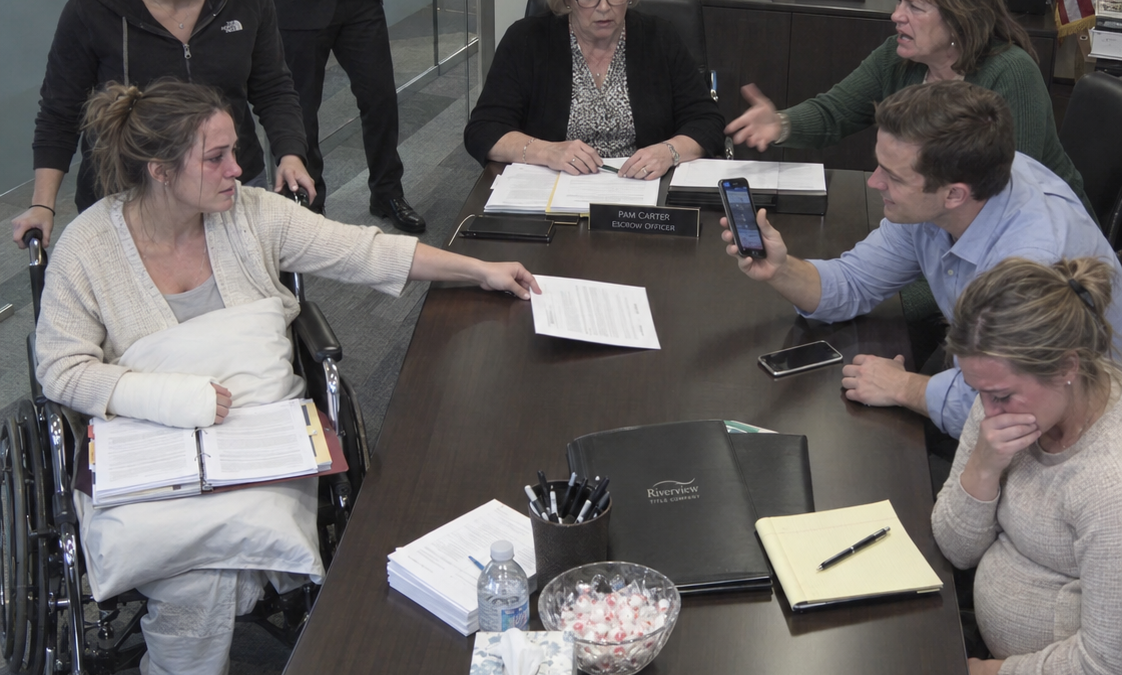
The conference room had glass walls. A long table stood in the center, with a bowl of wrapped peppermints in the middle. In front of the chair at the head of the table was a stack of closing documents, yellow signature flags sticking out of them like little tongues.
Joan took the head chair.
Kyle and Tessa sat on one side, my mother and father beside them. The seller’s agent stood near the door with her phone.
Danny pushed me to the opposite end of the table, across from Joan, then stood behind my wheelchair with her hands resting on the grips.
The room smelled like coffee and printer toner.
Joan folded her hands.
“Miss Puit,” she said, “I’ll be honest with you so we don’t waste each other’s time. The lender has reviewed this file. They’ve accepted a sworn affidavit from your mother stating that the funds in that joint account belong to her. Joint owners are entitled to withdraw from joint accounts. Unless you can show me that these funds were not hers to give, I’m inclined to proceed.”
I opened the binder.
I handed her Exhibit A first.
Eight years of statements. Every deposit from every transcript I’d ever typed had gone into that savings account, with my name and only my name printed at the top.
Then Exhibit B, showing the two transfers at 2:14 and 2:16 in the morning from my personal account into the joint account.
Then Exhibit C, my ICU sedation score at two in the morning.
Then Exhibit D, the belongings log bearing my brother’s signature.
I didn’t say much.
I simply turned the binder around and slid it toward Joan, one tab at a time, and let her read.
In my work, you learn that the record is louder than you are.
Joan read slowly. She put on her glasses.
“It went into my account,” my mother said. “I’m allowed. The bank told me I was allowed.”
“Then why,” I asked, “did the lender need my signature?”
I handed Joan Exhibit F, the sealed envelope with Joy’s signature across the flap and the date and time written beneath it.
Joan took a letter opener from the cup on the table and carefully opened the envelope.
She unfolded the gift letter and read it.
Donor: Hannah Puit.
Relationship: Sister.
Amount: $46,000.
No repayment expected.
Then she looked over the tops of her glasses at my brother.
“This is your handwriting.”
“Underwriting wanted both names on it,” Kyle replied. “That’s just paperwork.”
“If the funds belonged solely to your mother,” Joan asked, “why would underwriting need a gift letter from your sister?”
Nobody answered.
The seller’s agent stopped typing on her phone.
Then my brother did the thing he’d apparently come prepared to do.
He reached into the pocket of his blue shirt, took out a phone, and placed it on the table. He turned it around so Joan could see the screen.
It was my phone.
My old phone, still inside the case with little sunflowers on it that Danny had given me for Christmas.
He’d kept it charged.
It was connected to somebody’s Wi-Fi.
He opened my text messages, tapped one, and pushed the phone across the table toward Joan.
“She confirmed it herself,” he said. “The bank sent her a message asking if she authorized the transfers, and she said yes. In writing. Right there.”
He looked at me.
“So you can stop with the binder, Han.”
I didn’t look at Kyle.
I looked at Joan.
“Would you read the time on that message out loud, please?”
Joan leaned forward.
“Friday, October twenty-sixth. Four fifty-one p.m.”
I turned to the tab marked G and slid the binder toward her one last time.
Officer Tran’s report. Fort Wayne Police Department.
Statement taken in Room 622 at Lakemon Regional Medical Center, from 4:30 p.m. to 5:15 p.m. on Friday, October 26.
And the line I’d asked him to write, using my own voice, before I knew why I would need it.
Victim does not currently have possession of her phone. States phone taken by brother Kyle Puit.
“At 4:51 on Friday,” I said, “I was answering a police officer’s questions in a hospital bed. I didn’t have my phone. My brother had it.”
Then I said the last part quietly because it didn’t need to be loud.
“That’s my phone you’re holding up, Kyle. You just showed a title officer that you still have it.”
Nobody moved.
I heard the heater click on somewhere in the ceiling.
Tessa turned toward her husband, and I watched her understand something all at once, the way you watch a witness on the stand hear their own story told back to them by someone else.
Joan removed her glasses.
She closed the binder gently and laid her hand flat on top of it.
“Three Rivers will not disburse disputed funds,” she said. “I’m going to hold the $46,000 in our escrow account until the parties reach a written agreement or until there’s a court order telling me where it goes.”
She paused.
“I’m sorry. This closing can’t go forward today.”
“Excuse me,” the seller’s agent said.
She walked out of the room with her phone already against her ear.
That’s when Kyle broke.
He came around the end of the table so fast that his chair toppled behind him. He grabbed the binder from the tabletop, then reached for the loose papers in my lap, the copies.
Danny lunged forward and caught the edge of the binder.
She held on.
They pulled against each other.
The metal rings snapped open.
Pages scattered across the table and onto the carpet, sliding beneath chairs.
I saw the ICU flowsheet, Exhibit C, skidding toward the edge of the table near Kyle’s hand.
That was the page I needed more than anything.
I didn’t think.
I put my good hand on the arm of the wheelchair and stood up.
I’d been told not to do that.
I did it anyway.
I got my feet beneath me, reached across the table, and caught the page. My fingers closed around it.
Then my brother put both hands flat against my chest and shoved me.
He shoved me directly against the ribs that were broken.
The pain was so enormous that I didn’t feel myself fall. I only knew that suddenly I was back in the wheelchair, which had rolled backward with me and slammed into the glass wall with a sound like a door being kicked.
The glass held.
I didn’t know if I had.
I couldn’t draw a breath.
Something warm and wet was spreading beneath my shirt again.
And then my father stood up.
I have to tell you this part exactly right because I’d never seen anything like it before, and I’ve never seen anything like it since.
In thirty-three years, I had never once seen my father get out of a chair to stop anything.
He was a man who cut his meat and let things happen around him.
But he stood up from that conference table.
He went around behind my brother, took Kyle by both arms from behind, and pulled him away from me.
Kyle fought him, twisting against his grip, but my father held on. He walked my brother backward and pushed him down hard into Joan’s empty chair.
Then he kept both hands on Kyle’s shoulders.
“Sit down, son,” he said.
His voice was shaking.
“Sit down. Sit down.”
My mother didn’t go to Kyle.
She came toward me.
She stood over my wheelchair, her face red and twisted, and screamed. Really screamed, the way I hadn’t heard her scream since I was a teenager.
“Look what you’re doing to him on his closing day! Look what you’re doing to your brother!”
I had one hand pressed against my stomach.
I could feel the blood.
The page from my medical chart was crumpled inside my other fist.
I looked up at my mother, standing there in the green sweater I’d bought her.
“You did this on my surgery night,” I said.
She stopped for a moment, as though she’d run into a wall she hadn’t known was there.
Then I turned to Joan, who was standing now with her phone in her hand, and said the hardest thing I’d said that entire week.
Harder than no.
Harder than setting off the bed alarm.
“Please call 911,” I said. “He just assaulted me in front of five people. I need it in the record.”
Joan dialed.
The police arrived nine minutes later.
Two patrol officers.
Everyone in that conference room was a witness, and nobody, not even my mother, said it hadn’t happened.
They put my brother in handcuffs in the waiting area of a title company, beneath a framed print of a covered bridge, while Tessa cried in a chair beside the wall nearest the eyebrow-threading business.
I asked one of the officers to take my old phone as evidence and to write in his report that Kyle had brought it into the meeting.
He did.
He also called Detective Bell, who called me back while Danny was still helping me into her car. His voice sounded very different from the way it had sounded Friday.
He told me he’d be talking to my brother that day.
My mother didn’t follow us to the hospital.
She followed the police car.
My father walked out into the parking lot.
He stood at the curb in his good brown jacket while Danny buckled me into the passenger seat, his hands hanging at his sides.
Through the car window, I watched him lift one hand halfway.
Not exactly a wave.
Not a call.
Just a hand raised into the cold air, like a man who had forgotten what he meant to do with it.
Then Danny pulled out of the lot.
I watched him grow smaller in the side mirror until we turned onto Coliseum Boulevard.
In the emergency room at Lakemon, they cleaned the wound and discovered that one staple had torn through the skin.
They closed it again and started me on antibiotics because I didn’t have a spleen.
The emergency room doctor, a young woman with a ponytail, looked at my chart, my cast, and my bruised ribs.
“Miss Puit,” she said, “I really need you to stop letting people knock you down.”
Danny laughed.
A big, startled, honking laugh, right there in the curtained treatment bay.
Then she covered her face with both hands and cried for the first time in front of me since Tuesday night.
I’d never seen her cry like that.
I held her hand with my good one and let her.
When she finished, she wiped her face with the sleeve of her coat, looked at me, and said, “So, the spare room?”
“Yes,” I said. “The spare room.”
I spent the next five weeks in Danny’s spare room in Indianapolis.
It was painted pale yellow, with a window overlooking her neighbor’s maple tree, which was turning the color of fire.
Danny’s mother, Mrs. Okafor, came over three times a week carrying soup in large plastic containers. She told me I was too thin and that I needed to eat to build my blood back up.
Danny’s cousin Amika came one Saturday with a drill and installed grab bars in the bathroom without being asked. Her other cousin, Tou, drove me to follow-up appointments whenever Danny was working at the salon.
I’d spent my entire life being the person who showed up for other people.
I didn’t know how to be the person other people showed up for.
I had to learn it slowly, the same way I was learning how to stand up again.
The legal part moved once it started moving.
I’ll tell you what I know and how I know it.
Detective Bell interviewed my brother the afternoon of the closing, while Kyle was still in custody on the battery charge from the title company.
Bell told me later, during a phone call, that Kyle had held out for about forty minutes. Then Bell showed him Officer Tran’s report from Friday, with the times clearly recorded, and Kyle lowered his head onto the table.
He said our mother had told him to get my phone.
He said she’d said the words at her own kitchen table Wednesday night, after the hospital called to tell her I’d been taken off the breathing tube.
“Get her phone before the check deadline.”
Then she’d said, “She’ll be fine. She always lands on her feet.”
When Bell interviewed my father, my father said the same thing.
He said he’d been standing at the sink when she said it. He’d heard her, hadn’t said anything, and had been thinking about that moment ever since.
The county prosecutor charged Kyle with theft for taking my money and unlawfully accessing my phone and bank accounts, along with two counts of battery.
One for what he’d done to Danny in the ICU.
One for what he’d done to me at Three Rivers.
My mother was not charged.
The prosecutor’s office said that was a matter of discretion and that my mother had acted on an account she legally owned.
Her name was in the file.
Her words, as my brother had repeated them, were in the file.
That was going to have to be enough.
I’ve decided it is.
Kyle and Tessa lost the house.
The seller kept their $5,000 earnest money deposit and sold the place with the porch swing to somebody else before Thanksgiving.
Tessa moved in with her mother in Wabash for a while. I heard that from my father later.
And my mother started texting.
She never called. She just sent texts, a long chain of them over three weeks, to the new number she wasn’t supposed to have.
They started out angry.
Tessa cried for two days. I hope you’re proud of yourself.
Then they turned cold.
You’re out of the will if that’s what you’re after.
I’m not sure what she thought I was after.
Then they became soft and pleading again.
All you have to do is sign a statement that it was a gift and all of this goes away.
He’s your brother, Hannah. He has a baby coming.
You’re the one who always fixes things.
I didn’t answer any of them.
I saved every one.
The last text came on a Wednesday night in early December.
Your father and I are coming to your apartment on Saturday at noon. We are going to talk about this as a family. You WILL open the door.
She’d written the word WILL in capital letters.
I read that message for a long time.
Then I called my landlord, Mr. Hoveramp.
My doctor cleared me to drive on the Monday before that Saturday, five and a half weeks after the crash.
On Saturday, December 8, Danny and her two cousins met me at my apartment in Fort Wayne at six in the morning with a rented moving truck.
By 10:30, everything I owned was in the back of it.
The stenotype machine went in first, wrapped in two blankets.
The old, high bed went to the dental hygienist from the office downstairs, who said she’d always wanted one like it.
I swept the floors. I wiped down the inside of the refrigerator.
I took the empty magnet off the refrigerator door and put it in my coat pocket.
At 10:30, I gave Mr. Hoveramp both sets of keys.
He shook my hand and said he was sorry to lose a good tenant. Then he told me he’d say to anyone who came looking that I’d moved and hadn’t left a forwarding address.
He said it as though he’d decided it entirely on his own.
I think he had.
Danny and her cousins drove the truck south toward Indianapolis.
I got into my car.
It was a used Honda I’d bought in November with insurance money. I hadn’t driven it farther than the grocery store yet.
I sat behind the wheel for a while, both hands resting on it, my left wrist still a little stiff from the cast.
It had started to drizzle.
I watched the raindrops collect on the windshield and thought about State Road 9, about headlights appearing where they shouldn’t have been.
My hands were shaking.
I turned the key anyway.
Then I drove to Huntington.
I parked at the end of my parents’ street behind a neighbor’s pickup at 11:20.
At 11:24, the garage door opened.
My parents’ tan Buick backed out of the driveway and turned left toward the highway, toward Fort Wayne, toward an apartment where nobody was going to open the door.
I watched them go.
My mother was in the passenger seat. I could see the shape of her hair through the back window.
I still had my key to their house, the one she’d given me when I was sixteen, hanging on a ring with a little plastic letter H.
I let myself in through the side door, the way I’d done ten thousand times.
The house smelled the way it always smelled in December.
Apple-cinnamon candles, coffee, and furniture polish.
In the living room, on the shelf above the television, there was a new framed photograph.
Kyle and Tessa stood in front of the house in Rowan Oak, the one with the porch swing. They were both smiling, his arm around her.
The picture must have been taken before the closing.
Nobody had taken it down.
I looked along the shelf.
There were pictures of Kyle in his baseball uniform, Kyle at graduation, Kyle on his wedding day.
The last picture of me on that shelf was from my high school graduation.
I was eighteen in it.
I was thirty-three now.
I went into the kitchen.
I placed an envelope on the oak table, directly over the round black burn I’d made when I was twelve.
Then I set my key to their house on top of the envelope, the little plastic H facing upward.
I stood there for a minute.
I didn’t sit down.
I didn’t cry.
I’d already done that in a hospital bed, in small breaths.
Then I walked out through the side door, locked it behind me using the button on the knob, and drove south through the rain toward Indianapolis.
I’d written that letter three times.
I tore up the first two versions because both of them contained the word why, and I’d finally realized that I didn’t need to ask my mother why anymore.
I’d heard every reason she had.
So the third time, I wrote it the only way I truly know how to write anything.
I wrote it like a transcript.
I’ll read it to you now exactly the way it was written, because that was the point.
For the record.
Tuesday, October 23.
9:58 p.m. I texted Danny that the roads were bad.
11:20 p.m. I arrived at Lakemon Regional by helicopter.
11:41 p.m. A nurse called you and told you I might not survive surgery. You asked if I was awake. You said, and I am quoting the hospital’s record, “Just call when she’s out.”
12:58 a.m. My heart stopped on the operating table. It stayed stopped for 94 seconds. Nobody called you because you had asked them to call when I was out.
1:35 a.m. Danny arrived. She drove two hours in the rain.
Thursday, October 25.
2:14 a.m. Kyle held my thumb on my phone while I was unconscious and moved $46,200 out of my account.
9:06 a.m. You signed for the check.
I have removed you as my emergency contact. My hospital, my doctors, my insurance company, my employer, and the state of Indiana now have Danny Okafor’s name.
If anyone ever calls this house about me again, it is a mistake.
You do not have to come.
You never did.
Hannah.
End of record.
I learned what happened in that kitchen three weeks later from a letter.
It arrived at Danny’s address in my father’s square, careful handwriting, which I hadn’t seen since he used to sign my report cards.
He’d gotten the address from the court papers.
It was the first letter my father had ever written to me.
He told me they’d gone to my apartment that Saturday at noon, just as my mother had said they would.
They knocked for ten minutes.
My mother called through the door, insisting that she knew I was inside.
Then Mr. Hoveramp came up the stairs and told them I’d moved out that morning without leaving a forwarding address.
My father wrote that my mother had stood in the hallway for a long time without saying anything.
Then she’d said, “She’ll come crawling back by Christmas.”
And they’d driven home.
They came in through the garage.
My mother went into the kitchen first and saw the envelope lying on the oak table, with the key bearing the little H resting on top.
She recognized the key.
She opened the envelope while she was still standing, still wearing her coat.
My father wrote that she began reading the letter aloud under her breath, the way she reads recipes.
Then she reached the line about ninety-four seconds.
She stopped reading aloud.
And her knees went.
That’s how my father put it.
Her knees went.
She sat down on the kitchen floor, right there in her coat, with the paper still in her hand.
“They didn’t tell me,” she said. “Nobody told me.”
My father wrote, I told her she never asked.
He wrote that he’d told Detective Bell the truth and that he’d told Pastor Dale the truth before my mother could tell it her way.
He wrote that he was sorry for thirty-three years of sitting at that kitchen table cutting his meat.
He wrote that he wasn’t asking me to come home.
He just wanted me to know he’d seen the record, too.
And that he believed it.
I read that letter on Danny’s front porch with a blanket wrapped around my shoulders.
I’d thought I might feel something like winning when I finally knew my mother understood.
I didn’t.
What I felt was a kind of clean sadness, like the feeling after a fever breaks, when you’re weak and empty and everything in the room looks very clear.
She had finally heard me.
She’d heard me five weeks and ninety-four seconds too late.
The rest came the way these things come, in pieces, over the following year.
In June, a judge ordered Three Rivers Title Company to release the $46,000 in its escrow account back to me.
I had to pay a lawyer to obtain that order, almost $3,000, and the court ordered Kyle to reimburse me as part of his sentence.
There was still a little over $400 in the joint account at the credit union. My old $212, plus what remained after my mother’s withdrawal.
I walked into a branch in Indianapolis with my new ID and closed the account.
The teller asked whether I wanted to transfer the remaining balance to another account.
“Yes,” I said. “Mine.”
Kyle pleaded guilty to theft and one count of battery.
He received two years of probation, restitution, and a court order requiring him to stay away from both Danny and me.
He and Tessa now live in a two-bedroom apartment in Wabash.
Their daughter was born in January.
Her name is Ivy.
I sent a little set of baby clothes through my father. They were yellow, with ducks on them.
No card.
I didn’t know what a card should say.
I still don’t.
My mother left the church choir that spring. I’m told it was her own decision.
She has written me two letters.
I read the first one. It said she was sorry I felt the way I felt.
I didn’t open the second.
The air ambulance company sent me a statement for $52,000, with the words This Is Not a Bill printed across the top.
It turned out there was a federal law protecting insured patients from surprise bills like that. My insurance handled it, and I paid what I would have paid if the flight had been in network.
I thought about calling my mother to tell her she didn’t need to worry about the helicopter after all.
I didn’t.
I don’t have a spleen.
I get extra vaccinations, and I carry a small medical card in my wallet explaining that. If I run a fever, I go to the doctor that day instead of waiting.
I have a scar running from my breastbone to below my belly button, with a little pucker near the bottom where the staples tore twice.
My left wrist aches when it’s going to rain.
I can tell you a storm is coming a full day before the weather forecast does.
And in August, I bought a house.
A small one in Irvington, on the east side of Indianapolis, eleven minutes from Danny’s place.
Two bedrooms. A kitchen with a window over the sink. And a porch.
No swing.
I bought it with my own house fund, the money I’d saved for eight years, plus what I’d earned working that summer.
I signed my own closing papers at a table where nobody was pressing my hand.
That same week, I wrote a postcard to my father.
There was a picture of the Indianapolis skyline on the front.
On the back, I wrote, Thank you for holding him.
I signed it H.
I didn’t send one to my mother.
One night in September, almost a year after the crash, my phone rang at 11:40.
It was Danny.
She’d been driving home from her cousin’s wedding up north when her car broke down on the shoulder of Interstate 65, somewhere past Lafayette.
It was raining.
Her phone battery was at six percent.
She was standing beneath the awning of a closed gas station, and she sounded embarrassed, the same way she’d sounded when we were nineteen.
“I’ll come get you,” I said.
It took me an hour and fifty minutes.
The rain fell so heavily that trucks threw sheets of water across my windshield. Twice I had to slow almost to a stop because I couldn’t see the lines on the road.
My wrist ached the entire way.
My hands shook slightly on the steering wheel.
I drove anyway.
When I finally pulled beneath the gas station awning, Danny was standing there soaked through, her hair flattened against her head. The little white scar cutting through her eyebrow shone beneath the lights.
She climbed into the passenger seat and started to apologize.
“Don’t you dare,” I said.
She laughed.
She fell asleep before we reached Indianapolis, sitting upright in her wet coat, her hood still dark from the rain.
Her hand ended up resting near mine on the center console.
Not holding it.
Just near it.
The way you leave a light on in a hallway for somebody.
While she slept, I thought about the little card in my wallet, the one beneath the medical card about my spleen.
The emergency contact card.
It says Danny Okafor now.
And I know, because she showed me once, that there’s a card in Danny’s wallet with my name on it.
We pulled up to my house a little after three in the morning.
The porch light was on.
I’d left it on when I went out because I knew I’d be coming home, and I knew who I’d be bringing with me.
That’s what I know about family now.
It isn’t the people who are told.








