I walked into the showroom where my son-in-law worked, and he laughed: “security, get this old man out of here! he thinks this is a bus stop!”. his colleagues gathered around, looking at me like a pathetic beggar. i didn’t get angry. i looked him dead in the eye and said, calmly: “i own this building. you’re the one who’s leaving.”
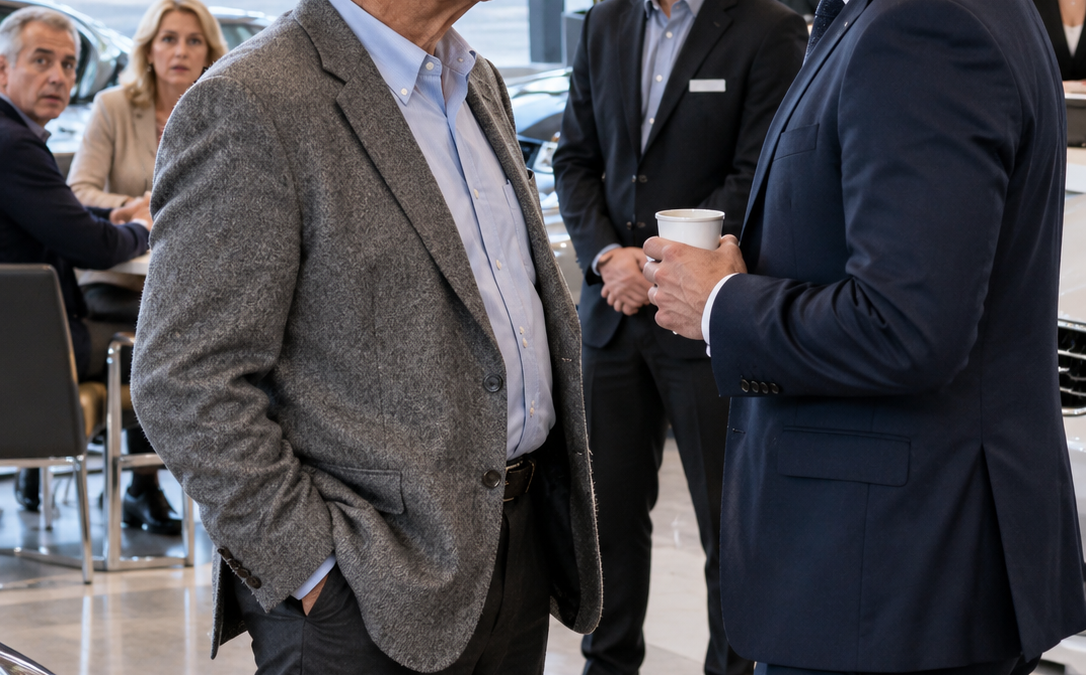
My son-in-law told a young employee in a suit to walk me out of the showroom. He said it loudly, right in the middle of the display floor on a Saturday morning, in front of more than a dozen people.
“Get that old man out of here. He keeps standing around making customers think this showroom is handing out charity.”
I didn’t say a word back, because there was one thing he had absolutely no idea about. The land he was standing on belonged to me. Not part of it. All twelve and a half acres.
The ironic part is that, for six years, I had let him believe I was just an old man who wasn’t worth paying attention to. And I have to admit, I used to enjoy it. I liked walking into the bank in an old coat. I liked driving a truck with hundreds of thousands of miles on it. I liked watching men like him size me up by my clothes and then decide, with complete confidence, that they had me figured out.
But this story doesn’t really start on the morning he threw me out of that showroom. It started months earlier, with a phone call that showed me the life my daughter had been hiding. And the deeper I looked, the more I had to face something much harder to accept. My son-in-law’s arrogance wasn’t just because he looked down on me. He was hiding something else, something serious enough to make me look at my own family in a completely different way.
In the end, I had to ask myself a question I had never dared to ask in all those years. Was I silent because I was humble, or because I liked watching people get me wrong?
My name is Emile Petrosian. I’m sixty-seven years old. My parents brought me to Pittsburgh from Beirut in 1969, and my father worked twenty-two years for a linen service on the South Side. I graduated from Carrick High School with a C-minus average and no plan whatsoever. In 1983, I bought a coin laundry on Brownsville Road for $11,000. It was a disaster, and I ran it for four years without a day off.
By 2019, I had twenty-six of them. Coin laundries all over Allegheny County and out into Westmoreland. Carrick, Beechview, Wilkinsburg, Braddock, McKees Rocks, Monessen. Nobody puts a laundromat in a nice neighborhood, and I want you to sit with that for a second, because it’s the whole business. You put them where people don’t have washers, which means you spend your working life in exactly the parts of a city that people like my son-in-law drive around.
I sold twenty-five of them in 2023 to an operator out of Columbus. Twenty-two million dollars. I kept one, and I’ll tell you why later.
Now, the money. You’re going to want to know why nobody knew, and I’m going to give you the real answer, not the flattering one. I told myself it was privacy. I told myself it was because my wife and I were raised by people who thought talking about money was a form of showing your throat. That’s about forty percent true. The other sixty percent is that I liked it.
I liked being the guy in the room nobody bothered to look at twice. I liked walking into a bank in a windbreaker. I liked watching a commercial broker talk down to me for eleven minutes and then handing him a number that shut his mouth. Forty years of that, and it becomes a taste in your mouth you go looking for.
That’s not humility. I want to be extremely clear about that, because I spent about a year believing I was the humble one in this story. A man who lets you be wrong about him and keeps score is not humble. He’s just quiet about his contempt. More on that later, because it’s the whole point.
My wife was Anahit. Anie. Thirty-four years. She did the books for all twenty-six stores from a folding table in our basement in Brentwood, using paper and pencil until 2011, when our daughter made her use a computer. Anie complained about that computer for a decade.
She died on February 14, 2018, on the floor of store number one on Brownsville Road, at 6:40 in the morning. Alone. Doing the thing she had done nearly every morning for thirty-five years, which was to unlock the door, turn on the lights, and start the first load in the big machine so the place smelled right when people came in. Heart attack.
The man who found her at 7:10 was a regular named Dev, who had been coming to that store since 1994. He sat on the floor next to her and held her hand until the paramedics came, and I have never in my life been able to repay that. I got there at 7:30. I’m not going to describe it.
My daughter is Sona. She’s thirty-six. She was going to be an architect. Two years into the program at Carnegie Mellon, she had a model of a transit shelter on our dining room table for four months that I was not allowed to touch. I have never been prouder of anything in my life, including twenty-six stores.
She didn’t finish. She married Bram Sedwick in 2013, and she didn’t finish.
Bram is thirty-nine. He’s the general manager of a European car dealership out on the boulevard, the kind with the glass tower and the espresso machine in the lounge. He’s been in car sales since he was twenty-three, and he is objectively extremely good at it.
I want to say something now that a lot of people are going to skip past, so I’ll say it plainly. I liked Bram. For the first three years, I liked him a great deal. He came to Anie’s funeral early and stayed late, and he handled the parking, which sounds like nothing and is not nothing. He drove out to Monessen at eleven at night in 2016 when a machine flooded store nineteen, and he mopped for two hours in a good shirt.
Whatever he turned into, he wasn’t born that way. And if I let you think he was, this whole story is worth nothing.
Now, the grandchildren. Arv is eleven. That’s an Armenian name. It means sun, and it was Anie’s mother’s name. Bram fought that one and lost, which I always respected Sona for. Tigran is seven. Everybody calls him Tig.
Fourteen months before that Saturday in the showroom, I stopped being allowed to see them. Not with an announcement. That’s not how it works. If you’ve been frozen out of a family, you know it never comes with a letter. It came as a series of Saturdays.
First it was, “This weekend’s bad. We’ve got a thing.”
Then it was, “We’re doing more structured weekends now. The kids need routine.”
Then it was Sona not answering until Tuesday. Then it was Bram calling me, Bram, not Sona, to say that they had decided, as parents, to be more intentional about who was in the kids’ lives on a regular basis.
Intentional about who was in the kids’ lives. Fourteen months. Two birthdays. A Christmas.
Let me take you to the last dinner I got invited to, because it’s the one I keep in my pocket. October, two years ago. Their house up in Franklin Park, the one with the double doors.
I pulled up in my truck. It’s a 2007 Ford Ranger with 241,000 miles on it and a passenger door that’s a different color because I got clipped in 2015 and never bothered to fix it. I’ve owned that truck for nineteen years. I’ve hauled soap and quarters and dryer motors and my daughter’s furniture in it.
Bram came out onto the driveway before I got to the steps, and he said, pleasantly, smiling the whole time, “Emile, do me a favor. Park down at the corner. We’ve got the HOA guy walking around Thursdays.”
I parked down at the corner. I did it.
That’s the part. I got back in that truck, drove it 140 feet, parked it in front of somebody else’s house, and walked back up the hill. Sixty-five years old, and I did not say one word, because I was enjoying myself.
I want you to understand what was going on in my head, because it was not humiliation. I stood in that driveway and thought, This man just moved a truck belonging to somebody who could buy his house four times without financing anything.
That’s what I was thinking. That’s what I had instead of a spine.
At the table that night, Bram did the thing he always does. He talked about the business, allocation, floor plans, the manufacturer’s targets, and then he said to the whole table, “Emile, you should come by the store sometime. We’ll get you into something that isn’t a hazard.”
And Sona laughed.
That’s the one. Not him. Her.
My daughter, who I taught to drive in that truck in the lot behind store four, laughed at it. Then she looked at her plate, and I watched her decide not to look up. I said nothing about that, either.
If you’ve ever watched somebody you raised become fluent in a language you don’t speak, where the vocabulary is all about what things cost and how they look from the street, you know it doesn’t feel like anger. It feels like grief with nowhere to sit down.
That was the last dinner. Fourteen months.
Here’s how it broke open. It wasn’t a private investigator, and it wasn’t a plan. It was a phone call from a school.
January 19, 10:40 in the morning. A woman named Mrs. Drowski from the front office of the private school in the North Hills where Arv goes.
She said, “Mr. Petrosian, I’m sorry to bother you. You’re listed as an emergency contact for Arv Sedwick. Is that still current?”
I said, “Yes,” and my heart came up into my throat, because when a school calls you at 10:40 in the morning, you assume the worst thing.
“No, no, Arv’s fine. She’s in class,” Mrs. Drowski said. “This is actually a billing matter, and we’ve had trouble reaching the parents. Since you’re on the contact list, I thought I’d try.”
I asked, “What billing matter?”
She got very careful, the way people do when they realize they’re standing on something. She said the account was in arrears for two terms. Then she said the sentence that started everything.
“We’ve already spoken with them about the reenrollment deadline for next year.”
I sat down on my own steps, because I’d been paying attention to the wrong things for fourteen months. I’d been keeping a private ledger of insults like a man collecting stamps. Meanwhile, a school secretary in the North Hills knew more about my granddaughter’s life than I did.
Now, I did something, and I want to describe it accurately, because people hear the word investigate and picture a guy in a car with a camera. I did what I’d done for forty years before buying a building.
When you buy a laundromat, you’re not buying machines. You’re buying a location and the story the seller is telling you about it. That story is always a little bit wrong, and your entire job is to find out how.
You pull the water bill. You pull the electric bill. You count cars in the lot at seven in the morning for a week. You sit across the street and watch.
I did that to my own family, and I’m not going to pretend that’s a wholesome thing to do.
First, the house. Twenty seconds in the public records. Bought in 2019 for $695,000. Two liens on it that I could see, including a second mortgage filed nine months earlier.
Second, the Escalade in his driveway. That’s a lease. I know what a lease looks like on a general manager’s driveway. They all drive lease returns.
Third, I drove out to the school. Not to go in. I sat in the parking lot at 3:10 on a Thursday afternoon in the Ranger, and I watched the children come out.
I saw my granddaughter. Arv came out with her backpack, got into the line, and she was wearing a navy-blue wool coat with toggle closures.
I recognized it.
I want you to understand this properly. I recognized the coat.
Anie bought that coat for Sona at a store in the South Hills in the winter of 2004, when Sona was fifteen. I was there. I remember complaining about the price in the car. Anie kept it the way she kept everything, in a cedar chest, and it went to Sona when Arv got old enough.
Twenty-two years old, that coat. On an eleven-year-old in January in Pittsburgh.
It’s a beautiful coat, and there is nothing wrong with a child wearing her mother’s coat. In a different story, that’s a lovely thing. In this story, her father drives a leased Escalade and takes clients to a steakhouse twice a week.
I sat in that parking lot, put both hands on the steering wheel, and did not move for a long time.
Then I found the rest of it. It took me eleven days.
Some of it was in plain sight. The liens. A judgment from a credit union in Bethel Park. Some of it took a lawyer I’ve used for twenty-five years, named Rosalyn Duta, who asked me twice whether I really wanted to know and then went and found out.
Here’s the shape of it. Roughly $310,000 over about twenty-six months.
Not a woman. I want to say that because it’s what everybody assumes, and it’s what I assumed for about six days.
Sports betting. Online. On his phone.
Two apps I’d seen advertised eleven times during a single football game the week before, with a celebrity in the commercials.
The second mortgage went into it. $110,000 from a credit union went into it. Two personal loans went into it. His 401(k) had been drawn down twice, with penalties.
And there was one line Rosalyn found that made me actually put the paper down. A $19,000 advance against a commission plan his employer was carrying.
That meant the dealership knew he was underwater, at least a little.
Here’s where I have to be fair to a man I do not like, and it’s the hardest part of this for me. I understood him, because I finally understood the driveway.
I understood the HOA comment and the truck and the crack about getting me into something that wasn’t a hazard. That was not a rich man being contemptuous of a poor one.
That was a man who was three payments away from the whole thing coming apart, standing in a driveway he didn’t own, terrified that a rusted Ranger parked in front of his house was going to be the thing that gave him away.
Every single insult that man ever handed me was noise he was making to cover the sound of himself drowning.
That does not excuse it. Not one syllable of it. He put my granddaughter in a twenty-two-year-old coat and froze her grandfather out of her life, and he did it while losing $300,000 on a telephone.
But I understood him, and understanding him ruined the version of this story where I got to feel good.
Now let me tell you about the building, because the timing of this is either the funniest or the ugliest thing that’s ever happened to me, and I still can’t decide.
When I sold the stores in 2023, I did not buy stocks. I don’t understand stocks. I understand a roof, a parking lot, and a tenant who signs for fifteen years. So I put most of the money into net-leased commercial property.
In May of that year, I bought a package of four parcels in the Pittsburgh market from a fund that was liquidating sale-leaseback properties. A distribution building in Findlay, a grocery-anchored strip center in Ross, a vacant pad, and a car dealership out on the boulevard.
Twelve and a half acres. Building and improvements. A triple-net lease running to 2041, with a corporate guarantee from the dealer group.
I did not know. I want to say that as clearly as I can say anything. I did not know it was his store.
I bought a rent roll. I looked at the guarantor, which was a holding company with eleven rooftops in three states, and I looked at the coverage ratio, and I signed.
It was eight months later, sitting at my kitchen table with Rosalyn’s file open, that I put a lease abstract next to a page about my son-in-law’s employer and read the same corporate name twice.
I sat there for a while, because here’s what that meant.
I was his landlord’s landlord. Not his boss. Better than his boss.
The dealer group pays me $29,000 a month. There’s a purchase option in that lease in 2031 that I control. Every principal in that group knows my name and has met me on a video call, and they had all been extremely polite to me for eight months.
And their general manager on the boulevard had made me move my truck.
I’m going to be honest with you about the next four days, because I think it’s the only useful thing in this whole story.
For four days, I was a bad man.
I built it in my head. I built the whole thing. I knew exactly which Saturday. I knew what I’d wear. I knew which of the group’s principals I’d call and when. I ran it maybe two hundred times while lying in a recliner in Brentwood.
On the fourth night, I got up at two in the morning, went into the kitchen, and stood there. I heard my wife. Not literally. I’m not that guy. But I heard her the way you hear people who ran your life for thirty-four years.
Because there was a thing Anie had a rule about, and here’s the flashback I owe you.
In the eighties and nineties, people stole from us constantly. Coin boxes. It’s a cash business in poor neighborhoods. It’s what happens.
In 1991, I caught a kid, sixteen or seventeen, with a screwdriver in the coin box at the Beechview store at eleven at night. I grabbed him by the collar, and I had him, and I was going to make an example of him.
That was my exact phrase to Anie in the car. Make an example.
She said, “Emile, what do you want?”
I said, “I want him to know he can’t do that.”
She said, “No. What do you want? Say the actual thing.”
I couldn’t answer her, because the actual thing I wanted was to feel big in front of somebody who’d made me feel small.
Anie looked at me and said, “If what you want is your money, take your money. If what you want is a boy scared of you, say that out loud, and then decide if you want to be a man who wanted that.”
We didn’t call the police. He worked it off. He swept and hauled for six weeks.
His name was Dev.
Dev is the man who sat on the floor and held my wife’s hand for thirty-five minutes in 2018.
I want you to sit with that as long as you need to.
So, at two in the morning in my kitchen, thirty-three years later, I asked myself her question.
What do you actually want?
The answer was not, I want Bram Sedwick destroyed on a showroom floor.
The answer was, I want to sit in a kitchen with my granddaughter on a Saturday.
That is all. That is the entire thing I wanted.
And everything I’d built in my head for four days would have made it less likely, not more.
Which is when I made the plan I actually used. It was much less satisfying and much harder.
Now, the Saturday. March 8.
I want to slow all the way down here, because this took about nine minutes, and I’ve gone through it maybe a thousand times.
I did not dress down on purpose. I want to be honest. The old me would have. The old me would have worn the windbreaker like a costume.
I wore a gray sport coat that Anie bought me in 2009 and my regular shoes. I drove the Ranger because that’s my truck, and I wasn’t making a point with it.
I parked in customer parking, front row.
The showroom out there is all glass, two stories. On a Saturday morning in March, there were maybe eleven people. Three salespeople, a woman at the reception podium, a family with a toddler looking at a wagon, an older couple doing paperwork at a desk in the corner, and a kid in a blazer, maybe nineteen, who I think handled deliveries and coffee.
I asked the woman at the podium if Bram Sedwick was in.
“He’s on the floor,” she said, pointing.
“Thank you,” I told her.
Bram was standing near the espresso machine with a coffee, talking to one of his salespeople.
He saw me from about forty feet away, and I watched his face do something I have not been able to stop thinking about.
It wasn’t anger. Not at first.
It was fear. Pure, immediate, uncomplicated fear for about a quarter of a second before anything else got there, because he thought I knew.
He didn’t know what I knew or how. But a man carrying $300,000 of secrets sees every unexpected face as the one that finally found out.
Then he covered it, and the way he covered it was volume.
He came across that floor, and he was loud. I mean loud enough that the family with the toddler turned around.
“Emile, buddy, what are we doing?”
“I’d like ten minutes with you somewhere private,” I said.
He laughed. He did that laugh and looked around the room.
“This is my father-in-law,” he announced, speaking more to the room than to me. “He’s a character.”
Then he turned to the kid in the blazer, pointed with his coffee cup, and said, “Marcus, do me a favor. Walk him out. He’s turned around. He’s looking for the bus.”
That poor kid.
I want to tell you about that kid for a second, because he’s the one I felt for. Nineteen years old, wearing a blazer that didn’t fit, and his general manager had just told him to physically remove a sixty-seven-year-old man in front of customers.
He came about four steps toward me, then stopped. He looked at me and said, very quietly, “Sir, I’m sorry.”
Nineteen years old, and he had more of it than everybody else on that floor combined.
“Son, it’s all right,” I told him. “You stay where you are.”
The room had gone quiet. The older couple at the desk had stopped signing. The salesman near the espresso machine was looking at the floor. It was that specific kind of silence where everybody has decided to become furniture.
Bram was still speaking loudly.
“Emile, I’m not doing this here. You want to talk, you call Sona. You do it the right way.”
“Bram,” I said, “I’m not here as your father-in-law.”
He stared at me. “What?”
“I own this.”
“You own what?”
“The ground you’re standing on. The building, the lot, the pad across the access road. I bought it in May of 2023 in a portfolio from a fund. Your company’s lease runs to 2041, and I hold the purchase option in 2031. I did not know it was your store when I bought it, and I found out eight months ago.”
Nobody moved.
I have never in my life heard a room that size get that quiet. There’s a chime the door makes, and somebody came in during that silence. The chime sounded enormous.
Bram Sedwick stood there holding his coffee.
Here’s what I watched happen on that man’s face over about six seconds. I’ll give it to you in order, because I counted.
First, he didn’t believe me.
Then he did.
I watched him do the arithmetic on eight months of a landlord he’d never met, and it landed. Then he went white. Actually white around the mouth.
His eyes moved to the salesman, to the receptionist, to the older couple, all the way around the room, doing the only calculation he had ever known how to do.
Who saw this?
Then came the last thing.
He looked at me, his chin moved once, and he said very quietly, in a completely different voice, “Please don’t.”
Two words.
That’s my son-in-law. Six years of that man, and I had never heard him say a single true thing until that Saturday morning.
And it was two words.
Please don’t.
That’s when I understood that he had been afraid of me the entire time. Not of my money. He didn’t know about my money. He was afraid of me the way a man is afraid of the one person who might look at his life closely.
“Get your coat,” I said. “We’re going to the diner across the boulevard.”
“I’m the GM. I can’t just—”
“Bram, get your coat.”
Here’s the part everybody wants, and I’m not going to give it to you, because it didn’t happen.
The regional guy did not appear. Nobody got fired on that floor. There was no speech.
I made one phone call about that dealership in my life. It was three days later, and it was to a man named Hollis Tanaka, the group’s chief operating officer.
I did not ask him to fire my son-in-law.
I asked him not to.
I told him what I’d found. All of it. Because the company had $19,000 of exposure to a man with a gambling problem sitting in a building I owned, and not telling him would have been the actual wrong thing.
Then I asked him to hold Bram’s job for ninety days if Bram went to treatment.
Hollis said he’d have to talk to people. Two days later, he said yes.
Now, the diner.
Two hours in a booth.
Bram didn’t touch anything. I laid it out, page by page, the way I’d have laid out a bad profit-and-loss statement for a seller who was lying to me.
The second mortgage. The credit union judgment. The 401(k) withdrawals. The commission advance. The school.
He denied nothing. Not one item.
At about the fifty-minute mark, he put both hands flat on the table and said, “Does Sona know?”
“No,” I said. “And you have until Wednesday.”
“What happens Wednesday?”
“I tell her.”
That was the whole negotiation.
I made him one offer, and I made it once.
“I will pay for thirty days of inpatient treatment, and I’ll pay Arv’s tuition through the end of this school year, directly to the school. That is the last dollar you will ever see from me for the rest of my life. And this offer is good until Wednesday at noon.”
He looked at me, and this is the only time I’ve ever seen a car salesman lose the thread.
“Why would you do that for me?”
“I’m not doing it for you.”
He told her Tuesday night. I know because Sona called me at 11:40, and I sat on the floor of my kitchen with the phone for two hours and forty minutes and mostly listened.
She said one thing during that call that I’m going to carry.
“Papa, I knew.”
Not all of it. Not the number.
But she’d known for over a year that something was wrong. She’d found a statement in June and asked him about it, and she’d accepted his answer.
Then she had stopped looking. Deliberately. Because she could not afford for it to be true.
“And I couldn’t call you because of the driveway,” she said.
I asked, “What driveway?”
“You moved your truck, Papa. He told you to move your truck, and you moved it, and you never said anything.”
I laughed.
I’ve thought about that literally every week since.
“I couldn’t call you after that,” she said. “How do you call somebody after that?”
So there it is.
My silence in that driveway, which I had been so proud of, which I had been savoring like a hard candy, was the thing that told my daughter I wasn’t available.
I thought I was being the bigger man.
What I was actually doing was teaching her that I would absorb anything and say nothing.
And a person who absorbs anything is not somebody you can go to when you’re in trouble.
That’s the whole story. Everything else is furniture.
Now, where things stand, fourteen months on.
Bram went thirty days to a place outside Somerset. He came out and did ninety days of intensive outpatient treatment, and he has, as of last week, 406 days.
He’s still at the store. Hollis kept his word.
He’s not general manager anymore. He’s on the floor selling, which is a demotion worth about $90,000 a year.
Every single dollar of that difference is a consequence he earned.
He and Sona are still married. Barely.
They’re in counseling, and it is not going great. I’d put it at fifty-fifty, and it is not my business. I have said exactly zero words about it to either of them.
Bram and I are not friends. We may never be. But in September, he called me on his own and asked how I’d handled it in 1991 with the kid and the screwdriver, because Sona had told him that story.
We talked for forty minutes. That’s more than I expected.
The tuition, I paid through June, and then I stopped exactly like I said I would.
Sona is paying it now, out of a salary from an architecture firm in the Strip District that took her on last February as a project coordinator at $52,000 a year. Which is not enough, and which she got herself, and which she has told me twice she will not take help with.
She’s going back for the license.
Nine years late. She’ll be forty-five when she finishes.
I have never been prouder of anything, including twenty-six stores.
Arv has a new coat. Her mother bought it. I saw it in November and said nothing about it at all, which is possibly the single greatest act of self-control of my entire life.
I see them Saturdays.
Every Saturday, nine in the morning until whenever.
Tig is learning chess and is bad at it and furious about it.
Last month, Arv asked me why I still go to Brownsville Road on Tuesdays.
Because I kept store number one. I never sold it.
It loses about $4,000 a year, and I go every Tuesday morning at 6:40. I unlock the door, turn on the lights, and start the first load in the big machine so the place smells right when people come in.
Dev still comes. He’s sixty-one now.
I told Arv the truth.
“Your grandmother did this every morning for thirty-five years,” I said. “She died on that floor right there, and this is the only room in the world where I can still hear her.”
Arv looked at me and asked, “Can I come Tuesdays?”
She comes now.
She empties the coin boxes. Eleven years old, and she counts quarters, and she is very, very good at it.
So let me tell you what this actually taught me, because it isn’t what you think.
The lesson is not, don’t judge a man by his truck.
The lesson is that I spent forty years letting people be wrong about me on purpose, and I told myself that was humility.
It was not.
Every time I let somebody talk down to me while I knew the number in my account, I wasn’t being gracious.
I was collecting.
I was running a test I never told anyone they were taking, and I was grading them, and I was enjoying it. The whole time, I thought I was the good man in the room.
That is a kind of contempt. It’s the quiet kind, which is the worst kind because you never have to admit it’s there.
And it cost me fourteen months of my grandchildren’s lives, because a daughter cannot come to a father who has trained her to believe nothing touches him.
So here’s the one thing I’d ask you to do this week, and it’s free, and it’s hard.
Think of one thing you’ve been letting somebody be wrong about. Not a secret that protects you. The kind you’re enjoying. What you make. What you know. What you did. What you could do if you wanted to.
Go correct it out loud. Plainly.
Not to impress them. The opposite.
That’s why it’s hard.
Do it so they can stop guessing about you and start actually talking to you.
Because the people who can’t see you cannot come to you when they’re in trouble.
And somebody in your life is in trouble right now and hasn’t come.
Here’s the question I sit with on Tuesday mornings, mostly with the machines going.
Who am I letting be wrong about me on purpose? And what exactly am I getting out of it?
Because there’s always something.
There is always, always something.
That’s the part I didn’t know at sixty-five, and I know at sixty-seven.
Now tell me something, because I read every one of these.
Comment one if you think I did it right. If you think walking into that showroom and saying it out loud, then calling his boss and asking him to keep the man’s job, was the correct thing.
Comment two if you think I should have let it fall.
Ninety thousand dollars a year and a demotion isn’t nothing, but a man who put a twenty-two-year-old coat on my granddaughter got a hand up from me. There are days I think I was soft.
And comment three if you think the real failure was mine years earlier. That a man who moves his truck 140 feet and says nothing has already lost the argument, and everything after that was just interest on the debt.
That’s the one Sona and I go around on. She’s usually right, and I usually don’t say so until the next Saturday.
Tell me where you’re watching from and what time it is there.
Somebody wrote to me last month that it was eleven at night in Yerevan and they’d been crying, and I sat with that one for a week.
If you’re still out there, thank you.
And if some version of this has happened to you, if you’ve ever been small in a driveway on purpose and called it dignity, put it in the comments.
You will not be the only one down there. Not even close.
If you stayed with me the whole way, hit subscribe before you go. That’s all I’ll ask of you tonight.
There’s a new one every week, and every single one is really the same question underneath, which is what it costs to be the quiet one in the room.
It costs more than people think.
One more thing, and then I’ll let you go.
I’ve been thinking about what a man is actually worth, and I don’t mean the number.
For forty years, I thought the answer was what I’d built.
Twenty-six stores. A rent roll. A truck I didn’t have to replace. A balance nobody could guess at.
I thought carrying all of it quietly made it a better answer.
Then I sat on my kitchen floor at 11:40 at night, listening to my daughter cry into a telephone, and I found out the real one.
What a man is worth is how many people can reach him.
That’s the whole number.
Everything else is inventory.
And there’s a difference between a private man and a hidden one. I did not know that difference until I was sixty-seven years old.
A private man simply doesn’t announce himself.
A hidden man makes sure you get him wrong and then keeps the receipt.
One of those is quiet. The other one is armor.
And armor works. That’s the trouble with it.
It keeps out the insult, and it keeps out your own child.
Here’s the second thing.
I had power over that man for about nine minutes on a showroom floor. Nine minutes after six years of driveways.
I’ll tell you what I learned in them.
You don’t find out what you actually wanted until the day you can finally have it.
Not before. Before that, it’s all theory.
Every plan I made in that recliner was theory, and it was flattering, and it was wrong.
The moment you have the power to take something from a person is the exact moment you find out whether you wanted justice or whether you wanted the sound of him hitting the floor.
Most of us never get tested that clearly.
I did, and I nearly failed it.
The third thing is the one I’d want written down somewhere.
Mercy is not the same as letting it go.
He lost the title. He lost $90,000 a year. He sat in a room outside Somerset for thirty days, and he told the truth out loud to strangers.
Every one of those is a consequence, and I did not lift a finger to soften any of them.
But I asked a man to hold his job.
Those are two separate decisions, and most people only ever make one of them.
They either burn a man down or they wave it off.
Both are easier than what’s actually required, which is to let the weight land on someone and then stay in the room while it does.
And the last one.
Every small silence is a loan.
You take it out against somebody you love, and it charges interest, and the payment comes due at the worst possible hour.
Usually late at night. Usually on a telephone.
I moved my truck 140 feet and said nothing. I thought I’d paid nothing.
It cost me two birthdays and a Christmas.
Nobody is going to stand at my grave and say, “He was badly underestimated, and he never once corrected anybody.”
If I do this right, what they’ll say is much smaller than that.
They’ll say, “I could go to him.”
That’s the whole thing.
That’s what I was building for forty years and didn’t know it, and I almost missed it standing in a driveway, feeling superior about a parking space.
Thanks for sitting with me. Go get some sleep. I’ll see you next time.
This is a fictional story inspired by real emotional experiences, fully rewritten and reimagined in Pittsburgh, Pennsylvania, to create original content. Any resemblance to real people or events is coincidental.








