I walked into divorce court knowing my husband was sleeping with my sister. he demanded our house, my company, even our kids. mom whispered: “don’t ruin your sister’s future. just give him everything he wants.” dad added: “she made 1 mistake. you’ll survive.” i said: “fine.” they all smiled. the judge didn’t.
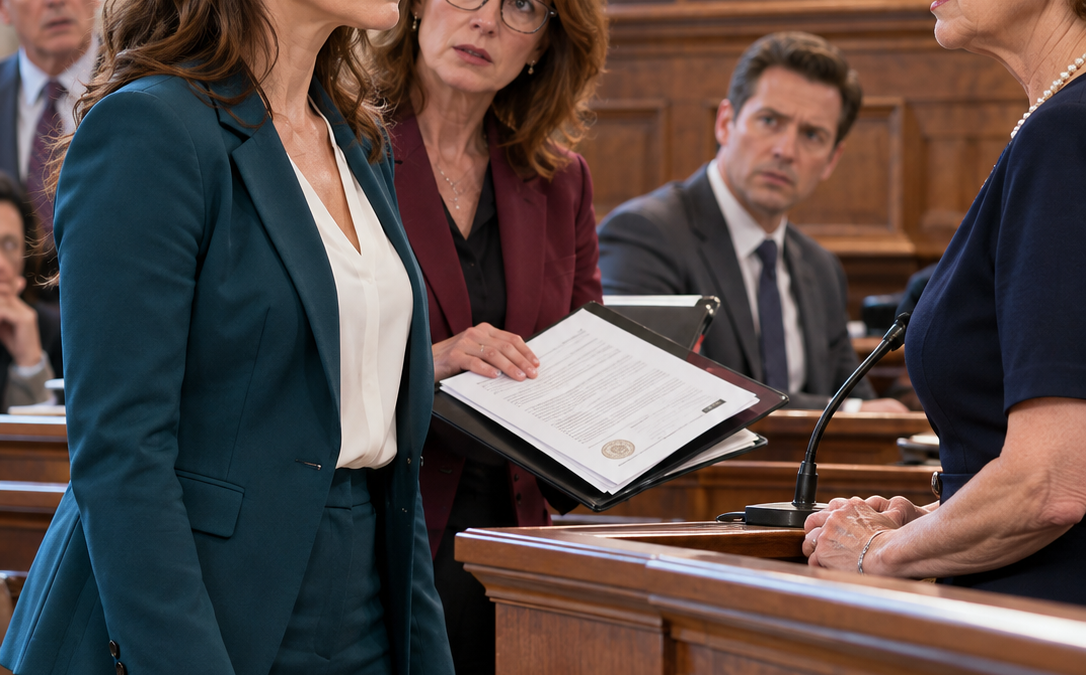
My husband was already seated at the far table when I walked into divorce court that morning, and he didn’t bother to look up. He knew exactly what I had been told to say. For seven weeks, I had known he was sleeping with my sister, and still he sat there flipping through the agreement that would give him my grandmother’s house, half my company, and our two children. My mother caught me at the water fountain outside the courtroom door. She took my wrist, the one that had been bruised in March, and leaned in close.
“Don’t ruin your sister’s future,” she whispered. “Just give him everything he wants.”
My father stood behind her with his hands in his coat pockets. “She made one mistake,” he said. “You’ll survive.”
I looked at the two of them, then at my husband through the open door, and I said the word I had been saying my whole life to end every argument in that family.
“Fine.”
They all smiled. My mother’s shoulders dropped an inch. My father nodded the way he did when a bill got paid. Colin gave me the half smile he used to give me across crowded rooms, back when it meant something.
The judge didn’t smile.
Judge Dileia Marsh turned a page, looked at me over her glasses, and said, “Mrs. Carol, before I sign this, I’m going to ask you some questions.”
Welcome back to Calm Drama Stories. This channel tells first-person stories about families who break the people they were supposed to protect, and about the quiet moment when someone finally stops carrying what was never theirs to carry. If you’ve ever been asked to be the one who gives in, this story is for you. Drop a comment, and be sure to subscribe.
Seven weeks before that hallway, on a Sunday, my mother called my company Colin’s business at her kitchen table, and I let it go.
It was the middle of March, and the kitchen smelled like her pot roast. My mother, Linda, was at the stove. My father, Raymond, was at the head of the table, reading the sports section out loud to nobody. My son, Owen, who was ten, was building something out of dinner rolls. My daughter, June, who was seven, was sitting in my husband’s lap with her head against his chest. June had decided at four that Colin’s lap was the best seat in any room, and I had never once disagreed with her.
“So, how’s the business, Colin?” my mother asked without turning around. “Your father said you picked up that hospital.”
“We did,” Colin said. “Mercy General. Two hundred beds. Every sheet, every towel, every gown. Eve’s crew is running two shifts now.”
“Well, you two are doing something right.”
“It’s Carol Linen, Mom,” I said. “I started it before I met him. He’s been there two years.”
My mother waved a spoon over her shoulder. “Fine, fine. Your business. You know what I mean.”
I did know what she meant. I had known since I was nine and my sister Brooke was three, when the rule in our house became that Eve could handle it. Eve was the strong one. And the strong one in my family was the person who said fine first so everybody else could stop being uncomfortable.
I had said it so many times that it had stopped being a word. It was just the sound of me stepping back.
Brooke came in forty minutes late wearing a camel-colored coat I hadn’t seen before. She kissed everyone but me and sat at the far end of the table without looking in my direction. Brooke was thirty-six and worked the front desk at a spa out by the mall. What I noticed, and then told myself I hadn’t noticed, was that she didn’t look at Colin either. She kept her eyes on the pot roast.
“New coat?” I asked.
“Clearance,” Brooke said, still looking at the food.
After dinner, my mother handed me a dish towel the way she always did and handed Brooke a glass of wine the way she always did. I dried the dishes while my sister told my father about a condominium development going up along the river that was apparently really nice.
We drove home with June asleep in her booster seat and Owen reading by the light of his phone, an old one of mine he’d inherited. At the end of our driveway, I stopped and pulled the mail from the box, just as I did every night.
There was a thick envelope from the credit union, the kind with a window and my name typed inside it. I carried it into the house and left it on my grandmother’s kitchen table without opening it. June was asleep on my shoulder. It was Sunday, and I was tired.
The house had belonged to my grandmother. She left it to me outright when I was twenty-six, before Colin, before the business, before any of it. It was a square brick house with a deep porch and a bathroom she had tiled herself in 1971, one little white hexagon at a time. She used to say a woman should know how to do at least one hard thing with her own hands.
The deed was in my name alone, and it had stayed that way for sixteen years. When Colin and I got married, he had asked lightly whether we should put the house in both our names. My grandmother had been dead four years by then, but I could still hear her as clearly as if she were standing in the hall.
“The house is yours, Evie. Not the marriage’s. Yours.”
So I had said no. I had never refinanced it, never borrowed against it, and never let it touch anything that wasn’t mine.
That night, I carried June upstairs to bed, then lay down next to my husband. He said, “Long day,” kissed my forehead, and was asleep within a minute.
I opened the envelope the next morning over coffee and found my own signature on a line I had never seen before.
It was a welcome letter. The credit union was pleased to inform me that my home equity line of credit had been approved and funded, with a credit limit of $180,000 secured by the property at my grandmother’s address.
Co-borrowers: Eve Carol and Colin Carol.
There was a copy of the signature page. My name was on it in blue ink. It was a good signature. It had the loop in the C that I made, but the E was wrong. I make my E the way my grandmother taught me, with the top bar longer than the bottom. This E was even on both bars, the way a person would write it if they had practiced from a copy but had never actually watched me do it.
I sat there long enough for the coffee to go cold. Then I called the number on the letter and asked a very patient woman named Denise to tell me what I had done.
She told me the line had been opened on February 12. She told me that, of the $180,000 available, $161,000 had already been drawn. And when I asked where the money had gone, she told me the draws had been transferred to an account in Colin’s name.
“Ma’am, is there a problem with the account?”
“I don’t know yet,” I said. “I’ll call you back.”
I did not call my husband. I drove to the plant.
Teresa Bako had been my operations manager for eleven years and my friend for about eleven years and one week, which was how long it had taken her to tell me my pricing on the hotel account was a disaster. She was forty-eight, sharp as a tack, and she had access to the company’s bank accounts because somebody had to be able to see the money when I was out running a route.
I put the welcome letter on her desk. She read it twice, looked at me, and said, “Where did it go?”
“His account. I want to see ours.”
She pulled up the operating account.
Carol Linen ran about $300,000 a month through that account, money coming in and going out for payroll, chemicals, gas, and the loan on the new ironer. Colin had signing authority. I had given it to him myself two years earlier, the week he quit the restaurant supply company and came to work for me.
Because that was what you did when your husband joined the business. You didn’t make him ask you for a check.
Teresa scrolled through the transactions. Over the previous two months, there had been four transfers out, each between $8,000 and $15,000, to an account labeled CO. There was also a wire transfer from three weeks earlier, for $22,000, sent to a title company.
The memo line read: Riverline Condominiums, Unit 304, earnest money.
“Riverline,” I said. “That’s the development on the river. My sister was talking about it last night.”
Teresa didn’t say anything. She was a good enough friend not to say anything.
I called Colin then. He picked up on the second ring, cheerful, riding in the truck with the radio playing in the background. I told him I had received a letter from the credit union.
There was a pause about half a second too long.
“Okay,” he said. “Yeah, I was going to tell you. It’s working capital, Eve. The hospital ramp-up ate us alive on chemicals, and I didn’t want to scare you. I put it in my account so it wouldn’t get mixed up with payroll. I was going to walk you through it this weekend.”
“You signed my name.”
“I signed for both of us. It’s a joint line. You were slammed, and I had a window with the loan officer, and I figured—”
“Colin, I’m looking at an earnest-money wire to Riverline Condominiums.”
The radio went off.
“Where are you?”
“Where are you?”
“I’m on the road. I’ll be home at six. Don’t do anything crazy, okay? We’ll sit down.”
I should have called a lawyer right then. I know that. I had a lawyer’s number in my phone from when we incorporated, and I had Teresa standing next to me, and I had a letter in my hand that was evidence of a crime.
What I had instead, beneath all of that, was my grandmother’s bathroom floor, one white hexagon at a time, and the sound of my husband’s voice saying, “Don’t do anything crazy,” as though I were the one who had done something wrong.
I looked up Riverline Condominiums. It was fifteen minutes from the plant. I told Teresa to hold down the fort, got into my car, and drove.
Riverline was three stories of gray siding and black window frames, with a sign out front promising modern riverside living. Colin’s truck was parked in a space marked 304. I sat in my car and stared at it for maybe a minute.
Then I went in through a door somebody had propped open with a rock, climbed the stairs, and stood in front of a door with a brass 304 on it. There was a welcome mat still wrapped in plastic.
I knocked.
I did not know yet what I was going to see. I want to be honest about that. Part of me still thought I would find a half-furnished unit and my husband sitting there with a spreadsheet and an explanation that would make me feel stupid for driving over.
Colin opened the door six inches. He was wearing his work polo.
“Eve, you need to go home. We’ll talk at six.”
Behind him, in the kitchen, my sister was standing at the counter wearing one of his flannel shirts. The green one. Her hair was up, and one hand rested flat against her stomach, the way women sometimes do when they have started thinking of it as somebody else’s.
The first thing I did was say nothing.
The second thing I did was put my shoulder into the door.
Colin wasn’t ready for it. His weight was on the wrong foot, and I was through the doorway and past him before he managed to get the door closed behind me.
The condo was small and new and smelled like fresh paint. There was a couch with the tag still attached. On the kitchen counter, right next to Brooke’s coffee cup, lay an open folder from the credit union. I could see the signature page on top, with my fake E and a notary stamp beneath it.
“Get out,” Brooke said. “Colin, get her out.”
I went for the folder. I don’t know what I thought I would do with it. I only knew that it was mine. The house was mine, the signature was supposed to be mine, and the paper that said so was lying next to my sister’s coffee.
I put my hand on it. Colin put his hand over mine.
And there we were, both holding on to a folder like two people in a stupid movie.
“Let go, Eve.”
“It’s my house.”
He didn’t argue. He reached for my wrist with his other hand and twisted it inward and down, the way you do when you want to force somebody to drop something. He had big hands. It hurt, but I did not let go.
The signature page tore straight across the middle with a sound like a sheet going into the rollers.
He had the top half. I had the bottom half, the part with the signature line and the notary stamp. There was also a name in the acknowledgment block, but I didn’t read it then because Brooke had grabbed a glass of water off the counter and thrown it onto the floor between us.
Then she was screaming into her phone.
“My sister broke into my apartment! She’s attacking us! She’s attacking us! Please send someone!”
I let go of my wrist, which is the only way I can describe it. I simply stopped pulling. Colin stepped backward with his half of the paper and put it behind him.
What happened to his face then is the thing I still think about more than anything else.
He calmed down right in front of me.
With my sister screaming into the phone, my husband’s shoulders relaxed and his voice lowered. He spoke loudly enough for someone in the hallway to hear.
“Eve, you need to leave. You’re scaring her. Look at her.”
The neighbor across the hall had opened his door. He was an older man in a cardigan. He looked at the water on the floor, at my sister with her hand pressed against her stomach, and at me standing there with half a piece of paper and my hair falling into my face.
I watched him decide what he was looking at.
I could have left then. I should have left.
Instead, I sat down on the couch with the tags still attached because my legs were finished. I waited for the police because I had half a page in my hand proving that my grandmother’s house had been mortgaged without my permission.
And I honestly believed that would matter.
Two officers arrived. The younger one took Colin into the hallway. The older one, a woman with gray in her braid, stood in the kitchen with Brooke, who cried and pointed at her stomach and claimed I had pushed her.
I had not touched my sister. I said so, and the officer wrote it down.
Then the officer came over and stood in front of me. I handed her my half of the paper and explained, as evenly as I could, that this was a home equity line of credit secured by my grandmother’s house, that my name had been signed without my knowledge, and that my husband had drawn $161,000 against it and spent some of that money on this condominium.
She studied the paper for a long time.
“Ma’am, that’s a civil matter. You can file a report about the forgery at the station, and I’d recommend you do that today.”
She glanced at the water on the floor.
“What I’ve got in front of me right now is you entering a residence that isn’t yours and a physical altercation. I’m not arresting anybody, but I’m writing it up, and your name is going on it as the one who came in.”
“He twisted my wrist.”
“Do you want medical attention?”
I looked down at my wrist. It was already turning red.
“No.”
“Then I’d go home, Mrs. Carol.”
I got up, with the officer behind me and the neighbor still watching from across the hall. At the door, I turned around and asked my sister the only question I had left.
“How far along?”
Brooke looked at Colin. Colin looked at the floor.
“Four months,” she said.
I drove home with my wrist resting on the steering wheel, turning purple. My phone started ringing before I reached the highway. It was my mother.
“Brooke just called me,” she said. “Where are you?”
I didn’t answer.
When I got home, I sent Owen and June down to the basement with a movie. Then I sat at my grandmother’s kitchen table with a bag of frozen peas on my wrist and the bottom half of a mortgage document in front of me.
My parents’ car pulled into the driveway forty minutes later.
Colin’s didn’t.
My mother came in first. She hugged me, which she always did, then held me at arm’s length and said the sentence she had obviously been rehearsing in the car.
“We were going to tell you after the baby was born.”
I heard every word separately.
We were going to tell you.
After the baby.
“How long have you known?”
She looked at my father.
My father, who had taught me to drive, who had carried me on his shoulders at every fair in Dauphin County, stood in my grandmother’s doorway and said, “Since Christmas. Brooke was scared, Evie. She didn’t know how to tell you.”
“Colin’s going to do right by both of them,” my father continued. “He’s told us he’s going to take care of Brooke and the baby, and he’s going to take care of you and the kids. Nobody has to lose anything here if everybody stays calm.”
I slid the torn half page across the table.
“He signed my name on a mortgage on this house. This house, Dad. Grandma’s house. He took $161,000 against it. He put $22,000 of it down on a condo for Brooke.”
My mother picked up the paper and looked at it without really reading it, the way you look at a bill you’ve already decided not to pay.
“Colin said you signed it for the business.”
“I didn’t sign it.”
“But he said—”
“Mom, I didn’t sign it. Look at the E.”
She put the paper down.
And here is where I made my second mistake of the day, because I had made so many by then that it was getting difficult to count.
I stood up and yelled.
I don’t yell. I have run a plant with twenty-four employees, two shifts, and a hospital contract, and I have never once raised my voice on that floor. But I stood in my own kitchen and shouted at my mother that my husband was a thief, my sister was a liar, and the two of them had known since Christmas and had still sat across from me every Sunday, passing me the potatoes.
I threw my phone onto the table hard enough to crack its case. I said I would rather burn the company to the ground than hand it to Colin.
June came up the basement stairs. She was carrying her blanket. She stood at the top step and stared at me with her mouth open.
I stopped.
I put my hand on the table, brought my voice all the way down, and said, “Go back downstairs, sweetheart. Grandma and Grandpa are just leaving.”
My father rested his hand on June’s head as he walked toward the door. Then he turned around and spoke to me very quietly.
“Keep your voice down in front of the kids, Eve. You see how you get.”
My mother touched my back as she passed, the same spot she used to rub when I was six and she was explaining why I should let Brooke have the toy.
“Think about your sister’s future,” she said. “That’s all I’m asking. Just think about it.”
“Get out of my grandmother’s house,” I said.
They left.
I sat back down and put the peas against my wrist again. At one in the morning, with the torn page still lying on the table, I typed family lawyer near me into my phone.
Because the strong one in the family had finally figured out that she was going to be alone in this.
Dana Puit’s office was above a dry cleaner on Market Street, which I took as a sign. She was somewhere in her fifties, wore reading glasses on a chain, and had files stacked on every flat surface, including the windowsill.
She listened to the entire story without writing anything down. That frightened me until I realized she was simply remembering it.
When I finished, she said three things.
“One, we’re filing for divorce today with a request to freeze every joint asset so he can’t move another dollar. Two, you’re calling the credit union’s fraud department from my desk right now, and then you’re going to the police station to file a forgery report. The credit union is going to want a report number before they’ll give me the loan file.”
Then she took off her glasses.
“Three, you walked into that condo and got yourself written up as the aggressor in front of a pregnant woman. I’m not going to lecture you. I’m going to tell you that he’s going to use it, and we’re going to have to live with it.”
I called the credit union. Denise transferred me to a man in the fraud department who took down everything I said and told me the line of credit was frozen as of that minute.
No more draws.
The $161,000 already gone was another matter. He said it would require a police report and an investigation, and he used the word weeks twice.
I went to the police station. A detective named Nuan, who looked about as tired as I felt, took my half of the signature page and the welcome letter, made copies, and said forgery of a mortgage instrument was a felony. He would open a case.
Then he told me kindly that he had forty-one open cases on his desk and that I should not expect to hear from him soon.
Afterward, Teresa and I went to the company’s bank to take Colin off the operating account. It took fifteen minutes and a form. While we waited, the branch manager printed a fresh statement for me.
I stood at the counter reading it. When I reached the last line, I stopped.
$94,000 transferred out of Carol Linen’s operating account at 11:52 the previous night, into a Colin Carol personal account.
He had done it after I called him.
He had done it while I was sitting at my grandmother’s kitchen table with a bag of peas on my wrist, telling my parents to get out.
“Payroll is Friday,” Teresa said beside me, using the same voice she used to tell me a dryer was down. “We have thirty-one thousand. We need fifty-eight.”
My phone buzzed in my coat pocket.
It was a text from my husband.
You froze my line of credit. You’ll regret that.
I showed it to Dana that afternoon. She read it, nodded as if she were adding another item to a list, and said, “Good. Keep every one of those.”
The man who served me was polite about it. He found me on the plant floor Friday morning, in the middle of the count. He waited until I had written down a number before handing me the envelope and telling me he was sorry.
I opened it while standing between two carts of hospital gowns.
Emergency Petition for Special Relief.
Interim Order.
The children would reside with their father, effective immediately, pending a hearing in seven days.
For the stability of the children, the father was granted possession of the marital residence. The mother was to vacate within forty-eight hours and could retrieve personal belongings by arrangement.
The marital residence.
My grandmother’s house.
Stapled behind the order was the police report from the condo, with my name on the line that said entered. Behind that were two affidavits.
I read the signatures first because I already knew.
Linda Hail.
Raymond Hail.
My mother and my father had sworn under penalty of perjury that on the night of March 16, they had witnessed me screaming at the children, that I had smashed my husband’s phone, that I had threatened to burn everything down, and that they feared for the safety of their grandchildren in my care.
I had not smashed his phone. Colin hadn’t even been there. I had thrown my own phone onto the table, hard enough to crack the case, and I had told my mother I would rather burn the company down than hand it to him.
I had said that.
The rest had been built around it like a frame around a photograph of something else.
I called Dana. She said four words I would hear a lot over the next six weeks.
“Do not react. Comply.”
So at three o’clock, I drove to the elementary school the way I did every Friday, because the order said the children were to reside with Colin, and nobody had told me what that meant for three o’clock.
I was waiting in the pickup line in my usual spot when the vice principal, a kind woman named Mrs. Okapor, who had known Owen since kindergarten, came out of the building and walked straight to my window with her hands clasped in front of her.
“Mrs. Carol, I am so sorry. Mr. Carol brought us a copy of a court order this morning.”
“I just want to see them.”
“I understand. I can’t release them to you. Please don’t make me call anyone.”
Colin’s truck came around the corner and pulled into the space in front of the school doors. My sister was in the passenger seat. She was wearing sunglasses.
The doors opened, and Owen came out first, his backpack hanging from one shoulder. June followed behind him, swinging her lunchbox. She saw my car, and her whole face opened up. She started to run.
Brooke climbed out of the passenger side of the truck, opened the back door, and called June’s name.
My daughter stopped between us as though somebody had cut a string.
I got out of the car. Mrs. Okapor put her hand on my arm. Not hard. Just there.
“Mrs. Carol, please.”
I had maybe three seconds to decide who I was going to be in that parking lot.
I could cross those ten feet. I could pick up my daughter, because she wanted me to, and put her in my car. And by six that evening, there would be a second police report with my name on the line marked entered, and a third affidavit about the mother who defied a court order in front of a school.
And I would never get her back.
So I got down on my knees on the asphalt in front of the pickup line, in front of everyone, and spoke to my daughter across ten feet of parking lot.
“Mommy’s going to fix this. Go with Daddy. I’ll see you really soon.”
June looked at me. She looked at Brooke holding the truck door.
Then she walked to the truck and climbed in.
Owen stood on the curb for one more second, looking at me over the roof of a car. I watched him understand something about me and his father that a ten-year-old should not have to understand.
Then he climbed into the truck, too, and the door closed.
The sound of it closing is a sound I can still hear if I let myself.
I went home and packed for forty-eight hours.
Not the house. Just me.
I took my clothes, my grandmother’s quilt, and the box of company records that had lived in the hall closet for years. The deed, the incorporation papers, and sixteen years of tax returns went with me because Dana had said something the day I met her.
“Whoever has the paper has the argument.”
I left the furniture. I left June’s drawings on the refrigerator. I left my grandmother’s umbrella in its stand by the front door, where it had stood since before I was born.
Then I drove to the plant and carried the box up the back stairs to the little apartment above the office, a place nobody had ever once slept in.
The hearing a week later lasted twenty-five minutes. It was not Judge Marsh. It was a hearing officer named Katz, in a small room with no windows, and Colin’s lawyer, a smooth, well-rested man named Vance, did most of the talking.
Dana laid everything out: the forged signature, the $161,000, the $94,000, the condominium, my sister, and the baby.
Vance let her finish. Then, in a perfectly reasonable voice, he explained that the financial disputes belonged in equitable distribution proceedings, not in a custody hearing. What the hearing officer had in front of him, he said, was a police report documenting a mother forcing her way into a residence, a physical altercation, and two sworn statements from the mother’s own parents.
People with no reason on earth to lie about their daughter, describing her as a danger to her children.
Katz looked at Dana.
“Counsel, I have two grandparents and a police report on one side. What do I have on the other?”
“You have my client’s word and a forged mortgage.”
“The mortgage is being investigated by the police, as you’ve told me. It’s not before me. The interim order stands pending a full hearing in six weeks. Mother gets alternating weekends. Exchanges at the police station lobby. We’re adjourned.”
I signed a schedule to see my own children.
In the hallway, Dana stood very close to me and spoke quietly.
“Your parents just handed him your kids. Do you understand that?”
“Yes.”
“Then understand this, too. Their word against yours loses every time. We need something they can’t argue with.”
Payroll was the next Friday, and the Friday after that, and the plant did not care about my custody schedule.
We had $31,000 in the operating account and needed $58,000. I sat in the office with Teresa and a list of every customer who owed us anything. The only number big enough to help was Mercy General, which owed us $42,000 for the month and would pay in thirty days, just as the contract said.
I called the facilities director. His name was Bill. He had walked the loading dock with my husband, and he liked my husband because everybody liked my husband.
I asked if the hospital could pay the March invoice early.
“Eve, I’ve got a contract. I don’t have a reason.”
I had a choice there, too. I could make up a reason, or I could give him the real one.
“Bill, my husband emptied our operating account on his way out the door to my sister. If I don’t make payroll Friday, twenty-four people who wash your gowns don’t get paid, and I don’t know how many of them come back Monday.”
I took a breath and continued.
“You’re going to hear a version of this at church Sunday from my mother, and hers is going to be about how I lost my mind. I’d rather you hear it from me.”
Bill didn’t say anything for a while.
Then he said, “Forty thousand by Thursday. Don’t make me regret it.”
Payroll went out. Nobody quit.
Hector, who had been folding laundry at the end of table four for eleven years, was sixty-one years old and had never said more than ten words to me in a row. That Friday, he stopped me at the door.
“Mrs. Carol, we heard. We’re here.”
Then he went back to folding.
The apartment above the plant had been my office for eleven years, and it had never once been a place to sleep. I understood that now. The dryers ran until ten, and when they stopped, the building ticked as it cooled, like something settling into a decision.
I lay on the cot Teresa had found for me and listened to those sounds.
Somewhere across town, my daughter was brushing her teeth in the bathroom my grandmother had tiled by hand. My sister was probably standing in the doorway telling her to hurry.
I did not cry. I counted the ticks instead, the way I used to count sheets, because counting was the only thing in that building I still had the right to do.
My first weekend with the children finally came.
I waited in the police station lobby at six o’clock on Friday evening with a bag of their favorite snacks, as though I were picking them up from camp. Colin walked them inside without looking at me, then turned around and left.
June held on to my leg for a full minute.
Owen stood a little apart. After a moment, he reached into his backpack, pulled out something long and black, and handed it to me.
My grandmother’s umbrella.
“Aunt Brooke moved it,” he said. “She put it in the garage. I thought you’d want it.”
I held that umbrella as though it were a person.
“Aunt Brooke lives with us now,” June said into my leg. “She sleeps in your room.”
I couldn’t make myself answer.
Then June looked up at me.
“Grandma says you’re sick, and that’s why you can’t come home. Are you sick?”
“No, baby. I’m not sick.”
“Then why does Grandma say it?”
I didn’t have an answer a seven-year-old could carry. I told her we would talk about it when she was bigger.
Then we went and got pancakes.
I spent two days being a mother in a plant with a cot and a microwave. On Sunday at six, I walked my children back into the police station lobby and watched them leave with my husband.
Owen looked back.
He always looked back.
That night, Dana called.
The loan file had come in. The credit union had finally sent her everything because the police report had made it worth their trouble.
The application. The approval. The disbursement records. All five draws, totaling $161,000, transferred into Colin’s account.
And the mortgage itself.
The document that had been recorded at the county courthouse. The one that made my grandmother’s house collateral for the bank.
It had a signature page with the same forged E. Beneath it was the thing that had been under my hand when the paper tore at the condominium, the thing I hadn’t actually read because my sister was screaming.
The notary acknowledgment.
Dana read it to me over the phone.
“On this twelfth day of February, before me, the undersigned notary public, personally appeared Eve Carol, known to me or satisfactorily proven, and acknowledged that she executed the foregoing instrument for the purposes therein contained.”
Then she read the location.
“Keystone Title Services. Harrisburg, Pennsylvania.”
And finally, the name beneath the stamp.
“Peter Dunlap, Notary Public.”
“Who’s Peter Dunlap?” Dana asked.
“Pete,” I said. “He’s Colin’s golf friend. He works at a title company.”
“Okay. So a friend of your husband stamped a piece of paper saying you stood in front of him in Harrisburg on February twelfth. Eve, where were you on February twelfth?”
I didn’t know.
It had been a Thursday, six weeks before my whole life fell apart. I couldn’t remember anything special about it.
I told Dana I would find out.
Teresa found it in ten seconds.
The plant calendar, the big paper one hanging on the office wall that I had been keeping for eleven years, had one word written in my handwriting on February 12.
Owen.
And beside it, in smaller letters:
Aquarium.
The fourth-grade field trip to the National Aquarium in Baltimore.
I had been a chaperone. I had taken a personal day for it, my first in a year, because Owen had asked me to. He had asked in that particular way ten-year-old boys ask for things when they’re beginning to believe they’re too old to want them.
I opened the photos on my phone and scrolled backward.
There they were.
Sixty-eight photographs.
Owen in front of the shark tank at 8:40 in the morning. Owen and three other boys pressing their faces against the glass in the jellyfish room. Pictures of the bus, the gift shop, the other children.
The last photograph was blurry, taken at 5:15 in the afternoon. It showed the highway, with the Baltimore skyline growing smaller in the rearview mirror.
Every single photograph carried a date, a time, and a location, recorded by a phone that had no idea it was keeping me from losing my grandmother’s house.
There was an email from the school, sent in January, confirming me as a chaperone.
There was a credit card receipt for gas at a station in Maryland at six that evening.
I was two hours away from Harrisburg with twenty-six fourth graders when Pete Dunlap swore I had been standing in front of him.
I called Dana back.
I was shaking, but not the way I had been shaking for six weeks. This was different.
She listened while I told her everything.
Then she said, “That’s a document, Eve. That’s not a feeling. That’s not your word. That’s a government stamp on one side and a school bus on the other.”
I could hear paper moving on her desk.
“Now listen to me very carefully. Do not post about this. Do not tell your mother. Do not tell anyone you don’t pay.”
“Why?”
“Because the minute he knows you have the date, he’ll find a reason the date is wrong. The notary made a mistake. He had the paperwork in the truck. Something. Right now, he doesn’t know you’ve read that acknowledgment, and I want it to stay that way until he’s sitting in a room where he can’t fix it.”
The offer came the following week on Vance’s letterhead.
Dana read it to me at her desk, with the dry cleaner’s steam press thumping through the floor beneath our feet.
I would convey the house to Colin so the children could remain in the home they knew.
I would transfer fifty percent of Carol Linen to him and make him chief executive officer, since he had supposedly been integral to the company’s growth during the marriage.
Colin would have primary physical custody.
In exchange, once the court approved the agreement, he would voluntarily modify custody to an equal split. Half the weeks. Every other holiday. I would have my children half the time by summer.
I wanted to fight.
But the full hearing was still six weeks away, and the hearing after that could be months away. Every one of those months, my children would sleep in my grandmother’s house with my sister in my bed.
“There’s more,” Dana said.
Attached to the offer was a supplemental affidavit.
My mother and father again.
Two paragraphs.
On the afternoon of February 12, Eve came to our home and signed the credit union documents at our kitchen table. We both witnessed her sign. She told us the loan was for the business.
Dana read it twice.
Then she put the paper down and removed her glasses, which I had learned meant she was about to say something she didn’t particularly want to say.
“Do you understand what they’ve just done?”
“They lied.”
“They lied in a way that puts them inside the forgery. Before, they were two worried grandparents saying their daughter yells. That’s bad for custody. This is different. This says they personally watched you sign a document that a notary says was signed forty miles away. One of those accounts is false.”
She tapped the affidavit.
“And if this goes to a full hearing, Eve, your parents are witnesses against you under oath. Your aquarium photos only matter if we get to put them in front of a judge who’s listening.”
“Why would they do this?”
“Because he told them you signed it for the business, and they wanted to help. Because they’ve never seen a notary acknowledgment in their lives, and they don’t know it has an address on it.”
Dana paused.
“Because they think you’re the strong one.”
She put her glasses back on.
“I’m guessing. I don’t know your parents.”
I did.
She was right on every count.
My mother came to the plant two days later.
She had never been inside it before. She stood in the office doorway and looked at the cot in the corner, with my grandmother’s quilt folded neatly at its foot.
Something crossed her face that might have been shame if she had let it stay.
But she didn’t.
She came inside, sat on the edge of my desk, and took my hand. Then she spoke so quietly that I had to lean toward her to hear.
“Don’t ruin your sister’s future. Just give him what he wants, Evie. You’ll build again. You always do.”
That was the whisper.
That was the second time I heard it, almost word for word the same thing she would say at the water fountain outside the courtroom.
I think she had practiced it.
I think she had practiced it in the car the way she had practiced, We were going to tell you after the baby was born, because she needed the words to come out gentle.
“Mom,” I said. “February twelfth. Where was I?”
She didn’t blink.
“At our table.”
“You’re sure?”
“I was there, Eve. I watched you.”
I looked at my mother for a long moment, and I understood something I had been circling for seven weeks.
She wasn’t going to break.
She had decided what the truth was, the same way she decided what we were having for dinner. Brooke was in that truth, and I was not.
No photograph of a shark tank was going to change that in her kitchen.
It would only change in a room where somebody other than my mother got to decide.
She stood up to leave, and before she went, she did something I will never forget.
She took a cloth from the corner of my desk and wiped down the cot. She wiped the frame and the edges, like she was tidying up, like it was a table that needed cleaning.
My father called that night.
He didn’t ask how I was.
“She made one mistake, Eve. You’ll survive. You always survive.”
Then he hung up.
I sat on the cot afterward with the affidavit in my lap and the notary acknowledgment on the desk.
The two documents contradicted each other, and my parents didn’t know it.
And I realized I had been fighting this the wrong way.
I had been trying to get my family to see the truth. My family had already looked at the truth on my grandmother’s kitchen table and told me to think about my sister.
The truth wasn’t going to work on them.
It was only going to work on a judge.
And I couldn’t get in front of a judge for months unless I walked in carrying the one thing they all wanted me to carry.
I called Dana.
“I’m going to sign it.”
She was in my office at eight the next morning, which, for Dana, was practically the middle of the night.
“If you sign that, you’re handing him the house.”
“I’m handing him a piece of paper the judge has to approve. She has to ask me questions first, right? Whether I read it, whether I understand it, whether anybody made me?”
“Yes.”
“When she asks me if anybody made me, what do you want me to say?”
Dana didn’t answer.
She sat down on the cot.
“Here’s the risk,” she said finally. “And I need you to hear every word of it.”
She leaned forward, her hands together.
“You walk in, you tell the truth, and the best case is the judge refuses to approve the agreement. That’s it. That’s the win. She doesn’t have to do anything else that day. Colin keeps the interim order, the kids stay in the house, and we’re back to a full hearing in six weeks with a judge who now knows your parents will swear to anything.”
She waited to make sure I understood.
“That’s the good version. The bad version is that she thinks you’re playing games with her courtroom. And she’s not wrong. If you say one thing in that room that isn’t true, Eve, one thing just to make it come out better, you’ve lost everything. And I can’t help you.”
“I’m not going to lie. That’s the whole plan.”
She studied me for a while.
Then she stood and started counting on her fingers.
“Then this is how it works.”
We prepared an exhibit packet.
The notary acknowledgment. All sixty-eight aquarium photographs, with the metadata printed beneath each one. The school email. The gas receipt. The $94,000 transfer out of the company. The condominium wire.
And a copy of my parents’ kitchen-table affidavit.
“Because if they’re going to say it,” Dana told me, “I want the judge reading it in their own words.”
Then she gave me the rules.
“You will answer only the question you’re asked. You will not look at your mother. You will not make a speech. And you will not, under any circumstances, say the word forgery first. You let her get there.”
“Fine,” I said.
Dana almost smiled.
“Don’t say that in the courtroom either.”
I signed the agreement that afternoon at Vance’s office, in a conference room overlooking the river.
Colin sat across from me checking his phone.
He didn’t look at my hands while I signed. If he had, he might have noticed they weren’t shaking.
When I finished, I walked out to the parking lot and called my mother.
“Fine,” I said. “I’ll give him what he wants.”
“Oh, sweetheart,” she said. “Thank you.”
Vance put the approval hearing on the calendar for May 5, three weeks away.
Judge Dileia Marsh.
Three days before the hearing, my husband came to take the plant.
It was two o’clock on a Friday afternoon, right in the middle of the hospital run. Every table was working. Colin came through the loading dock with a man named Derek, who sold us our chemicals and looked as though somebody had told him this was going to be quick.
Colin walked to the middle of the floor, planted his hands on his hips, and raised his voice over the folding equipment.
“Okay, listen up. As of next Tuesday, I run this company. There’s going to be some changes. Anyone who’s got a problem with that can leave right now and save us both the trouble.”
Twenty people did not move.
Not one.
Hector didn’t even look up from table four.
A sheet went into the rollers behind Colin and came out the other side folded. For a moment, that was the only sound in the entire room.
Colin turned and walked into the office.
I was already standing there.
He went past me toward the wall safe, where we kept the petty cash, truck keys, and customer contracts. He reached for the key sitting in the lock as if it already belonged to him.
“Step back, Eve.”
I didn’t.
I put my hand flat against the safe door beside his.
“The court hasn’t signed anything. Until it does, this is my building.”
He didn’t argue.
He shoved me.
Not hard. Not a punch. Just a flat palm against my shoulder.
The folding table behind me caught me across the hip, and an entire stack of hospital gowns toppled over with me onto the floor.
Twenty people stopped moving.
Hector, who was sixty-one and had never raised his voice in the eleven years I’d known him, came around table four and stepped between us.
“No.”
Just that.
One word.
Colin looked at Hector, then at the phone in Teresa’s hand.
She had it raised and was recording.
She had been recording since he walked in through the loading dock.
That was the moment Colin understood the room wasn’t his.
I did not get up quickly. My hip hurt, and I wanted every person standing there to see that it hurt.
From the floor, with hospital gowns scattered around me, I said, “Teresa, call the police. Non-emergency. Tell them the owner of record was pushed by an employee.”
Something changed in Colin’s face.
“Employee?”
“That’s what you are, Colin. Until Tuesday. You said so yourself.”
Derek had him by the arm by then.
“Come on, man. Come on. This isn’t it.”
Colin let Derek walk him out through the loading dock. He was gone before the officer arrived.
The officer was a young man who looked around the floor and counted the people still standing there. He took statements from six employees, watched Teresa’s video twice, and looked at the bruise rising on my hip.
Then he wrote a report that, for the first time in seven weeks, had the right name on the wrong line.
Dana called that night.
“I’ve seen the video. We could pull the agreement tomorrow on this. He assaulted you three days before asking a judge to hand him your company. No judge is going to sign that.”
“No.”
“Eve—”
“If we pull it now, we file a motion. He files a response, and we’re in a hearing in August with my kids in that house all summer. We go Tuesday. Put the video in the packet.”
Dana was quiet.
“I want my parents in the room when she asks,” I said.
“Your parents are going to be in the room because they think they’re there to watch you give up.”
“I know.”
“You’re sure?”
“They watched me sign something I didn’t sign. Dana, let them watch me sign something I did.”
The night before the hearing, I lay on the cot with my suit hanging on the back of the door and my hip aching. The plant ticked around me as it cooled.
Dana called at nine and repeated the instructions one more time.
“Answer only what you’re asked. Don’t look at your mother. If the judge doesn’t ask, we’ve lost the agreement, and you’ll have to live with your signature.”
“Then I’ll have signed it knowing,” I said. “Not the other way around.”
At ten, my phone lit up with Owen’s name.
He was whispering.
He was hiding in the closet in his bedroom, the one I had painted blue, because he said Aunt Brooke could hear through the walls.
“Mom?”
“I’m here, buddy.”
“Grandma said you’re going to give Daddy the house so everyone can be happy.”
I closed my eyes.
“Are we everyone?” he asked.
I had to wait a moment before I could speak.
“You’re the only ones I have, Owen.”
“Are you coming Tuesday?”
“Yes.”
“Okay.”
There was a pause.
“Don’t say fine to her. You always say fine.”
I looked at the suit hanging on the door.
“I’m going to say it one more time, buddy. And then I’m done saying it.”
After we hung up, I took my suit from the hanger and folded it on the cot the way I fold a sheet, in thirds, the corners square, so it wouldn’t crease.
Then I lay down beside it.
I did not sleep.
Which brings me back to the hallway, the water fountain, my mother’s hand on the wrist that had healed, and the word I said to make all three of them smile.
Courtroom Four was smaller than I expected.
Judge Dileia Marsh was a woman in her sixties with short gray hair and a voice that did not rise or fall very much. She had our agreement in front of her, with a yellow tab on every page.
Colin and Vance sat at one table. Dana and I sat at the other.
My parents were seated in the second row behind Colin, which told me, if I had needed telling, whose side of the room they had chosen.
Brooke was not there.
Brooke was at my house with my children, waiting for a phone call.
“Mrs. Carol,” the judge said, “please stand. I’m going to ask you some questions. Is that all right?”
I stood. My hip reminded me of the folding table.
“Yes, Your Honor.”
“Did you read this agreement before you signed it?”
“Yes.”
“Do you understand that it transfers to your husband a house that is titled in your name alone, which the record indicates you inherited before this marriage, half of a company you founded three years before this marriage, and primary physical custody of your two children?”
“Yes.”
“Did anyone threaten you, pressure you, or promise you anything in order to get you to sign it?”
I did not look at my mother.
I looked straight at the judge and said the true thing in the plainest words I had.
“My husband promised that if I signed, he would let me see my children half the time. My mother asked me to sign it so my sister’s future wouldn’t be ruined. My father told me I’d survive. I signed it because of them, Your Honor. Not because I think it’s fair.”
Nobody said anything.
I heard my mother draw a breath.
Then I heard Vance’s chair scrape against the floor.
“Your Honor—”
He was already on his feet.
“Mrs. Carol was represented by counsel throughout. She had three weeks to—”
Judge Marsh raised one hand without looking at him.
“I asked her, Counsel.”
Then she turned back to me.
“Mrs. Carol, is it your position that this agreement is not voluntary?”
“It’s my position that I’m not going to lie to you about why I signed it. What you do with that is yours.”
Vance tried again.
“Your Honor, if we could have ten minutes to confer with—”
“We’re already here, Mr. Vance. Sit down.”
He sat.
The judge turned a page, then another.
“Before I decide anything about voluntariness,” she said, “I want to understand something I noticed when I read this last night.”
She looked down at the agreement.
“This agreement treats the residence as marital property. The title documents in the file say it belongs to Mrs. Carol alone by inheritance prior to the marriage. Why is it in here at all?”
Vance stood again, more carefully this time.
“Because the parties jointly encumbered it, Your Honor. There is a home equity line on the property, with both signatures, taken out this February. And because the parties treated it as a joint asset throughout the marriage, which is attested to in the record by Mrs. Carol’s own parents, who witnessed her sign the loan documents.”
He held up the affidavit.
“Mr. and Mrs. Hail are present in the courtroom.”
“Are they?”
Judge Marsh looked toward the second row.
“Mrs. Hail, you’ve sworn in this affidavit that you watched your daughter sign a credit union mortgage at your kitchen table on February twelfth. Mr. Vance has just relied on that statement before this court.”
My mother sat very still.
“Since you’re here, and since he’s relying on it, I’m going to ask him to call you. And I’m going to ask you to say it again under oath.”
The judge looked at Vance.
“Mr. Vance.”
Vance hesitated for exactly as long as a man hesitates when he has no idea what’s about to happen.
Then he said, “The defense calls Linda Hail.”
My mother stood.
She was wearing the navy dress she wore to funerals.
The clerk swore her in. She placed her hand on the Bible my father had taught me to swear on, and she spoke in her small Sunday voice.
“She signed it at our kitchen table. February twelfth. I was there. Ray was there.”
My father nodded from the second row, like a man agreeing with the weather.
“Thank you,” the judge said. “Mr. Vance, anything else?”
“No, Your Honor.”
“Ms. Puit.”
Dana stood.
“Your Honor, I’d ask the court to look at what the defense has just put in front of you. Exhibit Three is the recorded mortgage instrument obtained from the credit union after a police report was filed. Page four is the notary acknowledgment.”
She handed the document forward.
The judge read it.
She read it again.
Then she placed it flat on the desk and looked at my mother, who was still standing in the witness box with her hands folded in front of her.
“Mrs. Hail, where is your kitchen?”
My mother didn’t understand the question.
“Your Honor?”
“Your home. Where is it?”
“Hummelstown, Your Honor. On Chestnut.”
The judge lifted the page.
“This document says that on February twelfth, your daughter personally appeared before a notary public at Keystone Title Services in Harrisburg and signed it there.”
She looked directly at my mother.
“Harrisburg is not your kitchen.”
My mother’s hands tightened together.
The judge held up the acknowledgment.
“So either the notary is lying, or you are, or your daughter signed the same mortgage in two places on the same afternoon.”
My mother opened her mouth.
“I—Colin said she signed it.”
From the second row, my father spoke loudly.
“She signed it for the business!”
Judge Marsh turned toward him.
“Sir, you are not under oath. You are not a witness. You will sit down and be quiet in my courtroom, or you will leave it.”
He sat.
“Mrs. Hail, you may step down. Don’t go anywhere.”
Dana didn’t wait.
“Exhibit Four, Your Honor. Sixty-eight photographs from Mrs. Carol’s phone, with the date, time, and location data printed beneath each.”
She handed over the next set of documents.
“Exhibit Five, an email from Chambers Hill Elementary confirming Mrs. Carol as a chaperone for the fourth-grade trip to the National Aquarium in Baltimore on February twelfth.”
Another page.
“Exhibit Six, a fuel receipt from Maryland at six o’clock that evening. My client was approximately two hours from Harrisburg, accompanying a school trip from eight in the morning until six that evening.”
Judge Marsh looked through the photographs one at a time.
She stopped on one of them for a while.
I knew which one without seeing it.
Owen in front of the sharks.
“Mr. Carol,” she said. “Stand up.”
Colin stood.
He had his lawyer’s face on, the reasonable one, and he went straight for the argument he thought was his.
“Your Honor, respectfully, this is a sideshow. The value of Carol Linen doubled during the marriage. I worked in that company for two years. The law in this state says I’m entitled to a share of that increase regardless of—”
“You’re entitled to argue that at an equitable distribution hearing, and you will.”
The judge’s voice hadn’t changed.
“I asked you a question. Where was your wife on February twelfth?”
“I don’t know. I don’t remember.”
“You don’t remember where she was on the day you say she stood next to you at a title company in Harrisburg?”
“It doesn’t matter.”
His voice rose.
I had heard it rise like that exactly once before, in a condominium with a folder between us.
“She agreed. She signed the agreement. She stood in that hallway twenty minutes ago and said fine. She was going to give it all to us anyway.”
The room stopped.
Us.
Judge Marsh looked at him.
“You said us, Mr. Carol. Who is us?”
He didn’t answer.
He didn’t have to.
Everybody in that courtroom knew who was sitting in my house waiting for the telephone to ring.
“Sit down.”
She let him sit.
Then she looked at me, and her voice was no different from the way it had been for any other question that morning.
“Mrs. Carol, given what’s in front of me, do you wish to withdraw from this agreement?”
I could have said yes and asked for all of it.
The house. The company. The kids. The $94,000. The whole seven weeks back.
Dana had told me not to make a speech.
I didn’t need one.
“I’d like my children home tonight, Your Honor. The rest can take as long as the law needs.”
Judge Marsh wrote something down.
When she looked up, she was speaking to the whole room. She still did not smile.
And I understood then that she was never going to, because none of it was funny to her.
That was the first time in seven weeks that an adult in a position of authority had looked at my life and seen exactly what I saw.
“I am not approving this agreement.”
No one moved.
“On this record, I find that it was not entered into freely and voluntarily, and I would not approve its terms in any case.”
She glanced at the documents before continuing.
“I further find that the interim custody order in this matter rested substantially on affidavits from two affiants whose sworn testimony this morning is contradicted by a recorded instrument and by documentary evidence of the mother’s whereabouts.”
I could hear the paper moving beneath her hand.
“That order is modified pending the full hearing as follows. The children will return to the residence this evening, which is the mother’s separately titled property, and the mother is restored to exclusive possession of it.”
I kept my eyes on the judge.
“Mr. Carol will vacate by six o’clock. Mr. Carol’s periods of custody pending the hearing will take place away from the residence and will not include the presence of the mother’s sister.”
Somewhere behind me, my mother made a small sound.
“All marital and separate assets are frozen. No transfers, no borrowing, no sales. Mr. Carol will account within fourteen days for the disposition of $161,000 drawn on this line of credit and $94,000 removed from the business account.”
Judge Marsh looked at the clerk.
“The clerk will transmit a copy of this record and of Exhibit Three to the district attorney.”
Then she turned her attention to my parents.
“Mr. and Mrs. Hail, I am not going to make a referral today, but I want you to understand that you swore to something this morning that a piece of paper says cannot be true.”
Her gaze remained on them.
“And the next person who asks you about it may not be me.”
My mother was crying.
Not at me.
She was crying at Colin’s back because Colin had stood up and was already speaking to Vance in a low, fast voice about the fourteen days. He hadn’t looked at her once.
“Eve,” Colin said as I passed his table.
I did not turn around.
In the hallway, my mother caught up to me at the same water fountain.
She didn’t take my wrist this time.
She just stood there in her funeral dress, her face wet.
“You said fine,” she whispered.
“I did,” I said.
I looked at her.
“I meant it.”
Then I walked out to my car and drove to Chambers Hill Elementary.
At three o’clock, I was first in the pickup line.
And when June came through those doors and saw my car, she didn’t stop between anybody.
She ran all the way.
It was August before the rest of it was settled, and it did not settle the way my family would have liked.
Colin took a plea deal.
It turned out that a notary acknowledgment with an address printed on it is very hard to explain, and Pete Dunlap lost his notary commission trying.
Colin pleaded guilty to a lesser forgery charge. There was no prison sentence. He received three years of probation and an order to repay the money he had taken.
Once the forgery was established, the credit union removed my name from the line of credit entirely.
The debt stayed with him.
My grandmother’s house was mine again on paper, the way it had always been mine in every other way.
The property hearing came in July.
Dana had been right that Colin had a claim. The company had grown during our marriage, and the law gave him a share of that growth.
But the same law also counted the money a spouse took out the back door for a condominium and a sister.
And $161,000 plus $94,000 was more than his share was worth.
He walked out with a small check and no stock.
I kept primary custody of Owen and June.
Colin got alternating weekends and Wednesday dinners, with a provision in the custody order stating that my sister was not to be present until a further review.
Brooke had a little girl in late August.
Owen told me.
I didn’t go to the hospital.
The district attorney sent my parents a letter.
It wasn’t a charge. It explained what perjury was and informed them that the office had reviewed their statements.
My mother sent me a card in September, the kind with a watercolor bird on the front.
Inside, she had written:
Please come Sunday. We’re family.
I read it standing in the hallway.
Then I put it in the filing cabinet, in the drawer with the deed, and closed the drawer.
Last Sunday, I made the pot roast.
I made it in my grandmother’s kitchen, in my grandmother’s house, with the deed in the drawer in the hall and her umbrella back in its stand by the front door, where Owen had put it himself.
June set the table.
She wiped it down first with a cloth, her whole hand flat, the way I do it and the way my grandmother did it.
I watched her and had to go stand at the sink for a minute.
At five o’clock, Teresa and Hector came up the porch steps carrying a stack of white sheets folded into perfect squares, every corner true.
It was the only gift Hector had ever given anyone and the only one I would have wanted.
We ate together.
Owen built something out of the dinner rolls.
Nobody read the sports section out loud to nobody.
After dinner, Owen stood beside me at the sink holding a dish towel, which was something he had never done before.
“Mom,” he said, “are you okay?”
I looked at my son standing in my grandmother’s kitchen.
My daughter was at the table. The plant was quiet across town. My husband’s tie was in a bag in the garage with the rest of his things.
And I said the word.
“I’m fine.”
For the first time in my life, I wasn’t saying it to end anything.
I was just telling him the truth.








