I signed for my son’s $410,000 loan; my house, my shop, everything i owned; three months later he blocked my number and left me stuck with the debt; then the bank called: “sir, you need to come in today, there’s something you have to see before you make any decisions on your own”
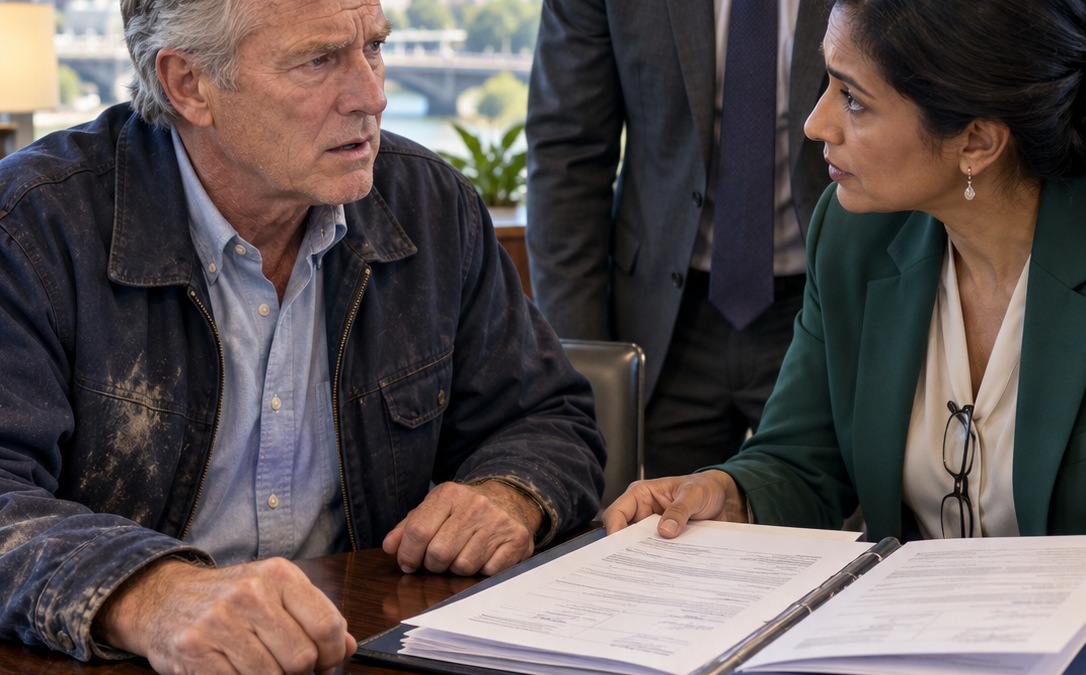
A woman I had met exactly once slid a folder across the conference table, then turned it around so I could read it. Inside were eleven draw requests against a loan worth $410,000. Eight of them carried my son’s signature. I had been calling him for eleven days. He had blocked my number.
Only three months earlier, I had sat in that same chair, at that same table, and signed my own name to help my son turn his dream of opening a climbing gym into something real. I had put up my house, my woodshop, everything I owned, because I believed in him. And now my son was gone. No call, no explanation, nothing about what had happened. While I couldn’t reach him, the bank was preparing to hold me responsible for $410,000 in debt.
But the question I didn’t yet know how to answer was the one that would keep me awake for months afterward. Had my son actually betrayed me, or was he a victim, too, of someone else’s con?
My name is Roy Vandenberg. I’m sixty-five years old, and I own a millwork shop on the west side of Grand Rapids, Michigan, off Butterworth. Commercial casework, nurse stations, exam-room cabinetry, reception desks, conference tables. I started the business in 1988, in half a rented bay, with a used panel saw and $4,000 borrowed from my father-in-law. It took me nine years to pay that money back. Nine years, and he never once asked me about it. Not one time. That’s going to matter later.
I married Margot in 1987. We’d been married thirty-seven years this past October. We raised two kids in a story-and-a-half house on Alger Street, and I paid that house off in 2016. I still remember standing on the porch the night I mailed the last payment, feeling like a man who had finally gotten somewhere.
Our daughter, Merritt, is thirty-one. She’s a hospice social worker. She works out of a place on the northeast side, sits with families during the worst weeks of their lives, and then comes home and makes dinner. She’s married to Kwame, who fixes school buses for the district and is one of about four people I’d trust with my truck keys. Merritt has never asked me for a dollar in her adult life. Not for her wedding, not for a car, not even when she and Kwame were eating rice four nights a week so they could close on their house faster.
Hold on to that. It comes back at the end, and it’s the part I got most wrong.
Our son, Wes, is thirty-four. Smart, charming in a way that used to make me proud and, looking back now, makes me watchful. Wes has been around climbing gyms since he was nineteen. He started at the front desk of a place in Kentwood, worked his way up to route setting, then head route setter, then general manager. Eleven years in one industry, moving up the whole time. For a long while, I told myself that was just Wes finding his footing. Every father tells himself some version of that sentence about one of his kids.
Then, one Tuesday night in January, Wes called and asked if he, his mother, and I could sit down together.
“Family dinner,” he said. “Nothing heavy.”
Nothing heavy is never nothing heavy. I’ve known that for forty years, and I still walked right into it.
He showed up carrying a laptop bag and brought along a business partner I’d met twice before, a man named Chase Alderink. Around forty. Good jacket. A handshake that lasted about a second longer than it needed to. The kind of man who smiles like he already knows how the conversation will end because he’s rehearsed it four times on the drive over.
They’d worked together at the Kentwood gym for two years, and somewhere along the way, they’d decided to build their own place. Northline Climbing. A warehouse conversion on the near west side, with forty-foot lead walls, a bouldering cave, a mezzanine housing a yoga studio, and a coffee bar beside the front desk.
Wes had prepared a forty-one-page slide deck. He had clearly been staying up half the night for weeks putting it together. And I’ll be honest with you. I was moved. There was my son, sitting at my kitchen table at thirty-four, talking about something with actual fire in his voice instead of just getting by. Margot squeezed my knee beneath the table. She saw it, too.
The number was $410,000.
It would be an SBA loan through Grand River Mutual, the branch on Monroe Center. They had about $75,000 between their savings and one small outside investor, but the bank wanted a personal guarantor with solid credit and real collateral before it would release the rest.
Wes’s credit wasn’t good enough. Chase’s, as it turned out much later, was considerably worse. Nobody said a word about that in my kitchen.
Wes looked at me, and I can still hear exactly how he spoke. Quiet, careful, as though he’d practiced the words in the car.
“Dad, I wouldn’t ask if I didn’t believe in this all the way. You’re not writing a check. You’re just believing in me on paper.”
Just believing in me on paper.
Margot was quiet as we went upstairs to bed that night. After thirty-seven years of marriage, you learn to read a woman’s silence like a barometer. She sat on the edge of the bed, taking off her earrings, and finally looked at me.
“Roy, I want to believe in him, too. I do. But that Chase fella looks at you like he’s already spent it.”
I told her she was being protective. I reminded her that Wes had put eleven years into the same industry and finally had a real opportunity. What kind of father would I be if my own hesitation was the reason he never got his chance?
I told myself that love without risk wasn’t really love.
On February 6, I signed the personal guarantee in a second-floor conference room on Monroe Center, across from a loan officer named Priya Balakrishnan. She was a sharp woman with reading glasses hanging from a chain. She went through every single page with me, slowly, making sure I understood that if the business defaulted, the bank could come after my personal assets. The house, the shop, the equipment, all of it could be used to satisfy that debt.
I nodded along like a man who fully understood what he was agreeing to.
I did not fully understand what I was agreeing to.
I want to say that plainly because people ask. I wasn’t tricked at that table. Priya did her job. I heard the words, and I signed anyway, because I had already made my decision back in January. Everything after that was just procedure.
The first ten weeks were good. Genuinely good. There were crews moving in and out of the warehouse, permits taped to the front window, and photographs arriving on my phone from Wes. The concrete slab being ground down. Structural steel going up for the mezzanine. A pallet of auto-belays sitting in the middle of an otherwise empty room.
He called most Sunday evenings, walked me through the budget line by line, and asked my opinion about the HVAC bid. He knew I’d spent thirty-six years around commercial buildouts. I know what a mechanical contractor’s number ought to look like, and for once, my son wanted to hear what I had to say about it.
For about two and a half months, I felt like the father I’d always wanted to be. Present. Trusted. Needed in the right way instead of the wrong way.
Then, in late April, the calls started slowing down.
You notice a thing like that the same way you notice a compressor has stopped cycling in the shop. Not all at once. There’s just a hole where a familiar sound used to be.
One Sunday passed, then another. I sent texts and got short answers back.
“Crazy week, Dad. Talk soon.”
That’s the kind of message you send when you’re managing somebody, not talking to them.
On May 12, I received a letter I wasn’t expecting. It came from Grand River Mutual and was addressed to me as guarantor. The letter said the account had missed a scheduled draw reconciliation and that a payment-cycle review was underway.
I didn’t understand half the language. I understood the temperature of it just fine.
I called Wes that night. Voicemail. I called again the following morning. Voicemail. Over the next six days, I called that boy fourteen times, and every single call dropped into the same flat recorded voice.
Then, on Sunday, May 18, I tried one more time.
Instead of ringing, the phone gave me one short tone and disconnected.
If you’ve ever heard that particular sound, you know immediately what it means. There’s a half second when your brain simply refuses to accept it.
Thirty-four years. That boy had never hung up on me in his life.
I stood in my kitchen holding my phone out in front of me, staring at the screen as though it might change its answer if I looked at it long enough. I called Margot into the room and showed her what had happened. I watched my wife’s face move from confusion to fear in about four seconds.
Now, here’s where I need you to stay with me, because the next stretch is the part I really wanted to tell you about.
Between May 18, when Wes blocked my number, and May 27, when the bank called, I built a story. Nine days, and I constructed the whole thing out of nothing but hurt.
I decided my son had looked at his father’s signature on that guarantee and calculated exactly what it was worth. I decided he’d taken the money, spent it, and blocked me because he couldn’t bear to look at what he’d done. I decided I’d been a mark.
I lay awake in bed and played that movie so many times that eventually it had scenes. Dialogue. I could picture him sitting in a bar with Chase, laughing about how easy the old man had been.
Not one frame of it was true.
And I want you to understand something about that story, because it took me until October to see it clearly. That story wasn’t really about Wes. It was about me. It was about a sixty-five-year-old man who had been a fool, who had been warned by his wife and hadn’t listened, and who would rather be angry than embarrassed.
We don’t wait for information when somebody we love goes quiet. We manufacture it. And we always, always manufacture the version that confirms the worst thing we already suspect about ourselves.
All right. Back to what happened.
I called my oldest friend, S. Bergsma. S. had run a hydraulics repair shop two units down from mine since 1993, and we’d been eating breakfast at the same place on Leonard Street for thirty years.
I laid everything out for him over eggs. S. stirred his coffee slowly, the way he does whenever he’s about to say something I won’t enjoy hearing.
“Roy, when a grown man blocks his own father three months after that father signs for him, that’s not nothing. You know it isn’t.”
“I don’t want to believe that.”
“I know you don’t,” he said. “But you haven’t driven out there yet, have you?”
I hadn’t.
So the next morning, before the shop opened, I drove over to the warehouse.
Picture what I expected to find. Scaffolding, a working crew, maybe even a banner hanging above the entrance. Wes had told me in April that they were six weeks away from a soft opening.
Instead, brown paper still covered the storefront glass. There was a padlock on a door that hadn’t had one in March. A roll-off dumpster sat out front, filled with drywall scraps that had been rained on long enough to settle into a heavy, damp mass.
That wasn’t the accumulation of a few days. That was weeks.
No lights. No trucks. Nobody.
And here’s where my trade earned its keep. This is the part that made my stomach drop.
I walked up close to the glass, where the paper had torn away at one corner, and looked inside. Thirty-six years of commercial buildouts had taught me how to price a room by eye, usually within about ten percent. I would have bet my shop on what I saw.
The concrete slab had been ground and sealed. That was real money, a legitimate expense. There was some structural steel for the mezzanine, maybe half of what should have been installed. A few sprinkler heads had been relocated.
And that was it.
Bare block walls on three sides. No climbing-wall structure whatsoever. No HVAC units on the roof. I had walked around the back and checked.
I stood on that sidewalk doing arithmetic in my head, and I couldn’t make the work I was looking at cost more than about $50,000 to $55,000.
Yet Wes had told me back in March that they’d already drawn well over $200,000.
I want to describe what it felt like standing there, because that’s the exact middle of this story.
It was May in Grand Rapids, with a cold wind coming off the river. I stood with my hands shoved into my jacket pockets, staring at that brown paper over the windows.
And the feeling wasn’t shock.
It was the feeling of something you already knew finally arriving as an official fact.
If you’ve ever driven somewhere just to confirm something you were already afraid was true, you know that particular hollow feeling. You go hoping you’ll be wrong. Then you find out you aren’t, and somehow being right hurts worse than not knowing did.
The call came nine days later, on Tuesday, May 27, at 11:40 in the morning. I was at the shop running a batch of laminate panels for a dental office in Rockford.
My phone rang. It was a local number I didn’t recognize.
“Mr. Vandenberg, this is Priya Balakrishnan, senior loan officer at Grand River Mutual. We met in February when you signed as guarantor on the Northline account.”
“I remember you,” I said.
Every part of me went still, the way you go still around running machinery when something sounds wrong.
“Sir,” she said, and there was something very careful in her voice. It was the tone of somebody who had made this exact call before and knew precisely how much it weighed. “I need you to come into the branch this afternoon, if you can. There are things related to this loan that you need to see in person as guarantor, before you make any decisions on your own.”
I asked her right there, standing beside a running saw with sawdust covering my forearms, whether my son was in trouble.
She paused long enough for me to hear the hesitation.
“Mr. Vandenberg, I’d rather walk you through it in person. I don’t want to hand you half a picture over the phone.”
I was in my truck nine minutes later.
Now, let me slow this part all the way down, because what happened next was the longest half hour of my life, and I’ve gone over it more times than I can count.
It was the same conference room, the same table, on the second floor, with windows overlooking Monroe Center. Except this time, Priya wasn’t alone. A younger man sat beside her, someone from the bank’s fraud and risk group. His name was Theo Kaminsky. He was quiet, with a notepad squared neatly in front of him.
There was a folder in front of Priya, thick enough that my stomach dropped just looking at its spine.
“Mr. Vandenberg,” she said, “I’m going to go through this slowly. Stop me anytime.”
She slid the folder across the table and turned it so it faced me. I noticed that she turned it. Somehow, that small movement has stayed with me as clearly as anything else from that day.
Here’s what was inside.
The $410,000 loan had been structured to release funds through construction draws tied to specific milestones. Standard SBA setup. Permits, structural work, mechanical systems, wall systems, flooring, opening equipment. Every draw required documentation, invoices from licensed vendors, and signatures from both owners.
Over fourteen weeks, $246,000 had already been drawn.
And I had stood in front of that building nine days earlier and priced the visible work at roughly $52,000.
“The invoices came from four vendors,” Priya explained.
One was a concrete-finishing company that had genuinely performed its work and been paid fairly. Another was a steel fabricator whose invoices were partially legitimate.
The other two didn’t hold up.
One was an equipment company called Ridgepole Fitness Leasing. The other was a construction management firm called Alderink Project Services.
Theo Kaminsky spoke for the first time.
“Alderink Project Services is registered to a residential address in Holland, Michigan. Listed managing member: Chase Alderink.”
I sat there and read that line about four times.
My son’s business partner had created a company using his own last name, submitted invoices from it as though it were an independent vendor, and arranged for the bank to wire construction funds directly into an account he controlled.
“Where’s my son in this?” I asked.
I heard my own voice come out smaller than I wanted it to.
Theo turned to a tabbed page and rotated it toward me.
“Sir, your son’s signature is on eight of the eleven draw requests. As co-owner, that’s required for release. I’m not in a position to tell you what he understood when he signed them. Bank records can’t answer that. What I can tell you is the pattern.”
He walked me through the transactions. Every one of those releases had moved into an account controlled by Alderink within forty-eight hours.
“Our team classifies that as structured diversion. We flagged it internally on the twelfth and froze the undisbursed balance the same day. That’s the only reason there’s still $164,000 sitting in that account instead of being gone.”
Nobody said anything for a while.
I sat in that chair looking down at eight pages bearing my son’s handwriting. That was the thing I couldn’t get past. Not the numbers. The handwriting.
It was the same hand that had written “Thanks, Dad” on a card in 1998, with the D backward.
And I didn’t know yet whether I was looking at the handwriting of a victim or a participant.
Then Priya closed the folder halfway and looked at me.
“Mr. Vandenberg, I brought you in today because you’ll get formal notice of default proceedings within ten business days. I wanted you to have the whole picture before that letter lands, and before you make any decisions, financial or otherwise, based on partial information. I’ve watched guarantors panic and do things that hurt them worse than the debt did.”
I asked her straight out why the bank would go to that trouble for me.
She looked at me for a second, and something in her face softened.
“Because in February, you asked me three separate times what happens to your house. Most people don’t ask that once.”
I drove home and sat at the kitchen table for about twenty minutes without saying a word. Margot stood at the stove, not cooking anything, just waiting.
Thirty-seven years teaches a woman when a silence needs room before it turns into words.
Eventually, I told her everything. The invoices. The shell companies. The missing money. The eight signatures. The frozen balance. The default notice that would be coming.
She listened without interrupting, and when I finished, she said quietly, “That Chase. I told you.”
“You did,” I said. “I’m not going to pretend you didn’t.”
S. came to the shop the next morning before the crew arrived. I told him the whole thing, and he listened without interrupting once, which, for S., is nearly a religious experience.
When I finished, he set his coffee down.
“Roy, you need a lawyer before you need a conversation with your son. Lock the facts down first. Because if you go at that boy hot, whatever he says back, you won’t be able to trust it. And neither will anybody else if this ends up in front of a judge.”
He was right, and I hated it.
So I called an attorney a client of mine had used, a woman named Lena Quist. Her office was over on Michigan Street. I sat across her desk and laid everything out while she took notes in tiny, precise handwriting.
When I finished, she set down her pen and said something that turned the whole situation sideways for me.
“Roy, as guarantor, you can request the complete loan file directly from the bank, independent of anything your son tells you. And I’d strongly suggest you find out where he actually is. Because there’s a real difference, legally and honestly just as a matter of fairness, between a partner who helped divert funds and a partner who got used by somebody he trusted and is now too ashamed to pick up his own father’s call.”
I want to be honest about what happened inside me when she said that.
For about four seconds, I got angry at her.
I’d spent nine days building my version of what had happened, and by then it had become load-bearing. I’d been sleeping on it, leaning on it, using it to hold up everything I thought I understood.
And she’d just put a crack in it.
Part of me didn’t want that crack, because if my son was drowning instead of stealing, then I had spent nine days convicting him in my own kitchen.
Lena requested the complete file. It arrived that night through secure email.
I sat up until nearly one in the morning, going through it page by page with a legal pad beside me, cross-referencing dates the way I’d compare a shop drawing against a submittal. That’s just what my brain does when it’s trying not to come apart.
And there, buried in an email chain the bank had retrieved as part of its review, was a message dated July 2, timestamped 11:52 at night.
It was from Wes to Chase.
“Chase, I went out to the site and counted. The Alderink invoices don’t match anything that’s actually been done. Where is that money? I want an answer tonight or I’m calling Priya at the bank in the morning.”
Chase had replied six minutes later.
“Wes, breathe. It’s a timing thing on supplier deposits. Meet me tomorrow and I’ll walk you through the whole thing. Do not call the bank. You’ll blow the draw schedule and kill the project over a paperwork lag. And then we’re both done.”
I sat at my kitchen table at one in the morning, staring at those words on my laptop screen, and something that had been clamped tight inside my chest for nine days loosened about a quarter of an inch.
He’d seen it.
My son had gone out to that building and counted the work himself. He’d asked exactly the question I would have asked. He’d threatened to call the bank.
And somewhere between that July 2 email and the day he’d blocked my number, something had gone badly wrong. I still didn’t know whether it was fear or shame or something worse, but for the first time, I had evidence that the story I’d been telling myself might not be the right one.
S. found him.
Not through any detective work. Through his own kid, who still worked kitchen shifts with a couple of guys Wes had come up with. One of them mentioned over a beer that Wes had been picking up overnight shifts at a produce cold-storage warehouse out in Wyoming, Michigan. He was working on the schedule under his middle name.
I drove out there on a Thursday and sat in the parking lot from 3:20 in the morning until almost four.
I sat there because I didn’t know which version of my son I was about to see. I didn’t know whether I was walking into a confrontation with somebody who had knowingly used me or somebody who was trying to escape a disaster he couldn’t explain.
They let me stand just inside the dock door.
Wes was working in a thirty-four-degree room in the first week of June, wearing a parka and a headlamp, pulling cases off a pallet onto a jack. He was thirty pounds lighter than the man who had sat at my kitchen table in January with a forty-one-page business plan and a voice full of confidence.
He looked up and saw me.
I watched all the color leave his face.
We stood outside on that loading dock for close to an hour, with the refrigeration compressors running behind us.
He cried before I did.
That knocked me sideways, because Wes hadn’t cried in front of me since he was about thirteen.
“Dad,” he said, “I found out what Chase was doing at the start of July. I went at him. He swore he’d have it back inside of three weeks. And then he told me that if I called the bank, he’d say I signed off knowing.”
Wes looked down at his gloved hands.
“Dad, my name’s on eight of them. My handwriting. It would be his word against mine. And I’d signed every one.”
He wiped his face with the back of his glove.
“So I panicked. I thought if I picked up hours, I could put some of it back before anyone caught it, and nobody would ever have to know how stupid I’d been.”
Then he said the thing that I still hear when I think about that morning.
“I blocked you because I couldn’t stand hearing your voice and lying to you. And I couldn’t stand telling you the truth either. I didn’t have a third option, so I just turned it off.”
I stood on a loading dock at four in the morning, looking at my son in a borrowed parka, stacking lettuce for cash under his middle name, trying to quietly undo a disaster he hadn’t caused.
He was not innocent. I want to be honest about that because people ask.
He had been naive. He had been slow to recognize what was happening. He had been proud. And eight of his signatures were sitting in a bank file, regardless of what had been going through his head when he wrote them. There were consequences attached to those signatures, and he took every one of them.
But he had not stolen from his father.
And here’s what I did. I want to be honest about this part, too, because the version where I hug him would make a nicer story, but that isn’t what happened.
I did not hug my son on that loading dock.
I put my hand on his shoulder, the way I used to when he was small and had done something he couldn’t undo.
“Get in the truck,” I told him. “We’re going to fix this the right way, starting tonight. And you’re going to tell me every single piece of it on the drive.”
The next ten days moved fast, and they moved clean.
Lena walked Wes through a complete, documented statement for the bank’s fraud division. Theo Kaminsky’s team checked it against the records for the shell companies. Then they told us something that rearranged the way I felt about the entire situation.
Chase Alderink had built a climbing gym in 2019. A real one. It had failed after twenty-two months, and he’d personally guaranteed both the lease and the equipment note. He’d been underwater ever since.
Every venture after that had been another attempt to rob the new business to feed the ghost of the old one.
And the man who had co-signed for Chase in 2016, the man whose signature had helped make that first gym possible, was his own father.
His father had lost a rental duplex in Zeeland over it. He hadn’t spoken to his son since 2021.
Theo told me that across a conference table, and I had to turn and look out the window for a moment.
I want to be extremely clear about something. None of that excuses a single dollar of what Chase did. He looked at another man’s family money and another man’s signature, and he took advantage of that trust all over again, knowing exactly what it could do to a family because it had already happened in his own.
But I understood him.
For about ten seconds in that conference room, I understood Chase Alderink completely.
And understanding him didn’t make me feel triumphant. It just made me tired.
Charges came in August. Wire fraud and forgery related to the diverted construction draws. Restitution proceedings opened against Chase’s personal assets, which included a boat he’d bought in April with money that was supposed to pay for a rooftop air handler.
The bank restructured the loan after the fraud findings were established and Wes’s cooperation was officially on record. Lena and Priya negotiated my personal guarantee down to the funds that had actually been used legitimately, about $88,000, once the concrete and steel invoices had been verified.
Eighty-eight thousand dollars is not nothing.
But it wasn’t the $410,000 I’d been staring at alone at my kitchen table back in May, either.
Wes sold his truck and rode the bus for five months. He worked overnight shifts at the warehouse and took a day job setting routes at a gym in Kalamazoo. He paid down his half of that balance himself, dollar by dollar, month by month.
The same way I had paid my father-in-law back for that panel saw over nine years, while he never once brought it up.
I did not pay Wes’s debt off for him.
I want to be honest about that because it matters more than almost anything else I did in this entire story.
I sat with him at the kitchen table plenty of nights, going through the numbers. I explained amortization to him twice. I helped him understand what he owed, what his payments meant, and how long it would take.
But I did not hand my son an easy way out.
Because some debts, even the ones that aren’t entirely your fault, only teach you something if you pay them with your own two hands.
Now, there’s one more piece to this, and it’s the piece I’m least proud of.
In August, while going back through old text messages to build a timeline for Lena, I found something I’d read back in January and let slide right off me. It was a message from Merritt, sent the night after Wes and Chase had come to our kitchen table with their business proposal.
“Dad, I don’t want to be the negative one. But something about Chase gives me a bad feeling. I’ve met men like him at work, families of patients, the ones who talk big and then vanish the second anything’s actually hard. Please just be careful before you put your name on anything. Love you.”
And I’d written back, “Thanks, sweetheart. I’ll be careful.”
That was it. That was the whole exchange.
I never followed up. I never asked her a single question about what she’d actually seen. I had a daughter whose entire working life was spent watching people reveal who they really were when things got difficult, and she’d tried to tell me something.
I’d thanked her and gone right back to believing what I wanted to believe.
I called Merritt in September and asked her to come over for dinner. Just her. I sat her down at that same kitchen table and told her everything, start to finish. The loan, the missing money, Chase’s companies, Wes disappearing, the bank investigation, the loading dock, and what it had taken to start putting things right.
Then I told her I owed her an apology from January.
“You saw it before any of us,” I said. “And I brushed you off because I wanted so badly to believe in your brother that I didn’t want to hear anything standing in the way of it. That wasn’t fair to you, and it wasn’t smart of me.”
Merritt has a thing she wants to do. She’s mentioned it maybe four times in six years, and she’s never once pushed it.
She wants to start a respite house. Three or four beds, short-term stays, somewhere people caring for a dying spouse or parent at home can go and sleep for two nights without being afraid.
She sees the need for it every single week. She sits with families who’ve reached the point where they can barely keep their eyes open, people who love somebody so much they’re wearing themselves down trying to care for them. She knows what two uninterrupted nights of sleep could mean to those people.
And she has never asked anybody for a dime toward making it happen.
In October, Margot and I restructured our estate with Lena’s help. We seeded a fund with $70,000 earmarked for that respite house, whenever Merritt is ready to move forward with it. The rest of what we have will be divided evenly between our two children when we’re gone, this time with the kind of protections I wish to God I’d understood back in January.
When I told Merritt, she cried harder than I’ve seen her cry since her wedding.
She told me she had never done any of it expecting anything in return.
“I know,” I said. “That’s precisely why.”
And I want to add something here, because I’ve seen where stories like this usually end, and I don’t want mine to end that way.
The money was the easy part.
Writing a check to help my daughter was easy. It took an afternoon. We could sit with Lena, arrange the paperwork, make the necessary decisions, and walk out knowing we’d done something useful.
The hard part was the conversation that came before it. Sitting across from my daughter at the same table where I’d ignored her warning, and saying out loud that she’d been right. Admitting that I hadn’t listened, hadn’t asked her why, and hadn’t given her judgment the respect it deserved.
You can’t buy your way out of an apology you owe. I’ve watched men try my whole life, and I’ve never once seen it work.
So here’s what this whole experience actually taught me.
And it isn’t “be careful who you co-sign for.”
You already know that. That’s not worth four thousand words of your evening.
It’s the nine days.
Nine days between my son blocking my number and that folder sliding across the conference table. In those nine days, I built a complete, detailed, emotionally satisfying story about who my son was.
And it was wrong in every single particular.
He wasn’t hiding from me because he’d used me. He was hiding from me because he’d been used, and he was ashamed.
And shame makes people disappear.
That’s the piece I’d hand you if I could only give you one thing from this story.
When somebody you love goes silent, you’ll assume it’s contempt. But so often, it isn’t contempt at all.
Contempt argues. Contempt shows up and tells you exactly what it thinks of you.
Shame vanishes.
So if somebody you love drops off the face of the earth, consider shame before you decide they’re treating you with contempt. You’ll be right more often than you might think, and even when you’re wrong, you’ll have done a lot less damage while you were finding out.
I wish I’d understood that during those nine days. I wish I’d spent less time writing conversations in my head and more time trying to find out what was actually happening. I had turned my son’s silence into a verdict, and I hadn’t given him the chance to explain what it meant.
Then there’s the other half of it, the part I owe my daughter.
We ask people we trust for their opinion about something, and then we never ask them for their reasons.
Merritt told me she had a bad feeling. I said thanks. I never asked her the one question that mattered.
“What did you see?”
She would have told me.
She’d met men like Chase during the worst weeks of families’ lives. She knew the difference between a person who could speak confidently when everything was going well and a person who would still be standing there when things fell apart.
She could have described that difference to me in about ninety seconds.
And if I’d listened, I would have asked Chase Alderink two questions in my kitchen that he could not have answered.
Two questions. That’s all it might have taken.
So here’s the one thing I actually want you to do this week.
The next time somebody close to you says, “I’ve got a bad feeling about this,” whether it’s about a job, a contractor, a person your kid is dating, or anything else, ask one follow-up question.
“What specifically did you see?”
That’s it. Five words.
Most people never ask, because a bad feeling is easy to wave off. A specific observation is not.
And some part of us knows that. Some part of us would rather not hear the specifics, because once somebody tells us exactly what they’ve noticed, we have to do something with that information.
A vague warning can be dismissed as somebody worrying too much. An actual detail demands attention. It asks you to look more closely at a situation you might already have decided you want to believe in.
The warning is worthless without the specifics.
And the specifics are what could have saved me $88,000 and my son a year of his life.
Here’s the question I’d like you to sit with tonight. It’s the same question I’ve been sitting with on that porch on Alger Street most evenings since all of this happened.
When the people I love go quiet, what story do I write about them? And what does that story say about me instead of them?
Because mine said I’d been a fool.
That’s all it ever said.
My son was never really in it.
Now, I’d like to hear from you. And I do read the comments.
If you think I did right by holding the line and letting Wes pay back his own half of the debt, working two jobs and going without his truck, comment the number one.
If you think I should have covered it for him and let the boy start fresh after everything he’d already been through, comment two.
And if you think the real failure here was mine, that I signed that guarantee in January over my wife’s objection and my daughter’s warning, and that I own this more than anybody, comment three.
I’ll tell you where I stand.
It’s three.
It’s been three since about October, and it isn’t close.
Tell me where you’re watching from, too, and what time it is where you are. It still gets me, thinking about how a story that began in a millwork shop off Butterworth in Grand Rapids, Michigan, can end up in somebody’s kitchen on the other side of the world.
And if you’ve ever had somebody you love go silent on you, and you spent a week building the worst possible explanation for it, tell me about that down below. You don’t have to use your name.
Somebody scrolling past tonight is on day four of exactly that experience, and they may need to hear how mine turned out.
If any of this reached you, do me one favor before you go. Subscribe. Not for a number on a screen, but for the next person who needs to hear that silence from someone who loves you is often shame, not contempt, and that the difference is worth finding out before you decide anything.
Take care of your people. And go ask somebody what they actually saw.
This is a fictional story inspired by real emotional experiences, fully rewritten and reimagined in Grand Rapids to create original content. Any resemblance to real people or events is coincidental.








