I retired after 37 years and bought 9 acres in montana. then my daughter-in-law called: “my parents are moving in next month! at your age, that’s too much land.” i didn’t argue. i quietly prepared one thing. and when they arrived…
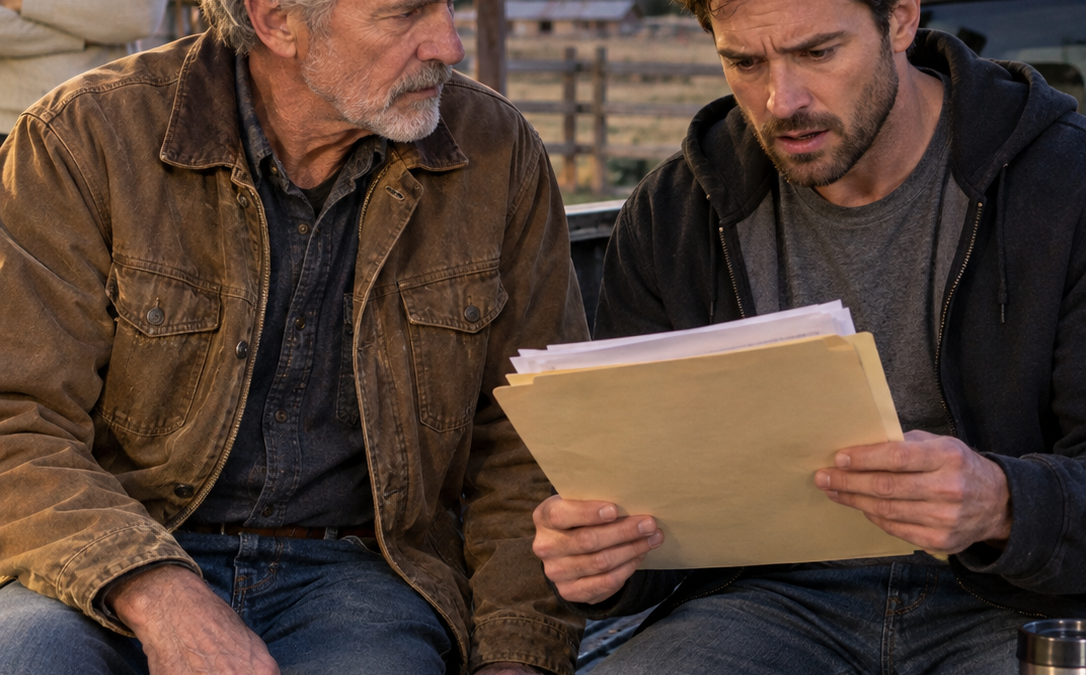
My son was sitting on the tailgate of my pickup in the middle of a field in Montana, holding a court document in his hands. His name was on it, along with a debt he’d never heard of. Seventy-one thousand dollars. He read the number aloud twice, as though saying it again might somehow change what was printed on the page. Six weeks earlier, his wife had called to inform me that her parents would be moving into the guesthouse behind my place before the first of the year. I had told her no. That’s where all of this started.
My name is Roy Maretti. I’m sixty-six now, but I was sixty-four when this began, and I spent thirty-seven years working as an aircraft mechanic. I held an A&P license, airframe and powerplant, and spent most of my career on the cargo side out of Cincinnati. That meant night shifts. For the better part of four decades, I went to work when everybody else was coming home. Hydraulics, landing gear, maintenance on the line at three in the morning in February, with the wind coming straight off the ramp. You learn certain things doing that kind of work, and the one qualification I have for telling this story comes directly from those years.
You don’t sign your name to something just because it looks all right. I had a stamp with my number on it, and that stamp went into a logbook. If I signed off on a repair and something came apart at thirty-one thousand feet, that responsibility was mine forever. So you inspect. You check the actual torque value against the actual chart. You don’t go by feel. My father told me that when I was twelve years old, standing in a garage in Norwood with a Chevy up on jack stands. He looked at me and said, “Feel is what fails.” I’ve thought about that sentence more in the last two years than I did in the fifty years before them.
I retired at sixty-three with a decent pension, a 401(k) I’d been contributing to since 1989, and a picture in my head I’d been carrying around since roughly 1998. Nine acres in the Bitterroot Valley, south of Hamilton, Montana, with the Sapphire Mountains on one side and the Bitterroots doing what they do on the other, which is rise straight out of the ground like something ended there. There was a house built in 1938, part log and part frame, added onto twice by people who hadn’t cared much about making the additions match. There was a bunkhouse out past the larch trees where somebody’s hired man had apparently lived for thirty years. And there was a shop.
The shop was the whole reason. Forty feet by thirty, concrete floor, twelve-foot ceiling, and a 220-volt line already installed because the previous owner had done welding. I’d been paying $160 a month for a storage unit in Cincinnati since 2016 to keep a table saw, a lathe, a band saw, and about $400 worth of hand tools I’d collected over thirty years. Eight years of storage fees. Do that math sometime. I have. I looked at properties in four states over eleven months and flew out to Montana three times on standby before I finally found the place.
The closing took place in an office above a hardware store on Main Street in Hamilton. Twenty minutes, start to finish. I signed every document with the same pen, and when it was done, the attorney slid the keys across the desk and said something about how the property had been waiting for me. I drove out there afterward, shut off the engine, and sat in my truck with the windows down for what I’d guess was forty minutes. It was late September. The larch trees hadn’t turned yet. They turn gold in October and then drop their needles, which is something I hadn’t known larch trees did until I moved there.
A hawk was working the field. The air smelled like pine, cold water, and dust. I was sixty-four years old, and I had never been so certain of anything in my life. That evening, I called my son from the front step of the house. His name is Theo. He was thirty-eight then, teaching high school biology in Missoula and coaching junior varsity wrestling. He’s a genuinely good man in a way that has nothing to do with me. His mother did that.
Adele died when he was nine. An aneurysm. No warning. She was forty-one years old, and I’ve always believed that everything decent in that boy came from the nine years he had with her. “You actually did it,” Theo said when I told him where I was calling from. I could hear him grinning through the phone. He got that from her, too. “Keys in my hand,” I told him. “Thirty-seven years, Dad,” he said. We spent the next hour talking about nothing in particular. His semester, the students he was working with, a trip he and Camille were thinking about taking.
I asked about Camille the way I always did, briefly and carefully, and he answered the way he always did. “Fine. Good. Busy.” There was something his voice did whenever her name came up, a small adjustment, like a man shifting his weight on a chair with one short leg. I’d been hearing it for about two years. I never said a word about it. It wasn’t mine to say, or at least that was what I told myself.
And I want to be honest about that, because it’s what men my age are always telling ourselves, and it’s almost never true. It isn’t that the thing isn’t ours to say. It’s that saying it costs something, and we’d rather not pay. So we call our silence respect, or restraint, or minding our own business, when sometimes it’s nothing more than an unwillingness to have a difficult conversation.
Theo and Camille didn’t come out that first month, so I worked on setting up the shop instead. I mounted my hand tools on French cleats in an arrangement I’d been drawing on graph paper since I was fifty-three. I built a workbench out of Douglas fir I’d hauled from a lumberyard, with a laminated top four inches thick. I cut the joinery by hand, without a single fastener, the way my father had taught me. When I finished flattening the top and ran my palm down its surface, I stood there in the sawdust for a long time, with the shop door open and the mountains right in front of me.
I don’t have a particularly good word for what I felt in that moment. Whole, maybe. It felt like being entirely in one place for the first time since 1987.
The call came on a Tuesday in October while I was putting the second coat of oil on that bench. “Roy.” Camille had a particular voice she used whenever she was executing something. Efficient, slightly impatient, as though the conversation were an item on a checklist she intended to complete. “I need to talk to you about a situation.”
I put the rag down and listened. Her parents’ lease was up in December. The rental market in Missoula was impossible. They’d been looking, but everything was either too expensive or too far away. She laid out the circumstances in a quick, orderly sequence, and then, without leaving any space for me to respond, she arrived at her solution. “You’ve got a bunkhouse sitting empty. The obvious answer is that they use it while they get sorted out. Just a few months.”
I stood in the middle of my new shop, looking at the workbench I’d spent weeks building. “Camille, I closed on this place eight weeks ago.”
“And the bunkhouse has been empty those entire eight weeks,” she replied. “My parents need somewhere to live, and you have a whole building nobody’s using.”
There was a brief pause before she added, “This is what family does.”
This is what family does. I’d heard that sentence from her before. Not many times, but every single time it had meant the same thing: I was about to supply something I hadn’t actually been asked to provide. I held the phone against my ear and considered what she’d just told me.
“Have you talked to Theo?” I asked.
“Theo agrees. Family comes first.”
That’s not an answer. I want to point that out because it went right past me for about four seconds. It’s a sentence engineered to sound like a yes without actually being one. I finally said, “I’ll talk to him.”
“I’ve already talked to him.”
“I’ll talk to him anyway.”
That was when her voice cooled by about half a degree, and the thing underneath the conversation began to show itself. “My parents are good people who’ve had a hard few years. If you can’t find a way to help family when they need it, that tells me something.”
She let that settle before continuing. “And honestly, Roy, if nine acres is more than you can handle on your own at your age, maybe the real conversation is whether you bought too much property.”
Sixty-four years old. I walked four miles a day up a forest road with a grade on it. I’d just built a workbench using hand-cut joinery. I’d spent thirty-seven years signing my name to work that people’s lives depended on. And my daughter-in-law was suggesting I reconsider owning the property I’d spent three decades saving for because she wanted to move two people into it without asking my permission. I told her good night and hung up the phone.
I want to tell you what I felt afterward, because it wasn’t rage. If you’re waiting for the part where the old man loses his temper, this isn’t that story. I became very quiet. I felt exactly the way I used to feel at two in the morning when a gauge showed a reading it shouldn’t have shown. Not upset. Interested. Something was wrong with the aircraft, and I’d just been given the first indication.
If you’ve ever been spoken to as though your judgment is now a subject for discussion rather than an established fact, especially when the words are delivered kindly, with concern in the speaker’s voice, you know how it feels. It doesn’t land like an ordinary insult. It lands like a reassignment. Somebody has quietly decided that your capacity to make decisions is now under review, and most of us become so busy defending ourselves against the tone that we never examine the sentence underneath it.
Theo called the next morning. He sounded tired in a way that had nothing to do with sleep. “Dad, I’m sorry about last night. She shouldn’t have come at you like that.”
“No, she shouldn’t have.”
“Her folks really are in a bind, though. Dwight’s between things again, and their landlord’s selling.”
I kept my voice flat. “She told me you’d agreed.”
“Pa, I said it could work. If you were okay with it.”
“But you didn’t call and ask me yourself.”
There was a longer pause this time. “No,” he admitted. “I didn’t. I should have.”
I told him I wasn’t making any decisions that week and that I’d call him when I had something to say. Then I hung up, made coffee, and sat down at the kitchen table with a legal pad. I wasn’t writing to vent my feelings. I divided the page into four parts: what I knew, what I didn’t know, what I needed to find out, and what my options were. It was the same format I’d used on a hundred discrepancy reports over the course of my career.
Because I’d already figured something out while standing in that shop the night before. This wasn’t a housing problem. It was three years of things I’d let go without challenging them. Camille telling me what to bring to Thanksgiving as though I’d asked for instructions. Camille informing me after the fact that Theo wouldn’t be able to come for a weekend I’d already taken off work to spend with him. Camille mentioning the amount of my pension to a mutual friend at a party, twice, when it wasn’t hers to mention.
Each incident by itself amounted to almost nothing. You’d sound insane complaining about any one of them. That’s the whole trick. Nobody moves a boundary a foot at a time. They move it an inch, and they do it forty times, until one day somebody is assigning your outbuildings to relatives who have never asked you whether they might stay there.
The first call I made was to a property attorney in Hamilton. Her name was Berenice Toll, and her office was above a saddle shop. She was in her sixties, with the kind of directness that comes from spending decades cutting through what people wish were true. I laid out the circumstances without adjectives. She listened without changing her expression, and when I finished, she asked one question.
“Where’s your son in this?”
“In the middle. I don’t think he engineered it. I think he got walked into looking like he’d cosigned something he never agreed to.”
“Your ground, your call. There’s no ambiguity,” she said. “If those people arrive and you’ve told them no, staying would be trespassing, and the sheriff can handle it.”
She folded her hands on the desk and studied me for a moment. “What’s bothering you besides the legal part?”
I thought about giving her a careful answer, but instead I told her the truth. “What bothers me is that I’ve sat across the table from Dwight Ostrander at family dinners for three years, and I still couldn’t tell you what the man does for a living. I’ve asked Theo twice. Both times, he changed the subject.”
Berenice was quiet for a second. Then she said she would give me a name.
My second call was to my insurance agent, and that conversation turned out to matter more than I expected. He explained that long-term unauthorized occupants living in a secondary structure could create a genuine insurance coverage problem. He walked me through the details and then carefully asked whether I was planning to rent out the bunkhouse. I told him I was gathering information. He said that was the right order in which to do things.
The third call I made that week wasn’t strategic at all. I called my son, not about the bunkhouse or his in-laws, but simply to talk the way we used to before there always seemed to be somebody or something between us. For forty-five minutes, we talked without an interpreter. His kids at school, a bench I was thinking about building, a book he wanted me to read. Ordinary things. The kind of conversation that doesn’t sound important until you’ve gone too long without having one.
Near the end, Theo said, “I miss just talking to you.”
“Same,” I told him.
I’ve thought about that call a great deal. It was the only completely clean thing in fourteen months.
The investigator Berenice recommended was named Ambrose Deal. He was seventy-one years old and worked out of a single room in a strip mall in Corvallis. He had a filing cabinet that took up half a wall and reading glasses hanging from a chain around his neck. His fee was $550 for a standard background investigation on two individuals, and he said it would take about a week. I gave him Dwight and Vera Ostrander’s names and told him I wanted to understand their circumstances before I made any decisions concerning them.
The report arrived Thursday afternoon. Fourteen pages, cleanly organized and straightforward. Dwight Ostrander, sixty-nine years old, had been involved in three businesses over eleven years. There was an excavation and grading operation that folded in 2016 while still owing vendors money. Then there was a trailer-based food business that ended in 2019 with a civil judgment against him for breach of contract. The third was a residential cleaning company operating out of Missoula under his wife Vera’s name, which had dissolved eight months before I received the report.
There was also a lien on their vehicle for unpaid state taxes and a $63,000 civil judgment obtained by a former business partner two years earlier, still unsatisfied. I read the report twice at my kitchen table. It wasn’t pleasant reading, but it wasn’t exactly a surprise either. What surprised me was the memory that surfaced as I sat there looking at those pages.
It was Easter, back in the spring. Theo had been standing at a family gathering with a paper plate in his hand, mentioning in passing that he and Camille were saving to buy a house. He’d been specific. Three more years, he’d said. He’d even told me the amount they were hoping to put down. A high school teacher and a woman who worked in billing for a dental group, saving for another three years to afford their own home.
I thought about that conversation for the rest of the weekend. Then, on Monday morning, I called Ambrose.
“I need you to look at something else,” I told him. “I don’t know if it’s within the scope of what you do.”
“Tell me the shape of it.”
“I want to know whether these people’s problems have been getting solved through my son.”
He was quiet for a moment. Then he explained that he couldn’t access anybody’s private financial information without consent or a court order. But public records, business filings, court documents, UCC filings, and judgments were another matter. Those he could obtain. If loans had public filings attached to them, or if debts had been registered against an address, he could find them.
“Do it,” I said.
Ten days later, I read the second report on my own front step on a Sunday afternoon in November. The larch trees were already bare, and the air had the kind of cold in it that makes you aware of your breathing. I sat with the pages in my lap until I reached the section near the back that contained a personal consolidation loan originated twenty-two months earlier. The loan was in Theo’s name alone. Seventy-one thousand dollars.
I set the page down beside me on the step. A white-tailed doe came out of the brush at the bottom of the field and stood there looking at me for a while. Eventually, she decided I wasn’t anything worth worrying about and went on with her afternoon. I stayed where I was, staring at the same patch of ground, trying to understand what I’d just learned.
And that was when it became clear to me that the bunkhouse wasn’t the story. The bunkhouse was a warning light. It was the little amber indicator on an aircraft panel that makes you open something you hadn’t intended to open, only to discover what’s actually been happening behind it for the last two years.
I don’t know how another man would have handled that afternoon. I’ve asked myself the question more than once. Some men would have driven straight to Missoula. Some would have called their sons screaming. I sat on that step for two hours, then went into the shop and sanded a piece of wood for a while because my hands needed to do something that my head wasn’t doing.
Theo came out on a Friday three weeks later, alone. Camille hadn’t come up during the phone call when we made the arrangement, and I hadn’t asked about her. When he climbed out of his truck, I could see that he looked bad. Thinner than he should have been, with a tightness around his eyes that I recognized immediately. I’d worn that same expression myself from about 1996 to 2001, trying to raise a nine-year-old boy while working rotating night shifts.
We spent the first afternoon in the shop without discussing anything important. I showed him the workbench, and he ran his hand along the top and said it was the best piece of furniture he’d ever put his hands on. He said it without looking up, which is how you know somebody means something. I showed him a few other things I’d been working on, and we let the afternoon pass that way.
That evening, we grilled dinner and sat outside until it became too cold to be comfortable, which in the Bitterroot Valley in November happens around six forty. The mountains had turned into dark shapes against the last of the evening sky, and for a long time, neither of us said much. Eventually, Theo looked out into the darkness and broke the silence.
“She told me to come out here and talk you into it.”
“I know.”
“I don’t want to.”
“I know that, too.”
He continued looking toward the mountains. After a while, he asked, “Dad, how did I end up here?”
It wasn’t really a question, but I answered it anyway. “You loved somebody. You trusted her. Neither one of those is a defect.”
Then I told him there was something I needed to show him. “And it’s going to be a bad night,” I said. “I’m going to show you anyway.”
I need to slow this part of the story all the way down, because this is the part that matters. Every version of a story like this I’ve ever heard seems to rush straight past the moment when somebody actually learns the truth. People want to get to the confrontation, the argument, the decisions that follow. But there’s something that happens before all of that, something quiet, and if you hurry through it, you miss the most important part.
I went inside and brought out the folder I’d been assembling since October. It was a manila folder about half an inch thick. By then, Theo and I had moved from the porch to the tailgate of my truck because the porch light was drawing moths, and he’d wanted to see the sky. I sat down beside him with the folder in my hands.
I didn’t hand it to him. That was deliberate. I laid it on the tailgate between us and let him decide whether to pick it up. After a moment, he reached for it, opened it, and began to read. I turned my face toward the stars and listened to the creek at the back of the property. You can hear it from where the truck was parked when the wind is right. I knew what was in those pages, and there was nothing I could say that would make them easier to read.
Ambrose wrote plainly and sourced everything. There was no drama in the report, no speculation dressed up as fact, no attempt to tell a story that the documents didn’t support. Just names, dates, filings, and numbers. In some ways, that made it worse. Theo worked through the first four pages at a normal pace. Dwight’s excavation company, the food operation, the judgment. Then he slowed down.
He went back a page. I saw him do it from the corner of my eye. He read the section about Vera’s dissolved cleaning business twice. I could see his gaze returning to the top of the paragraph. He studied it for a while before turning to the last section, and then he stopped moving entirely. I mean entirely. The kind of stillness where a person’s chest doesn’t even appear to rise and fall.
“$71,000,” he said.
Just the number, flat and without emphasis. A second later, he said it again, a little differently, as though testing whether it would sound the same the second time.
“Seventy-one thousand dollars.”
I didn’t say anything. I want to be very clear about that because it was the hardest thing I’ve ever done, and I’ve done some hard things. I sat beside my son and remained silent for what I would estimate was ninety seconds. Every instinct I had wanted to start explaining. I wanted to tell him we’d figure it out, that there had to be a way through it, all the things a father says when he wants to shorten a bad moment for his child.
But shortening that moment would have been exactly the wrong thing to do. Theo needed to be all the way inside what he’d just discovered. If I’d pulled him out of it too soon, I believed he might have spent the next three months halfway convincing himself there was some other explanation. So I kept my hands on my knees, looked out across my own field, and let my son find out.
Finally, he spoke. “I knew about a loan.”
I waited.
“There was a consolidation loan about two years ago. She said it was ours. Our cards, the truck, the thing with her deductible.” He paused, staring at the papers. “She showed me a spreadsheet, Dad. She sat at the table and showed me a spreadsheet. And I looked at it.”
He was talking with extraordinary care, the way you carry something that’s already cracked and might come apart if you move it too quickly. “She never said it was going to them. She never said their names. Not once.”
I let him finish before I spoke. “The judgment against Dwight was entered two years and one month ago. The loan originated two years and two weeks ago.”
He lowered the papers onto the tailgate and put his face in his hands. He stayed like that for a long time, and I let him. There are things a man cannot fix for his son. Sometimes the only service available to him is to be sitting beside that son while the thing happens.
After a while, Theo spoke into his hands. “The cleaning business in Vera’s name dissolved in March. We gave them $16,000 for that.”
He laughed once, a short, terrible sound. “She called it an investment. She said we’d get it back with a return when it got going. I remember thinking that was smart.”
He sat upright again. His face was wet, and he didn’t try to hide it or wipe it away.
“That was the down payment. That was it, Dad. I picked up summer school. Three years running. I refereed. I did the ACT proctoring on Saturdays for a hundred and ten bucks a pop.”
And that’s the part that broke me, if you want to know. Not the number on the report. The Saturdays.
My son had been sitting in a fluorescent-lit room proctoring standardized tests for $110 while the savings he was working to build went out through a back door he didn’t even know was open. I could picture him there, handing out test papers, watching the clock, giving up mornings he could have spent doing something he enjoyed because he believed he and his wife were building a future together. There are numbers you can recover from, one way or another. The time is a different matter.
“I’m not telling you what to do,” I said. “I’m telling you what’s true, because you’re entitled to know it. What you do with it is yours.”
Theo stayed through Sunday. We didn’t talk about Camille again, not once. On Saturday, we drove up to a trailhead and walked four miles in and four miles back. He was out of shape and complained about the distance, then made fun of me for not being out of shape. I let him. That evening, we built a fire behind the shop and talked until after midnight about his mother, about a fishing trip we’d taken in 1997 that we both remembered completely wrong, each in a different direction.
When he left on Sunday, he hugged me and held on longer than he usually did.
“Thanks for telling me,” he said.
“That’s what I’m for.”
I watched his truck disappear down the county road. Then I went inside, poured myself a cup of coffee, and sat at the kitchen table to wait. I knew exactly what was coming next. Maybe not the form it would take, but the fact that something was coming. I’d seen what happened when Camille didn’t get the answer she wanted, and I didn’t believe she was going to accept this one quietly.
The first thing that arrived wasn’t from Camille. It was a letter bearing a Ravalli County address, sent by a property management company. The letter informed me that, as the owner of a parcel containing an unoccupied secondary dwelling, I might be out of compliance with certain county requirements concerning habitable structures. The company would, naturally, be pleased to assist me with compliance or rental management.
I read the letter twice. Then I looked up the company on the Montana Secretary of State’s website. It had been incorporated fourteen months earlier. Its registered agent was Vera Ostrander.
I called Berenice and read the letter to her over the phone.
“That’s harassment in a necktie,” she said. “There is no such county requirement. I can send a letter, or we can put it in the file.”
“File it,” I told her.
I wanted to see what else was coming.
The second thing came from Theo four days later, at seven in the morning, which wasn’t a time when he ordinarily called. His voice was flat and careful, and I knew almost immediately that he wasn’t calling with his own words.
“She wants me to ask if you’d consider adding her parents to the deed,” he said. “A small percentage, in exchange for them acting as caretakers when you’re away.”
I set down my coffee cup. “Theo, I’m here every day. This is where I live. What am I away from?”
“I know, Dad.”
“Are you reading that off something?”
There was a pause. “She’s in the kitchen.”
“Okay.” I kept my voice even. “Then tell her the property isn’t available for partial transfer in any amount, and that if that management company contacts me again, I’ll be filing a harassment complaint. Don’t soften it.”
He repeated my words. I heard Camille’s voice rise sharply somewhere behind him, although I couldn’t make out everything she said. Then Theo came back on the line.
“She says you’re being paranoid and that the company was just trying to help.”
“Theo, that company’s registered agent is her mother.”
The silence that followed was different from the one before.
“How is Vera Ostrander the registered agent of a property management company eight months after dissolving a cleaning company?” I asked.
I heard him begin walking. Then I heard a door open and close. When he spoke again, his voice was quiet and completely exhausted.
“I didn’t know she’d done that. I swear to God, Dad. I didn’t know.”
“I believe you.”
“She’s on the phone with them every day. Two, three hours sometimes. I thought it was just…” He stopped for a moment. “I thought they were stressed about the housing.”
He fell silent again, and I let him work through the thought. Then he said, almost to himself, “I didn’t understand. She was organizing something.”
“I know.”
“What do I do?”
“That’s the only question that matters,” I told him. “And I’m not going to answer it for you. But I’ll tell you this much. Whatever you decide, decide it based on what’s actually true, not on the version you’ve been handed.”
The following week, Theo hired an attorney in Missoula. He called me after the first meeting, sounding like a man who’d finally been given a floor plan after wandering around the same building in the dark for two years. I could hear a difference in him. Not relief, exactly. There was still too much to face for that. But he had begun asking questions that belonged to him, and he had somebody helping him understand what the answers meant.
Nineteen days later, he told Camille he wanted to separate. Her response came within forty-eight hours, and it was far too organized to have been improvised. I received a certified letter from a law firm in Missoula I’d never heard of, asserting that my son’s wife held a financial interest in my property because funds from her family had supposedly contributed to its acquisition and maintenance.
I called Berenice and read the letter to her.
“So they gave you money?” she asked.
“Not one dollar has moved between me and any member of that family, in either direction, ever.”
“Obviously, it’s a nuisance filing,” she said. “It’s meant to cloud the title and create leverage in the dissolution.”
She paused. “How’s your documentation?”
“Every transaction involved in this purchase is in a binder in my filing cabinet, scanned onto two drives, and I’ve got bank statements going back to 1998.”
There was a brief silence on the other end of the line.
Then Berenice said, “Of course you do. You were a mechanic.”
She had a response prepared and sent within six days. Four days after that, the Missoula attorney withdrew the claim. Berenice later told me that, after receiving her response, he’d spent about ten minutes doing the actual diligence required to discover there was nothing supporting his client’s assertion. It was diligence, she noted, that he apparently hadn’t performed before sending the original letter.
Then Camille did the thing that told me how frightened she’d become.
She called my cousin Lorraine, a woman I’d known since the day she was born, and told her I was showing signs of cognitive decline. According to Camille, I was isolated on a rural property, had become confrontational with family members in ways that were unlike me, and was making decisions that suggested somebody needed to intervene before something happened. She used the word deteriorating.
Lorraine, to her enormous credit, hung up and called me directly.
“Roy, I didn’t know what to do with that,” she said.
“You did exactly the right thing. How specific was she?”
“She said you’ve made erratic decisions about the property.”
“Lorraine, I walk four miles a day up a road with an eight-percent grade. I’m cutting dovetails by hand. And I filed a legal response to a fraudulent property claim through my attorney last month. You want her number?”
Lorraine laughed. “No. I just thought you should know.”
“I’m going to write this conversation down, if that’s all right.”
“Write it down.”
I called Berenice afterward, and she added the conversation to the file, which had become rather thick by then. She listened to what Lorraine had said and gave me her assessment.
“She’s throwing everything she can reach. That tells me your son’s attorney has her genuinely scared.”
“So what do we do?”
“Nothing. Let her. Every move she makes is documented, and every fabrication is exposure she’s creating for herself in the dissolution.”
She paused before adding, “She isn’t hurting you, Roy. She’s building a case against herself.”
I sat with that thought for several days. And here’s where I have to be fair, although I don’t particularly want to be, because there’s a part of this story that complicates the easy version of who Camille was. It would be simpler if she’d always been the same person I was dealing with now. It would be easier to tell the story if I could say she’d never shown anybody a decent side of herself.
But that wouldn’t be true.
In 2019, I had shingles, which, if you’ve never had it, isn’t just a rash. It’s a nerve condition that makes you understand why people used to believe illness was a form of punishment. I was alone in Cincinnati at the time, and I hadn’t told anybody because I couldn’t see what anyone would be able to do for me.
Camille found out from Theo. She got in her car and drove four hours to see me, bringing soup, a heating pad, and three books. She stayed one night. She helped me without making a production of it, and afterward, she never brought it up again. Not once in the five years that followed. She didn’t use it as a favor owed or a story about her own generosity.
That woman existed.
So I’ve spent two years trying to understand what turns a person capable of doing that into somebody who calls a sixty-four-year-old man’s cousin and tells her he’s losing his mind. The closest I’ve come to understanding it is this: Camille had been holding up two adults since she was about nineteen years old. Every business Dwight started, she wrote the plan for. Every eviction notice, she made the phone call. Fifteen years of being the only competent person in her family.
And the reward for being the competent one is that it never, ever stops.
Somewhere along the way, I think money stopped being money to her. It became something more like water, something that simply moves toward whoever happens to be drowning. When you start thinking that way, asking permission before moving it can begin to feel like an insult to the entire idea of family. She wasn’t stealing from my son in the story she told herself. In her own head, she was allocating resources to people who needed them.
I don’t agree with a word of that justification. It cost my son two years, $71,000, and his marriage. Those consequences are real regardless of how she explained her behavior to herself. But I understand something about the machinery that produced it, and I think that matters because the machinery is common.
Most people hearing this story know somebody who’s been designated the fixer in a family. Some of you are that person. You’re the one everybody calls when something collapses, the one who understands the paperwork, makes the arrangements, finds the money, and solves the problem. After enough years of that, the distinction between being responsible for somebody and being entitled to use somebody else’s resources on their behalf can become dangerously blurred.
And the distance between exhausted and dishonest is a lot shorter than most people care to admit.
The divorce was finalized in June. Theo’s attorney had done thorough work, and the forensic portion of the financial investigation turned up two accounts Camille had kept separately. The money in those accounts partially offset what had gone out. There was also an attempt by her parents to attach a lien to Theo’s truck, but the filing was found to have been improper and was thrown out.
Dwight Ostrander, in what his own attorney later described as a decision made without adequate consultation, filed an affidavit swearing that Theo had verbally promised him $50,000. That claim took nine days to come apart because Theo had kept three years’ worth of text messages in which Dwight asked him for money and Theo either declined or deflected the request every single time. The judge said very little about it. But there’s a particular quality of silence a judge can produce, and everybody in that room apparently understood it.
When Theo called to tell me it was finally done, I was sitting on the porch watching weather come down the valley from the north. That’s another thing about living in the Bitterroot. You can see weather arriving about forty minutes before it reaches you, the clouds pushing between the mountains while the ground around you is still sitting in sunlight. I watched that storm approaching as I listened to my son explain that the divorce was over.
“How do you feel?” I asked him.
“Lighter,” he said. “Like I’ve been carrying something, and I only just noticed I set it down.”
“That feeling’s worth protecting.”
“I know. I’m working on it.”
We were quiet for a moment, and then he said, “I’ve been looking at teaching jobs in the valley.”
I kept my eyes on the weather coming over the mountains. “I’d like that,” I told him.
He moved to Hamilton in August. He found a small place on a side street with a front porch and a backyard, which he immediately overplanned. He’s out at my place most weekends now, sometimes because there’s something he wants to help me with, and sometimes for no reason at all. He’s teaching himself to cook badly, with tremendous confidence. I ate a great many ambitious failures that fall and didn’t complain about a single one.
Camille called once in October. She wanted to know whether I’d provide a statement in an unrelated matter. I told her I wished her well, and I said no. That was the last time I heard her voice. And I want to be honest about something that happened after I hung up. I put the phone down and stood alone in my kitchen for a while because a person can hold two things at once. I meant it when I wished her well. I also meant the no.
In November, Theo brought somebody out to meet me. She came up the steps ahead of him, held out her hand, and introduced herself as Sabine. She repaired violins in Missoula, bows mostly, and did restoration work for a shop that had been there since the 1950s. She’d grown up in Trois-Rivières and had extremely firm opinions about hide glue, which was something I learned within the first ten minutes of meeting her.
Theo mentioned that I’d built the workbench in my shop myself, and Sabine immediately asked, “Can I see it?”
We spent the next forty-five minutes out there. Theo stood in the doorway the whole time while Sabine and I went through the joinery, the reasons I’d used oil instead of a film finish, and the way the grain ran along the front apron. She asked questions that told me she actually understood what she was looking at. She wasn’t performing interest for the sake of being polite. That’s a specific thing, and you can always tell the difference.
At one point, she pressed her thumbnail into the line of a joint, examined it closely, and said, “That’s tight.”
“It has to be,” I told her.
“Yes, it does.”
That was the whole conversation on the subject, and it was plenty. There wasn’t any need to make more of it. I looked over at Theo standing in the doorway, watching the two of us talk about wood and glue, and there was something different about the way he stood there. He wasn’t waiting for the conversation to go wrong. He was simply enjoying it.
We had Thanksgiving at my place that year. Sabine’s mother came, along with her brother, and it was the first Thanksgiving in five years that felt like the actual holiday rather than a scheduled obligation with bad weather hanging in the room. People talked because they wanted to talk. Nobody appeared to be calculating what they could get from somebody else, and there wasn’t that peculiar tension of waiting to see who would say the wrong thing.
At one point, Sabine’s mother and I stood together by the window, looking out at the larch trees, which were bare by then. Some people find bare larch trees sad. I don’t. The shape of those branches against the snow is one of the better things there is, and I’ve come to appreciate them as much in winter as I do when they turn gold in October.
“It’s a beautiful place,” she said. “How long did it take you to find it?”
“Longer to find it than to know it was right.”
She considered that for a moment. “That’s usually the order.”
And that, more or less, is what I’ve got now. It’s not what I expected to have when I moved out here. I’d imagined a quiet retirement, a shop where I could build things, and enough space around me that nobody would bother me unless I wanted company. I got those things. But I also got my son back in a way I hadn’t realized I’d been losing him, and I came to understand something I wish I’d learned a good deal earlier.
Most people will hear this story and think the lesson is to stand your ground. It isn’t. Standing your ground is perfectly fine advice, but it isn’t particularly useful because nearly everybody already agrees with it in principle. What people don’t know is when to apply it, especially when the request seems small and the person making it knows exactly how to make refusing feel unreasonable.
Here’s the lesson I’ve actually taken from all of this: No is a diagnostic instrument.
That’s the whole thing. I said no to one relatively small request. There was a building I wasn’t using for a few months, and somebody wanted it for family. On the surface, it was a minor inconvenience I could easily have absorbed. But saying no lit up the entire system around that request, and what happened afterward showed me things I might otherwise never have discovered.
Everything I learned during those fourteen months, I learned because I declined something minor and then paid attention to the response. If I’d said yes about the bunkhouse, I’d have been considered a good guy. Everybody would have been pleased with me. Camille would have gotten what she wanted, her parents would have had somewhere to live, and nobody would have had any reason to question the arrangements that were already in place.
And my son would have kept proctoring the ACT on Saturdays for $110.
He would have kept working those extra hours, believing he was building a down payment for a house. He would have kept trusting the spreadsheet he’d been shown, and none of us would have known what was happening until the money was gone. By my arithmetic, that was about nine months away.
That’s the part that still keeps me awake sometimes. I nearly said yes.
I came close. It was a building I wasn’t using. Her parents needed somewhere to stay. My son was caught in the middle, and I wanted him to be happy. It would have been easy to tell myself that letting them move in was a reasonable thing to do, that it was only temporary, that family ought to help family. All of those arguments sounded perfectly respectable until I looked at what was happening underneath them.
So here’s something specific you can do this week. It’s small, and it will probably feel like nothing at first. Pick one request, something minor, something you would normally agree to because saying yes seems easier than having the conversation. Something you’d absorb, not because you genuinely want to, but because refusing would make somebody uncomfortable.
And decline it plainly, without attaching a reason.
Not “I can’t because…” followed by a long explanation of your circumstances. Just, “No, that doesn’t work for me.”
Then watch what happens.
A healthy relationship can absorb a no without incident. That doesn’t mean the other person has to like your answer. It means they can hear it, be disappointed if they need to be, and still recognize that you’re entitled to make the decision. That’s the entire test.
But if your no comes back at you as guilt, or as a comment about your age, your reliability, your judgment, or your loyalty to the family, you’ve just learned something about that relationship that you couldn’t have learned any other way. And it cost you one uncomfortable minute.
I spent thirty-seven years checking gauges, inspecting components, and learning to recognize the difference between something that looked all right and something that actually was all right. I was trained to pay attention to small indications, because small indications are often the only warning you get before a larger failure. Yet in my own family, I ignored the little changes in my son’s voice for two years because I didn’t want to have a conversation that might upset him.
I knew something wasn’t right. I just preferred not to inspect it.
And here’s the question I’d like you to sit with for a moment rather than move past it.
What have you been saying yes to because saying no would show you something you don’t want to find out?
There’s an answer. There is always an answer, even if it’s something you haven’t allowed yourself to put into words. I had one for three years, and I was very comfortable not looking at it. I told myself I was respecting my son’s marriage, staying out of his business, and keeping peace in the family. Some of that might even have been true. But it was also a convenient explanation for doing nothing when I could hear that something in his life had changed.
Now I want to hear what you think, and I mean that.
Comment one if you believe I was right to have a background check conducted on my son’s in-laws. There’s a real argument that their financial circumstances were none of my business, that I crossed a line by investigating them, and that the only reason my decision looks justified is because I happened to uncover something important.
Comment two if you think the moment that actually mattered was the one on the tailgate, when I put the folder between my son and me and then said nothing for a minute and a half while he discovered the truth. I still think about those ninety seconds. Every part of me wanted to make it easier for him, and I had to decide whether comforting him immediately would actually be helping him.
And comment three if you think I should have said something two years earlier, the first time I heard that little shift in Theo’s voice whenever Camille’s name came up. Maybe I should have asked him what was wrong. Maybe I should have insisted on an answer. Maybe everything that happened afterward was, in part, what my politeness cost him. I don’t have an easy answer to that question, and I’ve spent a fair amount of time considering it.
I read every comment. It’s become the best hour of my week, and I’m genuinely interested in what other people make of a situation like this. Tell me where you’re watching from, too, and what time it is where you are. I spent thirty-seven years working nights while the rest of the world slept, so the thought of this story playing in somebody’s kitchen at four in the morning, halfway around the planet, feels strangely like company.
And if you’ve ever been the fixer in your family, the competent one, the person everybody’s problems flow toward, I’d especially like to hear from you. Maybe you’ve been holding up two or three other adults since you were nineteen years old. Maybe you’ve spent years making phone calls, handling bills, sorting through documents, and solving problems that weren’t originally yours, until you could no longer remember what it felt like not to be responsible for everybody.
I’m not asking because I want to excuse what Camille did. I don’t excuse it. I don’t excuse what it cost my son, and I don’t excuse what she tried to do to me when I refused to cooperate. But I do think there are more people living under that kind of obligation than anybody says out loud, and I suspect most of them have never been asked what it has done to them.
If this story stayed with you, stay with me and subscribe. I tell these stories because I believe there’s somebody listening right now who’s about to say yes to something small just to keep the peace, somebody who’s had a bad feeling for a couple of years and has become very good at talking themselves out of it.
I know what that feels like. I did it myself. I heard the change in Theo’s voice. I watched Camille make decisions for him, watched her assume authority over things that weren’t hers, and kept telling myself there was nothing serious enough to justify getting involved. It wasn’t until she tried to make a decision about my own property that I finally stopped accepting the explanations I was being given.
That feeling you’ve been trying to explain away is data.
Check it.
There’s another story next week.
This is a fictional story inspired by real emotional experiences, fully rewritten and reimagined in Hamilton, Montana, to create original content. Any resemblance to real people or events is purely coincidental.








