I moved our pension into a new account and left exactly $96 behind. the next morning my son came through my door, grabbed me by the collar and screamed: “you’re ruining my life!” his wife tore through every drawer in my kitchen. my wife and i just smiled… and an hour later… they were both arrested!
On a Thursday, my wife and I moved 41 years of pension and Social Security money into an account nobody knew about. We left $96 behind in the old one.
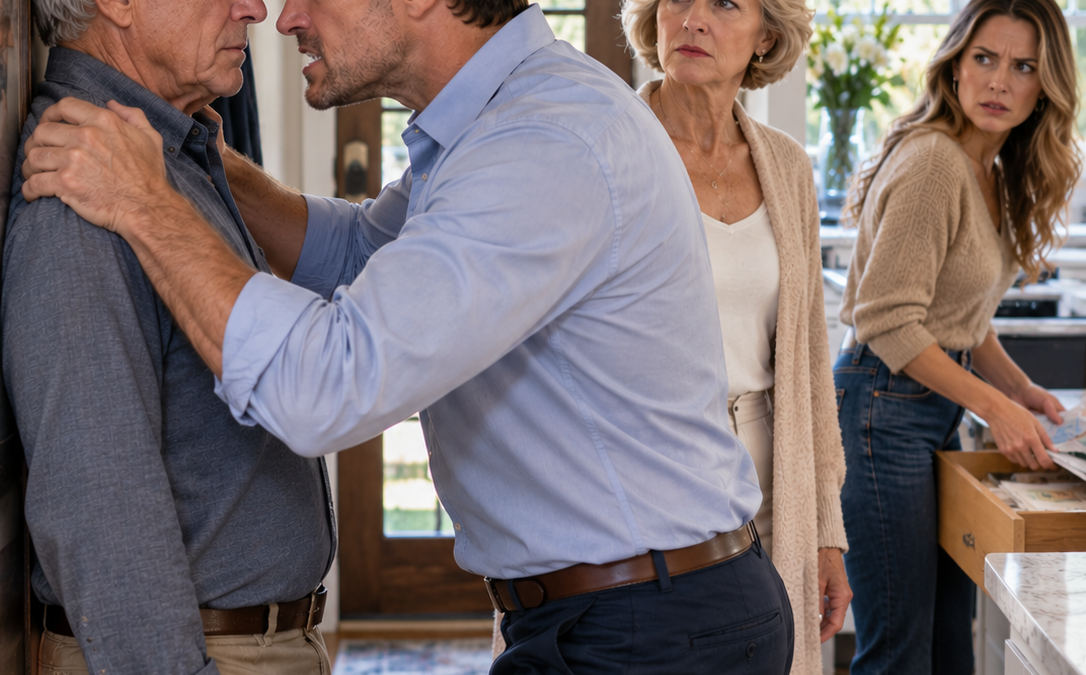
At six o’clock the next morning, my son came through our front door. He grabbed me by the collar in our own hallway and screamed that we had ruined his life. Behind him, his wife was pulling open every drawer in my kitchen, looking for the money that had disappeared.
And the two of us just stood there. We didn’t say a word because there was a camera above their heads. It had been recording for three days.
They thought they were looking at two panicked old people. What they didn’t know was that every word out of their mouths had already been recorded days before either of them walked in. Three hours later, both of them were in handcuffs.
But if you think I’m the one who planned all this, you’re wrong. I didn’t see any of it coming. My wife saw all of it, and I spent three weeks telling her she was reading too much into things.
My name is Marlon Kubak. Everybody’s called me Kub since about 1978. I’m 69 years old, and I’ve lived in Reno, Nevada, since I was four. I spent 34 years as a slot technician.
Now, people hear that and picture a man with a screwdriver opening a machine when somebody’s ticket printer jams. And that’s about ten percent of it. I did that, too. But the back half of my career, I was inside those cabinets, working with boards, hoppers, bill validators, and later on, the whole network side of it when everything went to servers.
I know how those machines work at the level of the schematic. And here’s the thing I know that almost nobody outside the business knows. It’s the entire spine of this story, so hold on to it.
A slot machine has never taken one dollar from anybody in the history of the world. Not one. It cannot. There’s no arm that comes out. Every dollar that goes into a machine is handed over voluntarily by a person, one pull at a time.
And the single most important piece of engineering in that whole cabinet is not the payout percentage. It’s the near miss.
Two cherries and a blank on the third reel. A jackpot symbol landing just above the payline, where you can see it sitting there.
That is designed. That is on purpose. It’s not a loss the machine got sloppy about. It’s a loss built to look like an almost. Because a loss that looks like a loss makes a person stand up, and a loss that looks like an almost keeps the hand moving.
For 34 years, I stood on that carpet. And I want you to hold on to that, because in about ten minutes, I’m going to tell you that my own family ran on that exact mechanism for two years, and I did not see it.
And I am the one man in Washoe County who should have.
My wife is Willine. Everybody calls her Willa. Forty-five years this September. We met in 1979 at a laundromat on Wells Avenue, which is not romantic and which she tells people anyway.
She spent 31 years in medical records, clinical coding mostly, which, if you don’t know what that means, involves reading a doctor’s chart against a billing sheet and finding the place where they don’t match.
That is her actual professional skill. Finding the line that doesn’t reconcile.
I have teased that woman about her filing for four decades. She keeps everything. Three-ring binders in the hall closet going back to 1986, tabbed in order.
“Who’s ever going to read all that?” I’d say.
Turns out one person was, and it was her. And it saved us about $118,000.
Our son is Bracken. Everybody calls him Brack. He’s 41. And I need to tell you about Brack at nine years old, because everything in this comes out of that.
When I worked swing shift, Willa would drop him at the property about ten minutes before I got off. He’d sit in the coffee shop off the casino floor with a Shirley Temple and do his homework, and then we’d walk out together.
And that boy loved it. He loved the noise and the carpet and the men in the shop with their bins of boards. He’d ask me what every part did, and he wanted to do it himself.
From about eleven to about twenty-two, that’s what my son wanted to be.
And then the industry changed, around 2004 through 2010. Everything went to server-based systems and central determination. The shop I worked in went from nineteen technicians to six.
They weren’t hiring. They were not going to hire again.
He never got in. It wasn’t anybody’s fault. The door just closed.
He sells commercial insurance now out of an office on Kietzke Lane. He’s been doing it fourteen years, and he has never once, not one single time, said anything good about it.
Hold on to that, too.
Seven years ago, he married a woman named Shaughnessy. Everybody calls her Shawn. She’s 37. She does aesthetics, injectables, laser treatments, that whole business, and she owns a piece of a clinic out in South Reno.
And Willa knew inside a year. Not about the money, but about the shape of it.
She said to me after the third or fourth time they came over, “Kub, watch how she looks at the house.”
And I said, “What house? It’s a 1960 ranch on Ralston with a swamp cooler.”
And Willa said, “Watch.”
Anyway, so I watched. And what I saw was a woman doing an appraisal. Her eyes went across the front room the way an adjuster’s eyes go across a car.
I said she was probably just nervous.
My wife looked at me with the exact patience she has used on me since 1979 and said, “Okay.”
She does that. When she’s certain and I’m not, she says, “Okay.” And she waits.
She has been right roughly ninety percent of the time for forty-five years, and I have learned nothing from it.
Brack changed slowly. The Sunday calls stopped in about year three. Then the drop-ins. Then he’d come by, and Shawn would do most of the talking while he’d sit there and agree with things.
I said he was busy.
Willa said, “He’s careful. That’s different from busy.”
Two years ago, in February, he came over by himself, sat at that kitchen table with a cup of coffee going cold in his hands, and said, “Dad, I want to help you and Mom with the bills.”
I put the paper down.
He said it was getting complicated. Online banking, autopay, the credit union app. He said it wasn’t my generation’s thing, and he didn’t mean it in a bad way. I didn’t take it in a bad way, either.
And he smiled at me.
Here’s the thing I have to say, because if I don’t say it, none of the rest makes sense.
That was the real smile. That was my son’s actual face, not a performance.
I have gone back over that afternoon about four hundred times looking for the tell, and there isn’t one. And I have decided that’s because there wasn’t anything to find yet.
In February, he meant it.
The rot came later. It always comes later. That’s the part nobody understands about people who do this. Most of them are not planning it in February.
So I said, “All right. We’ll put you on the checking account for the bills.”
Willa was standing in the doorway with a dish towel in her hands, and she did not say one word.
When he left, she said, “That was a mistake.”
And I said, “He’s trying to help.”
And she said, “Is he? Or is he being sent?”
It took her two weeks.
She came to me on a Sunday morning with the statement, and she was careful about it. Too careful, which is how I knew before she said anything.
She spread it out on the table, put her finger on four lines, and said, “These don’t match any bill we have.”
I looked, and she was right.
Nothing enormous. Two hundred forty dollars. Three hundred ten. One hundred eighty-five. Amounts close enough to a real bill that you’d skate right past them.
I said, “Maybe there’s an explanation.”
And Willa said, “Maybe. Let’s find out how bad it could be before we ask him.”
That’s the whole woman right there in one sentence. Not let’s confront him. Not let’s give him the benefit of the doubt.
Let’s find out how bad it could be.
She went down to the credit union on Monday and pulled six months of statements. She came home at eleven and sat at that table for four hours with three highlighters.
She built a system. Yellow for questionable, orange for definitely not ours, and a green check for anything she could tie to an actual invoice.
There was very little green.
Six months. $19,200.
I want to tell you what I did when she showed me that number, because it’s not flattering.
I argued.
I stood in my own kitchen and told my wife there were probably transfers she didn’t know about, that some of it might be him paying a bill early, and that we should ask him before we jumped to anything.
And I said one thing I’d give a lot to take back.
I said, “Willa, you’ve never liked her, and I need you to be honest with yourself about whether that’s in this.”
Forty-five years, and that is the worst sentence I have ever said to that woman.
She did not raise her voice. She has never once raised her voice at me, and it is the most unnerving quality a person can have.
She said, “You’re right that I don’t like her, and that’s why I pulled six months instead of coming to you after one line.”
Then she let me finish all of it. Two or three minutes.
And when I was done, she said, “Kub, he’s had access for two weeks. This is six months of statements.”
I sat down, because she was right, and it took me about four seconds to catch up.
I want you to understand the size of it.
He got on that account in February. The withdrawals had started the previous September.
Which meant that when my son sat at my kitchen table and offered to help me with my bills, he was not starting something.
He was regularizing something he’d already been doing for five months.
He had been getting in some other way, and we found out later it was the online login he’d set up for us in 2019 as a favor. He had never taken himself off of it, and nobody had thought about it since.
That’s when I stopped arguing with my wife, and I have not started again.
Willa called Booker Lamb the next morning.
Booker’s seventy. He does estate and elder law out of an office on Court Street. He did our wills in 2011 and Willa’s mother’s before that.
We sat in front of his desk, and Willa put the binder on it, because by then it was a binder, tabbed with a table of contents in her handwriting.
Booker read for eleven minutes without saying anything.
Then he looked up over his glasses and said, “Mrs. Kubak, how long did this take you?”
And she said, “A weekend.”
He said, “I’ve had forensic accountants give me less.”
Then he asked how far back we’d pulled.
Willa said, “Six months.”
And Booker said, “Pull three years.”
I said, “Booker, he’s only had access since February.”
He took his glasses off and said, “Mr. Kubak, the access is not the crime. The access is the part he asked permission for.”
Willa went back down there on a Wednesday and asked Nadira Sheth, who has been the branch manager since 2015 and knows us, for thirty-six months of everything.
Nadira looked at her and said very quietly, “Mrs. Kubak, is somebody taking advantage of you?”
And Willa said, “I don’t know yet. Ask me in a week.”
That week was the longest of my life.
My wife and I barely talked about it, because what was there to say?
The records came on a Thursday. I was out in the garage, and I heard the front door open. Then I heard her footsteps stop in the hall.
Just stop, halfway down the hall.
I stood up off that stool, and I knew.
She was at the table when I came in. Papers everywhere.
And she was not crying. Willa does not cry easily, and she wasn’t crying then. But her face had gone a color I’d only seen twice, and one of those times was at her mother’s funeral.
I said, “How much?”
And she said, “$118,400.”
I sat down. Had to.
“Over how long?”
“Twenty-six months.”
She said it started at three hundred a month. By last summer, it was four and five thousand dollars at a shot.
“And, Kub…” She turned a page. “It’s always within two days of a deposit.”
Now, I want to slow all the way down here, because this is the exact second the whole thing turned over for me, and it had nothing to do with the number.
Within two days of a deposit.
Our pension hits on the third. Social Security hits on the second Wednesday.
Which means that for twenty-six months, my son knew our deposit schedule better than I did.
And he was waiting.
He wasn’t taking what he needed when he needed it. He was taking when the well filled.
That is not somebody in a jam. That is somebody with a system.
And then Willa said, “There’s one more thing.”
She pulled out a single sheet.
A credit-line application. $24,000 in my name.
And at the bottom of it, my signature.
I picked it up and looked at it for a long time.
It was close. It was really close.
The M was right, and the loop on the K was right. But my last letter runs downhill. It has since I was a kid. Every K I have ever written drops off the line at the end, because I’m already moving on to the next thing.
That one sat level.
I said, “That’s not mine.”
And Willa said, “I know. I already knew.”
I said, “How?”
And she said, “Because it’s too neat. Yours is never that neat.”
Thirty-one years of reading charts. She caught it in about six seconds. And she’d been sitting with it for an hour, waiting for me to get to it myself.
That’s the moment it stopped being a family problem.
Because everything before that, every withdrawal, every dollar, a lawyer can stand up in a courtroom and call it a misunderstanding about the scope of permission.
You cannot misunderstand your way into writing another man’s name.
If you have ever had somebody hand you proof about a person you love and felt yourself reaching for a reason it might not mean what it means, that’s not stupidity.
And it isn’t denial, exactly.
It’s that your whole nervous system is voting.
Mine voted for three weeks.
Willa’s didn’t vote at all, and I think that’s because she’d already grieved it quietly somewhere around week two, while I was still explaining things.
Booker laid it out on a Tuesday.
He said elder financial exploitation, forgery, and, depending on what else turned up, identity theft.
He said Nevada takes the elder piece seriously and that we were past the point where this ends with a family conversation.
And then he said the thing that mattered.
“You cannot confront him.”
I said, “He’s my son. I have to.”
And Booker said, “The second he knows, two things happen. He starts explaining, which he’ll be good at because he’s had twenty-six months to practice. And every piece of paper that’s still in his house goes in a bag.”
He said, “Here’s what you do instead. You cut it off without a word, and then you let him show you who he is.”
And Willa said, “How?”
Booker Lamb said, “He’ll come to the house.”
Here’s what we did.
We opened a new account at a different institution entirely. Willa handled it, because Willa does the paperwork. Pension and Social Security were redirected effective the next cycle.
We left the old account open with $96 in it.
I asked Booker, “Why not zero?”
And he said, “Because zero looks like a decision, and ninety-six looks like an oversight. And we wanted the reaction to happen at your house, not in his lawyer’s office.”
On Tuesday, I put a camera up over the front door.
It was a doorbell unit. Ninety dollars at the hardware store on Mae Anne Avenue. Took me twenty minutes on a stepladder.
Willa stood in the doorway watching me do it with her arms folded.
She said, “You think they’ll come here?”
And I said, “When the money doesn’t land? Yeah, they’ll come here.”
And she said, “Good.”
That’s my wife. Sixty-eight years old, five feet two inches tall, thirty-one years reading other people’s charts.
“Good.”
Then we waited eleven days.
And I want to tell you about those eleven days, because I don’t think anybody talks about this part.
He called twice. Normal calls.
“How you doing, Dad? Is Mom’s knee any better? What do you think of the game?”
And I sat in my kitchen and talked to my son about basketball while the $96 sat in that account like a baited hook.
I was pleasant, and I was warm.
When I hung up the second time, I went out in the garage and sat on that stool for about half an hour.
Because I loved him.
That is the thing that doesn’t fit anywhere in a story like this, and I’m going to say it anyway.
In the middle of all of it, on the phone, I loved that man.
There was one night in there, the Sunday, I think, when I got up at about two in the morning and went out to the kitchen. I took the phone off the charger and stood there with it in my hand for probably four minutes, because everything in me wanted to call him and say, “I know. I know all of it. Just come here and tell me the truth, and we’ll figure it out.”
I want that on the record, because I think a lot of people watching this are standing in a kitchen at two in the morning right now, with a phone in their hands.
And what stopped me was not strength.
What stopped me was that I turned around, and Willa was standing in the doorway in her robe.
She hadn’t said anything. She’d just been standing there.
And she said, “Put it down, Kub.”
So I put it down.
That’s the whole marriage right there. She didn’t argue with me. She didn’t remind me of anything. She just came and stood where she could see me.
The deposit hit the new account on a Thursday morning.
Willa checked her phone at the breakfast table, looked up at me, and said, “It’s in.”
And I said, “Then it starts now.”
Friday morning, ten to six.
It wasn’t a knock. I want to be precise about that because it ended up mattering.
The door itself shook. Three hits, hard, with the flat of a hand, and then a fourth.
Willa was already up and dressed. Both of us had been sleeping about four hours a night for a week and a half.
I looked at my phone. The camera feed was up.
Brack was on the porch, and behind him, halfway down the walk, was Shawn.
I opened the door.
Now, I want to slow this all the way down, because it lasted eleven minutes and forty seconds. I know that because that’s the length of the file, and it is the longest scene in this whole thing.
He came in before I could say anything.
Right past me into the front room.
And he said, “Where is it?”
I said, “Where’s what?”
And he said, “Don’t. Don’t do that. The account’s got nothing in it. Where’s the money?”
Shawn came in behind him and did not stop in the front room. She went straight through to the kitchen.
I heard her open a drawer, then another one.
She was going through my kitchen drawers, in my house, at six in the morning, looking for a statement or a card or whatever she thought was in there.
I want to tell you what that sounded like, because it is the detail I have not been able to get rid of.
That’s Willa’s kitchen.
Those are the drawers my wife has had organized in the same arrangement since we redid that kitchen in 1997.
The junk drawer sticks, and you have to lift it.
I heard it stick, and I heard her force it.
And there was a moment, maybe two seconds, when the only sound in that whole house was a woman I had eaten Thanksgiving dinner with seven times going through my wife’s drawers.
Willa came around the corner from the hall.
She was completely calm.
And she said, “Good morning, Brack.”
That’s all.
Good morning.
I want you to understand what that did.
He came in there at full volume, expecting a fight, and my wife met him with a pleasant good morning. It took the ground out from under him for about two seconds.
Then he got it back.
He said, “Mom, don’t. Don’t be like that. The mortgage came out, and it bounced. The car came out, and it bounced. Do you understand what that does to us?”
Shawn came out of the kitchen and said, “You have destroyed our credit. Do you have any idea what you’ve done?”
And I said, keeping my voice level because I had been telling myself for eleven days to keep my voice level, “What we’ve done?”
And Shawn said, “Yes, what you’ve done.”
Willa said, “Brack, that’s our pension.”
And here’s the part I still cannot get around. It’s the reason I’m telling this to strangers on the internet.
My son said, “We built our life around that.”
Around our pension.
He said it out loud in our front room, and he did not hear himself say it.
There was no flinch. It came out of him the way a fact comes out.
The house in Somerset, $3,850 a month. Two cars. The clinic buy-in. All of it.
He had built it on money that came out of a state retirement system for thirty-four years of a man opening cabinets.
Willa said, “You were supposed to pay our bills, Brack. You were not supposed to live on us.”
And Shawn said, “You gave him access. That makes it ours.”
Willa said, “No. That makes it reachable. It doesn’t make it yours.”
And this is the line. This is the one I’d put on a shirt.
That makes it reachable. It doesn’t make it yours.
Shawn’s mouth actually opened, and nothing came out.
And that’s when Brack put his hands on me.
He came across that room, got both hands on my shoulders, and put me back into the wall by the coat hooks.
Not hard enough to hurt.
I want to be accurate about that. It wasn’t a blow. It was a shove and a hold.
He had his face maybe eight inches from mine.
And he said, “You’re going to call them right now and put it back. Now.”
I am sixty-nine. He’s forty-one, and he’s got four inches on me.
I had about a second and a half to make a decision, and I want to walk you through it because it’s the only genuinely difficult thing I did in this entire business.
I could have shoved back.
I wanted to. Every part of a man wants to.
And if I had, then what’s on that camera is two men fighting in a hallway. Every lawyer in Washoe County calls that a family dispute.
And a family dispute goes nowhere.
So I didn’t move.
I let my son hold his father against a wall in his father’s own house, and I did not lift a hand.
I want to tell you honestly that it is the most humiliating thirty seconds I have ever experienced.
And I would do it again tomorrow.
I’ll tell you what I was actually looking at while it happened, because it wasn’t him.
There’s a row of coat hooks on that wall. Four of them. I put them up in 1994.
And the second one from the left has a mark under it about the size of a thumbprint, where a nine-year-old boy hung a backpack every single day for six years, and the wall never recovered.
I was eight inches from my son’s face, and I was looking past his ear at that mark.
If you have ever had to hold absolutely still while somebody you love did something that could not be taken back, because moving would have made it worse or because moving would have handed them the version of the story they wanted, then you know what that is.
It is not restraint.
There’s no dignity in it while it’s happening.
You just stand there and go somewhere else in your head.
And mine went to a backpack.
Willa said from about six feet away, in a voice like a nurse taking a temperature, “Brack, take your hands off your father.”
And Shawn said, “Don’t talk to him.”
And Willa said, “The camera above the door has been running since Tuesday.”
Eleven seconds.
I counted them later on the file.
Eleven seconds when nobody in that room said one word.
I watched my son’s face, and it went through about four things.
First, he didn’t believe her. Then he looked at the door, actually turned his head and looked at the transom over the door.
Then he saw it.
And then his hands came off my shoulders like I’d gone hot.
He backed up two steps.
Shawn said, “You’re recording us? That’s illegal!”
And Willa said, “It’s a doorbell camera on our own house.”
Then my son said the only thing he said that whole morning that I believe was true.
He said, “Dad, I was going to put it back.”
And there it is.
I’ve heard that sentence about nine hundred times in my life, standing on a casino carpet, from people who had just fed a machine everything in their pockets.
I was going to get it back.
They left.
Shawn was still talking on the way down the walk.
Willa and I stood in our front room, and neither of us moved for a while. Then she came over and put her hand flat on my chest, right where he’d had me.
Neither of us said anything.
Detective Alma Yepz came out that afternoon.
She watched the file twice. Then she watched the first ninety seconds again.
And she said, “Mr. Kubak, why didn’t you push him off you?”
I said, “Because I’ve been married forty-five years to a woman who told me not to.”
Detective Yepz looked at Willa and said, “That was correct.”
They arrested them both the next morning at the house in Somerset.
I did not go, and I did not ask.
And then the thing got bigger, which I had not expected.
Detective Yepz called us in about three weeks later, and she had a whiteboard behind her with a timeline on it.
$19,700 in credit card debt in my name. Three cards.
$38,500 in personal loans.
And here’s how they got them.
On three separate applications, Brack listed our house as an asset worth $800,000. Listed himself as the sole heir.
And this is the one Willa had to leave the room for.
He indicated that both of us were in declining health.
He told lenders his parents were rich and dying.
We are neither.
That house is worth about $340,000, and I ran four miles a week until my hip went.
Then Detective Yepz put up the last one.
$31,000 in casino losses across fourteen months.
I said, “Whose?”
And she said, “Hers, mostly. Some his.”
I sat in that room and looked at a printout of ticket-in, ticket-out records from three properties in this town, two of which I have personally worked in.
And I want to tell you exactly what happened in my chest, because it was not what I expected.
It wasn’t rage.
It was recognition.
I have watched that pattern from six feet away for thirty-four years.
I could have drawn that curve on a napkin before anybody showed me a printout.
It starts small, and it’s fun.
Then there’s a hole.
Then you’re not playing anymore. You’re chasing.
And chasing is a completely different activity that uses the same machine.
The whole time, the thing that keeps a person in that seat is not winning. Winning gets you up eventually.
It’s the almost.
And here’s the part that took me four months to be able to say out loud.
Willa had to sit with me on the back steps the night I finally got there.
My son ran the same play on us.
Twenty-six months.
Small at first, then bigger, then systematic, then desperate.
And in the middle of it, this is in the records, Willa found something.
He paid us back twice.
Nine hundred dollars in December of the first year. Six hundred and something the following March, unprompted, into the account.
Nobody asked him for it.
At the time, I didn’t even notice.
Willa found those two deposits on the third pass. She brought them to me and said, “Kub, why would he put money back?”
I looked at those two lines, and it went through me like a current, because I knew exactly why.
Because I have known why since 1991.
A machine that never pays out doesn’t hook anybody.
People stand up and walk away.
What holds a person is intermittent reward. Small, unpredictable, occasional partial payoffs.
Those two deposits were the most expensive money we ever received.
Because in the moment we got them, without either of us thinking about it, we stopped being parents watching a situation and became players who’d seen the machine pay.
Nine hundred dollars in December bought him eleven more months.
That’s not me being poetic.
That is the actual mechanism.
It is the same one printed on a board inside a cabinet, and I spent my whole life inside those cabinets.
And it ran in my own kitchen for two years.
The plea took four months.
Their attorney was a man named Rhys Toiver, who’s good, and who opened by trying to make it about a dysfunctional family and greedy parents.
He dropped that line entirely the day after the deputy district attorney sent him the video.
The deputy DA was a woman named Camille Boateng. She’s about thirty-eight, and she does nothing but financial crimes against older adults.
She was the third person in this whole business to look at Willa’s binder and ask who put it together.
She was straight with us.
She said, “Trials are unpredictable. Juries can go soft on a family case, and a conviction you negotiate is worth more than a conviction you gamble on.”
Then she asked us what we actually wanted.
Willa said, “Every dollar back, in writing, on a schedule.”
Booker helped us draft what we’d accept.
And I want to be clear about what was in it and what wasn’t, because I have opinions about how these things get portrayed.
We did not get a public apology.
That’s not a thing.
You cannot make a plea deal require somebody to be sorry.
What we got was guilty pleas to felony exploitation of an older person and forgery, with the identity-theft counts running concurrently.
Full restitution. The $118,400, plus the credit card and loan amounts, totaling just under $177,000, at $1,974 a month for six years.
Six years of probation, mandatory gambling treatment for both of them, and a no-contact order.
And one thing Camille Boateng told us was worth more than anything else in the document.
A full allocution in open court.
Which means he had to stand up and say what he did out loud, on the record, in front of a judge.
Not an apology.
A statement of facts.
That hearing was in September.
Now, I want to slow down again, because this was twenty-five minutes, and it’s the last time I was in a room with my son.
Judge Nakagawa’s courtroom. Second floor. A Tuesday morning.
There were maybe eleven people in there. Willa wore her navy suit. She has worn that suit to two weddings, four funerals, and one hearing.
When Brack came in, I did not recognize him for about a second and a half. He’d lost weight. Real weight. Twenty-five pounds of it. His suit was hanging on him, and he had gray at the temples that had not been there in the spring.
Shawn came in behind him, and she looked exactly the same. She looked at us the way you look at a road closure.
The judge asked him to state, in his own words, what he had done.
He stood up with a piece of paper, and his hands were shaking so badly he had to put it flat on the table to read it.
I’m giving you the substance of what he said.
He said that beginning in September of the year before last, he used online access to his parents’ account, which he’d set up for them as a favor and never removed himself from, to withdraw money without permission.
He said the total was $118,400 over twenty-six months. He said he timed the withdrawals to their deposits.
He said he applied for a credit line of $24,000 using his father’s name and a signature he wrote himself.
He said he obtained loans by telling lenders his parents were wealthy and in poor health, both of which he knew were false.
He said that when they cut off his access, he went to their home and put his hands on his father.
And then he stopped reading.
The judge said, “Is there anything further?”
He looked up, and he looked at us for the first time.
And he said, “I told myself every single month that it was the last one.”
Judge Nakagawa answered him, and this is the part I wrote down in the car afterward.
She said, “Mr. Kubak, everyone I sentence in this seat tells me that. It’s the most common sentence in this building, and it’s the reason the number gets to $118,000 instead of stopping at $300.”
Then she gave him the terms, and it was done.
Out in the hallway, he tried to come toward us, and his attorney caught his arm because of the order. He stood there about ten feet away with his hands at his sides.
And Willa, my wife, who caught it in two weeks, who built the binder, who told me not to push him off me, who did not cry through any of it, looked at our son.
She said, “Brack, we love you.”
Then she said, “And we’re not going to see you for a while.”
She took my arm, and we walked to the elevator.
I did not say one word to my son in that hallway.
I have thought about that more than anything else in this whole business. She got a sentence out, and I got nothing out. And I don’t know to this day whether that was strength or whether the tank was just empty.
Here’s where it all landed.
Shawn filed for divorce in November. Moved to Sacramento, to her sister’s place. That did not surprise anybody.
Willa called it in March, in our kitchen, before charges were even filed. She said, “That woman will be gone inside a year of the money stopping.”
She was off by two months.
Brack works two jobs now. A warehouse out by the airport during the week and weekend shifts at a rental car facility. He lives in a studio in Sparks.
The payment comes on the first. $1,974.
It has not been late one time in fourteen months.
I want to say something about that because I go back and forth on it. That is a man working six days a week to pay back his parents for six years.
And there is a version of me that is proud of him for it.
I do not entirely trust that version.
Willa said something about it in April that I’ve thought about a lot.
I said something like, “Well, at least he’s paying.”
And she said, “Kub, he’s paying because a judge is watching. That’s not the same as changing, and you’re going to have to be able to tell the difference for the next five years, or you’ll be right back in that chair.”
Then she said the harder one.
“And if he does change, it’ll be slow, and it won’t look like anything, and it won’t announce itself. Real change is the most boring thing in the world to watch. If it ever shows up looking dramatic, it’s not it.”
I’ve spent a lot of time thinking about that, too.
His wife’s sister called us the week after the arrest. Terrilyn. She wanted to know how we could do this to our own son.
She said Shawn told her we were declining, that we were confused, and that they were only trying to help manage things for us.
I said, “Terrilyn, there’s video. There’s $118,000 in bank records, and there’s an application with my name on it in somebody else’s handwriting. Wait for the hearing. It’s public.”
She called me a monster.
And I said, “No, ma’am. I’m just somebody who quit paying.”
Now, the hard part. And I’m going to be fair, even though I don’t feel like it.
My son wanted my job.
From about eleven to twenty-two, that’s what he wanted. He used to sit in that coffee shop off the casino floor doing his homework, then walk out to the truck with me asking about bill validators.
And that trade closed.
Not to him personally. To everybody.
Nineteen technicians down to six, and they were not hiring again. There was nothing anybody could do about it.
He ended up selling something on Kietzke Lane that he has never once said a good word about.
And then he married a woman with a real problem.
I want to say this carefully because this is my town, Reno.
That’s not exotic. That’s a thing that happens here to somebody’s daughter, somebody’s dentist, somebody’s shift supervisor, constantly.
And most of them are functioning right up until they aren’t.
Brack started covering for her.
That’s how it began. One hole, once.
And covering made the hole bigger.
Then he was chasing.
He did it in the exact pattern I could have drawn on a napkin, in the town I’ve lived in for sixty-five years, in the industry his father worked in for thirty-four.
And nobody in that family knew how to name it, including me.
And I am the one who should have.
That doesn’t excuse a thing. He put his hands on me in my own hall, and he wrote my name on a document. There is no bad decade that gets a man there.
But I’m not going to sit here and tell you my son is a monster, because he isn’t.
He’s a man who was chasing.
And chasing is the most ordinary thing in the world. It looks completely reasonable from the inside, right up until you’re standing in a courtroom.
So here’s what this taught me, and it comes right off a casino carpet.
Nobody takes anything from you. You hand it over one pull at a time because you keep being shown an almost.
That’s true of a machine.
And it turned out to be true of my family.
Every “I’ll get it back to you next month” was two cherries and a blank. Every small thing he did right, the phone calls, Christmas, the two deposits, was the jackpot symbol sitting just above the payline where you can see it.
And the thing that keeps a hand moving is never the win.
It’s the almost.
So here’s the one thing I would ask you to actually do. It takes about four minutes, and it is the opposite of what everybody’s instinct says.
If somebody in your life owes you money, a kid, a sibling, anybody, go count the paybacks, not the loans.
Everybody tracks what they gave.
Nobody tracks what came back.
Write down every partial repayment. The date, the amount, and, this is the important part, what happened next.
Then look at the shape of it.
Because here’s what you may find, and it is what we found.
If the paybacks are small and irregular and unprompted, and each one is followed within a few months by a larger ask, that is not somebody demonstrating good faith.
That is intermittent reinforcement, and it is the exact schedule those machines run on.
And it is not an accident that it’s working on you.
I am not saying the person is doing it on purpose. My son was not sitting there with a chart. Most people who do this are drowning, not scheming.
But the mechanism does not care about intent.
It works either way.
And the only defense against it is a piece of paper with dates on it, because your feelings will not catch it.
Mine didn’t.
And one more thing, because this is my town, and I’d be a coward not to say it.
If the person in your family is the one at the machine, there is a helpline printed on every cabinet in this state.
And there’s a national one. 1-800-GAMBLER.
It’s free, and it’s answered around the clock. It is not a moral failing, and it is treatable. The average person waits about seven years to make that call.
Don’t be average about it.
And the question I sit with most nights is this: When was the last time somebody showed me an almost, and did I write it down as progress?
We’re all right, Willa and I.
The money’s ours again. The house is quiet.
We do the same thing we’ve done for about twenty years, which is coffee on the back steps in the evening, looking at Peavine, and neither of us says much.
She’s still got the binder.
It’s in the hall closet with the rest of them, tabbed in order. Third from the left.
I asked her once if she wanted to throw it out.
And she said, “No. That’s the year I was right, and you finally listened.”
Forty-five years.
She’s going to hold that one over me until one of us is gone.
And honestly, she has earned it.
Now, I want to hear from you, because I go back and forth, and I’d like to know.
Comment one if you think we did right, cutting it off cold with no warning, putting a camera up, and letting them come to the house and show us who they were.
Comment two if you think we should have sat him down the day Willa found those first four lines and asked him straight out, before it ever got to a lawyer, even knowing that everything on paper would have gone in a bag that night.
And comment three if you think I should have pushed him off me. Because I did not. I let that happen on camera on purpose, and I have not entirely made my peace with it.
My brother has told me twice that a man does not stand there.
Number three is the one.
Tell me what you’d have done. And tell me where you’re listening from and what time it is where you are right now.
It’s a little past nine here, and it’s cold off the mountain the way it gets in October. It still gets me that somebody’s hearing an old slot tech talk while they’re eating breakfast on the other side of the world.
And here’s the one I really want.
If somebody who owes you money has ever paid you back a little bit out of nowhere, and you felt relieved and thought, “Okay, he’s turning it around,” tell me what happened after that.
Not what you hoped.
What actually happened, and how long it took.
Because we got $900 in December, and it bought that boy eleven more months.
I didn’t understand what I’d just been handed until my wife put it in front of me with a highlighter on it.
If this one reached you, stay with me and subscribe.
It’s an old man on the back steps in Reno with a microphone and a wife who was right the whole time and is very gracious about it.
Mostly.
This is a fictional story inspired by real emotional experiences, fully rewritten and reimagined in Reno to create original content. Any resemblance to real people or events is coincidental.








