I got a $450,000 a year job; my dad demanded, “50% for us, 30% for your brother, no excuses”; that afternoon i packed everything and cut off all their credit cards; now they are coming…
“Fifty percent for us, thirty percent for your brother. No excuses.” That afternoon, I packed everything and cut off all their credit cards. Now they are coming.
The rain had started an hour before I got to my parents’ house, and it hadn’t let up by the time I parked in their driveway with a bakery box balanced on my knee and a manila folder tucked under my arm. I sat there for a minute, engine ticking as it cooled, watching the porch light flicker the way it always had. A loose wire nobody had ever bothered to fix, because fixing things that didn’t directly benefit my brother had never been a priority in that house.
I was thirty-one years old, and I was about to tell my parents that I’d just been made director of structural engineering at Halverson Maritima, a marine infrastructure firm that built offshore platforms and seawalls up and down the coast. The offer letter in that folder listed a base salary of $310,000 a year, plus a profit share that could double it in a good year. I had spent eleven years getting to this driveway—eleven years of night classes, of failed certification attempts, of living in a converted garage apartment with a hot plate and a space heater, of doing overtime nobody asked me to do because I needed the extra four hundred dollars more than I needed sleep.
I should have known better than to bring the folder into that house. But some part of me, the part that was still nine years old and holding up a spelling trophy nobody looked at, wanted one more time to see if they could be proud of me. It’s a strange thing, how long that part of you survives. How many times it can be disappointed and still show up the next time with the same foolish hope intact, like a dog that keeps waiting by a door someone stopped walking through years ago.
My mother, Karen, opened the door before I knocked. She hugged me the way she always did, arms not quite closing all the way around, eyes already sliding past my shoulder toward the car to see if I’d brought anything else. It was a specific kind of hug, one I’d cataloged without meaning to over the years: warm enough to pass for affection in a photograph, hollow enough up close that you learned not to lean into it.
My father, Roland, was in his recliner with the television on, and he didn’t get up. He rarely did for me. He’d gotten up for Julian’s college acceptance call. He’d gotten up once, memorably, when Julian walked in wearing a new watch he wanted everyone to admire. For me, the recliner held.
“You’re late,” he said, which was how he said hello.
“Traffic,” I said, setting the bakery box on the counter. It was a lemon tart, my mother’s favorite, purchased on the theory—which I still, even now, cannot fully explain—that showing up with something sweet might soften whatever was coming. I had learned this instinct from her, ironically: the belief that food could stand in for feeling, that a well-chosen pastry could do the emotional labor a sentence couldn’t.
My younger brother, Julian, was already at the table, wearing a blazer that cost more than my monthly rent, scrolling through his phone with the particular slouch of a man who has never once in his life worried about being interrupted. He was twenty-eight and called himself a growth strategist, which, as far as I could tell, meant he consulted for companies that didn’t exist yet using money that wasn’t his. His current venture, I’d been told over several unsolicited phone calls, was something called a logistics optimization platform, a phrase he used with the confidence of someone who had memorized it phonetically without ever quite understanding what it meant.
“Marin,” he said without looking up. “Did you bring the tart with the lemon curd or the regular one? Mom likes the curd one.”
“Curd,” I said. “Hi to you, too.”
He grunted something that might have been acknowledgment and went back to his phone. Dinner was pot roast, my mother’s one dependable dish, and for twenty minutes the conversation moved the way it always did: around me, past me, occasionally at me when someone needed a ride or a signature or an opinion on something that had already been decided.
My father talked about a client dispute at his consulting business that, as far as I could tell from the details he gave, was really just a client who had finally stopped paying him for advice that hadn’t worked. My mother talked about a woman at her bookkeeping job whom she suspected of stealing office supplies, a suspicion she’d been nursing for what sounded like months with the intensity most people reserve for actual crimes. Julian talked at length about a pitch deck he was building for investors who, when I later asked around in professional circles I now had access to, turned out not to have returned a single one of his emails.
I let it happen. I was used to being furniture in that dining room. Useful furniture, load-bearing furniture, but furniture all the same—the kind of chair nobody thanks for holding up the room because holding up the room is simply what chairs are for. When my mother started clearing the plates, I set the folder on the table.
“I got a promotion,” I said. “I wanted to tell you in person.”
My father muted the television. That alone should have warned me. He never gave anything his full, undivided attention unless he smelled money in the room. It was a reflex I’d watched my whole life, the way some men perk up at the sound of a slot machine paying out three rows over. He had a nose for windfalls that didn’t belong to him, and it had never once in thirty-one years failed to activate.
I opened the folder and turned it so they could read the top line. My mother’s eyes went straight to the number, the way a moth goes straight to a porch light, helpless and instant. She didn’t say congratulations. She said, “Three hundred and ten thousand,” half under her breath, like she was tasting the words, weighing them, already doing arithmetic of her own.
Julian looked up from his phone for the first time all evening. That, too, told me everything. The number had done in half a second what nothing else at that table had managed to do in twenty minutes. My father picked up the letter, read it slowly—too slowly, deliberately slowly, the way a man reads a contract he intends to negotiate rather than a piece of news he intends to celebrate—and set it back down, folding his hands on the table like a man about to deliver a verdict. In a sense, he was.
“This changes things,” he said. “You understand that, don’t you, Marin? A family looks out for its own. Your mother and I put a roof over your head for eighteen years. We are entitled to a share of what that investment produced.”
“What are you asking for?” I said, though I already knew. I’d watched this exact scene play out in smaller versions my whole adult life. Every raise, every bonus, every tax refund had come with an invoice attached, presented as if it were the most natural thing in the world, as if love and debt were the same instrument and I had simply never read the fine print closely enough to notice.
“Half,” he said. “For your mother and me. And Julian needs seed capital for his new venture. A logistics platform. Very promising. So twenty percent to him. That leaves you thirty percent, which is still more than most people your age make in a year. You should be grateful we’re not asking for more.”
I did the math without meaning to. It arrived in my head fully formed, the way a structural load calculation does when you’ve run enough of them that your brain does it automatically, without conscious effort, the numbers simply presenting themselves. Seventy percent of $310,000 was $217,000 a year, gone before I ever saw it, leaving me with less than I’d made at my last job. The one I’d spent three years clawing my way out of. The one where I’d eaten the same six-dollar lunch every day for two years to make my student loan payments on time.
“That’s not a share,” I said quietly. “That’s you taking almost all of it.”
“Don’t be dramatic,” my mother said.
And there it was: the word she always reached for first, the one designed to make my math into an emotion, my emotion into a character flaw. The reliable pivot that had ended a thousand conversations before they could go anywhere honest.
“Your brother has real expenses. This platform of his could be enormous. You want to be part of that, don’t you? Family should invest in family.”
“His last three ventures didn’t make it a year,” I said. I could list them if pressed: the artisanal coffee subscription box, the crypto-adjacent rewards app, the influencer logistics company that had, as far as I could tell, never actually shipped anything to anyone. Each had been funded, at least in part, by money that had passed through my hands first.
“That’s because he never had proper backing,” my father snapped. “You have the backing now. Use it.”
Julian didn’t defend himself. He didn’t need to. He just watched me with the mild, patient expression of a man waiting for a vending machine to finish dispensing, the expression of someone who has never once had to consider the possibility that the machine might simply stop working.
“I built a filtration model for the dry docks two years ago that’s still holding under load nobody thought it could handle,” I said, mostly to myself, mostly because the absurdity of the moment needed somewhere to go. “I can run the numbers on a seawall that has to survive a hundred-year storm. I can tell you exactly what thirty percent of $310,000 looks like after taxes, after rent, after the loans I’m still paying off from the degree that got me this job in the first place. It’s not enough to live the way I live now. You’d be asking me to take a pay cut to get a promotion.”
“Then live smaller,” my father said, as if this were a reasonable thing to say to a woman who had already spent a decade living smaller than anyone in that room had ever had to. “You’ve never needed much. That’s always been your strength.”
I looked around that table: at the man who had once sold my bicycle to cover a bounced check and told me I’d understand when I was older; at the woman who cried real tears over furniture but never once over me; at the brother who had learned, correctly, that he would never have to earn anything he could instead simply request. And I felt something in my chest go very still and very cold.
Not rage. Rage would have been loud, and loud had never worked in that house. Loud got you labeled dramatic, unstable, ungrateful. This was quieter than that. This was a door closing somewhere deep in a house I didn’t live in anymore, closing with the soft, final click of a lock rather than the bang of anything slammed.
“Okay,” I said.
My father smiled, satisfied, already reaching for the pot roast again like the matter was settled, like he’d expected nothing less, because in his accounting of our relationship, nothing less had ever been required of me.
“I’ll think about it,” I added.
That smile faltered because, in thirty-one years, I had never once said those words to him. I had always simply paid. Sometimes with a sigh, sometimes with a quiet, private resentment that I never let surface at the table, but always, eventually, with the money.
“There’s nothing to think about,” he said, an edge creeping into his voice now. “This isn’t a negotiation, Marin.”
“Everything is a negotiation,” I said. “You just haven’t had to negotiate with me before.”
My mother made a small, wounded sound, the kind she deployed the way other people deployed evidence. “Why are you being like this? We’re your parents. We’re not asking for charity. We raised you.”
“You raised me to pay for things,” I said, and I heard my own voice come out steadier than I felt, steadier than I had any right to feel with my hands shaking slightly under the table where no one could see them. “I don’t think that’s the same thing.”
I left before dessert. I did not eat the lemon tart, which sat, I imagined, forgotten on the counter while the argument about me continued without me in the room to hear it. I did not sleep that night. I lay in my garage apartment listening to the space heater cycle on and off, running the numbers again and again: seventy percent, $217,000, thirty percent, less than I made now. Until the numbers stopped being numbers and became something closer to a verdict on exactly how much of my life I was expected to hand over simply because I had at last made something of it.
But for the first time in longer than I could remember, the thing keeping me awake wasn’t dread. It was arithmetic. And arithmetic, unlike dread, has an answer.
To understand why that dinner broke something instead of just bending it, you have to understand the shape of my childhood. Because it wasn’t cruelty in the dramatic sense. No one hit me. No one screamed obscenities in public. No one would have looked from the outside at the Voss family and seen anything but an ordinary suburban household with two working parents and two kids who mostly kept to themselves.
It was quieter and, in its way, more thorough: a slow, patient redistribution of resources and attention from me to Julian, dressed up as fairness, as necessity, as love, until the redistribution became so normalized that even I, for years, couldn’t have told you exactly when it started or named it as anything other than the way things simply were.
I was seven when Julian was born, old enough to remember the before. Before, I had been the only child, and while my parents were never warm people—Karen had grown up with a mother who believed praise spoiled children, and Roland’s own father had run their household like a small, underfunded business—they were at least evenly cold. I did not feel singled out because there was no one to be singled out against.
Once Julian arrived, something in the household’s operating system changed, quietly and then not quietly at all. He cried more than I had, or so I was told, and my parents responded to that crying with an urgency they never extended to my quieter needs. I learned early, the way children learn everything important without being told, that being difficult got you resources and being easy got you overlooked.
And since I was, by temperament, an easy child—self-sufficient, undemanding, quick to soothe myself rather than wait to be soothed—I spent the next eighteen years being systematically overlooked in favor of a brother who had figured out, correctly, long before either of us could have articulated it, that difficulty was a currency, and I was comparatively spending none.
The clearest early memory I have is from when I was fourteen. I’d spent four months building a water filtration model for the regional science fair, a real working system using layered sand, gravel, and activated charcoal that could take pond water and make it drinkable, tested against county health department standards with the help of a chemistry teacher, Mr. Aldana, who believed in me more than my parents ever had.
I remember the particular ache of those months: staying after school in the empty chemistry lab while Mr. Aldana graded papers at his desk, testing turbidity levels with a borrowed meter, redesigning the filtration layers three separate times after my first two attempts failed to clear the water to standard. I won second place and a check for eight hundred dollars, which felt, to a fourteen-year-old who owned exactly two pairs of jeans and had learned to layer thin socks inside shoes with worn soles, like the entire contents of Fort Knox.
I remember running the six blocks home with the check folded so many times it had gone soft at the creases, my chest burning, already imagining what eight hundred dollars might mean. New shoes, maybe, or the start of a savings account, or just the quiet, private satisfaction of having something that was unambiguously mine, earned by my own hands, untouchable by anyone else’s need.
My father deposited that check into the family account the next morning without asking me, walking me to the bank himself, in fact, as though accompanying me were a kindness rather than supervision. He explained in the car on the way that the family account was for everyone, that money coming into the house belonged, in a sense, to the house itself, that this was simply how families worked. I didn’t understand at fourteen that I was being taught a lesson that would take me another seventeen years to fully unlearn.
Two weeks later, Julian, who was seven and had expressed a passing interest in soccer after watching a World Cup match with unusual attention, had a full set of club-level cleats, a travel bag, and a private coach who came to the house twice a week. When I asked about my money, my mother told me that I was the responsible one and didn’t need things the way Julian did, that Julian was more sensitive and required more support to thrive.
I did not see another dollar of that eight hundred. I did, however, see Julian quit soccer four months later, bored, the cleats donated still barely worn, the private coach quietly let go with what I later learned was a full month’s severance my parents hadn’t been able to easily afford.
That pattern held for the next decade in a hundred variations, most of them too small to name individually but cumulatively unmistakable in their shape. I worked through high school, first at a movie theater concession stand, later at a hardware store where the manager, a gruff, decent man named Gil, taught me more about structural materials than I realized at the time I was learning. I gave half my paychecks to “help with groceries,” a phrase that I later worked out, from an old bank statement I wasn’t supposed to see, mostly funded my father’s truck payments on a vehicle he’d bought slightly beyond his means because “a man needs a truck that says something.”
I put myself through a state engineering program on loans and grant money and forty-hour weeks at that same hardware store, sleeping four, sometimes five hours a night for most of two years. Meanwhile, Julian’s tuition at a considerably more expensive private college two states away was paid in full. No loans, because, my mother explained without apparent irony over a phone call I took in a stairwell between classes because I couldn’t afford the data plan to take it anywhere with better reception, “We don’t want him starting his adult life in debt.”
I did not point out that I was already starting mine forty thousand dollars behind. There didn’t seem to be a version of that sentence that wouldn’t have been received as an accusation, and I had learned by then that accusations in that family were always redirected back onto the person who made them.
By the time I graduated and got my first junior engineering job—a modest position at a small civil firm, sixty-one thousand dollars a year, which felt, after years of hardware store wages and ramen dinners, like an obscene fortune—the pattern had fully calcified into an unspoken arrangement. I earned, they spent, and Julian benefited.
I paid my father’s mortgage arrears twice. Once during a stretch when his consulting business had gone six months without a signed client, once during a period he described only as a “rough patch” that I later suspected, from stray comments, had involved a bad bet on a friend’s failed restaurant venture. I covered a dental emergency for my mother that turned out, months later, when I happened to see the itemized bill she’d left on the counter, to have been elective veneers rather than the root canal she’d described on the phone.
I quietly, for two years, made the minimum payments on a credit card that had been opened, I was told, for household emergencies, and that I did not learn until much later had been maxed out almost entirely on Julian’s failed ventures: a batch of branded merchandise for the coffee subscription box that never shipped, a deposit on a coworking space he used for four months before the business folded.
The specific horror of realizing you’ve been financing your own exploitation is not a dramatic one. It doesn’t arrive as a thunderclap. It arrives as a slow, sick recalibration, one receipt at a time, until one day you are sitting at your kitchen table with a spreadsheet open, adding up a decade of numbers, and you understand with total clarity that you have not been a daughter in that house. You have been a credit line with a heartbeat, extended terms, and apparently an unusually high tolerance for late payments that were never actually late because you’d simply absorb the cost before anyone had to ask twice.
There is one more story from that stretch of years I should tell because it’s the one that, looking back, most clearly foreshadowed everything that came later. Though at seventeen, I had no framework yet for understanding it as anything other than one more disappointment to absorb and move past.
I had been accepted that spring into a summer pre-engineering program at a university two states away, a genuinely competitive placement, the kind that colleges like to see on an application, fully funded except for a four-hundred-dollar deposit to hold the spot and cover housing incidentals. I had saved that four hundred dollars myself in cash, in an envelope taped to the underside of my desk drawer, a hiding spot I’d chosen specifically because I had already learned by seventeen not to trust any account, jar, or drawer that anyone else in the house had access to.
Two weeks before the deposit was due, my mother came into my room while I was doing homework and sat on the edge of my bed with the particular overgentle posture she reserved for conversations she already knew I wouldn’t like. Julian, she explained, had been invited to a two-week leadership retreat for gifted young entrepreneurs, a program that even at seventeen I recognized from the brochure she showed me as essentially a very expensive summer camp with a business-casual dress code. The fee was three hundred and fifty dollars, money they didn’t currently have, what with the truck payment and my father’s slow month.
I remember the exact sinking certainty I felt before she even finished the sentence, the sense of watching a familiar machine begin its familiar cycle. I told her evenly that I had the money in an envelope for my own deposit and that it wasn’t available for anything else.
She didn’t argue directly. She simply said, in the soft, wounded voice she used instead of arguing, that she supposed Julian would just have to miss the opportunity, then, since I clearly wasn’t willing to help, and that she hoped I’d be able to live with that. Then she left my room and closed the door quietly behind her, which was, I had learned by then, considerably more effective than slamming it.
I held out for four days. On the fifth, I came home from school to find the envelope gone from under my drawer, the tape peeled back cleanly. No note, no explanation, no acknowledgment that anything had happened at all. When I asked my mother about it that evening, she told me, without looking up from the stove, that she’d needed to borrow it for Julian’s retreat fee, that she’d pay me back before my own deposit was due, that I shouldn’t make such a fuss over something so temporary.
She did not pay me back before the deadline. I missed the program. I wrote the university a stilted, humiliated email explaining that a family emergency had come up because I did not yet have the language at seventeen to write the truer sentence: that my mother had simply taken the money because she’d decided, without asking me, that Julian’s want outranked my already-earned, already-paid-for opportunity.
And I have never, in all the years since, been able to fully separate the memory of that summer from the specific, quiet devastation of watching an opportunity disappear, not because I’d failed to earn it, but because someone I trusted had simply decided it wasn’t really mine to keep.
I think of that story often when people ask me, as they sometimes do, why the reckoning with my parents took the specific structural shape it did: the closed accounts, the LLC, the ironclad lease with its explicit ban on Julian ever crossing that lawn again. It’s because I had already tried once the version of protecting what was mine that didn’t involve documentation, that relied only on asking and trusting and hoping the asking would be honored. It hadn’t been.
I had spent the better part of two decades since relearning, slowly, painfully, that the only kind of boundary that family had ever actually respected was one they couldn’t argue, negotiate, or simply walk into my room and quietly dismantle.
I want to be precise about something, because I’ve turned this over enough times to know precision matters here. I don’t think my parents thought of themselves as doing anything wrong. That’s the part that took the longest to metabolize. They weren’t cartoonish villains twirling mustaches over a ledger. They believed, genuinely, that this was simply how a family functioned, that resources flowed toward whoever needed them more, that need was self-evidently more urgent than earned autonomy.
They believed that my competence was itself a kind of debt I owed them repayment on, since competence, in their accounting, was something they’d manufactured in me rather than something I’d built. It is a very effective kind of exploitation precisely because it doesn’t require malice. It only requires a family willing to mistake one child’s strength for a resource and another child’s need for a permanent, unquestionable claim.
The one person who saw what was happening to me before I did was my supervisor at my second job, a structural engineer named Priya Anand, a woman in her fifties with a laugh like a foghorn and absolutely no patience for wasted potential. I started under her the same year I finally moved out of my parents’ orbit and into that converted garage apartment: four hundred square feet behind a retired schoolteacher’s house, with a hot plate, a mini fridge, and a space heater that I ran on the lowest setting all winter to keep the electric bill under eighty dollars.
She watched me for the first six months the way you watch a plant you suspect is being kept in the wrong kind of light, waiting to see if it would recover once moved.
“You apologize before you speak,” she told me once over coffee in the break room, not unkindly. “You did it in the client call today. You said ‘sorry, but’ before you gave them the correct load calculation. You were right. You didn’t need to apologize for being right.”
I laughed it off, the way I laughed off most observations that hit too close to something I wasn’t ready to look at directly. But she didn’t let it go. Over the following two years, Priya did something no one in my family had ever done. She pushed me hard toward more responsibility, more difficult problems, higher stakes, because she believed—actually believed, not performed believing for the sake of a compliment—that I could handle them.
She put my name on projects, insisted I present my own findings in client meetings instead of letting a senior engineer speak for me. She fought for my raises in rooms I wasn’t in, something I only learned about secondhand months later from a colleague who’d sat in on a budget meeting where Priya had apparently refused to sign off on the department’s compensation plan until my number was adjusted upward.
She told me more than once, over drinks after a hard delivery—the kind of drinks where you finally exhale after weeks of holding your breath through a difficult project—that I was worth twice what I was making and that the day I understood that, my whole life would look different.
“You carry yourself like someone who’s used to being told no,” she said to me once, on a night when the bar was nearly empty and she’d had just enough wine to say things more directly than usual. “You’re not that person anymore. You haven’t been for years. Your body just hasn’t caught up to your résumé.”
“What do you mean?” I asked, though some part of me already knew.
“I mean, you flinch,” she said. “Small things. Someone raises their voice in a meeting, and you go quiet before you go firm. Someone asks you to justify a number, and you apologize for the number instead of defending it. You did brilliant work on the Cape Serrano retaining wall last month, and when the client’s engineer pushed back, wrongly, on your soil analysis, you spent the first two minutes of your response softening the ground before you told him he was wrong. He was wrong, Marin. You didn’t need to build him a ramp down to that information.”
I didn’t have an answer for that. Not that night. It took me the better part of a year to understand what she meant, and longer still to start correcting it, one meeting at a time, the way you’d retrain a muscle that had learned the wrong movement so early it felt, for a long time, like the only natural one.
It was Priya who eventually asked me, gently, over another one of those after-work drinks, about my family. Not fishing, exactly, just curious about the shape of the person she’d been mentoring for two years. And it was the first time I had ever laid the pattern out loud to another adult, chronologically: the science fair check and the credit card and the years of quiet, invoiced love.
She listened without interrupting, the way Odelise would later listen in a very different office. When I finished, she didn’t offer sympathy, exactly. She offered something more useful.
“You know that’s not normal,” she said. “Not the individual pieces. Maybe those, in isolation, a family could argue about. But the pattern. You understand the pattern isn’t normal.”
“I know that now,” I said. “It took me a long time.”
“It always does,” she said. “That’s sort of the design of it, isn’t it? If it were obvious from the inside, it wouldn’t work.”
It was Priya who quietly and without fanfare forwarded me the listing for the director position at Halverson Maritima two years before I actually applied, attaching only the note, “This has your name on it whenever you’re ready. No rush.” It sat in my inbox for eighteen months before I worked up the professional confidence to apply.
When I finally did, it was Priya who coached me through three brutal rounds of interviews, running mock sessions in the same break room where she’d first told me I apologized too much, drilling me on load scenarios and budget defenses until I could deliver them without a single unnecessary “sorry” anywhere in the answer.
And it was Priya who took me out for a very expensive dinner the night I got the offer, a steakhouse downtown that I would never in my old life have considered walking into, let alone eating at. She told me, with her glass raised, that this was the beginning of the part of my life that actually belonged to me.
“To the part that’s yours,” she said.
“To the part that’s mine,” I repeated. And I meant it more than she probably realized, because I already knew, sitting there, that telling my parents was going to cost me something. Some part of me was already bracing for the invoice before it had even arrived.
I did not tell my parents about any of it until the offer was signed. I had learned by then that news shared early was news that got spent before it ever reached my bank account.
There is one other memory from those years at the civil firm that I’ve come to think of as the hinge the rest of my life eventually turned on, though I didn’t recognize it as such at the time. It was during the Cape Serrano retaining wall project, the one Priya had referenced that night at the bar, and it involved a mistake. My mistake, a real one, not a manufactured crisis of the kind I’d grown up navigating at home.
I had misjudged a soil compaction reading by a margin that, in a smaller project, might not have mattered. But on a slope that steep above a road that saw real traffic, it mattered considerably. I caught it myself two days before the pour, doing a routine second pass on my own numbers the way Priya had drilled into all of us to do.
I remember the specific sick lurch of finding an error with my own name attached to it, the particular vertigo of realizing that being wrong here had consequences that didn’t evaporate the way they had at my parents’ dinner table, where being wrong mostly just meant being blamed and moving on.
I went to Priya’s office that same afternoon, closed the door, and told her everything, expecting—bracing for, really, out of a lifetime of practice—the kind of reaction I’d learned to expect from authority when I brought it bad news. Anger. Disappointment dressed up as concern. The subtle recalibration of how much responsibility I’d be trusted with going forward.
She listened, asked two clarifying questions, and then said, “Good. You caught it before it cost anyone anything. Now let’s fix it.”
That was all. No lecture, no punishment disguised as a lesson, just the calm, practical assumption that a mistake caught in time was simply an ordinary part of doing serious work, not a referendum on my worth as a person. We spent the rest of that afternoon and most of the next reworking the calculation together, and the pour went ahead on schedule three days later, sound.
I did not understand until years afterward how unusual that response actually was, how rare it was to be trusted with your own error instead of having it used against you. I had spent my whole childhood learning that mistakes—real or invented, mine or simply assigned to me—were currency, leverage, weapons to be kept in reserve for whenever a parent needed the upper hand in an unrelated argument.
Priya had shown me, without ever framing it as a lesson, that competence and error could coexist in the same room without one being weaponized against the other. It was, I think now, the first time I understood what a healthy authority figure actually looked like, and it recalibrated something in me that I would need later, when it came time to sit across from my own father and refuse him for the first time in my life.
I did not sleep the night of that dinner, and by five in the morning I was at my kitchen table with my laptop open, doing the thing I am, by training and temperament, extremely good at: taking apart a structure to see exactly where its load-bearing points are.
It is, I’ve come to think, the single most useful thing my career ever taught me, more useful in that moment than any calculation I’d ever run for an actual seawall. The discipline of looking at something that feels immovable and asking, patiently, methodically, what is actually holding this up, and what happens if I remove it?
The structure, in this case, was my family’s dependence on me. It turned out to have exactly four load-bearing points once I laid them out on the page and stopped letting them blur together into one undifferentiated mass of obligation.
There was the joint account my father had talked me into opening eight years earlier “for emergencies,” which I still, for reasons I could no longer justify to myself even in the privacy of my own kitchen, funded every month with an automatic transfer I’d set up so long ago I’d genuinely forgotten it was still running.
There was the authorized-user credit card in my name that my mother used for what she called incidentals, a card I’d added her to during a genuine emergency four years earlier—a broken furnace and a cold snap—and never once revisited since.
There was the autopay I’d set up years ago covering my parents’ home internet and half their utilities, a habit that had started as a one-time favor during a bad month and had never once been revisited. The digital equivalent of a wound that never got a chance to close because something kept reopening it before it could scab over.
And there was the $2,200 monthly “family contribution” I wired on the first of every month, a figure that had crept upward over a decade the way water finds every crack in a foundation. It had started when I was twenty-three and freshly employed as a hundred dollars, a genuine gesture of gratitude, and had grown almost imperceptibly, request by request, guilt trip by guilt trip, into a figure that now represented nearly a fifth of my take-home pay.
I closed the joint account first, transferring the eleven thousand dollars in it into a new account under my name alone at a different bank entirely, one my father had never had the login credentials for. Money I recognized, when I traced the deposits line by line against my own bank statements going back three years, as almost entirely mine, deposited faithfully every month while withdrawals I hadn’t authorized and couldn’t fully account for chipped away at the balance in between.
I called the card issuer and reported my mother’s authorized card lost, which was not, strictly speaking, a lie. It was lost to me in every sense that mattered. I canceled the autopays one by one, watching each confirmation email land in my inbox with a small, satisfying finality, like pulling nails out of a board I’d spent a decade nailing myself into. One at a time, methodically, without hurry, because hurry felt like something I could finally afford not to do.
Then I ran a credit report on myself, mostly out of habit. Priya had taught me to check quarterly, the way you’d check a foundation for cracks before you build on it, a habit I’d adopted without ever expecting it to actually catch anything. And I found the thing that turned my cold resolve into something with teeth.
There was a personal line of credit opened fourteen months earlier, currently carrying a balance of thirty-one thousand dollars under my name. I had not opened it.
I sat very still in front of my laptop for a long moment, rereading the entry three times to make sure I wasn’t misunderstanding something before the full weight of it landed. I dug into the paperwork, which took most of a weekend and two very tense calls with the lender’s fraud department, the first of which put me on hold for forty minutes before disconnecting entirely. The second finally connected me to a patient representative named Oay, who walked me through the application records line by line.
I found that the application had used my Social Security number and date of birth, verified through a phone number that, when I looked it up in my own contacts, was Julian’s, saved under his name. The number I’d called a hundred times over the years to ask if he needed a ride or wanted to split a pizza, before either of us understood exactly what he was capable of.
I sat with that for a long time. Not the betrayal of it, exactly. I had run out of capacity to be surprised by my family’s willingness to take from me. Surprise requires a baseline expectation that this was somehow new, and it wasn’t new. It was only larger.
It was the scale. Thirty-one thousand dollars was not an emergency. It was, according to the transaction history I eventually obtained through the representative’s office after filing a formal dispute, almost entirely spent on a trading platform associated with speculative digital assets, in bursts over eight months. The way a person spends money they’ve already decided isn’t really theirs to lose. Three thousand here, five thousand there. A final, catastrophic eleven-thousand-dollar transfer in a single week that the transaction log showed had been immediately, entirely lost.
That was the moment I stopped thinking of what was coming as a boundary. It became something closer to an engineering problem. How do you permanently remove a structural failure from a system without letting it take the rest of the building down with it?
You don’t do it emotionally. You don’t do it in the heat of an argument, where anger makes you sloppy and sloppiness leaves cracks an opponent can exploit later. You do it the way you’d approach any real structural failure: with documentation, with sequencing, with a plan you’ve stress-tested before you ever apply the first real force.
I filed an identity theft report with the credit bureaus and the local police that same week, sitting in an uncomfortable plastic chair at the precinct for two hours, waiting to be seen, answering an officer’s careful, unhurried questions with a steadiness that surprised even me. I did not tell my parents. I did not tell Julian.
I simply, quietly began building the case, the way you’d shore up a foundation before you knock out a wall: invisibly, from the inside, so that by the time anyone upstairs noticed anything had changed, the structure would already be sound without them, and there would be nothing left for them to argue their way back into.
I sent one final email to my parents three days after the dinner. I did not call. I had learned over a decade of these conversations that calling only gave them room to talk me out of my own decisions in real time. My father’s voice had a particular, well-practiced cadence that could make the most reasonable boundary sound, by the end of a phone call, like an act of cruelty, and I did not trust myself not to be talked out of this one if I gave him the chance to use it.
The email was short. I drafted it four times before I sent it, cutting each version down further, stripping out every sentence that sounded like an argument I was still trying to win rather than a decision I had already made.
I told them I would not be sending any percentage of my new salary, now or in the future. I told them the joint account was closed and the funds returned to me. I told them, in a single flat sentence, that I was aware of the unauthorized line of credit opened in my name, that I had already filed a police report, and that any further contact regarding money would be forwarded to my attorney.
I did not have an attorney yet when I wrote that sentence. I would within the week, but I wanted it said plainly because I had learned that ambiguity in that family was always interpreted as an opening.
The replies came within the hour, and they came in the order I expected because I had, without quite realizing it, spent thirty-one years learning their sequence by heart. My mother first: a wall of text alternating between grief and accusation, calling me cold, calling me selfish, informing me that “this will kill your father,” a phrase she had used, by my count, at least six times over the years for offenses considerably smaller than this one.
And in the same message, she asked whether I could at least cover Julian’s rent for the month, because apparently even in the middle of being confronted with a felony committed under her own roof, the family reflex to ask me for money didn’t have an off switch. I read that request three times, checking to make sure I hadn’t misunderstood it before I accepted that I hadn’t.
My father’s message was three lines long and considerably more direct. He called me ungrateful. He reminded me, as he always did, that he had put a roof over my head, as though eighteen years of substandard parenting were an invoice with compounding interest that I had somehow failed to notice accruing.
He told me I would regret this, a sentence he delivered with the flat, unadorned confidence of a man who had never once been wrong about anything in his own accounting, though I could by then have produced a fairly long list of counterexamples.
Julian never replied to the email at all. He called four times in a row, the calls landing one after another with a kind of insistence that used to make my stomach drop and now, strangely, only made me tired. When I didn’t pick up, he sent a single text: “You’re really going to try to ruin my life over a misunderstanding?”
I read the word “misunderstanding” for a long time, turning it over, trying to imagine the version of events in which opening a thirty-one-thousand-dollar line of credit under someone else’s name using their stolen identity qualified as a misunderstanding, and failing to find one.
I did not respond to that either. There was no version of a reply that wouldn’t have been wasted on him because I had, somewhere in the previous six months, stopped believing that words could reach whatever room in Julian’s head decisions actually got made in. I blocked all three numbers by the end of the week.
I felt, in the days that followed, a kind of silence I had never experienced in my adult life. No incoming demands, no invoices disguised as love, no phone buzzing with dread at ten p.m., wondering which version of crisis I was about to be asked to fund.
It did not feel like victory. Not exactly. Not in the clean, triumphant way I might have imagined it would feel if you’d asked me to picture this moment five years earlier. It felt like the first full breath after holding one for a very long time: a little dizzy, a little strange, the lungs almost unfamiliar with their own full capacity.
I went to work the following Monday and did not tell anyone what had happened over the weekend. I ran a load calculation on a retaining wall in Cape Serrano with a clarity of mind I hadn’t had in months, and I remember thinking somewhere around lunch that this—this specific, uneventful, undramatic Monday—was the thing I had actually been fighting for the whole time. Not a confrontation, not a victory, just an ordinary day that belonged entirely to me.
That first month of silence had a texture I hadn’t anticipated, one that surprised me more than the silence itself. I had expected relief, and relief came, but underneath it, in the early weeks especially, ran a strange, disorienting undertow of something closer to grief. Not grief for what had happened, but grief for the family I had never actually had and had spent thirty-one years trying to earn my way into anyway.
I would catch myself at odd moments reaching for my phone to share some small piece of good news—a compliment from a client, a well-reviewed presentation—before remembering mid-motion that there was no longer anyone on the other end of that impulse who would receive it as anything other than an opening for a request.
I mentioned this to Priya on one of our calls, somewhat sheepishly, embarrassed to still be grieving a family that had, by any reasonable accounting, never given me much worth grieving.
“That makes perfect sense,” she said, without any of the impatience I’d braced for. “You’re not grieving them. You’re grieving the version of them you spent your whole childhood hoping might still show up. That version was never real, but hope doesn’t always know the difference, and it doesn’t let go just because your circumstances changed. Give it time. It’ll loosen.”
She was right, though it took longer than I expected: the better part of four months before I stopped reaching for the phone, before a good day at work simply belonged to me instead of feeling incomplete without an audience to report it to.
I marked the actual turning point in retrospect to a Thursday evening about five months after the email, when I closed a difficult negotiation on a materials contract, drove home, made myself dinner, and realized only around ten o’clock that I hadn’t thought even once about calling anyone to share it. It hadn’t occurred to me. The impulse had simply stopped generating itself, the way a muscle stops cramping once you’ve finally stretched it enough times in the right direction.
I started at Halverson Maritima on a Monday in early spring, and for exactly eleven days, everything went the way it was supposed to. I had a corner office with a view of the dry docks, where I could watch the cranes swing their long, patient arcs against the sky while I worked, a view I found myself staring at more often than was probably professional simply because it was mine to stare at.
I had a team of six engineers who deferred to my judgment because my judgment had earned it, not because a title said they had to. I had, for the first time, a salary that made my hands not shake a little when I looked at my banking app, that let me buy groceries without doing silent math in the aisle, that let me say yes to a dinner invitation without first calculating whether yes would cost me something I couldn’t afford to lose that week.
On the twelfth day, security called up to my office at ten in the morning.
“There’s a situation in the lobby,” the front desk manager said, her voice carrying the particular strain of someone trying to stay professional through something absurd. “Two people are saying they’re your father and brother. They’re saying you stole money from the family business and they want it back. They’re not leaving.”
I felt the floor tilt slightly under me, the old childhood vertigo of being made small and public, the specific, humiliating sensation of your two worlds—the one you built and the one you escaped—suddenly and violently colliding in a space where you had no cover.
And then, deliberately, consciously, I put it down. I was not fourteen anymore, standing in a hallway with cardboard-lined shoes, hoping no one at school had heard about the check. I was a director with a security team and a legal department, and I intended to use both.
“Do not let them past the turnstiles,” I said, my voice steadier than I felt. “I’m coming down.”
The elevator ride to the lobby felt considerably longer than the forty seconds it actually took. I spent it running through what I would say, discarding version after version—too defensive, too apologetic, too much explanation offered to people who had not earned any—until I settled on the simplest possible version of the truth, the one I intended to say regardless of what they said first.
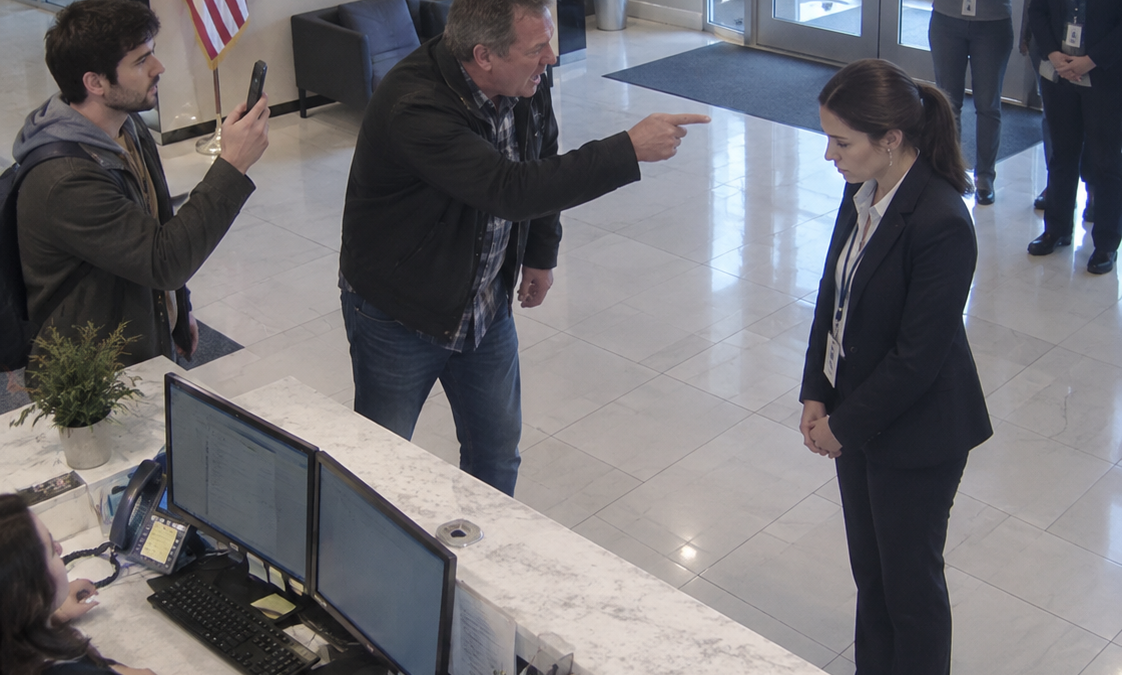
The scene in the lobby when I reached it was exactly as undignified as I’d feared, and somehow worse for being witnessed by people whose respect I had only just started to earn. My father was standing near the reception desk in a suit that had been expensive a decade ago and had not aged well since, red-faced, jabbing a finger at a young receptionist named Ren, who looked like she wanted the marble floor to open beneath her and swallow the entire scene.
Julian stood a few feet away in a leather jacket that did not fit the setting or, frankly, the season, filming the confrontation on his phone at chest height, presumably for content. The way he filmed most of his life, as though every moment were raw material for a story he hadn’t figured out how to tell yet.
“There she is,” my father announced loudly, as though addressing a jury rather than a corporate lobby full of employees on their way to meetings. “Ask her. Ask your director why she stole eighty thousand dollars from her own family and thinks she can hide behind a corporate badge.”
The number had grown, I noted, somewhere between his imagination and my lobby. It did that. My father’s grievances, I had noticed over the years, had a way of inflating in transit, arriving at their destination larger than they’d left, as though outrage itself accrued interest.
Security—two calm, unhurried men whose names I would later learn were Desmond and Fared—moved to flank them before I’d said a word, their body language communicating, without any need for raised voices, that this situation was already under control regardless of how loudly my father continued to insist otherwise.
“Sir,” Desmond said to my father, “you’re on private property, and you’re disturbing our staff. I’m going to need you and your associate to step outside.”
“I am her father,” Roland said, as though the word were a badge that outranked corporate ownership, outranked trespassing law, outranked anything a mere employee of a private company might have the authority to enforce.
It was, I realized, watching him say it, the same tone he’d used my entire childhood to end arguments he had no other way of winning. The assumption that the relationship itself was the trump card, that biology conferred a jurisdiction no institution could override.
“That doesn’t give you access to this building,” Desmond said, unmoved, his tone flat and utterly uninterested in the emotional weather my father was trying to generate. “Last chance to leave on your own.”
I stepped forward into their line of sight, and something in me that had spent thirty-one years flinching simply did not flinch. I felt it happen almost physically, a kind of settling in my spine, the way a structure settles once you’ve finally distributed a load correctly instead of letting it concentrate on a single failing point.
“I don’t know these men,” I said, loud enough to carry across the lobby, where a dozen employees and at least two visiting clients had stopped to watch, phones lowered, coffee cups paused halfway to mouths. “They’ve been harassing me for weeks. Please have them escorted out, and I’ll be filing a formal report.”
My father’s face went through several colors in quick succession, red deepening toward something closer to purple, then, as the words fully landed, a kind of pale, stunned white I had genuinely never seen on him before. Julian lowered his phone, the content evidently no longer worth the risk of being on the wrong side of whatever was about to happen next.
Security walked them both out with the brisk, bored efficiency of men who had done this before and would do it again, my father’s protests trailing behind him, growing fainter, less coherent, until the automatic doors closed behind them with a soft, anticlimactic hiss that felt, in that moment, like the most satisfying sound I had heard in years.
I went back up to my office, closed the door, and sat very still for ten minutes before I called HR. My hands, I noticed once I’d stopped moving, were shaking after all. Not from fear, I think, but from the sheer effort of having stood there and not flinched, the way a muscle shakes after holding a position far longer than it’s used to.
I told them everything. Not the whole decade—there wasn’t time or need for that—but enough. The years of financial pressure, the identity theft, the incident that had just occurred in the lobby. I brought the police report, already filed, already assigned a case number. I brought the fraud alert from the credit bureau.
I expected, if I’m honest, some version of “This is a personal matter. Please keep it out of the building,” the kind of polite institutional distancing I’d half braced for on the elevator ride up.
Instead, the head of HR, a measured woman named Odelise, who listened with her pen resting untouched on a legal pad rather than taking notes, heard me out without interrupting. Then she told me the company would add my parents’ and brother’s names to the building’s restricted-access list, loop in corporate security for future incidents, and connect me, should I choose, with the firm’s outside counsel for the identity theft matter.
It was the first time in my professional life that an institution had simply believed me and acted without asking me to first prove I deserved to be believed, without making me perform my own credibility before extending the basic courtesy of taking my word seriously.
“For what it’s worth,” Odelise said as I was gathering my folder to leave, “you handled that with more composure than most people would have managed. I’ve seen grown men fall apart over far less.”
“I’ve had practice,” I said, and I meant it as a joke, mostly, though it landed, once I heard it out loud, as something closer to the truth.
I want to describe what the rest of that day was like because I think the aftermath of a scene like that is often more revealing than the scene itself. I went back to my desk after the meeting with Odelise, and I found that I could not, for nearly an hour, make myself look at the load calculations I’d been working on that morning.
My hands were steady enough to type, but my mind kept sliding sideways back to the lobby, replaying the sound of my father’s voice bouncing off marble, the specific, awful publicness of it, the way Ren’s face had looked before security arrived, caught between professional composure and open alarm.
Around noon, a woman from my team, a junior engineer named Priscilla Oando—sharp and quiet, the kind of employee who noticed things without commenting on them until she decided a comment was warranted—knocked on my open door and set a coffee down on my desk without being asked.
“Rough morning,” she said. It wasn’t a question.
“You could say that,” I said.
“For what it’s worth, the whole building already knows you did nothing wrong,” she said. “Ren told half the fourth floor before lunch. Nobody thinks less of you. If anything, people are talking about how calm you were. Desmond’s telling it like a legend already.”
I laughed, surprised into it, the first real laugh of the day. “Desmond doesn’t strike me as the type to tell legends.”
“You’d be surprised,” she said, and left it there, the coffee steaming faintly on my desk. She went back to her own work without waiting for me to perform gratitude I didn’t yet have the composure to perform properly.
It was a small thing, that coffee, that unasked-for reassurance. But I remember it disproportionately because it belonged to a category of gesture I had almost no frame of reference for growing up: someone extending care not because I had earned it through usefulness, not because I was expected to reciprocate it later with money or labor, but simply because I looked like I needed it that day.
I sat with my coffee for a long moment before I went back to work, and I understood, in a way I hadn’t fully let myself understand before, how much of what I’d be rebuilding over the coming months wasn’t just a bank account or a legal case. It was a working definition of what ordinary decency from other people was even supposed to feel like.
The attorney Odelise connected me with, a sharp, unhurried woman named Ingred Faustst who specialized in financial fraud and family-adjacent civil disputes, reviewed my folder in near-total silence for the better part of an hour. Bank statements, the fraud report, the credit line paperwork, a decade of receipts I’d apparently been unconsciously archiving for exactly this purpose in a shoebox I’d never fully examined until that week. Occasionally she made a note; occasionally she slid a document into a separate pile without comment.
“Your family has been remarkably careless,” she said finally, tapping the folder, looking up at me over reading glasses that made her look somehow even more formidable than she already was. “Most people at least try to cover their tracks. This is going to be very easy to prove and very unpleasant for them.”
“I’m not trying to destroy anyone,” I said, which was mostly true, though I noticed, saying it, that I wasn’t entirely sure it was true anymore. Not after the lobby.
“You don’t have to try,” Ingred said. “The facts are going to do most of that work on their own. My job is just to make sure they land where they’re supposed to land, and that you’re protected while they do.”
Over the following two weeks, Ingred drafted and sent a formal cease-and-desist letter barring my parents and Julian from contacting me, approaching my residence, or appearing at my workplace, with the threat of a restraining order attached to any violation. She filed a civil suit against Julian for the fraudulent credit line, seeking full repayment plus damages, a process that involved more paperwork than I had expected.
Depositions scheduled, records subpoenaed from the lending platform, a slow, grinding machinery of civil process that felt at times almost anticlimactic after the drama of the lobby. The mundane bureaucracy of justice moving at its own unhurried pace, regardless of how urgent the underlying wound felt.
And she sent a formal demand letter to my parents for repayment of a portion of the funds I could document as having been extracted from me under financial duress over the preceding several years. Not all of it. Some of that was simply gone, unrecoverable, absorbed into thirty years of a household budget with no clean line between what was theirs and what had been mine. The cost of a childhood I couldn’t itemize my way out of, no matter how carefully I built the spreadsheet.
But enough to make a point. Enough to put a number on paper that matched, at least roughly, the number my father had once tried to extract from me at that dining room table.
“You don’t have to send this to anyone but them,” Ingred said of the demand letter, sliding it across her desk for me to review. “But you’re entitled to share the documentation so the wider family understands what actually happened here. I’ve seen enough of these situations to know the extended relatives usually side with whoever tells the story first and loudest. Just the facts. No embellishment needed. The facts do the work.”
I thought about that for a long time before I acted on it. I had spent my whole life being told, implicitly and explicitly, that airing this kind of thing was shameful, that family business stayed inside the family, that a good daughter absorbed the cost of other people’s failures quietly, gracefully, without ever making anyone else uncomfortable with the sight of her own exhaustion.
I had absorbed a great deal quietly for a very long time, and some stubborn, well-trained part of me still flinched at the idea of putting any of it in writing where an aunt or uncle might read it over their morning coffee.
I sent one message to the family group chat I’d been a silent, dutiful member of for a decade: the aunts, the uncles, the cousins who had, I already knew from a worried text from my cousin Denise, been fed a version of events in which I was the villain of an unprovoked betrayal. A cold, ungrateful daughter who had abandoned her struggling parents the moment she came into money.
I kept it factual the way Ingred had suggested, resisting every instinct to explain, to soften, to preemptively apologize for the discomfort the message itself would cause. I explained the promotion and the eighty-percent demand, stating the numbers plainly. I explained the fraudulent credit line and attached the police report, the fraud bureau’s confirmation letter. I explained the lobby incident and the restraining order.
I did not editorialize. I did not need to. The documents laid out in order told a story that required no additional narration from me. Then I left the group chat and blocked every number in it, and I did not look back to see what was said after I was gone.
Denise told me weeks later that the chat had gone almost entirely silent for two full days after my message, an unprecedented stretch of quiet in a group that had, for as long as I’d been in it, rarely gone more than a few hours without someone sharing a recipe or a complaint about the weather.
What followed was, for a while, the strangest kind of peace. The peace of absence, of a phone that didn’t ring with dread, of a bank account that grew instead of bleeding out on a schedule I’d never agreed to but had somehow accepted as immutable law, the way you accept gravity without ever having consented to it.
I moved out of the garage apartment into a modest but genuinely mine two-bedroom near the water, close enough to the dry docks that I could see the cranes from my kitchen window. The same cranes I’d watched from my office all day now visible again from home, a small, strange comfort in the continuity of it.
I furnished it slowly, buying things because I liked them rather than because they were the cheapest option available, which was a form of luxury I hadn’t fully understood until I had it. The simple, previously unimaginable freedom of standing in a furniture store and choosing the chair I actually wanted rather than the one that happened to be on clearance.
I started seeing someone, a marine biologist named Theo, gentle and unbothered, who worked with the same firm on environmental compliance and whom I’d met, unglamorously, in a hallway argument over whether a proposed retaining wall design would disrupt a nearby eelgrass bed. He’d won the argument gracefully, with better data than I’d had, and asked me to lunch afterward with the same unhurried confidence he brought to everything else.
When I finally told him the whole ugly shape of my family history, six months into dating, sitting on my new couch with two mugs of tea going cold between us, he did not flinch, did not lecture me about forgiveness, did not suggest that blood was thicker than the years of evidence sitting in my filing cabinet.
He just asked good questions. “What did you need back then that nobody gave you?” And he believed my answers, which turned out to be the rarest and most valuable thing anyone had ever offered me. Rarer even than the salary, rarer than the title on my office door.
“You don’t have to explain why you did what you did,” he told me once, when I found myself, out of old habit, defending a decision he hadn’t actually questioned. “You’re allowed to just have done it.”
I remember one evening in particular, a few months into living together, when the habit of overexplaining myself surfaced in a way that embarrassed me even as it was happening. We were splitting the cost of groceries, an ordinary, unremarkable domestic negotiation, the kind of thing couples work out in five minutes without either party thinking twice about it.
I found myself, apropos of nothing, launching into a detailed justification for why I preferred to pay for the groceries slightly more often than he did. Some tangled reasoning about how I made more money and it only made sense and I didn’t mind and it wasn’t a big deal, the words tumbling out faster and faster the way they used to at that dinner table, defending a number before anyone had actually challenged it.
Theo just watched me for a moment, patient, waiting for me to run out of momentum, and then said gently, “I didn’t ask you to explain that. I was just going to say, ‘Sure, that sounds fine.’”
I stopped talking. I felt my face go warm. “Sorry,” I said, and then caught myself saying it, the old reflex firing exactly the way Priya had once pointed out it did in client calls.
“You don’t have to apologize for offering to pay for groceries,” he said, laughing, but not unkindly. “Where did that come from?”
“I think I spent thirty years having to justify every dollar before anyone would let me keep it,” I said, surprising myself with how plainly it came out. “I think some part of me still expects to have to defend a number before it’s allowed to just be a number.”
He didn’t say anything profound in response. He just reached over and took my hand across the counter, and we finished making the grocery list. It was, in its total unremarkableness, one of the more healing evenings of that entire year.
The discovery that a disagreement, even a mild and hypothetical one about grocery money, didn’t have to become a referendum on my worth, didn’t require documentation or justification or a decade of context to be permitted to simply resolve itself and be forgotten by morning.
Through the thinning, distant channel of relatives who still occasionally reached out—my cousin Denise mostly, who had quietly taken my side once she’d seen the documentation, texting me every few weeks with small, careful updates she seemed to sense I both wanted and dreaded—I heard fragments of what was happening on the other side of the silence I’d built.
My father’s small logistics consulting business, which had always run on a thin margin propped up by money that was, in hindsight, mine, was struggling without the informal subsidy it had apparently depended on for years. A client contract he’d been counting on had fallen through, and without the buffer he’d grown used to, the loss actually registered as a crisis instead of a manageable setback.
Julian, facing a civil suit he had no real defense against, had reportedly told people I was overreacting, a phrase that told me everything I needed to know about how little any of it had cost him in his own accounting. How thoroughly he had convinced himself that a stolen identity and a maxed-out line of credit were simply the ordinary friction of family life rather than a crime with my name attached to it.
At Halverson, my second year closed with the seawall retrofit project I’d led coming in under budget and ahead of schedule, a project that involved reinforcing a badly eroded stretch of coastline that had flooded three neighborhoods in the previous decade’s worst storm. Priya, who had since retired but still called every few months to check on me the way you’d check on a bridge you helped design, wanting to know if it was holding, told me with unmistakable pride in her voice that I’d become exactly the engineer she always knew I could be.
“I used to worry about you,” she admitted on one of those calls. “Not your work. Your work was never the problem. I worried you’d never let yourself take up the space the work had earned you.”
“I think I finally did,” I said.
“I think you finally did, too,” she said.
There was one more conversation from that period I’ve kept returning to over the years, one that didn’t involve my family at all but that I think, in retrospect, mattered just as much to the shape of who I became afterward.
It happened at a project kickoff meeting for a new breakwater installation, my first as director rather than as a supporting engineer, in a conference room full of people who did not yet know whether to take me seriously. One of the senior consultants brought in from the client’s side, a man named Howerin, older, accustomed to being the most experienced person in any room he entered, spent the first twenty minutes of the meeting directing every technical question to my second-in-command, a capable but considerably junior engineer named Foster.
Apparently, he assumed that the woman at the head of the table was there to manage logistics rather than the engineering itself. The old version of me, I think, would have let that slide for the length of the meeting and corrected it quietly afterward, in private, in a way that cost Howerin nothing and cost me the visible authority I’d actually earned.
Instead, when he turned to Foster for the third time with a question about pile depth tolerances, I answered it myself directly before Foster could open his mouth, laying out the calculation in enough technical detail that there was no polite way to pretend I hadn’t been the one who’d actually run it.
Howerin blinked, recalibrated visibly in real time, and for the rest of the meeting addressed his questions to me. It was a small moment, over almost as soon as it happened. But I remember driving home that evening feeling something settle in my chest that had nothing to do with Howerin specifically and everything to do with the accumulating evidence, meeting after meeting, that the flinch Priya had first pointed out in that break room years earlier was, piece by piece, becoming something I could simply choose not to indulge.
Theo and I moved in together that spring, into the two-bedroom near the water, his books slowly colonizing the shelves I’d left deliberately half empty, as though some part of me had known, even furnishing that apartment alone, that I was building a home meant to eventually hold more than just myself.
We didn’t talk about my family much, and when we did, it was in the flat, closed tone of a subject that had already been fully resolved rather than one still being litigated, a settled matter rather than an open wound we kept accidentally reopening.
I had, for the first time in my life, a home that didn’t require an invoice to keep the lights on. A family—the one I’d built rather than the one I’d been issued—that asked nothing of me except my presence.
The call from my mother came on an evening in early autumn from a number I didn’t recognize. A friend’s phone, I’d learn later, since mine had blocked every number she’d ever had access to. A fact that meant she’d had to ask someone, had to explain at least partially why she needed to borrow a phone to call her own daughter, a humiliation I found myself uncharacteristically able to imagine without any satisfaction attached to it.
I almost didn’t answer. I answered anyway, mostly out of a curiosity I wasn’t proud of, standing at my kitchen window with Theo’s dinner half-prepped on the counter behind me.
“Marin, please don’t hang up,” she said, and her voice had none of the performed grief I remembered from that first email, the wall of accusatory text she’d sent within an hour of my severing everything. This sounded unnervingly like the real thing, ragged in a way I didn’t recognize from thirty-one years of watching her manufacture distress on demand.
“The bank is taking the house. We have thirty days. Your father won’t come out of the bedroom. I don’t know what to do.”
I stood at my kitchen window, looking out at the crane silhouetted against a darkening sky, and I let the silence stretch for longer than was comfortable for either of us, long enough that I heard her breathing shift on the other end, uncertain whether the call had dropped.
“How much do you need?” I asked. Not because I intended to pay it, but because I wanted once to hear the actual number instead of a percentage of my life. I wanted to know what the concrete, specific cost of thirty years of this had finally come to, now that it was reduced to something as simple as an overdue balance rather than an abstract, endlessly renewable claim on my future.
“Forty-two thousand,” she said. “Just the arrears. You make so much money now, Marin. Please. We’re your parents.”
I thought about the eight-hundred-dollar science fair check deposited into an account I never controlled the morning after the happiest afternoon of my fourteen-year-old life. I thought about the joint account I’d fed for a decade without ever once being asked whether I could afford to. I thought about a stolen identity and a lobby full of strangers watching my father scream my name like an accusation, his finger jabbing toward a receptionist who had done nothing except happen to be standing at the desk that day.
“No,” I said.
The silence on her end was total, the kind of silence that comes from someone who has never once in her life heard that word applied to her own need. A word that had, for thirty-one years, only ever been permitted to travel in one direction across our family’s ledger.
“You would let us lose our home?” she said, disbelief curdling into something sharper, something closer to the old accusatory tone, the one designed to make my no into my failure rather than her consequence.
“You were willing to let me lose mine,” I said. “Every month for over a decade, and call it love. I paid your mortgage twice, Mom. I funded a credit card I didn’t know was funding Julian’s failures. Someone in that house stole my identity, and you asked me, in the same breath as finding out about it, to cover his rent. I’m not doing that anymore. Good luck.”
“You’ve become so hard,” she said quietly.
I heard underneath the accusation something that might genuinely have been grief, though I couldn’t by then fully trust my own ability to tell the difference between her grief and her performance of it, the two having been indistinguishable for so long that even she might not have known which one she was having.
“I’ve become someone who doesn’t finance her own exploitation,” I said. “That’s not the same thing as hard. I’m sorry about the house. I mean that. But it’s not mine to save.”
I hung up. I blocked the new number. I did not cry, and I noted, with a kind of clinical interest that surprised me, standing there in my kitchen with dinner still half-prepped behind me, that I had expected to, had braced for it the whole call, and it simply never came.
Theo found me still standing at the window ten minutes later, the pan on the stove gone cold, and asked carefully whether I wanted to talk about it.
“I don’t think I’m sad,” I said, testing the sentence out loud to see if it was true. “I think I expected to feel sad, and I don’t, and now I’m sad about not being sad, which is its own strange kind of exhausting.”
“That sounds like a very reasonable thing to feel,” he said, and didn’t try to talk me out of any part of it. He didn’t offer the easy reassurance that I’d done the right thing, which I already half believed and didn’t need repeated back to me. He just finished making dinner while I sat at the counter and, for the first time since the phone call, let myself actually think through what I’d just done rather than simply having reacted to it.
I called Denise the next day, mostly because I wanted to hear the shape of it from someone still standing close enough to my parents to have context I didn’t. She confirmed what I’d suspected: that the forty-two thousand dollars wasn’t, in fact, the full extent of the arrears; that my father had let the mortgage slide for the better part of a year while continuing to make small, cosmetic payments just large enough to delay the bank’s more aggressive collection process.
The exact kind of quiet, patient can-kicking I recognized instantly from a lifetime of watching him manage crises by postponing them rather than solving them.
“He kept saying you’d help eventually,” Denise said, her voice careful, clearly unsure how much of this I wanted to hear. “That’s what he told Uncle Rafe, anyway. That you always came through in the end. That this time wasn’t any different.”
“It was always different,” I said. “He just never noticed the difference until it stopped working.”
“I don’t think he still believes that,” Denise said. “For what it’s worth, I think it actually landed this time.”
I didn’t know what to do with that information any more than I’d known what to do with the earlier report that my mother wished she’d done things differently. Belief, landing, understanding. These were all words that implied a kind of internal shift I had no way of verifying and, I was coming to accept, no real obligation to verify.
My job at this point wasn’t to monitor their emotional growth from a safe distance. It was simply to keep living the life I’d built and let whatever happened on their side of the silence happen without my involvement.
I did not decide to buy the house that night. That decision came a week later, sitting across from Ingred in her office, half joking about the poetic unfairness of a foreclosure auction, when she looked up from her laptop with an expression I’d come to recognize as the one she wore right before she suggested something legally aggressive and entirely within bounds.
“You could buy it,” she said. “Anonymously, through an LLC. Foreclosure auctions move fast, and the properties usually go for a fraction of market value, especially in a neighborhood like that. You’d own the asset outright. What you did with it afterward would be entirely up to you.”
“That feels like a strange kind of revenge,” I said.
“It’s not revenge if you’re just buying real estate at a discount,” Ingred said, mild as ever. “What you do with the deed afterward is a separate question. I’m only telling you the opportunity exists.”
I sat with that for three days before I said yes, turning it over during long, unfocused stretches at my desk, during a run along the water with Theo, who, when I finally mentioned it, only asked, “What would it mean to you, actually owning it?” A question I didn’t have a full answer to until I sat with it longer.
It was not, in the end, about the house itself, a tired three-bedroom with a leaking roof and thirty years of my own unpaid labor baked into its bones, since I’d spent half my adolescence mowing that lawn and patching that fence for an allowance that never materialized, scraping and repainting the shutters one long, sweaty summer at fifteen for a promised fifty dollars I never actually received.
It was about the shape of the ending. I wanted my exit from that family’s economy to be final, structural, undeniable, the kind of ending you can point to on a deed, not a feeling that might, in some weak, exhausted moment years from now, be argued back open.
Ingred set up the LLC, Ledger Holdings, a name I chose myself with a private smile I didn’t explain to her, a small joke only I was in on. I moved a portion of my savings into its account, an amount that a few years earlier would have represented more money than I could have imagined having at all, let alone spending on something this deliberately symbolic.
The auction was public record. I did not attend. Ingred attended on the LLC’s behalf, authorized to outbid anyone reasonable, and by early afternoon she called to tell me the property was ours for just under sixty percent of its assessed value. The other bidders had dropped out once the opening bids climbed past what a distressed suburban property in that condition was typically worth to an investor more interested in profit margins than history.
“They have seven days to vacate before the county enforces the transfer,” Ingred said. “What do you want to do?”
I already knew. I had known, I think, since the moment my mother said the word “arrears” over a borrowed phone.
I drove to the house myself on the seventh day, in the gray, unremarkable light of an ordinary Tuesday morning, the kind of light that makes everything look slightly smaller and more tired than it actually is. The lawn—the same lawn I’d mowed a thousand times as a teenager for no pay and no thanks, the same lawn where I’d once buried a time capsule at eleven that Julian, too, had dug up and scattered within a week, laughing—was covered in mismatched boxes and black trash bags. The detritus of a life that had run out of runway.
My father stood on the porch in sweatpants that had clearly not been purchased in this decade, a man I barely recognized in that posture, all his old bluster gone slack. My mother sat on the top step with a single box of ceramic angels in her lap, the kind of possession you cling to not because it’s valuable but because it’s the last thing that still looks like control. The last small kingdom you get to decide the fate of when everything larger has already been decided for you.
Julian was nowhere in sight. I hadn’t expected him to be. Denise had told me days earlier that he’d moved into a friend’s spare room across town and had, as far as anyone could tell, made no offer to help his parents move a single box.
My father saw my car and straightened, some old reflex of authority trying to reassert itself even now, even here, in sweatpants on a porch surrounded by the visible wreckage of thirty years of decisions I hadn’t made.
“Did you come to gloat?” he said. “Or did you come to help?”
“Neither,” I said, closing the car door behind me, my footsteps loud on the cracked driveway in the otherwise silent morning.
I walked up toward the porch, a manila envelope in my hand. I had apparently developed a taste for delivering news that way, a small habit inherited, ironically, from the same folder I’d once nervously carried into a dining room. I set it on the step beside my mother rather than handing it to him directly, a decision I made without fully planning it but which felt, once I’d done it, exactly right.
“That house isn’t going to a stranger,” I said. “I bought it. Ledger Holdings. That’s me. You can choose to stay. There’s a lease in that envelope. Market-rate rent, due on the first. No exceptions. No grace period. And Julian is not permitted on the property under any circumstances. If he sets foot on this lawn, I’ll have him removed for trespassing.”
My father’s face did something I had genuinely never seen it do in thirty-one years. It went slack with a kind of total, undefended shock. Not anger. Anger required the belief that he still had leverage, some remaining card to play.
This was the specific collapse of a man realizing all at once, standing on a porch surrounded by his own boxed-up life, that he had none left, that the negotiation he’d assumed was still open had, in fact, closed the moment I set that envelope down.
“You bought our house,” he said very quietly, the loud voice gone entirely, replaced by something smaller and more honest than I’d heard from him in years.
“I bought a house,” I said. “It stopped being yours the day the bank took the deed. What happens to it from here is up to you. Sign the lease or don’t. The county will be here at noon either way, and I’d rather you not be sleeping in your car.”
My mother didn’t say anything at all. She just looked down at the envelope and then at me, and something in her face—not gratitude, not quite, but a kind of dawning, unwelcome respect—settled there and stayed, the ceramic angel still balanced in her lap, catching the gray morning light.
“Why?” my father said finally, the question coming out smaller than any question he’d ever asked me. “Why not just let it go to someone else? Why you?”
I thought about that question for a moment, genuinely, standing there on a driveway I’d repaved myself with money I never saw returned to me in any form, before I answered.
“Because I wanted the ending to be mine,” I said. “For once.”
I did not wait for an answer beyond that. I walked back down the driveway, got in my car, and drove away without looking in the rearview mirror. I heard three days later through Denise that they’d signed.
The months after that were unremarkable in the best possible sense of the word, which is to say that my life finally became boring in all the ways a life is supposed to be boring, full of small, unspectacular satisfactions rather than crises, the ordinary texture of a life no longer organized around the next emergency.
My parents became, against every prediction I would have made, punctual tenants. Whatever else could be said about them, the fear of losing a second roof turned out to be more motivating than three decades of my devotion ever had been.
My father, at sixty-one, took a job managing inventory at a regional distribution warehouse, the first job I could remember him holding that didn’t involve a title he’d invented for himself, that required him to clock in and out on a schedule someone else set. My mother expanded her part-time bookkeeping work to nearly full-time, taking on clients she’d previously turned away for lack of time. Time that, I understood without anyone saying it directly, had previously been spent managing the elaborate emotional economy of extracting money from me.
I did not see them. I did not speak to them. But Denise, my one remaining thread to that world, mentioned once, almost in passing over coffee on one of her infrequent visits, that my mother had started saying to anyone who’d listen that she wished she’d done things differently.
I did not know what to do with that information, so I simply let it exist without responding to it, without either accepting it as absolution or dismissing it as another performance. Some things, I was learning, didn’t need a verdict from me. They could just be true at a distance without requiring my participation.
Julian’s civil case settled eight months later for a fraction of what he owed, paid out over an ungainly repayment schedule that Ingred assured me would follow him for years through his credit history even after the settlement closed. A slow, unglamorous accountability that felt, in the end, more fitting than any dramatic public reckoning could have.
He was, last I heard, working at a car dealership. No longer a growth strategist. No longer anyone’s golden anything. Just a twenty-nine-year-old man discovering very late what the rest of us had been doing since we were children: earning what he had, one modest paycheck at a time, with no one left to absorb the difference for him.
I did see him once more, unexpectedly, nearly a year after the porch, in a hardware store two towns over where I’d gone to pick up supplies for a shelving project at the new apartment. He was behind the counter at first, in a polo shirt with the dealership’s logo embroidered on the chest, ringing up a customer’s purchase of hinges with the flat, practiced patience of someone doing a job he’d never imagined himself doing and had stopped resenting only because resenting it changed nothing.
He looked older than the year should have accounted for, thinner in a way that read more like stress than discipline. He saw me before I could decide whether to duck down another aisle. For a long moment, neither of us said anything, the hinges and the customer between us forgotten.
“Marin,” he said finally, and there was none of the old smugness in it, none of the vending-machine patience I remembered from that dining room. Just a kind of flat, unpracticed weariness, the voice of someone who genuinely did not know what was about to happen next and, for possibly the first time in his life, had no leverage to control it.
“Julian,” I said.
“I’m not going to ask you for anything,” he said quickly, before I’d given any indication I expected him to. “I know I don’t get to do that anymore.”
“Okay,” I said.
“I’m paying it back,” he said. “The settlement. Every month. It’s not much, but it’s on time.”
“I know,” I said. “Ingred tells me when a payment lands.”
He nodded, looking down at the register for a moment, and I watched something move across his face that I didn’t have a clean name for. Not quite remorse, not quite the theatrical self-pity I remembered from his texts. Something closer to a kind of tired, private reckoning that had clearly been going on for a while without an audience.
“I used to think you were just uptight,” he said. “About money. I used to think you liked being the responsible one because it made you feel superior. I didn’t understand for a long time that you were just the only one of us who ever had to actually be responsible, because the rest of us knew you’d catch it if we weren’t.”
I didn’t say anything to that. I didn’t owe him absolution, and I didn’t have any particular urge to offer it, but I also didn’t feel the need to correct him or extend the moment into something larger than it was.
“Anyway,” he said, straightening, the register between us again, the customer with the hinges shifting slightly, patient but waiting. “I hope you’re doing well. I mean that. I don’t say it to get anything.”
“I believe you,” I said, and found, somewhat to my own surprise, that I did. “Take care of yourself, Julian.”
I bought my shelving supplies at a different register from a teenager who had no context for any of it, and I drove home turning the conversation over without any particular conclusion attached to it. I did not tell Theo it had shaken me because it hadn’t. Not exactly.
It had simply confirmed something I’d already begun to suspect: that consequences, real ones, sustained over enough time, could produce a kind of change that a decade of my quiet, absorbing generosity never had and never would have. Julian had needed, it turned out, the one thing our family had never once given him—a boundary he couldn’t argue his way around.
At Halverson, my second year closed with a seawall retrofit project I’d led coming in under budget and ahead of schedule, and the firm put my name, along with my team’s, on a small plaque near the site. Not for me particularly, but for the neighborhoods behind it, the ones that hadn’t flooded that winter for the first time in a decade.
Priya came to the small dedication, retired but still sharp, still unimpressed by anything less than good work, and told me afterward, with unmistakable pride in her voice, that I’d become exactly the engineer she always knew I could be.
Theo and I moved in together permanently that spring, no longer an experiment but simply the shape of my life now. We didn’t talk about my family much, and when we did, it was in the flat, closed tone of a subject that had already been fully resolved rather than one still being litigated.
I had, for the first time in my life, a home that didn’t require an invoice to keep the lights on. A family—the one I’d built rather than the one I’d been issued—that asked nothing of me except my presence.
Sometimes, standing at my kitchen window in the evenings, watching the cranes at the dry docks swing their slow, patient arcs against the sky, I think about the version of me who sat in that dining room at thirty-one, watching her father demand eighty percent of a life she’d nearly killed herself building.
I don’t feel sorry for her, exactly. I feel something closer to gratitude that she was tired enough, finally, to stop paying, and steady enough, when the moment came, to build something sound out of the wreckage instead of just walking away from it and leaving the wreckage standing for someone else to eventually deal with.
A family, I’ve come to understand, is not the people who raised you. It’s the structure you choose to keep standing, load by load, deliberately, with your eyes open. Everything else, no matter how load-bearing it once felt, no matter how many years you spent believing the whole roof would come down without you under it, is just weight you were never actually required to carry.
Two years after the porch, on an ordinary Saturday morning that had no significance to anyone but me, I drove out to the house alone without telling Theo where I was going because I wanted, for reasons I didn’t fully examine at the time, to see it without an audience.
I hadn’t been back since the day I’d set that envelope down beside my mother. Ingred’s office handled the lease renewals, the rent collection, the occasional maintenance request, all of it routed through a property manager I’d hired specifically so I would never have to personally negotiate a leaking pipe with my own father.
I knew, in the abstract, factual way you know things you’ve deliberately kept at arm’s length, that they were still there, still paying on time, still, according to the quarterly reports my property manager sent, keeping the place in reasonable repair.
I parked across the street rather than in the driveway, some old instinct telling me I no longer had automatic claim to that particular strip of concrete even though I owned the deed to everything beyond it. The house looked different than I remembered. Not renovated, exactly, nothing dramatic, but tended in a way it never had been when it was theirs to lose.
The shutters, the same ones I’d repainted at fifteen for a promised fifty dollars I never received, had been repainted again, a deeper, more deliberate green than the flat beige they’d faded to over the years. There was a small vegetable garden along the side fence that hadn’t existed before, tomato cages visible even from the street, staked with a care that suggested someone was actually paying attention to it rather than letting it fend for itself the way most things in that house once had.
I sat in my car for a long time, not entirely sure what I’d driven out there to feel. I was still sitting there when my mother came out the front door with a watering can, moving toward the garden with the unhurried, purposeful gait of someone doing a chore she’d chosen rather than one assigned to her by exhaustion.
She didn’t see me. I watched her water the tomatoes methodically, checking the underside of a few leaves for something—pests, I assumed, though I had no way of knowing for certain—with the kind of patient attentiveness I had never once in thirty-three years seen her extend to anything that wasn’t Julian.
I didn’t get out of the car. I didn’t announce myself. I sat there for perhaps ten minutes, watching a woman I no longer knew tend a garden in a house I owned, and I found that what I felt wasn’t triumph. It wasn’t grief. It wasn’t even the flat, resolved neutrality I’d expected.
It was something closer to a strange, distant tenderness for a stranger who happened to share my mother’s face. The recognition that whoever this version of her was, watering tomatoes on a Saturday morning with no one there to perform for, might genuinely be a better person than the one who’d raised me, and that I would likely never know her because the road between us had been closed too thoroughly, for too many good reasons, to reopen.
I drove home without ever getting out of the car. I told Theo about it that evening, the whole small, uneventful scene, and he listened without offering any particular verdict on what it meant, which was by then exactly what I needed from him.
“Do you think you’ll ever talk to her again?” he asked, not pushing, just asking.
“I don’t know,” I said. “Honestly. I don’t think it would go back to what it was. I don’t think I’d want it to. But I don’t think never is a promise I need to make, either. I think I just get to decide whenever there’s a decision to make, instead of it being decided for me by guilt.”
That felt, saying it out loud, like the truest thing I’d said about my family since the night of the dinner. Not a verdict, not a reconciliation, not even really a boundary in the sharp, defensive sense I’d needed two years earlier. Just an open question I no longer felt any urgency to close, because for the first time in my life, the question belonged entirely to me, and I was under no obligation to answer it on anyone’s schedule but my own.
People ask occasionally, when the subject comes up at a dinner party or in the careful, curious way new friends ask about family once they’ve known you long enough to sense there’s a story there, what finally made me do it. What the actual breaking point was. As though there must have been one single dramatic moment rather than a decade of smaller ones that simply reached a threshold.
I’ve come to give a shorter answer than the true one because the true one takes the better part of an evening, and most people, understandably, aren’t asking for that. I usually say something like, “I realized I’d been paying for the privilege of being loved conditionally, and once I could afford not to, I stopped.” It’s true as far as it goes.
But the fuller version, the one I’ve only ever told completely to Theo, and once in fragments to a therapist named Odalia I started seeing about a year after the porch—not because I felt broken, but because I wanted to make sure I wasn’t simply carrying the old patterns forward into a life that was supposed to be different—is more complicated than a single sentence can hold.
Odalia was the one who first suggested, gently, in our third or fourth session, that what I’d built over those two years wasn’t really about punishing my parents at all, even though it had certainly felt that way in the moment, standing in that lobby, standing on that porch.
It was about proving something to the fourteen-year-old girl who’d run home with a folded check and a hammering heart, only to watch it disappear into an account she never controlled. Every structural decision I’d made since—the closed accounts, the lawsuit, the LLC, the lease—had been, in some sense, a long-delayed answer to that girl’s very simple, very reasonable question: Doesn’t this belong to me?
“You spent seventeen years not getting an answer to that question,” Odalia said. “And then you built yourself a life sturdy enough to finally answer it yourself.”
I think about that framing often, especially on the ordinary days. The Tuesday mornings running load calculations. The Saturday afternoons at the hardware store buying shelving brackets. The quiet, unremarkable dinners with Theo that require no defense, no invoice, no justification.
The extraordinary parts of the story—the lobby, the porch, the deed—get told at dinner parties because they’re dramatic, because they have a shape people can follow and be satisfied by. But the actual victory, I’ve come to believe, isn’t in any of those scenes.
It’s in the boring Tuesdays. It’s in being able to buy groceries without doing silent math in the aisle. It’s in a house with a leaking roof I no longer have to think about, in a garden I’ll probably never fully understand, in a mother tending tomatoes for an audience of no one.
The story people want, the one with the lobby confrontation and the foreclosure auction and the poetic justice of a landlord’s envelope landing at a father’s feet, is satisfying because it has an ending. My actual life doesn’t have an ending. Not yet. Not for a long while. It just has a lot more ordinary days than it used to, days that belong to me without anyone else’s name on the deed.
And if I’ve learned anything worth passing along from all of it, it’s that the ordinary days were always the actual prize. The confrontations, the legal maneuvering, the dramatic reversal on a rain-soaked porch—all of that was only ever the cost of admission. What I was actually buying the whole time, without fully realizing it until much later, was the plain, unremarkable right to a Tuesday that belonged to no one but me.
If there’s a piece of advice buried in all of this—and I resist most days the idea that a life this specific translates cleanly into advice for anyone else’s—it’s probably this: the moment you notice yourself calculating what percentage of your success someone else believes they’re entitled to, that calculation is already the answer.
You don’t owe anyone a debate about the number. You’re allowed to simply close the account, hire the attorney, change the locks, and let the silence that follows be as long as it needs to be. It will feel, for a while, like the cruelest thing you’ve ever done. It will also, if you let it, become the first real foundation you ever got to pour yourself on ground you finally, fully own.








