“I don’t shake hands with men who only produce failures,” the new ceo—my son’s ex-father-in-law—said coldly as i reached out; the whole room laughed, i smiled and replied: “you’re right, but you just called the man who owns 53% of your company a failure,” his smile vanished, he froze, then dropped his wineglass.
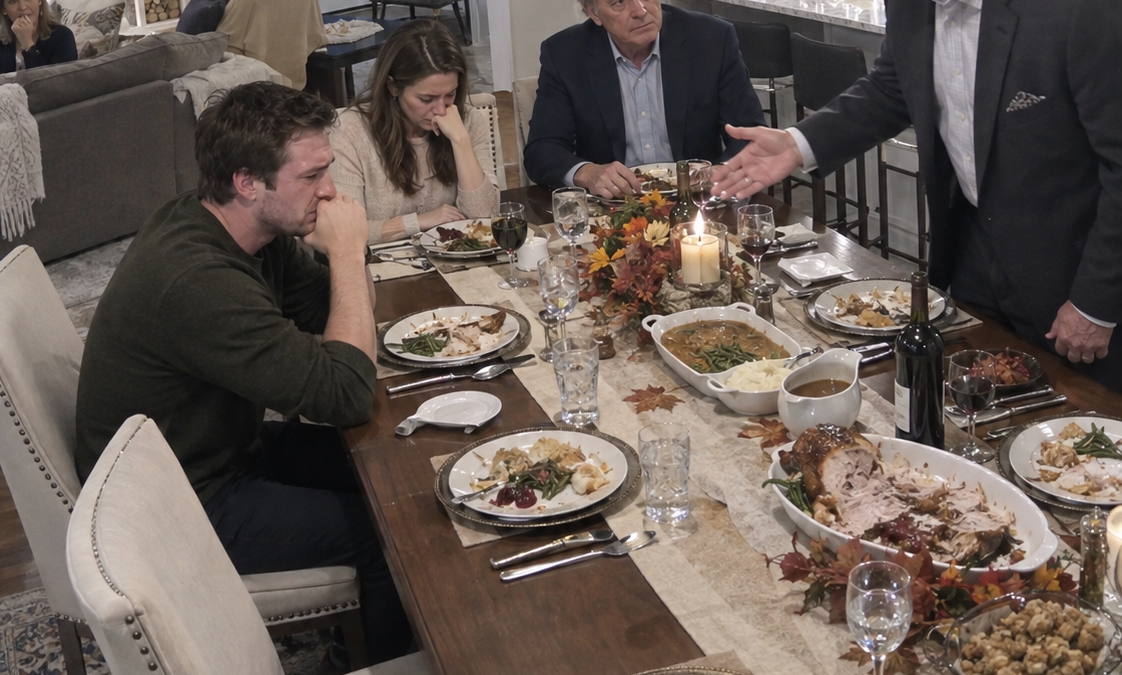
The room went quiet the second the champagne glass hit the marble floor.
Three hundred people were watching. My son’s hand tightened around my arm. And Richard Whitmore—the man who had just announced in front of his own board, his own family, and everyone who mattered to his future that he didn’t shake hands with failures—stood there with his mouth half open, realizing he’d just insulted the one man who could end his career with a single phone call.
Nobody in that ballroom knew what I owned. Not yet. But they were about to find out.
I’ve never been a man who needed a room to notice me. Fifty-eight years of living will do that to you. It teaches you that the loudest person at a party is usually the one with the least to lose. I built a midsize industrial equipment company from a rented warehouse in Ohio into something worth real money, and I did it without ever raising my voice in a boardroom. When I sold most of it four years ago, I told myself I was finished with rooms like the one I was standing in that night.
Chandeliers, string quartets, men in five-thousand-dollar suits pretending they’d earned every dollar themselves. I’d had enough of all of it. But my son had asked me to come, and there are certain things you don’t say no to when it’s your boy asking.
Ethan was thirty-four, sharp and thoughtful, with the kind of quiet confidence people mistake for weakness until they actually try to outthink him. He’d built a small software company from nothing. The kind of nothing where you pay your two employees before you pay yourself. I’d been proud of him long before any of it turned a profit. But pride doesn’t pay the rent, and for a long time, the one person’s opinion Ethan cared about more than mine belonged to Richard Whitmore.
Richard had just been named CEO of Whitmore Industrial Holdings, a company that manufactured heavy machinery components for half the manufacturing plants along the East Coast. Thousands of employees, an established name, and a reputation that still meant something in industrial circles—or at least it used to.
The invitation to Richard’s celebration came addressed to both Ethan and me, which surprised me. My son hadn’t set foot inside a Whitmore family function in more than a year, not since the divorce. I almost told him we should skip it. Instead, I put on the same navy suit I wore to every event I couldn’t avoid, and we walked into that ballroom together.
I felt the atmosphere change before I understood why. A few heads turned. Someone whispered to somebody else, and I caught the end of it.
“That’s him. That’s the ex-husband.”
Ethan’s jaw tightened beside me, but he kept walking, chin level, the way I’d taught him to enter rooms where he knew he wasn’t welcome. Richard found us within four minutes. He’d always had a talent for making an entrance feel like a summons.
He looked taller than I remembered, though maybe he was simply standing straighter, inflated by the kind of confidence that comes from receiving a title before you’ve done anything to earn it. Margaret stood on his arm, wearing the practiced smile of a woman who’d spent thirty years learning how to stand beside her husband without saying anything.
Clare was somewhere behind them. I caught her eyes flick toward Ethan for half a second before she looked away.
I did what I always do. I extended my hand.
“Congratulations, Richard,” I said. “I hope the new position goes well for you.”
I want to be honest about something. I meant it. Whatever history existed between our families, I’ve never been a man who roots for another man’s failure. There’s no dignity in that. I’d watched too many good companies collapse to wish that kind of trouble on anyone, even somebody I had every reason not to like.
Richard looked at my outstretched hand the way you’d look at something left too long in the sun.
“I don’t shake hands,” he said, loud enough for the six or seven people standing nearest us to hear clearly, “with men who are only good at producing failures.”
The laughter came fast. Ugly, quick laughter, the kind that tells you people have been waiting for permission to laugh at somebody.
I understood exactly what he meant. He wasn’t really talking about me. He was talking about Ethan. About the failed marriage. About the company that hadn’t turned a profit during its first two years. About every dinner-table conversation where Richard had made it clear that his daughter had married beneath her, and that, in his mind, the apple hadn’t fallen far from a rotten tree.
Ethan’s hand found my elbow. I felt him begin to turn, gently pulling us both toward the door. It was the instinct of a man who’d spent years absorbing insults like that one and had simply run out of room to take another.
I didn’t move.
Something in me—call it patience, call it forty years of watching men like Richard mistake arrogance for strength—kept my feet planted exactly where they were.
I smiled. Not a performance. A genuine smile, small and easy, the kind that unsettles people far more than anger ever could.
“You’re right,” I said.
I watched something flicker across Richard’s face. Satisfaction, perhaps. That particular pleasure a man feels when he believes he’s just won something in front of an audience.
Then I finished my sentence.
“But you just called the man who owns fifty-three percent of your company a failure.”
I’ve replayed that moment more times than I can count, and I still can’t fully describe the way Richard’s expression changed. It wasn’t exactly shock. It was closer to the look of a man realizing, all at once, that the ground he’d been standing on his entire adult life had been quietly sold out from under him months earlier, without his knowledge or consent, by the very man he’d just humiliated in front of three hundred witnesses.
The champagne glass slipped from his hand.
It didn’t shatter dramatically. There was only a dull crack against the marble, followed by the sound of glass skidding across the polished floor. Champagne spread across the white stone, a darkening stain that somehow looked as though something had spilled out of Richard himself rather than out of the glass.
Nobody laughed this time.
But to understand how I ended up standing in that ballroom, I need to take you back eight months, before the fifty-three percent, before Richard’s shattered champagne glass, and before I understood that my son’s broken marriage was about to collide with my quiet retirement in a way neither of us could have predicted.
Because none of this started as revenge. It started with watching my boy lose faith in himself, one dinner-table insult at a time, and deciding I wasn’t going to stand by without at least trying to understand why.
Ethan and Clare didn’t start out broken. I need people to understand that before I tell the rest of this story, because it’s easy to look at how things ended and assume their marriage had been doomed from the beginning.
It wasn’t.
I watched my son fall in love with that girl the way you only get to fall in love once or twice in a lifetime—completely, foolishly, without keeping anything in reserve. The kind of love that makes a grown man forget to eat dinner because he’s too busy smiling at something on his phone.
Clare was smart, with a dry sense of humor that caught you off guard. For the first year, I think she loved Ethan just as deeply as he loved her.
The problem was never Clare. Not really.
The problem walked into every family dinner wearing a three-thousand-dollar watch and a permanent expression of disappointment.
Richard never once tried to hide what he thought of my son. He didn’t need to raise his voice. Men like Richard have an entire vocabulary of contempt that doesn’t require volume. A pause before saying Ethan’s job title. The way he’d ask how “the little company” was doing, putting just enough emphasis on little to make sure everyone at the table understood exactly what he meant.
“A man should be able to provide,” he’d told Ethan once at a Thanksgiving dinner I hadn’t attended. “That’s not old-fashioned. That’s just fact.”
I heard about it later from Ethan, who repeated those words in a voice so flat that it frightened me more than anger would have.
At the time, Ethan was building his software company out of a converted garage. Four employees crammed into a space that was barely an office, living on ramen, momentum, and the particular exhaustion that comes from believing in something nobody else believes in yet.
His business wasn’t failing. It simply wasn’t making anybody rich.
Not yet.
And in Richard’s world, there was no difference between not yet and never.
I watched my son shrink over those two years. Not physically. He still stood the same height and had the same shoulders I’d watched broaden through high school football practices, the ones I’d driven him to every morning before work. But something behind his eyes began folding inward.
You could see it in the way he carried himself, the subtle change in a man’s posture after he’s spent too long being told he doesn’t measure up.
I told him once, over coffee at the kitchen table where we’d had a thousand conversations while he was growing up, “Don’t try to prove yourself to people who’ve already decided you’re worthless.”
He nodded as though he’d heard me. I don’t think he actually had. Not yet.
You can tell a person something true a hundred times, but sometimes it doesn’t become real to them until they’ve lived through the alternative first.
Ethan kept trying. That’s the part that still gets me, even now, telling this story with the benefit of knowing how everything turned out. My son didn’t become bitter. He became desperate to prove Richard wrong, which is an entirely different thing, and a much more dangerous one.
He worked eighteen-hour days. He missed anniversaries chasing investor meetings that went nowhere. He kept pushing himself harder, trying to earn a seat at a table where the people sitting around it had decided long before he arrived that he didn’t belong.
Clare tried for a while, too. I’ll give her that.
But there’s a particular kind of pressure that comes from watching your father’s disappointment in your husband slowly curdle into something closer to disgust. And I don’t think many marriages survive that kind of pressure for long, no matter how much love brought two people together in the beginning.
The divorce wasn’t loud. There was no screaming, no dramatic confrontation I could point to and say, That’s where everything broke.
It was quieter than that, and somehow worse. A slow withdrawal. Two people who used to reach for each other across a bed simply stopped doing it one night, without either of them quite deciding to.
I remember the day Ethan told me it was over.
He sat across from me at that same kitchen table, turning a coffee mug in slow circles without taking a single drink. Then he said the words I’ve carried with me ever since.
“Maybe he was right about me, Dad.”
I didn’t yell. I didn’t tell him he was being ridiculous, even though every part of me wanted to.
I simply watched my son—a man who had built something out of nothing, who had worked harder than almost anybody I’d ever met—sit there believing he was the failure Richard Whitmore had always called him.
That was the moment something shifted inside me.
Not toward revenge. I want to be clear about that, because this story isn’t really about revenge. Not even now.
It was something quieter and more stubborn. A decision that I wasn’t going to let my son believe a lie simply because a bitter, wealthy man had repeated it with enough confidence to make it sound like fact.
I invested in Ethan’s company. Not a fortune. I want to be honest about that, too, because the version of this story where a rich father writes a check that magically solves everything isn’t the truth, and it isn’t the point.
It was a modest amount. Enough to give Ethan some breathing room. Enough to hire two more engineers and finally stop paying himself last.
I didn’t do it to make him rich. I did it because every man deserves at least one genuine opportunity to prove what he’s capable of without somebody else’s judgment drowning out everything he tries to accomplish.
The business grew more slowly than either of us expected and more steadily than I think either of us dared hope. Within three years, Ethan’s company had real contracts, real revenue, and a small office instead of a converted garage.
He never talked about Richard during that stretch. I noticed he didn’t need to anymore. He was too busy building something that spoke for itself.
Meanwhile, quietly, without headlines or announcements, Whitmore Industrial Holdings had begun coming apart at the seams. Richard kept the image polished—the expensive watch, the elegant dinners, the confident handshake he apparently reserved for people he considered his equals.
But behind that carefully maintained image, the company was hemorrhaging clients, drowning in debt, and losing the kind of ground that doesn’t show up in a press release until it’s already too late to hide.
I didn’t know any of that yet, at least not in detail.
But I was about to find out.
I first heard about Whitmore Industrial’s troubles the way I hear about most things these days: secondhand, through an old colleague who still sat on a few boards and liked to call me every few months just to talk shop. Men who’ve spent thirty years in an industry never quite stop thinking in terms of balance sheets and quarterly earnings, even after they’ve stepped away from it.
His name was Walter. He’d retired two years before me and was about as subtle as a freight train.
“You hear about Whitmore Industrial?” he asked somewhere in the middle of a conversation that had started with golf and wandered, as most of our conversations eventually did, toward business.
“Company’s bleeding. Lost two of its biggest contracts to overseas manufacturers. Stock’s down almost forty percent from where it was three years ago.”
I remember exactly where I was standing. In my kitchen, looking out at the backyard, with a cup of coffee going cold in my hand.
I hadn’t thought about the Whitmores in months. Ethan’s divorce had settled into that particular kind of quiet that comes after a wound stops being fresh but before it’s fully healed. I’d made a point of not bringing up the family around him unless he mentioned them first.
But something about Walter’s words stayed with me.
Not because of Richard. I want to be honest about that. My first thought wasn’t some secret satisfaction at hearing that the man who’d humiliated my son was struggling. I’ve never found pleasure in watching somebody drown, even somebody who might deserve a little discomfort.
My first thought was about the people who worked there.
I know what happens when a company that size begins to fail. I spent more than thirty years building one from nothing, and I know exactly how many families depend on a paycheck that most executives never think twice about.
Whitmore Industrial employed close to four thousand people across three states. Machinists, line supervisors, accountants who’d worked there for twenty years without ever meeting anybody on the executive floor.
If that company collapsed, Richard Whitmore wasn’t going to be the one who suffered most. It would be everybody underneath him, people who had nothing to do with the decisions that had put the business in that position.
So I started looking into it, quietly, the way I approach most things.
I pulled public filings. I talked to a few people I trusted in the industry, people who wouldn’t ask too many questions about why a retired equipment manufacturer had suddenly developed an interest in a struggling holding company three states away.
What I found wasn’t exactly a company run by a fool. Richard wasn’t stupid, whatever else he might have been. But he’d inherited leadership of a business that had been coasting on its reputation for years, making decisions based on how things looked rather than how they actually worked.
And the company had finally run out of room to keep pretending.
I made a decision that surprised even me.
I started buying shares.
Not directly under my own name, but through an investment entity I controlled. It was the kind of legitimate ownership structure that keeps your name off the most immediate paperwork, giving you room to move without the entire company reacting to your presence before you understand what you’re actually dealing with.
I bought a modest position first. Then I watched, waited, and studied.
When the stock dipped further, as it did twice more over the following months, I bought more.
I wasn’t trying to take the company away from Richard. I know how that sounds from the outside, and I know how easy it would be to paint this as some elaborate scheme I’d been plotting since that Thanksgiving dinner Ethan told me about.
But it wasn’t that.
The truth was simpler and, in its own way, considerably more boring.
I saw a company with genuine value being mismanaged by leadership that cared more about appearances than fundamentals. I saw an opportunity to protect something worth protecting: the jobs, the engineering talent, and the decades of institutional knowledge that would disappear if the whole thing went under.
By the time the dust settled, my investment group controlled fifty-three percent of the voting shares.
Richard had no idea.
That part still sits strangely with me, even now. For months, I held more control over the future of his company than he did. And he kept walking around Manhattan and Connecticut country clubs, believing he was the most powerful man in every room he entered, when in reality, every major decision the board made eventually ran through paperwork connected to me.
I didn’t tell Ethan right away, either.
Partly because I wasn’t yet sure what I intended to do with my position. Partly because I didn’t want him thinking this had anything to do with revenge. Because it didn’t, at least not in the way most people would assume.
The board, unaware of who actually held the controlling interest, brought Richard in as CEO not long afterward. They needed somebody with the Whitmore name to reassure clients and investors that the company’s leadership crisis was under control.
Richard accepted the position the way I imagine he’d accepted most things in his life: as something owed to him rather than something he’d have to earn.
I found out about his appointment through a filing notice, the kind of dry corporate paperwork that doesn’t convey anything about the human stakes hiding behind the words.
I sat with that piece of paper longer than I probably needed to.
Then the invitation to his leadership celebration arrived.
Ethan saw it on my kitchen counter before I’d decided what to do with it. He picked it up, read the engraved lettering, and put it back down as though it had burned his fingers.
“Dad, you don’t have to go,” he said. “I don’t need to go either. We could just skip this one.”
I understood exactly why he wanted to.
Walking back into a room full of Whitmores after everything he’d been through, after watching his confidence get dismantled dinner by dinner for two years, couldn’t have been easy. I wouldn’t have blamed him for never wanting to see any of them again.
“I’m not going for him,” I told my son.
Ethan looked at me, confused, waiting for me to explain.
“I’m going because sometimes you need to sit at the same table as the people who once told you that you didn’t belong there.”
I didn’t tell him about the fifty-three percent that night. I wanted him to walk into that ballroom believing we were just two men attending an obligatory event, nothing more.
And perhaps, selfishly, I wanted to see what would happen when Richard opened his mouth without knowing who was actually standing in front of him.
I didn’t have to wait long to find out.
Which brings me back to that ballroom, the three hundred guests, and the champagne still spreading across the marble floor.
Richard stood motionless for a moment after I told him what I owned. Then I watched him struggle to find his voice.
You could almost see the calculations running behind his eyes, the particular panic of a man realizing the ground beneath him had shifted in a way he couldn’t immediately reverse.
For a moment, I think he genuinely believed I was bluffing.
That’s the thing about men who’ve spent their entire lives having power handed to them rather than earning it. They struggle to imagine that somebody might quietly outmaneuver them, because it has never occurred to them that anybody could.
“That’s not possible,” Richard said, his voice suddenly so low that the people gathered around us had to lean in to hear him. “I’d know. The board would know.”
“You would know,” I replied, “if I’d wanted you to know sooner.”
I wasn’t trying to humiliate him any further. I want to be honest about that, because I certainly could have. I held every card in that moment, and there’s a particular temptation, when you’ve watched somebody belittle your son for two years, to press your advantage as hard as it will go.
But that’s never been who I am.
I wasn’t about to become that man in a ballroom full of witnesses, no matter how satisfying it might have felt.
“You won’t have to take my word for it,” I told him.
That’s when the lawyer walked in.
Her name was Patricia Ruiz, a sharp-eyed, unhurried woman, the kind of attorney who’d spent an entire career being underestimated by men like Richard right up until the moment it cost them.
She’d been waiting outside on my instructions, in case the conversation needed to be supported by something more concrete than my word against Richard’s version of events.
Patricia introduced herself to the small crowd that had gathered around us. She didn’t raise her voice or attempt to make a spectacle of anything. She spoke plainly, almost the way someone might read a weather report.
She explained that the investment group holding the controlling interest in Whitmore Industrial Holdings had formally requested a special shareholder meeting, effective immediately, and that the necessary documentation would be circulated to the board within the week.
I watched the entire room begin to recalibrate.
The laughter from a few minutes earlier, the ugly, effortless laughter that had followed Richard’s insult, had turned into something closer to stunned silence. It was the kind of silence that spreads through a crowd when people suddenly begin wondering whether they’ve been laughing at the wrong man all along.
Richard’s face had gone the color of old paper.
“This is a mistake,” he said, though most of the certainty had disappeared from his voice. “You’re bluffing. You don’t have the capital for a position like that.”
I let his words sit between us for a moment before answering.
Some part of me wanted him to hear himself say it. I wanted him to understand, even before I confirmed anything, exactly how little he’d actually known about the man he’d just insulted in front of his own board members.
“I sold a company for considerably more than you seem to think, Richard,” I said. “I’ve just never felt the need to tell people about it at parties.”
Somewhere behind him, I caught sight of Clare.
She’d gone very still, the way people sometimes do when they’re seeing a side of someone they thought they knew that they’d never witnessed before.
For her, I imagine it was the first time she’d ever seen her father like that. Not the confident executive who dominated dinner tables the way he dominated boardrooms, but a man suddenly made small, suddenly exposed, suddenly aware that the foundation he’d built his entire identity on had been quietly sold out from under him months earlier.
I want to say something about Clare here, because I’ve thought about that moment more than almost anything else that happened during this entire ordeal.
She looked at her father. Then she looked at Ethan.
I watched something complicated move across her face. It wasn’t quite shame, and it wasn’t quite pity. It was something closer to the expression of a woman realizing, all at once, how much of her marriage had been shaped by another man’s insecurities, insecurities that had nothing to do with her ex-husband’s actual worth.
I didn’t say anything to her directly.
It wasn’t the moment for it, and frankly, it wasn’t my place. Whatever needed to be said between Clare and Ethan belonged to them. I wasn’t going to orchestrate that conversation, no matter how much I wanted my son to find some peace.
Instead, I turned back to Richard.
He was still standing there in his expensive suit and wine-stained shoes, trying to reassemble whatever dignity he had left.
“This isn’t about you insulting me,” I told him, and I meant it. “I’ve been insulted by better men than you, Richard, and it’s never once kept me up at night.”
He didn’t respond. I don’t think he had anything left to say.
I looked past him toward my son, who stood a few feet away with an expression I hadn’t seen on his face in years. It wasn’t exactly shock. It was something closer to relief—the particular relief of watching a wound you’ve carried in silence finally acknowledged by somebody else in the room.
“It’s about what happens,” I continued, speaking loudly enough for the people nearby to hear, “when people mistake humility for weakness.”
Richard’s jaw tightened.
I watched him search for some version of the evening he could still salvage. Some angle, some clever response, some way to reclaim the room he’d entered as its guest of honor and was now standing in as something closer to a cautionary tale.
He found anger instead, which I suppose was the only thing he had left.
“You planned this,” he snapped, raising his voice and drawing even more attention. “This whole thing. The shares, the timing, showing up here tonight. You’ve been plotting this for months.”
I understood why he reached for that explanation.
It’s easier to believe you’re the victim of an elaborate scheme than to admit you underestimated a quiet man in a simple suit because he didn’t fit your idea of what power was supposed to look like.
“I bought those shares before you were named CEO,” I told him evenly.
There was no satisfaction in my voice, because I genuinely didn’t feel any.
“This isn’t about you, Richard. It never was. I saw a company worth saving, and I had the means to try. Your appointment was the board’s decision, not mine.”
I could see him looking for a hole in that explanation.
He couldn’t find one, because there wasn’t one.
There was no elaborate revenge plot behind my investment. No years-long scheme, no carefully orchestrated humiliation waiting to unfold the moment Richard insulted me at a party.
There was simply a retired businessman who’d noticed a struggling company full of good people trapped under bad leadership, and who’d quietly done something about it months before he had any idea his path would cross with the Whitmores again.
And now we were standing together in a ballroom beneath chandeliers neither of us had chosen.
I think that was what unsettled Richard most.
It wasn’t the fact that I had power over him. Men like Richard can usually find a way to respect raw power, even when it’s turned against them.
What he couldn’t understand was that I hadn’t been chasing it. I’d simply seen something worth protecting, and the fact that it happened to be his company was closer to coincidence than conquest.
The special shareholder meeting was scheduled for the following Tuesday, in a conference room on the fortieth floor of Whitmore Industrial headquarters.
It was the kind of room with floor-to-ceiling windows and a view expensive enough to distract you from whatever bad news was about to be delivered inside it.
I hadn’t set foot in a room quite like that in years. I’d built my career in warehouses and on factory floors, not in glass towers. There was something almost uncomfortable about the silence of the place, the thick carpeting that swallowed every footstep, the particular kind of quiet that money buys when it doesn’t want anybody to hear the walls creaking.
Richard arrived looking like a man who’d spent the entire weekend rehearsing.
His suit was pressed more sharply than usual. His hair had been combed with the particular precision of someone trying to project a sense of control he no longer fully possessed.
I didn’t feel sorry for him exactly, but I recognized something in the way he carried himself. The specific exhaustion of a man trying to hold together a story that both of us already knew was falling apart.
He opened with a restructuring plan.
It was delivered confidently, accompanied by plenty of numbers and the kind of corporate language designed to reassure a room rather than inform it. New efficiency targets. Streamlined operations. Broad promises that meant almost nothing concrete but sounded, if you weren’t listening carefully, like the words of a man fully in control of his company’s future.
I let him finish.
I’ve never believed in cutting a man off before he’s had a chance to make his case, even a man who’d called me a failure in front of three hundred people less than a week earlier.
Then Daniel Brookke stood up.
I’d only met Daniel once before that meeting, briefly, during the due diligence process when my investment group had been quietly building its position.
He was the company’s CFO, fifty-one years old, with the kind of steady, unglamorous competence that businesses like Whitmore Industrial depend on far more than they’re ever willing to publicly acknowledge.
He’d spent the better part of two decades keeping the company’s financial engine running while executives like Richard collected the credit for decisions Daniel had already stress-tested six different ways before they ever reached a boardroom.
Daniel had never known who controlled the fifty-three percent.
That detail matters, because what he said next wasn’t shaped by loyalty to me or resentment toward Richard. It was simply the truth, delivered by a man who’d apparently decided he was finished protecting a story that no longer held up.
He laid it out plainly.
Cash flow had been declining for six consecutive quarters. Two of the company’s largest contracts were set to expire within the year, with no serious renewal negotiations underway. Executive compensation and travel expenses had increased even as operating margins continued to shrink.
Whitmore Industrial had become dangerously dependent on a handful of major clients, any one of whom could put the entire operation in jeopardy simply by taking its business elsewhere.
And the previous leadership, Richard included, had spent the better part of two years postponing the difficult decisions that might have addressed those problems.
Instead, they’d chosen to project confidence to the market while the underlying numbers quietly deteriorated.
I watched Richard’s face while Daniel spoke.
He didn’t interrupt. I think some part of him understood that doing so would only confirm what everybody in that room was already beginning to believe.
When Daniel finished, the silence that followed felt different from the one in the ballroom the week before.
That silence had been shock.
This one was closer to reckoning.
I stood when it was my turn to speak, and I want to be honest: I hadn’t prepared some triumphant speech. I’ve never been a man who feels particularly comfortable holding a room’s attention, and I didn’t suddenly develop a taste for it just because I happened to possess the controlling interest in the company.
“Richard isn’t responsible for every problem in this business,” I began.
And I meant it.
I’d studied the numbers closely enough to understand that plenty of the company’s troubles had been building for years before Richard ever moved into the corner office. He’d inherited a business from leadership that had prioritized appearances over substance long before his name appeared on the door.
I saw something shift in his expression.
Not gratitude exactly, but something close to surprise. The particular surprise of a man bracing for a blow that doesn’t land quite the way he expects.
“But,” I continued, “a CEO doesn’t get to blame everybody else when the numbers stop cooperating.”
That landed harder, and I meant that, too.
There’s a difference between inheriting a problem and refusing to confront it honestly once it becomes yours to solve. Richard had spent months doing the second while pretending it was the first.
I laid out what I believed the company needed. Not as a collection of demands, but as a practical plan the board could evaluate.
First, we needed to protect the engineering and technical staff, the people whose expertise had kept Whitmore Industrial’s reputation intact even while its finances eroded underneath them.
We needed to cut the layers of executive excess that had accumulated over the years, the kind of spending that existed mostly to signal success rather than produce anything of value.
The company’s debt structure needed to be renegotiated honestly instead of continuing to service obligations in ways that only postponed a more difficult reckoning.
We needed to refocus the product lines on what was actually profitable rather than chasing prestige contracts that looked impressive in press releases but drained the business of its resources.
We needed to protect as many jobs as the restructuring could reasonably sustain, and we needed to rebuild the board with people who understood the difference between managing a company’s image and actually managing a company.
Richard sat through all of it without interrupting.
That surprised me more than almost anything else that had happened during the preceding week.
When I finished, he asked the only question that truly mattered to him, and I understood why.
“Then why take control?” he asked. “If this isn’t about revenge, if you’re not trying to destroy me, why do any of this?”
“Because somebody had to,” I told him.
I could see that my answer wasn’t enough, and I understood why.
Men like Richard are accustomed to motives that make sense within a framework of power and self-interest. A straightforward explanation like mine probably sounded to him as though something important was being withheld.
So I gave him the rest of it, the part I hadn’t intended to say out loud but which felt true the moment the words left my mouth.
“And because I know what it feels like to watch a good company die when its leaders care more about appearances than people.”
I wasn’t only talking about Whitmore Industrial at that moment, and I think some part of Richard understood that.
I was talking about every version of that same mistake I’d witnessed throughout more than thirty years in the industry. Good companies, good employees, and years of hard work undone by leaders too proud or too frightened to admit when something wasn’t working.
Richard didn’t respond immediately.
He sat there, the confident posture he’d maintained earlier in the meeting finally giving way to something more honest. And for the first time since I’d known him, he looked less like a man defending his territory and more like someone beginning, slowly, to understand how much of that territory he’d never actually earned in the first place.
The board voted three days later.
Richard lost the CEO position, although lost makes what happened sound considerably more dramatic than it actually was.
There was no shouting. No grand confrontation. No theatrical exit. None of the spectacle people tend to imagine when a powerful executive is finally forced to surrender his authority.
There was simply a quiet vote, a handful of board members who’d clearly made up their minds before entering the room, and Richard sitting very still while other people decided his professional fate in careful, measured language designed to avoid the word failure even as it described exactly that.
I could have pushed for more.
I want to be honest about that, because I think it matters to the shape of this story. I had the votes to remove Richard from the company entirely. I could have walked him out of the building he’d spent two decades believing belonged to him.
And there would have been a certain satisfaction in doing it.
The kind of clean, uncomplicated justice that makes for a good story but rarely reflects the messier truth of how people actually deserve to be treated.
Instead, I offered him a consulting role during the transition.
Six months. Reduced pay. No authority over major decisions, but enough involvement to ensure that the institutional knowledge he possessed—and to his credit, he had plenty of it buried underneath all the bluster—wouldn’t simply walk out the door with him.
Ethan couldn’t understand my decision at first.
We were sitting in my kitchen a few days after the board’s vote, at the same table where I’d told him years earlier not to waste his life trying to prove himself to people who’d already decided he was worthless.
He looked at me as though I’d somehow lost something essential during the negotiations.
“After everything he did to us,” he asked, “why would you help him?”
I thought about that question longer than he probably expected me to.
It deserved a real answer, not a convenient one.
“Because if I become the same kind of man he was,” I told him, “then I haven’t learned anything from any of this.”
Ethan didn’t respond immediately.
He sat there turning his coffee mug in slow circles, the same nervous habit he’d had since he was a teenager. I watched something loosen in his shoulders, something that had been tight for longer than either of us probably wanted to acknowledge.
That was the night my son finally said the thing he’d been carrying for two years without ever putting it into words.
“I used to believe him,” Ethan said quietly. “Not just during the divorce. Afterward, too. I’d lie awake some nights actually believing I was what he said I was. A failure. Someone who couldn’t provide. Couldn’t measure up. Couldn’t…”
He stopped himself, his jaw tightening as he lowered his eyes to the table.
I didn’t rush to fill the silence. Some things need room to be said completely before anybody responds to them.
“Your divorce wasn’t proof that you were a failure,” I told him when I was sure he’d finished. “Losing somebody’s approval isn’t the same thing as losing your worth.”
I don’t know whether he fully believed me that night.
I’m not sure a person can entirely believe something like that the first time they hear it, even when it comes from somebody they trust.
But I watched those words settle somewhere inside him, the way true things sometimes do. Not all at once, but as the beginning of something that would continue taking shape over the following weeks.
Clare came to see him about two weeks after that conversation.
I wasn’t there when it happened, but Ethan told me about it afterward, and I think the way he described it says more about both of them than anything I could add.
She apologized.
Not the polished, carefully constructed apology of somebody trying to protect her own image, but something raw and uncomfortable. She apologized for staying quiet during the years her father spent chipping away at Ethan’s confidence, and for choosing the easier path of maintaining her family’s approval instead of standing beside the man she’d married.
Ethan didn’t forgive her on the spot, and I respected the way he handled it.
There’s a particular kind of story where the ex-wife apologizes and everything resets instantly, the wound closing as neatly as it opened. I’ve always found those stories a little dishonest.
Real forgiveness, when it’s real, usually takes longer than a single conversation.
And it should.
“I don’t hate you, Clare,” Ethan told her. “But I can’t pretend nothing happened. It’s going to take time.”
She accepted that.
From what Ethan told me, she didn’t push for more than he was ready to give, which I think was the most mature thing either of them had done throughout the entire ordeal.
Richard and I had our own conversation not long afterward, during one of the transition meetings that had become unexpectedly less adversarial than either of us probably anticipated.
We were alone in his old office, soon to be somebody else’s office, and he was packing the last of his personal belongings into a cardboard box that looked almost absurd against the expensive furniture surrounding it.
He stood beside his desk, carefully gathering the little objects that had accumulated over the years. Things that must once have seemed important simply because they belonged to the man sitting behind that particular desk.
“I judged you before I knew you,” he said without looking up from the box. “I judged your son the same way. I’m not proud of that.”
It was the closest thing to a genuine apology I’d ever heard from him, and I recognized how much it must have cost a man like Richard to say those words out loud.
“That’s the difference between us,” I told him.
He looked up, waiting for me to finish.
“I needed years to learn that,” I said. “You’re learning it now, at sixty-three, after it’s already cost you almost everything. I’d rather you learned it late than never, but I won’t pretend it isn’t a hard way to arrive at it.”
He was quiet for a moment, turning something over in his hands.
It was a small brass paperweight, the kind of object that sits on a desk for years without meaning anything until the desk doesn’t belong to you anymore.
“And what did you learn?” he asked. “Along the way. Whatever it was that got you here.”
I thought about the question for a moment, because I wanted to give him something true, not merely something that sounded good.
“That money can buy control,” I told him. “It can’t buy respect.”
He didn’t say anything to that.
I don’t think there was anything left to say.
Richard set the paperweight down, closed the cardboard box, and for the first time since I’d known him, he looked like a man who was finally, quietly beginning to understand the actual weight of the things he’d spent his entire life mistaking for strength.
A year passed the way most meaningful years do, not in dramatic leaps, but through the slow accumulation of small, steady decisions that eventually add up to something worth calling a recovery.
Whitmore Industrial didn’t become an overnight success story.
I want to be honest about that, because I think the honest version of this story matters more than a tidy one.
There was no headline announcing a miraculous turnaround. No magazine cover. No moment when everybody in the industry suddenly declared that the company had been saved.
It was slower and quieter than that, which is usually what real recovery looks like.
But by the end of that year, Whitmore Industrial was profitable again. Not spectacularly profitable, but modestly and sustainably so, the kind of profitability that comes from careful decisions rather than lucky ones.
The engineering team we’d fought to protect during the restructuring had remained largely intact. Two of those engineers had gone on to develop a new product line that eventually became one of the company’s most reliable sources of revenue.
We’d signed new contracts, too. Smaller than the flashy agreements Richard’s leadership had once chased, but steady. The kind of contracts that didn’t disappear the moment one major client decided to look elsewhere.
I never became CEO.
People sometimes assume that’s where this story was heading. The quiet outsider seizes control, remakes the company in his own image, and moves into the corner office Richard had been forced to vacate.
But that was never my plan.
I took the chairman position on the board, giving me enough involvement to guide the company through the most difficult part of its transition. Then I handed operational control to a professional CEO.
The board brought in somebody with fresh eyes and none of the old baggage that had weighed the company down for years before I ever became involved.
Ethan didn’t inherit anything, either.
Not that he would have wanted to.
He kept building his own company, the one I’d invested in years earlier during the hardest stretch of his life. By then, it had grown far beyond anything either of us could have imagined back when it was four people crammed into a converted garage, surviving on ramen and momentum.
He didn’t need Whitmore Industrial.
He’d already proven, on his own terms, exactly what Richard had once insisted he could never accomplish.
His relationship with Clare settled into something civil, respectful, and distant in the way that makes sense for two people who once loved each other and are now simply trying to exist in the same orbit without reopening old wounds.
They weren’t friends exactly, but there was no bitterness left in the way they spoke about each other.
Given everything they’d been through, I considered that its own kind of quiet victory.
Richard changed, too, though more slowly than anybody else involved.
I watched him over that year gradually trade the expensive watch and practiced confidence for something more modest, more careful. Eventually, he took a smaller advisory role at a different company, nothing close to his old position.
From what I heard through people who still moved in those circles, he’d become a different kind of presence in a room.
Quieter. Less certain that his opinion was automatically the right one. More willing, perhaps, to listen before deciding that somebody else had nothing worth saying.
He came to see me about eleven months after that Tuesday board meeting.
Unannounced.
He stood in the doorway of my office looking like a man who’d rehearsed something important during the drive over but had forgotten most of it by the time he arrived.
“Do you remember what I said to you?” he asked. “At the party, before any of this?”
Of course I remembered.
I don’t think either of us would ever fully forget it.
Richard looked at me for a moment before repeating the words slowly.
“I don’t shake hands with men who are only good at producing failures.”
Then he extended his hand.
It was the same gesture he’d refused to complete almost a year earlier, in front of three hundred witnesses.
I looked at his hand for a moment, not out of spite and not because I wanted to make him wait.
I think I simply wanted to be sure, for my own sake, that if I shook his hand, it would be because I meant to, not because the moment demanded it.
Then I took it.
“I was wrong,” Richard said.
“We both know that,” I told him.
There was no edge in my voice, no satisfaction, just the simple acknowledgment of something true that had taken both of us a long road to reach.
He almost smiled.
“You really don’t make apologies easy, do you?”
“You didn’t make respect easy, either,” I said.
And this time, I did smile.
Because there was something almost absurd about the two of us standing there, a year removed from a shattered champagne glass, finally speaking to each other like two ordinary men instead of adversaries.
He left not long afterward.
I don’t know exactly what the rest of Richard’s story looks like from here. I don’t think that part is mine to tell.
But I do know what happened later that same afternoon, when Ethan walked into my office to go over some paperwork for the board.
He didn’t know Richard had been there.
He wasn’t thinking about any of it. Not the ballroom. Not the fifty-three percent. Not the two years he’d spent believing he wasn’t good enough.
He simply walked in the way he walks into every room now, shoulders back, steady and unhurried, a man who no longer needs anybody else’s approval to know exactly what he’s worth.
And I realized something as I watched him cross my office.
There wasn’t a trace of the man who used to shrink at family dinners. No nervous hesitation. No searching other people’s faces for permission to speak. No quiet expectation that someone was about to remind him of all the ways he didn’t measure up.
He was simply Ethan.
My son.
The same thoughtful, hardworking boy I’d raised, now grown into a man who understood that his value had never depended on Richard Whitmore’s opinion.
And standing there, watching him, I finally understood what the real victory had been.
Not the fifty-three percent.
Not the vote in the boardroom.
Not watching Richard lose a title he’d never fully earned in the first place.
It was this.
My son standing tall in a room, needing nothing from anybody who’d once told him he didn’t belong.
For years, I’d wanted Ethan to understand something I’d learned through decades of hard work, failures, successes, and moments when the world seemed determined to measure a man’s worth by the size of his bank account.
You don’t become valuable because somebody powerful finally recognizes your value.
You don’t become successful because the people who doubted you eventually change their minds.
And you don’t become a failure simply because somebody who speaks louder, dresses better, or possesses more money decides that’s what you are.
Ethan had spent years chasing the approval of a man who was never going to give it to him. He’d nearly worked himself into the ground trying to win an argument that had been settled against him before he’d ever been given the chance to speak.
But in the end, he hadn’t needed to defeat Richard.
He’d needed to stop believing him.
That’s what I understood as I watched my son move through my office with the quiet confidence I’d always known was somewhere inside him.
I’d bought a controlling interest in a company. I’d helped protect thousands of jobs. I’d watched an arrogant man confront the consequences of his own decisions and, eventually, begin to change.
But none of those things mattered as much to me as seeing my son finally free of the weight he’d been carrying.
Some people think revenge means taking everything away from the person who hurt you.
I learned something different along the way.
Sometimes revenge is simply becoming the person they were never capable of seeing.
And sometimes the greatest victory isn’t watching somebody else fall.
It’s watching someone you love finally stand tall.
If this story meant something to you, if you’ve ever had to sit at a table with people who doubted you and learned to prove your worth quietly instead of loudly, I’d love to hear about it.
Drop a comment below and let me know where you’re watching from. We’ve got plenty more stories like this one to share, so make sure you’re subscribed so you don’t miss what’s coming next.
Let’s keep this journey going.








