For three long years, I faithfully nursed my blind fiance day and night, yet I overheard his words to her: ‘don’t let serena know my sight has returned; the engagement with my mistress in seven days will proceed as planned’…
I heard every word through that door.
And in that single moment, three years of my life collapsed into rubble at my feet.
It was a Thursday afternoon in late October, and the air inside the Beacon Hill brownstone, where I had lived as both a caretaker and a ghost, smelled of the chamomile tea I had just brewed. I was carrying a bone-white ceramic mug up the staircase toward the third-floor study when my fiancé Elliot Voss’s voice filtered through the heavy oak panel, unhurried and utterly cold.
“Don’t breathe a word of this to Serena. My vision has been fully restored. The engagement dinner at the Whitmore Club will go forward on Saturday. But the woman I’ll be presenting as my future wife won’t be her.”
My right foot froze on the top riser. The mug tilted in my grip, and a thin rivulet of scalding tea ran over my thumb. I did not move. I barely breathed.
The other voice belonged to Pearl Fontaine, the daughter of the family behind Fontaine Diagnostics, a medical empire that covered half the Eastern Seaboard. Her laugh was the kind that belonged to someone who had never once questioned whether she deserved to take up space.
“Honestly, Elliot, doesn’t it tire you, watching that woman follow you around like you’re made of glass? She genuinely believes you’re still in the dark. Literally.”
Elliot’s reply came without a heartbeat of hesitation. It was the same voice he used to close multimillion-dollar licensing deals with hospital systems across New England. Precise, bloodless, and without apology.
“Serena was convenient. If she hadn’t stepped in when she did, Voss Medical would have bled out during the transition period. The board needed to see continuity, not collapse. She was the stability they were watching for.”
“So what happens to her now?” Pearl asked.
“She gets a check. A generous one. She’ll cry for a week, and then she’ll move on. Women like Serena always do.”
I have thought about that sentence every single day since. Women like Serena. As if I were a category. As if I could be summed up, handed a dollar amount, and filed away.
I am Serena Adler, and I will tell you exactly what happened next.
Three years before that moment on the staircase, Elliot Voss had been driving home from a board dinner at Davio’s on Arlington Street when a delivery truck ran a red light at the intersection of Commonwealth Avenue and Exeter Street. The accident crushed the front quarter of his car and sent a wave of shattered glass into his face. He survived. His corneas did not.
The attending ophthalmologist at Massachusetts Eye and Ear on Charles Street used the word permanent with the particular, careful weight of someone who had delivered this news before and learned that softening it didn’t actually help.
Elliot was thirty-four. He had just taken over as CEO of Voss Medical from his father, a company worth somewhere north of $400 million, and he had done it on the back of pure, relentless ambition. He did not know how to be fragile. He did not know how to ask for help.
What he did that first week in the hospital—the screaming, the refusals to eat, the night the charge nurse called me at two in the morning because he had shattered his IV port against the bed frame—I will not go into in full detail. I will only say that I walked through the automatic doors of that hospital, and I did not leave his side for the next seventy-two hours.
“I’m not here because of you,” I told him on the second night, sitting beside his bed in the dark. “I’m here because you are still a person, and people deserve someone nearby when they are breaking.”
He reached for my hand with both of his, his knuckles split and bandaged, and held it with a grip that was more drowning man than romantic gesture.
“Don’t leave, Serena.”
That was all he said. “Don’t leave.”
I didn’t.
I left my architecture licensing exam preparation behind. I deferred the associate position I had been offered at Handel Architects’ Boston office. I sublet my apartment in the South End to a PhD student from Northeastern, packed a single rolling suitcase, and moved into the guest room of Elliot’s four-story Beacon Hill brownstone on Pinckney Street, a house with original 1870s crown molding and a kitchen that had cost more to renovate than most people’s annual salaries.
The early months were the worst. Elliot slept badly and ate erratically, and he oscillated between a cold, furious self-sufficiency that frightened me and a clinging dependency that exhausted every reserve I had.
I learned the geography of every room in that house by heart, not for my own sake, but so I could describe it to him. The precise angle of morning light that hit the bay windows in the sitting room. The way the smell of the Charles River drifted up on humid evenings. The texture of the marble countertops beneath his palm when he ran his hand along them during breakfast, anchoring himself.
I read him everything. Financial disclosures, FDA approval briefs, The Wall Street Journal from start to finish every morning. I sat beside him during video calls with Voss Medical’s board of directors while he ran meetings through a wireless headset, his face composed and authoritative, giving no indication that he was navigating the world entirely by sound and memory.
The company’s shareholders needed to believe he was still at the helm. He was. I was simply the scaffolding holding the structure upright while no one looked.
In the evenings, when the briefs were finished and the house went quiet, he would sometimes reach across the space between us and find my wrist. His thumb would trace a small, slow circle on the inside of my forearm. I used to think that was the most honest thing about him—that unconscious gesture, that reaching.
He proposed on a Sunday morning in April, nine months after the accident. He was sitting at the kitchen island in a gray cotton shirt, his coffee going cold beside him, and he said it without preamble, without ceremony.
“I want to marry you, Serena. When things settle, when the board approves the next acquisition cycle and the specialist in Zurich finds a procedure that works, I want you to be my wife. I want to give you back everything you gave up for me, and then some.”
I said yes. Of course I said yes.
I believed him completely. That is the part I am still working through, even now.
The Zurich trip happened eight months later. Elliot flew out on a Friday morning on a private charter with his personal physician and his executive assistant, a quiet, capable man named Aaron Park. He was gone for six days.
When he returned, he was wearing thick surgical gauze over both eyes, and Aaron was guiding him carefully down the jet bridge at Logan International Airport. I was waiting at arrivals with his coat.
“The procedure failed,” Aaron told me quietly outside the terminal while Elliot was helped into the waiting car. “The optic nerve response was absent on both sides. They did everything they could.”
I sat in the back seat with Elliot’s hand in both of mine for the entire drive back into the city. I did not cry in front of him. I waited until I was in the downstairs bathroom with the water running before I pressed a towel against my face and let myself fall apart.
Then I dried my hands, reapplied the ChapStick I kept on the bathroom shelf, and went back upstairs to read him the New England Journal of Medicine article he had requested.
What I did not know, what I would not know for months, was that the procedure in Zurich had not failed.
It had worked.
Elliot Voss had walked off that plane with full visual function restored in both eyes. He had walked past me in arrivals, looked directly at my face, and chosen to say nothing.
I think about that moment at least once a day. The way he must have taken in the airport’s fluorescent lights, the crowd, the exit signs. The way he must have seen me standing there with his coat folded over my arm, my hair pulled back in the way I always wore it when I was tired, my expression careful and steady the way it always was when I was trying not to show him that I was scared, too.
And he made the decision, in that instant or sometime before it, to keep lying.
Eight months.
He had clear, working vision for eight months while I read to him, while I described the color of the harbor from the kitchen window, while I sat across from him at the dining table and carefully cut his food into pieces so he wouldn’t have to navigate his plate alone.
Eight months of manufactured helplessness.
And I was so thoroughly convinced of his blindness that I had turned down two contract offers and a full-time senior position at a Newbury Street interior design studio because leaving felt like abandonment.
I found out on a Thursday in October because I happened to be carrying chamomile tea upstairs.
I stood on that top step for what felt like a very long time. Below me, the house hummed with its usual indifferent warmth: the radiator ticking in the hall, the distant sound of Elliot’s voice and Pearl’s laughter drifting under the door.
I looked at the mug in my hand. The tea had stopped steaming.
I turned around and walked back downstairs.
In the kitchen, I set the mug on the marble island and stood very still for a moment, both hands flat against the cold surface. Outside the window, Beacon Hill’s gas lamps were starting to come on in the early dusk. The cobblestones of Pinckney Street gleamed with the afternoon rain that had passed through an hour earlier.
My phone buzzed on the counter. A text from Elliot.
“Serena, can you bring the Whitmore Club seating chart up? Aaron emailed the final file.”
I stared at the screen for a long time. Then I typed, “On my way.”
What I want you to understand is that there was no dramatic moment of weeping, no slamming of doors, no confrontation. What settled over me in that kitchen was something much quieter and much more final than grief.
It was the feeling of a decision being made at a cellular level, somewhere beneath thought, beneath language. The kind of knowing that doesn’t ask for permission.
I spent the next four days in a state of complete, eerie calm.
Elliot noticed nothing. He was too occupied with the logistics of his weekend event, the Whitmore Club dinner on Chestnut Street, at one of Boston’s oldest private members’ clubs, where the Voss and Fontaine families would gather to celebrate what the society press had already been briefed to frame as a landmark personal and corporate union.
I knew this because I had organized the invitations. I had made the arrangements with the florist on Charles Street and confirmed the private dining room reservation.
I had done all of it believing I was the woman who would be standing beside him that evening.
On the first day, while Elliot was on a call with his legal team, I went into his study and photographed the audio files listed on the voice-activated recorder that sat on the corner of his desk. It was the same device I had placed there eighteen months earlier so he could dictate memos when I wasn’t available to transcribe them.
The recorder had been running the afternoon Pearl visited. Everything was on it. Pearl’s laughter, Elliot’s calm instructions, every syllable of the plan to hand me a check and call it settled.
I copied the files to a private cloud account and returned the recorder to its exact position.
On the second day, I called my oldest friend from architecture school, a woman named Ren Gallagher, who had moved to Portland, Maine, two years earlier to open her own sustainable design practice. Ren had texted me approximately once a month for three years without ever getting a real answer, and when she picked up the phone, she sounded more startled than angry.
“Are you okay?” was the first thing she said.
“Not yet,” I told her. “But I need a favor.”
Ren listened without interrupting, which is one of the things I have always loved most about her. When I finished, she said, “I’ll be in Boston whenever you say the word. You name the time.”
On the third day, I quietly removed my professional portfolio from the study—the sketchbooks, the floor-plan drafts, the three years’ worth of design work I had done in the margins of Elliot’s life, late at night after he fell asleep—and shipped everything to Ren’s studio in Portland via FedEx.
On the fourth day, I tested something.
I placed a blue glass vase on a narrow console table in the upstairs hallway, directly along the path Elliot walked from the master bedroom to the study every morning. It sat squarely in the middle of the runner, where any person truly navigating by touch and memory would have walked directly into it.
The following morning, I heard his footsteps in the hall. A pause, then the sound of him continuing forward, his footsteps shifting, bypassing the console by three inches. A beat of silence followed, then the deliberate sound of his elbow nudging the table’s edge, the vase swaying but not falling.
“Good Lord, Serena, what is that doing in the hallway?” he called out, his voice pitched in the exact register of a man startled by something he could not have seen.
I appeared at the bedroom doorway.
“I’m sorry. The flowers from your sister’s arrangement were delivered, and I set them there while I was carrying laundry. Did you hurt yourself?”
“Be more careful,” he said. “Please.”
“Of course,” I said. “I’m so sorry.”
I took the vase, went back inside the bedroom, and sat on the edge of the bed, listening to my own breathing for a full minute.
The day before the Whitmore dinner, Aaron Park arrived at the brownstone carrying a dark garment bag. He had come to drop off Elliot’s tuxedo from the tailor on Newbury Street, a midnight-black suit with peak lapels that had clearly been commissioned for a high-profile occasion.
I opened the door for him.
Aaron looked at me with an expression I had not been able to identify in the moment but have since understood as guilt.
“These are also from Elliot,” he said quietly, holding out a small arrangement of white freesias from the florist on Charles Street. “He mentioned you like them.”
I took the flowers. “Thank you, Aaron.”
Aaron did not quite meet my eyes. He left quickly.
I set the freesias in a vase on the kitchen table and looked at them for a long time.
White freesias.
He had remembered. He had chosen to remember even now, even while he was organizing his own exit from this life we had built together.
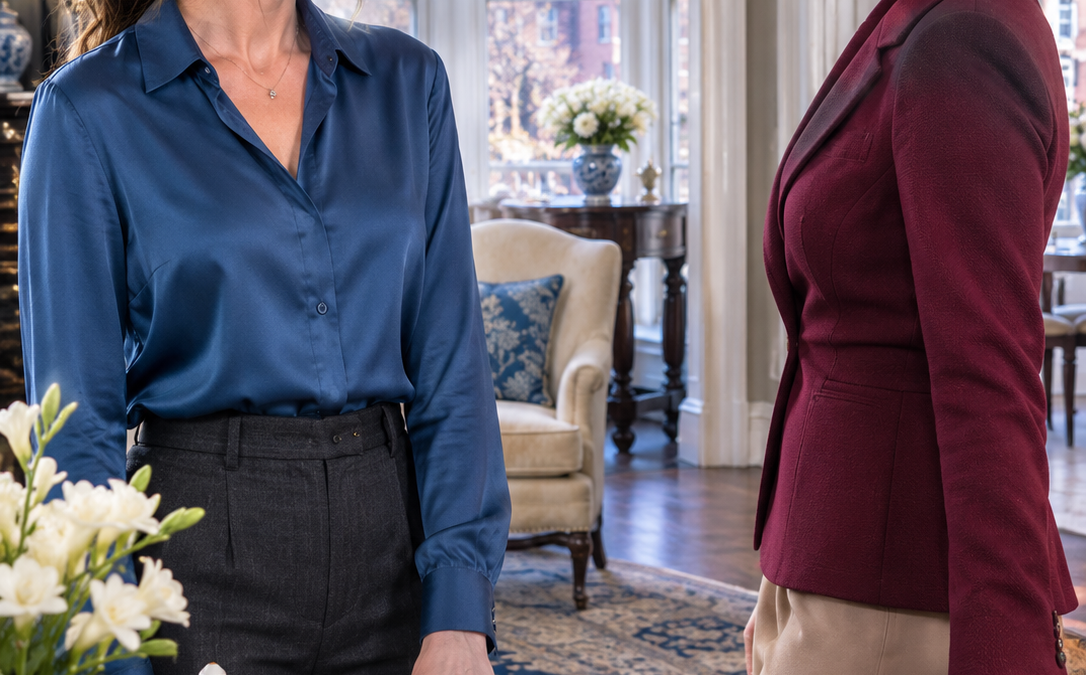
That evening, Pearl came to the house in person. She arrived in a wool-crepe blazer and camel trousers that probably cost more than a month of my former South End rent, and she stood in the center of the sitting room with the particular confidence of someone who had already decided the space belonged to her.
“You’ve done a remarkable job here,” she said, glancing around the room I had rearranged twice to make navigating the furniture easier for Elliot. “I mean that sincerely. Managing a household like this, managing him, it’s not nothing.”
I finished arranging the tea tray and set it on the coffee table.
“He wasn’t particularly difficult,” I said. “You just have to pay attention.”
Pearl watched me with something close to curiosity.
“You know, Serena, there’s no version of this where you come out looking bad. You were devoted. You sacrificed. Anyone with sense can see that. But Elliot’s world is a specific world. It requires a specific kind of partner.”
I looked directly at her. “What kind of partner is that?”
She smiled with one corner of her mouth. “The kind who was born to it.”
I thought about that for a moment. Then I said, “The chamomile is ready. Sugar is on the left.”
She blinked.
I sat down across from her, folded my hands in my lap, and waited for her to leave.
That night, after Elliot had gone to bed, I sat down at the study desk and opened my laptop.
The Whitmore Club had sent Aaron the login credentials for the private multimedia server that would run the evening’s presentation, a slideshow of portraits and company milestones that would play on the club’s main screen as the dinner opened. Aaron had forwarded the email to Elliot’s account.
I had been managing Elliot’s email for two years.
I logged in.
The folder structure was clean and simple. Under the introductory sequence folder, I uploaded the audio file from the recorder. I linked it to the opening sixty seconds of the presentation. I saved it under the original filename, closed the browser, and shut the laptop.
My hands were completely steady.
I want to be honest about this. I did not feel triumphant. I did not feel relief. What I felt was something closer to the sensation of setting down a weight you’ve been carrying so long that your muscles have simply forgotten what it felt like to be empty-handed.
The morning of the Whitmore dinner arrived gray and cold, the kind of November Saturday in Boston that smells of woodsmoke and wet leaves.
Elliot woke early and dressed without asking for my help, something he had done with increasing frequency over the past eight months, though he always covered it with a plausible explanation.
I watched from the doorway as he straightened his own tie in the mirror, his reflection moving with the practiced ease of a man with full visual command of the space around him.
He crossed the room toward me, reaching out with slightly exaggerated imprecision, and cupped my face in his hands. His thumbs traced my cheekbones.
“Go see your parents today,” he said. “Give yourself a rest. Tonight, when I’m back, I’ll take you to Oana. You’ve been wanting to go for months.”
I let my eyes close for just a moment.
The warmth of his palms against my face was real, even if nothing else was.
I had loved him genuinely. I wanted to be clear about that, at least to myself.
“I’ll do that,” I said softly. “Drive safely.”
The front door closed. I opened my eyes.
I had not accumulated much in three years. The things I truly cared about were already in Portland. What remained were the gifts: the Cartier bracelet, the cashmere coats, the pearl earrings, the weekend bag from a boutique on Newbury Street.
I piled them all on the sitting room coffee table in an arrangement that was more accurate than dramatic. I did not want to perform grief I did not feel.
From the drawer of the bedside table, I removed the engagement ring, a round-cut diamond set in platinum, engraved on the inside curve with the date of the night he had proposed.
I carried it to the kitchen and set it flat on the marble island, directly beneath the pendant light, where the stone caught the gray November daylight and threw a small, cold prism across the wall.
Then I put on my old canvas coat, the one I had worn in architecture school, lifted my bag, and walked out the front door onto Pinckney Street.
The cobblestones were still wet from the morning frost. I walked down the hill toward Charles Street, past the corner coffee shop where I had bought Elliot’s morning tea for three years, past the pharmacy where I had filled his prescriptions, past the small park where I used to describe the color of the autumn leaves to him while he sat on the bench with his face tilted up toward the sun.
At the bottom of the hill, I stopped beside a recycling bin and snapped my SIM card cleanly in half.
I had arranged a car through a private service. The driver was already waiting on Cambridge Street. I got in, gave him the destination—South Station—and watched Beacon Hill disappear behind me through the rear window without feeling the need to look at it for very long.
Ren was parked in the pickup zone outside the station’s Atlantic Avenue entrance, her ancient Subaru idling with the hazard lights on. She had driven down from Portland at six in the morning, and she looked it: tired, windburned, and completely certain about being there.
She stared at me when I got in.
“You’re thinner,” she said.
“I’m fine.”
“You’re always fine,” she said, which was more accurate than she probably intended.
She signaled and pulled into traffic.
“Where are we going?”
“North,” I said. “Somewhere with a harbor and trees and not a single person who knows my name.”
Ren drove.
The Whitmore Club’s private dining room was illuminated by candlelight and the warm amber glow of the sconces along the wainscoted walls when the presentation screen came to life.
One hundred and twelve guests had gathered: Boston’s medical and financial establishment, a clutch of journalists from The Boston Globe and the Boston Business Journal, and several members of the Fontaine family who had flown in from their compound outside Newport.
Elliot stood at the front of the room beside Pearl, who was wearing a deep wine-red gown that had arrived from a Manhattan atelier two days earlier. She looked, by every objective measure, exactly like a woman who had won.
The evening’s host, a silver-haired partner from the Fontaine family’s law firm, raised his glass and welcomed the room. He spoke warmly of legacy, alliance, and the kind of partnership that defines generations.
Then he gestured toward the screen, where the introductory presentation would begin.
The lights dimmed for approximately four seconds.
The room heard the opening notes of the instrumental piece Aaron had selected, something classical and understated. Then the audio beneath it shifted, and a voice filled the room that was not part of any script.
It was Pearl’s voice.
“Doesn’t it tire you, watching that woman follow you around like you’re made of glass?”
The room went absolutely still. The kind of stillness that happens when a hundred people simultaneously stop breathing.
Then came Elliot’s voice, measured and cold, moving through the speakers of a room full of his investors and colleagues and the family he was hoping to merge with.
“Serena was convenient. If she hadn’t stepped in when she did, Voss Medical would have bled out during the transition period.”
Someone dropped a fork.
A journalist near the back had already raised a phone.
The recording ran for two full minutes. It covered everything: the plan, the timeline, the Whitmore dinner itself, and the severance check. Pearl’s laughter when she said he sounded so much better without the caretaker hanging around. Elliot’s flat agreement. The casual confirmation that his vision had returned months earlier and he had simply chosen not to mention it.
Pearl grabbed Elliot’s forearm with both hands. Her face had drained to the color of the tablecloths.
“Do something,” she said very quietly through her teeth. “Tell them it’s been altered. Tell them it’s out of context.”
Elliot said nothing.
He was looking at the screen with the expression of a man watching a building he owned burn to the ground.
A reporter from The Boston Globe had already crossed the room and was asking loudly whether it was true that Voss Medical’s CEO had concealed a successful medical procedure from his board for eight months.
A Fontaine family attorney was on the phone in the corner. The law firm partner who had opened the evening had quietly set down his microphone and was moving toward the exit.
Pearl’s composure fractured all at once. She turned on Elliot with a ferocity that was audible across the room.
“This is your fault,” she said. “You told me she was manageable. You told me she was nobody.”
Elliot looked at her for a long moment.
Then he said very quietly, “I told you too much.”
He walked off the small stage without another word.
The room erupted behind him. Cameras flashed. The Globe reporter was dictating notes into her phone. The attorney had stopped pretending to be on a call and was openly recording the scene.
By Sunday morning, the story was on the front page of the Boston Business Journal’s website and had been picked up by outlets across the country.
The headline was not kind.
Neither was the board, which called an emergency session that same evening. Nor was the Massachusetts Securities Division, which opened a preliminary inquiry into whether the concealment of a medical recovery that affected executive capacity constituted material misrepresentation to Voss Medical shareholders.
Elliot spent Sunday driving to every address he had for me.
My sublet in the South End, where the PhD student who now lived there answered the door in confusion. My parents’ house in Concord, where my mother told him through the screen door that she hadn’t heard from me since I had called three days earlier to say I was leaving, and that if he was looking for her blessing to bring me back, he had come to the wrong house.
He stood on their front porch in the November cold for twenty minutes before he left.
Aaron Park found himself in the impossible position of a man who had known too much for too long and helped too little. He tendered his resignation the following Monday.
I heard about this later and felt something for him that wasn’t quite forgiveness, but was, at minimum, understanding.
Pearl Fontaine released a statement through her family’s publicist characterizing herself as a victim of Elliot’s deceptions. The Fontaine family formally dissolved all merger discussions with Voss Medical. Their attorneys filed a civil complaint for breach of a preliminary agreement.
Voss Medical stock dropped twenty-six percent before trading was paused.
I know all of this because Ren forwarded me the articles from her phone while we sat in a rental cottage outside Bar Harbor, eating takeout from Café This Way on Mount Desert Street, watching the November Atlantic through a window that had frost forming at the corners.
She laid her phone across the table between us, and we read in silence.
“I’m not glad he’s suffering,” I said finally. “I want to be clear about that.”
Ren looked at me.
“What are you glad about?”
I thought about it.
“I’m glad I didn’t cry in front of him. I’m glad I had time to do it right.”
Ren nodded. She refilled my tea.
Outside, the water was completely dark, and the lights of the town were small and steady on the other side of the harbor.
Two years later, I opened my own practice in Portland, sharing studio space with Ren in a converted warehouse near the Old Port.
We specialize in residential and boutique commercial interiors, the kind of projects that require patience and precision and a genuine understanding of how people move through the spaces they live in.
We had more work than we could take within the first eight months.
I did not hear from Elliot for a long time.
When I finally did, it was a handwritten letter. No attorney’s letterhead, no legal language, just paper and a pen.
He wrote that he had spent a year trying to find me before deciding he didn’t have the right to keep looking. He wrote that he understood what he had done and that he was not asking for anything. He was not offering an explanation.
He wrote, “You gave me light when I was in the dark, and I spent that gift on the worst version of myself. I think about that every day.”
I read the letter twice.
Then I folded it and put it in the drawer of my desk beside a small framed photograph from my first solo project, a beach house on Peaks Island with floor-to-ceiling windows and white plank ceilings and light that moved through every room like something alive.
I didn’t write back.
There was nothing left to say that the Whitmore Club hadn’t already said for me.
What I know now that I did not know at the beginning is this: Love given without conditions is not weakness. It is the rarest thing a person can offer.
What makes it dangerous is not the love itself, but the assumption by the person receiving it that it will simply keep coming, no matter what they do. That it is a resource without limit, a light that cannot be switched off.
I switched it off, and in the quiet that followed, I found out who I was when I wasn’t building my entire life around someone else’s darkness.
On a clear morning last spring, I was standing outside our studio on Exchange Street, arranging a sample of reclaimed white oak paneling in the window display, when a woman stopped on the sidewalk to look at it.
She was maybe thirty, carrying a coffee from Tandem in one hand and a set of rolled architectural drawings under her arm.
She asked about the project. I told her it was a small residential renovation on Munjoy Hill. A first-time homeowner, a tight budget, a lot of natural light.
She smiled at the oak panel.
“It’s beautiful,” she said. “How do you know what a space needs?”
I thought about it for a second.
“You listen to it,” I said. “You stop trying to make it into something it isn’t, and you listen.”
She nodded like that meant something to her, thanked me, and walked on down Exchange Street with her coffee and her drawings and her whole clear, unhurried morning ahead of her.
I watched her go, and then I went back inside to…








