Every year my family said i “ruined” christmas; this year i didn’t show; i didn’t pay for any of it either; the calls started at five.
The warm breeze off the Atlantic felt like a physical weight lifting off my tired shoulders. I sat on my sunlit balcony on the Outer Banks, a cup of strong black coffee in my hand, watching the gray-green waves roll gently against the sand. It was a beautiful evening, but more importantly, it was exactly five o’clock on Christmas Eve.
I set my coffee down on the glass table next to my phone. I didn’t have to wait long. Right as the digital clock shifted to 5:01, the screen lit up. The phone began to vibrate violently, buzzing against the glass like an angry hornet.
First, it was a text from my son, Tyler.
“The card declined. They’re kicking us out. Call me right now.”
Then came a message from my daughter, Megan.
“Dad, answer the phone. Craig’s card is frozen. What did you do?”
A second later, my daughter-in-law, Paige, chimed in.
“The lodge manager is threatening to call the police. We have nowhere to go.”
My phone screen was a cascading waterfall of pure, unadulterated panic. I simply sat back, crossed my legs, and watched the notifications roll in. I didn’t answer. I didn’t even flinch.
For the last nine years, ever since my late wife Louise passed away, my family had told me every single winter that I somehow ruined Christmas. I was too cheap, too traditional, too boring. I ruined their holidays by asking them to budget. I ruined their holidays by not buying the right vintage of champagne.
So this year, I gave them exactly what they wanted.
I didn’t show up to ruin anything, and I didn’t pay for any of it either.
My name is Walter Hrix. I’m seventy years old. And before I tell you about that Christmas Eve, I want to explain how a man who built an entire company with his own two hands ended up sitting quietly on a beach while his own children froze in the mountains. Because I don’t think any of what follows makes sense without understanding exactly what kind of father I tried to be, and exactly where that trying went wrong.
I should describe the neighborhood I grew up in because I think it explains something important about the particular values I carried into my own fatherhood decades later. My father, a machinist at a midsized manufacturing plant, raised five of us in a small rented house on the edge of town. I remember him coming home exhausted six days a week, his hands permanently stained with machine oil that no amount of soap ever fully removed.
He never once complained about the work, at least not where his children could hear it. And he had exactly one rule he repeated often enough that all five of us could recite it by heart.
“Nobody in this house gets handed anything they haven’t earned, including me.”
I watched him turn down a loan from his own brother once, a genuinely generous offer meant to ease a difficult winter, because accepting it, he told my mother later, would have meant admitting he couldn’t provide for his own family through his own labor.
I thought that pride was almost foolish at the time, watching my mother stretch a thin grocery budget through February because of it. I understand it considerably better now, having watched exactly what happens to a family when that particular kind of pride gets replaced entirely by comfortable, quiet rescue.
You have to understand the illusion we had been living in. That illusion completely shattered exactly one month earlier, on Thanksgiving.
I was hosting the holiday at my house, a modest four-bedroom colonial I’d lived in for twenty-eight years. I’d paid for everything. I’d hired a private catering company to cook a massive feast because my daughter Megan refused to eat my home cooking, claiming she was on a strict organic diet I simply could not comprehend.
I’d spent nearly $1,000 making sure the table was perfectly set with her favorite free-range turkey and imported sides.
I want to pause here and say something about Louise, because I think her absence sits underneath every single decision I made that year, whether I was consciously aware of it or not.
She was diagnosed with pancreatic cancer eleven months after we sold the company, the same year we’d finally started talking about traveling, about the modest, comfortable retirement we’d quietly earned after four decades of hard work. She died seven months later.
I nursed her through most of it myself in that same house. And I remember, near the very end, her gripping my hand and telling me to please, please make sure the kids turned out all right. That money without character was the loneliest kind of poverty a person could have.
I promised her I would.
I think, looking back, I spent the following nine years trying to keep that promise in exactly the wrong way, believing that generosity alone could substitute for the boundaries I never had the heart to enforce once she was gone.
There was a version of Tyler and Megan once that I think about often now. The two of them as children, in the years before the company really took off, when we still lived in a cramped two-bedroom apartment above a hardware store and Louise stretched every grocery budget to its absolute limit.
I remember Tyler at seven, saving his own allowance for three straight months to buy his mother a birthday present, proud beyond measure of the modest little jewelry box he’d picked out himself. I remember Megan at nine, insisting on getting a summer job walking neighborhood dogs specifically so she could contribute toward a family vacation rather than simply expecting one.
Those children existed. I know they existed because I watched them grow, day by day, into people who understood effort and gratitude in a way that somehow gradually dissolved once real money entered the picture.
I’ve spent a great deal of time since trying to understand exactly when that dissolution began. And I’ve come to believe it wasn’t any single moment, but a slow, cumulative erosion. One unnecessary rescue at a time. Each one individually so small I never noticed the tide pulling the shoreline away beneath their feet.
But the moment Megan and Paige walked through the front door that Thanksgiving, the complaints began.
Megan tossed her expensive coat onto my sofa and immediately sighed at the temperature, lowering the thermostat without asking. Paige, holding a glass of wine I’d poured for her, took one sip and wrinkled her nose.
“This wine is so aggressive, Walter,” she said, setting the crystal glass down on the counter with a loud clink. “Did you get this on sale at the grocery store?”
I’d actually spent $55 on that bottle. But I swallowed my pride and offered her a different one.
I remember standing in the kitchen a moment after that exchange, pouring Paige’s replacement glass and catching my own reflection faintly in the dark window above the sink. An aging man in a cardigan, quietly absorbing yet another small humiliation in his own home.
I thought in that brief moment of a phrase Louise used to say whenever I came home frustrated from some difficult client negotiation early in the business’s history.
“You can’t pour from an empty cup, Walter. So stop letting people drink you dry and call it generosity.”
I’d always understood that advice as applying to my professional life, to demanding clients and difficult vendors. Standing in my own kitchen that Thanksgiving, pouring a second glass of wine for a daughter-in-law who’d just insulted the first one, I finally understood she’d meant it for my family, too, all along. And that I’d simply never been ready to hear it applied there until it was almost too late.
As we sat down to eat, the atmosphere was suffocating. I sat at the head of the table, listening to my children and their spouses talk right over me.
Craig, Megan’s husband, spent twenty minutes bragging about his new imported truck, the very same truck I was secretly co-signing the massive payments for because his credit was completely destroyed. Tyler spent dinner talking about his new logistics tech startup, boasting about being a founder, conveniently leaving out the fact that I’d been floating his company with monthly bridge loans just to keep the lights on.
At one point during dinner, Paige asked me, almost as an afterthought between bites, how retirement was treating me and whether I’d found any new hobbies to fill my days.
I told her I’d taken up volunteering at the library twice a week, reading to children in the after-school program, something Louise and I used to do together before she got sick.
Paige nodded politely, already turning her attention back to Tyler’s story about a supposed investor meeting, and I understood in that small, forgettable exchange exactly how little curiosity any of them actually carried about the shape of my daily life beyond what I might still be persuaded to fund.
They looked around my house with barely concealed disdain.
“Dad, when are you going to update these drapes?” Megan asked, pointing a manicured finger at the living room window. “It smells like a museum in here. You really should think about downsizing.”
I just nodded and chewed my food, keeping the peace, just like Louise used to do.
I’d spent my entire working life building a regional trucking and warehousing company from a single leased truck. I started at twenty-four, married to Louise for barely a year, sleeping in the cab of that truck more nights than I slept in our own bed, hauling freight across three states for anyone willing to pay.
I remember the exact winter I bought my second truck, financed against everything we owned. Louise sat across the kitchen table doing the math with me twice, three times, making absolutely sure we could survive if the gamble failed.
It didn’t fail.
Twenty years later, I had a fleet of sixty trucks and four regional distribution centers. I sold it for millions a decade ago, right before Louise got sick. But we kept the wealth quiet. We lived modestly because we wanted our kids to learn the value of a dollar.
Instead, my silence only bred their entitlement.
I think about that decision often now. The decision to hide what we’d built rather than teach them how to hold it responsibly. Louise used to say that money changes people slowly, the way water changes stone, and that she’d rather our children never feel the current at all than risk it wearing them down into something unrecognizable.
I agreed with her completely at the time.
I understand now that we simply traded one danger for another. Instead of being shaped by visible wealth, they were shaped by invisible rescue, learning that failure simply never produced consequences without ever understanding why.
When the plates were finally cleared, Tyler stood up and clapped his hands together.
“All right, family,” he announced with a wide, arrogant smile. “Let’s talk about Christmas. I found the perfect spot this year. A luxury lodge in Jackson Hole. Private hot tub, ski-in, ski-out, a private chef option.”
Paige pulled out her phone immediately, already scrolling through photographs of the property. She turned the screen around to show Megan the private hot tub overlooking the mountains, the vaulted timber ceilings, the professional photographs clearly designed to sell exactly the fantasy Tyler had already half convinced everyone at that table was somehow going to be mine to fund.
I watched them pass the phone around, oohing appropriately at each new photograph. And I remember feeling, even before Tyler named a number, the familiar sinking certainty that whatever figure came next was going to be substantial, and that objecting to it would once again be framed as some character flaw of mine rather than a reasonable question about a five-figure expense.
I looked at him, surprised.
“Jackson Hole?” I asked mildly. “Tyler, that sounds incredibly expensive. How much is a lodge like that going to cost for a week?”
Tyler waved his hand dismissively.
“About $22,000 for the week, but don’t worry about the details, Dad. It’s a family tradition. You’ll cover the deposit to secure the booking, right? We can put the incidentals on your black card, like we did last year in Big Sky.”
I remember Big Sky clearly, actually, in ways I hadn’t fully let myself examine until sitting at that Thanksgiving table, listening to Tyler mention it so casually.
I’d flown out for exactly two days of that trip, the rest of the week apparently reserved for the four of them to enjoy without an aging father slowing down their skiing. And I remember standing on the edge of a crowded slopeside patio, watching my children take photographs of the mountain views for their social media accounts, none of them once suggesting I join them for so much as a chairlift ride.
I told myself, flying home early, that I simply wasn’t up for the altitude anymore.
I understand now that the real reason had nothing to do with altitude at all.
I remember the flight home from that trip particularly well, actually. Sitting alone in a middle seat between two strangers, scrolling through the handful of photographs I’d managed to take of my own children before they’d left for the slopes without me, and feeling a loneliness so specific and so unexpected that I nearly asked the flight attendant for something stronger than the ginger ale I’d ordered.
I told myself, landing back home to an empty house, that this was simply what it meant to have grown children living their own lives. That expecting them to organize a vacation around an aging father’s preferences was itself a kind of selfishness I didn’t want to indulge.
I understand now that there’s a considerable difference between graciously stepping back from your children’s independent lives and being quietly, repeatedly excluded from a life you’re the one actually funding.
I’d spent years confusing the two, telling myself the second was simply a more mature version of the first.
I felt a familiar knot tightening in my stomach.
“$22,000 for a single week? That’s a lot of money to drop on a cabin,” I said gently. “Your startup is barely breaking even right now. Maybe we should look into something a little more reasonable.”
Megan slammed her hands down on the table.
“Unbelievable,” she groaned. “You do this every single year, Dad. You always ruin the holidays with your penny-pinching. We just want one nice, memorable family vacation.”
I sat with that word for a moment. Penny-pinching. Turning it over in my mind against everything I actually knew about my own spending on this family. The $400,000 and counting that Mr. Whitfield’s ledgers would soon reveal in cold, undeniable print.
I said nothing about it in that moment, letting the accusation simply land and pass the way I’d trained myself to do at that table for years. But I remember thinking, with a clarity that surprised even me, that I had built an entire life around teaching frugality through my own example rather than through withholding.
And that somewhere along the way, my children had confused the two entirely, mistaking my modest personal habits for stinginess rather than recognizing them as the same discipline that had quietly funded nearly every comfortable thing in their own adult lives.
Craig chimed in, leaning back with a smug expression.
“Come on, Walter. You can’t take it with you. Just write the check.”
I want to describe the specific quality of that moment. Sitting at my own dining table while four grown adults treated a reasonable question about a five-figure expense as some kind of moral failing on my part.
I remember looking at Craig’s expression particularly closely, the easy, entitled certainty of a man who had never once in his entire adult life had to seriously weigh whether he could afford something before deciding to buy it.
I thought, sitting there, of my own father, a machinist who worked six days a week and never once in the whole of my childhood spent a dollar on himself he hadn’t already earned twice over.
I wondered, watching Craig, at exactly what point generational comfort curdles into this particular flavor of blindness. The total inability to imagine that money might ever run short, or that someone else’s labor might be the only reason it hadn’t yet.
I remember, too, thinking in that exact moment about a phrase Louise used to say whenever one of the kids complained about a rule they thought was unfair, back when they were young enough that rules still applied cleanly to their lives.
She used to tell them gently but firmly that fair doesn’t mean equal, and equal doesn’t mean deserved.
I’d forgotten that phrase entirely until it surfaced again at that dining table decades later, watching Craig treat an ordinary question about a vacation budget as some kind of unfair imposition on a life he believed, without ever quite articulating it to himself, that he’d earned simply by marrying into it.
I looked around the table. Four healthy, capable adults in their late thirties and early forties, glaring at me like I was a stubborn child refusing to hand over a toy.
I raised my hands in surrender.
“All right,” I murmured. “We’ll talk about Jackson Hole. Let me look at the numbers.”
They cheered, raised their glasses, and completely ignored me for the rest of the evening.
I sat there for a while longer, watching them talk over each other about ski packages and private chefs. And I remember thinking with a strange, quiet detachment that I could have been any stranger seated at that table for all the attention any of them paid me once the money question was settled.
I finished my plate alone in silence while four grown adults planned a $22,000 vacation three feet away from me.
About an hour later, the house had quieted down. The kids were in the living room watching football, leaving me to clean up the catering trays alone. Tyler had left his expensive leather jacket draped over a kitchen bar stool.
A muffled ringing started coming from inside the pocket.
I dried my hands on a dish towel, reached in, and pulled the phone out to bring it to him. It stopped ringing, but the screen was brightly lit, opened directly to a group text.
The name of the chat caught my eye immediately.
“Lodge Plan Confidential.”
I froze.
I knew I shouldn’t read my son’s messages, but the title sent a cold shiver down my spine.
The first message was from Craig.
“Just stroke his ego for a few more days until he signs the payment for the cabin. Let him think he’s the big man in charge. After the holidays, we push the assisted living brochure again. He’s getting too old for that big house anyway.”
My breath caught in my throat.
Assisted living.
I was seventy years old, walked three miles every morning, and managed my own investment portfolio myself.
I scrolled up, my thumb moving almost against my own will, and found the chat had actually been active for nearly three months, far longer than I’d initially realized standing there in that kitchen.
There were earlier messages, ones I made myself read in full even as my chest tightened with every line, discussing which assisted living facilities offered the best marketing brochures for softening the pitch, debating whether to frame the move as being closer to grandchildren rather than admitting the actual motive out loud, even to each other.
One message from Craig, dated weeks earlier, read simply:
“The sooner we get the deed, the sooner we stop having to ask permission for our own lives.”
I read that sentence three times, standing in my own kitchen, in the house I’d paid off with forty years of eighteen-hour days, and felt something in my chest go permanently, quietly cold.
Then came a reply from Tyler’s wife, Paige.
“If we can get him to put the house in a trust for us now, before the end of the year, we won’t have to deal with his penny-pinching next year. We can sell this museum and use the cash to pay off Tyler’s business loans.”
Finally, a text from my own daughter, Megan.
“Agreed. Let him pay for Jackson Hole first. Once we get the deed signed over, we take control of the accounts. I’m so sick of begging him for our own money.”
The screen timed out, leaving me staring at my own reflection in the dark glass.
The illusion of my family shattered into a million pieces in that quiet kitchen.
They didn’t love me. They didn’t even respect me. I wasn’t a father to them anymore. I was a dying ATM they were actively plotting to dismantle.
I stood there a long moment before setting the phone down, my own reflection staring back at me in that dark screen. An old man in a kitchen full of dirty catering trays.
And I remember thinking with a strange, sudden clarity of every single moment across the preceding decade when I’d sensed something faintly wrong beneath the surface of our family gatherings and talked myself out of naming it.
The way Megan’s eyes would flick toward my watch or my car keys during certain conversations. The way Tyler’s gratitude for each bridge loan always arrived wrapped in a request for slightly more the following month. The way Craig had once, at a dinner two years earlier, made a joke about how convenient it would be if in-laws simply came with a warranty.
And how the whole table had laughed, including me, without any of us quite naming what the joke actually implied.
I’d spent years collecting small, dismissible pieces of evidence and refusing to assemble them into the picture they’d always been forming.
That phone screen simply forced the final piece into place.
I did not scream. I quietly slipped the phone back into Tyler’s coat pocket, smoothed the leather out, and went back to washing dishes.
If they wanted to play a game of strategy, they’d forgotten one crucial detail.
I was the one who built the empire they were trying to steal.
I stood at that sink for a long while after they’d all gone to bed, hands submerged in cooling dishwater, replaying the exact words on that screen over and over.
I thought about the $22,000 demand still sitting unanswered from earlier that evening, about Megan’s eye roll, about Craig’s smug little smile as he told me I couldn’t take it with me.
I climbed the stairs sometime after midnight, lay awake beside the empty half of the bed Louise used to occupy, and made the decision somewhere in that darkness that I would not spend whatever years I had left funding my own betrayal.
The morning after Thanksgiving brought a cold, sharp clarity.
I woke at five, long before sunrise, brewed a pot of the cheapest coffee in the pantry, and sat at the kitchen island staring at the spot where I’d found Tyler’s coat.
I showered, shaved, and put on my best tailored suit, a suit my children had never once seen me wear. To them, I was just the guy in faded flannel who complained about gas prices. They didn’t know that suit cost more than their mortgage payments.
I want to describe a little more about the actual business I built, because I think it matters to understanding exactly what kind of man walked into that suit that morning.
In our best years, we ran sixty-three trucks across a four-state region. And I knew every single driver by name, knew most of their families, made a point of personally calling anyone who’d had a hard month to check in rather than leaving it to a regional manager.
My fiercest competitor for over two decades was a man named Elias Brandt, who ran a rival firm out of the next county over, a man who cut corners on maintenance and safety inspections to undercut my prices, and whom I eventually watched go bankrupt after a catastrophic accident exposed exactly how badly those corners had been cut.
I never celebrated his downfall. I remember, in fact, quietly offering three of his stranded drivers positions at my own company the week his firm folded, understanding that whatever mistakes their employer had made weren’t theirs to carry alone.
I think about Elias sometimes now, oddly comparing his particular kind of failure, built on cutting corners with strangers’ safety, against my own, built on cutting corners with my own children’s character.
Different failures, both in their own way failures of the same fundamental discipline. The discipline to do the harder, more expensive thing simply because it was right, rather than the easier thing because it was convenient.
I drove my ten-year-old pickup into the city and rode the private elevator up to the offices of Whitfield Wealth Advisers.
Mr. Whitfield was fifty-four, sharp as a tack, and one of the very few people alive who knew exactly how much I was worth.
I’d known him for close to fifteen years by that point, ever since a mutual friend from the logistics industry recommended him shortly after I sold the company.
What I appreciated most about him, beyond his obvious competence, was that he’d never once tried to talk me into the kind of aggressive, showy investments other advisers were always pitching. He understood instead, almost intuitively, that what Louise and I actually wanted was quiet, dependable stewardship rather than dazzling returns.
He’d been the one who quietly structured the shell entities that let me fund Tyler’s startup anonymously in the first place. And I think, looking back, some part of him had always privately worried about where that particular arrangement was eventually going to lead, though he’d never once said so directly, respecting the boundary of a client’s personal decisions even when he suspected they weren’t wise ones.
“Walter,” he said, standing to shake my hand, genuine surprise in his voice. “You usually only come in once a year for tax season. What brings you in on a Friday?”
“I need to sever my financial ties,” I said quietly. “All of them.”
He sat back down and slowly steepled his fingers, reading the exhaustion in my eyes.
He knew my history. Forty years earlier, one broken-down delivery truck, eighteen-hour days, cold canned soup, cross-country freight runs. That single truck became a fleet, and that fleet became a regional empire.
When I sold it, the buyout was astronomical.
Louise and I made a choice early on to keep it quiet. Modest house, average cars, coupons at the grocery store. We wanted the kids to grow up normal, to understand what it meant to earn a dollar.
We thought hiding the wealth would protect them from becoming entitled.
I remember the specific conversation where Louise and I first made that decision, sitting at our kitchen table maybe two years after the company really started to take off, watching our accountant’s projected numbers for the following decade and feeling something closer to fear than excitement.
Louise had grown up in a family with real money, the kind that had quietly ruined two of her own cousins, young men who’d never worked a day in their lives and drifted through their thirties and forties without purpose or direction, propped up entirely by trust funds neither of them had earned.
She told me that night that she’d rather our children grow up thinking we were comfortably middle class than risk raising the kind of hollow, aimless adults she’d watched her own cousins become.
I agreed completely, and we built our entire approach to parenting around that fear for the next twenty years, never once considering that the specific mechanism of our protection, quiet, invisible rescue rather than transparent wealth, might eventually produce exactly the outcome we were trying so hard to avoid.
“We were wrong, Mr. Whitfield,” I said. “By hiding the money but secretly bailing them out every time they failed, I didn’t teach them resilience. I taught them consequences don’t exist. I became an invisible safety net. And now that net’s turned into a hammock they’re plotting to steal.”
I told him everything. Thanksgiving, the $22,000 demand, and the group chat.
His face went pale with a mixture of shock and professional fury.
He asked me to read him the exact messages word for word rather than simply summarizing them. And I remember his pen freezing mid-note when I reached the line about assisted living. The phrase, “He’s getting too old for that big house anyway,” landed in that quiet office with a weight I hadn’t fully anticipated, saying it out loud to another person for the first time.
He set his pen down entirely and looked at me for a long moment before speaking again.
“Walter,” he said slowly, “that’s not just ungrateful. That’s a coordinated conspiracy to defraud you. We can involve the authorities right now.”
I sat with that offer for a long moment, genuinely considering it before answering.
Some part of me understood that involving the police would have been the more conventional response, the one most people would expect from a betrayed father discovering exactly this kind of scheme.
But I thought about what a criminal investigation would actually mean. The drawn-out process, the public record, the inevitable moment when extended family and old friends learned every detail through a courtroom proceeding rather than through my own careful, controlled account of it.
I thought about Louise, about what she would have wanted for our grandchildren, however distant they might someday become, and about whether criminal charges against their parents were a wound I wanted to inflict on people who hadn’t yet had the chance to choose their own path separate from their parents’ greed.
I decided, sitting in that office, that financial consequence delivered with total, complete finality was a harder, more honest lesson than a courtroom could ever teach, precisely because it required no jury, no lawyer, no possibility of a lighter sentence for good behavior.
It simply was what it was, immediate and inarguable.
“No,” I replied firmly. “No police, no courtroom scenes. That’s what a scared old man would do. I’m not a scared old man. I’m the man who built the empire they’re trying to steal, and I’m going to tear it down brick by brick. Pull up the ledgers.”
Mr. Whitfield studied my face a long moment before nodding, the way a man might study another man he’s about to follow into something difficult, making sure of his footing first.
“All right, Walter,” he said quietly. “Let’s see exactly what we’re dealing with.”
He opened his laptop.
Over the past three years, I’d secretly funneled $130,000 into Tyler’s failing startup, disguised as anonymous bridge loans through a shell entity.
Two years ago, Megan and Craig had bought a sprawling home they couldn’t afford, approved only because I’d quietly co-signed and pledged a chunk of my portfolio as collateral. Every month, a silent transfer covered their mortgage deficit.
I want to describe what it actually felt like watching those numbers populate on Mr. Whitfield’s screen, because I don’t think I fully understood the scale of my own enabling until I saw it laid out in cold, orderly rows.
Tyler’s startup, a logistics software company he’d been telling anyone who’d listen was about to close a major funding round, had never once turned a profit in three years of operation.
Every payroll cycle, every client dinner, every conference booth he’d rented to look like a legitimate founder had been quietly financed by a shell entity Mr. Whitfield managed on my behalf, structured specifically so Tyler would believe he was attracting real investors rather than simply spending his father’s money with an extra layer of paperwork between us.
Watching that number climb past $100,000, I felt something considerably heavier than anger. I felt the specific, sick recognition of having built the exact trap I was now trying to dismantle, one well-intentioned transfer at a time.
Mr. Whitfield pulled up the mortgage file next, and I want to describe what I saw there, too, because it deserves the same honest accounting as Tyler’s numbers.
Craig’s actual documented income, the figure his own lender had on file, was barely a third of what their monthly mortgage payment required.
The only reason the loan had ever been approved in the first place was my collateral pledge, quietly structured through Mr. Whitfield’s office two years earlier when Megan had come to me in tears, describing the house as the last chance for their marriage to feel like it was moving forward rather than standing still.
I’d believed her completely at the time.
Looking at those numbers now, I understood that I’d essentially bought them a house neither of them could actually afford, then spent two years silently paying the difference every month so neither of them would ever have to discover that uncomfortable truth for themselves.
“They think they’re independently wealthy,” I said, staring at the screen.
“What do you want to do?” Mr. Whitfield asked.
“Cut the strings,” I said. “The whole way. Remove me as guarantor on the mortgage. Halt the bridge loans into Tyler’s accounts. Withdraw all corporate backing.”
“Consider it done,” he said, typing. “The mortgage company will flag Megan’s account for insufficient collateral immediately. They’ll freeze her credit and demand a balloon payment. Tyler’s startup will hit zero before month’s end.”
I asked him, before he went any further, whether he had any personal reservations about executing something this severe against my own children, whether the scale of it gave him any professional pause I should know about.
He set his pen down and considered the question seriously before answering, the way he considered everything.
“I’ve watched families destroy each other over far less than what you’re describing, Walter,” he said. “I’ve also watched a small number of families finally heal years later, precisely because someone had the courage to stop the bleeding before it became fatal. I can’t promise you which version this becomes. I can promise you that continuing to bleed quietly the way you have for years was never actually protecting anyone, including them.”
I thanked him for his honesty and told him I appreciated that he’d never once tried to simply tell me what I wanted to hear across the fifteen years we’d worked together, that his willingness to name hard truths plainly was exactly why I trusted him with something this personal in the first place.
He nodded once briskly, the way he always did when a conversation had reached its natural end, and pulled his legal pad back toward himself, ready to move from the emotional weight of the decision into the practical mechanics of carrying it out.
“I don’t want this in a few weeks,” I said. “I want it on my schedule. Can you time the execution?”
“Yes, we can place future-dated holds.”
He explained the mechanics to me in more detail than I probably needed, though I appreciated the thoroughness, walking me through exactly how a future-dated execution order worked within the banking systems he had access to, how the holds could be programmed to trigger automatically at a precise date and hour without requiring either of us to be present when they fired.
“It’s a bit like planting a very expensive, very patient bomb,” he said, with the dry humor I’d come to appreciate in him over the years. “Once it’s set, it doesn’t need us to babysit it. It simply waits.”
“They want me to pay for a luxury lodge for Christmas,” I said. “Final payment’s due December 24th. I want every lifeline to evaporate exactly then, five o’clock in the afternoon.”
He looked at me a long moment, then nodded respectfully.
“What will you do until then?”
I stood and buttoned my jacket.
“I’m going to go home, pretend I saw nothing, and act like the naive old man they think I am. I’ll give them my cards. I’ll let them climb as high as they can, because the higher they climb on my dime, the harder the fall when the money disappears.”
We spent the next hour reviewing legal firewalls, my personal assets shielded entirely from their coming collapse. Irrevocable trusts they could never touch or contest.
Mr. Whitfield walked me through each provision carefully twice, making certain I understood exactly what I was authorizing before he’d let me sign a single page.
At one point, he paused and looked at me directly, setting his pen down.
“Walter,” he said, “I need to ask you something, and I want you to actually think about the answer rather than just reacting. Once these accounts close, once this document is filed, there’s no soft landing for any of them. Is that truly what you want?”
I sat with that question for a long moment, thinking of Louise’s hand in mine, thinking of the phrase that had been sitting like a stone in my chest since Thanksgiving night.
“The sooner we get the deed, the sooner we stop having to ask permission for our own lives.”
I told him yes.
He nodded, and we finished the paperwork.
When we finished, I shook his hand. It felt like shaking hands with a surgeon who’d just removed a tumor.
I drove home through quiet, tree-lined streets, sat in the driveway a few long minutes to compose myself, and walked in wearing a wide, soft smile.
I told them I’d been thinking about our conversation, that I’d been too rigid, that life was too short to worry about budgets.
I want to describe those minutes in the driveway a little more, because they were, in some ways, harder than anything that came after.
I sat there rehearsing my own face in the rearview mirror, practicing the specific soft, apologetic expression I’d need to sell the performance convincingly, the same expression I imagined a poker player might practice before sitting down at a table with everything he owned on the line.
I thought about Louise, about what she would have said watching me do this. And I decided, sitting there in that cold driveway, that she would have understood completely, even if she wouldn’t have enjoyed watching it any more than I enjoyed doing it.
The shift in their demeanor was instantaneous and sickening.
Megan hugged me, cold and hollow, but I hugged her back. Tyler called me the best dad in the world. Craig raised his beer in a silent toast. Paige immediately started talking about private chefs.
I walked to the hallway table and handed Tyler and Megan each a black corporate card.
I told them to book the lodge, the flights, the rental vehicles, the best of everything. I wanted this Christmas to be the most memorable trip we’d ever taken.
They had no idea Mr. Whitfield had already placed a strict temporary limit on those cards, enough clearance to book reservations and pay deposits, but the final authorizations would collide with a closed account on exactly the date we’d chosen.
I sat in my armchair and watched them plan my supposed financial ruin, giddy with excitement, never once asking what I wanted to do in Wyoming.
I was invisible to them again.
This time it didn’t hurt. It only confirmed I was making the right decision.
I remember Craig at one point that evening glancing over at me with what I can only describe as a flicker of genuine surprise, as if some small part of him hadn’t fully expected the plan to work this cleanly.
He asked, almost testing the waters, whether I wanted to come look at the lodge photos with them, see the room I’d be staying in.
I told him I trusted their judgment completely, that I was sure whatever they picked would be wonderful.
I watched something in his shoulders relax at that answer, the last trace of caution draining out of him, replaced by the easy confidence of a man who believed he’d successfully managed a difficult aging relative exactly the way he’d planned to.
That night, I sat on the edge of my bed and looked at a framed photograph of Louise on the nightstand.
I told her silently that I was sorry it had come to this. Sorry our dream of a family had turned into a nightmare of greed.
But I was finally fixing the mistake we’d made. I was going to teach our children the value of a dollar.
It was just going to be the most expensive lesson they’d ever learn.
Two weeks before the trip, Tyler and Craig showed up at my door unannounced.
A third man climbed out of the back seat, wearing a cheap gray suit and carrying a battered briefcase. He introduced himself as a tax and estate specialist they’d hired to help the family optimize our financial future.
I remember watching all three of them climb out of Craig’s imported truck through the frost-covered front window before they’d even reached the porch, and feeling in that specific moment a strange calm settle over me rather than the dread I might have expected.
I’d been half anticipating some version of this visit ever since reading that group chat. And there was almost a strange relief in watching the anticipated threat finally arrive in the flesh, precisely because I’d already spent two weeks preparing exactly how I intended to meet it.
I want to describe that man a little more because I’ve thought about him often since. A minor character in this whole affair who nonetheless revealed something important about how far my children were willing to go.
He smelled faintly of stale coffee and drugstore cologne, and he had the particular practiced smoothness of a man who’d talked a hundred frightened elderly people into signing away things they didn’t fully understand.
I learned later, through Mr. Whitfield’s own quiet inquiry, that this specialist wasn’t licensed to practice law in our state at all, operating instead through a loose network of estate-planning consultants who charged a flat cash fee and disappeared the moment anything went sideways.
My own children had hired a man specifically because he wouldn’t ask too many questions about the ethics of what he was being paid to do.
They marched into my living room without removing their snowy shoes, tracking wet prints across the hardwood I’d maintained for three decades.
Craig sat heavily on my sofa, manufacturing urgency, throwing around terms like capital gains liabilities and probate penalties.
He claimed the government was changing estate tax law on January 1st, that if I passed away suddenly, the state would seize nearly half the value of my home.
“Walter,” he said, leaning forward with an expression I imagine he thought looked like genuine concern. “We’ve been up nights worrying about this. If something happened to you and this house wasn’t properly protected, Megan and Tyler could lose everything you worked for. We’re just trying to be responsible about the future.”
I nodded slowly, playing along, letting my eyes drift toward the window as though the very thought of my own mortality had suddenly become too much to bear.
“It’s just a lot to think about,” I murmured. “My own mortality, taxes, all of it at once.”
Tyler chimed in right on cue, playing the concerned son, saying they’d found a completely legal loophole, but it needed immediate action before we left for Jackson Hole.
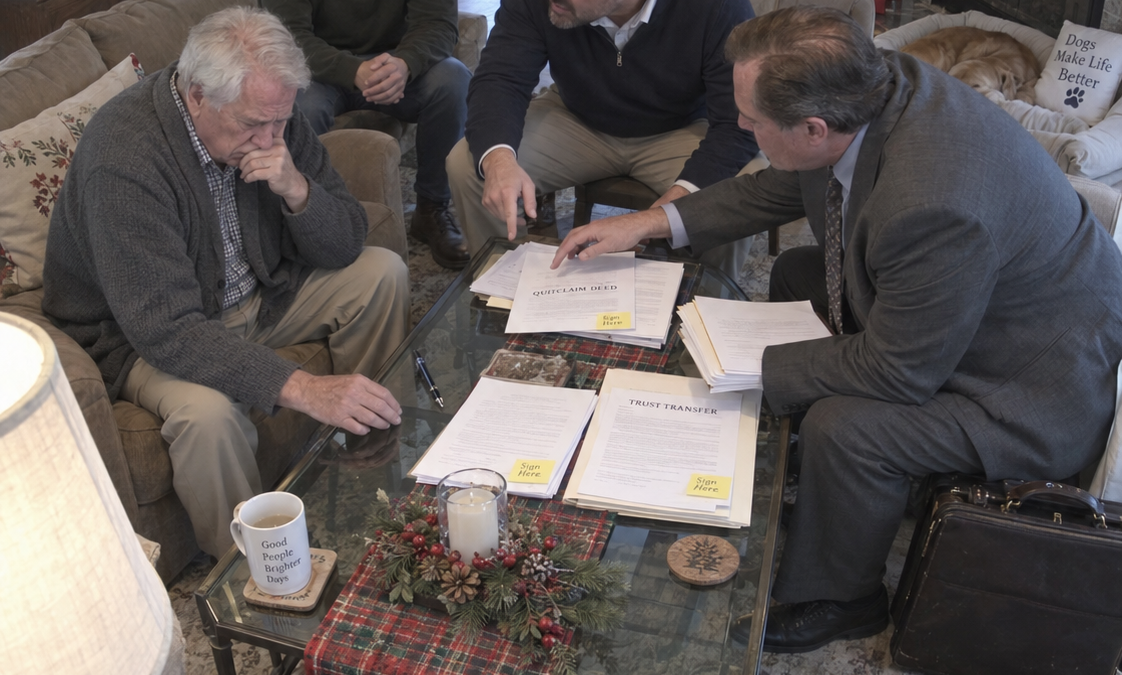
The lawyer unlatched his briefcase and slid a thick stack of documents across my coffee table.
A quitclaim deed combined with an irrevocable trust transfer, yellow sticky notes marking every signature line.
He assured me nothing would change day to day, that I could live in the house the rest of my life. He conveniently glossed over the fact that signing would strip me of all legal ownership immediately, handing full control to Tyler and Megan as trustees.
I picked up the first page and pretended to read it slowly, my eyes moving across dense paragraphs of legal language while my mind actually cataloged every detail for Mr. Whitfield.
Later, I noticed buried in the fourth paragraph a clause granting the trustees immediate authority to list the property for sale without requiring my signature or consent on any future transaction, language so carefully constructed that a less careful reading might have missed its full implications entirely.
I set the page down without commenting on it, filing it away as one more piece of evidence for the file I was quietly building against my own children.
I remembered the group chat, “Lodge Plan Confidential.”
This was the exact moment they’d been building toward since Thanksgiving.
I held the pen. I let a tremor creep into my hand, let it grow more pronounced as I lowered the tip toward the signature line.
I let the pen slip and clatter against the glass table.
I want to be honest about how difficult that particular performance actually was for me. Sitting there in my own living room, watching my son’s face flicker with something that looked for just a moment like genuine concern before the greed reasserted itself underneath it.
Some small, stubborn part of me, even knowing everything I knew, still wanted Tyler to be the boy who used to fall asleep against my shoulder on long drives, rather than the man calculating how quickly he could liquidate my house.
Playing the frightened, fumbling old man required me to access a version of vulnerability I’d spent my whole life trying not to show anyone. And doing it deliberately as a weapon felt like a strange, necessary betrayal of my own character, even as it protected everything else I had left.
“I’m sorry, boys,” I murmured, my voice wavering just enough. “My arthritis has been acting up. All this paperwork, it’s making my head spin a little.”
Craig stepped forward, using the tone you’d use on a toddler.
“Walter, it’s really simple. You don’t need to understand the legal jargon. Sign the yellow tabs and it’s done.”
I shook my head slowly.
“I know you’re looking out for me, Craig. But this is my home. Louise and I raised Tyler and Megan here. Signing it away, even into a trust, it feels so permanent. My doctor told me to keep my blood pressure down during the holidays.”
The lawyer leaned in, applying pressure.
“Sir, the tax code doesn’t care about your memories.”
I let my eyes water just a fraction.
“Tyler,” I whispered, “please, I just want this Christmas to be perfect. I’ve been looking forward to Jackson Hole since Thanksgiving. If I sign this right now, I’m going to spend the whole trip worrying. I made a mistake. Let’s just go. Let’s have the most beautiful Christmas we’ve ever had. I promise you, the first week of January, when we’re all back and relaxed, I’ll sign whatever you need.”
The room fell silent while they waited.
On one hand, they wanted the deed secured before year’s end. On the other, I was dangling an all-expenses-paid trip in front of them, funded by the very cards that would soon evaporate.
Craig gave Tyler a barely perceptible nod.
“Okay, Dad,” Tyler said smoothly. “We don’t want to stress you out. We’ll wait until January.”
They packed up the lawyer, said their goodbyes, playing the perfect caring sons, and left.
I listened to the door click shut, their footsteps crunch away through the snow, the engine fading down the street.
I sat alone in my living room.
The tremor vanished instantly. My posture straightened.
They’d taken the bait perfectly, trading the immediate theft of my home for the promise of a lavish vacation, never imagining the cards in their wallets were already tied to a ticking clock.
I called Mr. Whitfield that same evening to tell him what I’d seen buried in that fourth paragraph, the clause granting Tyler and Megan authority to sell the property without my consent once the trust was executed.
He listened, and I could hear him typing notes as I described it.
“That’s not sloppy drafting, Walter,” he said grimly. “That’s deliberate. Whoever wrote that document knew exactly what they were doing and knew exactly how to bury it where a frightened old man wouldn’t think to look.”
I asked him whether that changed anything about our plan.
He told me it didn’t. Not really. It only confirmed with even greater certainty that we were doing the right thing.
“Save the document if you can get a copy of it,” he added. “It may be useful leverage later, even if we never need to use it.”
I told him I’d already asked the lawyer apologetically whether I could keep a copy to review on my own time, and that he’d left one behind, tucked into a manila folder on my coffee table, clearly confident I posed no threat at all.
I drove out to the cemetery the following morning, something I did perhaps twice a year, usually on our anniversary and on her birthday, never in between because I’d always found the visits harder than I expected them to be.
This time, I went because I needed to say something out loud that I couldn’t quite bring myself to say inside my own house, surrounded by the family photographs Megan had once mocked as museum pieces.
I want to describe those final weeks with Louise a little more fully, because I don’t think I’ve ever told anyone the full shape of them. Not even Mr. Whitfield, not even Dorothy. And I think this story deserves that honesty, even if it’s difficult to write.
The hospice nurses came twice a day toward the end, but I insisted on doing most of the physical care myself, learning to manage her medications, to reposition her carefully when her body could no longer do it on its own, to sit with her through the long, quiet nights when sleep wouldn’t come for either of us.
Tyler and Megan visited, but not as often as I think either of them would tell you now, looking back, given how thoroughly the following years reframed their sense of obligation.
I never once resented their absence at the time. I told myself they were young, busy, that grief looks different depending on where you stand in relation to the person dying.
I understand now that I was already, even then, quietly making excuses for behavior I should have named honestly.
In her final week, lucid only in brief windows between the medication, Louise asked me to bring her the photo album from our first years together, the cheap vinyl one with the cracked spine.
And we went through it slowly, page by page, her fingers tracing photographs of Tyler as a toddler, of Megan’s first day of kindergarten, of a Christmas so lean we’d wrapped presents in newspaper because we couldn’t afford proper paper that year.
She stopped on a photograph of the four of us crowded onto a single motel bed during a driving vacation we could barely afford, all of us laughing at something none of us could later remember.
And she told me that was her favorite photograph in the entire album, out of thousands we’d taken over the decades since.
Not the professional family portraits from later years. Not the vacation photos from the Caribbean cruise we finally could afford.
That one. Cramped and imperfect and entirely unstaged.
I think about that specific memory more than almost any other from those final weeks, because I believe now that she was trying to tell me something important about where our family’s actual value had always lived. And I don’t think I fully understood the lesson until it was far too late to apply it the way she meant.
I stood in the cold, brushing a light dusting of snow off the top of her headstone, and told her everything. The group chat, the lawyer with his yellow sticky notes, the tremor I’d faked in my own hand to buy myself two more weeks.
I told her I was about to sell the house she’d loved, the garden she’d spent twenty years tending, to a developer who was going to tear it all down for something modern and forgettable.
I told her I was sorry, that I knew this wasn’t the ending either of us had imagined for our family, sitting at that kitchen table, doing the math on our first loan together, young and hopeful and certain that hard work and quiet generosity would be enough to raise good people.
I don’t believe in signs, not really. But standing there in that cold, quiet cemetery, I found myself thinking of the exact words she’d said to me in her final week.
And for the first time since Thanksgiving, I let myself cry right there beside her grave.
Not for the house or the money, but for the specific grief of finally, fully understanding that I couldn’t keep the promise I’d made her. Not in the way either of us had meant it.
I could still teach them the value of a dollar. I could no longer promise it wouldn’t come at the cost of losing them almost entirely.
An older groundskeeper I recognized from previous visits walked past while I was still standing there. Rather than simply nodding and continuing on as he usually did, he stopped a respectful distance away and asked if I was all right.
I told him honestly that I didn’t fully know yet.
He said something then that I’ve turned over in my mind many times since. That in thirty years of tending that particular cemetery, he’d noticed the graves that got the most flowers weren’t always the ones that got visited by the most people. And that sometimes a single person showing up, really showing up, meant more than an entire family performing grief once a year out of obligation.
I didn’t fully understand what he meant at the time.
I understand it considerably better now, having spent this past year discovering exactly which relationships in my life were performance and which were real.
The notifications began the very next morning, arriving in a steady, predictable rhythm.
First-class flight upgrades. Designer winter apparel. Paige and Megan apparently decided their mountain vacation required an entirely new wardrobe. Thousands of dollars at the city’s most expensive boutiques. A charge from a premium automotive rental agency. Craig had secured two fully loaded imported SUVs with concierge delivery to the airport.
Over the following ten days, the spending became a spectacle.
Pre-trip spa treatments. Reservations at a Michelin-starred restaurant in Jackson Hole requiring massive, nonrefundable deposits. Cases of premium wine shipped directly to the lodge ahead of arrival.
I watched each charge land on my phone with a kind of detached, almost clinical fascination, the way I imagine a doctor watches a diagnostic scan confirm something he already suspected.
Every purchase told me something about who they’d become.
Tyler’s insistence on first class, even for a domestic flight, revealed exactly how much of his identity was built on appearing successful rather than being it. Megan’s $4,000 order from an imported cashmere boutique was purchased the same week her own mortgage was quietly six days from formal default, though she had no way of knowing that yet.
Craig’s insistence on two SUVs rather than one suggested he was apparently unable to tolerate riding in the same vehicle as his own wife and brother-in-law for a two-hour mountain drive.
I remember one particular notification that stayed with me longer than the others. A charge from a children’s boutique for what turned out to be an elaborate, hand-smocked outfit for a niece of Paige’s who was joining part of the extended trip.
Nearly $300 for a garment a growing child would outgrow within a season.
I sat with that specific receipt a long while, turning it over in my mind, thinking about how casual $300 had become for my own family, a sum that would have covered an entire month of groceries during the lean early years of the business, back when Louise and I counted every dollar with genuine, careful attention.
I didn’t feel anger reading that particular charge. I felt something closer to grief. The specific grief of watching money lose all its meaning for people who’d never once had to understand what it actually cost to earn.
I sat in my quiet house and monitored every transaction. I didn’t send a single message questioning it.
Occasionally, Tyler would post to the family group chat a photo of a new jacket, a screenshot of the first-class itinerary, thanking me for being so generous. I replied with short, cheerful messages.
My lack of resistance only fueled their arrogance.
They thought my silence was submission. They never considered it might be a predator waiting patiently in tall grass.
I spent those ten days doing something I hadn’t done in years, methodically going through the house room by room, deciding what actually mattered enough to keep.
It was a strange, almost meditative process, sorting through four decades of accumulated life while the people I’d built that life for were three states away charging cashmere sweaters to an account that no longer belonged to them in any real sense.
I found an old cigar box in the back of my closet containing ticket stubs from our first movie date, a pressed flower from Louise’s wedding bouquet, a handful of photographs so faded I had to hold them up to the window to make out the faces.
Those went into my carry-on.
Almost everything else, I realized standing in that quiet house, had simply been accumulating dust around a life that had already fundamentally moved on years earlier, back when Louise was still alive to fill the rooms with something more than furniture.
In Tyler’s old bedroom, converted years earlier into a half-hearted home office nobody actually used, I found a small collection of trophies from his Little League years still lined up on a shelf exactly where he’d left them before college.
I picked up the smallest one, a participation trophy from a summer when he’d have been maybe nine years old, and remembered with a clarity that surprised me coaching that particular team myself, taking the whole summer off from the business to do it, back when the company was still small enough that I could occasionally afford to disappear for an afternoon.
I remembered a boy who used to run to the fence after every game, win or lose, just to tell me what he’d learned that day.
I stood in that empty room for a long time, holding that cheap plastic trophy, trying to locate the exact moment that boy became the man plotting my downfall in a group chat named “Lodge Plan Confidential.”
And I never quite found it.
I think in the end, there wasn’t one single moment. There were a thousand small ones, each individually forgivable, that I simply never added up until it was far too late to do the subtraction.
Megan’s old room held a different kind of evidence entirely.
A stack of composition notebooks from her elementary school years that I found tucked in the back of her closet, filled with the kind of earnest, unselfconscious writing children produce before they learn to perform for an audience.
One entry, dated when she’d have been about ten, described a plan to start a neighborhood lemonade stand and donate half the proceeds to the local animal shelter.
A plan she’d apparently actually executed that same summer, raising close to $40 for an organization she’d never once mentioned to me since.
An act of pure, unprompted generosity from a child who’d grown somehow into a woman capable of plotting to have her own father declared incompetent.
I sat on the edge of her old bed, reading through those notebooks for the better part of an hour. And I remember thinking that whatever had gone wrong hadn’t erased that generous ten-year-old entirely.
It had simply buried her beneath thirty years of learning that comfort came easier than character, that money solved problems faster than empathy did, until the girl who once gave away half her lemonade profits had forgotten she’d ever been capable of that kind of unprompted kindness at all.
Two days before departure, I made a single phone call to a commercial real estate developer who’d been trying to buy my double lot for five years.
He wanted to tear down the colonial and build two modern properties in its place. I’d always refused. Louise loved the garden. I loved the memories.
But memories are just ghosts tying you to a past that no longer exists.
I invited him over while the kids were busy buying ski goggles on my card. I told him I wanted a cash offer, a ten-day closing, no contingencies.
I’d leave the furniture, the appliances, the memories right where they sat.
He offered slightly below market for the speed. I didn’t care about maximizing profit. I cared about finality.
I signed the transfer right there at the dining table. The money was wired directly into an untouchable offshore trust.
I packed a single carry-on. Five lightweight linen shirts, khaki trousers, comfortable walking shoes, a toiletry bag, and Louise’s framed photograph wrapped carefully in a soft cotton shirt.
Twenty-eight years of a life, and everything I truly cared to keep fit into a bag under twenty pounds.
The developer’s assistant arrived the following afternoon with a stack of closing paperwork nearly two inches thick.
And I remember signing each page with a steadiness that surprised me. No tremor, real or performed, just the plain, unhurried signature of a man closing one chapter of his life to make room for whatever came next.
She asked near the end, almost as an afterthought, whether I wanted a final walkthrough before everything became official.
I told her I’d already said my goodbyes to that house in my own way out at the cemetery two days earlier, and that I didn’t need to walk through empty rooms to know I was making the right choice.
I walked through the house once more, left the television, the china, the silver.
Better for a bulldozer to take it than for greedy children to fight over it.
I locked the deadbolt and dropped the brass key into a prepaid envelope addressed to the developer.
At the airport, I didn’t go toward the gates for Wyoming.
My children were already in the air, sipping champagne, toasting their brilliant manipulation.
I walked toward the gates for the coast, boarded a flight to a quiet stretch of the Outer Banks, and watched the winter storm shrink beneath the clouds.
I remember that flight with unusual clarity. The specific relief of watching the frozen city fall away beneath me, replaced gradually by the deep blue-green of the coastline as we descended.
I ordered a simple black coffee from the flight attendant and held the warm cup in both hands, feeling for the first time in nine years something close to lightness.
I wasn’t running away from my children.
I understood that distinction clearly even then, sitting in that window seat.
I was simply finally stepping outside the blast radius of an explosion I’d spent months carefully constructing, one I no longer needed to witness firsthand to know exactly how it would unfold.
I stepped off the plane into warm, salty air right around the time Craig and Tyler’s rented SUVs crunched into the icy driveway of the Jackson Hole lodge.
I settled into a taxi toward my beachfront hotel while they marched into the grand timber-framed lobby, acting as if they owned the mountain.
The alerts painted the picture.
A pending charge for an upgrade to the master suite. Room service, an $800 seafood tower, and vintage champagne. Spa treatments for Paige and Megan. Top-shelf bourbon in the members’ lounge.
In just a few hours, they’d racked up thousands in incidentals, absolutely certain my accounts would absorb it without a hiccup.
The young man at the front desk of my own considerably more modest hotel asked cheerfully whether I was traveling for the holidays with anyone special.
The standard small talk of a clerk trying to make a solitary older guest feel less conspicuous checking in alone on Christmas Eve week.
I told him simply that it was just me this trip, and something in my tone must have carried more weight than I intended, because he paused his typing for a moment and told me, unprompted, that his own grandmother used to say the holidays hit differently once you’ve buried someone you love, that the quiet ones weren’t necessarily the sad ones.
I thanked him for that more sincerely than the moment probably called for.
And he handed me my key with a genuine smile rather than the practiced customer-service version I’d expected.
I checked into my own modest room, unpacked my few shirts, set Louise’s photograph on the nightstand, and sat on the edge of the bed watching the pending charge total climb.
I walked out onto the balcony and felt the warm sun on my face.
They were surrounded by snow and luxury, waiting for me to arrive on a later flight. They had no idea I was a thousand miles away, and no idea the cards they were tossing onto silver trays were tied to accounts in their final hours of existence.
I set Louise’s photograph carefully on that unfamiliar nightstand, adjusting its angle twice until the afternoon light caught it just the way I remembered it catching in our own bedroom.
And I told her quietly that we’d made it this far. That whatever happened over the next twenty-four hours, I’d finally found the courage to stop the bleeding she’d asked me to stop nearly a decade earlier.
I don’t know if she’d have approved of every single detail of the plan Mr. Whitfield and I had built together.
I believe, standing on that unfamiliar balcony, that she’d have approved of the fundamental decision underneath it, the refusal to keep funding a family that had stopped resembling the one we’d actually built together.
I spent that first evening walking the beach alone, barefoot, the sand cold under my feet in the December dusk.
And I found myself thinking, oddly, about the very first Christmas Louise and I ever spent together. Newly married, barely any money between us, a single strand of lights wrapped around a small potted pine because we couldn’t afford a real tree that year.
We’d been happier that Christmas, I think, than any of the extravagant ones that followed once the company finally started making real money.
I’ve wondered since whether that early scarcity, the fact that we had to build everything slowly together with our own hands, was the very thing that gave our marriage its foundation, and whether the ease I later provided our children had denied them the chance to build anything nearly as solid for themselves.
I had dinner alone that first night at a small seafood restaurant a few blocks from my hotel, the kind of unpretentious local place that hadn’t changed its menu in probably twenty years.
And I remember the waitress, a woman about my own age with a soft Southern accent, asking if I was in town visiting family for the holidays.
I told her honestly that I wasn’t, that it was just me this year.
She didn’t press further, just refilled my coffee without being asked and left me to my thoughts.
And I found something quietly comforting in that small, ordinary kindness from a total stranger. A kindness that asked for nothing in return and expected nothing back.
I left her a tip larger than the bill itself.
It felt that night like the most honest transaction I’d been part of in longer than I could remember.
Christmas Eve morning, I woke early, the way I always had, and walked the beach for nearly two hours before the town had properly stirred, the sand nearly empty except for a few other early risers and the gulls working the tideline.
I remember calling an old employee of mine that morning, a dispatcher named Ruth, who’d worked for the company almost from the very beginning and had retired the same year I sold it.
The two of us had stayed loosely in touch over the years through the occasional holiday card.
I hadn’t planned to call her. I simply found myself dialing her number somewhere around my second cup of coffee, needing, I think, to hear a voice connected to the honest, unglamorous years before the money changed everything about how my own children saw me.
Ruth listened to an abbreviated version of the whole story, the version I could manage without breaking down entirely.
And when I finished, she was quiet for a moment before she said something I’ve carried with me since.
“Walter,” she said, “I remember when you used to personally deliver freight yourself if a driver called in sick because you refused to let a client down, even if it meant you missed your own kid’s birthday party that year. You built that whole company on showing up when it was hard. Maybe it’s time you showed up for yourself the same way.”
I thanked her, and we talked another twenty minutes about nothing in particular.
I hung up feeling something I hadn’t expected to feel that morning. Genuinely, uncomplicatedly grateful.
The particular gratitude of realizing you’d built more good relationships across a lifetime than you’d fully given yourself credit for.
I spent the middle of that afternoon simply sitting on the balcony, watching the tide move in and out, deliberately avoiding checking my phone more than once every half hour or so, aware that the pending charges would only keep climbing higher the longer I waited, and wanting, oddly, to savor those final hours of quiet before everything I’d spent weeks engineering finally detonated on the other side of the country.
I made myself a simple lunch, a sandwich and some fruit. Nothing festive, nothing that acknowledged the holiday at all.
And I found a strange comfort in that plainness, the specific comfort of a day that asked nothing of me and expected nothing in return.
Around three o’clock, I called Mr. Whitfield one final time, more out of habit than necessity since everything had already been configured weeks earlier and there was truly nothing left to adjust.
He answered on the second ring, already at his own desk despite the holiday, and told me everything remained exactly as scheduled, the execution orders sitting ready, waiting only for the clock to reach the moment we’d agreed on.
“Nervous, Walter?” he asked.
And I told him honestly that I wasn’t. Not anymore.
That whatever nervousness I’d carried into this entire plan had burned away somewhere over the preceding weeks, replaced by a kind of settled, patient resolve I hadn’t expected to feel.
He wished me a good evening and told me he’d call the moment it was done.
I thanked him for that call and for every other quiet, careful thing he’d done for me across the preceding month, and hung up to watch the last hour of daylight fade over the water.
The sun began to dip below the Atlantic horizon.
My phone sat on the glass table.
The clock read 4:58.
In a downtown office hundreds of miles away, Mr. Whitfield watched his screen as the automated execution orders triggered.
The credit limit on the black cards was permanently revoked. Accounts closed. Bridge loans terminated.
He told me weeks later exactly what that moment had looked like from his side of the country, sitting alone in his office on Christmas Eve, the building otherwise entirely empty, his own family waiting for him at home.
He said he’d watched the confirmation messages populate across three separate systems within seconds of each other, and that despite having executed similar orders professionally for other clients over the years, this particular one had felt different, heavier, precisely because he’d come to know the actual human story behind the numbers rather than simply processing an anonymous instruction.
He told me he’d sat there for a full minute after the last confirmation cleared, not celebrating, simply absorbing the weight of what we’d just done together before finally picking up his own phone to call his wife and tell her he was finally, actually on his way home for the holiday.
At that exact moment, the accounting software at the Jackson Hole resort ran its evening audit, attempting to capture the final $15,000 balance along with the day’s incidentals.
The response from the bank was instantaneous.
Declined.
Account closed.
I didn’t have to be in that lobby to know how it played out.
The front desk manager would have walked over, spoken quietly to Tyler, asked for a secondary form of payment. Tyler would have laughed it off, blamed a fraud alert, told the manager to run it again.
Same result.
The manager’s tone would have shifted from hospitality to ice.
The total bill: over $18,000.
An hour to provide valid payment, or the resort would lock their suites, hold their luggage, and call local authorities.
I imagined that particular scene more than once in the days that followed, once I’d heard enough secondhand detail to fill in the picture with some confidence.
I imagined the specific quality of silence that would have fallen over that grand timber-framed lobby. Other wealthy guests glancing up from their own drinks by the fire, drawn by the sudden shift in tone at the front desk, the way a crowd is always drawn to the scent of someone else’s unraveling.
I imagined Megan’s face, the particular flush of humiliation she’d felt realizing that strangers were now watching the exact spectacle she’d spent years trying to avoid ever becoming.
Craig would have stepped in, playing hero, offering his own platinum card.
Declined the instant it hit the terminal, his mortgage default having frozen every revolving line he had.
Tyler would have opened his banking app, expecting to transfer from his business account, only to find an absolute zero. Three years of my ghost deposits vanished in an instant, his creditors auto-drafting whatever remained.
I imagined, too, the specific look on the manager’s face throughout all of it. A man who’d clearly seen this particular scene play out before with other guests who mistook confidence for solvency.
Patient but unmoved, professionally sympathetic without ever once bending the actual policy.
I imagined the other guests by the fire quietly returning to their own conversations once the spectacle lost its novelty. The particular cruelty of being humiliated in public only to discover that most witnesses simply don’t care enough to remember it happened at all, that the audience my children had spent years performing for had never actually been paying that much attention in the first place.
I’ve thought since about how thoroughly that single realization might have wounded them, more perhaps than the declined cards themselves.
My children had spent years curating an image for an audience of strangers, distant friends, gated-community neighbors, investors who never actually existed.
And I imagine that watching that entire imagined audience simply shrug and return to their drinks, uninterested in a stranger’s financial collapse, must have been its own small, specific humiliation.
The discovery that the performance they’d built their whole identities around had never mattered nearly as much to anyone else as it had mattered to them.
My phone buzzed.
Tyler calling.
I let it ring to voicemail.
I wanted a record.
The voicemail was the shaky, breathless voice of a terrified man, not the confident founder who toasted his own genius weeks earlier.
Behind him, I could hear the lodge manager’s ice-cold voice explaining the outstanding balance, the multiple hard declines, the sixty-minute ultimatum before police were called for theft of services.
I heard Megan screaming at Craig. I heard Paige sobbing that they had no money for gas in the freezing mountains.
I played that voicemail three times before I finally set the phone down.
Not because I needed to hear it again, but because some part of me was still, even then, checking my own reaction to it, waiting to feel the guilt I’d expected to feel and finding instead only a quiet, settled clarity.
I want to be honest that I did feel something during that first listen.
A small, involuntary flinch at the sound of my son’s genuine terror. A father’s old automatic instinct to fix whatever was breaking.
I let that instinct pass through me and out the other side without acting on it, the same way I’d learned over the preceding weeks to let every reflexive urge toward rescue simply arrive and depart without being obeyed.
At 5:15, a text from Paige begging me to wire money for a cheap motel.
I want to note that hers was, in its own way, the most different message of the entire afternoon. Quieter, less accusatory, closer to genuine desperation than performance.
She wrote, “I know I’m not really your daughter, and I probably don’t deserve to ask you for anything, but I’m scared, Walter. It’s below zero out here.”
I read that particular text more than once, feeling something considerably more complicated than I felt reading Megan’s demands or Tyler’s panic.
I didn’t reply.
I’d already decided weeks earlier with Mr. Whitfield that a single exception would unravel the entire structure.
And I understood, even feeling for her, that the kindest thing I could ultimately do for everyone involved, Paige included, was let the consequence land completely and evenly, without carve-outs.
I sat back in my chair and watched the sky turn deep purple, letting the reality of their destitution sink in before I finally accepted the video call.
I want to describe those final minutes before I answered because they were, in some ways, the hardest of the entire day.
My hands weren’t shaking. Not the way I’d faked them shaking two weeks earlier in my own living room.
But I noticed a tightness in my chest that hadn’t been there an hour before. The particular physical sensation of a man about to say something permanent to people he’d once rocked to sleep as infants.
I thought briefly about simply letting the whole thing play out through text messages and silence, never speaking to any of them directly, never giving them the satisfaction of a real conversation.
I decided against it.
I owed them and myself the honesty of saying it to their faces, however painful that honesty turned out to be for all of us.
Megan’s face filled the screen, snow falling around her, her nose bright red.
Behind her, Tyler and Craig paced furiously on the icy pavement. Paige sat on a pile of luggage.
“Dad, where are you?” she demanded. “What is going on?”
“There is no mistake,” I said calmly. “The bank executed my exact instructions yesterday afternoon. Every corporate account is permanently closed.”
“You gave us the cards. You said you wanted Christmas to be perfect.”
“I did want that,” I said. “And it’s beautiful down here on the coast. But I never said I was paying for yours.”
I let that settle for a moment before continuing.
“I picked up your coat after Thanksgiving, Tyler. I saw your screen. I read every message in ‘Lodge Plan Confidential.'”
The silence on the mountain was absolute.
I watched it happen through the small rectangle of my phone screen. Four faces frozen mid-motion, the wind whipping snow across the frame.
And I understood, watching them, that I was witnessing the exact moment my entire family’s shared story about themselves finally collapsed under the weight of a truth none of them could talk their way around.
“That was a joke, Dad,” Tyler stammered. “We were just venting.”
“I took it very seriously,” I said. “Seriously enough to give you exactly what you wanted. I sold the house three days ago. The cash is in a trust you’ll never touch. You don’t have to worry about my living arrangements because I’m never coming back.”
Megan began to sob.
“Dad, please. The bank says our mortgage is in default. We’re going to lose the house.”
I watched her cry through that small screen, snow catching in her hair, and felt something complicated stir in my chest.
The same old paternal instinct that had softened me a hundred times before across thirty years of watching my children cry over consequences I could have simply absorbed for them.
I let myself feel it fully this time rather than suppressing it, because I think denying the feeling entirely would have made me something colder than I actually wanted to become.
I felt for her.
I simply understood more clearly than I ever had before that feeling for someone and rescuing them from consequences they’d earned were two entirely separate acts.
And that I’d spent thirty years confusing the two so thoroughly that I’d nearly forgotten they were ever different things at all.
“You never had a house, Megan,” I said. “You had a mortgage I was quietly subsidizing every month. Craig isn’t a successful consultant. He’s drowning in debt. And Tyler, your company generates zero profit. I was the anonymous investor keeping the doors open.”
Craig grabbed the phone from Megan, his face red with cold and fury.
“Walter,” he snapped. “This is insane. You can’t just cut us off like this over one stupid text thread. We’re your family.”
“You were never interested in being my family, Craig,” I said evenly. “You were interested in what my family name could still provide. I heard exactly what you called me in that first message. A dying ATM. I’m neither dying nor an ATM anymore. I’m just a man who finally stopped paying for the privilege of being disrespected in his own home.”
Craig opened his mouth to respond, then seemed to think better of it, handing the phone back to Megan without another word, his bravado visibly draining out of him in real time.
Tyler pushed into frame then, his face pale, snow catching in his hair.
“Dad,” he said, his voice cracking in a way I hadn’t heard since he was a teenager. “Please, I know what I said in that chat was wrong. I know it, but you can’t just erase us. We’re still your kids.”
I looked at him a long moment through the small screen, searching, I’ll admit, for some trace of the boy who’d built that website business at sixteen, entirely on his own before any of this began.
I found it faintly, somewhere underneath the panic.
“I didn’t erase you, Tyler,” I said, quieter than I’d spoken to any of the others. “I just stopped being the reason none of you ever had to find out who you actually are without me. That’s not the same thing as erasing you. It’s the only thing left that might actually save you.”
“You’re ruining our lives!” Megan shrieked. “How could you do this to your own family?”
“I didn’t ruin your lives,” I said, my voice dropping cold. “I stopped funding your delusions. You wanted me out of the way so you could control the money. I’m out of the way. The money’s gone. You own your lives now. Good luck.”
I ended the call, powered the phone off, and sat listening to the ocean.
I sat there a long while after that, the phone dark on the glass table, the sky fading through its final shades of purple into full night.
I want to be honest that ending that call didn’t feel like the pure, uncomplicated triumph I might have expected walking into it.
There was relief, certainly, the specific relief of finally saying out loud everything I’d swallowed for nine years.
But underneath it sat something heavier. A grief I hadn’t fully anticipated.
The recognition that I’d just watched the last thread connecting me to the family I’d once imagined finally, permanently snap by my own hand, because it was the only way left to save what remained of myself.
I didn’t need to be on that icy pavement to know how the rest unfolded.
The security guards. The perimeter walk through knee-deep snow with dragged luggage. The empty fuel tanks. The humiliating calls to clients and old friends that went unanswered. The small digital transfers scraped together just to buy enough gas for the long, silent drive down the mountain.
I imagine that drive lasted the better part of eight or nine hours, four adults crammed into a rental never designed for a mountain crossing.
The particular silence of people who’d spent months celebrating a triumph that had just spectacularly detonated in front of dozens of strangers.
I’ve wondered more than once what they actually said to each other during those hours. Whether anyone tried to apologize, whether anyone dared bring up the words I’d quoted back to them from that group chat.
I’ve decided in the end that I don’t need to know.
Whatever happened in that car belongs entirely to them now, the first genuinely unfunded, unwitnessed chapter of their adult lives.
I want to describe my own state of mind during that same stretch of hours, sitting alone on my hotel balcony while somewhere far to the north my children drove through the dark, because I don’t think I was quite as unaffected as the calm surface of my actions might suggest.
I didn’t sleep much that night.
I sat with my phone powered off for the first time in weeks, watching the tide move in and out under a clear, star-filled sky.
And I let myself cry quietly for the better part of an hour, grieving something I couldn’t fully name at the time. The last comfortable illusion I’d let myself hold about who my family actually was.
I don’t think grief and conviction have to cancel each other out.
I think that night I finally understood they could exist together entirely, the certainty that I’d done the right thing sitting right alongside the plain, unadorned sadness of what doing the right thing had actually cost me.
January brought the reckoning in full.
Without my $4,000 monthly subsidy, Megan and Craig’s mortgage went into severe default within two weeks. Formal foreclosure notices arrived on bright yellow paper. Craig’s credit collapsed. His revolving lines shut down entirely.
The lawn service stopped showing up because the checks bounced. Neighbors who once admired her dinner parties began to whisper.
I heard secondhand through Mr. Whitfield that Craig had tried marching into his own branch of the bank wearing his best suit, attempting to negotiate an extension through sheer force of personality, the same way he’d always talked his way through problems before.
The branch manager, apparently unmoved by charm alone, informed him that the numbers simply didn’t support any further extension, that his actual documented income had never once come close to supporting the size of mortgage he’d been carrying.
Megan, for her part, had reportedly tried hosting one final dinner party for her gated-community friends before word of the foreclosure spread, an attempt, I suspect, to hold on to some final scrap of the image she’d spent years building.
I don’t know how that evening went. I know from the same secondhand reports that most of her guests stopped returning her calls within the month.
Tyler’s payroll deadline arrived with an account sitting at zero.
His consultants quit, taking laptops as informal collateral. A state tax audit triggered by the cascade of bounced payments revealed there had never been any real revenue at all.
The whole company had been a shell propped up by my money.
He abandoned the leased office in the middle of the night.
Paige realized her husband wasn’t a founder, but a fraud who’d been secretly funded by his father the entire time.
I want to say something about Tyler’s actual talent, because I think it matters to the full shape of this story, and because it’s the part I find hardest to reconcile even now.
He was genuinely gifted with computers from a very young age. Taught himself to code from library books when he was barely twelve. Built a small website design business for local shops while he was still in high school, entirely on his own initiative without a single dollar of my help.
That early version of Tyler had real promise, real discipline, the kind of quiet competence that made me proud in a way I don’t think I ever fully told him.
Something shifted after college, once the company sale made real, visible money available to him for the first time.
And I think, looking back, that the shift happened precisely because the safety net appeared exactly when he needed to learn how to work without one.
He never had the chance to fail small the way he’d failed small building that website business at sixteen, learning from each mistake because the stakes were low enough to survive them.
By the time he needed to build something that actually mattered, the stakes had become invisible to him entirely, cushioned by money he didn’t know was there.
I think about Paige’s particular position in all of this more than the others, actually, because she was the one person in that group chat who hadn’t married into blood, only into the illusion Tyler had built around himself.
I’ve wondered more than once whether she genuinely believed the story he told about his own success, or whether some part of her had always suspected the truth and simply chosen comfort over honesty.
The same calculation, in its own smaller way, that I’d made about my own children for years.
I don’t know the answer.
I don’t think it matters as much as the fact that she, too, walked away from that entire winter with nothing solid left standing beneath her.
I heard months later that Paige had actually left Tyler sometime in early spring, moving back in with her own parents two states away, a detail that reached me through the same distant family grapevine that occasionally still carried news my way.
I don’t know the specifics of what led to that separation, whether it was the financial ruin itself or the slow, corrosive discovery of exactly how much of their marriage had been built on money that was never really his.
I felt, hearing that news, an odd, complicated sadness that surprised me given everything she’d participated in.
I think some part of me had always suspected she was less an architect and more a passenger of that whole scheme, swept along by a husband’s confident lies the same way I’d once been swept along by my own children’s carefully performed gratitude.
The group chat that had plotted my downfall turned into a war zone of mutual blame.
I never saw those messages myself, but Mr. Whitfield’s contact mentioned in passing that Craig had accused Tyler of pushing too hard with the lawyer, that Megan had blamed Paige for the boutique spending that left them with nothing when the mortgage default hit, that the same tight, conspiratorial alliance that had once plotted my downfall over group chats and secret meetings had turned entirely on itself the moment the money disappeared.
Each of them scrambling to prove to the others that the ruin was someone else’s fault.
I heard, too, that Craig had spent much of January and February applying for consulting positions across the region, discovering to his apparent shock that his professional reputation carried considerably less weight once potential employers began calling his previous clients and discovering how little actual billable work those relationships had ever produced.
A former colleague of his, someone Mr. Whitfield happened to know through an unrelated business connection, mentioned that Craig had been quietly blacklisted from at least two firms in town after word spread about the mortgage default and the public spectacle in Wyoming, the specific, unforgiving memory small professional communities tend to carry about people who’ve publicly overextended themselves.
He eventually took a position selling insurance, a considerable step down from the consulting persona he’d spent years cultivating.
And I heard he complained about it bitterly to anyone who’d still listen.
Megan’s unraveling took a slower, quieter shape, in some ways harder for me to hear about than Craig’s more dramatic collapse.
The gated community she’d fought so hard to belong to turned out to have a particular kind of institutional memory of its own.
And I heard through the same thin channel of distant family gossip that she’d stopped attending the neighborhood association meetings entirely sometime in February, unable to face the same women who’d once admired her dinner parties, now aware of exactly how precarious her finances had always actually been.
I don’t know where she and Craig eventually landed, whether they managed to salvage the marriage through the shared crisis or whether it fractured the way Tyler and Paige’s eventually did.
I’ve made peace with not knowing.
Some doors, once you’ve closed them as deliberately as I closed mine, simply don’t reopen with enough detail to satisfy every remaining curiosity.
Tyler, for his part, took a job by early spring as a junior developer at a legitimate software firm, two rungs below the founder title he’d spent years performing, writing code for other people’s products rather than pitching investors on his own.
Mr. Whitfield heard through the same professional grapevine that carried most of this news my way that Tyler had actually proven quite good at the work itself, that a former colleague had described him as surprisingly humble for someone who used to describe himself as a visionary, willing to take feedback and correction in a way he’d apparently never been willing to before.
I don’t know whether to credit that shift to genuine growth or simple necessity, a man discovering that competence, quietly demonstrated, was the only currency he had left once the performance of success had been stripped entirely away.
I’ve chosen mostly to believe it might be a little of both, and to let that belief exist without needing further proof to sustain it.
By late January, desperation curdled into anger, and they decided it was time to show up at my door.
They drove up in a cramped economy rental. Craig’s imported truck had already been repossessed.
They turned onto my street, expecting to find my old pickup in the driveway.
Instead, a wooden post in the frozen front yard, a red banner reading “SOLD!” A moving van in the driveway. The front door propped open.
Inside, a young couple with clipboards directing movers carrying in new furniture, utterly confused about who these strangers were and why they were standing in their new home.
I heard about that scene from the young couple themselves, actually, months later, entirely by accident.
Mr. Whitfield had mentioned in an offhand way that the new owners had reached out to him through the title company with a strange, almost comic question: whether the previous owner had any relatives prone to trespassing, since a group of four had shown up in late January, distraught and confused, insisting there had been some mistake.
The young husband told Mr. Whitfield he’d never seen four adults look quite so thoroughly lost in his life, standing on a stranger’s front lawn, staring up at a house that clearly still meant something enormous to them, unable to fully process that it simply wasn’t theirs to grieve.
There was no forwarding address.
There was no contact information.
I had not just cut off their money. I had erased myself from their physical world entirely.
They stood on the frozen sidewalk, realizing I was no longer a person they could reach at all.
I asked Mr. Whitfield, when he first told me about that scene months later, whether the young couple had seemed frightened by the encounter.
He told me they’d mostly seemed bewildered, more than anything, unable to make sense of four grown adults grieving so openly over a house that had, from their perspective, simply been an ordinary real estate transaction closed months earlier.
It struck me, hearing that, how completely two entirely different stories could occupy the exact same patch of frozen grass at the exact same moment.
One family’s quiet new beginning colliding entirely by accident with another family’s public unraveling, neither version making the slightest sense to the people living the other one.
The following week, I learned through the same secondhand channel that they’d driven from my old street directly to a lawyer’s office of their own, hoping to find some legal avenue to contest the sale or force information about my whereabouts.
Whatever attorney they consulted apparently told them plainly that there was no legal standing whatsoever to challenge a competent adult’s sale of his own property, and that showing up uninvited at a stranger’s home again could expose them to a trespassing charge on top of everything else already piling up against them.
I don’t know exactly how that consultation went.
I imagine it was one more small, humiliating confirmation that the world outside our family had no particular interest in helping them recover what they’d lost through their own scheming.
I want to admit something here I haven’t admitted to anyone else, not even Dorothy.
I flew back once, quietly, in late January without telling a soul, and drove past that house myself late one evening.
I parked across the street for perhaps ten minutes in a rental car, watching warm light glow through windows that used to be mine, watching a stranger’s Christmas tree still lit in the front room through the first week of the new year.
I don’t know exactly what I was looking for, sitting there in the dark. Some final confirmation, maybe, that the decision had been real, permanent, that I hadn’t imagined the whole ordeal into something more dramatic than it actually was.
I drove back to the airport that same night without getting out of the car, without ever coming within a hundred feet of my own former front door, and flew home to the coast, feeling strangely more settled than I had before I made the trip at all.
I’ve never told anyone the exact route I took on that drive, either. A small private detail that still means something to me even now.
I drove past the old hardware store where my own father used to buy his tools. Past the elementary school Tyler and Megan both attended. Past the small municipal park where I used to coach that Little League team on weekend mornings decades earlier.
It felt that night less like visiting a house and more like visiting an entire chapter of my life all at once, laid out along a few familiar streets I’d driven a thousand times before without ever once stopping to really look at them.
I think I needed that quiet, solitary tour more than I needed to see the house itself.
It gave me something the house alone couldn’t have. A fuller accounting of everything that had actually built me, long before any of it became complicated by money or betrayal at all.
In early February, Mr. Whitfield summoned them to his office.
They arrived by city bus.
He slid across a thick black folder, a meticulous ledger of every bridge loan, every mortgage subsidy, every incidental charge from Jackson Hole.
The total printed in bold at the bottom: $138,000.
He told me afterward that the meeting had lasted barely fifteen minutes, that none of them had said very much once they understood there was truly nothing left to negotiate.
Megan had cried quietly, he said. Not the performed, manipulative tears I remembered from countless family dinners, but something that looked, in his professional opinion, considerably more genuine, the particular grief of a person finally confronting the full weight of what she’d actually done rather than what she told herself she was doing.
Mr. Whitfield told me that Tyler had asked near the very end whether there was truly nothing they could do to change my mind, and that he’d answered honestly, the way I’d asked him to answer any such question.
He told Tyler that in his professional experience, people rarely change their minds about decisions like this one through argument or negotiation, but that people did on occasion earn back trust through years of consistent, demonstrated change, with absolutely no guarantee of forgiveness attached to the effort.
He said Tyler had nodded slowly at that, the first genuinely thoughtful response Mr. Whitfield had witnessed from him across the entire ordeal, and had asked quietly whether Mr. Whitfield thought I’d ever be willing to hear from him again if enough time passed.
Mr. Whitfield told him he didn’t know, that it wasn’t his decision to make, but that the door, at minimum, wasn’t nailed shut, only closed.
Before Tyler could formulate an excuse, Mr. Whitfield slid a second document across the table.
High-resolution screenshots of “Lodge Plan Confidential.”
Every cruel word laid bare in print.
He told them I had seen every message on Thanksgiving night, that the entire trip had been a trap they’d walked into with their eyes wide open, fueled by their own greed.
He informed them that my remaining portfolio had been placed into an irrevocable charitable trust. They were written out of my will entirely.
No future payouts. No exceptions.
The meeting was over.
He directed them to the elevator.
I chose the beneficiaries of that trust carefully over several long conversations with Mr. Whitfield in the weeks leading up to that February meeting, wanting the money to actually mean something rather than simply disappear into some anonymous foundation’s general fund.
A portion went to a scholarship program for children aging out of the foster care system, kids without a family in any legal sense at all.
The specific kind of quiet, invisible support I wish someone had extended to Louise’s own younger brother, who’d spent two years in foster care himself before our family took him in as a teenager, decades before any of this happened.
Another portion went toward driver safety training programs for small trucking companies operating on margins too thin to invest properly in it themselves. The kind of investment I wished Elias Brandt had made instead of cutting the corners that eventually cost him everything.
I wanted my money, once it stopped being a leash for my own children, to finally do the kind of quiet, structural good I’d always meant it to do.
Back before I ever learned how easily generosity curdles into obligation when it isn’t paired with boundaries.
When he called to tell me it was finished, I was walking barefoot along the shoreline, morning sun bright on the water, watching a small sailboat drift across the horizon.
It’s been almost a year now since that Christmas Eve, and I think it’s only fair to say honestly that I haven’t spoken to any of my children since that February meeting.
I don’t know if that silence is permanent. I’ve come to accept that I may never fully know, and that accepting the uncertainty has been its own strange, necessary part of finally finding some peace.
I still think of Tyler sometimes, the boy who used to fall asleep against my shoulder on long drives before he became the man calculating how quickly he could liquidate my house.
And I let myself grieve that boy without needing the man he became to earn my forgiveness for it.
I built a modest life for myself here on the coast, smaller and quieter than the one I left behind, filled with early morning walks and afternoons spent volunteering at a local maritime museum, teaching visiting schoolchildren about the freight industry.
The same way I once explained it to my own kids, back when I still believed explaining it clearly enough would be sufficient.
I think most days that it might have been sufficient if I’d simply had the courage to let them feel the weight of a single failed loan payment thirty years ago instead of quietly absorbing it myself.
I understand now that love without boundaries isn’t really love at all.
It’s just a slower, more comfortable form of harm dressed up in generosity, so neither party has to look directly at what it’s actually doing.
I want to walk through what the rest of that first year actually looked like, month by month, because I think the specific texture of ordinary time matters more than the dramatic turning points people usually remember from stories like mine.
February brought the coldest weather the Outer Banks had seen in a decade, and I spent most of those weeks indoors reading, calling Ruth occasionally, letting myself simply exist without needing to perform strength for anyone.
March brought the first real thaw and, with it, the beginning of my volunteering at the maritime museum, a decision I made almost on a whim after passing the building on one of my morning walks and noticing a handwritten sign asking for docents.
The museum’s director, a retired Navy officer named Ela Foss, interviewed me for the position over coffee. And when I mentioned, almost in passing, forty years running a trucking company, her whole face lit up.
“We get so few volunteers who actually understand freight logistics,” she told me. “Most of our docents can explain the history of shipbuilding beautifully, but couldn’t tell you the first thing about how cargo actually moves through a modern supply chain.”
I’ve been there every Tuesday and Thursday since, and I’ve come to genuinely love watching schoolchildren’s faces light up when I explain, in terms they can actually picture, how the sneakers on their own feet traveled halfway around the world to get there.
April brought Dorothy’s potluck and, with it, the beginning of a friendship I hadn’t expected to need as badly as I apparently did.
I remember that first dinner vividly. Six or seven neighbors crowded into her modest dining room, nobody asking a single question about my finances or my family situation beyond the polite, ordinary curiosity neighbors extend to each other.
Somebody’s grandson had made the mashed potatoes. Somebody else brought a pie that didn’t quite set properly, and everyone laughed about it kindly rather than criticizing it the way Megan or Paige once would have.
I drove home that night feeling something I hadn’t felt in longer than I could remember. The specific, uncomplicated warmth of being included simply because people enjoyed my company, not because they needed anything from me.
May brought the first genuinely difficult stretch of that whole year, oddly enough, once the initial adrenaline of the entire ordeal had fully worn off and the reality of permanent estrangement settled into something heavier and more ordinary.
I remember one particular evening sitting alone on my balcony, watching a family several houses down setting up for what looked like a grandchild’s birthday party, balloons tied to the porch railing, and feeling a grief so sudden and physical it nearly took my breath away.
I called Dr. Marsh, a grief counselor Dorothy had recommended after Louise died years earlier, someone I hadn’t spoken to in nearly six years, and resumed sessions with her twice a month through the rest of that spring and summer.
She told me something in our first renewed session that I’ve held on to since.
“Walter,” she said, “you’re not just grieving the loss of your children’s presence. You’re grieving the loss of a story you told yourself for thirty years. The story where hard work and generosity guarantee a certain kind of family outcome. That story was never guaranteed to anyone. Losing it doesn’t mean you failed. It means you finally saw clearly enough to stop paying for a fiction.”
Summer brought Ranata, Dorothy’s granddaughter, home from her marine biology program for a few weeks, and I found myself, somewhat to my own surprise, genuinely enjoying long conversations with her about ocean ecosystems and coastal erosion.
Subjects I knew nothing about before that summer, and found myself reading up on late into the night just to keep pace with her enthusiasm.
She reminded me in some ways of the version of Tyler I’d loved best, the boy who taught himself to code out of pure curiosity rather than obligation.
And I found a quiet, unexpected comfort in that resemblance. A reminder that the particular kind of curious, hardworking young person I’d once believed my own children would become still existed in the world, just not any longer in my own household.
By autumn, I’d settled fully into the rhythm of this new, smaller life.
Tuesdays and Thursdays at the museum. Sunday dinners at Dorothy’s whenever she hosted. Morning walks along a beach that had become as familiar to me as my old neighborhood streets once were.
I think, looking back on that full first year, the hardest part was never any single dramatic confrontation.
It was learning to live inside the ordinary, daily absence of people I’d spent four decades organizing my entire life around, and discovering slowly that absence doesn’t have to mean emptiness if you’re willing to let something new grow into the space it leaves behind.
I want to describe one particular October afternoon at the museum because it’s become, in my own memory, something close to a turning point in how I understood the whole ordeal.
A school group came through, third graders on a field trip, and one small girl, maybe eight years old, asked me with the blunt directness only children manage whether I had grandchildren of my own who came to visit the museum.
I told her honestly that I did have grandchildren, but that they lived far away and I didn’t see them very often.
She considered this for a moment with the particular seriousness small children bring to questions adults have long since learned to deflect.
And then she said simply, “That must make you sad, but at least you get to teach us instead.”
I laughed more genuinely than I had in weeks and told her she was exactly right, that teaching her and her classmates about freight and ships had become one of the best parts of my week.
I’ve thought about that small, matter-of-fact kindness often since. The way children sometimes say the truest things precisely because they haven’t yet learned to soften them into something more comfortable.
I called Mr. Whitfield that same evening, mostly just to check in, our conversations having gradually shifted over the year from strictly business to something closer to genuine friendship.
I told him about the little girl, about the strange, unexpected comfort I’d found in a room full of strangers’ children after losing my own family’s daily presence so completely.
He was quiet a moment before responding.
“Walter,” he said, “I’ve handled a lot of difficult estate situations over the years. Families falling apart over money, siblings suing each other over inheritances. But I don’t think I’ve ever watched someone come out the other side of something like this as whole as you have. Most people either collapse entirely or harden into something bitter. You did neither.”
I told him I wasn’t entirely sure that was true yet, that some days still felt harder than others, but I appreciated him saying it all the same.
I’ve made a small number of genuine friends here. People who have no idea about the scale of what I once built or what I gave away, who simply know me as the retired trucking man who walks the beach every morning and volunteers at the museum on Tuesdays.
There’s a widow named Dorothy who lives two doors down, a retired schoolteacher with a sharp wit and absolutely no patience for self-pity, who invited me to a potluck dinner my third week here almost purely out of neighborly obligation, and who has since become one of the steadiest presences in my new life.
She asked me once over coffee why a man my age had moved somewhere so far from his own children, and I told her honestly more of the truth than I’d told almost anyone else since it happened.
She didn’t offer easy comfort or tell me I’d done the right thing.
She simply said that raising decent people is the hardest job in the world, and that most people who fail at it never even find out they failed until it’s far too late to fix.
I think about that sentence often.
I spent this past Thanksgiving, my first without any family at all in nearly forty years, at Dorothy’s house, along with two other widowed neighbors and her grown granddaughter, who’s studying marine biology at a university a few hours south.
It was a smaller, quieter table than any Thanksgiving I’d hosted in that colonial house.
No catering company, no expensive turkey, just a modest meal I helped cook myself, and conversation that never once turned toward budgets, deeds, or vacation demands.
I sat at that table and felt something I hadn’t felt at a holiday gathering in longer than I could remember.
Simple, uncomplicated ease.
I cried a little in the car afterward, driving home along the dark coastal road, grieving the family I’d lost and, at the same time, deeply grateful for the strange, unplanned one I’d apparently started building without fully realizing it.
I want to be honest about one loose thread before I close this out, because I think a story like mine owes its listeners the messier, less triumphant details along with the satisfying ones.
About four months ago, Megan sent a single letter to Mr. Whitfield’s office, the only address of mine still technically reachable, asking him to forward it to me if he thought it appropriate.
He read it first, as I’d asked him to do with anything that arrived from any of them, and told me carefully that it wasn’t a demand for money, that it read, in his professional opinion, like something closer to genuine reckoning.
I asked him to send it along.
The letter was short, handwritten, nothing like the polished, performative language I remembered from her texts in that group chat.
She wrote that she understood if I never wanted to see her again, that she’d spent the past year in therapy trying to understand exactly how she’d become the kind of person who could write the words she’d written about her own father.
She didn’t ask me to reply. She didn’t ask for anything at all, actually, beyond simply wanting me to know she was sorry, in case I ever wondered whether any of them had genuinely reckoned with what they’d done rather than simply resenting the consequences of getting caught.
I haven’t responded yet.
I keep the letter in the same drawer where I keep Paige’s old birthday cards, tucked beside Louise’s recipe box, and I take it out occasionally, usually late at night, and read it again, still uncertain what, if anything, I owe a response.
Dorothy tells me there’s no deadline on forgiveness, that I’m allowed to simply sit with uncertainty for as long as I need to before deciding anything at all.
I think most days that she’s right.
I think some other days that I’m simply still too afraid of being hurt again to find out.
I think often about the specific moment everything actually turned.
Not the Christmas Eve collapse or the corporate card declines, but that quiet kitchen sink on Thanksgiving night, hands submerged in cooling dishwater, reading three words on a lit phone screen that undid thirty years of careful, willful blindness in the space of a single paragraph.
I’ve wondered since whether I’d have found the courage to act on what I read if I hadn’t already been carrying, somewhere underneath the surface, years of smaller, unacknowledged doubts about the shape my family had quietly become.
I don’t think the group chat created the rot.
I think it simply forced me to finally see rot that had been growing patiently, invisibly, for the better part of a decade, waiting for exactly the kind of light that phone screen accidentally provided.
I don’t know what the next chapter of my relationship with my children looks like, if there is one at all.
I know I’ve stopped waiting for an ending that resembles the one I once imagined for us.
The comfortable, grateful family gathered around a table I paid for. Everyone finally appreciating the quiet sacrifices that built the life we shared.
That ending was never real.
It was a story I told myself to avoid the harder, more honest work of actually raising people capable of standing on their own.
I’ve made my peace, as much peace as anyone truly can, with the fact that the family I have now, built from Dorothy’s Sunday dinners and Ruth’s phone calls and a museum full of children who ask genuinely curious questions about freight logistics, might be the only family I get to keep.
Some days that feels like a loss too large to fully hold.
Most days, increasingly, it simply feels like what it actually is.
A life honestly built, finally free of the quiet, comfortable lie that money could ever substitute for character.
If there’s one lesson this entire ordeal has taught me, it’s that blind generosity can become the architect of your own destruction.
When we shield the people we love from the consequences of their own choices, we don’t teach them gratitude. We teach them entitlement.
Real love sometimes means closing your wallet and letting them fall hard enough to finally learn how to stand on their own.
You cannot buy respect from people who only value your bank account.
And there is no bottom to a greed that was never taught to feel one.








