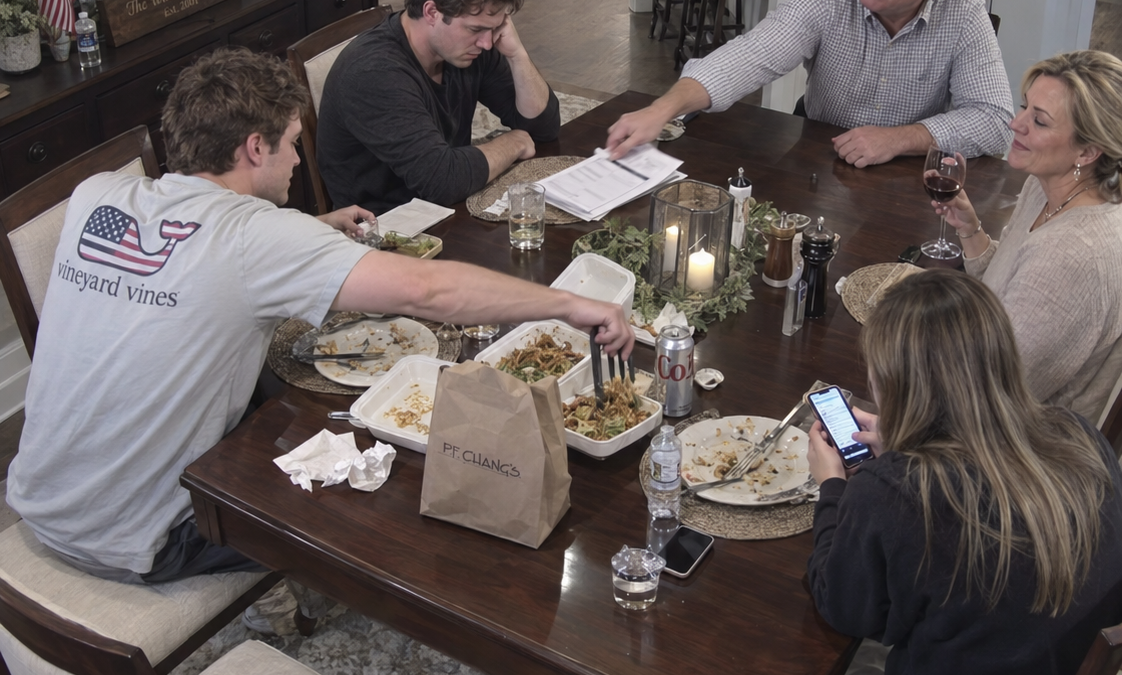
Dad smirked, “you’d be homeless without us,” while my brother stole my food, then he opened my private mail, “you make this much now?” then demanded more rent, i said nothing, i moved out in secret… and monday morning, everything went dark…
I am Harrison. I am 29 years old.
And exactly four years ago, on a humid Thursday night in late August, my own father looked me dead in the eye across our expensive mahogany dining table and told me I would be sleeping on the concrete without his daily charity.
I was sitting there with my bones physically aching from a fourteen-hour shift spent completely rebuilding his company’s primary technical infrastructure from scratch. My parents sat back and casually watched my younger brother steal the dinner I had just bought with my own money.
My father didn’t correct him. He didn’t tell him to stop.
Instead, he smirked.
He reached into his tailored suit jacket, pulled out a piece of private mail—a confidential, sealed bank statement he had illegally intercepted and opened—and tossed it onto the table. He tapped his heavy gold ring against the paper and said, “You make this much now? Then your rent goes up. Without this family, you wouldn’t last six months out there in the real world. You are nothing but a hobbyist. You’d be homeless without us.”
They laughed.
My own mother chuckled while my brother chewed the food I paid for. They humiliated me in what was supposed to be my own home.
But there was one massive thing they didn’t know.
As I sat there in silence, taking their abuse, I already had a signed lease for an apartment across town. More importantly, I held the absolute digital keys to the entire multimillion-dollar business they were so incredibly arrogant about.
And right now, today, they are paying the ultimate, devastating price for treating me like a disposable, worthless asset.
Before I tell you exactly how I dismantled their empire without breaking a single law, do me a favor. Hit that like button if you believe karma always comes to collect its debts. And please let me know in the comments where you are watching from today. I read every single one, and your support means everything to me.
Now, let’s go back to where this nightmare truly started.
To fully understand the absolute audacity of my father’s threat, you have to understand the physical and psychological environment I was trapped in.
We lived in Cincinnati, Ohio. My father, Richard, owned and operated a highly prominent architectural lighting company. The business occupied a massive, historically renovated brick streetcar depot near the bustling downtown area. It was a prime piece of commercial real estate.
The ground floor was a sprawling, state-of-the-art showroom, absolutely packed with imported European fixtures, programmable smart systems, motion-sensitive screens, motorized blinds, and fully immersive demonstration rooms. It was a technological marvel designed specifically to drop the jaws of high-end architects, wealthy developers, and corporate buyers before they signed massive six-figure contracts.
My parents lived in a gorgeous, sprawling, open-concept loft on the top floor of the building. It had floor-to-ceiling windows, imported marble countertops, and a private rooftop terrace where my mother hosted lavish parties for her friends.
My younger brother, Julian, and my younger sister, Clara, had massive bedrooms on the same floor with en suite bathrooms and walk-in closets. They had space. They had natural sunlight. And they had absolute luxury.
I, on the other hand, lived in a cramped, windowless archive room tucked behind an old, grinding freight elevator on the second floor.
My father had casually thrown a cheap mattress in there years earlier, when I moved back home after technical school. He told me I should be eternally grateful he was providing me with housing.
But it wasn’t free.
I was paying $950 a month in cash to sleep in a storage closet where the walls literally shook every single time the elevator moved. I had no kitchen access after ten at night because my mother claimed my footsteps disturbed her sleep. I shared a tiny, poorly ventilated half-bath with the showroom-floor employees.
My actual career had absolutely nothing to do with selling lighting fixtures.
I was a highly trained building automation engineer. I designed complex integrated control systems for hospitals, corporate offices, and massive public facilities. I wrote thousands of lines of code. I built secure networks.
Because I worked almost entirely from a laptop and a custom server rack I had built myself in the corner of my closet, my family collectively decided that my job wasn’t real work.
To them, manual labor or aggressive salesmanship was work.
Typing on a keyboard was playing a game.
I remember one specific Thanksgiving dinner. We had extended family over—aunts and uncles who always fawned over Julian. My uncle asked me what I was doing for a living.
Before I could even open my mouth, my father cut in.
“Harrison is still just tinkering with his computers upstairs,” he said loudly, pouring himself a glass of wine. “We let him run the internet cables for the showroom so he feels useful. It’s a nice little hobby.”
The entire table laughed.
I sat there and said nothing.
Later that same night, the showroom’s demonstration system crashed, and I would sigh, drop my own paid consulting work, run downstairs, and fix it.
I always fixed it.
At first, I did it because he was my dad. You help your family. That is what you are inherently taught to believe.
I want to describe what those Thanksgiving dinners actually felt like from the inside, because I think a single anecdote doesn’t fully capture the cumulative weight of years spent that way.
There was a specific choreography to those family gatherings that I only fully recognized once I had enough distance to see it clearly.
My father would hold court at the head of the table, directing conversation like a conductor, always steering praise toward Julian’s latest sales numbers or Clara’s latest social media engagement metrics, always finding some small, dismissive way to categorize whatever I’d accomplished that year as fundamentally lesser.
I remember one particular Christmas when I mentioned, almost offhandedly, that I’d just finished a contract redesigning the automation systems for a regional hospital’s entire east wing—work that had directly involved patient safety systems, redundant power failover code, and compliance audits that most engineers spend years working toward.
My father’s response was to ask whether I’d remembered to fix the flickering light above the showroom’s reception desk.
That was the entire register of engagement I could expect from him, no matter how significant the work actually was.
I want to add one more memory from that same category of gathering, because I think it illustrates something important about how thoroughly my worth had been recategorized in that household.
At my cousin’s wedding, roughly a year before everything finally broke, a family friend I hadn’t seen in years asked me warmly, genuinely curious, what exactly a building automation engineer did all day.
Before I could answer, my mother laughed.
“Oh, don’t get him started. He’ll bore you with server talk for an hour.”
Then she immediately steered the conversation toward Julian’s recent promotion—a promotion I later learned had been engineered entirely by my father moving numbers around on paper rather than reflecting any actual increase in Julian’s responsibilities or competence.
I remember standing there at that reception, drink in hand, watching my mother redirect an entire conversation away from my own professional accomplishments as though they were an embarrassment rather than something to be proud of.
And I remember feeling, for the first time with real clarity, that my family had collectively decided at some point I couldn’t quite pinpoint that my success was simply inconvenient to the story they’d built about who each of us was supposed to be.
The dynamic in that building was suffocating, and the primary source of that poison was my younger brother Julian.
Julian was the undisputed golden child, the heir apparent my father had already mentally crowned before Julian had done anything to earn it. Julian drifted through his twenties with a kind of breezy, unearned confidence that I both envied and resented in roughly equal measure, coasting on our father’s connections, our father’s money, and our father’s relentless public praise while contributing, as far as I could ever tell, almost nothing of measurable value to the actual business that supposedly employed him.
I want to describe one particular exchange with Julian that I think captures the specific texture of our relationship better than a general summary ever could.
About a year before everything broke, I was up until nearly three in the morning fixing a server issue that had taken down the showroom’s entire booking system two days before a major client visit. It was the kind of emergency that required real technical judgment under real-time pressure.
Julian wandered down to the server room around midnight, not to help, but because he’d heard the commotion and wanted to know if the Wi-Fi was still working upstairs so he could keep streaming a show.
I remember looking up at him, exhausted, sweating, my hands cramping from hours of typing, and seeing him simply shrug when I told him the network was going to be unstable for a while.
“Man, must be nice having something to actually do all night,” he said.
As though my labor were some kind of hobby I’d chosen for entertainment rather than an emergency I was solving to protect a business he’d go on to take credit for the next morning.
I don’t think Julian was being deliberately cruel in that moment. I think he genuinely, completely lacked the framework to understand what I was actually doing or why it mattered, because nobody in that house had ever bothered to teach him to see it as real work in the first place.
I once tried to leave two years before everything finally broke.
I’d applied for and been offered a senior engineering position with a large firm in Columbus. It was a genuine step up—better pay, real professional respect, distance from Cincinnati and everything it represented.
I remember the specific excitement of that offer letter arriving, the way I’d read it three times before allowing myself to actually believe it was real.
I told my father I was considering it, expecting some combination of pride or, at minimum, grudging acceptance.
Instead, he told me the offer had never arrived, that the mail must have been lost, that those things happen sometimes with interstate moves and busy mail carriers.
“Harrison, we give you a roof over your head,” he said when I pressed him about following up with the recruiter myself.
I waited for the follow-up call every day.
I never saw it.
When I finally swallowed my anxiety and called the recruiter weeks later, he coldly informed me that since I had completely ignored the contract, they had moved on to another candidate who actually wanted the job.
He stated that someone at my address had signed for the delivery on a Tuesday afternoon.
When I confronted my father, he brushed it off with some vague, unconvincing explanation about a package mix-up.
But the trust was broken permanently.
The very next day, I drove across town to a strip mall and rented a private P.O. box. I quietly redirected all my professional mail, my personal banking, and my client contracts to that secure box.
That P.O. box was the only reason my independent consulting business managed to survive and grow.
And it grew quietly, right under their arrogant noses.
I started picking up massive external contracts. A regional hospital network hired me to overhaul its climate and lighting automation. Two different school districts brought me on to optimize their energy grids. A massive property management firm put me on a lucrative retainer to handle smart-tech integration for its luxury apartment buildings.
I was pulling in more money than my father or Julian could have ever comprehended.
I was quietly building a massive financial war chest, but I kept living in that windowless closet behind the elevator. I kept wearing the same plain gray work clothes. I kept my head down because I knew that if they found out I was financially independent, the psychological warfare would escalate into a bloodbath.
They would view my success not as an achievement, but as an act of profound disrespect to their authority.
Then came Beatrice.
Beatrice was a senior electrical project manager I met on a massive municipal renovation job. She was sharp, incredibly intelligent, and possessed a deeply practical worldview that made emotional excuses sound utterly ridiculous.
She became the first real friend I had who existed entirely outside my family’s toxic, insular ecosystem.
The first time Beatrice visited the showroom to drop off some blueprints for our joint project, we were standing near the front reception desk. My father was on the other side of the massive room, schmoozing with a wealthy real estate developer.
Suddenly, he snapped his fingers loudly and yelled across the showroom floor, “Harrison, the conference screen is lagging again. Go fix it right now. We have people waiting.”
I instinctively dropped my conversation with Beatrice, apologized quickly, and started walking toward the server room.
Beatrice reached out and grabbed my arm, her grip surprisingly strong.
“Does he pay you an hourly wage to act like his personal tech support?” she asked, her eyes narrowing.
“No,” I replied, feeling my face flush with deep embarrassment.
“Do you invoice him for your software licenses?”
“Usually not.”
“Does he give you equity in the company? Profit sharing? Anything?”
“No.”
She stared at me like I had completely lost my mind.
“Harrison, why in God’s name are you maintaining a commercial enterprise’s entire digital infrastructure for free?”
“Because I live here,” I mumbled, looking at the floor. “It’s family.”
Beatrice looked up at the high ceiling, right toward the second floor where my storage closet was hidden.
“You pay almost a thousand dollars a month in cash to sleep behind an industrial elevator. That isn’t free housing, Harrison. That is a hostage situation.”
I never forgot the way she said it.
It wasn’t cruel.
It was just basic math.
And for the first time in my entire life, the thick, blinding fog of family loyalty began to lift.
I want to describe Beatrice a little more fully because I don’t think I’ve done justice in the retelling to how significant her role actually was in the following months.
She’d grown up in a large, close family herself—four siblings, a father who ran a small electrical contracting business she’d actually worked for briefly out of college. She wasn’t cynical about family in general, which I think is part of why her observations about mine landed as hard as they did.
She wasn’t projecting some generalized distrust of family obligation onto my situation. She was looking at the specific, measurable facts of my arrangement—the rent, the free labor, the intercepted mail—and simply refusing to let me dress those facts up in the comfortable, familiar language of family loyalty that I’d been using to explain them away to myself for years.
There was an evening maybe two weeks after that first conversation near the reception desk when Beatrice came by after work with takeout, sat with me on the loading dock behind the showroom because there was genuinely nowhere private inside the building for us to actually talk, and asked me to just tell her the whole thing from start to finish.
Every arrangement my father had ever imposed on me since I’d moved back home after technical school.
I remember being surprised by how long the list actually turned out to be once I started saying it out loud rather than simply living inside it day to day.
The rent paid at work. The shredded job offer I didn’t yet know about but already suspected. The constant public diminishment. The locked kitchen after ten at night.
Beatrice didn’t interrupt me once.
When I finished, she was quiet for a long moment.
Then she said something I’ve carried with me ever since.
“You’ve been describing captivity to me for twenty minutes and calling it inconvenience the entire time.”
I didn’t have a response to that.
I don’t think I needed one.
I think that was the exact moment the fog she’d first mentioned near the reception desk actually started to lift for good rather than simply flickering.
The activating event—the moment the fuse was officially and permanently lit—happened on a Tuesday afternoon.
I had just finished a grueling nine-hour remote debugging session for a client. I was exhausted, surviving on black coffee and sheer willpower.
I walked downstairs to the kitchen to grab a glass of ice water.
My father was standing by the massive marble kitchen island holding a thick envelope.
My envelope.
The one clearly marked PRIVATE AND CONFIDENTIAL from my bank.
He had found it in the mail stack before I could intercept it. He hadn’t just looked at the return address. He had taken a letter opener, sliced it wide open, and was pulling out the pages.
He was staring directly at my annual earnings statement.
He looked from the paper to me.
The expression on his face wasn’t pride. It wasn’t happiness that his son was succeeding and building a solid future.
It was pure, unadulterated, greedy calculation.
“Are you really pulling in this kind of money now?” he asked, his voice dangerously quiet.
I didn’t answer.
I just held my hand out for the paper.
His expression shifted into a cold, hard mask.
“Then your rent goes up. Effective immediately.”
He didn’t say it was for next month. He didn’t ask to sit down and discuss a fair market rate like adults. He didn’t acknowledge his blatant violation of my privacy.
He just threw out a number that was exactly three times what I was currently paying.
$2,500 a month.
For a windowless closet with no private bathroom and a rattling elevator wall.
He tapped the paper again.
“Family helps family, Harrison. You’ve been living under my roof, eating my food, enjoying the benefits of my real estate. This time, you start paying your fair share. I won’t have a wealthy freeloader hiding in my house while the rest of us work our fingers to the bone.”
A freeloader.
The word echoed violently in my head.
I thought about the four years of unpaid labor, the weekend emergencies, the thousands of dollars in software fees I absorbed so his showroom wouldn’t go completely dark.
I looked at the man who had secretly shredded my Columbus job offer to keep me trapped as his unpaid IT guy.
I didn’t argue.
I didn’t yell.
I just took the paper directly from his hand, walked back up to my closet, and locked the heavy door.
The grief of realizing your father views you as nothing more than a bank account is a very specific, deeply agonizing type of pain.
But grief is a paralyzing emotion, and I absolutely did not have time to be paralyzed.
My father had just crossed a line that could not be uncrossed.
I pulled out my phone, my hands shaking slightly with adrenaline, and texted Beatrice.
I need an apartment today.
She texted back three minutes later.
I know a guy. Let’s get you out.
The tension inside that building for the rest of the week was thick enough to choke on. My father’s aggressive demand for the exorbitant rent increase was hanging over my head like a guillotine, but I played the part perfectly.
I acted completely defeated.
I nodded, kept my eyes on the floor, and let him believe he had won. Let him believe he had successfully bullied his weak son back into total submission.
But behind the locked door of my closet, in the dead of night, I was methodically packing my life into boxes.
The true breaking point—the definitive moment that solidified my exit strategy and permanently destroyed any lingering ounce of guilt I had—arrived on Thursday night.
My father’s company was gunning for the absolute biggest contract in its twenty-year history.
Mr. Harrington, the vice president of a massive luxury hotel conglomerate, was coming in with his entire team of senior engineers. They were planning to renovate eleven high-end properties across the Midwest, and they needed a fully integrated smart lighting and climate control system.
If my father won this bid, the contract was worth over $1.6 million.
It would secure the company’s financial future for a decade.
It was the crown jewel.
For three straight weeks leading up to this massive pitch, my father pushed me to the absolute brink of physical collapse.
He didn’t hire me as a contractor. He didn’t offer me a percentage of the potential profits. He didn’t even offer to buy me dinner.
He just used the exact same old manipulation.
“We need this, Harrison. The family needs this. Do this for us. Be a team player.”
I caved like I always did.
But this time, it was for a different reason.
I wanted the system to be flawless so that when I took it away, the absence of it would be undeniable.
I spent night after grueling night fueled by cheap energy drinks and cold pizza, writing custom code.
I programmed a fully simulated luxury hotel suite right in the middle of the showroom. I integrated complex systems that adjusted the color temperature of the interior lights based on the actual, real-time position of the sun outside. I tied the climate control into a simulated hotel check-in system.
I built a flawless, gorgeous, highly responsive piece of technological art.
On Wednesday night at exactly two in the morning, the entire system crashed hard.
Why?
Because Julian, the golden child, had decided to randomly unplug a primary network switch in the server room so he could plug in his personal iPad charger.
He ended up corrupting the entire routing table.
I stayed up until dawn, my eyes burning, rebuilding the network from scratch while Julian slept soundly in his massive, comfortable bed.
Thursday evening finally arrived.
The showroom looked absolutely spectacular.
Mr. Harrington and his team of four senior engineers walked through the heavy glass doors. My father immediately went into full aggressive-salesman mode. He shook hands, poured expensive scotch, and confidently guided them toward the simulated hotel suite.
And then he introduced Julian.
“Gentlemen,” my father beamed, proudly clapping my brother on the shoulder. “This is Julian. He is our brilliant lead on smart building strategy. He designed this entire integration package for you today.”
I was standing twenty feet away in the shadows, holding a diagnostic tablet, wearing a plain gray work shirt.
I felt the air completely leave my lungs.
Julian hadn’t designed a single thing in his entire life.
Julian didn’t even know the difference between an IP address and a ZIP code.
Julian smiled his million-dollar smile, shook Mr. Harrington’s hand, and confidently started walking them through the demonstration.
He pressed the buttons on the iPad I programmed.
The lights shifted beautifully.
The blinds lowered silently.
The clients murmured in deep appreciation.
Then one of Mr. Harrington’s lead engineers pushed his glasses up and asked a highly technical question.
“Impressive transition speed. What specific protocol are you utilizing between the local room controllers and the main cloud gateway to prevent latency during peak hotel hours?”
Julian froze completely.
His smile stayed plastered on his face, but his eyes went completely dead.
He looked at the engineer. Then he looked down at the iPad like it was an alien artifact. Then he looked helplessly across the room at my father.
My father panicked.
He looked across the room at me, his eyes wide with desperate instruction.
Fix this.
Save your brother.
I gripped the edges of my diagnostic tablet until my knuckles turned white.
Then I stepped forward out of the shadows.
“We are utilizing a modified MQTT protocol over a localized VLAN, encrypting the payload before it hits the gateway to ensure zero packet loss, even if the hotel’s primary guest network gets congested,” I said smoothly, my voice echoing slightly in the large room.
The engineer turned away from Julian, raising an eyebrow at me.
“And what about the failover? If the cloud server goes down completely, does the room default to manual override?”
“Yes,” I replied, walking closer to the group. “I wrote a localized script directly into the hardware relays. If the internet drops, the wall switches retain full analog functionality. The hotel guest never knows there’s a network issue.”
Within sixty seconds, the entire dynamic in the room completely shifted.
The engineers physically turned their backs on Julian.
They completely ignored my father.
For the next twenty minutes, they spoke exclusively to me.
We talked about load balancing, server redundancy, and strict energy compliance codes.
Julian stood there holding the iPad like an overpriced serving tray, looking absolutely furious.
My father’s jaw was tight with barely concealed rage.
When the demonstration finally ended, Mr. Harrington walked directly up to me.
He completely bypassed my father.
He reached into his tailored suit jacket, pulled out a thick, embossed business card, and handed it to me.
“You are the technical director?” Mr. Harrington asked, looking me squarely in the eye with immense respect. “Your architecture is brilliant. I look forward to working directly with you on the rollout.”
Before I could even open my mouth to say thank you, my father materialized between us.
He literally stepped in front of me, physically blocking me from the vice president.
“Oh, Harrison isn’t the director, Mr. Harrington,” my father laughed, waving his hand dismissively as though I were a pesky intern. “He’s just my son. He just helps out with the wires sometimes. Julian will be your primary point of contact for the entire strategy.”
He just helps out.
Four years of blood, sweat, and brilliant engineering reduced to just helping out.
I didn’t say a word.
I put Mr. Harrington’s card securely in my pocket, turned around, and walked up the stairs to my closet.
Two hours later, my mother insisted on a mandatory family dinner to celebrate the highly successful pitch.
It was the most toxic, suffocating meal of my entire life.
Julian was sulking aggressively, stabbing his expensive steak with a fork because the engineers had made him look like a total fool. Clara was annoyed because I had refused to stand in the background of her celebratory social media video. My mother was pouring heavy glasses of wine, desperately pretending everything was perfect.
And my father was seething.
He absolutely hated that the professionals in the room had recognized my actual value.
He needed me to be worthless so he could continue to control me.
That was when the scene from the beginning of this story happened.
My father threw my bank statement aggressively onto the dining table.
He announced my private income to the entire family like it was a crime.
“Apparently Harrison has been secretly hiding money from this family,” my father announced, his voice dripping with intense disgust.
“I haven’t hidden anything,” I said, keeping my voice dangerously level. “That was private correspondence. You committed a federal offense by opening my mail.”
My mother scoffed loudly, waving her wineglass dismissively.
“Oh, stop being dramatic, Harrison. There are no secrets in this family. Did you really make this much money doing little side jobs?”
“Yes,” I said.
My father slammed his heavy hand on the table, rattling the silverware.
“And you’ve only been paying $950 a month for rent while we feed you, while we put a roof over your head. No more. Rent is $2,500 starting Friday. Pay up or get out.”
Julian snorted around a mouthful of food.
“Still cheaper than living downtown. Bro, stop crying.”
I looked directly at Julian.
“You don’t pay anything to live here. You don’t pay for your car. You don’t pay for your clothes.”
“That’s different,” Julian said defensively, his face flushing.
“Why?” I asked, my voice calm but sharp.
He didn’t have an answer.
Clara looked up from her phone, rolling her eyes.
“Because Julian actually works for Dad, Harrison.”
I looked around the table at the people sharing my blood.
“I built the entire control infrastructure for this company,” I said, my voice eerily calm. “That presentation today—the one that’s going to win you a million-dollar contract? That was my system running on my personal software licenses, hosted on my private server, programmed entirely by me.”
My father leaned back in his chair, swirling his scotch.
He looked at me with absolute, chilling contempt.
“Do you want a round of applause for doing the bare minimum to help the people who keep you from starving? Let me make this crystal clear for you, Harrison. You are a glorified hobbyist. Without this family, you wouldn’t last six months in the real world. You’d be homeless without us.”
Julian reached across the table, grabbed the takeout container of food I had just paid for, and dumped the rest of my dinner onto his plate.
My mother smiled softly at him.
Clara went back to scrolling on her phone.
Nobody stopped him.
That ridiculous, tiny detail—my adult brother stealing my food while my father told me I was nothing—flipped a massive switch in my brain.
The anger completely evaporated.
It was replaced by pure, cold, mathematical calculation.
I stood up from the table.
My father frowned, pointing a finger at me.
“Where are you going? Sit down. I’m not done talking to you about the rent.”
“I am,” I said.
I walked upstairs, locked the door to my closet, and pulled out my laptop.
I opened my messages and texted Beatrice.
The plan is a go. Friday night, get the truck.
Leaving a high-security commercial building unnoticed requires an immense amount of meticulous patience and planning.
The showroom and the loading docks were heavily wired with high-definition security cameras that I had installed myself. Julian worked highly unpredictable, lazy hours, often wandering the halls late at night looking for snacks. My mother possessed a terrifying, almost supernatural radar for anything that looked like disobedience.
And my father felt perfectly entitled to open the door to my room whenever he pleased because, as he loved to loudly declare, “There are no closed doors in a family.”
So I couldn’t just pack a moving truck in broad daylight.
For three excruciating weeks, I became a total ghost in my own life.
I moved my life out one ordinary bag at a time.
I would pack my heavy winter clothes into a gym duffel bag, throw it over my shoulder, and tell my mother I was taking donations to the local shelter. I would fill my laptop backpack with critical hard drives, server backups, my passport, and my birth certificate, then hand it to Beatrice through the back window of her car in the dark alley behind the building.
Beatrice even enlisted her friend Dean to help us move the heavier server racks in the dead of night while my parents were asleep.
Beatrice had found me a small one-bedroom apartment on the north side of town. It had uneven hardwood floors, a rattling radiator, and an old refrigerator that hummed constantly.
But the landlord didn’t ask for a deposit of gratitude.
He just asked for proof of my salary and a standard credit check.
I loved it the absolute second I walked in.
While my family thought I was up in my closet pouting about the impending rent increase, I was sitting on the bare floor of my new, empty apartment, mapping out the digital separation with absolute precision.
This was the critical part.
My father’s entire showroom—the very foundation of his $1.6 million pitch to Mr. Harrington—was running on external cloud infrastructure registered directly in my personal name.
I paid the exorbitant monthly fees with my own personal credit card.
The remote servers, the advanced lighting algorithms, the climate integration APIs—they were all tied legally and financially to Harrison the individual, not Harper Architectural Lighting the corporation.
My father had spent four years aggressively insisting to everyone, including clients, that I did not work for him.
I was just helping out.
I was a hobbyist.
I was absolutely not an employee, and I was not a contractor.
Legally, he had dug his own massive grave.
My professional consulting accounts could not legally remain linked to a commercial entity that I had no formal relationship with. It was a massive liability for my own business, and any decent lawyer would tell me to sever ties immediately to avoid a potential lawsuit from his clients if something went wrong.
So, sitting on my cheap new rug, I logged into the master control portal.
I scheduled a complete automated account separation.
I set the timer for the exact moment the current billing cycle expired.
Monday morning at 7:45 a.m.
I didn’t delete a single file.
I didn’t introduce any malicious code.
I didn’t sabotage anything.
I simply set the system to remove my personally paid-for cloud licenses from his local hardware.
The basic manual light switches in the showroom would still work perfectly fine.
But the magic—the automated sequences, the iPad controls, the simulated hotel environment—all of that required the active commercial licenses I was paying for.
Then I opened a spreadsheet.
I painstakingly calculated four years of unpaid technical labor, weekend emergency calls, and custom programming, billing at my standard corporate consulting rate.
The total came to exactly $46,180.
I printed the formal invoice.
I didn’t expect him to pay it.
I just wanted a physical document inside that building that told the absolute, undeniable truth about my worth.
Friday night arrived.
The final night.
By 9:00 p.m., my closet was almost entirely empty, save for a cheap sleeping bag and a single backpack.
Downstairs, I could hear my parents laughing loudly and drinking expensive wine with Julian. They were celebrating early, entirely convinced that Mr. Harrington was going to sign the massive contract on Monday morning.
At 9:20 p.m., my father yelled up the stairs, his voice echoing in the stairwell.
“Harrison, the East Wall presentation screen just dropped its IP address. Go fix it right now. The Calder team is coming for the final walkthrough on Monday morning. Everything has to be absolutely perfect.”
I walked downstairs.
I didn’t argue.
I went to the server rack, reconfigured the subnet mask, and brought the screen back online.
It took exactly eleven minutes.
My father didn’t look up from his scotch.
He didn’t say thank you.
That was the absolute last piece of unpaid labor I would ever give him.
At 10:04 p.m., I went back upstairs.
I unplugged my personal network gateway from the wall.
I placed the local analog credentials for the basic lighting system inside a thick envelope. I placed my $46,180 invoice right next to it.
Finally, I printed a very clear, bold-text warning page:
NOTICE: External cloud services and advanced automation licenses registered to Harrison will legally terminate on Monday at 7:45 a.m. Local manual lighting remains operational. Advanced showroom demonstrations require immediate procurement of new commercial licenses. System administrator credentials are provided below.
I walked softly down to the kitchen and placed the envelope directly on the marble island, right where my father always drank his morning coffee.
He had everything he needed to prevent a massive disaster.
He just had to actually read something I wrote instead of opening my private mail.
At 11:17 p.m., I slung my last backpack over my shoulder and walked quietly down the back stairs.
Halfway to the exit, the old floorboards creaked loudly.
I froze.
My father stepped out of the hallway shadows, holding a glass of water.
He looked at me, then looked down at my heavy backpack.
“Going somewhere?” he asked, his voice flat and suspicious.
“Late-night server migration for a client,” I lied smoothly, keeping my heart rate steady. “Emergency gig.”
He stared at me for a long, agonizing moment.
I braced myself for the interrogation.
I waited for him to demand that I open the bag.
Instead, he just took a slow sip of his water and shrugged his shoulders indifferently.
“Don’t forget,” my father said, his voice echoing in the empty, dark showroom. “The rent increase kicks in next week. Have the check on my desk by Wednesday or I start boxing up your little computer parts and throwing them in the dumpster. You’re an adult now, Harrison. Time to pay for your life.”
“I won’t forget,” I said softly.
I walked out the back door, the heavy metal locking shut behind me with a loud, incredibly final click.
Beatrice was idling her car in the dark alley, the headlights completely off.
I threw my bag in the back seat and got in.
She didn’t ask if I was okay.
She didn’t offer empty platitudes.
She just handed me a hot coffee, put the car in drive, and got me the hell out of there.
Nothing dramatic happened when I got to my apartment.
There were no fireworks.
I just put my bag on the floor and sat against the wall because I didn’t own a sofa yet.
I listened to the hum of the old refrigerator.
For the first time in twenty-nine years, the silence in the room belonged completely to me.
There was no one waiting to yell at me.
No one to call me a burden.
No one to steal from me.
Freedom is terrifying because suddenly you are the only one responsible for what happens next.
But as I lay down on my sleeping bag, looking up at the cracked ceiling, I felt a deep, profound sense of peace, because I knew exactly what was waiting in that envelope on the kitchen counter.
And I knew that my father’s massive, blinding arrogance would never allow him to read a warning written by the son he despised.
Monday morning was coming.
And at 7:45 a.m., the lights were going to go out.
I woke up on Monday morning at six without an alarm clock.
For the absolute first time in my twenty-nine years of existence, I did not wake up to the deafening metallic sound of an industrial freight elevator grinding against the drywall of my bedroom.
I did not wake up to my father yelling from the bottom of the showroom stairs that the internet was running slow.
I woke up to pristine, beautiful silence in my own apartment on the north side of Cincinnati.
I walked into my small, outdated kitchen. The linoleum was peeling in the corner near the sink, and the secondhand refrigerator I bought off Craigslist hummed with a loud mechanical rattle.
But to me, that rattle was the most beautiful symphony in the world.
It was the sound of my own independence.
I made a cheap cup of black coffee, dragged a metal folding chair over to the single window overlooking the street, and sat down.
I opened my laptop, typed in my administrative password, and pulled up the master control dashboard for my personal cloud server.
Then I sat there and watched the digital clock in the corner of my screen.
7:30 a.m.
7:35 a.m.
7:40 a.m.
I knew exactly what was happening across town at that very moment.
I knew the morning routine at Harper Architectural Lighting like the back of my hand.
My mother, Margaret, would be in the kitchen of her luxury loft brewing her expensive imported espresso and checking her stock portfolio. Julian would be rolling out of his king-sized bed, perfectly styling his hair and putting on a custom-tailored suit paid for by the company account, preparing to play the role of the brilliant tech executive for Mr. Harrington’s final walkthrough.
And my father, Richard, would be walking into the kitchen, picking up his coffee mug from the massive marble island.
Later, Clara told me exactly how it played out.
My father walked into the kitchen and saw the thick envelope I had left right in the center of the island.
He saw my handwriting on the front.
He picked it up, clearly annoyed, and ripped it open with a butter knife.
He pulled out the formal invoice first.
An invoice for $46,180.
Clara said he actually laughed out loud.
He thought it was a pathetic, childish joke.
He thought his son was throwing a temper tantrum.
Then he pulled out the warning letter, the bold text clearly stating that all advanced automation licenses registered to me personally would legally terminate at exactly 7:45 a.m.
He didn’t read the technical manual I had painstakingly written and printed for him.
He didn’t look at the analog administrative credentials I left so they could manually override the systems and save the pitch.
He crumpled the warning letter into a tight ball, threw it directly into the stainless-steel trash can, and told my mother that I was just trying to scare him with computer jargon.
He was so deeply insulated by his own massive ego and his narcissistic reality that he genuinely believed I did not have the guts to pull the plug.
He thought my compliance was a permanent condition.
He thought I would always be his obedient, terrified little boy.
He walked downstairs to the massive showroom, completely confident, entirely smug, ready to sign a contract that would fund his extravagant lifestyle for the next decade.
At 7:44 a.m., the showroom was functioning normally.
The baseline lighting schedules were still temporarily loaded in the local cache memory of the hardware. The lights were on. The massive smart screens were displaying the company logo in high definition.
At exactly 7:45 a.m., my professional cloud subscription automatically verified its billing status, recognized the separation command I had programmed, and severed its connection with the unauthorized Harper devices.
Sitting in my apartment, sipping my cheap coffee, I watched the active connections on my laptop dashboard drop from seventy-three to absolute zero in less than a second.
Across town, the building did not lose physical electrical power.
I had absolutely no intention of sabotaging the electrical grid or causing physical damage to the property.
That would be a crime, and I am a professional engineer, not a criminal.
But the brain of the entire operation—the advanced, highly customized features that my father had been aggressively selling for millions of dollars—vanished into thin air.
As the external cloud handshake failed, the automated scenes instantly stopped loading.
The massive room-booking touchscreens mounted outside the executive conference rooms flashed generic bright-red error codes and went completely black.
The advanced climate-control API severed, causing the commercial air-conditioning units to default to a raw, uncalibrated state, blasting freezing air into the lobby.
The motorized blinds covering the massive floor-to-ceiling windows lost their synchronization, freezing halfway down and leaving the showroom in awkward, broken shadows.
The remote demonstration interfaces on the sales team’s expensive iPads turned into completely useless, unresponsive bricks.
Several of the high-end demonstration rooms, lacking the continuous authentication ping from my encrypted server, automatically triggered their failsafe protocol and returned to their safest default configuration.
Lights off.
Complete, utter darkness.
At 8:07 a.m., Julian strolled through the front doors holding his artisanal coffee, completely oblivious to the technological apocalypse that had just occurred.
At 8:09 a.m., my phone, sitting on my folding table, started vibrating.
The caller ID flashed my father’s name.
I didn’t answer.
I didn’t decline it.
I just sat back, took another sip of my coffee, and watched it buzz across the cheap wood.
At 8:11 a.m., the heavy glass doors of the showroom opened, and Mr. Harrington, the vice president of Calder Hotels, walked in with his team of four senior engineers.
They were there to sign a legally binding contract worth $1.6 million.
They were there to see the flawless integration of the technology they were betting their hotel empire on.
Instead, they walked into a chaotic, freezing, half-lit warehouse where absolutely nothing worked.
According to Clara, who was watching from the reception desk in pure horror, my father went into an immediate frantic panic.
He rushed forward, trying to bluff his way through it with a manufactured salesman smile.
“Just a small network update, gentlemen,” he announced loudly, sweating through his custom suit. “Standard Monday morning maintenance. Julian, go restart the main router in the server room. We’ll be up and running in sixty seconds.”
Julian dropped his coffee and ran to the server room.
He frantically started pulling power cables and resetting the router.
But the router was perfectly fine.
The fiber-optic internet connection was flawless.
The problem wasn’t the hardware.
The problem was that the soul of the machine had been legally evicted.
And neither of them knew how to write a single line of code to bring it back.
Ten excruciating minutes passed.
The senior engineers from Calder started looking at their watches.
The screens remained black.
The lights remained off.
The silence in the room was deafening.
Desperate, my father finally ran back upstairs to the kitchen, dug through the garbage, and smoothed out my crumpled warning letter.
He saw the administrative credentials I had left behind.
He rushed back downstairs, called a massive, incredibly expensive corporate IT monitoring company in Chicago, and demanded immediate emergency service over the speakerphone.
The technician on the phone asked him what platform he was using.
My father didn’t know.
He literally did not know the name of the software environment that ran his entire business.
The technician patiently asked for his commercial license keys.
My father tried to read the local analog credentials I had left behind.
“Sir,” the technician said over the speakerphone while Mr. Harrington and his entire engineering team listened in dead silence. “Those are local hardware credentials. You do not have an active commercial license for the cloud environment. The account linked to this IP address was terminated by the owner an hour ago. We can initiate an emergency server migration, but it will cost tens of thousands of dollars, and the setup will take at least four to five business days to rebuild the architecture.”
My father stood there holding the phone, his face completely drained of blood.
Mr. Harrington, who had been watching this pathetic display of incompetence with growing visible anger, finally stepped forward.
He looked around the dark, broken showroom.
He looked at Julian, who was sweating and staring blankly at a dead iPad.
“Richard,” Mr. Harrington said, his voice dropping an octave, completely devoid of any professional friendliness. “Who normally manages the system?”
My father swallowed hard, his Adam’s apple bobbing.
“Our—our internal team. Julian usually oversees the architecture, but we had a minor glitch with the provider.”
One of Calder’s senior engineers—the exact same man who had questioned Julian during the pitch on Thursday night—stepped forward.
He had been looking closely at the error code on one of the frozen wall tablets.
He recognized the custom user-interface signature I always used.
“Where is Harrison?” the engineer asked bluntly, cutting through my father’s lies. “Where is your technical director?”
My father’s jaw tightened.
“Harrison is no longer with the company, but Julian is fully capable of handling the rollout.”
“Stop right there,” Mr. Harrington interrupted, holding up a hand.
The tension in the room was so thick it could choke you.
This is where the absolute, undeniable truth came out.
This is the exact moment my father’s lies completely destroyed him.
Mr. Harrington reached into his leather briefcase, pulled out the massive hundred-page bid proposal that my father had submitted to Calder Hotels weeks earlier, and slammed the heavy binder onto the reception desk.
“This entire $1.6 million contract,” Mr. Harrington said, his voice echoing in the silent, dark showroom, “was strictly contingent on the certifications, the engineering background, and the proven project history of your director of integrated controls—the man whose specific state licenses ensure this building meets federal energy compliance codes. That name on this legally binding document is Harrison, not Julian.”
Clara said you could hear a pin drop in the room.
I had never seen that proposal.
I had never authorized my professional résumé to be used.
I had absolutely never agreed to work on the Calder project in any official capacity.
My father had spent four solid years looking me in the eye and telling me I was just tinkering with computers in a closet.
He told me I was a useless hobbyist who would be homeless and destitute without his charity.
But behind my back, to secure millions of dollars in commercial real estate contracts, he was parading my résumé around and legally listing me as his technical director.
He was selling my brain, my qualifications, and my hard-earned engineering licenses to the highest bidder, all while charging me exorbitant rent to sleep in a storage room.
At 9:40 a.m., Mr. Harrington closed his briefcase with a loud, final snap.
“This is a blatant, fraudulent misrepresentation of your staff,” Mr. Harrington said coldly. “We are suspending all negotiations immediately. We will be auditing this proposal for corporate fraud. Do not contact my office again.”
He walked out the door with his team.
In less than two hours, my father hadn’t just lost a $1.6 million contract.
He had completely destroyed his reputation with the biggest luxury hotel developer in the Midwest.
At 10:15 a.m., my phone buzzed again.
It was a voicemail from my father.
I listened to it sitting in my quiet kitchen, the morning sun streaming through the window.
“Harrison.” His voice growled through the speaker, vibrating with pure, unadulterated rage. “Whatever sick point you are trying to prove, you’ve already proven it. You embarrassed the family. Now pick up the phone, get your ass back to this building, and turn the systems back on before I take everything you own. Call me right now.”
That voicemail told me everything I needed to know.
He still didn’t get it.
He still firmly believed that what happened on Monday morning was a malicious attack I had launched against him.
He couldn’t comprehend that the darkness swallowing his showroom was simply the natural absence of the free labor I’d been providing for four years.
I didn’t turn his lights off.
I just stopped paying his bill.
Let’s pause for a moment.
Thank you for staying with me this far. You’re truly amazing. Please help me by liking the video and commenting the number one below so I know you’ve been here with me until this point. This not only helps more people discover this story, but also lets me know that my experiences mean something to someone.
Your support is the greatest motivation for me to keep sharing the rest of this journey.
By noon on Monday, the situation escalated from a lost contract into a full-blown, catastrophic legal nightmare.
I was sitting in my living room assembling a secondhand desk I had bought off the internet when an urgent email popped into my professional inbox.
It wasn’t from my father.
It was from a senior corporate lawyer representing Harper Architectural Lighting.
The email was aggressive but highly specific.
The lawyer demanded to know, on the record, if I had formally authorized the use of my professional résumé, my engineering licenses, and my state certifications in the Calder Hotels proposal.
I sat back, staring at the bright screen.
My father was desperately trying to cover his tracks.
He needed a paper trail from me to save himself from a massive lawsuit for corporate fraud.
If I replied and said yes, I would be legally tying myself to his sinking ship, validating his lies and risking my own engineering licenses.
I placed my hands on the keyboard and typed a single two-word response.
I didn’t.
I hit send.
That single email changed the trajectory of my entire family’s history.
When that lawyer received my written denial, Calder Hotels formally and permanently withdrew from the project that same afternoon.
But the contagion didn’t stop there.
Calder’s acquisitions consultant, furious about the wasted time and the blatant deception, immediately raised severe doubts about Harper Architectural Lighting’s staff statements to two major architecture firms in the city that regularly referred high-end clients to my father.
The problem was no longer just a dark showroom.
It was a complete crisis of credibility.
In the commercial real estate world, your reputation is your currency.
If architects think you lie about your engineering staff, they stop sending you blueprints.
By Tuesday, the bank got involved.
My father had prematurely included Calder’s anticipated $1.6 million revenue in a pending financing review to secure a new line of credit for the business’s expansion.
When the bank found out the contract had evaporated under suspicious circumstances, they immediately requested updated financial information, demanded an audit, and completely froze the company’s expansion funds.
Then came the internal collapse.
Marcus, a veteran union installer who had worked for my father for twelve years, found out why the system crashed.
He did some quiet digging through the company’s internal server logs and discovered that Julian, the golden child, had received thousands of dollars in massive sales commissions for complex technology packages that I had completely designed and integrated myself.
Marcus was furious.
He realized the technical crew was doing all the heavy lifting while Julian was pocketing the bonuses.
He confronted my father on the showroom floor, resigned on the spot, and immediately told the other installers.
The entire technical crew demanded a full review of their compensation, threatening to walk off the job and trigger a union grievance.
Suddenly, the absolute chaos no longer revolved around me.
I wasn’t the scapegoat they could yell at.
They were locked in a burning building, and they started turning on each other like starved animals.
My father loudly blamed Julian for being incompetent.
Julian screamed at my father for not paying me enough to stay.
Clara stopped posting her cheerful, highly edited videos of the showroom because wealthy customers kept walking in and asking why all the interactive systems were completely dead.
Through it all, I went to work.
A massive community college just outside Dayton had hired my consulting firm to modernize the automation controls in three of its science buildings.
I drove there, put on a hard hat, and walked the site.
The project manager introduced me to the board as their lead automation consultant.
Nobody told me I was just helping out.
Nobody asked under whose roof I lived.
They treated me like a professional.
And they paid my exorbitant invoice without blinking.
For the first time in my entire life, their massive emergency did not automatically become my personal responsibility.
On Wednesday night, five days after I moved out in secret, my phone rang.
It was Clara.
She was the very first person in the family who stopped demanding that I come back.
I answered the phone fully expecting a screaming match or a guilt trip.
Instead, her voice was quiet and shaky.
“Harrison,” she said. “I need to tell you something. Something about that job offer in Columbus.”
I stopped wiping down my kitchen counter.
The air in my apartment suddenly felt very cold.
“What about it?” I asked, my grip tightening on the phone.
“Dad didn’t lose that envelope,” she said, her voice dropping to a whisper as if she were afraid someone in the loft would hear her. “I didn’t say anything back then because I was scared of him, but I was standing right there in his office two years ago. I saw him open it.”
A sick, cold feeling ran entirely through my body.
“What exactly did you see, Clara?”
“I saw the employment contract. The salary was huge. Mom asked him why you would want to move all the way to Columbus. And Dad looked at her and said that if you accepted the job, nobody would be left here to run the control systems for free. He said it would cost the company a hundred grand a year to replace you. So he threw it in the shredder and told us never to mention it.”
I leaned against the counter, closing my eyes, feeling the floor drop out from beneath me.
For two agonizing years, I had desperately convinced myself that my father had simply been grossly negligent.
Believing he was careless meant I could call him controlling without having to call him pure evil.
Clara completely destroyed that psychological distinction in less than a minute.
“Did he tell you they chose someone else?” she asked, her voice cracking.
“Yes,” I said, my voice hollow. “He told me they moved on because I wasn’t good enough.”
I looked at the cardboard boxes that were still stacked neatly against the wall of my living room.
“Why are you telling me this now, Clara? After two years of watching me suffer?”
“Because,” she sniffled, “because he wants us to lie. He sat Julian and me down today. He wants us to tell everyone—the lawyers, the clients, the bank—that you caused what happened on Monday. He is spinning this massive new family story. He wants us to say that Harrison is mentally unstable, that Harrison abandoned his family, that Harrison intentionally sabotaged the business servers because Dad simply asked for fair rent. It’s a cleaner narrative than the truth.”
“Are you going to do it?” I asked.
“No,” Clara said firmly. “I’m not. I’m done.”
That single word mattered infinitely more than any apology she could have ever given me.
But Clara’s revelation was only the match.
The real explosion—the massive, devastating twist that brought the entire empire down—came from my mother.
Margaret had always been fiercely protective of the family image, but she was even more protective of her own financial security.
Harper Architectural Lighting was originally founded thirty years earlier with money directly inherited from my maternal grandparents.
My father ran the loud day-to-day operations and took all the credit, but legally, my mother owned 52 percent of the corporate shares.
It was her inheritance.
Her safety net.
When the bank threatened to freeze the accounts and Calder Hotels threatened a massive lawsuit for corporate fraud, my mother finally panicked.
The threat of a lawsuit meant the potential loss of her commercial real estate, her luxury loft, her 401(k), and her entire lifestyle.
She realized my father’s massive arrogance was about to leave her completely bankrupt.
She stopped blindly trusting him.
She bypassed my father entirely, hired an independent, aggressive corporate lawyer and a forensic accountant, and forced an audit of the company’s recent bids.
What they found was absolutely staggering.
My father hadn’t just used my résumé for the Calder pitch.
He had systematically and fraudulently used my professional engineering credentials, my state licenses, and my forged signature on at least four previous major job offers over the last three years.
Three of those bids had won.
On paper, Harper Architectural Lighting had been illegally selling wealthy customers access to my top-tier qualifications for years, all while stubbornly refusing to list me as an employee, a contractor, or an owner.
He was committing federal fraud using my identity.
When my mother confronted him with the physical evidence in his office, my father didn’t even apologize.
He arrogantly stated that family businesses operate informally and that what’s his is his.
My mother coldly asked him if informality would satisfy a federal client’s fraud audit or a judge in a divorce proceeding.
He couldn’t answer.
He just walked out of the room.
My mother realized that if she didn’t act immediately, she would be held legally liable as the majority owner for his massive fraud.
To protect her inheritance, she turned on him with the absolute ruthlessness of a cornered animal.
On Thursday afternoon, Margaret called an emergency, legally binding shareholders’ meeting.
Using her 52 percent majority stake, she introduced a motion of no confidence.
In less than twenty minutes, she formally and permanently removed my father as president of Harper Architectural Lighting.
He was stripped of all operational power.
He remained a minority owner and a silent board member, but he no longer had any unilateral authority over business tenders, staff representations, company bank accounts, or commercial real estate leases.
She also immediately demoted Julian, transferring him from the lucrative position of sales leader to a closely supervised account-support role with a fraction of his previous salary.
Clara, seeing the writing on the wall, formally requested a transfer completely away from the family marketing department.
My father’s kingdom did not magically disappear.
Something vastly worse happened from his narcissistic perspective.
It ceased to be his kingdom.
He was rendered entirely powerless in the very building he used to terrorize me.
And then they came to my door.
The very next evening, Friday, at exactly 6:00 p.m., a heavy, demanding knock echoed through my small apartment.
I walked over to the door and looked through the scratched peephole.
My father was standing in the narrow, dimly lit hallway.
My mother stood right behind him, clutching her expensive designer purse like a shield.
Julian and Clara were there too, lingering awkwardly near the stairs, looking as though they would rather be anywhere else on Earth.
Beatrice, who had come over to help me mount my new television to the wall, stopped what she was doing.
She put her tools down, sat at my cheap kitchen table, crossed her arms, and looked at me.
“You absolutely do not have to open that door, Harrison,” she said, her voice steady and fiercely protective.
“I know,” I said. “And that is precisely why I’m going to do it.”
I unlocked the deadbolt and pulled the door wide open.
My father looked incredibly small standing outside my modest apartment.
Not physically.
He was still the same broad-shouldered, imposing man who had dominated every single room of my childhood.
But the psychological aura was entirely gone.
None of the symbols that propped up his massive authority were there.
There was no million-dollar showroom.
No executive office.
No terrified employees waiting for his barked instructions.
Just a narrow, slightly smelly hallway and a door whose lease was firmly in my name, paid for by my money.
His first words almost made me laugh out loud and slam the door in his face.
“This has gone way too far, Harrison,” my father said, his voice hard, desperately trying to project his old authority.
My mother immediately turned to him, her face tight with anxiety.
“Richard, stop.”
He completely ignored her.
He looked at me, his eyes narrowed.
“You proved your point. You proved that you can survive on your own. Good. Congratulations on being an adult. Now, we need to talk about how you’re going to repair the massive damage you caused this family.”
I didn’t move an inch.
I just stared at him.
“What damage?”
His face flushed red with instant anger.
“The Calder agreement. The showroom systems. The staff walking out. The bank freezing the funds. You sabotaged us.”
“You used my professional credentials without my permission to secure a corporate bid,” I said, my voice cold, precise, and completely devoid of emotion. “That is fraud. You sabotaged yourself.”
“We are family,” he barked, stepping forward, trying to intimidate me. “We share resources.”
“Blood is not a legal permit for fraud,” I fired back, not stepping backward. “I gave you four years of my life. I gave you tens of thousands of dollars in unpaid engineering. And what did you give me?”
He opened his mouth to shout about the roof over my head.
But I didn’t let him.
I raised my voice, cutting through his delusion with a blade.
“You illegally opened my private mail. You intercepted and shredded a massive employment contract from Columbus because you didn’t want to lose your free technical support. You put my engineering credentials on million-dollar client proposals without asking me. And then, when you found out I was secretly earning enough to finally leave your closet, your very first reaction was to demand triple rent to drain my accounts and make it impossible for me to escape.”
His voice lowered in pitch, a desperate attempt to sound like the wise patriarch.
“I was teaching you financial responsibility, Harrison. The real world is expensive.”
“No,” I said, my voice echoing in the hallway. “You were making independence too expensive for me to afford. You wanted to keep me chained to your floorboards.”
The hallway fell into absolute, deafening silence.
Julian looked at his shoes.
Clara looked away.
My father let out a bitter, humorless laugh.
“Do you honestly think you’ve won? Is this a game to you? You cost this family a $1.6 million contract. Are you happy?”
He desperately needed this to be a competition, because if it was a competition, he could still play the role of the victim.
“I didn’t move out to beat you,” I said calmly. “You lost a contract because you promised a massive client access to a professional engineer who never agreed to work for you.”
“You knew exactly what would happen on Monday morning.”
“I knew that the cloud services I personally paid for out of my own pocket would legally end. I left you a written notice. I left you the administrative credentials. I left you detailed instructions and alternative provider options. You threw the notice in the garbage because you thought you were untouchable.”
Julian finally stepped forward.
He looked exhausted, stripped of his usual arrogance.
“He did,” Julian mumbled.
My father spun around, his eyes wide with betrayal.
“Don’t get involved in this, Julian.”
“No,” Julian said, his voice shaking.
It was the absolute first time in my entire life I had heard the golden child defy his father.
“I found the warning sheet in your trash can. Harrison told us exactly what would happen. You just didn’t care.”
My father’s expression completely collapsed.
The entire foundation of his old system depended on everyone silently agreeing to his version of reality.
It infuriated him when someone refused.
But having his own family—his wife, his golden child, his daughter, and his scapegoat—all standing there stripping him of his power left him utterly impotent.
Clara stepped forward next to Julian.
“And I told Harrison about the Columbus job offer, Dad.”
My father remained motionless.
He looked like a man who had just been hit by a truck.
My mother closed her eyes and let out a long, shaky breath.
I looked directly at him.
“So it’s true.”
He glanced sideways at Clara, his jaw tight.
“You weren’t ready for a senior role in Columbus, Harrison.”
“That wasn’t your decision to make.”
“The company here needed you.”
“You told me I wasn’t doing anything,” I said, my voice finally carrying the weight of twenty-nine years of pain. “You told me I was a hobbyist, but you rejected my job offer behind my back because your million-dollar company desperately needed me to survive. And then you spent two more years looking me in the eye, day after day, telling me that I was a burden who depended on you.”
There was absolutely no response.
He had no lies left.
That was the moment I had spent years imagining.
I always thought that cornering him with the truth would feel triumphant.
I thought I would feel victorious.
But that wasn’t the case at all.
I was simply in deep mourning, because once the brutal truth becomes undeniable, you lose the comforting, naïve possibility that maybe you just misunderstood them.
My father knew my immense worth.
That was exactly why he worked so incredibly hard every single day to convince me that I didn’t have any.
My mother finally broke the silence.
She stepped in front of my father.
“Richard is no longer in charge of the day-to-day operations,” Margaret said, her voice strictly business. “The board approved external oversight of all proposals and personnel. I have hired corporate lawyers to review the prior unauthorized use of your credentials to ensure you are legally protected from Calder’s fallout.”
My father snapped, trying one last time.
“We don’t need to discuss internal company business in a filthy apartment hallway.”
My mother turned to him, her eyes flashing with cold fire.
“Yes, Richard, we absolutely do need to discuss it. The company’s business dealings became family affairs whenever it benefited you. Now you will stand there and listen.”
She turned back to me.
For the first time in my life, she didn’t look at me like a nuisance.
She looked at me with deep, profound regret.
“I owe you a massive apology, Harrison,” she said, her voice wavering. “I let him decide that giving you a closet to sleep in meant we had a fundamental right to own your time, your skills, and your future. I saw things I absolutely should have questioned. I accepted his explanations because confronting him would have made my own life more difficult. My comfort mattered more to me than your respect. And for that, I am so deeply sorry.”
She had finally realized it.
But realizing it wasn’t a time machine.
“I appreciate you saying that,” I said quietly.
She nodded, wiping a tear from her eye.
“I don’t expect you to come back to the company. Or to us.”
“Excellent,” I said.
Julian stepped forward.
He looked at the peeling linoleum on my floor.
“I was terrible to you,” he said.
I raised an eyebrow.
“You ate the food I paid for while Dad was actively telling me I was going to be homeless.”
Julian grimaced, his face turning red.
“Yes.”
“And you charged massive commissions for technical presentations I built.”
“Yes.”
“And you called my work fake.”
He sighed heavily.
“Yes, that too. I thought that because Dad treated you like you weren’t doing anything, you really weren’t doing anything. That sounds incredibly stupid now.”
“It sounded incredibly stupid back then, too,” I said flatly.
Clara let out a small, sad laugh.
“Even Julian gets it now. Dad doesn’t.”
Then Clara looked at me.
“I’m leaving the company, Harrison. I applied for two marketing jobs in Chicago. I’m getting out.”
My father’s face tensed in absolute horror.
“Marvelous,” he spat. “So Harrison convinced everyone to completely abandon the family.”
Clara shook her head, looking at our father with pity.
“No, Dad. Harrison just convinced me that no one should ever need their parents’ permission to have a résumé.”
That’s when my father finally, truly understood the devastating consequence of his actions.
It wasn’t about losing Calder Hotels.
It wasn’t about the dark showroom.
It wasn’t even about losing the title of president.
For years, his entire psychological authority depended on a single fragile belief: that everyone around him needed him vastly more than he needed them.
I had completely shattered that illusion.
And now the freedom was spreading like a virus.
My father looked at me, his eyes hollow.
“Are you proud of this?”
“No,” I said, my voice tired but resolute. “I wish you had treated me differently. Losing everything was the only thing that made you listen.”
He looked at the ground.
Then, for the first time in his life, he asked a genuine question.
“What do you want from me, Harrison?”
“Nothing,” I said immediately. “I don’t want your money. I don’t want revenge. I don’t want equity in the company. I just want you to stop describing absolute control as generosity.”
Nobody spoke.
“If you give someone a roof over their head and then use that roof to terrorize them into staying, that is not support. If you help someone only so you can demand blind obedience later, that is not generosity. If you call someone family when you need to exploit their labor, but call them a burden when they ask for basic human respect, that is not love.”
My father looked away.
He knew the consequences wouldn’t magically change who he was.
Sometimes consequences only eliminate a person’s ability to continue doing the exact same damage to you.
And sometimes that has to be enough.
I took a step back into my apartment.
My mother asked softly, “Can we call you?”
“You can call,” I said, “but I will decide when and if I answer.”
She nodded in understanding.
Julian said, “Fair.”
Clara smiled slightly.
My father didn’t say a single word.
I closed the door without drama, without yelling, without anger.
Just with absolute, unbreakable firmness.
Six months later, my life looks completely different.
Harper Architectural Lighting is still officially operating, but it is a ghost of its former self.
Calder Hotels never returned our calls, and the massive scandal surrounding my father’s fraudulent bid cost them several other major accounts.
To avoid bankruptcy and stabilize their bleeding cash flow after losing the expansion plan, my mother was forced to sell off a massive warehouse property they owned on the south side of the city.
An external, highly paid operations director now strictly approves all business proposals and oversees the engineering staff.
My mother remains the president of the board, heavily relying on a professional corporate controller to keep the business legally compliant.
Julian remained with the company, but he became vastly less impressive when his massive sales commissions were firmly linked to his actual documented contributions rather than my stolen labor.
He actually has to work now.
And he hates every second of it.
Julian actually called me directly about four months after everything settled, which surprised me more than almost anything else that happened during that entire stretch.
He didn’t ask for money.
And he didn’t ask me to come back.
He asked, somewhat awkwardly, whether I’d be willing to explain a basic networking concept he needed to understand for a report the new operations director had asked him to prepare—something genuinely, embarrassingly simple that I could have walked him through in five minutes.
I did walk him through it patiently, without any of the old resentment I might have expected to feel doing so.
He thanked me afterward, sincerely, and mentioned almost as an aside that he’d started actually enjoying certain parts of the work now that he had to understand it rather than simply take credit for it.
I don’t know if that represents a permanent change in him or a temporary adjustment born of necessity.
I’ve decided it doesn’t matter much either way.
I’m not responsible for who Julian eventually becomes, the same way I’m no longer responsible for holding up a business that was never mine to carry in the first place.
Clara got that communications job at a nonprofit arts organization in Chicago and moved away, finally stepping out from our parents’ shadow.
As for my father, Richard remained a minority shareholder, but he never regained the presidency.
He spends his days wandering the showroom he no longer controls, giving orders to employees who legally do not have to listen to him.
The company survived his catastrophic loss of control, which was perhaps the absolute hardest, most humiliating lesson for his massive ego to swallow.
The world kept spinning without him as the king.
I saw him once, actually, in the months since.
Entirely by accident.
It was at a hardware supply warehouse where I was picking up parts for an unrelated project.
He was standing near the electrical fittings, looking smaller somehow than I remembered him, dressed less sharply than the version of him who used to hold court at the head of our dining table.
He saw me before I saw him.
For a moment, neither of us moved, the two of us standing in an aisle of conduit and junction boxes, twenty feet and four years apart.
He nodded eventually.
A small, tired gesture that carried none of the old authority.
I nodded back.
And that was the entirety of the exchange.
I didn’t feel the need to say anything further, and neither, apparently, did he.
I finished gathering what I needed and walked to the register.
When I glanced back toward the electrical aisle, he was gone.
I drove home that afternoon feeling something quieter than I expected.
Not triumph.
Not grief, exactly.
Just the specific, settled recognition that whatever version of my father still existed in that warehouse aisle, he was no longer a man with any power over how my own life continued from there.
I stayed in my small, uneven apartment on the north side for another full year.
Even after my income grew to the point where I could easily afford a luxury condo downtown.
I didn’t want luxury.
I wanted peace.
I liked waking up and knowing exactly how much my life cost.
I liked walking to the mailbox and receiving confidential mail that nobody else had sliced open.
I liked buying expensive groceries and finding them exactly where I left them in the refrigerator, untouched by a brother who felt entitled to my labor.
My independent consulting firm grew exponentially without the massive anchor of my father’s business holding me down.
I secured contracts across three states.
We grew enough that I officially hired a second senior engineer to help manage the workload, and I made absolutely sure to pay her double the market rate, complete with full benefits.
I want to describe the actual moment I finally did decide to leave that apartment over a year later, because I think the timing itself says something about how differently I approach decisions now than I used to.
I didn’t move because the apartment had become inadequate or because some new milestone demanded a bigger address to match it.
I moved because Beatrice, sitting on my floor one Sunday afternoon eating takeout off paper plates because I still hadn’t gotten around to buying real dishes, pointed out that I’d been living for over a year in a space I’d chosen specifically because it was the opposite of everything my father’s world represented.
And at some point, staying in the opposite of something is just another way of still organizing your life around it.
She wasn’t wrong.
I found a modest two-bedroom a few months later.
Nothing extravagant, but a real kitchen, a proper office for client calls, and a spare room I eventually turned into a small workshop for the second engineer I’d hired.
I picked it because it was genuinely what I wanted, not because it was a rebellion against what I’d left.
That distinction, small as it sounds, felt like its own kind of milestone.
Maybe the truest sign yet that the four years in that closet had finally actually loosened their grip on how I made decisions.
The strangest, most poetic twist of fate happened just a few weeks ago.
The senior engineering consultant from Calder Hotels—the same man who had exposed Julian’s incompetence during that fateful Thursday pitch—personally recommended my independent firm for a massive, unrelated municipal energy-grid project.
I won the bid under my own name, with my own credentials.
I want to describe that specific phone call a little more because it stayed with me as one of the more quietly satisfying moments of the entire year.
His name was Owen, and he called my office directly, not through any formal referral process, simply because he remembered my work from that chaotic Monday morning and had apparently kept my business card in his desk drawer ever since.
He told me, almost as an aside, that he’d actually followed the Calder Hotels situation fairly closely after it happened, curious how it had all shaken out, and that he’d been quietly rooting for me the entire time.
He had recognized immediately, standing in that dark, freezing showroom, exactly which of the two brothers in that room actually understood the technology he was investing millions of dollars into.
Hearing that months later from a stranger who’d had no reason to think about me again after that one chaotic morning meant more to me than almost any single moment from the confrontation with my own family.
It was proof delivered by someone with no personal stake in my story at all.
Proof that the value I’d spent four years being told I didn’t have was never actually in question to anyone standing outside my father’s house.
The bizarre truth is that my father was actually partly right about one very specific thing.
Leaving was incredibly difficult.
There were hard months.
There were lonely nights sitting on the floor of my apartment.
There was immense financial uncertainty in those early days.
There were moments when I woke up in a cold sweat, doubting myself, wondering if I had made a massive mistake by severing ties with my only family.
Gaining your absolute independence does not magically erase your fear.
It doesn’t cure the trauma of being raised by a narcissist overnight.
But what independence does is give you the fundamental human right to choose which problems belong to you.
I traded the agonizing, suffocating problems of my father’s abuse for the manageable, practical problems of paying my own rent and building my own business.
That is the crucial lesson I wish I had understood so much sooner in my life.
Boundaries are not a punishment you inflict on other people.
Boundaries are simply information.
They are the user manual for how people are allowed to interact with you.
They tell people exactly what it takes to gain access to your energy, your time, and your life.
Responsibility does not mean blindly accepting every single heavy burden that a toxic family member tries to strap to your back.
And family loyalty—real, healthy loyalty—absolutely does not require you to surrender your privacy, your income, your career opportunities, or your fundamental self-respect.
Parents can provide immense support without demanding ownership over the future of the person they supported.
Adult children can be deeply grateful for their upbringing without becoming permanently, financially, and emotionally indebted slaves to their parents’ egos.
I’ve thought a great deal in the months since about what I’d actually say to someone standing exactly where I once stood.
Still inside the closet behind the elevator.
Still absorbing the daily insults.
Still telling themselves that fixing the crisis one more time is simply what family does for each other.
I don’t think I’d tell them to leave immediately and dramatically, the way it might look from the outside when a story like mine finally gets told after the fact.
I think I’d tell them to start quietly, the way I did.
With a single P.O. box.
A single separate account.
A single piece of documentation that exists entirely outside the reach of the person controlling them.
I think I’d tell them that the actual exit rarely happens in one grand cinematic gesture.
It happens in dozens of small, boring, patient decisions made in private over months, sometimes years, until one day the infrastructure of your own independence is simply, quietly, already built.
And the only thing left to do is finally step through the door you’ve been constructing the entire time without anyone else realizing it.
Sometimes the healthiest, most profound consequence you can deliver to an abuser isn’t an act of fiery revenge at all.
It isn’t screaming.
It isn’t a lawsuit.
It is simply stepping back, dropping the rope, and allowing those people to finally experience the full, crushing weight of the responsibilities you had been silently carrying for them.
My father spent years aggressively warning me that without him, everything in my life would completely fall apart.
He told me I would be homeless.
He told me I was nothing.
Instead, I moved out quietly in the middle of the night.
And on Monday morning, the lights went out in their world.
Not because I maliciously destroyed anything, but because for the absolute first time in my life, I finally stopped trying to hold their broken world together.
This is the ultimate question I would ask anyone watching this who has been told that they are a burden or that they cannot survive without another person’s control:
If they really, truly believe that you contribute absolutely nothing of value to their lives, why are they so utterly terrified of what will happen when you finally walk out the door?
Have you ever faced something similar with your own family?
Have you ever had to sever a toxic bond to save your own future?
Share your story in the comments below. I read them all, and your stories remind us that we are never truly alone in these battles.
And don’t forget to like and subscribe so you don’t miss the next journey.
Thank you for listening.
I still keep, in a drawer in my new office, a copy of that $46,180 invoice.
The one I left on the kitchen island that final Friday night.
The one my father laughed at before crumpling the warning letter beside it into the trash.
I never expected him to pay it.
And he never has.
I keep it for a different reason than collection.
Something closer to a monument.
A physical record of the exact moment I finally, formally put a number on four years of a life I’d been giving away for free.
Beatrice asked me once, sitting in that office, why I bothered keeping a document I knew would never be honored.
I told her the truth.
I didn’t keep it for him.
I kept it for the version of myself who spent four years in a windowless closet believing that his labor, his time, his entire adult life simply didn’t have a price attached to it worth naming out loud.
That invoice was the first time I ever said in writing exactly what I was worth.
I don’t need my father to ever acknowledge that number.
I just needed to know I was finally capable of writing it down.
There’s a specific evening, more recent than most of what I’ve described here, that I think actually belongs at the true end of this account more than the invoice, or the warehouse encounter, or even the confrontation in my apartment hallway.
My second engineer—the one I hired once the business had grown enough to need her—invited me to her family’s house for a holiday dinner a few months ago.
A small, unremarkable gathering.
Her parents.
Her brother.
An aunt who told the same story about a fishing trip three separate times over the course of the meal.
Nobody at that table asked what I contributed.
Nobody needed to be convinced I was doing real work.
Her father simply asked at one point how the municipal grid project was going, listened to my answer with genuine interest, and then asked a real follow-up question.
The kind you ask when you’re actually curious rather than performing politeness.
I remember driving home that night alone, feeling something settle in my chest that I don’t think I’d ever fully felt at any table in my own childhood home.
The simple, ordinary experience of being treated without any negotiation or proof required.
As a person whose time and work were self-evidently worth respecting.
It took me twenty-nine years to feel that at a family dinner table, even one that wasn’t technically my own family.
I don’t take it for granted anymore.
I don’t think I ever will again.
That’s the whole story.
From the closet behind the elevator to a dinner table where nobody needed to be shown my invoice to believe I mattered.
My father spent four years teaching me that I was worth nothing without him.
It took one Monday morning at 7:45 to teach him—and everyone watching—exactly how wrong he’d been the entire time.
I think if there’s one final thing worth saying to anyone reading this who recognizes even a fragment of themselves in it, it’s that the moment you stop performing gratitude for your own captivity is rarely the dramatic, cinematic turning point it looks like in a story told after the fact.
It’s quieter than that.
It’s a P.O. box rented on an ordinary Tuesday.
It’s a spreadsheet filled out late at night, calculating exactly what your own labor has actually been worth.
It’s a single, unremarkable conversation with someone outside your family who finally says the sentence you’ve been unable to say to yourself.
None of it feels heroic while it’s happening.
It just feels like slowly, patiently building the exit you’ll eventually walk through, one small private decision at a time, until the day finally arrives when you don’t have to ask anyone’s permission to simply close the door behind you.
Wherever you are tonight, whatever version of that closet you might still be living in, I hope you find your own P.O. box soon.
I hope you find your own Beatrice.
Someone willing to say the uncomfortable, obvious thing out loud when you’ve spent years too close to it to see it clearly yourself.
And I hope whenever your own Monday morning finally arrives, you’re sitting somewhere quiet with a cheap cup of coffee, watching the numbers on your own dashboard finally, permanently drop to zero.
Thank you again for staying with me through all of it.
The closet.
The invoice.
The dark showroom.
The quiet apartment on the north side where my whole new life actually began.
If any part of this reached you tonight, I hope it reached you exactly when you needed to hear it.
And I hope you carry it with you the next time someone tries to convince you that your worth is something only they get to decide.
Take care of yourselves out there.
And remember: the people most afraid of your independence are usually the ones who benefited most from you never having it.








