“Dad, get out before my wife gets home.” that was what my son said to me. right in front of my grandchildren. he thought i needed money or a place to stay. i didn’t argue. i didn’t explain. i simply placed the envelope on the table and turned toward the door. before walking away, i stopped. “julian,” i said, “read page four before nine tomorrow morning.”
THE REJECTED FATHER
“Dad, get out before my wife gets home.”
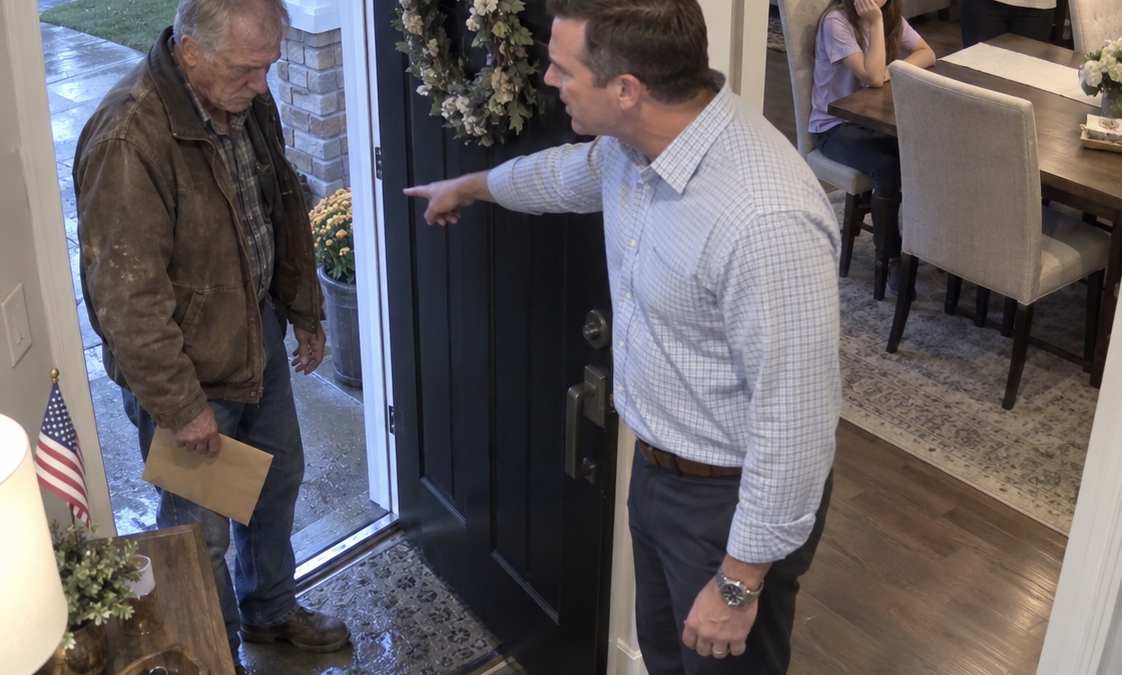
Those were the words my son said to me, right in front of my grandchildren. He looked at the old jacket I was wearing, glanced down at the envelope in my hand, and decided he already knew why I had come.
He thought I needed money. Maybe he thought I needed a place to stay. Maybe, in his eyes, I had finally become exactly the burden he had always told everyone I was.
I didn’t argue. I didn’t explain myself. I simply placed the envelope on the table and turned toward the door. Before walking away, I stopped and looked back at him.
“Julian,” I said, “read page four before nine tomorrow morning.”
Welcome back to Dad’s Real Life Revenge. My name is Raymond Caldwell, and I’m sixty-eight years old. I spent more than thirty years of my life running a small construction company. These hands have grown rough from working with bricks, stone, and cement. I know what a solid foundation looks like, and I also know how a house collapses when its cracks are ignored.
That night, a light rain was falling as I drove my old Ford F-150 to my son’s house. That truck had been with me through hundreds of construction projects. It wasn’t shiny, and its body was covered in scratches, but every inch of it had been paid for with money I earned through my own sweat and hard work.
Julian lived in a beautiful two-story mansion in an upscale suburban neighborhood. Warm light spilled from the chandeliers inside, illuminating the large windows and polished rooms. Through the glass, I could see a family gathering underway. There was good food, laughter, and conversation. My eleven-year-old granddaughter was sitting at the dining table.
I stood outside the front door with a flat brown envelope in my hand and knocked.
Julian opened the door wearing an expensive shirt, a gleaming Swiss watch wrapped around his wrist. His eyes traveled over me, stopping on my old jacket, which still carried a few stains from plaster and mortar. Then he looked past me toward the Ford parked along the curb. His expression darkened, and he made no attempt to invite me inside.
“What are you doing here, Dad?” he asked quietly, his voice carrying unmistakable annoyance.
“I came to talk to you,” I replied.
My voice remained calm. I was used to working with construction crews, and I had never developed the habit of raising my voice unless it was necessary.
Julian glanced quickly over his shoulder into the living room. His mother-in-law, Bernardet, was sitting on the sofa. His sister and children were there as well. He drew a breath, irritation deepening every crease across his forehead.
“Not tonight,” he growled.
“It’ll only take five minutes,” I said, extending the envelope toward him.
Julian didn’t take it. Instead, he pushed my hand away. Whatever thin thread of patience he had been holding on to snapped, and he raised his voice loudly enough for the entire living room to fall silent.
“Dad, get out before my wife gets home. I can’t keep doing this with you anymore.”
The space around us seemed to freeze. Inside, the faint clatter of silverware against plates stopped completely. My eleven-year-old granddaughter looked up from the dining table and stared at her grandfather standing outside on the rain-soaked porch.
Julian stepped forward and pointed a finger directly at my face.
“I can’t support an old man forever. I have my own family.”
Every word felt like a knife driven straight into my chest.
I stood perfectly still. The cold wind found its way through the worn fabric of my jacket, but the chill outside was nothing compared to what had settled inside me.
He thought I had come begging for food or money. He thought the old truck and the rough clothes I wore were proof that I was bankrupt. Somewhere along the way, he had convinced himself that a father who didn’t show off must be a father who had nothing.
I didn’t shout. I didn’t argue. A man who had spent his life working from blueprints understood something Julian apparently did not: when a structure is already damaged, shouting at it won’t make it stronger.
“Do you really think that’s why I came here?” I asked.
Julian scoffed. A bitter, contemptuous smile crossed his face.
“What else could it possibly be?”
That was the sentence that stripped away the last bit of respect I had for the way he was behaving.
I looked directly into my son’s eyes for several seconds. I searched for the little boy I used to carry on my shoulders at construction sites, the child who once looked at everything I built with wonder. But that child was nowhere to be found. Standing before me was an arrogant man drowning inside the image of success he had created for himself.
I bent down and placed the brown envelope on the small table beside the front door.
“All right,” I said quietly. “I guess you’ll find the answer tomorrow morning.”
Then I turned away.
My steps were slow, but they were steady. Behind me, Julian remained in the doorway, clicking his tongue impatiently as he prepared to slam the door shut.
I stopped on the wooden step and looked back.
“Oh, Julian.”
“What now?” he snapped.
“You should read page four before nine tomorrow morning.”
I walked down the steps without waiting for an answer. A moment later, the heavy door slammed shut behind me, its echo following me into the rain.
I climbed into my truck and started the engine. The familiar rumble of the Ford F-150 filled the cab as the rain began striking the windshield harder. I switched on the wipers and pulled away from the curb.
In the rearview mirror, Julian’s brightly lit mansion gradually disappeared into the darkness.
A FOUNDATION BUILT ON SECRETS
Julian had always been ashamed of that truck. He was ashamed of my rough hands, too.
My late wife, Helen, and I had spent nearly thirty-five years building Caldwell Construction. We started with nothing. We worked from five in the morning until sunset, and for years, sweat, cement, mortar, and dust were simply part of our daily lives. Those long days and hard jobs were what allowed us to raise our two children.
I wasn’t rich in the way some people liked to advertise. I didn’t drive luxury cars or wear diamond watches. My wealth existed in solid, dependable things: a fully paid-off house, secure savings accounts, and a few commercial rental properties. I had always lived below my means because I believed financial security was something you built, not something you displayed.
Julian never understood that.
When he was eighteen, he once looked at my dirt-covered work truck and sighed with the kind of embarrassment only a young man desperate to impress other people could feel.
“Dad, nobody cares how hard you’ve worked if you still look like you’re broke.”
I remembered smiling at him and patting his shoulder.
“That’s the great thing about money, son. It doesn’t care what I look like.”
But Julian cared very much about appearances.
As he grew older, he became obsessed with looking successful. He started a financial consulting company, bought an expensive house in the suburbs, and drove a luxury sedan. He collected Swiss watches and surrounded himself with things that announced his supposed achievements before he ever opened his mouth.
He married Eevee, a woman who had grown accustomed to living among the upper class. Eevee wasn’t a bad person. She was simply used to comfort and luxury, and Julian had always loudly insisted that everything they possessed had been provided through his own hard work.
The truth was that Julian was building his life on a foundation of sand.
Three years earlier, his financial consulting company had fallen into a serious crisis. A major partner withdrew its investment, contracts were canceled, and the business was facing bankruptcy within a matter of weeks.
Julian came to me during that difficult period. Even then, he struggled to put aside his arrogance. He described the crisis as a temporary liquidity shortage and insisted that the company simply needed a substantial amount of money to keep operations going.
I listened to him carefully. But I didn’t hand him a bag of cash. That had never been the way I worked.
I was a builder. When something was broken, I believed in repairing it with a secure structure beneath it. So I used a special financial arrangement to save his company.
Julian survived the crisis.
Afterward, he proudly told his friends that he had weathered the storm through his exceptional business talent. He believed the bank had placed its confidence in his potential, and he accepted that belief without ever bothering to discover who had actually taken on the risk.
For the next three years, he watched me continue driving my old Ford. He saw me living alone in the house Helen and I had shared. After she died, he began making assumptions about my finances, imagining that I had drained my savings and was slowly running out of money.
He believed that an old man who didn’t spend money on shiny things was an old man whose time had passed.
His arrogance had blinded him so completely that he seemed to forget who had taught him how to walk.
As I drove along the rain-soaked road that night, I thought about how certain Julian had always been of his own success. He remembered that someone had helped his company survive three years earlier. What he had never bothered to investigate was whose signature had actually saved his business.
And that was precisely what the brown envelope had been meant to explain.
THE EVOLUTION OF GREED
Julian’s contempt hadn’t appeared overnight. It had developed slowly, like rainwater seeping through an old roof until the damage could no longer be ignored.
After Helen, the woman who had spent her entire life by my side, passed away, Julian’s attitude toward me began to change.
At first, the difference was almost too small to notice.
One month after the funeral, he patted me on the shoulder and said, “Dad, if you need anything, just call me.”
Three months later, his tone had become noticeably colder.
“Dad, you really need to start planning for yourself.”
By the sixth month, whatever patience he had once pretended to possess was gone.
One afternoon, I stopped by his house to visit my grandchildren. Julian stood in the kitchen with his arms crossed, looking at me with unmistakable weariness.
“Dad, my wife and I can’t change our entire family life every time you feel lonely.”
I stood there, stunned by what he had said.
I had never asked him to leave work for me. I had never asked him to come over and clean my house or take care of my responsibilities. I simply missed my grandchildren and wanted to spend a little time with them.
More importantly, I had never asked Julian for a single dollar.
But somewhere along the way, my son had begun constructing an entirely different version of our relationship. He started speaking to relatives and friends as though he were carrying the financial burden of supporting me.
At my granddaughter’s tenth birthday party the previous year, the house was crowded with family and acquaintances. I was sitting in the loft when I overheard Julian talking to several people in the backyard.
His voice carried the proud exhaustion of a man who wanted everyone to admire the sacrifices he was supposedly making.
“Right now, I practically have to support two families,” he told them. “Everything is so expensive these days.”
One of my cousins overheard him and later approached me with a sympathetic expression.
“Julian’s been helping you out a lot lately, hasn’t he?” he asked.
I looked down at the glass of water in my hand and took a slow sip.
“Apparently so,” I replied.
That small moment pierced my heart more deeply than I cared to admit. But I stayed silent. I wanted to see just how far my son was willing to go with a lie he had invented himself.
Let me ask you something. If your own child began telling relatives that they were financially supporting you when you had never asked them for a single cent, would you confront them immediately? Or would you remain silent to discover how far they were prepared to push that lie?
Let me know below, because I chose the second option.
Unfortunately, my silence only made Julian more confident. He began treating me as though I were old, weak, and senile, a man who could no longer understand what was happening around him.
Three months ago, I accidentally overheard a conversation between Julian and Eevee. My son was telling his wife that my savings had run out. He was even preparing paperwork to sell my old house.
His plan was to place me in a cheap nursing home as soon as he could establish that I was no longer mentally capable of managing my affairs.
The next morning, when he stopped by my house to pick something up, I decided to ask him directly.
“Are you planning my future?”
Julian wasn’t embarrassed. He casually adjusted his tie as though we were discussing an ordinary business matter.
“Everyone’s future, Dad.”
I looked at him, and in that moment, I understood a bitter truth.
My son no longer saw me as his father. He saw me as an asset that had not yet been liquidated, a burden that needed to be removed as quickly and conveniently as possible.
I didn’t explode with anger. I had spent too many years working in construction not to recognize the signs of something that could no longer be repaired.
When a support column has rotted completely through, you cannot save it by covering the damage with fresh paint. A column eaten away from the inside by termites cannot be reinforced simply because you wish it were still strong.
Sometimes all you can do is prepare for the moment it collapses under its own weight.
That was when I decided to review every one of my financial documents. I called my personal attorney and began examining the arrangements Helen and I had made over the years.
I stopped asking myself whether my son was ashamed of me.
Instead, I began wondering what he was secretly preparing behind my back.
THE CONFRONTATION ON THE PORCH
Now, let me return to that rainy night on the porch outside Julian’s house, where this story began.
I hadn’t gone there looking for warmth, shelter, or financial help. I had gone because my attorney had sent me an urgent notice.
The loan that had saved Julian’s company three years earlier had reached its renewal date, and the bank required a review of the collateral supporting it.
I wanted to speak with Julian privately. I wanted to discuss the situation before it became an emergency. But he never gave me the chance.
When he shouted, “I can’t support an old man forever,” his voice carried through the open doorway and across the living room.
Bernardet, Julian’s mother-in-law, rose from the sofa and stepped closer. She wore an elegant dress, and a large sapphire ring glittered on one of her fingers. She looked at me with a mixture of pity and contempt.
“Julian has children to take care of, too,” Bernardet said sharply.
I met her eyes without raising my voice.
“I know. They’re my grandchildren.”
“Then you should understand the situation,” she replied.
“Understand what?”
The entire room fell into an oppressive silence.
Julian’s face turned red. He was visibly embarrassed, though not because of the way he had treated me. He was afraid his mother-in-law might believe he had a freeloading father.
“Dad, please stop making everything so embarrassing,” he growled.
I stared directly into his eyes.
“I’m making everything embarrassing?”
“You keep showing up unexpectedly,” Julian snapped, brushing off my question.
I glanced past him into the dining room. My eleven-year-old granddaughter was staring down at the table. When I looked toward her, she avoided my eyes.
That was what truly made my heart ache.
It wasn’t Julian’s disrespect, and it wasn’t Bernardet’s contempt. Those were things I could endure. What hurt me was seeing my grandchildren being taught a poisonous lesson about family.
They were learning that old people became burdens when they could no longer earn money. They were watching adults treat a family member as disposable simply because they believed he was no longer useful.
I realized that any explanation I offered in that doorway would only turn into another argument. Julian had already made up his mind about who I was, and he was determined to perform that version of the truth in front of everyone.
So I held out the brown envelope once more.
Julian crossed his arms, took a step backward, and refused to touch it.
I didn’t force him. I bent down and placed the envelope on the wooden table beside the door.
“You should read page four before nine tomorrow morning,” I told him.
Then I turned and walked out into the rain. The thick wooden door slammed shut behind me.
At that moment, Eevee’s luxury car turned into the driveway. She had just returned from work. I saw her step out and walk past me. She gave me a brief nod, and I nodded back before climbing into my old Ford.
Inside the house, Julian hurried to greet his wife.
“Did your dad come asking for help again?” Eevee asked when she noticed the tense atmosphere.
Julian sighed and shook his head with exaggerated exhaustion.
“Yeah. Dad came asking for money again. I told him to go home.”
With those few words, his lie was complete.
He had transformed me into a beggar in front of the entire family, and he had done it so casually that no one seemed to question him.
But Eevee didn’t walk straight into the living room. She stopped in the hallway, her eyes settling on the brown envelope lying alone on the table beside the door.
Julian had spent years telling everyone that he was supporting me.
By nine the following morning, he was about to discover that the truth was exactly the opposite.
TRUTH REVEALED ON PAGE FOUR
The next morning, at 8:50, Julian woke with a pounding headache.
He reached for his phone on the dresser and saw three missed calls from the commercial bank’s credit director.
He sat upright immediately, cold sweat forming on his forehead.
His company’s business credit account was due for reassessment. The bank had sent a warning the previous week, but Julian had assumed the renewal would happen automatically. He believed his professional reputation was strong enough to guarantee that everything would continue as before.
Now, looking at the missed calls, he was no longer so certain.
He went downstairs and found the living room empty. Eevee had already taken the children to school.
The brown envelope was still lying on the small table beside the front door, exactly where I had left it.
Julian frowned, walked over, picked it up, and tore open one edge.
Inside was a six-page financial file.
The first three pages contained his company’s business figures from three years earlier. At the bottom of the financial summary was a record of the nearly two million dollars in high-risk debt his company had once faced.
Then Julian turned to page four.
It was a legally signed asset guarantee agreement.
The collateral supporting the loan that had saved his company had never been his reputation, his business talent, or the confidence he believed he had inspired in the bank.
It was a three-million-dollar real estate trust.
Helen and I had established that trust in our names twenty years earlier.
For three years, Julian had congratulated himself on convincing a bank to trust his abilities. In reality, the bank had trusted the enormous assets standing behind him.
My signature appeared directly beneath the guarantee clause.
Helen’s signature was right beside mine.
Julian’s phone rang.
My name appeared on the screen, and he answered immediately.
“Dad, what is this?” he blurted out.
His voice was trembling. The arrogance from the previous night had disappeared completely.
“Page four,” I replied calmly.
I was sitting in my home office with a cup of hot coffee in my hand. Outside the window, the garden behind my house was quiet.
“You guaranteed the loan for me?” Julian asked, his voice cracking.
“Your mother and I did.”
A deathly silence stretched across the phone line. I could almost picture him standing there with the document in his hand, trying to understand how something so important had remained invisible to him for so long.
Then I heard him sink onto his expensive sofa.
“Last night,” I said slowly, “you told the entire family that you were supporting me.”
I paused, allowing the words to settle.
“Julian, for the past three years, it has been my assets keeping your company alive.”
The reality he had spent years refusing to acknowledge had finally collided with the image he had created for himself.
Julian held his breath. He understood the danger almost immediately.
The guarantee was scheduled to expire at five o’clock that Saturday afternoon. If I refused to sign the renewal, the bank would freeze his company’s assets, and the business could collapse within forty-eight hours.
I had gone to his house the night before because I wanted to ask him one simple question: did he have a plan to stand on his own two feet?
But he had thrown me out before I could ask it.
Julian’s voice softened. He tried to recover some of the confidence he had lost, then shifted into an apologetic tone.
“Dad, last night was just because I was under too much stress. I didn’t mean it.”
“No,” I interrupted.
He fell silent.
“Last night wasn’t stress. Last night was the truth.”
I leaned back in my wooden chair and looked out toward the garden.
I had spent thirty-five years building houses. Work long enough in construction, and you learn something most people never understand. Cracks themselves don’t necessarily bring a structure down. Ignoring those cracks does.
But I didn’t immediately withdraw the guarantee.
Despite everything Julian had done, I wasn’t the kind of father who wanted to corner his own child simply because he had been insulted. I had spent a lifetime helping that boy stand upright, and I wasn’t eager to watch him fall.
I decided to give him one final chance.
“Come to my attorney’s office at two this afternoon,” I told him. “And bring all of your company’s accounting records.”
Julian hesitated.
“What are you going to do?”
“I’m giving you a chance to fix this.”
Then I ended the call.
I could have ended everything right there. One refusal, one unsigned document, and Julian would have been forced to face the consequences immediately.
Instead, I chose to give my son one final opportunity to do the right thing.
A FINAL CHANCE FOR INTEGRITY
At exactly two o’clock that afternoon, Julian arrived at my attorney’s office.
He was wearing an expensive gray suit, but his face looked exhausted. Dark circles showed beneath his eyes, and the reckless confidence he had displayed the night before was gone. In its place was the unmistakable panic of a man who had just discovered that the ground beneath him wasn’t nearly as solid as he believed.
Julian entered the conference room and stopped abruptly.
Eevee was already sitting at the table.
“Eevee, why are you here?” he asked, looking genuinely confused.
“I invited her,” I replied calmly from the head of the conference table. “Eevee is your wife. She has the right to know the truth about the family’s financial situation.”
Julian pressed his lips together. Embarrassment spread across his face, but he clearly didn’t want to acknowledge it.
“This is my business,” he argued.
“Then you have even less reason to lie to your wife,” I said firmly.
My attorney pushed a stack of documents across the table toward Julian. I waited until my son looked at me before speaking again.
“I’m not withdrawing the guarantee immediately,” I began. “I’m giving you a chance to restructure the loan, but only under five conditions.”
Julian swallowed hard.
“What conditions?”
I kept my eyes on him.
“First, you fully disclose the company’s actual financial situation. Second, you immediately cut all extravagant spending that’s only meant to impress other people. Third, you remove my assets from every future financial plan you make. Fourth, you tell Eevee the truth.”
I paused for a moment, letting him absorb what I had said.
“And fifth, you apologize to the family for the insulting lie you told last night.”
Julian’s expression changed.
For a brief moment, I thought he might accept the conditions. He understood the numbers. He knew what would happen if the guarantee disappeared, and he had enough business experience to recognize that I was offering him a genuine opportunity to restructure his affairs.
But then his old arrogance began rising again.
Having to admit in front of his wife that his business had survived because of my support seemed to strike him as a humiliation greater than the financial crisis itself.
“You want me to humiliate myself?” he shouted.
I brought my hand down lightly against the table. My voice became lower, but every word carried the weight of what had happened.
“No. I want you to repair the humiliation you caused yourself.”
Julian shot to his feet and pointed at me.
“You’re using money to control me. You’re threatening me!”
I looked at him without flinching.
“I’m not threatening you. I’m simply taking back the money I’ve been putting beneath your feet.”
Be honest with me. Was Raymond using money to control his son, or was he finally refusing to fund ingratitude? If you believe that helping family still requires boundaries, hit like, because what Julian did next proved that this had never really been about hurt family feelings.
Julian was breathing heavily. He turned toward Eevee, clearly searching for agreement, some sign that she would support him against me.
But Eevee wasn’t looking at him.
She was studying the financial report on the table, carefully examining the figures she had never been allowed to see.
Her eyes widened as she followed the numbers.
The enormous debts, the loans, and the extent of Julian’s dependence on my assets were all laid out in front of her. The financial security she had believed her husband had created was suddenly revealed to be something very different.
“Julian,” Eevee said, her voice trembling with disappointment, “you’ve been lying to me for three years.”
Julian couldn’t answer.
For the first time since he entered the room, he seemed to have no explanation prepared.
His anger and shame built until he could no longer remain seated. He snatched his briefcase from the table, turned around, and hurried out of the conference room.
He didn’t choose to make things right.
He chose to run away.
And unfortunately, that wasn’t the worst of it.
Julian had been offered a chance to stand on his own two feet, but instead of accepting responsibility, he chose a far more despicable path.
A BETRAYAL OF FAMILY TRUST
After storming out of the conference room, Julian didn’t call the bank. He didn’t call me, either.
He immediately called his sister, Kora.
His voice was filled with carefully manufactured panic. Rather than discuss the truth, he began constructing another story, one designed to make himself appear concerned and responsible while making me seem incapable of understanding my own decisions.
“Kora, you have to help me,” he said urgently. “Dad hasn’t been himself lately. He’s making extremely irrational financial decisions.”
Kora was at her office when she answered the call. She frowned as she listened.
“What do you mean, Julian?”
“Dad’s becoming senile,” Julian whispered. “He’s been emotionally unstable ever since Mom died. Yesterday, he came to my house and caused a scene. Today, he wants to withdraw all the family investments. I’m afraid Dad is no longer mentally capable of managing his assets.”
His plan was far more calculated than a simple attempt to frighten his sister.
Julian wanted Kora to co-sign a petition asking the court to appoint him as the legal guardian over my financial affairs. He wanted to strip me of control over my own money and have me declared legally incapacitated.
If he succeeded, he believed he could keep the financial guarantee in place while taking complete control of the assets Helen and I had spent our lives accumulating.
My son was trying to use the law to take possession of the very foundation that had kept his business alive.
But Kora wasn’t easily manipulated.
She was a rational woman, and she listened carefully to everything Julian said. When the conversation ended, she didn’t rush to sign anything or repeat his accusations.
Instead, she called me directly.
“Dad?” she asked softly. “Julian says you’re having mental health problems. Is that true?”
I was sitting in my living room. The cup of coffee on the table beside me had already gone cold.
I wasn’t surprised by her question. After the conversation at my attorney’s office, I had expected Julian to react badly. Even so, hearing how far he was willing to go was a painful confirmation of something I had hoped might not be true.
“Do I sound like someone who isn’t well?” I asked.
“No,” Kora replied after a moment. “You sound perfectly clearheaded.”
“Then you understand why he’s saying that, don’t you?”
Kora sighed. I could hear the bitterness in her breathing.
“He wants control of your assets.”
At that moment, something inside me closed completely.
Until then, I had still believed that Julian was simply frightened. Fear can sometimes make people behave in ugly ways. It can make them selfish, unreasonable, and desperate.
But this was no longer fear.
This was a strategy, a ruthless attempt to destroy the credibility of the very father who had raised him, all so he could take control of money that had never belonged to him.
I ended my conversation with Kora and called my personal attorney.
My voice was low, calm, and completely free of anger.
When a builder discovers that a support column isn’t merely cracked but rotten all the way through, he doesn’t keep covering the damage. He removes the column before it brings down everything around it.
“Prepare all the documents I ordered,” I told my attorney.
He hesitated on the other end of the line.
“Mr. Raymond, are you sure? If you do this, Julian will be left in an extremely difficult position.”
“He already made the decision for me,” I replied.
Then I hung up.
I walked over to the window and looked outside. Evening had settled over the neighborhood. Streetlights were coming on, and cars streamed one after another along the road.
Julian believed he was assembling a convincing case that I was no longer capable of managing my own money. He thought he could persuade the rest of the family, and perhaps eventually a court, that my financial decisions were evidence of mental decline.
Unfortunately for him, I had quietly prepared evidence proving the exact opposite.
I invited everyone who had been present the night I was humiliated to return to Julian’s house on Saturday evening.
And Julian agreed to gather them.
THE COLLAPSE OF THE FACADE
Julian thought I had finally decided to give in.
He was confident that the story he had been spreading about my supposed mental decline had created enough pressure to make me surrender. In his mind, an aging father would always choose peace over conflict if it meant preserving the family’s dignity.
When I arrived at his house on Saturday evening, everyone was waiting.
Bernardet sat in the corner of the sofa. Eevee was beside her, quiet and withdrawn. Kora stood near the window, leaning against the frame. My grandchildren had been sent to their rooms.
Julian stood in the middle of the living room, smiling smugly as he adjusted the sleeves of his shirt.
“Dad,” he said, speaking first, “I’m glad you’ve realized what’s best for the family. We don’t need to make things complicated.”
I walked to an armchair and sat down.
Then I placed a black folder of documents on the glass coffee table.
“This isn’t a negotiation,” I said calmly.
Julian frowned.
“Then what is this, Dad? A family meeting to put me on trial?”
“The truth that needs to be made clear,” I replied.
I opened the folder and looked first at Bernardet, then at Eevee and Kora.
“Three years ago, Julian’s company was on the verge of bankruptcy,” I began. “At the time, the debt was nearly two million dollars. No bank was willing to lend him that money without substantial security.”
Julian’s expression changed immediately. He stepped closer to the table, his confidence beginning to slip.
“Dad, stop bringing up the past.”
I raised one hand, signaling him to be quiet.
“Helen and I used the assets we had accumulated over our lifetime to sign the guarantee that saved his company.”
I looked down at the documents for a moment before continuing.
“Helen told me one thing. She said, ‘Let Julian believe he saved himself. Confidence will help him become the man he wants to be.’”
Bernardet’s eyes widened. She turned toward Julian, clearly stunned by what she was hearing.
Eevee lowered her head. She had already discovered the truth at my attorney’s office earlier that week, but hearing it spoken in front of the family seemed to make the reality even heavier.
“After Helen died, I kept that promise,” I continued. “I drove my old Ford. I wore my rough work clothes. I let Julian believe he was a successful, self-made businessman.”
I paused and turned directly toward my son.
“Until last Sunday night.”
Julian stood rigidly.
“That night, in front of my grandchildren, you told me, ‘I can’t support an old man forever.’”
Sweat was beginning to gather on his forehead. He swallowed hard and struggled to respond.
“I… I was just too angry to think straight.”
“You were right, Julian,” I interrupted.
He stared at me in confusion.
“You were never supporting me. And starting at five o’clock this afternoon, I will no longer support your fake life, either.”
I reached into the black folder and removed the official notice from the bank.
“I have formally refused to renew the asset guarantee.”
No one spoke.
“I’m not taking your company away from you,” I continued. “I’m not taking a single cent from you. I’m simply no longer using your mother’s and my blood, sweat, and tears to support your ingratitude.”
The color drained from Julian’s face.
He lunged toward the edge of the table, his voice rising into a roar.
“You’re going to destroy my company! You’re going to ruin my life!”
I looked at him steadily. My voice remained calm and flat, like the surface of a still lake.
“No, son. If my signature is the only thing keeping your company alive, then it was never standing on its own.”
Eevee finally looked up.
She turned toward Julian, and when she spoke, her voice trembled.
“How much money do we actually owe?”
Julian fell silent.
He couldn’t answer his wife because answering would mean admitting how much of their life together had been built on financial promises he couldn’t keep.
I stood and put my old jacket back on.
“That’s a question for your husband, Eevee,” I said.
Then I walked toward the door.
For the first time in three years, Julian was about to discover what his life was worth without my signature underneath it.
And there was no magic left to rescue him from that discovery.
After that Saturday evening, the false image he had spent years building began to crack apart, just like a structure after its only load-bearing column had been removed.
Two weeks later, the bank officially reduced his credit limit.
Julian was finally forced to face reality.
REBUILDING AND HARD LESSONS
Without the leverage provided by my assets, Julian’s debts began closing in around him almost immediately.
He had to sell his luxury sedan and replace it with an old economy car. He refinanced his suburban mansion to pay down some of the short-term debt that threatened his company.
He downsized his expensive downtown office and laid off two consultants.
The lifestyle he had worked so hard to display began shrinking to match the actual financial condition of his business.
But the deepest wound wasn’t financial.
It was inside his own home.
Eevee didn’t leave Julian immediately. She was a strong woman, and she wasn’t the kind of person who made decisions lightly. But the trust between them had been badly damaged, perhaps beyond repair.
One day, I met her at a coffee shop near my house.
She looked thinner than I remembered. The pride that had once seemed so natural in her eyes was gone, replaced by a weary sadness.
“I can forgive him for having financial problems,” Eevee told me.
Her voice was bitter, but she spoke carefully, as though she had spent a long time thinking about what she wanted to say.
“But I don’t know if I can forgive being lied to for three years.”
I understood what she meant.
Money could be earned again. Debts could be repaid. A smaller house or an older car was not the end of the world.
But trust was different.
Once someone had deliberately broken it, there was no easy way to restore what had been lost.
One Sunday afternoon, there was a knock at my door.
I opened it and found Julian standing on the front step.
He wasn’t wearing an expensive tailored suit, and the gleaming Swiss watch that had once seemed permanently attached to his wrist was gone.
Instead, he wore a simple T-shirt. A few strands of gray had appeared in his hair, and his face carried the unmistakable marks of exhaustion and hardship.
For the first time in years, he reminded me of myself thirty years earlier, when I was struggling through long days on construction sites and trying to build a better future for my family.
The atmosphere was completely different from the night he had thrown me out of his house.
A light drizzle was falling, and Julian stood quietly on the front step without trying to push his way inside.
“Dad, can I come in?” he asked.
I looked at my son for several seconds before answering.
“Did you come here because you need money?”
Julian lowered his head and slowly shook it.
“No. I sold the car. I downsized the company. I’m paying off the debts myself.”
I studied his face for another moment, then stepped aside.
“Then come in.”
Julian entered the living room and looked around my old house.
It was the same house he had once assumed was proof of my financial decline. The furniture was familiar, the rooms modest, and nothing about the place had been designed to impress anyone.
But this time, there was no contempt in his expression.
He sat down on a wooden chair, rested his hands together, and looked at me.
“I’m sorry, Dad,” he said.
There was no elaborate explanation and no attempt to shift responsibility. The words seemed to come from the bottom of his heart, without calculation.
“I was too arrogant. I looked down on what you and Mom built.”
I listened to him carefully.
I didn’t say that everything was okay, because nothing about what had happened was okay.
The humiliation in front of my grandchildren could not be erased with a single apology. Neither could the lies he had spread about my financial condition, or his attempt to convince Kora that I was no longer mentally capable of managing my own affairs.
Those things had happened. They were real, and pretending otherwise wouldn’t make them disappear.
“I hear you,” I replied.
Julian looked up. His eyes were filled with a kind of pleading I hadn’t seen in him for years.
“Can you forgive me?”
“With time,” I said.
He hesitated before asking the question that mattered even more.
“Can you trust me again?”
I looked directly into his eyes.
“That will take much longer.”
It wasn’t an easy reconciliation, but it was the truth.
My dignity wouldn’t allow me to pretend that nothing had happened. Forgiveness and trust weren’t the same thing, and Julian would have to learn the difference through his actions, not merely through his words.
After a while, he stood and prepared to leave.
But before walking out the door, he turned and looked toward the wooden table in my living room.
For all that had happened, Julian still believed that the brown envelope I had carried to his house that rainy night had contained nothing more than documents concerning the guaranteed loan.
He didn’t know that the loan had never been the real reason for my visit.
Julian stopped in the doorway and looked back at me with a puzzled expression.
“Dad,” he asked softly, “that night, besides the bank guarantee documents, was there something else you wanted to talk to me about?”
I didn’t answer immediately.
Instead, I walked over to the wooden cabinet and opened it.
Inside was a yellowed sheet of paper that had been carefully laminated to protect it from age and damage.
It was a copy of the document that had been included on the final page of the file I brought to Julian’s house that night, the page he had never bothered to open and read.
It was a handwritten letter from Helen concerning our family’s inheritance.
She had written it six months before she passed away.
I carried the letter back to Julian and let him see the handwriting he knew so well.
Helen had explained our intentions very clearly.
She and I had set aside one-third of the assets we had accumulated over our lifetime to establish an independent family trust. That trust was reserved for our two grandchildren and for Julian himself when he had truly matured and become responsible enough to help manage it.
Helen had believed that our children should eventually receive more than money. She wanted them to understand the responsibility that came with protecting something built through decades of work.
That night, I had brought the envelope to Julian’s house not because I needed financial help, a place to stay, or someone to look after me.
I had come to give him a copy of his mother’s letter.
I wanted to discuss adding his name to the list of trustees for the family trust.
After all those years, I had been preparing to place something of enormous importance into his hands.
But the way he treated me in front of my grandchildren gave me the answer I hadn’t wanted to receive.
He wasn’t ready.
His arrogance and greed would have put everything Helen and I had worked for at risk.
I looked at Julian as he held his mother’s letter.
“That night, I didn’t come to your house because I needed a place to stay,” I told him. “I went there because I was preparing to trust you with everything your mother and I had spent our lives building.”
He remained silent.
“You thought I had come asking for a bedroom,” I continued. “I had come to hand you a key.”
Julian stood frozen.
The letter trembled in his hands as he stared down at his mother’s handwriting.
And at last, he understood the greatest price he had paid.
He hadn’t simply lost the financial guarantee that had supported his business. He had lost something far more valuable.
With his own actions, he had destroyed the absolute trust his parents had once been prepared to place in him.
There was nothing I needed to add.
Some lessons cannot be taught through arguments, no matter how loudly a father speaks or how patiently he explains himself. They must be learned through the consequences of choices that can no longer be undone.
The lesson I took from all of this was simple, but harsh.
Never use money or indulgence to buy your children’s affection once they are grown. Don’t turn yourself into an ATM for every frivolous desire they develop. Helping your children does not mean funding irresponsibility, dishonesty, or disrespect.
A parent’s worth should never be measured by the balance in a bank account or the clothes they choose to wear. Respect should not disappear simply because someone grows older, lives modestly, or refuses to display their wealth.
And above all, never mistake someone’s simplicity for weakness.
Some people don’t show off what they have because they have spent their entire lives understanding that true security doesn’t need an audience.
I watched Julian walk out through the gate that afternoon.
This time, his back was slightly hunched, and his steps carried none of the arrogance I had seen before.
He had finally begun to understand what it meant to walk on his own two feet.
Thank you for joining Dad’s Real Life Revenge. Subscribe to the channel for more heartfelt family stories, where the truth may arrive late, but the consequences always find the right person.








