“Christmas is only for genevieve’s family.” i replied: “okay.” — they had no idea i’d just closed on a $5.8m estate in colorado. days later… when they excluded showed up at my place instead… their calls never stopped…
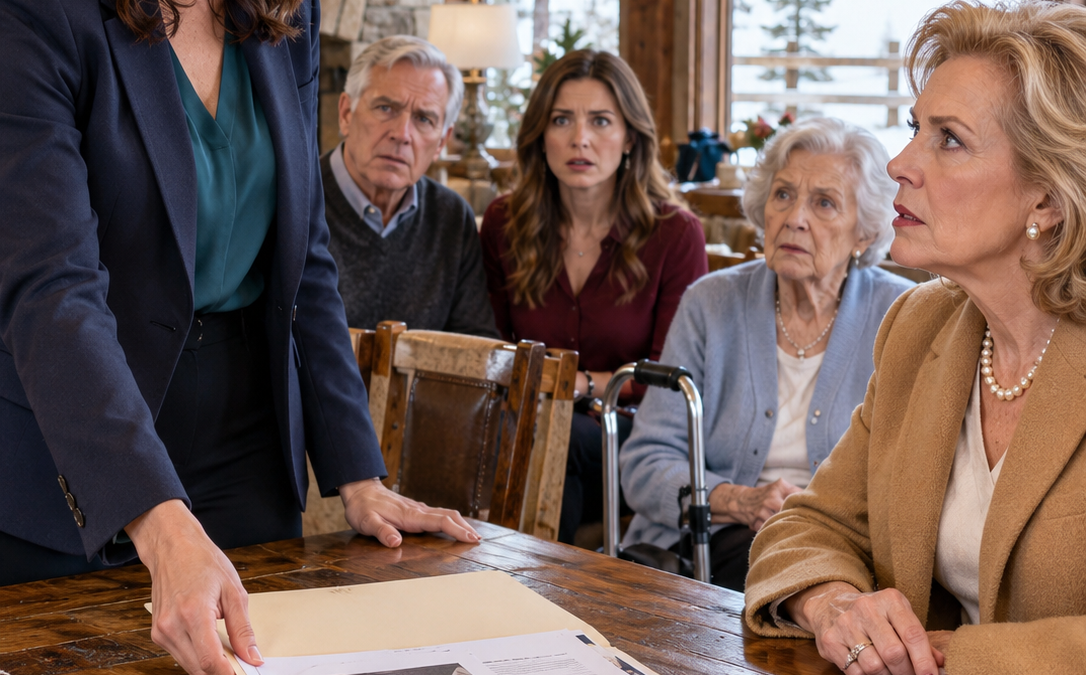
My mom sent the text while the closing officer was still sliding the keys across the desk. It landed in the family chat between a photo of my sister’s new dining table and a reminder to order the ham.
“Christmas is only for Genevieve’s family this year. The Ashcrofts are coming, and we want it intimate. You understand?”
You understand?
My mother only wrote those two words when the decision had already been made and the only part left for me was to agree. It was the fourth time in ten years I had been told to sit a holiday out. So I typed the four letters I had typed my whole life.
“Okay.”
Then I turned my phone facedown and signed the last page. The key tag said sixty-one acres outside Steamboat Springs, a stone lodge built in 1924, and a pine table with fourteen chairs that my family didn’t know existed. I scrolled back to the head count my mother had posted that morning. Eleven names. Then I counted who was missing, and the first name was my grandmother’s.
Welcome back to Calm Drama Stories. Here we share long family stories about people who were overlooked by the ones who should have loved them most, and the quiet, steady ways they finally chose themselves. Pour something warm and settle in. If this story stays with you, drop a comment, and be sure to subscribe.
The lodge was forty minutes outside Steamboat Springs, and that first night, I sat in it alone with the furnace ticking and my phone facedown on a table built for fourteen. I had walked through the entire house twice, opening every cupboard as though I were doing an inventory, which, if I’m being honest, is how I handle most feelings. Then I sat down at the table and, without thinking, chose the last chair, the one nearest the kitchen door. I noticed what I had done about a minute later. Forty-four years old, alone in a house I owned outright, and I had still picked the seat nobody else would want. I moved to the middle of the long side. It felt like sitting in someone else’s coat.
I called my grandmother at a quarter to eight because she goes to bed at nine and likes to say good night to the weather report.
“Marlo,” she said, and I could hear the television go quiet. “Your mother says I should rest this year.”
“Rest from what?”
“That’s exactly what I asked her. She didn’t say.”
Grandma Opal was eighty-six. She had broken her hip in March and used a walker now, but her mind was the sharpest thing in our family, and everyone knew it, which was maybe why some of them found her inconvenient.
“She’s bringing me a plate on the twenty-sixth,” Grandma said. “Leftovers. I’m told it’s very thoughtful.”
“Do you want to go somewhere for Christmas?” I asked.
She laughed, a dry little sound. “At eighty-six, honey, the only places people invite you are doctors’ offices.”
I didn’t tell her about the lodge. I told her I would call her tomorrow. After we hung up, I opened the family chat again to see who had put a heart on my mother’s message and who hadn’t.
My aunt Ruthie called before I had finished scrolling. Ruthie is my father’s younger sister. She drove a school bus in Englewood for thirty-one years, and she has a laugh you can hear across a parking lot. That night, though, her laugh came out thin.
“Well,” she said, “I’ve been uninvited from my own brother’s Christmas. Your mother says Celeste might find me a little loud.”
Celeste Ashcroft was Genevieve’s mother-in-law. She lived in Cherry Hills Village and owned a house that had a name.
“I am a little loud,” Ruthie said. “But I’ve been loud for sixty-three years, and nobody ever minded at Christmas before.”
An hour later, my cousin Dell texted me. Dell is Ruthie’s son, an electrician, and his wife, Priya, works nights in an emergency room. Their daughter, Juniper, was eight months old. His message said, “Aunt Darlene says no babies this year because the Ashcrofts like a calm house. Did you get cut, too?”
I took a legal pad out of my bag and wrote a list the way I would plan a shipment.
Grandma Opal. Ruthie. Dell. Priya. Juniper. Me.
Six people if you counted the baby, and I did.
Then I looked down the length of the table. Fourteen chairs.
I knew exactly what would happen if I invited them. My mother would say I had set up a rival Christmas out of spite. My father would say I was making things hard. Somebody in the family would repeat whatever version my mother told first, and that version would become the truth.
I sat with that for a long time. Then I thought about my grandmother eating cold ham out of foil on the twenty-sixth and being grateful for it, and I stopped thinking about what my mother would say.
The next morning, I made a new group chat and called it Howerin Christmas.
“I have a house with too many chairs. December twenty-third to the twenty-seventh. I’ll handle the driving.”
Ruthie answered in forty seconds with three exclamation points and a picture of a turkey. Dell wrote, “Are you serious?” and then, “We’re in.”
Grandma Opal doesn’t text, so I called her and read the invitation aloud. She was quiet for so long that I thought the line had dropped.
“Is there pie?” she finally asked.
I told her there would be pie.
When it was done, I realized I hadn’t told my mother, and I didn’t feel I needed to.
That was new.
It reminded me of the last time I had tried to host a holiday, and how that had gone.
When I was twelve, my mother set up a folding card table in the hallway outside the dining room, next to the coat closet. It was Christmas of 1994. Genevieve was seven, and her best friend’s family had come for dinner, so there weren’t enough seats at the real table.
“Just this year,” my mother said, smoothing a paper tablecloth over the card table. “You’re the big girl. You understand?”
So I sat in the hallway with my plate on my knees because the card table wobbled, listening to the laughter coming from the next room through the open doorway. I could see the back of my sister’s head and one side of the Christmas tree. I remember the smell of wet wool coming from the coats. I remember thinking that if I was very good about it, maybe they would call me in for dessert.
Nobody called me in.
Instead, my grandmother came out of the dining room carrying her own plate. She pulled the other folding chair away from the wall and sat down across from me.
“The view’s better out here,” she said. “You can see everybody, and nobody can see you sneaking pie.”
She had brought half a pecan pie on a saucer, which she had taken straight off the sideboard. We split it with two forks.
My grandfather, Walt, leaned out of the doorway once and winked. My mother leaned out once, too, looked at the two of us, and went back inside without saying anything.
I didn’t understand then what my grandmother had done. I only knew that the hallway wasn’t as cold after she sat down.
There was a card table every year after that. Sometimes it was in the hallway, sometimes in the kitchen, and once, when I was in college, on the back porch with a space heater.
It was always for me.
By the time I was thirty-one, I had decided I would rather have a table of my own. In November 2013, I had just bought a condo in Lakewood, and I asked my mother if I could host Thanksgiving. I had never asked to host anything before. She said yes over the phone, and she said it warmly, and I believed her.
I bought an extension leaf for my table. I ordered a fresh turkey from a farm in Brighton. I printed a little menu on card stock, which is embarrassing to admit, but I did. I folded fourteen napkins into shapes I had learned from a video.
Two days before Thanksgiving, my mother called.
“Genevieve just closed on her house,” she said. “She wants to have everyone there. It would mean so much to her. You understand?”
I stood in my kitchen holding a stick of butter and said, “Okay.”
On Thanksgiving, I roasted the turkey anyway and drove it across town to my sister’s new house in a cooler. It was a good turkey. People said so.
Halfway through the afternoon, Aunt Ruthie pulled me into the pantry with a glass of wine in her hand.
“I’m so glad you made it after all, honey,” she said. “Your mom said you backed out of hosting. Said work was too much for you this year.”
I opened my mouth to tell her what had happened. Then I saw my mother watching us from the kitchen island, a serving spoon in her hand, perfectly calm, and I closed my mouth.
I told myself it wasn’t worth ruining the day. I told myself it didn’t matter what Ruthie believed.
But here is what happened when I stayed quiet.
By Christmas, everyone believed the version where I had backed out. By the following year, I half believed it myself. I would replay the phone call and wonder if I had misunderstood, if my mother had only said maybe.
That is the thing about a family that rewrites events. After enough time, you start checking your own memory for errors as though you were the one who made them.
The extension leaf stayed in my storage closet for twelve years.
After that, I got very good at being easy.
At Genevieve’s wedding in 2011, I had already sat at table nineteen next to the swinging kitchen door. When my mother introduced me to the Ashcrofts, she said, “This is Marlo. She works for a tent company.”
I didn’t correct her.
When my marriage ended in 2020, quietly and without either of us being cruel, the first thing my mother asked was, “What did you do?”
“We’d grown apart,” I told her.
“Well…”
By then, I had learned her language the way you learn a second language when you move to another country: by necessity. “You understand?” meant it was decided. “We’ll see” meant no. “That’s nice” meant she wasn’t listening.
And I had learned my own word, the one I used for everything.
Okay.
Okay, I’ll skip it. Okay, I’ll bring the rolls. Okay, Genevieve can have the guest room. I’ll get a hotel. Okay, I’ll sit at the end.
I want to be fair about this. My mother did not make me say those words. I chose them every time because I believed something that I can only see clearly now. I believed that if I was patient enough, if I asked for nothing and caused no trouble, one day she would look up from her table, notice the empty chair, and pull it out for me herself.
I thought love was something you could wait your way into.
The only person who ever called to ask if I had eaten dinner was my grandmother.
My mother thought I worked for a tent company. In a way, she wasn’t wrong.
I started on the warehouse floor in Commerce City when I was twenty-three, working nights and learning to drive a forklift from a man named Esteban, who had nine fingers and never once raised his voice. I liked the work. I liked that a pallet was either where it was supposed to be or it wasn’t, and nobody could talk you into believing otherwise.
In 2009, a small outdoor gear company in Boulder called Switchback Outfitters hired me as employee number nine to figure out how to get its tents and packs into stores. For the first few years, the company couldn’t pay much, so it paid part of my compensation in shares. I took them because I didn’t have anyone to spend money on anyway.
By the end, I was running distribution for four hundred stores. I also worked seventy-hour weeks for most of a decade.
My husband, Grant, wanted children, and every time we talked about it, I said, “After this quarter.”
He waited longer than most men would have.
When he finally left, he wasn’t angry, just tired, and I couldn’t argue with a single thing he said.
In the spring of 2025, Switchback was bought by a much larger company. I received an email with a number in it, and I sat in my car in the parking lot for twenty minutes without starting the engine.
I didn’t tell my family.
Nobody asked how work was going, and I had stopped volunteering news years before.
I spent a year looking at houses.
Howerin Ranch had a two-bedroom guest cottage with no steps at all. Not one. The moment the agent mentioned it, I pictured my grandmother’s walker rolling right through the front door.
I didn’t let myself turn that into a plan.
The pine table came with the house because the previous owners couldn’t get it out the door.
On December twenty-second, I rented a second SUV, asked the ranch caretaker, Hollis, to put chains in the back of both vehicles, and drove down to the Front Range.
Hollis had come with the property. He was fifty-eight, said about forty words a day, and had already shoveled a path to the cottage without being asked.
Dell would bring Ruthie and his family in his truck. I was getting my grandmother.
Her little brick bungalow in Arvada was the house she and my grandfather had bought in 1971, and I had spent half my childhood in it.
When she opened the door, the first thing I noticed was how clean it was.
Not her kind of clean.
Empty clean.
Her Persian rug, the one I had learned to crawl on, was rolled up and standing on its end in the corner of the living room. There were cardboard boxes lined up along the wall with labels in my mother’s handwriting.
Kitchen. Keep. Linens. Donate.
The family photographs were gone from the hallway, and pale squares marked the wallpaper where they had hung.
“Your mother had some men in here for the furnace,” Grandma said as she buttoned her coat. “They took pictures of everything. The bathroom, even. I didn’t know furnaces were so photogenic.”
In the middle of the bare kitchen counter, all by itself, sat her yellow teapot. It looked like something in a store window.
I noticed all of it the way I would notice a shipment that had arrived with the wrong count. I didn’t decide anything yet. I just counted.
Grandma took a pen from her purse, wrote a note on the back of an envelope, and left it on the counter.
“Gone for Christmas. Don’t bring the plate.”
I thought about taking it back.
I left it where it was.
She slept most of the way over Rabbit Ears Pass, her head resting against the window and her hands folded on her purse. In the rearview mirror, Dell’s headlights stayed steady behind me through the snow.
We reached the lodge just after dark on the twenty-third.
Aunt Ruthie stopped in the front doorway with her suitcase in her hand and simply stared. Then she laughed so loudly that Juniper jumped in Priya’s arms. Juniper started laughing, too, and that set everybody off.
I had put a card on the chair at the head of the table that said GRANDMA.
She rolled her walker over to it, looked at the card, and kept going.
“I’ll sit next to Marlo,” she said.
Dell spent an hour fixing the lights on a tree Hollis had cut that morning. Priya found two cushions for my grandmother’s back without anyone asking.
Later, Ruthie and I stood at the sink peeling potatoes. She kept her eyes on her peeler when she spoke.
“I always knew that Thanksgiving wasn’t you backing out,” she said. “I knew it the minute I saw your face in that pantry. I just never knew how to say so.”
I set my knife down.
Twelve years.
For twelve years, I had believed I was the only person who remembered it the way it happened.
“Thank you,” I said.
Then I went into the pantry, which was a much bigger pantry than my sister’s, and cried for about a minute with my hand over my mouth.
When I came out, Dell was taking a picture of the whole table. Everyone squeezed into the frame.
That night, as I helped my grandmother settle into the cottage, she asked me a question.
“When I go into Cedar Hollow in January,” she said, “will you come visit?”
I had no idea what Cedar Hollow was.
I asked her the next morning over coffee. She explained it the way it had been explained to her.
Cedar Hollow Senior Living in Wheat Ridge. A respite stay beginning January fifth. Two weeks, maybe three, while the furnace was replaced.
“Your mother says the house will be too cold to stay in,” she told me. “I said I’d try it. I can try anything for two weeks.”
I asked her the name of the furnace company.
She didn’t know. She said my mother was handling it.
I went to the little office off the kitchen, opened my laptop, and typed my grandmother’s address into a real estate website because it was the only thing I could think of to type.
The listing came up first.
Coming Soon.
Four bedrooms. One and a half bathrooms. Arvada. Going live January fourth.
The third photograph showed her kitchen, and right in the center of the bare counter was the yellow teapot.
I sat there for a minute.
The agent’s name was at the bottom of the listing.
Kendra Voss.
I wrote it on my legal pad beneath the list of names from Christmas.
A house couldn’t be listed without someone signing for it, and my grandmother hadn’t signed anything. Or she didn’t think she had.
I closed the laptop before she could come in and see the screen.
Then I went back to the kitchen and asked her, as lightly as I could, whether she still remembered her password for the credit union app.
In 2024, I had set it up on her tablet and taught her how to check her balance because she didn’t trust paper statements.
She looked at me over the tops of her glasses.
“I remember it,” she said. “Why?”
I didn’t lie to her.
I told her there was something I wanted us to look at together.
We sat in the reading room with the tablet between us, and she typed her password slowly with one finger. It was the name of a dog she had owned in 1979 and the year she bought the house.
Her balance was lower than she expected.
She frowned at the screen.
I asked her to scroll back through December.
And there it was.
A check for $4,500, dated December ninth, paid to Cedar Hollow Senior Living.
When she tapped it, an image of the check appeared. The signature read Darlene Kesler, POA.
My grandmother held the tablet closer to her face.
“What’s POA?” she asked.
“Power of attorney,” I said. “A document that lets someone handle your money for you.”
She was quiet.
“I signed a paper in April,” she said. “At the rehab place, so your mother could pay my bills while I was laid up.”
It was Christmas Eve.
Upstairs, Ruthie was singing along badly to the radio. Juniper was banging a wooden spoon against a pot.
My grandmother was having the best Christmas she had had in years, and she had told me so twice before breakfast.
I went out onto the back porch without a coat and stood in the snow.
I thought about not telling her. I thought about waiting until after the twenty-seventh, letting her have the whole holiday first, and then handling it quietly myself.
Then I realized that handling it quietly myself, deciding what she could bear to know about her own house, was exactly what my mother had done.
I thought about the hallway in 1994 and the half a pie on a saucer.
If it had been my grandmother standing on that porch, she would have told me.
So I went back inside, printed the listing on the ranch office printer, and carried it out to the cottage.
She read it at the little kitchen table with a magnifying glass she kept in her purse. She read the whole thing, the price, the square footage, and the line about mature trees.
Her finger stopped on the photograph of the teapot.
For a long time, she didn’t say anything at all.
“I never said sell,” she finally said. “I said I’d try the place for two weeks.”
Then she set the magnifying glass down very carefully, the way you set down something that might break.
“She left me out of Christmas so I wouldn’t ask anybody about my own house.”
It wasn’t a question.
I told her I would help her with whatever she decided, but that she was the one who would decide it. It was her house and her name.
She nodded once.
“After dinner,” she said. “I want my dinner first.”
So we had our Christmas Eve dinner, all of us at the long table, and that was when Aunt Ruthie posted the picture.
Dell had put on an old Motown record he had found in a cabinet, and when “My Girl” came on, my grandmother pushed her walker aside and held out her hand to him.
He took it as though she were made of glass.
They danced very slowly, her hand resting on his shoulder, her feet barely moving. Priya filmed them on her phone with tears running down her face.
Ruthie posted a photograph twenty minutes later.
“Best Christmas Eve in years. Grandma Opal still has the moves.”
Ruthie has eleven hundred friends on Facebook, and about half of them live in Littleton.
I didn’t think about that at the time.
I was cutting pie.
At 9:40, my phone rang, and the screen said MOM.
I almost didn’t answer. Then I thought about the pantry in 2013, took the phone into the hallway, and said, “Hello.”
“You took Mother out of her house without telling me.”
There was no hello.
My mother’s voice was very controlled, the way it gets when other people are in the next room.
“She left you a note,” I said.
“She is not well enough to travel, Marlo. She’s eighty-six years old. She has a bad hip.”
“She danced tonight,” I said.
There was a pause.
In it, I could hear dishes and a man laughing. Somebody who sounded like money.
“We’ll discuss this tomorrow,” my mother said, and the line went dead.
I stood in the hallway for a while.
She knew now where her mother was. She didn’t know what I knew.
I didn’t know yet what had happened at her table that night or what it had cost her. I would find that out from my sister.
At 2:11 in the morning, my phone rang again.
I let it ring.
On Christmas morning, I woke up to twenty-three missed calls. Seventeen from my mother, four from my father, and two from Genevieve.
There was a text from my mother at 6:15 that said only, “Call me now.”
Downstairs, Juniper was tearing wrapping paper with both fists while everyone cheered.
I made coffee, carried a cup out to the cottage, and asked my grandmother whether she wanted to be there when I called back.
“I want to be right next to you,” she said.
So I called on speakerphone with my grandmother sitting beside me at her little kitchen table, wearing her blue robe.
My mother answered on the first ring.
“Mother has an appointment on the twenty-sixth,” she said. “Bring her back tomorrow. I’ll meet you at her house at noon.”
“I’m right here, Darlene,” my grandmother said.
There was a short silence.
When my mother spoke again, her voice had changed completely. It was warm and soft, the voice she used with waiters and pastors.
“Mom. Mom, you’re confused. Marlo is upset about Christmas, and she’s using you to get back at me. You don’t need to be in the middle of this.”
“I’m not in the middle,” Grandma said. “I’m in Steamboat.”
My mother’s voice tightened again.
“Marlo, I have power of attorney. I make the decisions about where she goes.”
My grandmother leaned closer to the phone.
“You decide where my money goes,” she said. “You don’t decide where I go.”
I had never heard anyone speak to my mother like that.
Halfway through the call, my father texted me separately.
“Just bring her home, kiddo. Keep the peace.”
I typed back, “Peace for who?”
Then I deleted it and wrote, “She’s staying.”
I want to tell you that I felt strong in that moment.
I didn’t.
When my mother finally said, “Fine, then I’ll have someone check on her,” and hung up, my hands were shaking so badly that I spilled coffee on my grandmother’s robe.
She patted my wrist.
“You didn’t say okay,” she said.
I hadn’t noticed.
In forty-four years, I didn’t think I had ever finished a phone call with my mother without saying it.
We went back up to the main house and opened presents. Ruthie had knitted everyone the same hat in different colors. Dell gave my grandmother a digital photo frame with a hundred pictures already loaded onto it, and she sat with it in her lap for an hour, pressing the button.
Every few minutes, my phone buzzed on the counter.
I turned it over.
It kept buzzing.
By evening, there were nine more missed calls, and I had stopped counting.
The sheriff’s deputy came on the twenty-sixth, a little after noon.
Hollis called the house from the gate.
“Routt County Sheriff,” he said. “Says it’s a welfare check. Want me to let him up?”
I said yes.
The deputy was young and polite and clearly uncomfortable. He stood in the front hall with his hat in his hands and explained that someone had reported an elderly woman with memory problems being taken from her home without her consent.
I felt my face go hot.
For one terrible second, I saw it from the outside, the way my mother would tell it.
The rich daughter. The isolated old woman. The big house at the end of a long private road.
I didn’t argue. I didn’t explain.
I pulled out a chair for him at the long table.
“She’s in the kitchen,” I said. “She can tell you herself.”
My grandmother rolled her walker in, sat down across from him, and folded her hands.
He asked her name. She told him. Then he asked her birthday, her address, the name of the president, and what she had eaten for breakfast.
He asked how she had gotten there.
“My granddaughter drove me,” she said. “I left my daughter a note. I’m here for Christmas because my daughter didn’t invite me to hers.”
Priya, who had come in behind her, said only one thing in her quiet emergency-room voice.
“She’s been taking her medications on time, and she’s eating well.”
The deputy wrote it all down, apologized for disturbing our holiday, and left.
My grandmother watched his car go down the hill through the front window.
“She called the police on her own mother,” she said, “because I went to a party.”
Then she turned to me.
“Marlo, how do I take that paper back?”
That was the moment I understood there was no road back to the way things had been. Not for me.
Whatever happened next, my mother would never forgive me for being in the room when her own mother turned against her.
And I was going to be in the room.
That evening, the phone buzzed again, and this time it was my sister.
Genevieve and I had not had a real conversation in years. We talked about logistics, who was bringing what, when the kids’ recitals were. I took the call on the porch in the cold.
She didn’t say hello either.
“Do you have any idea what you did to Mom?” she said. “On Christmas Eve? In front of Celeste?”
I asked her to tell me.
And she did, because Genevieve has never once in her life been able to resist telling a story in which she is the one who was wronged.
Celeste had asked at dinner where Grandma Opal was.
Celeste had sat next to my grandmother at Genevieve’s wedding fifteen years earlier and liked her.
My mother had said my grandmother was under the weather and resting at home.
Then Preston’s sister, who follows half of Littleton on Facebook, held up her phone across the table.
On the screen was my grandmother dancing with Dell.
Celeste had looked at it for a long moment.
“She looks well enough to dance,” she said.
She and Preston’s father left before dessert.
Mom cried in the bathroom for half an hour.
“You humiliated her,” Genevieve said.
I chose my words carefully.
“Did Mom tell you why Grandma wasn’t invited?”
“Because she gets tired, Marlo. Because she’s old.”
Then, I think because she wanted to prove that our mother was a loving daughter, my sister told me the rest.
“Mom has been so good to her,” Genevieve said. “Grandma’s even giving Preston and me three hundred thousand dollars toward the house in Cherry Hills. An early inheritance. It was her idea. Her gift.”
I didn’t say anything.
I couldn’t.
Beyond the porch railing, snow was falling through the light from the barn, and all at once, every piece of it lined up in my head like a packing list.
The listing. The check to Cedar Hollow. The furnace that didn’t need replacing. The house that would sell for something over half a million dollars. A gift of three hundred thousand dollars that my grandmother had never offered.
And the Christmas guest list with her name taken off it, because a woman who isn’t at the table can’t ask anybody why her rug is rolled up in the corner.
“Marlo? Are you there?”
“I’m here,” I said.
I could have told her everything.
Part of me wanted to, and I’m not proud of which part. It wanted my sister to finally know what our mother was capable of, and it wanted to be the one who told her.
But I didn’t want Genevieve finding out on a phone call from me, where she could decide I was lying, the way the whole family had decided I backed out of Thanksgiving.
I wanted her to hear it from the person who had done it.
So I said only this.
“Genevieve, ask Mom where Grandma’s gift is coming from. Ask her before you spend any of it.”
“What is that supposed to mean?”
“It means ask her,” I said. “I’m going to go now.”
I went inside, opened my laptop, and started looking for a notary in Steamboat who would be open on Monday the twenty-eighth.
Monday morning, I drove my grandmother into town.
I had found a notary at a credit union branch on Lincoln Avenue, and the night before, I had typed up a short revocation using a standard Colorado form.
Plain language. One page.
My grandmother read every word of it at the bank with her magnifying glass. It took her eleven minutes.
The notary, a woman about my age with reading glasses on a beaded chain, asked my grandmother whether anyone was pressuring her to sign.
“Only my granddaughter’s driving,” Grandma said.
The notary laughed, then looked at her closely, asked a few more questions, and was satisfied.
Before she signed, my grandmother turned to me.
“Do you want me to put your name down instead? Make you the one?”
I had thought about that question most of the night.
I knew my answer before she finished asking it.
“No, Grandma,” I said. “You’re not changing who holds the leash. You’re taking it off.”
I didn’t want her money.
I didn’t want her house.
And I didn’t want to become the next person in our family who decided things for her because it was easier than asking.
She nodded as though I had passed some test I hadn’t known I was taking.
Then she said she would see a lawyer in Denver in January and choose someone on her own.
She signed her name in big, firm letters, larger than the line.
In the car, I did what I’m good at.
I scanned the revocation with my phone and sent it, along with a short note from my grandmother, to Kendra Voss at the real estate brokerage, the credit union’s main office, and Cedar Hollow Senior Living.
My grandmother called my mother herself and left a voicemail.
“I’ve taken my paper back. Don’t sign anything else with my name on it.”
Then she hung up.
At 4:15 that afternoon, Kendra Voss called my grandmother back.
Grandma put her on speakerphone and told her I was there and that she wanted me to listen. The agent agreed.
Kendra sounded young and careful, like someone who had just realized she was standing in the middle of something.
She asked my grandmother to confirm her date of birth and address, and then whether she had ever agreed to sell the house.
“Never,” my grandmother said. “Not once. Not to anyone.”
Kendra was quiet for a moment.
Then she told us something I hadn’t expected.
About an hour before our email arrived, my mother had emailed her asking to move the listing up so it would go live on December thirtieth instead of January fourth.
There had been a change in the family situation, my mother had written.
She had also asked whether Kendra knew any cash buyers who could close quickly.
After our email came in, Kendra said, my mother had called her again.
She had told Kendra that her mother was confused, that the revocation had been signed under pressure, and that she should go ahead with the listing anyway.
Kendra said she couldn’t move forward with a listing when the owner herself was telling her no.
She had already taken it down.
She said she was sorry.
My grandmother thanked her and asked her to put that in writing, please, in an email.
Kendra said she would.
It arrived forty minutes later.
At 8:30 that night, my mother posted in the old family chat.
I was still in it.
“Your father and I are driving up tomorrow. We’ll settle this as a family.”
I looked at that message for a long time.
Then I answered with the gate address and nothing else.
It was the first time I could remember replying to my mother without that word.
That night, after the dishes were done, I sat at the long table with a manila folder and put four pieces of paper inside.
The listing with the yellow teapot.
The image of the check.
The signed revocation with the notary’s stamp.
Kendra’s email.
Ruthie announced she wasn’t going anywhere until this was over. Dell said he would take Priya and the baby out to the cottage tomorrow so it would be quiet.
My grandmother asked for only one thing.
“I want my key back,” she said. “Your mother has the only spare.”
Then I did something that made Ruthie stare at me.
I counted the chairs and set three more places at the table for my mother, my father, and my sister.
My grandmother watched me do it.
“Why are you setting places for them?” she asked.
I put the last fork down.
“Because I’m not going to do this the way she does it,” I said.
At noon the next day, Hollis called from the gate.
“Silver Lexus,” he said. “Three people.”
I watched them come up the driveway from the front window.
My father was driving, both hands on the wheel, the way he drives in snow.
My mother got out before the car had fully stopped.
She was wearing the camel-colored coat she wears to funerals and church. She stood in the turnaround and looked up at the lodge, all three stories of stone, then over at the red barn and the white fields stretching out toward the trees.
Genevieve climbed out of the back seat and did the same thing, only more slowly.
I opened the front door and walked down the steps to meet them.
My mother didn’t say hello.
“Whose place is this?” she asked.
“Mine,” I said. “I closed on it the day you sent the text.”
My father let out a long, quiet whistle.
Genevieve didn’t say anything.
I could see her doing the math, though.
She had married into a family that put prices on everything, and she knew what a stone lodge on sixty acres outside Steamboat Springs cost.
Her face went pale beneath her makeup.
My mother recovered faster than either of them.
I watched it happen.
Her eyes moved over the house one more time, and she adjusted.
“Well,” she said, “then you can certainly afford to be generous.”
She walked past me, up the steps and into the front hall as though she had been invited. Then she went straight to the kitchen, where my grandmother sat at the counter with a cup of tea.
My mother bent down, hugged her, and said loudly enough for everyone to hear, “Oh, Mom, you must be exhausted.”
For one second, I was twelve years old in a hallway.
Then I wasn’t.
“Let’s sit down,” I said. “There’s room at the table.”
They sat.
My father took a chair near the end. Genevieve sat across from me. My mother chose the chair beside my grandmother, close enough to keep one hand on her arm.
Ruthie stayed standing by the kitchen door with a dish towel over her shoulder, like a bouncer at a very small bar.
My mother started first because she always does.
“I don’t know what Marlo has been telling you, Mom, but you’ve been confused since your fall. I have legal power of attorney, and whatever paper you signed in a stranger’s house, under pressure, at a bank during a holiday week does not mean a thing.”
She said it pleasantly.
She said it to the whole table the way you would announce the time.
I didn’t argue with her.
I opened the folder and set the first page in the middle of the table, facing her.
The listing.
The yellow teapot.
Then the image of the check.
Four thousand five hundred dollars. Darlene Kesler, POA.
Then the revocation with the notary’s stamp.
Then Kendra’s email, which said in very plain language that the owner had refused the sale and that my mother had asked earlier that same afternoon to move the listing up and find a cash buyer.
My mother looked at the pages.
She didn’t touch them.
“I was protecting her,” she said. “That house has stairs. She fell.”
“I fell in March,” my grandmother said. “You sold my rug in December.”
“I didn’t sell your rug, Mother. I rolled it up for the pictures.”
“Same thing.”
There was a silence.
Then my father spoke very quietly to my mother, not to anyone else.
“You already listed it,” he said. “Darl, you told me you were looking into it.”
My mother didn’t turn to him.
She turned to me instead, and her eyes had gone hard and bright.
“And where exactly do you think she’s going to live, Marlo? Here, with you?”
“Wherever she wants,” I said. “That’s the point.”
My mother breathed out through her nose.
Then she did what she always does when one door closes.
She opened another one and stepped through it smiling.
“That money was always going to come to the girls,” she said. “It’s an inheritance. I was only helping Genevieve now, while it matters, instead of in ten years when it doesn’t. Is that so terrible?”
She spread her hands.
“And look at all this. You have millions, Marlo. You don’t need anything from anyone. If you’re so worried about your grandmother’s house, then lend your sister the money yourself, and we can all forget this happened.”
Genevieve was staring at our mother.
“You said it was Grandma’s gift,” she said.
Her voice came out small and strange.
“You said she wanted to. You said it was her idea.”
“Nobody asked me what I wanted,” my grandmother said.
My sister looked at her for a long moment.
Then she took her phone out of her purse, set it on the table, and called her husband on speakerphone.
Preston answered on the second ring.
“Hey, how’s it going up there?”
“We’re not taking the money,” Genevieve said.
“Any of it?”
“Not from my mom, not from Grandma, not from Marlo. I’ll explain when I get home.”
She hung up before he could ask anything else.
Then she turned to my grandmother.
“I didn’t know,” she said. “I should have asked where it was coming from. I’m sorry, Grandma.”
It was one sentence.
She didn’t cry or make a speech.
And I believed her more because she didn’t.
My mother had lost the only person at the table who had been on her side, and she knew it.
My grandmother turned her chair a few inches toward her and held out her hand, palm up, over the papers.
“My key,” she said.
My mother looked at the hand.
Her eyes filled.
“After everything I’ve done for you,” she said. “Every appointment, every pharmacy run, every bill. This is how you thank me?”
She was crying now, and I knew those tears.
I had seen them work on my father for forty years.
Then she turned on me.
“You did this. You’ve always wanted to be the one she loves best. You’ve been jealous of your sister since the day she was born.”
“She already loved me,” I said. “That’s not why I’m doing this.”
My grandmother’s hand stayed where it was.
Open.
Steady.
Waiting.
“Here’s what I want,” my grandmother said.
She spoke slowly, like she was reading from a list she had made in her head the night before.
And maybe she had.
“I want my key. I want the four thousand five hundred dollars back in my account, and my lawyer, when I have one, is going to ask you for a list of everything you did with my name since April.”
My mother stared at her.
“You would sue your own daughter?”
“I’d read what my own daughter did with my name,” my grandmother said. “That’s all. What happens after that depends on what’s on the list.”
Nobody moved.
Then my father stood up.
He walked around the end of the table and put his hand on my mother’s shoulder.
“Give her the key, Darl,” he said.
It was the first time in my life I had ever heard my father choose a side.
My mother pulled her key ring out of her coat pocket.
Her hands were not quite steady.
She worked one small brass key off the ring, the one with a strip of blue nail polish on it that my grandmother had painted there so she could find it in the dark.
She set it on the table.
She did not put it in her mother’s hand.
She put it on the wood beside the listing and took her hand away.
I picked up the key and laid it in my grandmother’s palm.
Her fingers closed around it.
My mother stood and buttoned her coat.
She looked around the long table, at Ruthie by the door, at my father, and at my sister, who wouldn’t meet her eyes.
Then she looked at me.
“Walk me out,” she said.
It wasn’t a question.
It never had been.
I got up anyway.
I wanted to hear what she had left.
We stood on the front porch.
The snow had started again, small and dry, and my father was clearing the windshield of the Lexus with his sleeve.
My mother pulled on her gloves one finger at a time.
When she spoke, her voice was soft, softer than I had heard it in years.
“Come home for New Year’s Eve,” she said. “All of us. We’ll do a second Christmas. Just family. I’ll set a place for you at the main table, Marlo. I promise. Things got out of hand, and I’m sorry for that. We can start fresh.”
She reached out and straightened the collar of my sweater, the way she used to before school pictures.
“You understand?”
I want to be honest about this part.
It was the thing I had been waiting thirty years to hear.
A place at the main table.
Her hand on my collar.
For about three seconds, I wanted to say okay so badly that my throat hurt.
But she had said those two words again at the end.
You understand?
And I heard them for what they had always been.
The sound of a decision already made, with a blank left for me to sign.
Nothing had changed except the size of the table she was offering.
I took a step back, out of her reach.
“No, Mom,” I said. “I don’t understand, and I’m not coming. Grandma decides where she lives. If you want to see her, you call her, not me. And you don’t come up this road again unless she invites you.”
My mother’s face went perfectly still.
“So that’s it? You’re choosing her over your own mother?”
“I’m choosing the person who sat in the hallway with me,” I said.
She looked at me as though she didn’t know what I meant.
Maybe she didn’t.
Maybe she had never once thought about that hallway in thirty years.
She turned and walked down the steps to the car.
I followed the Lexus on foot down the long driveway, all the way to the gate, and stood there in the snow until it swung closed behind them.
Hollis came out of the little gatehouse and stood next to me with his hands in his pockets.
After a while, I asked him how to change the gate code.
He showed me the panel and the sequence. He didn’t offer to do it for me, and I was grateful.
I entered the date my grandmother had come up the mountain.
One. Two. Two. Three.
That night, after everyone was asleep, I opened the Kesler family chat for the last time.
My thumb typed “Okay” out of pure habit, and I looked at it sitting there in the message box.
Then I deleted it and pressed Leave Group.
When I went back to the cottage to say good night, my grandmother was awake.
“Is it done?” she asked.
“It’s done for today,” I said.
The rest happened slowly, the way real consequences do.
In January, my grandmother hired an elder-law attorney in Denver, a brisk woman in her sixties who called my grandmother Mrs. Brandt and asked my grandmother, not me, every single question.
The attorney asked my mother for a full accounting.
Three weeks later, my mother returned the $4,500, plus another $2,300 she had paid herself in what she called management fees.
There was no note.
Cedar Hollow refunded the rest of the deposit.
My grandmother kept her house in Arvada and rented it cheaply to Dell and Priya because Priya’s hospital was ten minutes away. She decided to stay in the cottage through the spring.
My father started calling her every Sunday at four.
In February, Celeste Ashcroft invited my grandmother to lunch in Denver, just the two of them, and sent a car.
In March, Genevieve drove up the mountain by herself, without Preston or the kids, carrying a pecan pie from a bakery in Denver.
She sat at the very end of the long table, in the chair I used to choose, and apologized to our grandmother first.
Then she turned to me.
“I don’t know how to be your sister yet,” she said. “I don’t think I ever learned.”
“Neither did I,” I said. “Pie’s a start.”
We ate it with two forks, straight out of the box.
My mother sent an Easter card that spring.
It was addressed only to my grandmother.
Grandma read it, set it on the windowsill in the cottage, and called my mother herself.
They talked for eleven minutes about the weather in Littleton.
It was not a reconciliation.
It was a phone call.
Some days, that’s all there is.
And some days, it’s enough.
In November, I made a new group chat.
I didn’t name it after the house this time.
I just wrote, “Christmas at Howerin. Anyone who wants a chair has one.”
Ruthie answered in thirty seconds.
Genevieve answered two days later and asked if she could bring the kids for dessert on Christmas Eve.
I said yes.
On the twenty-third, I drove down to my old condo in Lakewood, where my things were still in storage, and brought back two pieces of furniture in the back of the SUV.
One was the extension leaf from 2013 that had never been used.
The other was an old folding card table I had bought at a yard sale years earlier without really knowing why.
On Christmas Eve, I set the card table up at the end of the long pine table, pushed tight against it.
The same height.
Covered with the same cloth.
Not in the hallway.
At the table.
Juniper was walking by then, more or less, and she spent the whole evening going from lap to lap around the table as though it were her job.
Hollis came in from the barn and sat beside Ruthie. She made him laugh twice, which I think is a ranch record.
Genevieve’s kids, Theo and Lily, came in stamping snow off their boots and fought over who got to sit next to their great-grandmother.
So Grandma put one on each side of her and told them to stop fussing.
I stood at the end of the kitchen island cutting pie, looked down the length of the table, and realized I wasn’t counting.
For the first time in my life, I wasn’t checking to see who was missing or where I was supposed to sit.
Everybody who wanted to be there was there.
My chair was in the middle of the long side, and nobody had to pull it out for me.
Later, when the plates were cleared and the kids were lying on the rug by the fire, I sat down next to my grandmother.
She had whipped cream on her lip, and I wiped it off with my napkin.
I asked her if she wanted to stay through one more winter.
The cottage was hers as long as she wanted it, I told her, but I wanted her to choose.
She looked out the window at the snow coming down in the yard light, then back at the table.
All of it.
The card table pushed tight against the end.
Then she looked at me and said the word I had spent my whole life saying to other people.
“Okay.”
And when she said it, it didn’t sound like giving up.
It sounded like yes.
Down the table, Juniper banged her spoon against the wood, demanding more pie, and everybody laughed.
Have you ever had to choose between the seat your family offered you and the people who sat with you when nobody else would? Tell me in the comments. And if you want more stories like this one, subscribe, and I’ll see you in the next one.








