At the hospital my parents said your sister her husband and his family will stay at your penthouse apartment so transfer the lease to her. i had just survived a terrible bone break. i calmly said i need time to recover please leave me alone. mom scoffed what does your cast have to do with us. the whole family laughed. i simply said then come. when they arrived at my penthouse apartment mom froze and screamed…
I was standing in the lobby of an orthopedic clinic, testing my first unassisted steps in a walking boot after six weeks in a plaster cast, when my family walked in and asked me to sign over my apartment.
My mother said it first, the way she said everything important, as though the matter had already been decided and she was simply informing me of the outcome. My younger sister, Vita, her husband Trent, and his entire family needed somewhere to stay. Since I had that nice downtown penthouse, it only made sense for me to transfer the lease to Vita.
My father stood a few feet away with his arms crossed, nodding along like a man ratifying a treaty he’d already signed in his head.
I asked them for some time. Just a few weeks.
I had spent six straight weeks learning to live around a steel rod and four screws a surgeon had driven into my shinbone the night of my surgery. I’d had to relearn how to shower, how to climb my own stairs, and how to sit in a car without wincing. I wanted to be left alone long enough to finish healing before we discussed anything concerning my apartment.
My father shifted his weight from one foot to the other, the same small, impatient motion I’d watched him make in a hundred meetings whenever a number on a page wasn’t the one he wanted. Vita checked her phone.
My mother looked at me the way she might look at an employee who’d asked for a raise at a particularly inconvenient time.
Then she laughed.
“What does your cast have to do with us?”
The whole family laughed with her.
They actually laughed, right there in a lobby full of strangers, while a steel rod still sat inside the leg I was only beginning to trust again.
I remember standing there, one hand pressed against the wall for balance, listening to their laughter fill the room. Something settled into place inside me with a finality I hadn’t expected.
It wasn’t rage exactly. It was something quieter and more permanent than rage, the peculiar stillness of a decision that had already been made somewhere deep inside me days or weeks earlier and was only now rising far enough for me to recognize it.
Then came the scream.
I want you to sit with that scream for a moment before I explain it, because I’ve turned it over in my mind more times than I can count in the months since, and I think it might be the most satisfying sound I’ve ever heard another human being make.
It happened six weeks after my family abandoned me on a stretch of asphalt behind our warehouse with my leg broken in two places. It happened in the private elevator of a building my mother had never once set foot inside. And it happened because she finally understood, all at once, exactly who she’d been laughing at.
I’ve thought a great deal since then about why that particular sound satisfied me so much when I’d spent thirty-one years believing I wasn’t the kind of person who wanted anyone to suffer.
I don’t think I wanted her to suffer, exactly. I think I wanted her, just once in her entire life, to be as surprised by me as I’d spent my whole life being surprised by her. I wanted her to confront what she’d allowed herself to believe about me simply because believing anything else would have cost her something she wasn’t willing to give up.
But I’m getting ahead of myself.
Let me take you back six weeks, to before any of this happened, when I was still the person who absorbed things instead of the person who ended them.
I was thirty-one years old, and I ran Alden Commercial Climate Solutions, a midsized commercial heating and cooling contractor my father, Harlon Alden, had founded twenty-six years earlier with a single service van and a line of credit he’d begged his own father not to cosign.
I handled the supply chains, safety codes, union scheduling, payroll, insurance renewals, and client contracts. I answered the three-in-the-morning phone calls when a chiller went down at a hospital or a cold-storage warehouse and someone’s entire operation depended on how quickly we could get a crew on-site.
My official title was operations manager. My actual job, most days, was keeping a company that looked profitable on paper from quietly falling apart underneath me.
My younger sister, Vita, twenty-eight, held the title of vice president of client relations. It was a position my father had invented for her the week she finished a six-week certificate program in business communications at a for-profit college that had since been sued twice for fraud.
Vita’s actual job, as far as I’d been able to determine in four years of watching her do it, consisted of arriving at the office around ten in the morning wearing a designer outfit that cost more than one of our technicians’ monthly take-home pay, photographing herself in front of our machinery for an Instagram account she called The Climate Queen, and making promises to clients that no crew on earth could physically keep.
My mother, Cleo, was the company’s nominal financial director. That meant she signed the checks I drafted, attended the meetings I prepared the materials for, and devoted the rest of her considerable energy to making absolutely certain that whatever Vita wanted, Vita got, regardless of what it cost the rest of us.
I want to say something plainly before I go any further. I understood my mother’s devotion to Vita long before I understood anything else about my family. What I never understood was why that devotion had to be funded, every single time, out of me.
I kept a framed photograph on my desk of the four of us at a company picnic years earlier. It was the kind of picture a well-meaning employee had taken and printed without anyone asking for it. Sometimes, during long afternoons, I’d look at that photograph and try to identify the exact moment the arrangement between us had hardened into something nobody in the family ever bothered questioning aloud.
I never could find it.
I think it probably happened the way most permanent things happen in families. Not in one dramatic afternoon, but over ten thousand small ones, each so minor that objecting to any single instance would have made me look unreasonable, until the pattern itself became a load-bearing wall nobody dared examine for fear of what might collapse if they did.
Vita’s Instagram account had built a modest but genuine following among a certain kind of small-business audience. Apparently, some people found something aspirational in a woman wearing white linen while standing in front of a rooftop condenser unit whose components she couldn’t have named.
She posted at least once a day, always during business hours, always in outfits our payroll system would have flagged if I’d ever tried to expense them. More than once, she’d driven forty minutes out of her way to photograph herself in front of particularly photogenic ductwork at a job site she’d never visited for any work-related reason.
My mother reposted every single photograph with some variation of “So proud of my girl,” regardless of whether the post had anything whatsoever to do with something the company had actually accomplished that week.
In mid-August, during a heat wave that pushed the thermometer past 105 degrees for eleven straight days, Vita took the plant manager of a regional meatpacking operation to the kind of steak dinner that cost more than most of our invoices.
His name was Roy De Laqua, a tightly wound man who was two weeks away from losing his job if his cold-storage lines failed during an upcoming USDA inspection.
De Laqua had come to us desperate. His existing cooling system was limping along on a patchwork of parts his previous contractor had cobbled together.
In my experience, desperate clients are exactly the ones a smart company handles with the most caution, not the least. A desperate man will agree to almost anything you tell him, which means the responsibility for telling him the truth falls entirely on you.
Over their second bottle of wine, Vita promised him a complete industrial cooling system. Compressors, condensers, the works. Installed, commissioned, and running to specification within three days.
I found out about that promise the same way I found out about most of Vita’s promises: secondhand, from our own purchasing coordinator, who called me at seven the next morning in a mild panic because Vita had already submitted a rush order for compressor units and needed them delivered by that afternoon.
The job required a minimum of eight days of work by two fully rested crews operating in shifts. I knew that the moment Vita appeared in my office doorway the next morning, her sunglasses still pushed up into her hair as though she’d just returned from somewhere far more important.
I told her as plainly as I could that three days wasn’t a schedule. It was a safety violation waiting to happen.
Rushing refrigerant lines under pressure, signing off on electrical work without proper inspection intervals, and pushing exhausted technicians into making the kinds of small mistakes that got people electrocuted or asphyxiated inside confined mechanical rooms wasn’t something I was willing to treat as a minor scheduling problem.
“It’s three days or we lose the account, Joe,” she said, using the name only my family still called me, the one I’d spent years trying to retire everywhere else. “He’s already telling his boss it’s happening. You want to be the one who tells a man his job’s gone because you were being cautious?”
“I want to be the one who doesn’t get somebody electrocuted,” I answered. “There’s a difference between cautious and physically possible, Vita. This isn’t the first time—”
“So figure it out.”
She walked away before I could finish the sentence, her heels clicking down the hallway at a pace that made it perfectly clear the conversation, as far as she was concerned, was over.
I went to my father.
I laid out the actual math on the whiteboard in his office. Crew hours against the clock. The specific inspection windows a rushed refrigerant charge would have to pass through to be safe. The exact failure modes that heat and haste could produce inside mechanical rooms nobody outside the trade ever thought about.
He listened for approximately ninety seconds, glancing at his phone twice, before telling me Vita was a visionary who closed business the rest of us were too cautious to attempt. A good sister, he explained, supported her sister instead of nitpicking her.
He said nitpicking the way someone might say it to a child who’d pointed out a hole in a magic trick: gentle, a little disappointed, as though the hole itself were the rude thing rather than the trick.
“If something goes wrong in that mechanical room, Dad, it’s not going to be a paperwork problem. It’s going to be a funeral.”
“Nothing’s going to go wrong,” he said, already standing, already moving past me toward the door. “Because you’re going to make sure of it. That’s what you’re good at.”
So I did what I always did.
I bought energy drinks and pizza for two crews, split them into overlapping shifts to meet the three-day deadline Vita had promised, and worked three straight nights alongside my technicians in steel-toed boots and a hard hat.
I personally supervised every pressure test, determined that nothing would leave that building unless it had been done correctly, even if doing it correctly meant working at an insane pace.
We finished the installation, fully tested and commissioned, with three hours to spare before De Laqua’s inspection.
I remember the second night most clearly.
Somewhere around three in the morning, I was standing on a rolling ladder with a leak detector in one hand when one of our younger technicians, a kid named Reuben who’d been with us barely six months, asked me why I was the one up on the ladder at that hour instead of the person who’d actually made the promise we were all now killing ourselves to keep.
He didn’t ask unkindly.
I told him, because it was the truest answer I had, that somebody had to care whether the building would still be standing in a year. It had simply turned out, over and over again, that the somebody was me.
Reuben didn’t say anything else for a while. He just handed me the next fitting.
I remember being grateful in that particular exhausted way a person feels grateful at three in the morning, when at least one other person in the building understands the question is worth asking, even if neither of you has a satisfying answer.
By the third night, my hands had gone beyond sore into something closer to numb, and I’d stopped tasting the pizza somewhere around midnight.
I personally checked every pressure test twice because I’d learned long ago that the difference between a job that holds and one that fails under load usually comes down to whether the person signing off on it actually watched the gauge or merely trusted someone else’s assurance that it had been watched.
By the time De Laqua’s inspector walked through at six that morning, everything was ready.
Every line held. Every reading sat exactly where it was supposed to.
At the Friday morning walkthrough, Vita arrived in a crisp white blazer I’d never seen before. She toured the facility in heels that had never once touched a service ladder and accepted De Laqua’s enthusiastic praise for her incredible leadership with a modest little laugh, as though she’d personally tightened a single bolt in the building.
“I just believe in surrounding myself with people who get the job done,” she told him, resting one perfectly manicured hand on a compressor housing I’d personally bled and charged six hours earlier.
De Laqua nodded as though she’d just given him something profound.
My father met her on the loading dock afterward and hugged her so hard he lifted her off the ground. He told everyone within earshot that his golden girl had just saved the company.
“That’s the Alden instinct,” he announced, loud enough for his voice to carry across the entire dock. “Knowing exactly how to close.”
I was standing twenty feet away, wiping three days of grease and refrigerant residue from my hands with a rag that used to be white.
Not one person in that parking lot so much as looked in my direction.
Reuben caught my eye from across the loading dock and gave me a small, tired nod. At that moment, it felt like the only honest acknowledgment I was going to receive from anyone that week.
I sat in my car afterward for a long time before I could bring myself to turn the key. With the air conditioning running on high, I watched heat shimmer off the asphalt through the windshield.
I remember thinking with a flat, exhausted clarity I hadn’t allowed myself to feel in years that I’d just spent three sleepless nights proving, once again, that the company could survive Vita’s mistakes indefinitely.
Which meant I’d also proven to everyone in that building, including myself, that there was no mistake large enough to actually cost her anything.
Oddly enough, I ran into Roy De Laqua again almost a year later, long after everything else I’m about to tell you had already happened.
We were at a supply house two counties over, somewhere neither of us expected to encounter anyone we knew. He recognized me immediately and asked how I was doing.
When I gave him the short, honest version of what had become of Alden Commercial, his face changed in a way that told me he’d finally done the math on that steak dinner himself.
“I always wondered how you pulled that job off in three days,” he said. “I think some part of me knew even then who actually did it.”
I told him it was fine, that it hadn’t been his fault, and I mostly meant it.
But walking back to my car afterward, I realized it was the first time anyone from that entire chapter of my life had independently arrived at the correct version of events without my having to hand them the evidence first.
There’s a museum I carry around inside my head, and I think you need to understand its full collection before anything that happened later will make complete sense.
But first, there’s something else I want you to understand. I don’t want you imagining a childhood completely devoid of love. That wouldn’t be honest, and it wouldn’t explain why everything that happened eventually cost me so much.
When I was eleven and Vita was eight, our father took us fishing at a lake two hours from home. Just the three of us. No phone calls from the office, no Cleo managing the schedule from the back seat.
Vita caught nothing all day.
On the drive home, she cried quietly in the truck, trying not to let either of us see.
I remember giving her the single small bluegill I’d caught that afternoon and telling her it had actually been hers all along. I’d simply reeled it in for her because her arms were tired.
She believed me completely.
For years afterward, she told that story as though it had happened exactly the way I’d described it, and I let her. The look on her face when she believed she’d finally caught something of her own was worth more to me at eleven than any fish could have been.
I think about that day often, more than almost any other memory I have of her.
It’s the clearest proof I possess that whatever Vita eventually became, she wasn’t born already knowing how to take something that belonged to someone else and call it her own.
Somebody taught her that, little by little, over years. Somebody gave her enough practice that by twenty-eight she could do it to her own sister’s leg without so much as blinking.
I don’t excuse anything she did later by remembering that day at the lake. I simply don’t think I’d be telling you the truth if I let you believe there had never been anything else there to lose.
I still have the hook and bobber from that fish, a cheap little rig that probably cost three dollars at the bait shop. They’re in a drawer in my kitchen beside a postcard that says, “Wish you were here.”
I’ve never been able to explain either object to anyone who asks, including, most days, myself.
When I was sixteen, I won the state science fair with a robotics project I’d spent four months building in our garage.
It was a simple pneumatic arm capable of sorting objects by weight without any human input once it had been calibrated. I’d built it under the quiet, patient guidance of my physics teacher, a man named Mr. Oay.
The day I brought the finished arm to show him, he told me the thing he liked best about me was that I’d never once asked whether my idea was good before I’d tested it myself.
“Most people want permission before they’ll trust their own eyes,” he said, turning the arm over in his hands to inspect the wiring one last time before the competition. “You just go find out. Don’t ever let anybody train that out of you, because it’s rarer than people think. And it’s the only thing that actually separates somebody who builds things from somebody who just talks about building them.”
I displayed my trophy on the mantel in our living room.
It was made of glass and brushed brass, heavier than it looked, and it remained there for exactly two days before being replaced by Vita’s homecoming queen tiara.
The tiara arrived home the following Friday in a velvet-lined box my mother had clearly purchased specifically to display it.
I found my trophy later that same week in the garage, broken into three pieces inside a box containing old paint cans and a broken candle, as though it had simply been swept into the nearest available container along with everything else that no longer had a place in the house.
My mother said the trophy had been too clunky for the mantel and Vita needed the confidence boost more than I needed to have my award displayed.
I remember asking whether I could at least keep it in my bedroom.
She told me I was being dramatic over a piece of glass.
That was the first time I remember hearing that particular word applied to me, although it would be far from the last.
I earned a partial academic scholarship to college, enough to cover tuition but nowhere near enough for room, board, and books. It left a gap of a little over fifty thousand dollars across four years.
I asked my father for help with the difference.
I sat across from him at our kitchen table with my financial aid letter in my hands and what I believed was a perfectly reasonable request.
He told me loans built character.
Years later, he would use nearly the same sentence when explaining a five-hundred-thousand-dollar equipment loan he’d taken out for the business without blinking, apparently satisfied that his own character had already been sufficiently developed by whatever process had allowed him to qualify for it.
I worked double shifts at a diner on the edge of campus for four years, slept considerably less than any textbook on adolescent development would have recommended, and graduated with just under forty thousand dollars in student debt.
It’s a number I still know down to the dollar.
There was also the spring of my sophomore year, when I came home for a weekend and Vita, seventeen and still three weeks away from even being eligible for her driver’s test, borrowed my father’s truck without asking.
She clipped a parked car hard enough to require bodywork, then called our father crying before contacting anyone else, including the owner of the car she’d hit.
He drove out himself at eleven that night, dealt with the other owner directly with a check and an apology that never mentioned who had actually caused the accident, and told Vita on the drive home that everybody made mistakes. The important thing, he assured her, was that she was safe.
I learned about it two days later from a neighbor who’d seen the dented fender in our driveway and asked what happened.
Nobody in my own family had thought to mention it to me, which told me something, even then, about which version of family I actually belonged to.
The same week Vita graduated from high school with a grade point average that would have embarrassed a houseplant, I came home and found a silver Porsche sitting in the driveway with a white bow tied across the hood.
It was exactly the kind of gesture you see in car commercials rather than actual family driveways.
I got a card.
In my mother’s handwriting, it said, “So proud of you, sweetie. Four years flies by.”
I kept that card for a while, mostly out of habit, before eventually throwing it away during a move somewhere around my fourth apartment.
I was surprised by how little I felt when I finally let it go.
The diner, at least, gave me something nobody in my family had intended for me to have.
A regular customer named Lucius Bannerman sat in the same corner booth most mornings.
He was a retired commercial appraiser who’d spent thirty years walking through warehouses and strip malls for banks before quietly building his own portfolio of distressed properties on the side.
Lucius was a precise, unhurried man. He ordered exactly the same breakfast every morning: two eggs over medium, dry wheat toast, and black coffee refilled exactly twice.
He read the newspaper in a particular order. Local section first, business section next, everything else afterward.
It was a ritual I noticed only because I noticed most things, a habit that had served me well in physics class and would serve me considerably better in business.
Sometime during my second year of refilling his coffee at six in the morning, Lucius noticed that I calculated the total of his breakfast faster than the register did.
One morning, he folded his newspaper into quarters and asked whether I’d ever thought about where undervalued commercial real estate actually came from.
I told him I didn’t know what that meant, mostly because I was twenty years old and had never thought about commercial real estate at all.
“Comes from fear,” he told me. “And from people who are too tired or too embarrassed or too far from home to come fix the thing that’s actually wrong with their building. The property is never really the problem. The problem is always a person who’s run out of whatever it takes to keep caring about it.”
He asked whether I wanted to learn how to tell the difference between a building that was genuinely worthless and one that simply belonged to somebody who’d given up on it.
I said yes before I’d even finished considering what I was agreeing to.
By the time I graduated, Lucius had spent two years teaching me over cold eggs and a legal pad he kept specifically for the purpose in his coat pocket.
He taught me how distressed properties were priced, what banks wanted to see when they needed to escape bad loans, and how anonymous limited liability companies could purchase buildings nobody else wanted without anyone in town connecting the dots back to a twenty-two-year-old diner waitress.
“Money doesn’t need your name on it to be yours,” he told me once, tapping the legal pad with one finger. “It just needs somebody who knows how to read the bank’s fear better than the bank does.”
I started small the year I turned twenty-three, using bonus checks I’d never told my family about to buy into a half-vacant strip mall two towns over.
Lucius had identified the property as undervalued eighteen months before anyone else noticed.
He died four years later, quietly in his sleep, in the same unhurried way he’d done almost everything else in his life.
By then, I no longer needed him walking properties beside me. I’d learned to see what he saw.
I still keep his legal pad in my desk drawer. The handwriting has faded now, but I still read the local section of the newspaper first, exactly as he taught me, although I couldn’t tell you anymore why that particular habit was supposed to matter.
Three years ago, the same year Vita got married, I used money my family didn’t know I had to do two things in the same month.
I’ve thought about that coincidence more than once since. The year that gave Vita everything she’d ever wanted was also, quietly, the year I finally stopped needing any of them to give me anything at all.
I paid cash, in full, for a five-thousand-square-foot penthouse at the top of Aurora Tower downtown.
I purchased it through the same kind of anonymous holding structure Lucius had taught me to build, closing the deal through an attorney named Desmond Flynn.
Flynn was a careful, dry-humored man Lucius had referred me to years earlier, specifically because, as Lucius put it, Flynn asked fewer questions than anyone else in the city who was actually good at his job.
He handled the paperwork the way I imagine a surgeon handles a routine procedure: efficiently, without drama, and without once asking why a twenty-eight-year-old operations manager at a midsized HVAC company wanted an anonymous ownership structure for a seven-figure cash purchase.
During the process of structuring the warehouse deal, Flynn did ask me one question.
He wanted to know why someone with my financial resources still showed up every day to manage a company that clearly treated me the way mine did, judging by the few details I’d accidentally allowed to slip out.
I told him it was complicated.
That was the truthful answer. Even as I said it, however, I understood it was also the kind of answer people give when they aren’t ready to hear what the simple version would sound like spoken aloud.
Flynn didn’t push.
He closed his folder and told me he’d represented plenty of people quietly building second lives out from under first ones that weren’t working.
In his experience, he said, the hardest part was never the paperwork.
“The hardest part is usually just deciding you’re allowed to.”
I thought about that sentence more than once in the years between that conversation and the night in the parking lot, usually at moments when I was about to do something generous for my family that no reasonable accounting of our relationship would have required.
That same month, I quietly purchased the warehouse and office building that housed Alden Commercial Climate Solutions.
It was a separate acquisition, handled through an entirely different LLC Flynn had established for me.
The seller was a retiring landlord who’d owned the property for decades and simply wanted out before facing another roof repair.
I kept the rent exactly where it had been under the previous owner, down to the dollar, specifically so nothing about the company’s monthly expenses would look different enough to invite a question.
I told no one.
My family believed, to the extent they thought about my living arrangements at all, that I rented a modest one-bedroom apartment somewhere reasonably convenient to the office.
It was an assumption I never corrected, because correcting it would have required explaining where the money came from.
And I’d learned long ago that anything my family discovered I had, Vita eventually needed more.
That same year, Vita married Trent Kowalski in a wedding that cost more than my entire undergraduate education.
There was a string quartet, a seated dinner for 220 guests, and an address my mother described to anyone who would listen as an investment.
Somewhere in the preparations for the honeymoon, Vita’s budget for a two-week stay in Bora Bora developed a shortfall of approximately twelve thousand dollars.
As far as I could determine, the shortfall existed almost entirely because she’d upgraded the overwater bungalow twice without telling anyone what those upgrades cost.
At the time, I’d spent three years quietly saving exactly twelve thousand dollars of my own, dollar by dollar and bonus by bonus, in an account I’d opened for one specific purpose.
I wanted to take a solo backpacking trip through Europe.
It was something I’d been planning since college, the one thing in my adult life I’d never allowed anyone to talk me out of wanting.
I’d mapped the entire trip on a laminated itinerary I kept folded in my desk drawer.
Six weeks. Nine cities. A hostel in Lisbon I’d discovered on a message board at two in the morning because the reviews mentioned a rooftop where you could watch the sunset over the river.
I’d never told my family how much I’d saved, only that I was putting money aside for a trip.
I understand now that even telling them that much was a mistake, because when my mother needed a number, she somehow already knew approximately where to start asking.
She sat on my sofa and cried for forty minutes.
Between tears, she told me she’d never ask me for anything again if I could just find it in myself to help my sister have the wedding trip she deserved.
It was a sentence I would hear some version of at least four more times over the following decade.
When I said no the first time, my father summoned me to his office.
He settled back in his chair, the way he always did when he wanted a threat to sound like simple reason, and calmly explained that my employment at the company he’d built might need to be reconsidered if I couldn’t find it in myself to support my own sister.
Then the entire family went silent on me for a week.
It was the specific, engineered silence that always preceded me eventually breaking.
No calls. No texts. Vita walking past my office without a glance. My mother’s chair at the family dinner table conspicuously empty on the one night I was invited at all.
And I broke, the way I always eventually broke.
I wired the money the next morning.
I never took that trip.
The laminated itinerary sat in my desk drawer for another two years before I finally threw it away.
Three weeks after the wedding, Vita sent me a postcard from the resort. A glossy photograph of turquoise water filled the front.
On the back, she’d written, “Thanks for the beach money. Wish you were here.”
I still have it in a drawer.
I’ve never been able to throw it away, and I’ve never been able to explain to myself exactly why, except that I think some part of me has always wanted physical proof, something I could hold in my hands, that I hadn’t imagined any of it.
My thirtieth birthday had fallen the previous spring.
I remember it mostly because my mother called that morning and asked if I could come by that evening to help set up for Vita and Trent’s anniversary party, which happened to be scheduled for the exact same night.
I didn’t correct her about the date.
I went over, set up three folding tables and forty feet of string lights in ninety-degree heat, and eventually drove home to an apartment with no birthday cake in it.
Not even a grocery-store cake.
After six hours of manual labor for someone else’s anniversary, I hadn’t had enough energy left to buy myself one.
I sat on my kitchen floor that night, not the floor of the penthouse, but the floor of the small rental I still kept registered as my official address purely to maintain my cover story.
I ate cereal straight from the box for dinner.
And I told myself, the way I’d told myself at least a dozen times before, that it didn’t actually matter. I wasn’t the kind of person who needed a cake to feel loved.
I don’t fully believe that anymore.
I think that by thirty, I’d simply become very good at telling myself things that allowed me to keep showing up the next morning.
Not long after the meatpacking fiasco, I quietly updated my résumé on a laptop I’d purchased specifically for that purpose.
I created an email address nobody in my family had ever seen and interviewed twice with a sharp, exacting regional manager named Grady Combes.
The position was senior operations director for the southern division of Apex Logistics, a legitimate freight and distribution company with real benefits, a real salary nearly double what Alden Commercial paid me, and, as far as I could tell from two interviews, absolutely no interest in what my last name happened to be.
Grady spent most of our first interview asking increasingly specific questions about how I’d handled a supply-chain disruption during a winter storm two years earlier.
I told the story honestly, including the part where I’d personally driven two hours through sleet to deliver a replacement part because no courier would risk the roads.
He didn’t ask a single question about my family’s company brand, its Instagram presence, or anything resembling the kind of vision my father liked to discuss in meetings.
He asked what broke, how I fixed it, and what I would change afterward so it wouldn’t break the same way twice.
I remember driving home from that interview feeling something I hadn’t felt in a professional setting for years.
Someone had asked me about the actual work, instead of asking me to make somebody else’s version of the work sound more impressive than it was.
Grady offered me the job over the phone on a Thursday, using the same flat, efficient tone he’d employed in both interviews.
“I don’t need you to be excited,” he said when I thanked him a little too enthusiastically. “I need you to show up and be as good as your references say you are. That’s the whole job.”
I accepted that afternoon, with a start date four weeks away, and told no one at Alden Commercial.
I called Bria that same night.
She was the first person I told, before I’d even fully admitted the decision to myself.
I was sitting on my kitchen floor with my back against the cabinets because the sofa suddenly felt too far away to reach.
“I think I’m actually leaving,” I said.
My voice cracked on the word leaving, surprising me. I’d expected to feel relief. Instead, what I felt was closer to grief, the particular grief of finally admitting something had been broken for a very long time.
Bria didn’t tell me I was doing the right thing, which I appreciated more than I could have explained at the time.
She simply asked what I was most afraid of.
I told her honestly that I was afraid nobody outside that building would ever again find me as necessary as the people inside it did.
“Joe,” she said quietly, “you’ve spent your whole life being necessary to people who never once thanked you for it. Try being wanted instead. It’s a different thing. And you’ve never gotten to find out how different.”
I thought about that sentence for four straight weeks, right up until my actual first day at Apex.
Looking back, I think those words did more to get me through that building’s front door than anything Grady ever said in either interview.
The job that ended everything, as it turned out, was never going to be the meatpacking contract.
It was the Merit Health account.
Merit Health was a regional hospital system whose facilities-maintenance contract was worth just over three million dollars a year, nearly a third of our company’s total revenue and the single largest client Alden Commercial had ever signed.
I’d spent the better part of two years personally pursuing that contract, sitting through eleven separate compliance meetings with Merit Health’s facilities director, a precise, unsmiling woman named Patricia Wyn.
Patricia managed the hospital system’s vendor relationships the way I imagined she’d run a surgical unit, with zero tolerance for anything that looked even slightly improvised.
Winning that account had been the single proudest professional accomplishment of my career up to that point.
I remember Patricia shaking my hand after the signing and telling me, without much warmth but with what I recognized as genuine respect, that she’d never once had to ask me the same question twice.
Merit Health’s compliance department required every senior manager assigned to the account to hold a current OSHA thirty-hour general industry certification.
The credential had to be earned through the required training and examination process. It couldn’t be photocopied, improvised, or falsified.
A hospital facilities contract touches sterile environments, negative-pressure isolation wards, and surgical suites. A safety failure in one of those places doesn’t merely mean a late delivery. It can mean somebody’s grandmother dies on an operating table because the air in the room was wrong.
Vita ignored six separate reminder emails from our compliance coordinator, the kind of plain, unmistakable deadline notices that even a cursory glance would have caught.
Then, the week before her certification lapsed, she rushed through the online course, apparently playing a true-crime podcast through one earbud the entire time.
At least, that was what our compliance coordinator reported after overhearing part of a call Vita took in the middle of a module on confined-space hazards.
She failed the proctored examination badly enough to miss more than half the questions, including several concerning basic lockout/tagout procedures.
Those were procedures I personally drilled into every technician in our building during their first month of employment.
The system locked Vita’s account for thirty full days, a mandatory waiting period built into the examination structure to prevent people from guessing their way through immediate retakes.
Merit Health’s scheduled annual renewal meeting was five days away.
It was the meeting where the contract would either be extended for another three years or allowed to expire.
My father, my mother, and Vita called me into the conference room on a Thursday afternoon and slid a blank compliance attestation form across the table.
It was the kind of document specifically designed to allow a safety officer to certify, under penalty of federal law, that every manager assigned to the account held a valid, current certification.
They wanted me to log into the training portal, override Vita’s failing examination score, generate a certificate in her name, and sign the attestation myself as the company’s safety officer of record.
I told them as evenly as I could manage that what they were describing was federal fraud.
My signature on that document would be the thing that could send me to prison if the file were ever audited. I would not do it under any circumstances, for any client, for any amount of money.
“This isn’t a form. It’s a federal certification,” I said. “If anyone ever audits that file and finds my name on a fake one, I go to prison. Not the company. Me, personally. And I’m not doing that so Vita doesn’t have to retake a test she already failed once.”
“I didn’t fail it,” Vita snapped. “The test was badly written. Anybody could tell you that test doesn’t actually measure anything real.”
“You missed the lockout/tagout section, Vita. That’s not a badly written question. That’s the section that keeps a technician from getting electrocuted when he thinks a breaker’s off and it isn’t. I taught every single person on our crew that section myself, in person, before any of them touched a panel.”
“Well, maybe if somebody had taught it to me instead of assuming I didn’t need to know it—”
“I offered twice. You told me you didn’t have time.”
“It’s a formality,” my father interrupted, waving one hand as though swatting a fly. “Nobody’s going to audit it. They never have before.”
“That’s not how federal certifications work, and you know it because I’ve explained how OSHA certifications work at least six times in the past two years.”
My father called me dramatic.
Vita laughed and called me a power-hungry cubicle dweller who’d never closed a real deal in her life.
My mother began crying.
It was the fast, practiced kind of crying she could produce on command, pressing a tissue against the corner of one eye without ever allowing it to smear her mascara.
She accused me of holding the entire family hostage over a piece of paper.
“It’s not a piece of paper, Mom,” I said. “It’s my license to ever work in this industry again. And it’s the only thing standing between Vita and an actual federal investigation. I’m trying to protect her from this, not punish her for it.”
I remember noticing that nobody in that conference room had a single response to my statement that didn’t simply repeat the same demand a little louder.
That evening, around six, my mother sent me a text.
“Meet us in the back lot at 8. Let’s talk this out like a family.”
I should have known, the moment I read those words, exactly what a conversation like a family meant in our house.
I went anyway.
Some part of me still wanted to believe there was a version of my family capable of simply talking.
They were waiting beside the company van when I arrived.
Its sliding steel door was already open. The van sat beneath the one working light in a parking lot that had gone mostly dark an hour earlier.
The other two bulbs had burned out months before and never been replaced because fixing them had never made it onto anyone’s priority list but mine.
The air had finally begun cooling after the day’s heat.
I remember noticing how quiet the lot was as I walked toward them. There was no traffic noise from the road beyond the fence, no sound except my own footsteps and, somewhere in the distance, a dog barking at nothing.
My father demanded one more time that I sign the attestation.
He held the folded form toward me like a man offering a peace treaty he fully expected me to accept out of sheer exhaustion.
My mother wept that the stress was going to put my father in the hospital with his blood pressure, as though my refusal to commit a federal crime were a cardiac event I was personally inflicting on him.
“You know how he gets,” she said. “You know what stress does to him, and you’re just going to stand there and let it happen because you’re too proud to help your own sister.”
Vita stood with her arms crossed and told me I was an underpaid secretary playing dress-up as an executive.
She said I’d die alone in that same office chair, a bitter spinster nobody would ever bother remembering.
“At least I’ll have actually built something,” she added, “instead of just filing paperwork for the people who did.”
I told them, as calmly as I’d ever told them anything in my life, that I’d already accepted a position at a legitimate logistics company.
I was giving my standard four weeks’ notice, effective immediately.
And if a forged OSHA certificate ever surfaced anywhere near the Merit Health account, I would personally report it to the hospital’s compliance board.
My father roared that I would be dead to him and that I’d end up on the street without his name behind me.
I turned and started walking toward my car.
Vita lunged at me with both hands.
She shoved me hard, square in the chest, so hard that I didn’t have time to brace myself before I was stumbling backward.
My right leg slid into the gap between the van’s frame and its open sliding door.
At that exact moment, Vita grabbed the door and slammed it shut against my shin with her full weight behind it.
For one strange, suspended half second before the pain arrived, I remember thinking with the detached clarity the mind sometimes produces in the middle of something it cannot yet process that the sound hadn’t come from the door at all.
Then I heard the bone break.
It sounded like a dry branch snapping underfoot.
The pain arrived all at once, so overwhelming that it didn’t feel as though it came from my leg specifically. It felt as though it came from everywhere.
I collapsed onto the asphalt, and the world narrowed to a small, white, roaring point.
Then, while I was still screaming, Vita pulled the door open again.
She smiled.
An actual smile.
It was the same bright, camera-ready smile she gave photographers when posing in front of our machinery.
Even there. Even then.
She slammed the door shut on the same leg a second time, with what felt impossibly like even greater force than the first.
I begged.
I don’t remember the words anymore, only the sound of my own voice doing something I’d never heard it do before, something closer to an animal’s cry than anything I recognized as mine.
Vita crouched beside me for a moment, almost as though she were checking on a scraped knee rather than a shattered bone.
In a bright, nearly delighted voice, she told me I finally had a real reason to call in sick the next day.
My father told me to stop being so dramatic and get up off the pavement.
There was that word again.
The same word he’d used against every single thing I’d ever asked for throughout my life, now somehow applied to a woman lying on the ground with a visibly broken leg.
My mother was standing closest to me.
She bent down, picked up my phone where it had skidded out of my pocket and landed a few feet away with its screen still lit, and kicked it underneath the van with the toe of her sandal.
She laughed along with the other two the entire time.
It was a high, easy laugh, as though we were all participating in the same joke, as though I were simply being a good sport about a prank that had gone slightly too far.
I remember looking up at her face, illuminated sideways by the one working light.
And I understood, with a clarity that would stay with me for the rest of my life, that I was looking at the actual woman underneath thirty-one years of birthday cards and Sunday dinners.
This, not any of the rest of it, was who she had always genuinely been.
Something inside me simply stopped lying on that asphalt.
I stopped crying.
I stopped begging.
I lay very still.
And I did the one thing I’d always been good at under pressure, the thing three decades of my family’s chaos had trained into me without any of us ever calling it a skill.
I memorized them.
I memorized exactly how my father’s arms were crossed, his elbows locked and chin raised, the posture of a man watching a problem resolve itself without his involvement.
I memorized exactly where my mother’s foot had been when she kicked my phone, the particular angle of her sandal, the small, satisfied flick of her ankle afterward.
And I memorized Vita’s smile in the glow of that single working light, the specific curve of her mouth and the way her eyes hadn’t changed at all, even when her expression did.
Lying there, I understood that I might never again see a version of these people quite so honest.
Some old, careful part of me, the part that had spent a lifetime documenting things nobody else in my family ever bothered to write down, refused to let the moment pass without recording it properly.
Then they climbed into their cars.
One after another.
My father’s truck first, then Vita’s car, then my mother’s.
Three engines started in close succession.
They drove away and left me on the ground in an empty parking lot with a bone broken in two places.
Their taillights disappeared around the fence line one by one until the lot fell silent again, except for the same dog barking somewhere off in the darkness.
Still barking at nothing.
I dragged myself beneath the van on my elbows to retrieve my cracked phone.
Every inch across the gravel sent a fresh wave of white-hot pain through a leg that no longer felt as though it belonged to me.
Lying there in the oil-stained gravel, my leg on fire, the first thing I understood was that if I called 911 and my father got there first, he’d have a story prepared by the time anyone in uniform arrived.
I would become the hysterical daughter who had slipped and fallen in a dark parking lot.
So I called my best friend, Bria Okafor.
Bria was an independent forensic financial auditor I’d known since college, back when we’d both pulled all-nighters in the same cramped library carrel and promised each other, half joking, that we’d be each other’s first call if anything ever went seriously wrong.
She answered on the second ring.
After hearing exactly four sentences from me, enough to understand that what I was describing was real and not an exaggeration, she told me not to move.
Her voice went instantly flat and practical, steadying me more than I’d expected.
She arrived twelve minutes later, driving faster than I’d ever seen her drive in the eleven years I’d known her.
She helped me into the back seat, propped my leg as carefully as possible across her folded jacket, and drove me to the emergency room herself.
Neither of us trusted an ambulance to arrive quickly enough.
My tibia was fractured in two places.
The X-ray technician told us, in a tone of carefully controlled surprise, that the fracture pattern looked less like the result of a fall and more like something had been crushed between two hard surfaces.
Lying flat on a gurney with Bria gripping my hand, I told the attending physician plainly and without flinching that my sister had deliberately slammed a steel van door on my leg twice while my parents stood watching and did nothing to stop her.
A patrol officer took my initial statement that same night, writing carefully and methodically in longhand while a nurse adjusted my IV.
The following morning, the case was assigned to Detective Ranata Cho.
She called me directly at the hospital and asked whether she could visit that afternoon rather than wait for me to come to the station.
It was a courtesy I hadn’t expected, and I appreciated it more than I let on.
Cho arrived with a recorder, a legal pad of her own, and a manner so unhurried it almost seemed at odds with the urgency of what we were discussing.
Over the following weeks, I would come to understand that her calm was its own kind of thoroughness, the same patience Lucius had once brought to a plate of cold eggs.
She asked me to walk through the entire evening twice.
The first time, I described everything in rough chronological order.
The second time, she had me work backward, beginning with the moment I was found and tracing events toward the beginning.
She explained that this was one of the best ways to catch small details the mind tends to smooth over during a first telling.
I described my father’s folded arms and my mother kicking my phone away while she laughed, in exactly that much detail.
Lying on the gurney with the ceiling tiles swimming overhead, I understood that the version of events that survived would depend, at least in part, on which account was written down first and which file was stamped and dated before anyone else’s version had a chance to catch up.
Cho wrote without looking up to react, maintaining the professional neutrality of someone who’d heard many families describe many terrible nights.
When she finally closed her notebook, she told me she’d be in touch as the investigation developed.
That turned out to be an understatement of just how much more there was still left to discover.
The next morning, lying in a hospital bed with a morphine drip making the ceiling tiles swim gently every few minutes, I asked Bria to help me draft a formal written resignation from Alden Commercial.
Not that I owed them one.
After fourteen years of simply being assumed to be there, I didn’t even have a formal written employment contract.
But I wanted a clean, documented, timestamped record, emailed and impossible to dispute later, establishing the precise date I’d left.
I wasn’t going to give anyone the opportunity to claim I’d simply wandered away.
Separately, I sent my family a single message informing them that any further contact from any of them would be treated and reported as harassment.
I attached the police report number at the bottom, the way you’d attach a reference number to any other formal complaint.
Then I called Desmond Flynn, my real estate attorney and wealth manager, the man who’d quietly handled both my penthouse purchase and the warehouse acquisition three years earlier.
I told him, in a voice I barely recognized as my own, that it was time to activate the plan we’d built together and spent three years hoping we’d never actually need.
Flynn had always treated the arrangement like an insurance policy.
Neither of us had expected to collect on the quiet contingency clause we’d built into the warehouse lease specifically in case Alden Commercial’s finances deteriorated badly enough to warrant it.
I think some part of him had genuinely hoped, as I had, that we’d never have a reason to use it.
“Say the word and I’ll have it moving within the hour,” he told me, without asking a single question about what had happened.
I was more grateful for that than I could explain at the time.
Alden Commercial was two full months behind on rent by then.
I’d known for weeks and had said nothing because Vita had been diverting cash flow toward her own bonuses for longer than anyone but me seemed to have noticed.
Some old, exhausted part of me had continued quietly covering the gap out of my own paycheck rather than allow the company to default.
I’d kept doing that right up until the night I decided I was finished covering anything for any of them ever again.
I told Flynn to prepare the eviction papers.
I also called Bria back, this time in her professional capacity.
Her voice shifted instantly from best friend to forensic auditor the moment I explained what I needed.
I asked her to quietly audit four years of inventory and purchase-order records for the specific kind of shrinkage a company our size should never have been carrying.
Missing copper pipe. Missing refrigerant. Missing tools.
The kinds of losses people who’ve never reconciled a warehouse themselves casually write off as waste.
I’d personally flagged those discrepancies as suspicious more than once over the years, but I’d never had the standing, or the stomach, to push the issue beyond a raised eyebrow at a budget meeting.
When my father called screaming after Flynn’s office served the first formal notice, I said twelve words to him.
“Enjoy your office, Dad, while it’s still yours.”
Then I blocked his number before he could answer.
I set the phone down on the hospital blanket with hands that, for the first time since the parking lot, were no longer shaking.
Bria stayed with me for the first ten days after surgery.
She slept on an air mattress in my living room rather than drive forty minutes back to her own apartment every night.
It was something I’d never asked her to do and something she never once offered to stop doing, even when I told her repeatedly that she didn’t have to stay.
She was the one who figured out how to arrange pillows beneath my leg so I could finally sleep through an entire night.
She was the one who sat beside me at two in the morning when the pain medication wore off faster than the prescription schedule allowed.
And on the fourth night, when I finally cried about everything at once instead of in the carefully rationed pieces I’d been allowing myself, she simply sat on the floor beside my bed and let me cry.
She didn’t try to fix it.
She didn’t try to hurry me along.
“You don’t have to be useful to me right now,” she told me when I apologized for being so much trouble. “That’s not what this is. This is just what people who love you do.”
I’d spent thirty-one years being told, one way or another, that love was a transaction I owed labor against.
It took a woman who shared none of my blood, sitting on my bedroom floor at two in the morning, to show me a version of love that didn’t come with an invoice attached.
I started at Apex on crutches, four weeks earlier than my original start date.
When I called Grady from the hospital and told him honestly what had happened and why I needed to start immediately instead of waiting another month, he simply said, “Then start Monday.”
He hung up before I could thank him.
He said it as though I’d asked him something perfectly ordinary, rather than something that had taken me almost an hour to work up the courage to say aloud.
Before I even arrived, he had someone bring an ergonomic chair with a leg rest into my new office. He also had my parking space moved to the spot nearest the building’s entrance.
I hadn’t asked for either accommodation.
I noticed both the moment I arrived on my first day.
I remember standing in the lobby that morning with crutches beneath both arms, reading the directory on the wall of a building where not a single person had ever called me dramatic.
I felt a strange, disorienting lightness, the particular vertigo of walking into a room where nobody already had an opinion about who you were allowed to be.
It took most of that first week for me to stop flinching slightly whenever someone asked me a direct question.
Some part of me remained braced for the kind of question that was actually an accusation wearing a question’s clothes.
Nobody at Apex ever asked me a question like that.
It took considerably longer than a week for me to fully believe they wouldn’t.
Three weeks into the job, I was conducting a routine audit when I noticed something unusual in a vendor contract nobody else had bothered reading closely.
Buried inside a rate schedule that appeared to have been written specifically to be skimmed rather than examined was a six-figure freight-billing error.
The discrepancy had apparently been quietly inflating a regional carrier’s invoices for the better part of a year.
I brought it to Grady, expecting, at most, a nod and a thank-you.
Instead, he personally brought me into the next regional board meeting.
He asked me to walk the directors through the discrepancy, line by line, using the screen behind him.
When I’d finished, he looked around the room.
“This is the kind of catch that pays for an entire department’s salary in a single afternoon,” he said. “I want everyone in this room to know her name.”
He said it without mentioning that I’d entered the meeting on crutches.
He didn’t frame my discovery as some inspirational story about overcoming adversity. He simply presented it as a fact about the quality of my work.
For the first time in my adult life, competence alone had been enough to earn a room’s attention.
There was no asterisk, no guilt, no invented title standing in front of mine.
I remember sitting back down afterward and staring very hard at the conference table for several seconds, until I trusted my own face not to do something embarrassing in front of twelve strangers.
Meanwhile, Alden Commercial began falling apart in exactly the way a company falls apart when the one person who actually understands how it operates is suddenly gone.
Hoy Bramlet was the first to leave.
He’d worked for my father for eighteen years.
Back when I was nineteen and tagging along on summer jobs in borrowed boots two sizes too big, Hoy had taught me how to read a pressure gauge before I was even legally old enough to drink.
I remember him crouching beside me at a job site that first summer, tapping the glass face of an old analog gauge with one thick finger.
“Numbers don’t lie to you, kid,” he told me. “People lie to you. Numbers just sit there being true whether you look at them or not. Your job is just to actually look.”
I thought about that sentence more times than I could count over the following decade, usually while sitting in rooms where the people around the table were doing their best impression of a pressure gauge that had somehow learned to lie.
Hoy quit within the first two weeks after Vita screamed at him in front of his own crew because she believed their lunch break had lasted four minutes too long.
He called me the night he quit, using my personal cell number, which he’d apparently kept from years earlier.
“I’ve worked for your daddy eighteen years,” he said, “and I’ve never once been talked to like that by somebody who couldn’t find a breaker panel if you drew her a map. You take care of yourself, Joe. You were always the only one of them actually running that place.”
I thanked him.
I meant it more than I could easily say aloud.
I didn’t tell him, because everything still felt too recent and too raw, exactly how much worse things were about to become.
Within a month, two more senior technicians followed Hoy out the door.
One of them, a twelve-year employee, told the exit interviewer, according to Nadia, that he’d rather take a pay cut at a smaller shop than spend another week being managed by someone who thought a service call was something you could schedule around a hair appointment.
I never got a proper goodbye from that building.
In the end, my last physical act as an employee of Alden Commercial Climate Solutions had been dragging myself beneath a company van to retrieve a cracked phone.
In retrospect, it feels like precisely the kind of ending that company had always been quietly building toward, even if nobody there could have recognized it at the time.
Nadia Price, our dispatcher, was a sharp, no-nonsense woman who’d fielded nearly every emergency call Alden Commercial had received for the better part of a decade.
She called me quietly one day from her personal phone during her lunch break.
She wanted to tell me she was sorry about everything and that half the office already knew the real story, regardless of whatever version my father was telling clients about why I’d moved on.
“They’re saying you got a better offer and left on good terms,” she told me. “I didn’t correct it. Figured that part wasn’t mine to fix. But I wanted you to know I know.”
I told her I appreciated that more than she probably realized.
And I meant it.
By then, honest information from inside that building had become a rarer commodity than I’d ever imagined back when I was the one generating most of it.
One Tuesday afternoon, Vita stormed into Apex’s lobby wearing a red dress loud enough to be heard from the elevator bank.
Her heels struck the marble floor so sharply that a passing courier actually stopped to watch.
In front of a security guard and half the building’s foot traffic, she accused me of stealing proprietary client lists and company software.
She also insisted, at a volume that carried clean across the atrium, that I’d faked my injury to gain sympathy.
“She’s been planning this for years!” Vita announced to a lobby full of strangers who had no idea who either of us was. “She broke her own leg falling off a curb and decided to turn it into a lawsuit!”
The receptionist near the front desk had already called security by the time Grady appeared.
He knew what had happened because I’d voluntarily shared the police report with HR during my first week.
He walked out himself.
He didn’t raise his voice, which somehow made what followed land harder than it would have if he’d shouted.
“Ma’am, I’m going to need you to lower your voice or leave the property,” he told her. “If you’d like to make any further accusations, you can make them to our legal department. And I promise you they will be documented in detail.”
Vita opened her mouth to say something else.
Grady turned to the approaching security guard.
“Please escort her out.”
He said it in the same tone someone might use to ask another person to hold an elevator.
I watched the whole thing unfold from the mezzanine above, leaning on one crutch.
I was close enough to see Vita’s face go through its familiar sequence: fury, calculation, then brittle, performed composure as she realized the room wasn’t going to side with her the way rooms always had before.
Watching her being escorted across the lobby by a security guard twice her size, I quietly said two words to nobody but myself.
“Stop acting.”
They were the exact words she’d once used against me in a different context.
My father, meanwhile, was scrambling to save the Merit Health renewal.
He hired an outside compliance consultant at an eye-watering hourly rate to sign off on the OSHA paperwork legitimately.
That should have ended the immediate crisis.
It didn’t.
Vita was still nominally overseeing client relations for the account, despite lacking the technical qualifications necessary to make a single safety-related decision.
She ordered the wrong grade of filter media for the hospital’s critical-care wing to save a few hundred dollars on the invoice.
It was a substitution that anyone with actual training could have rejected in about four seconds simply by reading the specification sheet.
She also ordered the mandatory pressure testing on a rooftop safety valve to be skipped entirely, saving two days on the schedule.
It was precisely the kind of shortcut I’d spent my entire career making absolutely certain never happened on a single job Alden Commercial touched.
Eleven days later, on a Wednesday afternoon, the valve ruptured.
The failure compromised the negative-pressure seal on the hospital’s infectious-disease isolation ward and forced the emergency evacuation of two entire floors.
Alarms sounded through corridors crowded with patients who had no way of knowing, at that moment, whether the building itself was failing around them.
Three separate surgeries were halted mid-procedure as surgical teams scrambled to confirm that the operating theaters hadn’t lost containment along with the isolation ward above them.
I later learned from someone who was still willing to speak to me that Patricia Wyn stood in the facility’s command center for six straight hours, personally overseeing the emergency response.
Once the immediate crisis had passed, she reportedly told her staff that in twenty years of running that department, she’d never seen a vendor fail a basic safety protocol so completely.
Merit Health canceled the contract within forty-eight hours.
The hospital system also filed formal notice of a massive negligence lawsuit naming Alden Commercial directly.
The bank was already nervous about the missed rent and a credit line the company had quietly maxed out months earlier without my knowledge.
That same week, it froze the company’s operating accounts.
My father suddenly found himself unable to make payroll for the handful of technicians who hadn’t already quit.
The calls and messages began almost immediately.
Over approximately four days, they moved through a predictable progression from demands to begging to blame.
Each stage lasted almost exactly as long as the one before it, as though my family were following a script I’d somehow already read.
My father wanted me to intervene with the bank, as though I still had the authority to do so or any reason left to want to.
My mother texted that blood was thicker than water.
She seemed entirely unaware of the irony of invoking that particular proverb to the daughter whose blood she’d personally helped spill on a parking lot, after kicking away the phone that could have been used to call for help sooner.
Vita, further down the list of numbers I eventually blocked, sent one message before I cut her off entirely.
“None of this would have happened if you just signed the form.”
I read it twice.
I recognized the number only because I hadn’t blocked it yet.
Something in my chest went very still and very cold, the particular settled coldness of a question finally answered in full.
I blocked every number they tried, one after another.
They cycled through burner phones and borrowed numbers, and at one point even relayed a message through a cousin neither of us had spoken to in years.
Each morning, I drank my coffee at my desk at Apex and discovered I didn’t feel much of anything about it.
That surprised me more than the calls themselves.
During those first weeks, I kept waiting for a wave of guilt or grief to catch up with me, the way it always had before.
It simply never came.
Somewhere around the third week of silence, I began to understand that its absence was its own kind of answer.
Six weeks after the assault, my orthopedic surgeon finally removed the cast and fitted me for a walking boot.
For the first time in six weeks, my leg saw daylight.
It looked pale and strange, thinner than I remembered, almost as though it belonged to someone slightly smaller than me.
The surgeon said the bone had healed cleanly, better than he’d expected given the mechanism of injury.
He used that phrase so clinically that it took me a moment to register that he meant a steel door being slammed against my leg twice.
He showed me the final X-ray on a monitor mounted beside the examination table.
The titanium rod ran like a clean, bright line down the center of the bone, held firmly in place by four screws.
He told me I’d probably feel a faint ache before storms for the rest of my life.
It was the body’s way of remembering changes in the weather through old hardware.
Looking at that image, I remember thinking what a strange kind of permanent record it was to carry inside yourself.
In some ways, it was more truthful than any police report.
A police report can be challenged or recharacterized by a sufficiently skilled attorney.
A titanium rod simply exists, forever, regardless of what anyone later claims happened.
I was still in the clinic lobby afterward, carefully balancing through my first unassisted steps in weeks, with one hand resting lightly against the wall, when my father, mother, and sister walked through the automatic doors together.
They’d clearly been waiting outside for me.
I noticed they were dressed like people headed somewhere important rather than people arriving to ambush someone in a medical waiting room.
“The bank is foreclosing on the house,” my mother announced.
There was no preamble, not even a hello.
She spoke as though the six weeks of silence between us had simply been a pause in an ongoing conversation, rather than something either of us needed to acknowledge.
Vita’s apartment complex had also served her an eviction notice that same week for nonpayment.
That seemed to surprise exactly nobody in the lobby except possibly Vita herself.
She stood slightly behind our parents with her arms crossed and a look on her face I hadn’t quite seen before, something between embarrassment and entitlement that didn’t sit comfortably together.
Then my mother delivered the line I’d half expected to hear in some form ever since learning about my sister’s eviction.
Her voice took on precisely the tone it always had when she’d already decided what was going to happen.
Vita, Trent, and his entire family would be staying in my penthouse.
I should go ahead and transfer the lease to her.
I later discovered how they’d learned about Aurora Tower.
A building-services notice bearing the address had somehow been forwarded to my mother’s house, probably from an old account I’d forgotten to update years earlier.
My family had pieced together that I was living at a desirable downtown address.
Then they’d made the same assumption they always made about me: that I was some harmless tenant paying rent to someone else, rather than the answer to a question none of them had ever thought to ask.
As far as I could determine, it hadn’t occurred to a single one of them to wonder how I could possibly afford that address on an operations manager’s salary.
That particular blind spot, I think, tells you almost everything you need to know about how my family had learned to see me.
I asked for time to recover before we discussed any of it.
My voice was steadier than I’d expected.
My mother laughed.
“What does your cast have to do with any of this?”
The cast had already been removed, but she either hadn’t noticed or hadn’t cared enough to look.
The three of them laughed together.
It was the same easy, practiced laughter I remembered from the parking lot, bouncing off the clinic’s tiled floor in a way that made the receptionist behind the counter glance up before quickly returning her attention to her screen.
Hearing that exact laugh again, in that exact register, I felt something settle inside me.
It was a kind of calm I hadn’t expected.
This time, I didn’t try to talk myself out of it.
I picked up the single crutch my physical therapist had set aside for me to use during the first shaky week out of the cast.
By then, carrying it was almost more habit than necessity.
I told my family to follow Bria’s car.
Bria had come to drive me home from the appointment and was waiting outside in the loading zone.
The concierge at Aurora Tower was a soft-spoken, unflappable man named Milo.
He’d known me by name for three years and, on more than one late night, had allowed me to vent about work for ten minutes in the lobby before I went upstairs to be alone.
He greeted me warmly the moment the four of us walked into the building.
“Good afternoon, Miss Alden,” he said with the same easy warmth he always used.
I watched my mother’s head turn sharply at the sound of our actual last name coming out of a stranger’s mouth in a building she’d never once entered.
Milo personally escorted us to the gold-paneled private elevator reserved for the building’s top two floors.
He made small talk about the weather during the ride up, entirely unbothered by the three visibly confused people standing behind me in the elevator.
There was an eviction notice folded inside someone’s coat pocket.
My mother’s confusion didn’t truly break until the doors opened directly into a five-thousand-square-foot penthouse.
White marble floors, faintly veined with gray, stretched across the entrance.
A crystal chandelier the size of a small car hung above the sitting area.
Beyond it, an entire wall of floor-to-ceiling windows held the downtown skyline in one uninterrupted sheet of glass.
Late-afternoon sunlight poured across the marble, making the whole room look, for a moment, like something out of a magazine rather than somewhere a real person actually lived.
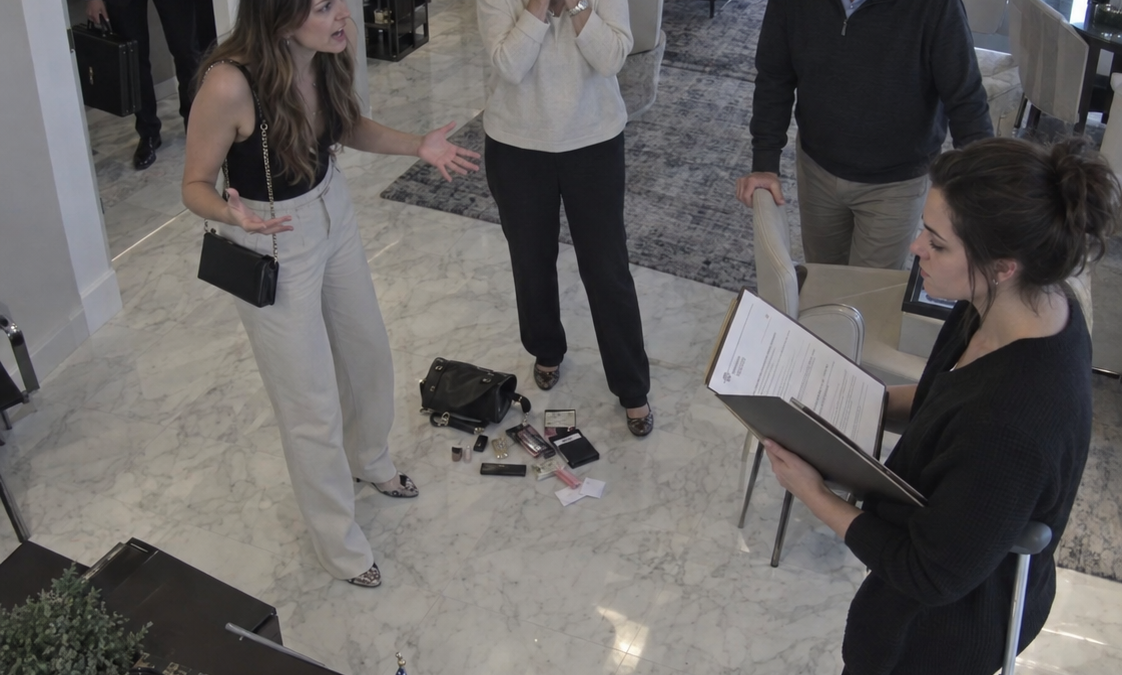
My mother screamed.
She dropped her purse onto the marble.
Its contents scattered across the floor.
Lipstick. A compact. A crumpled receipt.
They slid across a floor she’d never once imagined her own daughter owned.
And I understood instantly, with enormous satisfaction, that this was the exact sound I’d promised you at the beginning of my story.
My father gripped the back of a chair as though the floor had tilted beneath him, his knuckles turning white around the fabric.
Vita recovered first, the way she always did.
She looked around the room once, then twice, and predictably landed on the only explanation that would allow her to avoid the obvious one.
“Whose place is this?” she demanded. “Who are you dating? Is this some sugar daddy thing, Joe? Because if you’ve been hiding a rich boyfriend this whole time while we—”
“Nobody’s,” I interrupted. “It’s mine.”
I walked to the desk in the corner and picked up a folder I’d asked Flynn to leave there that morning.
Inside was the notarized deed.
I held it out at exactly the height where my mother would have to look down and read it rather than simply arguing with the air around it.
I explained that I’d purchased the penthouse myself, in cash, three years earlier.
I was the sole owner and the only person with any authority to decide who stayed there.
Which meant Vita would never be staying there under any circumstances, for any reason, Mother’s Day or otherwise.
“That’s not possible,” my mother said.
She stared at the deed as though the words might rearrange themselves into something more acceptable if she looked hard enough.
“You make… You don’t make this kind of money, Josephine.”
“I never told you what I make,” I replied. “You just assumed. Because that’s what you’ve always done with everything about me.”
Desmond Flynn stepped out of a side room at that exact moment, briefcase in hand.
I’d called him from Bria’s car during the short drive over, telling him only that my family was about to see the penthouse for the first time.
Since the warehouse eviction notice had already been drafted and sitting in his office for days, I suggested it might as well be served in person while everyone who needed to hear it was standing together in the same room.
He’d beaten us there by six minutes.
He confirmed to my parents, in the same even, professional tone he used with every client, that the penthouse had indeed been paid for in full three years earlier.
Then, almost as an afterthought, he told them the second thing.
I also owned, through a separate holding company, the warehouse and office building where Alden Commercial Climate Solutions had operated for the past three years.
Given the two months of missed rent and the publicly filed negligence lawsuit now attached to the company’s name, Flynn was there to formally serve notice of lease termination.
The termination would take effect in fourteen days.
After that, the building would be padlocked.
Vita shrieked that I’d stolen from the business.
She shouted that none of it was fair, that I’d been hoarding money the whole family could have used while they struggled to keep the company alive.
“You could have saved us this whole time!” she cried. “And you just sat there watching us drown!”
“I tried to save you for thirty-one years,” I said. “You never once let me. And the one time I actually tried to protect you from a federal crime, you broke my leg in a steel door for it.”
Bria had been standing quietly beside the window until that moment.
Now she stepped forward with a folder of her own.
Without a trace of satisfaction in her voice, she calmly informed my parents that she’d spent the previous several weeks completing a forensic audit of four years of Alden Commercial’s inventory records at my request.
She’d discovered that Vita had personally diverted more than two hundred fifty thousand dollars’ worth of copper pipe, refrigerant, and tools over that period.
The missing materials had been sold to local scrapyards through falsified work orders and rerouted deliveries that never reached an actual job site.
“I have the scrapyard receipts,” Bria said, opening her folder to a tabbed page. “They’re dated and itemized. Three of them have her signature on the pickup slip.”
Vita’s face did something I’d genuinely never seen it do before.
It was a kind of collapse that began around her eyes and slowly worked its way down.
For one unguarded second, she looked less like the woman who’d slammed a van door against my leg twice and more like a cornered teenager caught in a much smaller lie than the one actually on the table.
My father looked at Vita then in the way I imagine he must have once looked at a bad invoice, back before he’d allowed himself to stop examining anything in our family too closely.
He seemed to be seeing, all at once, something he’d spent years refusing to add up: the actual sum of every small dishonesty he’d excused because excusing it had always been easier than confronting it.
“You’ve been stealing from me,” he said quietly, almost to himself, as though it hadn’t fully occurred to him yet that he was saying the words to someone else.
As far as I know, it was the first time in his entire life my father had used that particular word to describe his golden girl.
During the six weeks I’d spent lying awake in my apartment with a leg I couldn’t move, I’d made another decision.
I wanted to say something aloud exactly once, with all three of them standing in front of me.
I told them that my liquid assets and real estate holdings currently totaled eight and a half million dollars.
I could, if I ever wanted to, write a single check that cleared every dollar of the company’s three-million-dollar debt without blinking or making a meaningful dent in anything I’d actually need for myself.
My mother’s entire face rearranged itself instantly.
Warmth. Pride. Affection.
It was the specific loving smile she produced only when she needed something from me.
The transformation happened so quickly and so completely that I almost admired the muscle memory behind it.
Thirty-one years of practice compressed into approximately two seconds.
“Baby,” she said, stepping forward, her arms already lifting. “I always knew you had it in you. We could fix all of this right now, as a family.”
I stopped her with the end of my aluminum crutch, pressing it lightly but firmly against her collarbone, close enough to her throat that she stopped moving the instant she felt it.
“Don’t,” I said. “You don’t get to call me baby in the same breath you ask me for money. Pick one.”
She blinked at me.
She looked genuinely startled, perhaps for the first time in my entire life, by something I’d said directly to her.
“I would rather set every single dollar of that money on fire in front of you,” I told her, “than give one cent of it to people who stood in a parking lot and laughed while my own sister broke my leg in a steel door twice. While you kicked my phone out of reach so I couldn’t even call for help.”
I looked straight at her.
“You didn’t even have to do anything to earn that no. You just had to not do that. And you couldn’t manage it.”
Two days before the assault, Vita had smashed our old parking lot security camera.
She’d been certain, as I later learned from Bria’s broader audit, that there was no footage of anything she’d ever done in that lot.
In fact, she’d personally disabled that camera on at least two previous occasions to conceal exactly the kind of inventory theft Bria’s investigation had uncovered.
Which meant the same habit that had always protected her in the past was ultimately the habit that caught her.
What none of them knew was that I’d quietly installed a new high-definition, night-vision-capable camera of my own two days before the attack.
I’d paid for it, like everything else, with money they didn’t know I had.
It was mounted discreetly beneath the eave of the loading dock roof.
I’d begun noticing small discrepancies in our inventory counts and wanted a quiet way to confirm my suspicions without starting a confrontation I wasn’t yet ready to have.
When I installed that camera, I had no idea it would eventually capture something so much worse than a few missing coils of copper pipe.
I’d already turned the footage over to Detective Ranata Cho, the patient, sharp-minded woman who’d taken my statement at the hospital with the same unhurried thoroughness she brought to everything else.
She’d received it the same week I filed the police report.
Cho had watched the recording twice in front of me.
The second time, she didn’t say a single word.
Afterward, in the flat, professional tone of someone who had seen a great deal and still occasionally encountered something that got through anyway, she told me it was one of the clearest pieces of evidence she’d worked with in years.
There was absolutely nothing left open to interpretation.
The footage showed everything in clean, unmistakable color, timestamped down to the second.
Vita shoving me.
The van door slamming against my leg twice.
My father standing with his arms folded the entire time, without taking a single step to intervene.
And my mother bending down to kick my phone away while she laughed, her face turned just far enough toward the camera to make her identity unmistakable.
Less than a minute later, Milo buzzed up from the lobby.
His voice was carefully neutral over the intercom as he informed me that two police officers were on their way upstairs with a felony arrest warrant for Vita.
My sister’s face went white in a way I’d never seen before.
Every trace of the composure she’d walked into my penthouse with vanished.
“Daddy,” she whispered, turning toward our father the same way she had her entire life.
Her voice had gone small and young.
Once, that voice might have moved me.
But I’d watched her use that exact tone before, begging a man not to tell his own wife a truth that hadn’t even been mine to protect.
“Fix this,” she pleaded. “You always fix this. Tell them it’s a misunderstanding. Tell them—”
My father just stood there.
He said nothing.
For the first time in my memory, he looked genuinely broken rather than merely disappointed.
He was a man who’d spent twenty-eight years building a container around every one of his daughter’s mistakes, and he’d finally run out of places to put the next one.
“Daddy,” Vita said again, louder this time.
Something close to panic was creeping into her voice.
He didn’t answer.
A minute later, two officers stepped out of the elevator.
They were polite, composed, and entirely businesslike.
They read Vita her rights while she stood frozen in the middle of my living room.
She began screaming the moment the handcuffs closed around her wrists.
She screamed that the whole thing was insane.
She screamed that I’d done this to her, that I’d always been jealous, and that this was my revenge.
She kept screaming all the way across the marble floor and into the elevator.
My mother wailed after her down the hallway and pounded once, uselessly, against the closing elevator doors.
Then the doors shut.
The sound finally stopped.
I turned to my parents and told them to leave.
Before they went, I looked my mother directly in the eyes so there would be no confusion later about what I’d said.
I reminded her that the same footage showing her kicking my phone away while she laughed could provide more than enough evidence to pursue charges against her as an accessory after the fact, should I ever decide that was a conversation worth having with the district attorney.
“I haven’t decided yet,” I told her. “That part’s still up to me. I’d think very carefully, if I were you, about how the next few months go.”
Detective Cho called me two days later to confirm Vita’s arraignment date.
Almost as an afterthought, before we ended the call, she asked whether I’d given any more thought to the question of my mother’s involvement.
I told her I hadn’t decided.
In the same unhurried, patient tone she’d used in my hospital room weeks earlier, she said she understood completely.
She explained that the case against Vita was strong enough to stand entirely on its own, regardless of what I chose to do about anyone else.
“Some people want everyone in the room punished,” she told me. “Some people just want the one who actually broke the bone to be the one who answers for it. Neither answer is wrong. I just didn’t want you to feel like the file was going to make that decision for you.”
I thought about that conversation for a long time afterward.
In the end, I never pursued anything against my mother.
It wasn’t exactly mercy.
I think I simply decided that watching her spend the rest of her life in a building with a flooding parking lot, married to a man wearing a blue vest and slowly losing the audience of relatives willing to believe her version of events, was a more complete consequence than anything a courtroom could have handed her.
It was also considerably less effort for me to carry.
Alden Commercial Climate Solutions filed for Chapter 7 liquidation within the month.
The paperwork was handled by a bankruptcy attorney my father had to pay in installments because there wasn’t enough cash left in any account to cover the retainer upfront.
The warehouse was seized and emptied within the fourteen-day window Flynn had given them.
The last of the company’s equipment was auctioned off at a fraction of its value to buyers who drove in from three counties away after word spread.
My parents’ house was already underwater on the mortgage.
My father had refinanced it twice over the years to keep the business afloat.
Eight weeks later, the bank foreclosed.
The notice was taped to the front door the same way I imagine thousands of foreclosure notices are taped to thousands of doors every year: impersonal and final.
What remained of my father’s retirement accounts went almost entirely to attorneys who, in the end, couldn’t stop any of it.
There was simply nothing left inside the company’s structure to protect once the negligence lawsuit, bankruptcy proceedings, and criminal case converged on it.
My parents moved into a two-bedroom apartment on the far side of town.
It was the kind of building with a chain-link fence around a parking lot that floods whenever it rains.
I remembered driving past places like it as a teenager and feeling a vague, unexamined pity for whoever lived there, never once imagining that one day my own parents would have an address like that.
Months later, I drove past the building myself on my way somewhere else entirely.
I stopped at the traffic light across the street and sat there longer than the light actually required.
My mother’s old sedan was parked in one of the spaces, now dented along a fender, with a puddle creeping toward its back tire.
I watched it through the windshield.
I didn’t go inside.
I didn’t call.
I simply sat through the length of one traffic light, feeling something complicated and unresolved moving through me.
Then the light changed.
I drove on.
I haven’t gone back since.
Vita was denied bail.
The judge cited the clarity of the video evidence and specifically the premeditated nature of the second door slam.
Eventually, she accepted a plea deal.
It included a heavy fine, full restitution for my medical bills, and a permanent felony conviction for aggravated assault.
That conviction will follow her for the rest of her life, appearing on background checks, job applications, and apartment lease screenings whenever she tries to build something new.
Trent filed for divorce six weeks after her arrest.
I learned about it from Bria rather than anyone in my family, none of whom had resumed speaking to me by then.
Apparently, Trent hadn’t known anything about the embezzlement, the camera, or any of it until the story was already appearing on local news.
Watching his own wife’s face on a news segment about a felony assault charge had evidently been the betrayal that finally moved him from standing beside her to standing somewhere else entirely.
I never spoke to Trent myself, either before or after everything happened.
But Nadia told me she’d run into him at a gas station months later, and he’d quietly asked whether I was doing all right.
Most days, I don’t know what to do with that information except hold on to it carefully.
It’s one small piece of evidence that someone who married into my family eventually saw the same thing I did and didn’t need a camera to believe it.
My father called me once, months later, from a number I didn’t recognize.
It was probably a prepaid phone he’d purchased specifically for the call.
He asked, in a voice I’d never heard him use with me before, whether I could spare a few thousand dollars to help with groceries during the coming winter.
His voice was small, almost apologetic, nothing like the man who used to fill an entire doorway just by standing in it.
“The heat’s already turned off twice this month,” he said. “I know I don’t have any right to ask you this. I know that. I just didn’t know who else to call.”
He paused for a long moment.
Long enough that I almost thought the connection had dropped.
Then he added quietly that he finally understood where he’d gone wrong.
He’d had a great deal of time lately, he said, to think about every choice that had led him to a two-bedroom apartment with a broken heater and a daughter who no longer answered his calls.
I allowed the silence to sit between us before I responded.
It wasn’t cruelty.
I genuinely wanted to make certain the words I said next were the ones I actually meant, rather than whatever softer version thirty-one years of training might have tried to substitute at the last second.
“Forgiveness is for people who accidentally bump into you on the street, Dad,” I told him. “It’s not for people who stand there with their arms crossed and watch while your own sister crushes your bones in a steel door, and then tell you to stop being dramatic while you’re lying on the ground.”
He said nothing.
“I hope you figure out how to stay warm this winter. I mean that. But I’m not going to be the one who makes sure of it. Not after everything. And I don’t think, if you’re being honest with yourself, that you’d even have the right to ask me to be.”
He didn’t say anything else.
I changed my phone number that same afternoon.
I haven’t heard from him since.
I understand that, from the outside, this might sound colder than I actually feel about it most days.
Most days, it doesn’t feel like cruelty at all.
It feels like the first door I ever got to close on my own terms, in my own time, at precisely the moment I decided it should close.
Six months after the parking lot, I can walk across Apex’s logistics floor without a single crutch.
My gait is almost entirely back to normal, apart from a faint hitch my physical therapist says may simply be permanent.
It’s a small tax the steel door left behind, one I’ve mostly stopped noticing.
I’ve just been promoted to regional vice president of operations after saving the company nearly ten million dollars in a single quarter by discovering a systemic billing failure that three separate regions had overlooked for more than a year.
It was the kind of discovery Grady once again told the full board he wanted everyone to know my name for.
He took me to lunch the week the promotion was finalized, somewhere nicer than either of us would normally bother expensing.
Without any particular ceremony, he told me he’d recognized what I was capable of during our first interview.
He’d simply been waiting ever since for the rest of the company to catch up with what he already knew.
“Some people spend their whole careers being underestimated by exactly the people who should know better,” he said. “I try not to be one of them twice in a row.”
I didn’t tell him how closely that sentence landed against the center of my entire life.
But I think, from the way he allowed the silence afterward to remain unfilled, he already understood that it had.
Patricia Wyn called me directly a few months after the Merit Health disaster.
She’d apparently gotten my number through someone at Apex who knew someone who knew her.
She told me she’d followed the lawsuit and bankruptcy filings closely, partly out of professional obligation and partly, she admitted, out of simple curiosity.
She couldn’t understand how a contractor that had been so careful under my management could fail so completely the moment I was gone.
“I want you to know I never once doubted that the person I negotiated that contract with wasn’t the person who lost it,” she told me.
It was a small thing.
One telephone call that changed nothing material about my life.
But after we hung up, I sat at my desk for a while, turning her words over in my mind.
It was the first time since the parking lot that someone from my former professional life had examined the wreckage and assigned the blame correctly on the first attempt, without my having to produce a single piece of evidence to convince them.
My real estate holdings have continued quietly growing.
Two more properties closed this year alone, purchased through the same ownership structures Lucius taught me about in a diner booth more than a decade ago.
His legal pad still sits in my desk drawer, where I can see it whenever I open it.
I still eat breakfast at a diner most Saturdays.
It’s a different diner now, but without consciously deciding to, I always order the same thing.
Two eggs over medium. Dry wheat toast. Black coffee.
I read the local section of the newspaper first.
And I think more often than I probably should admit aloud about how strange it is that the steadiest, most honest education I ever received about money, patience, and seeing things clearly came from a stranger in a corner booth rather than either of the two people who were legally responsible for raising me.
Vita works nights now, cleaning rooms at a cheap roadside motel off the interstate.
With a felony conviction on her record, she hasn’t been able to get hired anywhere that runs a background check.
She’s paying down her restitution one paycheck at a time.
I learned about the job secondhand from Nadia, who still checks in with me occasionally and whom, for reasons I haven’t fully examined, I still haven’t asked to stop.
Sometimes I think about Vita stripping sheets from a stranger’s bed at two in the morning, during the same hours she used to spend curating photographs of herself standing in front of machinery she’d never touched.
And when I examine what I feel about that image, I realize it isn’t triumph.
Not really.
It’s something closer to the exhausted relief of finally setting down a weight I’ve carried for so long that I stopped recognizing it as weight at all.
Then, once it’s gone, discovering how much lighter and how much sadder empty hands can feel at the exact same time.
My father wears a blue vest now and greets customers at the entrance of a hardware store three towns over.
Nadia told me he took the job because it was the only place that called him back after the bankruptcy made the local news.
My mother, from what I understand, still calls distant relatives to tell her version of what happened to us.
I imagine her account involves an ungrateful daughter, a greedy lawsuit, and considerably fewer details about steel doors.
More and more often, apparently, she discovers nobody believes her anymore.
The police report and bankruptcy filings are public records now, searchable by anyone willing to look.
No amount of practiced crying can talk its way around documents that are available for anyone to read.
Most days, I think my greatest victory in all of this was never the penthouse, the eviction, or the handcuffs closing around Vita’s wrists.
It was something much simpler.
And it took me considerably longer to understand than it probably should have.
My greatest victory was permanently revoking my family’s access to my life and allowing them, finally, to carry the full weight of their own incompetence instead of continuing to carry it for them the way I’d done for thirty-one years.
One three-night rescue and one wired check at a time.
People who have never been forced to pay for their own choices will never stop making the same ones.
Why would they?
When somebody competent and exhausted always eventually arrives to absorb the cost on their behalf, there’s no reason for them to change.
The only thing that ever actually changes that arrangement is someone finally stepping out of the way and allowing the bill to come due in full, with nobody standing between the person who created the mess and the true size of it.
A few months after everything happened, I looked up Mr. Oay.
I found him still teaching at the same high school, now gray around the temples and apparently still running the robotics club on Thursday afternoons.
I sent him a long email.
I rewrote it four times before finally allowing myself to press send.
I told him some of what had happened and thanked him for a sentence he’d probably said to a hundred other students without thinking about it again afterward.
He wrote back two lines.
“I always knew you’d eventually stop waiting for somebody else’s permission. I just didn’t know it would take this long or cost you this much.
“Proud of you regardless.”
I printed his email and placed it in the same desk drawer as Lucius’s legal pad.
I recognize now, describing it to you, that the drawer is becoming something like its own small museum.
Except this is a museum I’ve built deliberately.
Every single thing inside it is something I actually chose to keep.
I think about Mr. Oay sometimes, my old physics teacher, and what he told me the day I brought him that finished robotic arm.
Most people want permission before they’ll trust their own eyes.
I spent thirty-one years wanting that same permission from precisely the three people least equipped to give it to me honestly.
And I think the actual turning point in this entire story, more than the parking lot or the penthouse, was the quiet, unglamorous morning when I finally stopped waiting for it.
I simply started building the life in front of me instead.
Exactly the way I’d built that robotic arm all those years earlier, testing it myself before asking anyone else whether it was any good.
I still have nightmares sometimes about the sound the van door made.
That dry, particular snap has a way of returning to me, unwanted, in the most ordinary places.
A car door closing a little too hard in a parking garage.
A kitchen cabinet slammed shut by someone who doesn’t realize how loud it was.
I still grieve, in a quiet and unresolved way I don’t expect to ever fully resolve, for the family I never actually had.
Not the family I lived with.
The family I spent thirty-one years telling myself I had.
The one where a trophy stays on the mantel and a sister sends a postcard that doesn’t read like a taunt.
Some nights, that grief feels almost indistinguishable from relief.
I understand intellectually that it doesn’t make much sense.
I’ve stopped trying to make sense of it.
A few relatives who still speak to me, mostly cousins who initially heard some filtered version of events through my mother before the public records made the filtering pointless, have told me I was too harsh.
They think I should have shown a little mercy.
Maybe helped my parents find a small rental somewhere instead of allowing all three of them to land exactly where they landed.
One of them, an aunt I hadn’t spoken to in years, actually used the word unforgivable to describe me in a message I read once and never answered.
Even in that moment, I noticed it was a word nobody in my family had ever applied to anything Vita did to me, no matter how many times she did it.
I don’t know whether they’re right.
I’ve asked myself that same question more nights than I’d like to admit, usually around three in the morning, the same hour the phone rang on the night everything finally broke.
All I know is what I watched three people do to me in an empty parking lot while they laughed.
And I know now, with a clarity I wish I’d possessed a decade earlier, exactly what it cost me every single time before that night when I chose mercy instead of consequences.
A trophy.
A scholarship.
A solo trip through Europe I never took.
A birthday without a cake.
A leg that still aches faintly before it rains.
Bria asked me once, not long after everything had settled into whatever this is now, whether I’d do any of it differently if I could go back.
She didn’t mean the parking lot itself.
None of us could have stopped what happened once Vita’s hand was already on that steel door.
She meant everything before it.
The twelve thousand dollars.
The three sleepless nights.
The thirty-one years of simply absorbing whatever landed on me because absorbing it had always been easier than naming it aloud.
I told her the only thing I’d actually change, if I could do it again, was the year.
Not which choices I made, but how long I waited to make the one that mattered.
How many birthdays, postcards, and silent weeks I’d allowed to pass before I finally understood that loving people who refused to see me clearly wasn’t virtue.
It was simply a slower, quieter version of the exact same door closing on the exact same leg, over and over, until something inside me either broke completely or finally learned to step back out of the way.
I’ll let you decide for yourself which one of those outcomes my family actually earned.
I made my own decision a long time ago, somewhere on that asphalt, with a dog barking at nothing in the distance and three sets of taillights disappearing around a fence line.
And I haven’t found a single reason since to reconsider it.








