At the christening of our new boat, my son grabbed the mic and laughed in front of 200 guests: “my father-in-law paid for everything — including this champagne. my own father couldn’t spare a single penny.” i smiled and walked out. the next morning, i dissolved the company i spent 40 years building for him, called my lawyer — and woke up to 41 missed calls
Two hundred people packed the Clinton Street dock that afternoon. I stood in the middle of them, waiting for my son to pick up the microphone and say his mother’s name. I thought that moment was going to be the best thing I had left after Teresa died.
For forty years, every boat I ever owned had carried the name of a woman in this family. My father did it before me, and I never once thought there would be a reason to break that tradition. The new tug was no different. In my head, it had been named a long time ago. Teresa. My wife’s name.
But that wasn’t what Nolan said.
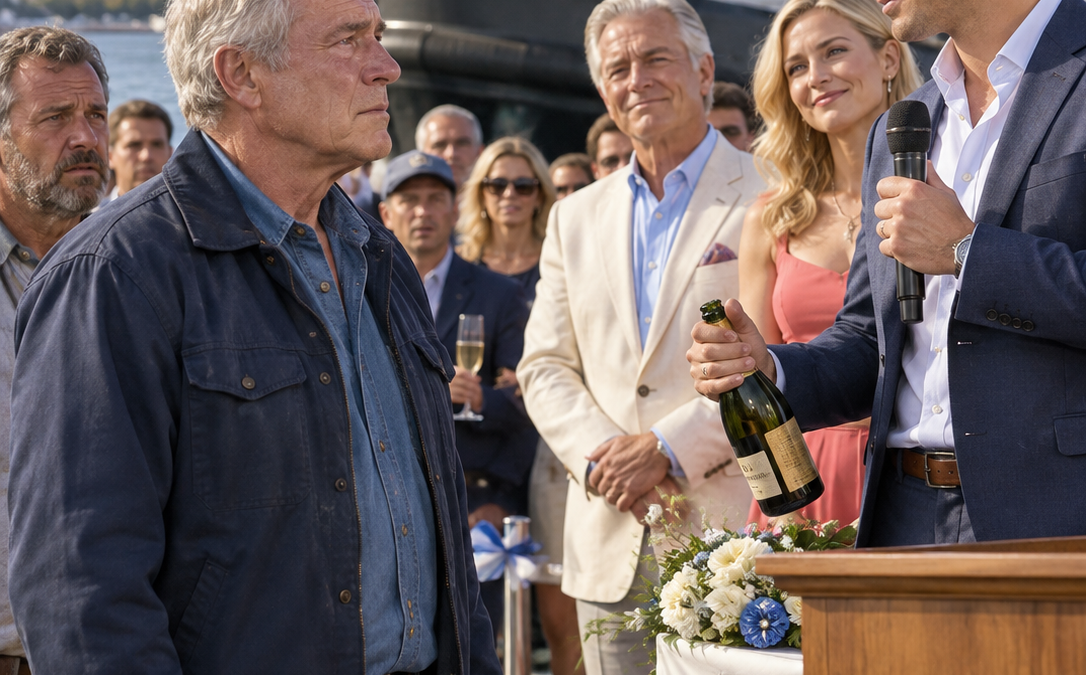
He raised the champagne bottle, looked out at the crowd, and smiled. “I’m very proud to name this vessel the Delicort.”
The cloth came down off the bow. The name was right there in bright gold letters. People started clapping. Nolan waited for the applause to die down, and then he kept going in that easy, joking voice of his.
“And of course, I’ve got to thank Wit, my future father-in-law. Without him, we wouldn’t have this boat today. He was generous enough to cover the champagne, too.”
Then he looked over at me.
“As for my dad, he probably wouldn’t have been too happy about paying for that bottle.”
The crowd laughed.
I didn’t argue. I walked straight to my truck, drove off that dock, and left the laughter behind me.
And by Tuesday morning, the company he was supposed to inherit was no longer going to be his.
My name is Ray Klowski. I’m sixty-four years old. I grew up in Highlandtown in Baltimore, three blocks off Eastern Avenue, in a row house with formstone on the front. My father was very proud of that formstone. I thought it was the ugliest thing God ever allowed.
I ran a marine construction outfit called Kestrel Marine Services. Pile driving, bulkhead and dock repair, small dredging, salvage. If you’ve walked out on a pier anywhere between the Key Bridge and the Susquehanna Flats in the last thirty years, there’s a decent chance my crew drove the timbers under your feet.
I started the company in 1984 with a borrowed barge, a Chevy with a bad clutch, and a wife named Teresa who did the invoices at the kitchen table with a baby monitor sitting next to the adding machine.
Forty-one employees at the end. Three boats, and a fourth on the way. Which is where this story starts and ends.
My boats were the Alma Kay, named for my mother; the Bernice, named for Teresa’s mother; and the Teresa K, a 1978 hull I’ve rebuilt twice and which I intend to be buried with if the state allows it.
That’s a real tradition in the harbor. Everybody in that world knows what a boat’s name means. It’s the only kind of monument working people build.
Teresa died on June 11, 2019. Brain aneurysm. She was fifty-nine.
There was no warning of any kind. No diagnosis, no decline, no goodbyes in a hospital bed. She was standing at the counter making coffee when she said, “We’re out of the good filters.”
And I said, “I’ll pick some up.”
About ninety seconds later, I heard the mug break.
That was it. Those were the last words between us after thirty-four years of marriage.
We’re out of the good filters.
People assume the slow deaths are worse. I’ve buried friends both ways, and I’m still not sure. What I know is that when you get the fast one, you spend the rest of your life having an argument in your head with somebody who isn’t there anymore, and you always lose it.
Nolan was thirty-one when his mother died. He’d been working for me since he was twenty-three, on the operations side of the business. And I want to say something true here.
For about eighteen months after the funeral, my son was good to me.
He came on Sundays. He ate at my table. We sat in the yard and didn’t say much. Some Sundays, he’d fall asleep in the chair with a beer going warm in his hand, and I’d sit there looking at him, thinking he was the only piece of her left on this earth.
I need that on the record before I tell you the rest.
Then, in the fall of 2021, he met Sloan Delicort.
Her father was Wit Delicort, sixty-eight years old, owner of Delicort Waterfront Group. Marinas, mixed-use waterfront redevelopment, condominiums where warehouses used to be. Big man, big voice. He filled a room the way water fills a bilge.
The first time I met him, at a dinner at their place out in the county, he shook my hand and said, “Ray Klowski, I’ve heard so much about your little pile-driving outfit.”
Little.
That word sat in the air the whole night like a fly you couldn’t get out of the truck.
And here’s what took me two years to admit. Wit Delicort wasn’t running a con on my son in the beginning.
Wit had three daughters and no sons. He’d wanted a son his whole life. He told me so himself that night, half a bottle in, in a voice that was almost human.
So when Nolan showed up, thirty-one, smart, motherless, and starving for something, Wit got the son he’d been missing for forty years.
And Nolan got something, too. Something I have to say out loud.
Wit answered his phone at nine o’clock on a Saturday night. First ring, every time. He took my son sailing on a Wednesday afternoon in the middle of a workweek because the wind was good. He asked Nolan about the books he was reading. Once, he sat with him for three hours on a dock, arguing about a movie.
I never did any of that.
Not once in thirty-five years.
I’m going to come back to that, because it’s the whole thing.
The Sunday visits started thinning out in early 2022. First one a month disappeared, then two, then three. Always by text. Always short.
“Can’t make it. Delicorts have a thing. Rain check, Dad?”
A thumbs-up.
And I always answered the same way.
“No problem, son. Whenever you can.”
You want to know what I actually did on those Sundays?
I cooked anyway.
Teresa’s pot roast, the one with the beer in it. I’d make the whole thing for a table of three, then eat standing at the counter. The rest went into the freezer.
By that August, I had eleven containers of my dead wife’s pot roast stacked in a chest freezer in the basement.
I never threw a single one out.
I want you to understand how insane that is. I was freezing evidence.
If you’ve ever kept doing something for somebody who stopped showing up, you know it isn’t hope. It’s more like a machine you don’t know how to switch off.
Now, let me go back, because you can’t understand what happened on that pier without this.
Nolan started working on the boats at sixteen, spending his summers as a deckhand. He came on full-time at twenty-three.
And I was harder on that boy than I was on any man who ever worked for me.
I did it on purpose. I had a whole philosophy about it. I told myself that if I went easy on my own son, the crew would smell nepotism, he’d never have their respect, and I’d be doing him no favors in the long run.
So I corrected him in front of people for twenty years.
A wrong bight in a line, in front of five men. A bad read on a tide, in front of the whole barge crew.
Once, standing on a bulkhead in Fells Point, I told him he could have gotten somebody killed. Four other guys stood there pretending to look at their boots.
He was twenty-four. He’d been awake for nineteen hours.
He never argued back. Not once. He’d turn red from the collar up, say, “Yes, sir,” and go fix whatever I’d told him to fix.
And I would drive home feeling like a good father.
Milt Ferris was sixty-six years old and had spent thirty-one years on my crew. Best man I’ve ever had on a hammer.
One time, Milt told me quietly in the wheelhouse, “Ray, you know he’s not going to hear the good stuff if you only ever say the bad stuff in front of everybody.”
And I said something like, “He’ll be fine. He’ll be fine.”
That was my whole parenting philosophy in three words.
He’ll be fine.
Because I’d made sure he’d never be broke.
In early 2023, Nolan started bringing Wit around the yard. They’d walk the property together.
Wit asked good questions.
Too good.
“What’s your utilization on the crane barge? What’s the term on your lease with the port? Who holds your bonding?”
Those weren’t sightseeing questions. Those were due-diligence questions. I’d been on the other side of enough acquisitions to know the difference.
And my son answered every one of them enthusiastically, like a kid showing his report card.
In January 2024, I found a folder on the copier in the office.
It wasn’t hidden. It was sitting on the copier because Nolan had printed it and gotten distracted, which is the most thirty-five-year-old thing that has ever happened.
Twenty-two pages.
Delicort Waterfront Group.
Kestrel Integration Framework.
The structure was simple. Wit’s group would acquire Kestrel. My Clinton Street yard, waterfront property with deep-draft access and forty feet of bulkhead, would be redeveloped.
Because that’s what my company actually was to them.
It was never a marine contractor.
It was a parcel.
The crew would be “rationalized.”
That was the word in the document.
Forty-one people. Rationalized.
And Nolan would become vice president of marine operations, which was a title and a salary, with no equity and no vote.
There was an email chain printed at the back.
Wit had written, “Your father is a builder, not a strategist. He’ll be relieved once it’s done.”
And my son had written back, “Agreed. Let me handle the timing. He trusts me.”
He trusts me.
I sat in my own office with the door shut and read those words seven or eight times.
And I want to be honest with you about what I felt, because it wasn’t rage.
It was embarrassment.
The same feeling I’d had when Wit called my company little. That old formstone-row-house feeling, the one I’d been trying to outrun since 1971. The feeling that everybody else could see something about you that you couldn’t see about yourself.
I put the folder back on the copier, face down, exactly as I’d found it.
And I said nothing for eight weeks.
That was March.
The christening was May 12.
The new boat was a seventy-eight-foot push tug built in Louisiana, and Wit’s group had financed it. That was the deal Nolan brought me in December. Delicort put up the capital. Kestrel operated the vessel.
I signed off on it.
I thought it was my boy finally bringing something home.
And in my head, though I never said this out loud to another living soul, that boat was going to be the Teresa K II.
I had it all worked out. The old Teresa K would move to lighter work, and the new one would carry her name forward. I’d stand on that pier and hear my wife’s name come out of my son’s mouth in front of two hundred people, five years after she died at the kitchen counter over coffee filters.
I want to slow way down now, because this next part took about six minutes, and I’ve lived inside those six minutes for two years.
Clinton Street. May 12. Four o’clock in the afternoon.
It was warm, with that yellow-gray Baltimore light that comes off the water in spring. There were two hundred people there, easily. The whole crew and their families. Port Authority people. Two harbor pilots I’d known since the eighties. Three guys from the union hall.
Wit’s people stood together in linen clothes, clustered nearer the podium than anybody else. The way money always ends up closer to the front without anybody arranging it.
Milt Ferris was standing next to me with his wife, Dorene. He had on a shirt with a collar, which, for Milt, was a tuxedo.
The tug was beautiful. Black hull, white house, fresh paint. The name on the bow was covered with a canvas sleeve, the way it’s done until the bottle goes.
Nolan stepped onto the little platform. He had on a jacket I hadn’t seen before.
He thanked everybody. He thanked the yard in Houma. He thanked Wit.
He thanked Wit first, actually, and spoke about him for forty seconds. He used the phrase “the vision to see what this company could be.”
And I stood there in the third row with my hands in my pockets and did the stupidest thing a man my age can do.
I got ready.
I actually adjusted my feet. Set myself the way you do before somebody says your wife’s name in public and you have to hold your face together.
Then Nolan said, “It gives me tremendous pride to christen this vessel the Delicort.”
They pulled the sleeve away.
And there it was in gold leaf.
Nine letters that had nothing to do with anybody I’d ever loved.
The clapping started.
It was real clapping. Most of those people didn’t know. They just saw a nice boat and a young man in a jacket.
But I’ll tell you who did know.
Milt Ferris went absolutely still beside me.
And the two harbor pilots, two men in their seventies who’d known me since I was a kid driving a Chevy with a bad clutch, both turned their heads and looked at me.
Not at the boat.
At me.
That’s the thing about a working harbor. It’s the last place in America where names still mean something.
Every man on that pier over fifty understood exactly what had just been done. And every one of them understood it in front of the others.
Then, because he was up there and things were going well and the crowd was warm, my son went one step further.
“And I want to thank Wit for the bill on this, because”—he grinned—”my old man wouldn’t have sprung for the champagne.”
The laugh was big.
That’s what I remember most.
It was a big, easy, genuine laugh from two hundred people on a beautiful afternoon.
Wit put his hand over his heart and shook his head as if to say, “Oh, stop.”
Sloan laughed with her hand up near her mouth.
And I stood there feeling my face get hot from the jaw up, exactly the way Nolan’s used to when I humiliated him on a bulkhead in front of five men.
That’s the part I didn’t understand until months later.
He wasn’t inventing something cruel that afternoon.
He was doing it the way it had been done to him.
For a few seconds, I couldn’t make my legs work.
And I want to be honest. There was a version of me that wanted to walk up onto that platform and say something.
I could have.
I had twenty-two pages in a folder at the office and a crowd full of men who would have backed me.
I didn’t.
I clapped.
I made my hands come together maybe six times.
Then I walked back along the pier, past people I’d employed for twenty years.
One of them, a young welder named Christina, touched my arm as I passed.
“Mr. K.”
“It’s a good boat,” I told her.
And I kept walking.
I got into my truck, drove out Boston Street, and got on I-95 heading north with no destination in mind.
Somewhere past the tunnel, I had to pull over.
I sat on the shoulder with the hazard lights flashing and cried harder than I had at Teresa’s funeral.
I mean that literally.
At the funeral, I’d had things to do.
This time, there was nothing to do.
And what I kept saying out loud in the cab of that truck, sitting on the side of an interstate, was, “She’s not on anything anymore.”
Because that’s what it was.
Not the money.
Not the company.
My wife’s name had been available, and my son had given it to somebody else’s family.
If you’ve ever had somebody take the one thing you had left of a person, I’m not going to pretend I have wisdom about that.
I just want you to know that a sixty-four-year-old man cried on the shoulder of I-95 for about half an hour, then blew his nose on a shop rag and drove home.
That’s all.
I called Moren Doyle at nine the next morning, Monday.
Moren was a lawyer downtown who specialized in employee ownership and employee stock ownership plans, ESOPs. I’d met her twice at Port Authority functions and thought, Huh. Someday.
“Moren,” I said, “how fast can you sell a company to the people who work in it?”
“That’s a strange way to phrase a Monday,” she said.
“I’ve got 211 days of patience left, and I’d like to spend about thirty of them.”
We closed on June 19.
Five weeks.
Here’s what we did, and it matters because everybody assumes I sold the company to some corporation, cashed a check, and ran.
I sold one hundred percent of Kestrel Marine Services to an employee stock ownership trust.
Four point two million dollars.
Seller-financed.
That means the company pays me out over twelve years at six percent interest, using money it earns. Which means my retirement now depends entirely on forty-one people I spent forty years yelling at doing a good job without me.
I’ve thought a lot about why I did it that way.
Some of it was clean.
Milt Ferris had spent thirty-one years on my crew and had a retirement account with eleven thousand dollars in it.
But some of it wasn’t clean at all.
An ESOP trust is one of the hardest things in American business to acquire.
Wit Delicort couldn’t simply buy that yard from forty-one owners and a trustee, no matter what he offered.
I’d built a wall out of my own workforce.
I’d like to say I only thought of the first reason.
I’d be lying.
Nolan found out on a Wednesday.
He was out on the water when the papers closed. He came into the yard at four o’clock that afternoon and found people he didn’t recognize sitting in the conference room.
He called me forty-one times over the next two days.
I’ve never counted anything so carefully in my life.
Forty-one calls.
Forty-one employees.
I noticed that, and it made me feel something I still don’t have a word for.
A week later, I listened to all the voicemails at once, sitting in my truck.
The first ones were confused.
The middle ones were angry.
Around message twenty-six, his voice changed, and he started saying he was sorry over and over.
Around message thirty-four, he stopped talking about the company entirely.
He just kept saying, “Dad, pick up. Dad, pick up.”
I didn’t pick up.
Wit dropped him within the month.
I got that part secondhand from Dorene Ferris, who hears everything.
Apparently, Wit told people the boy couldn’t manage his own father.
And that was the whole of his eulogy for two and a half years of Wednesdays, sailing trips, and phone calls answered on the first ring.
The engagement to Sloan ended in September.
I moved out of Highlandtown in July.
Not to California. Not anywhere dramatic.
I went ninety-one miles down to the Eastern Shore, to a village called Winona on Deal Island, where there are more workboats than cars and the sunset over the marsh takes about an hour.
I bought a small place on a creek for twenty-six thousand dollars, and I brought the Teresa K down with me. I put her in a slip forty feet from my back door, because the one thing I hadn’t sold was that boat.
For about four months, I wasn’t okay.
I want to be honest about that, too, because these stories always jump straight to the peaceful ending. I slept maybe five hours a night. I drank more than a man my age should. I’d sit on that boat with the engine off and talk to my wife out loud like a lunatic.
And the thing I kept telling her, over and over, was, “I did the right thing.”
Which is what you say when you’re not sure.
In November, I met Odessa Marsh. Everybody calls her Des.
She was sixty-one, a retired oyster hatchery biologist who ran the little community sailing program out of the old firehouse. She taught nine kids every summer how to rig a boat.
We’re not a love story. I know that’s what you want, and I’m sorry.
We’re something quieter than that. I don’t have a good word for it, and neither does she, and we’ve agreed not to look for one.
But in February, she said the thing that broke this whole story open for me.
We were sitting on the Teresa K, tied up and drinking coffee, when I told her the whole thing for the first time. The pier, the name, the forty-one calls. Everything.
Des listened all the way through without interrupting.
Then she looked at me and said, “Ray, when did you and that boy ever spend a day together when nobody was working?”
I started to answer, and I couldn’t.
I sat there with a coffee cup in my hand and went back through thirty-five years, looking for one day. One single day with my son when there wasn’t a job to do, a tide to make, a crew waiting, or an invoice that needed attention.
There was a Cubs game at Camden Yards in 1998. Nolan was nine.
There was that.
And there were a couple of Christmas mornings before eight o’clock, when I had to leave because of a bulkhead failure in Locust Point.
That’s what I came up with in thirty-five years.
And Des said, without any cruelty in her voice, “So a man came along who had Wednesdays.”
She said it gently.
Which somehow made it worse.
Now, here’s the lesson, and it’s not the one I went down there expecting to find.
Everybody wants this to be a story about a greedy son, a rich manipulator, and a father who finally stood up for himself.
That’s a clean story.
I’ve told it that way in a bar and gotten free drinks for it.
But it isn’t true.
Here’s what’s true.
My son didn’t get bought.
He got fed.
Wit Delicort is a worse man than I am. I’ll say that in front of anybody. But Wit Delicort was available.
And I wasn’t.
Not for three and a half decades.
A hungry person will take a bad meal over no meal every single time.
I gave my son every single thing I’d never had. Private school, a car at seventeen, a career handed to him. Never once did that boy have to wonder whether the lights would stay on.
And I’m proud of that.
I’d do it again.
But I never gave him the one thing I actually had.
Me.
An afternoon. My attention, with nothing else running in the background.
I worked sixteen-hour days for forty years, and I called it love.
And I want to be careful here, because it was love.
It was absolutely love.
But I let it be the only love.
And a thing that is a real gift can still be the wrong gift when it’s given nine thousand times in a row.
Then there’s the other half.
The half I still choke on.
I corrected that boy in front of other men for twenty years and told myself it was character-building. Then I stood on a pier and got corrected in front of two hundred people, and it nearly killed me.
I taught him that.
Not the greed. The greed he found on his own.
But the method.
The idea that you handle a man publicly so the room learns something.
He got that from me, standing on a bulkhead in Fells Point when he was twenty-four and had been awake for nineteen hours.
Children don’t do what you tell them.
They do what you did to them.
So here’s the last piece.
Nolan came down to Deal Island in April, a year after the christening.
He found me through Milt.
He’d lost about twenty pounds and was driving a car with a hundred and forty thousand miles on it.
He stood on my dock and didn’t come aboard until I told him he could.
He apologized for a long time.
And it was real.
I could tell it was real because he didn’t ask for anything at the end of it, which is the only way you can ever tell.
And I didn’t do the thing you’re supposed to do in these stories.
I didn’t hug him and cry and say, “All is forgiven.”
But I also didn’t do the other thing.
I didn’t tell him never to call me again, shut the door, and walk into a beautiful sunset feeling strong.
Because I’d tried that for a year.
And I’m here to tell you that peace you get by amputation isn’t peace.
It’s just quiet.
There’s a difference, and you’ll find out which one you’ve got somewhere around three o’clock in the morning.
What I said was, “You can come the first Saturday of the month. We’ll work on the boat. There’s no job on, and nobody’s paying anybody.”
He’s come eleven times now.
We mostly don’t talk.
He sands, and I paint.
Last month, he asked me a question about how I met his mother. I answered it, and it took forty minutes.
Forty minutes.
It was the longest I’d ever spoken to my son about anything that wasn’t a tide chart.
We’re not fixed.
I don’t know that we ever get fixed.
But we’re in the same boat, with the engine off.
And after everything I’ve told you tonight, I’ll take it.
So here’s what I’d ask you to do today.
Not this month.
Today.
Take forty minutes and give them to somebody you’ve been giving things to.
Your kid. Your parent. Your husband. Whoever’s been getting money and rides and problems solved instead of your face.
Forty minutes.
Put your phone in another room, face down. Not in your pocket.
No task. No errand. Nothing being accomplished.
Just sit with them.
You’ll find out in about eleven minutes whether you know how.
I didn’t.
It took me a year on a creek and a woman with a coffee cup to learn it.
And my son was thirty-six by the time I managed it once.
Here’s the question I want you to sit with tonight. It took me sixty-four years and a boat with the wrong name on it to ask it.
If the people I love only had my attention—none of my money, none of my fixing, none of my providing—would they still feel loved?
You felt something just then.
So did I.
Sit with it for a minute.
That’s where the work is.
Now, before I go, I’d like to hear from you. And I read these comments, especially the ones from people who think I got it wrong.
Comment one if you think I was right to sell the company out from under Nolan. A man who plans your retirement behind your back has told you who he is, and forty-one working people ended up owning a company.
Comment two if you think I should have put that folder on his desk in March and had it out with him face-to-face instead of letting him walk onto that pier. Because I knew what was happening, and I let it happen.
Comment three if you think the real damage was done twenty years earlier, on a bulkhead in front of five men, by me.
Milt Ferris says three.
Milt’s been right about everything since 1994, and it’s exhausting.
And tell me where you’re watching from and what time it is where you are.
It’s five past midnight here on Deal Island. Dead calm, and you can hear the halyards on the workboats from my back step, which is the best sound there is.
And if you’ve ever been the person a room laughed at—or, and I mean this one more, if you’ve ever been the person who got the laugh and only understood later what it cost—tell me in the comments.
Two lines is plenty.
Somebody’s going to scroll past this tonight, sitting exactly where I sat on the shoulder of that highway.
And what you write will get to them faster than anything I’ve said.
If any of this sounded like your life, stay with me and subscribe. I’ve got more of these real feelings wearing new names, and I’d like you here for the next one.
Thank you for sitting up past midnight with an old pile driver and his regrets.
It means more than you know.
This is a fictional story inspired by real emotional experiences, fully rewritten and reimagined in Baltimore to create original content. Any resemblance to real people or events is coincidental.








