At the christening of our new boat, my son grabbed the mic and laughed in front of 200 guests: “my father-in-law paid for everything — including this champagne. my own father couldn’t spare a single penny.” i smiled and walked out. the next morning, i dissolved the company i spent 40 years building for him, called my lawyer — and woke up to 41 missed calls.
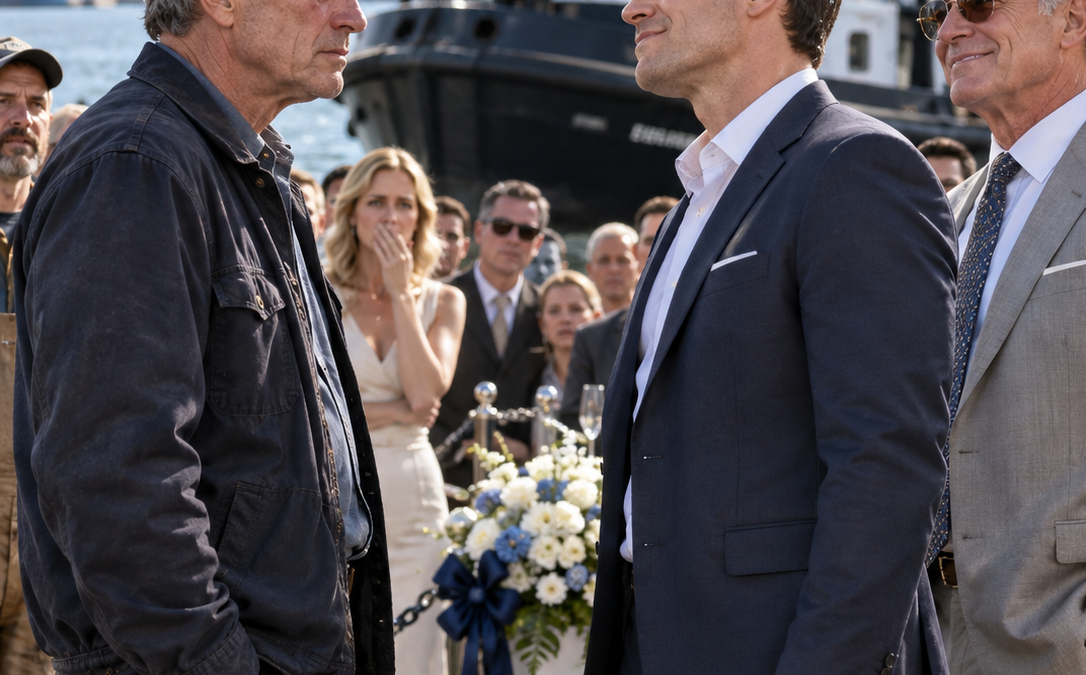
Two hundred people packed the Clinton Street dock that afternoon. I stood among them, waiting for my son to pick up the microphone and say his mother’s name. I thought that moment would be the best thing I had left after Teresa died. For forty years, every boat I ever owned had carried the name of a woman in our family. My father had done it before me, and I had never once imagined there would be a reason to break that tradition. The new tug was supposed to be no different. In my mind, it had been named long before anyone gathered on that pier. Teresa. My wife’s name.
But that wasn’t what Nolan said.
He raised the champagne bottle, looked out over the crowd, and smiled. “I’m very proud to name this vessel the Delicort.” The canvas came down from the bow, revealing the name in bright gold letters. People began applauding. Nolan waited for the clapping to settle, then continued in that easy, joking voice of his.
“And of course, I’ve got to thank Wit, my future father-in-law. Without him, we wouldn’t have this boat today. He was generous enough to cover the champagne, too.” Then he looked directly at me. “As for my dad, he probably wouldn’t have been too happy about paying for that bottle.”
The crowd laughed.
I didn’t argue. I walked straight to my truck, drove off that dock, and left the laughter behind me. By Tuesday morning, the company my son was supposed to inherit no longer existed under his name.
My name is Ray Klowski. I’m sixty-four years old. I grew up in Highlandtown, Baltimore, three blocks off Eastern Avenue, in a row house with formstone on the front. My father was enormously proud of that formstone. I thought it was the ugliest thing God had ever allowed a man to put on a building.
I ran a marine construction outfit called Kestrel Marine Services. Pile driving, bulkhead and dock repairs, small dredging jobs, salvage work. If you’ve walked out onto a pier anywhere between the Key Bridge and the Susquehanna Flats in the last thirty years, there’s a decent chance my crew drove the timbers beneath your feet. I started the company in 1984 with a borrowed barge, a Chevy with a bad clutch, and a wife named Teresa who handled the invoices at our kitchen table with a baby monitor sitting beside the adding machine.
By the end, we had forty-one employees, three boats, and a fourth on the way. That fourth boat is where this story begins and, in a way, where it ends.
The boats I already owned were the Alma Kay, named for my mother; the Bernice, named for Teresa’s mother; and the Teresa K., a 1978 hull I’d rebuilt twice and intended to be buried with, assuming the state would allow it. That naming tradition is a real thing in the harbor. Everybody in that world understands what a boat’s name means. For working people like us, it’s sometimes the only kind of monument we ever build.
Teresa died on June 11, 2019. A brain aneurysm. She was fifty-nine years old.
There was no warning. No diagnosis, no gradual decline, no hospital bed where we got to hold hands and say the things people are supposed to say at the end. She was standing at the kitchen counter making coffee when she told me, “We’re out of the good filters.”
“I’ll pick some up,” I said.
About ninety seconds later, I heard the mug break.
That was it. Those were the last words we exchanged after thirty-four years of marriage. We’re out of the good filters.
People sometimes assume a slow death is worse. I’ve buried friends both ways, and I’m still not sure. What I know is that when you lose somebody that quickly, you spend the rest of your life having arguments in your head with a person who isn’t there anymore. And somehow, you always lose.
Nolan was thirty-one when his mother died. He’d been working for me since he was twenty-three, mostly on the operations side of the business. Before I go any further, I want to say something about my son that I know is true, because it matters to everything that happened afterward.
For about eighteen months after the funeral, Nolan was good to me. He came over on Sundays. He ate at my table. We sat together in the backyard, sometimes for hours, without saying much of anything. Every once in a while, he would fall asleep in the chair with a beer growing warm in his hand, and I would sit there looking at him, thinking that he was the only piece of Teresa I had left on this earth.
I need that understood before I tell you the rest.
In the fall of 2021, Nolan met Sloan Delicort.
Her father was Wit Delicort, sixty-eight years old, the man behind Delicort Waterfront Group. Marinas, mixed-use waterfront developments, condominiums built where warehouses used to stand. He was a big man with a big voice, the kind of person who filled a room the way water filled a bilge.
The first time I met him was at a dinner at their place out in the county. He took my hand, gave it a firm shake, and said, “Ray Klowski, I’ve heard so much about your little pile-driving outfit.”
Little.
That word hung in the air all evening like a fly you couldn’t get out of the truck. I smiled and said whatever a man is supposed to say when someone has just insulted forty years of his life without technically being rude.
Here’s something it took me two years to admit. Wit Delicort wasn’t running a con on my son when they first met. I know that’s the easier way to tell this story, but it isn’t what happened.
Wit had three daughters and no sons. He’d wanted a son his entire life. He told me that himself during our first dinner, after about half a bottle of wine, in a voice that was almost human. So when Nolan came into his life, thirty-one, smart, motherless, and starving for something neither of them knew how to name, Wit found the son he’d been missing for forty years.
And Nolan found something, too.
Wit answered his phone at nine o’clock on a Saturday night. First ring, every time. He took my son sailing on a Wednesday afternoon in the middle of a workweek because the wind was good. He asked Nolan about the books he was reading. Once, they sat together on a dock for three hours arguing about a movie.
I never did any of those things.
Not once in thirty-five years.
I’m going to come back to that, because when you strip away the money and the boat and everything else that happened, it’s the whole story.
The Sunday visits started thinning out in early 2022. First, Nolan missed one Sunday a month. Then two. Then three. There was always a text message, always short, usually arriving close enough to dinner that the food was already in the oven.
Can’t make it. Delicorts have a thing. Rain check, Dad?
Sometimes there was just a thumbs-up afterward. I always answered the same way.
No problem, son. Whenever you can.
You want to know what I actually did on those Sundays?
I cooked anyway.
I made Teresa’s pot roast, the one with beer in it. I’d prepare the whole thing, enough for a table of three, even though there was nobody there to eat it but me. Then I’d stand at the kitchen counter with my plate, eat what I could, and put the rest in the freezer.
By August, I had eleven containers of my dead wife’s pot roast stacked inside a chest freezer in the basement.
I never threw a single one away.
I want you to understand how insane that sounds to me now. I was freezing evidence. Eleven plastic containers of proof that I kept setting a place for somebody who had stopped coming.
If you’ve ever kept doing something for a person who no longer shows up, you know it isn’t exactly hope. Hope implies you’re still making a choice. This is something different. It’s more like a machine you don’t know how to switch off.
But I need to go backward for a moment, because you can’t really understand what happened on that pier unless you understand what kind of father I was.
Nolan started working on the boats when he was sixteen. Summers at first, as a deckhand, then full-time when he turned twenty-three. And I was harder on that boy than I was on any other man who ever worked for me.
I did it on purpose.
I had an entire philosophy built around it. I told myself that if I went easy on my own son, the crew would smell nepotism a mile away. He’d never earn their respect, and I would be doing him no favors in the long run. I wanted him to inherit a business where every man knew he’d earned his place.
So for twenty years, I corrected him in front of other people.
A wrong bight in a line in front of five men. A bad reading of the tide in front of an entire barge crew. Once, standing on a bulkhead in Fells Point, I told him he could have gotten somebody killed. Four other guys stood there pretending to look at their boots while I said it.
Nolan was twenty-four at the time. He’d been awake for nineteen hours.
He didn’t argue. He never argued. His face went red from the collar upward, and he said, “Yes, sir.” Then he went and fixed whatever I’d told him to fix.
And I drove home feeling like a good father.
Milt Ferris was sixty-six years old and had spent thirty-one years on my crew. Best man I ever had working a hammer. Milt was the kind of person who could tell you something unpleasant without making a production out of it, which is one of the reasons I kept him around so long.
One day, he caught me alone in the wheelhouse.
“Ray,” he said quietly, “you know he’s not going to hear the good stuff if you only ever say the bad stuff in front of everybody.”
I gave him some version of the same answer I always gave.
“He’ll be fine. He’ll be fine.”
That was my entire parenting philosophy in three words.
He’ll be fine.
Because I’d made sure he’d never be broke.
In early 2023, Nolan started bringing Wit around the yard. They walked the property together, pointing things out, talking quietly, and looking at equipment. Wit asked good questions. Too good, as it turned out.
“What’s your utilization on the crane barge?”
“What’s the term on your lease with the port?”
“Who holds your bonding?”
Those aren’t sightseeing questions. They’re due-diligence questions. I’d been on the other side of enough acquisitions to understand the difference, and I knew exactly what I was hearing.
But my son answered every one of them enthusiastically, like a little kid showing somebody his report card.
In January 2024, I found a folder lying on the copier in the office. It wasn’t hidden. Nolan had printed it, gotten distracted, and walked away, which might be the most thirty-five-year-old thing that has ever happened in the history of family businesses.
Twenty-two pages.
The heading read:
Delicort Waterfront Group — Kestrel Integration Framework.
The structure was simple.
Wit’s group would acquire Kestrel Marine Services. Our Clinton Street yard, with its waterfront access, deep draft, and forty feet of bulkhead, would be redeveloped. Because that was what my company had actually been to those people all along.
Not a marine contractor.
A parcel of land.
The crew would be “rationalized.”
That was the exact word in the document. Rationalized. Forty-one people who’d spent their working lives driving piles, repairing docks, and keeping the harbor moving, reduced to an item in an acquisition plan.
And Nolan would become vice president of marine operations.
It sounded impressive. A title, an office, probably a better suit than anything I’d ever worn. But when I looked at the actual terms, it was a salaried position with no equity and no vote. My son would be the vice president of something he didn’t own, reporting to people who could remove him whenever they pleased.
There was an email chain printed at the back of the folder.
Wit had written, “Your father is a builder, not a strategist. He’ll be relieved once it’s done.”
Nolan had replied, “Agreed. Let me handle the timing. He trusts me.”
He trusts me.
I sat alone in my own office with the door shut and read those words seven or eight times.
I want to be honest about what I felt, because it wasn’t rage. Not at first.
It was embarrassment.
The same embarrassment I’d felt when Wit called Kestrel my “little” pile-driving outfit. That old feeling from the formstone row house in Highlandtown, the one I’d been trying to outrun since 1971. The suspicion that everybody around you can see something inadequate about you that you somehow can’t see yourself.
For a moment, I was that kid again, standing in front of a house I thought was ugly while my father proudly admired it.
I put the folder back on the copier, face down, exactly as I’d found it.
And I said nothing for eight weeks.
By then, it was March.
The christening was scheduled for May 12.
The new boat was a seventy-eight-foot push tug built in Louisiana, and Wit’s group had financed it. That was the arrangement Nolan brought to me the previous December. Delicort would put up the capital, and Kestrel would operate the vessel. It was a straightforward deal, and I signed off on it. At the time, I thought my son was finally bringing something home.
There was something else about that boat, something I never said out loud to a living soul. Maybe that’s why what happened hurt as much as it did. In my head, that new tug was going to be the Teresa K. II. I’d already worked out how it would happen. The old Teresa K. would move into lighter duty, and the new boat would carry her name forward.
I could see the whole thing before it happened. I’d stand on the pier with the crew and their families, and five years after my wife had died at the kitchen counter over a package of coffee filters, I’d hear her name spoken aloud by our son in front of two hundred people. It seemed like such a small thing to want. A name on a boat. But to me, it was going to mean that Teresa was still part of what we’d built.
I want to slow this part down, because what happened next took about six minutes, and I’ve spent two years living inside those six minutes.
It was May 12, four o’clock in the afternoon, down on Clinton Street. The weather was warm, with that yellow-gray Baltimore spring light coming off the water. There were easily two hundred people there. Our entire crew and their families, people from the Port Authority, two harbor pilots I’d known since the eighties, and three guys from the union hall.
Wit’s people stood together in their linen clothes, clustered closer to the podium than anybody else. That’s the way money works, I’ve noticed. It always seems to end up nearer the front without anyone having to arrange it.
Milt Ferris stood beside me with his wife, Dorene. He was wearing a shirt with a collar, which, for Milt, was practically a tuxedo. The tug itself was beautiful. Black hull, white wheelhouse, everything fresh and clean. The name on the bow was covered by a canvas sleeve, the way it’s supposed to be until the bottle goes against the hull.
Nolan climbed onto the little platform they’d set up for the ceremony. He had on a jacket I’d never seen before. He looked comfortable up there, like a man who had finally found the room where he belonged.
He thanked everybody. He thanked the yard in Houma, Louisiana, where the tug had been built. He thanked Wit Delicort, and he thanked Wit first. For about forty seconds, he talked about his future father-in-law and used the phrase “the vision to see what this company could be.”
I stood three rows back with my hands in my pockets, listening.
Then I did the stupidest thing a man my age can do.
I got ready.
I actually adjusted my feet on the boards beneath me. I planted myself the way you do before somebody says your dead wife’s name in public and you know you’re going to have to hold your face together.
Nolan lifted his head toward the crowd.
“It gives me tremendous pride to christen this vessel the Delicort.”
They pulled away the canvas sleeve.
And there it was, written in gold leaf across the bow. A name that had nothing to do with anybody I had ever loved.
The applause started immediately. It was genuine applause, and I don’t blame the people who clapped. Most of them had no idea what had just happened. They saw a beautiful new boat, a young man in a nice jacket, and a successful company celebrating another addition to its fleet.
But I’ll tell you who did know.
Milt Ferris went absolutely still beside me. And the two harbor pilots, both men in their seventies who had known me since I was a kid driving a Chevy with a bad clutch, turned their heads and looked directly at me.
Not at the boat.
At me.
That’s the thing about a working harbor. It may be one of the last places in America where names still mean something. Every man on that pier over fifty understood exactly what had just been done, and every one of them understood it in front of the others.
And because Nolan was standing up there, because the ceremony was going well and the crowd was warm, my son decided to go one step further.
“And I want to thank Wit for the bill on this,” he said, grinning. “My old man wouldn’t have sprung for the champagne.”
The laughter was enormous.
That’s what I remember most clearly. Not the name, not the bottle, not even the gold lettering. I remember that big, easy, genuine laugh coming from two hundred people on a beautiful afternoon.
Wit put one hand over his heart and shook his head as though to say, Oh, stop. Sloan laughed with her hand raised toward her mouth. And I stood there feeling the heat rise through my face, starting at my jaw and moving upward.
It was exactly the way Nolan’s face used to turn red when I corrected him in front of five men on a bulkhead.
That’s the part I didn’t understand until months later. My son wasn’t inventing some new form of cruelty that afternoon. He was doing what had been done to him. He was treating another man the way he’d learned a man could be treated in public.
For several seconds, I couldn’t make my legs work.
There was a version of me that wanted to walk straight up onto that platform, take the microphone, and tell everybody what I’d found on the office copier. I could have done it. I had twenty-two pages sitting in a folder, and there were enough men on that pier who would have stood behind me if I’d asked.
But I didn’t.
Instead, I made my hands come together. I clapped maybe six times, though I couldn’t hear myself doing it over the noise of everybody else.
Then I turned and walked back along the pier, past people who had worked for me for twenty years. A young welder named Christina reached out and touched my arm as I passed.
“Mr. K.”
I stopped just long enough to look at her.
“It’s a good boat,” I said.
And I kept walking.
I climbed into my truck, drove out Boston Street, and got onto Interstate 95 heading north. I didn’t have a destination. I just knew I couldn’t be on that pier another second.
Somewhere past the tunnel, I had to pull onto the shoulder. I sat there with my hazard lights blinking and cried harder than I had at Teresa’s funeral.
I mean that literally.
At the funeral, there had been things to do. People needed answers. Arrangements had to be made. Somebody had to decide where the flowers went and what time the service started, and I’d spent my whole life being the man who handled things.
But sitting on the shoulder of an interstate highway, there was nothing to handle. There was no equipment to repair, no tide to calculate, no crew waiting for instructions.
And the thing I kept saying out loud, alone in the cab of my truck, was, “She’s not on anything anymore.”
Because that’s what it was.
It wasn’t the money. It wasn’t even the company. My wife’s name had been available, and my son had given that honor to somebody else’s family.
If you’ve ever had someone take away the one thing you thought you had left of a person you loved, I’m not going to pretend I have some wisdom that will make it easier to understand. All I can tell you is that a sixty-four-year-old man sat on the shoulder of I-95 and cried for about half an hour.
Then he blew his nose on a shop rag and drove home.
That was all.
At nine o’clock the next morning, Monday, I called Maureen Doyle.
Maureen was a lawyer downtown who specialized in employee ownership arrangements, particularly employee stock ownership plans, or ESOPs. I’d met her twice at Port Authority functions. Both times, we’d talked briefly about what she did, and I’d walked away thinking, Huh. Someday, maybe.
When she answered the phone, I asked, “Maureen, how fast can you sell a company to the people who work in it?”
She paused.
“That’s a strange way to phrase a Monday.”
“I’ve got two hundred and eleven days of patience left,” I told her, “and I’d like to spend about thirty of them.”
We closed on June 19.
Five weeks.
I want to explain exactly what we did, because when people hear this story, they tend to assume I sold Kestrel to some corporation, cashed a giant check, and disappeared.
That isn’t what happened.
I sold one hundred percent of Kestrel Marine Services to an employee stock ownership trust. The sale price was $4.2 million, seller-financed. That meant the company would pay me over twelve years at six percent interest, using the money it earned to cover the payments.
In practical terms, my retirement now depended entirely on forty-one people I’d spent forty years yelling at continuing to do a good job without me standing over their shoulders.
I’ve thought a lot about why I structured the sale that way, and there were two reasons.
One of them was clean.
Milt Ferris had worked for me for thirty-one years, and he had eleven thousand dollars in his retirement account. Eleven thousand dollars after more than three decades of showing up before daylight, handling dangerous equipment, and keeping my business running. Milt was the best man I’d ever had on a hammer, and that was what he had to show for it.
I knew he deserved better. So did the other forty people who’d made Kestrel what it was.
But the second reason wasn’t clean at all.
An employee stock ownership trust is one of the hardest things in American business for an outside buyer to acquire. Wit Delicort couldn’t simply come along with a bigger check and buy that yard from forty-one employee-owners and a trustee. He couldn’t sit across from Nolan, shake hands over a nice dinner, and make the entire operation disappear into Delicort Waterfront Group.
I had built a wall around my company out of my own workforce.
I’d like to say I was thinking only about Milt and the crew when I did it.
I’d be lying.
Nolan found out on a Wednesday. He’d been out on the water when the papers closed, and he came back into the yard around four o’clock that afternoon. There were people he didn’t recognize sitting in the conference room, and by the time he understood what had happened, the company he’d expected to inherit belonged to the people who worked there.
Over the next two days, my son called me forty-one times.
I’ve never counted anything so carefully in my life.
Forty-one calls.
Forty-one employees.
I noticed that number, and the coincidence made me feel something I still don’t have a proper word for.
I didn’t answer any of those calls. A week later, I sat in my truck and listened to every voicemail in order.
The first messages were confused. Nolan wanted to know what was happening, what the papers meant, who the people in the conference room were, and why nobody had told him.
The messages in the middle were angry. He accused me of going behind his back, destroying his future, and making decisions that affected him without giving him a chance to speak.
Somewhere around message twenty-six, his voice changed.
He started apologizing. Over and over. At first, the apologies were tangled up with explanations and questions about the company, but eventually those disappeared.
By message thirty-four, he wasn’t talking about Kestrel anymore.
He was just saying, “Dad, pick up. Dad, pick up.”
I sat there listening.
And I didn’t pick up.
Wit dropped him within a month.
I heard that part secondhand from Dorene Ferris, who has always known everything that happens within twenty miles of the harbor before the people involved know it themselves. Apparently, Wit started telling people that Nolan couldn’t even manage his own father.
And that was the whole of his eulogy for two and a half years of Wednesday afternoons, sailing trips, long conversations about books and movies, and phone calls answered on the first ring.
The engagement to Sloan ended in September.
By then, I’d already left Baltimore.
I moved out of Highlandtown in July. Not to California, not to some glamorous retirement destination, not anywhere that would make people say I’d started a new life.
I went ninety-one miles down to the Eastern Shore, to a village called Winona on Deal Island, where there are more workboats than cars and the sunset over the marsh seems to take an entire hour.
I bought a small place on a creek for twenty-six thousand dollars.
And I brought the Teresa K. with me.
That was the one thing I hadn’t sold. I took her down to the island and put her in a slip about forty feet from my back door. After everything that had happened, I wanted to be able to look out of the house and see my wife’s name whenever I chose.
For about four months, I wasn’t okay.
I want to be honest about that, too, because stories like this always seem to jump straight from the dramatic decision to the peaceful ending, as if the man makes one bold move and then spends the rest of his days drinking coffee and watching sunsets.
That wasn’t my experience.
I slept maybe five hours a night. I drank more than a man my age should. Some evenings, I’d sit alone on the Teresa K. with the engine off and talk to my wife out loud like a lunatic.
And the thing I kept telling her, over and over, was, “I did the right thing.”
Which, I’ve come to understand, is exactly what you say when you’re not entirely sure.
In November, I met Odessa Marsh.
Everybody calls her Des. She was sixty-one, a retired oyster hatchery biologist who ran a small community sailing program out of the old firehouse. Every summer, she taught nine kids how to rig a boat.
We’re not a love story. I know that’s what people expect, and I’m sorry to disappoint anybody looking for a neat romantic ending.
What we have is something quieter than that. I don’t have a good word for it, and neither does she. We’ve agreed not to go looking for one.
But in February, Des said something that broke this whole story open for me.
We were sitting aboard the Teresa K., tied up at the dock, drinking coffee. For the first time, I told her everything. The christening, the name on the bow, the laughter, the documents, the sale, and the forty-one phone calls I’d refused to answer.
Des listened all the way through without interrupting.
When I finished, she sat with her coffee for a moment. Then she looked at me and asked, “Ray, when did you and that boy ever spend a day together where nobody was working?”
I opened my mouth to answer.
And I couldn’t.
I sat there with my coffee cup in my hand and went back through thirty-five years of memories, searching for one day. Just one day with my son when there hadn’t been a job to finish, a tide to catch, a crew waiting, or an invoice that needed attention.
There was a Cubs game at Camden Yards in 1998. Nolan was nine years old. I remembered that. And there were a couple of Christmas mornings before eight o’clock, before I’d had to leave to deal with a bulkhead failure in Locust Point.
That was what I came up with.
Thirty-five years of being somebody’s father, and those were the memories I could find that didn’t have work attached to them.
Des looked at me. She wasn’t being cruel, and I want to make that clear. She said it gently, which somehow made it worse.
“So a man came along who had Wednesdays.”
I didn’t answer her. There wasn’t anything I could say.
Now, here’s the lesson I took from all of this, and it isn’t the one I expected to find when I moved down to that little creek on Deal Island.
Everybody wants this to be a story about a greedy son, a rich manipulator, and a father who finally stood up for himself. That’s a clean story. I’ve told it that way myself while sitting in bars, and I’ve gotten free drinks out of it. People love a story where the villains are obvious, the hero makes one brave decision, and everything turns out exactly as it should.
But that version isn’t true.
Here’s what’s true.
My son didn’t get bought.
He got fed.
Wit Delicort is a worse man than I am. I’ll say that in front of anybody. I know what he wanted from my company, and I know how quickly he discarded Nolan when the deal fell apart.
But Wit Delicort was available.
And I wasn’t.
Not for three and a half decades.
A hungry person will take a bad meal over no meal every single time. My son was hungry for something I didn’t understand he needed, and when another man offered it to him, he went toward that man.
I gave Nolan every single thing I never had growing up. Private school. A car when he turned seventeen. A career waiting for him when he finished school. He never once had to wonder whether the lights would stay on or whether there would be enough money to keep the house warm.
I’m proud of that. I worked hard to give him those things, and if I had the chance to do it again, I would.
But I never gave him the one thing I actually had.
Me.
An afternoon. My attention. A few hours when there wasn’t another problem running in the background of my head, waiting for me to solve it.
I worked sixteen-hour days for forty years, and I called it love.
I want to be careful about that, because it was love. It was absolutely love. I loved that boy from the day he was born, and every early morning, every freezing winter on the water, every contract I chased, and every piece of equipment I repaired was part of how I tried to take care of him.
But I let that be the only kind of love I gave him.
And a thing that is a real gift can still be the wrong gift when you give it nine thousand times in a row.
Then there’s the other half of this story. The part I still have trouble saying without feeling something catch in my throat.
I corrected that boy in front of other men for twenty years. I embarrassed him publicly and told myself I was building his character. I thought I was making him strong. I thought I was teaching him how to command respect.
Then I stood on a pier in front of two hundred people, heard my own son turn me into the joke, and it nearly killed me.
I taught him that.
Not the greed. Whatever greed was in him, he found that on his own. I won’t take responsibility for every decision he made, and I won’t pretend he didn’t know what he was doing when he agreed to that acquisition.
But the method was mine.
The idea that you handle a man publicly so the rest of the room learns something. The belief that humiliation is a useful tool when you’re trying to make somebody better.
He learned that from me on a bulkhead in Fells Point when he was twenty-four years old and had been awake for nineteen hours.
I stood there in front of five men and made my own son feel small. Years later, he stood in front of two hundred people and did exactly the same thing to me.
Children don’t always do what you tell them.
They do what you did to them.
That brings me to the last part of the story.
Nolan came down to Deal Island in April, a year after the christening. He found out where I was living through Milt Ferris.
He’d lost about twenty pounds. He was driving a car with a hundred and forty thousand miles on it, and when he arrived, he walked down toward the creek and stood on my dock.
He didn’t come aboard the Teresa K. until I told him he could.
He apologized for a long time.
I listened.
And it was real. I could tell it was real because he didn’t ask me for anything at the end. No job. No money. No favor. No explanation about what had happened to his inheritance.
He just apologized.
That’s the only way you can ever really tell, I think. Whether the apology is the thing somebody came to give you, or whether it’s just what they have to say before asking for something else.
When Nolan finished, I didn’t do the thing fathers are supposed to do in stories like this. I didn’t grab him in my arms, burst into tears, and tell him all was forgiven.
But I didn’t do the other thing, either.
I didn’t tell him never to call me again, shut the door in his face, and walk into a beautiful sunset feeling strong and independent.
I’d already tried that for a year.
And I’m here to tell you that peace you get by amputation isn’t really peace.
It’s just quiet.
There’s a difference, and you’ll find out which one you’ve got somewhere around three o’clock in the morning, when there’s nobody around to distract you from your own thoughts.
So I looked at my son standing there on the boat and said, “You can come the first Saturday of every month. We’ll work on the boat. There’s no job on, and nobody’s paying anybody.”
He’s come eleven times now.
Mostly, we don’t talk much.
He sands. I paint.
We work side by side on that old hull, with the water moving gently around us and no deadline hanging over our heads. There’s no crew waiting for instructions, no customer expecting a finished job, and no money changing hands.
Last month, Nolan asked me how I met his mother.
I answered him.
The conversation lasted forty minutes.
Forty minutes talking about Teresa, about how we met, about things that happened before Nolan was even born. It was the longest conversation I’d ever had with my son about anything that wasn’t a tide chart.
Think about that.
Thirty-five years, and the longest conversation we’d ever had that didn’t involve work happened when he was already a grown man, sitting beside me on an old boat.
We aren’t fixed.
I don’t know whether we ever will be fixed. There are things between us that don’t disappear just because we’ve finally learned how to sit together. I remember the pier. He remembers the bulkhead. We both remember all those phone calls I didn’t answer.
But we’re in the same boat now, with the engine off.
And after everything I’ve told you tonight, I’ll take that.
So here’s what I’d ask you to do today.
Not sometime this month. Not after the next big project at work. Not when the kids are older or retirement finally arrives.
Today.
Take forty minutes and give them to somebody you’ve been giving things to instead.
Your child. Your parent. Your husband. Your wife. Whoever has been getting your money, your rides, your solutions, and your ability to fix problems instead of getting your face and your undivided attention.
Forty minutes.
Put your phone in another room, face down. Not in your pocket, where you can feel it vibrate. Not on the table, where you can glance at it every time the conversation gets quiet.
In another room.
No task to complete. No errand to run. No job to finish. Nothing to accomplish.
Just sit with them.
You’ll find out in about eleven minutes whether you know how to do it.
I didn’t.
It took me a year alone on a creek and a woman holding a coffee cup to understand something I should have known when my son was small enough to sit on my shoulders.
And Nolan was thirty-six years old by the time I finally managed it once.
There’s a question I want you to sit with tonight, because it’s the question that took me sixty-four years and a boat with the wrong name on it to ask myself.
If the people I love had only my attention, none of my money, none of my fixing, none of my providing, would they still feel loved?
I think you probably felt something when you read that.
So did I.
Sit with it for a minute. Don’t rush to answer it, and don’t make an excuse for yourself before you’ve really considered what it means.
That’s where the work is.
Now, before I go, I’d genuinely like to hear what you think about all this. I read these responses, especially the ones from people who think I handled things the wrong way.
Comment one if you think I was right to sell the company out from under Nolan. A man who makes plans for your retirement behind your back has told you something about who he is. And in the end, forty-one working people became the owners of the company they’d spent their lives building.
Comment two if you think I should have put that folder on Nolan’s desk back in March and confronted him face-to-face. I could have done that. I could have asked him what he thought he was doing, shown him the emails, and given him a chance to explain himself before the christening. Instead, I kept quiet. I knew what was happening, and I let him walk onto that pier.
Comment three if you think the real damage was done twenty years earlier, on a bulkhead in front of five men, by me.
Milt Ferris says three.
Milt’s been right about practically everything since 1994, and I have to tell you, it’s exhausting.
I’d also like to know where you’re watching from and what time it is where you are. It’s five minutes past midnight here on Deal Island. The water is dead calm, and I can hear the halyards on the workboats from my back step.
That’s the best sound there is.
And if you’ve ever been the person a room laughed at, I want to hear from you. Or, and I mean this one even more, if you’ve ever been the person who got the laugh and only understood later what it cost somebody else, tell me about that, too.
Two lines is plenty.
Somebody is going to scroll past this story tonight while sitting in exactly the kind of place where I found myself on the shoulder of that highway. Alone, hurting, and trying to understand how something they thought was right turned into something they can’t take back.
And what you write might reach that person faster than anything I’ve said here.
If any of this sounded like your life, stay with me and subscribe. I’ve got more of these real feelings wearing new names, and I’d like to have you here for the next one.
Thank you for sitting up past midnight with an old pile driver and his regrets.
It means more than you know.
This is a fictional story inspired by real emotional experiences, fully rewritten and reimagined in Baltimore to create original content. Any resemblance to real people or events is coincidental.








