At my sister’s engagement dinner, her fiancé held court. “honestly, give me a year, i’ll outrank her,” he told the table, and my parents laughed along. i didn’t correct him. then my sister bragged that he could “look anyone up,” and handed him his phone to prove it. he typed my name in to be funny. the table waited for the joke. he kept staring at the screen. “this can’t be right. say that again.”
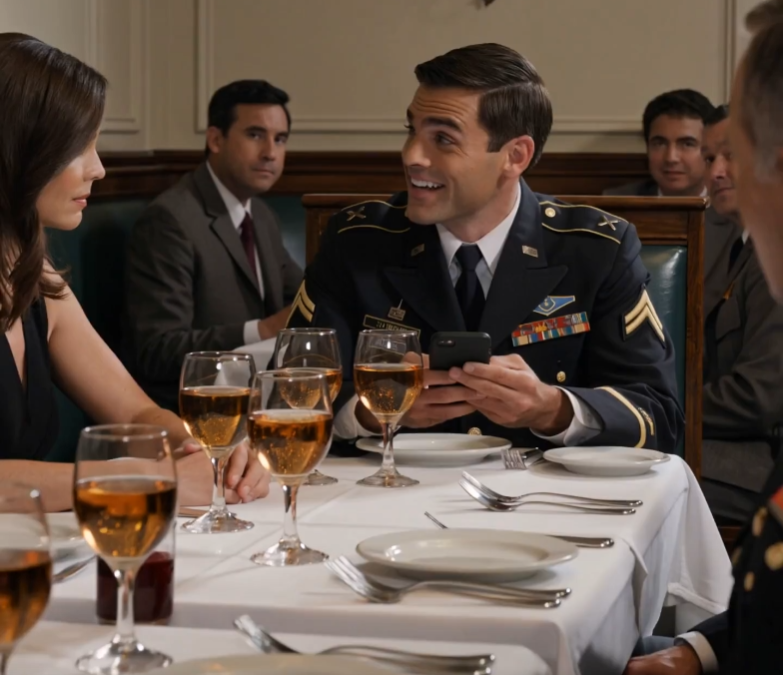
The private room at the back of the steakhouse had gone very quiet.
Not the good kind of quiet. The other kind. The kind that happens when a table full of people is waiting for a punchline that is not coming.
My sister’s fiancé sat at the head of the table with his phone in both hands. A minute earlier, he had been the loudest man in the room. He had a fresh gold bar on his collar and three months of the Army behind it, and he had just promised everyone within earshot that he would outrank me inside a year.
Now he could not make his mouth work.
The glow of the screen lit the underside of his face. His thumb had stopped moving. His jaw was working around a word he could not find, and his eyes kept going back to the top of the screen again and again, like the letters might rearrange themselves into something he could survive.
My sister was still smiling. She had not caught up yet. She was the one who had handed him the phone in the first place, laughing, telling him to prove it, to look me up, to show everyone how small my little Army job really was.
“This can’t be right,” Garrett said.
His voice had dropped out from under him.
“Say that again.”
I did not say anything. I folded my hands on the white tablecloth and waited.
I had learned a long time ago, in a place very far from this room, that the truth does not need my help to be loud. You do not have to shout over it. You just have to stand still and let it arrive.
Thirty relatives and friends. A rehearsal of a celebration. Two Army buddies he had brought to back him up. And a phone in his hand that was busy ending the version of me he had spent the whole night selling.
But let me back up a little.
This started three days earlier.
I flew home for my sister’s engagement dinner. I do not get home often. That is the honest shape of my life, and I stopped apologizing for it years ago.
Home is a small city where everyone knows my parents and no one is quite sure what I do.
I fly Black Hawks for the United States Army. I command soldiers. I have done it for fourteen years, and to most of my family, it has always looked like a phase I refuse to grow out of.
My brother Owen picked me up from the airfield. He is two years younger than me and the only person in the family who reads me on the first try. He took my bag before I could stop him and swung it into the back of his truck like it weighed nothing.
“You look tired,” he said.
“I flew a long way to get insulted at a nice dinner,” I said. “I pace myself.”
He laughed.
Then he stopped laughing.
He pulled out of the lot and watched the road for a second before he said the thing he had picked me up early to say.
“Garrett’s a lot, Dana. I need you to know that going in.”
“Kayla’s fiancé?”
“Kayla’s fiancé.” He shook his head. “He commissioned three months ago. Second lieutenant. And he has been telling everyone at every family thing that he is basically already a general.”
“He’s twenty-four.”
“He’s twenty-four. And he found out you’re in the Army too, and he has decided that makes you competition.”
Owen glanced at me.
“He asked Dad what your rank was.”
“Dad doesn’t know.”
“Dad’s never known my rank,” I said.
“That’s the thing, though. Garrett kept pushing like it was a test Dad was failing, and Dad just laughed it off and said you were ‘doing something with helicopters.’”
Owen’s mouth went flat.
“And Garrett looked at Kayla and kind of smiled like that told him everything he needed.”
I let that sit for a mile.
“How long have they been engaged?”
“Two months.”
“It’s fast.”
“She’s happy, though. Or she’s decided she’s happy, which with Kayla is about the same.”
He checked his mirror.
“He’s got her half convinced he’s on some rocket to the top. She keeps saying it at dinner. ‘My fiancé, the officer,’ like it’s a title she gets to wear too.”
“It kind of is,” I said. “For her.”
“Yeah. Well.” He shot me a look. “Just don’t let him get to you. You’ve got nothing to prove to a kid three months out of a commissioning ceremony.”
“I know I don’t.”
“I know you know. I’m saying it for me.”
He smiled a little.
“It’s going to be hard to watch, is all. Sitting there while he explains the Army to you.”
I looked out the window at the town going by. The same gas station. The same church. The same water tower with the same faded letters.
I have set a helicopter down on a ridge in the dark with people screaming on the radio, and none of it ever made my chest tight the way this ordinary street could.
“I’ll be fine,” I said. “I have handled worse than a lieutenant with opinions.”
“I know you have.”
Owen’s jaw tightened.
“That’s kind of the point.”
My parents’ house had not changed in twenty years.
My mother had the good tablecloth out on the kitchen table even though the dinner was at a restaurant. My father was in his chair with the television on low and his reading glasses pushed up on his forehead.
He stood when I came in and hugged me the way he always does, a little stiffly, proud of me in a way he has never had the words for.
“There she is,” he said. “How’s the flying?”
“Still up in the air,” I said.
It is the joke I always give him because it is the answer he can hold.
“Good, good.”
He patted my shoulder.
“You eating enough? You look thin.”
“I eat plenty, Dad.”
“Your mother made a coffee cake for the morning. Don’t let her tell you she didn’t.”
My mother came in wiping her hands on a towel and fussed over me for a solid minute. The flight. The weather. Whether I was warm enough. Whether the Army was feeding me.
All the small worried questions that are the only language she has ever had for the fact that her oldest daughter does a job she cannot picture.
I let her fuss.
I have learned to let her fuss.
It is love with the label rubbed off.
Then Kayla came down the stairs, glowing and a little sharp, the way she has been since we were kids. Love and competition braided so tight I stopped trying to pull them apart.
Kayla is twenty-nine. She has spent her whole life being the pretty one, the easy one, the one who stayed, and she has never once believed that costs her anything next to me.
“You made it,” she said.
She hugged me hard and then held me at arm’s length.
“You’re not wearing that to the dinner, are you?”
I was wearing traveling clothes. Jeans and a sweater.
“No, Kayla. I brought something.”
“Good. It’s a nice place. Garrett picked it. He’s got taste.”
She dropped onto the arm of the couch.
“You’re going to love him. Everybody loves him. He’s just—he’s got this energy, you know? He walks into a room and it’s his.”
“I can’t wait,” I said, and I mostly meant it.
“He’s really into all the military stuff too, so you two will have that.”
She said it like a gift and a warning in one package.
“He talks about it constantly. It’s kind of adorable. He’s got all the terminology.”
“How long has he been in?”
“Since the summer. He went to the officer school thing. He was top of something. He told me the name of it.”
She waved a hand.
“You’ll get the whole rundown.”
“Believe me, I’m sure I will.”
“Just—okay, one thing.”
She lowered her voice and glanced toward the kitchen.
“Don’t do the thing where you get all quiet and let people talk, and then everyone finds out later you knew better the whole time. It makes people feel stupid. Just be normal. Be my sister. It’s my night.”
I looked at her for a moment.
There was a whole argument I could have started right there. An old one, worn smooth from handling.
“It’s your night,” I said instead. “I’ll be your sister.”
She smiled, satisfied, and went to help our mother.
I carried my bag upstairs to my old room and sat down on the bed in the quiet.
On the wall there was still a picture of me at nineteen. Before flight school. Before any of it. A girl who did not yet know what her own hands were going to be capable of.
And then, without meaning to, I was somewhere else.
Nine years ago. A different kind of dark.
I was a captain then, an air mission commander, and the radio would not stop. There was a ground element pinned on a ridgeline, the weather was closing, and the word from higher was to hold.
I remember the smell of the cabin. I remember the crew chief’s voice. I remember a young sergeant on the ground net whose call sign I would learn later, whose name was on a roster I would read a hundred times afterward, saying in a flat, terrible calm that they could not hold much longer.
I remember making a decision that a lot of people, safe and warm and far away, told me not to make.
Then my mother called up the stairs that Kayla wanted to leave for the restaurant early, and I was back in my childhood bedroom, thirty-seven years old, my hands very still in my lap.
I put the memory away where I keep it.
It has its own drawer, and I have gotten good at closing it.
I got dressed. I went downstairs. I told myself the way I always do that the past was not invited to this dinner.
I was wrong about that, but I did not know it yet.
The restaurant was the nicest one in town.
Garrett had booked the private room in the back. There were eight of us at the immediate table and more than twenty others spread around— aunts and uncles and cousins, a few friends of my parents, and two young men Garrett introduced as his Army buddies.
Both were about his age.
Both were clearly there to be his audience.
He was handsome in the way that twenty-four is handsome. Sharp haircut. A firm handshake he held one beat too long.
He looked at my civilian clothes, my sweater and simple slacks, and something behind his eyes filed me away as harmless.
“So, you’re the sister in the Army,” he said. “Kayla told me. What do you drive? A desk?”
His buddies grinned.
“Something like that,” I said.
I had decided in the truck three days earlier how I was going to handle this.
I was not going to fight a lieutenant at my sister’s engagement dinner.
I was going to eat a good steak, congratulate my sister, and go home.
Another voice, the one the Army spent fourteen years training into me, said the same thing in fewer words.
Observe.
Say little.
Do not detonate.
I have been shot at over a valley in the dark. I told myself a dinner table could not touch me.
I was wrong about that too, but only for a little while.
The salads came.
Garrett talked.
He was, it turned out, an expert on the entire United States military, having been a member of it since roughly the start of summer.
He explained the difference between officers and enlisted to the table as though none of us had ever met a soldier. He explained deployments. He explained to me what a chain of command was, using his fork and his water glass as props.
“So the water glass is the general,” he said. “And the fork is like a private.”
“That tracks,” Owen said, deadpan.
Only I caught it.
I ate my salad.
Kayla watched Garrett with her chin in her hand, delighted. My father laughed at the right moments. My mother refilled water glasses.
And Garrett, encouraged, turned the beam of his attention on me the way a boy turns a magnifying glass on an ant.
“So what’s your deal, though?” he said. “Like, actually. Kayla says helicopters, but she’s vague on it.”
“I fly Black Hawks,” I said. “I command an aviation element.”
“Command.”
He nodded slowly, as if humoring me.
“That’s cool. That’s cool. See, people don’t get that there’s a whole support side. Somebody’s got to do the logistics and the admin so the pointy end can go do the work. No shame in it.”
“None at all,” I said.
“I’m just saying, it’s different lanes.”
He gestured with his fork, the private, toward his water glass, the general.
“Some people are in the fight and some people are behind it. And that’s fine. It takes all kinds.”
“It does,” I agreed.
I cut a piece of tomato and let him have it.
“Like, take flying,” he said, encouraged by how easy I was being. “People think the pilot is the whole show, but it is systems. It is checklists. A monkey could hold a hover if you trained it long enough.”
He looked at his buddies for the laugh and got it.
“The actual skill is in the planning. The mission stuff. Which, hey, maybe that is your lane. I don’t know.”
“Maybe it is,” I said.
“You ever fly anything hairy?” one of the buddies asked me.
Not unkind. Just young.
“Or is it mostly the routine stuff?”
I thought about how to answer that honestly at a dinner table without lighting the fuse.
“It’s had its moments,” I said.
“See, she’s being modest,” Garrett said, as if modesty were a small and slightly embarrassing thing he had caught me doing. “That is the support mindset. Heads down, do your part, don’t make waves. Which, again, I respect. It just isn’t the same as being the one who has to make the call. You know, the one where lives are on it.”
“No,” I said. “It isn’t the same as that.”
Owen set his water glass down a little too hard.
I put my hand on his knee under the table once, and he let it go.
I want you to understand that I was not being a martyr.
I was being a professional.
There is a specific discipline to sitting in a room while someone tells you a wrong story about your own life, and I have that discipline in my bones.
You let the small stuff go.
You save your ammunition.
You do not fire on a target that is not worth the round.
The problem is that my sister does not have that discipline, and she was about to hand him a loaded weapon.
The entrée came, and the wine.
Somewhere in there, Garrett stood up to make a toast.
The toast turned into a speech.
And the speech turned toward me.
“I want to say something about family,” Garrett said, raising his glass, “because I’m marrying into a good one.”
Everyone smiled.
My mother pressed a hand to her chest.
“And I know we’ve got another service member at the table.”
He tipped his glass toward me.
“Dana, respect. Truly. Not everybody can do the support side. Somebody’s got to push the paper so the rest of us can do the real work.”
A few people laughed.
The comfortable kind of laugh.
The kind that agrees.
I set my fork down.
I did not say anything.
“I’m serious,” he went on, warming to it. “Honestly, give me a year, maybe two, I’ll outrank her.”
He grinned at his buddies.
“No offense. It’s just how it works. I’m on the fast track. She’s been in, what, a while doing the admin thing, and that’s great. That’s important. But it’s a different lane.”
“Garrett,” Owen said quietly.
“What? I’m being nice.”
He spread his hands.
“I’m saying I respect it.”
My father chuckled and said something about how good it was to have two of us in uniform in the family now.
My mother beamed.
Kayla laughed and put her hand on Garrett’s arm.
Proud of him.
Proud of how well he was performing for her family.
I looked at my sister.
I have loved her every day of her life.
I looked at her laughing at a joke about how small I was, and I felt the old familiar ache, the one I flew fourteen hundred miles to feel.
And I kept my face perfectly still.
“Kayla,” Garrett said, riding the moment. “Back me up. You said it yourself. She does the office stuff.”
“She does something with helicopters,” Kayla said, waving a hand. “I don’t know. She never really explains it.”
“See, that is the thing about the real Army,” Garrett said. “If it was a big deal, you would know. It would be all over the place. You would be able to look it up.”
There was a small silence.
The kind that opens up right before a mistake.
And that was the moment my sister decided to help.
“Look her up, then,” Kayla said, laughing.
She plucked Garrett’s phone off the tablecloth and put it in his hand.
“Go on. Prove it. Show everybody Dana’s big secret Army career.”
“Kayla,” Owen said, sharper now.
“What? It’s funny.”
She turned to the table, playing to the room, warming her hands at the little fire she had started.
“She is so mysterious about it. Major this, classified that. She acts like she cannot tell us anything. Let’s just see it.”
“I really don’t think—” Owen started.
“It’s fine,” Kayla said. “It’s a joke. Dana can take a joke. Can’t you, Dana?”
I did not move.
I want to be honest about something.
There was a part of me, a small and tired part, that wanted to stop it. To say his rank across the table and then my own and put an end to it with two flat sentences.
I had the sentences ready.
I have had them ready my whole adult life.
I could have ended it clean.
But I have also learned that a thing you announce about yourself and a thing that arrives on its own are not the same weight.
One can be argued with.
It can be called a boast, or a chip on the shoulder, or a person who cannot take a joke.
The other cannot be argued with at all.
It just sits there in the middle of the table.
True.
So I folded my hands and let it happen.
“Go ahead,” I said.
It was almost the only thing I had said in twenty minutes.
“Look me up.”
Garrett grinned.
He liked being handed the phone.
He liked the audience.
He typed my name with his thumbs, slow and showy, spelling it out for the table.
“Dana,” he said. “United States Army. Dana. Let’s see.”
He hit search.
He sat back.
He waited, still grinning, for the joke to land. For a blank screen, or a stranger’s obituary, or nothing at all. For proof of how small I was.
I watched his face.
“Okay, so probably nothing, right? Because it’s not like they put the paper pushers on the internet.”
He scrolled.
“Let’s see. Dana. Dana. Here we go. There’s a bunch of—huh.”
The grin held for one more second.
Then it did not.
I know exactly what came up first because he read it out loud before he understood what he was reading.
“Army.mil,” he said, frowning. “Aviation feature. Commanding officer Major Dana…”
He stopped.
He looked at the photo.
His thumb hovered over the screen.
“Major Dana Ror.”
The room did not know yet, but something in the air changed anyway.
The way it does before weather.
A pressure drop you feel before you see the clouds.
“That’s a different Dana Ror,” Kayla said, but her smile had gone uncertain at the corners.
Garrett did not answer her.
He was reading.
His lips moved.
He scrolled and stopped and scrolled back up and read it again from the top.
“This can’t be right,” he said. “Say that again. Your last name.”
“Ror,” I said. “The same as my sister’s.”
He looked up at me.
Then down at the phone.
Then up again.
And I watched the first real fear cross his face.
Not fear of me.
Fear of himself.
Fear of the twenty minutes he could not take back.
Down the table, one of the two Army friends he had brought to back him up had gone very still.
I had noticed him earlier without noticing him.
Older than the others, maybe forty. Quieter. A man who sat the way men sit when they have carried heavy things for a long time and expect to carry more.
He had not laughed at the toast.
He had a glass of water in front of him, and he had not touched it since Garrett started talking about the “real Army.”
Now he set his own glass down with a small, deliberate click and looked across the table at me.
His face did something complicated.
Something that started as recognition and ended somewhere much deeper than that.
“Sir,” he said.
It took me a second to realize he was talking to Garrett.
“I’d put the phone down.”
Garrett blinked.
“What?”
“Put it down.”
The man’s voice was low and even and left no room anywhere in it.
“I know exactly who she is.”
His name, I would piece together over the next hour, was Marlon Teague.
Sergeant First Class.
Garrett had gone through part of his pipeline with Teague as a cadre instructor and had invited him to the dinner the way a young officer invites the one senior enlisted man he most wants to impress.
Teague was not looking at Garrett anymore.
He was looking at me.
And there was a question in his face.
An old one.
I gave him the smallest nod.
Permission.
Go ahead.
“You don’t recognize the name,” Teague said to the table slowly, “because she does not tell it. But I will tell it, if that is all right with the Major.”
“Major?” Kayla said.
A laugh that did not work.
“Okay. She’s not. That’s not—Dana is not a—”
“She is a major, ma’am,” Teague said.
Not unkindly.
Just flat.
The way you state a fact that is not up for a vote.
“And that is not even the part that matters.”
The table had gone quiet.
Really quiet now.
My mother had stopped fussing.
My father had put down his water glass and pushed his reading glasses down off his forehead, which he only does when he is about to concentrate very hard on something.
Garrett was still holding the phone, but he had stopped reading it.
He was staring at Teague like a man watching a floor tilt under his feet.
“What matters,” Teague said, “is that I was a private nine years ago on a ridgeline I was pretty sure I was going to die on.”
He turned his water glass a quarter turn on the tablecloth.
He did not look away from it.
When a man who has been quiet all night starts to talk, the whole room leans in without meaning to.
“June,” he said. “The weather was coming down. We had wounded. Two of them bad. And we had run the math on our ammunition, and it was not good math.”
The word came down that no aircraft were coming.
That it was not survivable to fly in that weather into that valley.
That they were to hold and wait for morning.
He paused.
“Everybody who has been in that spot knows there is a particular quiet that comes over a group of men when they understand that morning is not a thing that is going to happen for them.”
Nobody at the table moved.
One of the aunts had a hand pressed to her mouth.
Then Teague said, “One aircraft turned around. Came back into weather it had no business being in after higher had said no, when it was not supposed to.”
He looked up from the glass and looked at me.
“I never met the pilot. We did not exactly have time for handshakes. But I read the name later. On the citation. You read a name enough times on a piece of paper that explains why you get to go home, and you do not forget it.”
“That doesn’t mean she’s important,” Kayla said.
It came out small.
She heard it come out small, and her face crumpled a little at the sound of her own voice.
“Kayla,” Owen said. “Stop.”
I have thought a great deal in the years since about why I did not enjoy that moment more.
Everyone expects you to.
The story people love is the one where the arrogant young man gets taken apart at the dinner table and the quiet woman sits back and savors it, and justice is loud and complete.
And I will not pretend that some part of me did not feel the old wound ease just slightly, the way a splinter eases when it finally works its way free.
But mostly what I felt was tired.
And a little sad.
Because I looked at my sister’s face falling apart across the table on the night that was supposed to be hers, and I understood that whatever happened in the next ten minutes, none of it was going to give me the thing I had actually wanted my whole life.
Which was for them to have known already.
To have asked.
To have believed me without a phone and a stranger to prove it.
You cannot get that back at a dinner table.
It is either given freely over years, in a thousand small moments of somebody choosing to see you, or it is not given.
And a phone cannot hand it to you, no matter what is on the screen.
Garrett found his voice, barely.
“It says here…”
He read, and his voice had thinned out to almost nothing.
“‘For extraordinary heroism while participating in aerial flight… The Distinguished Flying Cross is presented to…’”
He stopped.
He could not say my name in that sentence.
His mouth simply would not do it.
“Keep going,” Teague said quietly. “She earned every word of it. Read the whole thing.”
Garrett read the rest in a whisper.
The date.
June, nine years ago.
The number of soldiers extracted under fire in two separate lifts.
The minutes the aircraft held in the open on the slope while the ground element loaded.
The words that get written in a very particular, flat language when the Army is trying to describe something that was not flat at all.
Fourteen soldiers.
Two lifts.
A little under seven minutes on the ground in the open across both.
I know those numbers better than I know my own telephone number.
I do not think about them the way the citation thinks about them.
The citation makes it sound orderly.
It was not orderly.
It was the loudest, longest seven minutes of my life.
And Marlon Teague was one of the fourteen.
Until tonight, I had never seen his face.
“We were told not to go,” I said.
The whole table turned toward me.
“I went.”
That is the entire story people find so hard to believe.
That is it.
That is the big secret.
I need to tell you the seven minutes because I have never told my family, and it is the middle of everything.
Nine years ago, I was twenty-eight.
I was the air mission commander for a two-ship, and we were coming off another task, fuel getting to be a question, when the call came in about the ridge.
The ground element was a small one. Cut off. Taking fire from higher ground, with two wounded who would not last the night.
The weather was dropping fast.
The ceiling was coming down, and the visibility was going with it.
The window to get in was closing by the minute, and the assessment from higher was that the risk to the aircraft exceeded the possible gain.
The order, when it came, was to hold.
To wait for morning.
To wait for a break in the weather that everyone in the sky and everyone on the ground knew was not coming in time.
I remember my crew chief’s voice in my headset.
Calm, because he was always calm.
But there was a question folded into it.
“Ma’am,” he said, “are we holding?”
I remember the young sergeant on the ground net.
Flat and even.
The way people get when they have moved past fear into arithmetic.
He did not beg.
That is the part that stayed with me all these years.
He just reported rounds remaining. The condition of the two wounded. How much light was left.
A man doing math out loud while the math killed him, trusting the voices in the sky to hear it and do something.
I remember looking at my copilot.
I remember the weather to the west, a wall of it.
I remember thinking very clearly, and without any drama, that if we waited until it was safe, there would be nobody left to come back for.
“We are not holding,” I said. “Turn us around.”
I will not pretend it was a hard decision in the moment, because in the moment it was not a decision at all.
It was the only thing my hands knew how to do.
The hard part was everything before.
All the years of training that put me in a seat where that was even possible.
And everything after.
All the reviews and the questions and the very careful language of the people whose job it is to decide whether you were brave or reckless, which are sometimes the same thing wearing different clothes.
We came in low.
We came in fast.
And we took fire the whole way in.
The valley threw everything it had at us.
I flew it anyway because a helicopter does what your hands tell it, and my hands had stopped asking permission.
The first lift was the two wounded and half the element.
We sat down on the slope in the open, in weather we had no business flying in, the aircraft shaking and the whole world outside the windscreen a mess of noise and light.
My crew chief and my medic worked the door.
And Teague, though I did not know his name and would not for nine more years, was one of the hands throwing men aboard.
One of the shapes in the dark loading the wounded, screaming things I could not hear over the rotor.
Then we lifted, heavy and slow and everything protesting, and we cleared the ridge.
“Second lift,” I said on the internal net.
My voice sounded like someone else’s.
Calm.
Very far away.
“Coming back around.”
“Ma’am, they are still taking fire from the high ground,” my copilot said.
“I know,” I said. “That is why they are still down there.”
I brought us around.
The valley was worse the second time because the second time they knew exactly where we would come from.
The weather had dropped another notch, and my fuel was a number I had stopped looking at because there was nothing useful the number could tell me anymore.
I flew it on the picture in my head and the voice on the ground net counting his people to the aircraft.
“Six,” the sergeant said.
“Seven.”
“That is everybody.”
“Go, go,” my crew chief’s voice said. “Last man is on, ma’am. Go.”
I went.
We came up off that slope with the aircraft screaming and the whole ridge behind us lighting up where we had been one second before.
And I did not breathe, I think, until we were three ridgelines away.
Then the number I had been refusing to look at finally became the only number that mattered.
We made the fuel.
Barely.
That is a different story and a boring one.
And I have never told it to anyone either.
Two lifts.
Fourteen people.
A little under seven minutes on the ground total across both.
We should not have made it.
That is not modesty.
It is the weather and the terrain and the fuel and the plain arithmetic of it.
We made it anyway.
And I have spent nine years being quietly grateful and quietly unable to explain to the people who raised me why I cannot just get a normal job and come home for the holidays like a normal person.
Back in the restaurant, Garrett set the phone down on the tablecloth, face up, the citation still glowing.
He did not seem to know what to do with his hands.
Here is the thing about a young officer, and I say it without cruelty because I was one once and I made my own version of every mistake he was making.
They learn the shape of the structure before they learn anything else.
They have to.
It is drilled in from the first week.
Rank.
Chain of command.
Who answers to whom, and how, and when.
It is the skeleton you learn before you have any muscle on you at all.
So I watched Garrett do the arithmetic.
And I watched the arithmetic land.
It landed harder than the citation did because the citation was about a stranger who had turned out to be me, and a person can hold a stranger’s heroism at arm’s length.
But the arithmetic was about him.
The arithmetic was personal.
“You’re a major,” he said slowly, working it out. “Aviation. You have command time. You’ve got…”
He looked at the screen again, as though it might have changed.
“You’ve got a Distinguished Flying Cross.”
“Yes,” I said.
“I said I’d outrank you in a year.”
His face had gone a strange pale color.
“I said that out loud. In front of…”
He looked around the table.
At the family.
At his two buddies.
At Teague.
At Kayla.
“It would take me… Ma’am, do you know how long it would take me to—”
“It would take you a career, Lieutenant,” Teague said.
Not cruelly.
Just true.
“If everything went right. If you were very good and very lucky and you did not get yourself killed being stupid first.”
Garrett looked at me.
And something in him—the part underneath all the noise, the part the Army had started quietly building in three short months without him noticing—stood up before the rest of him could stop it.
He straightened in his chair.
His hands came off the table and settled at his sides.
His chin came level.
“Ma’am,” he said. “I did not know. I am sorry. I was completely out of line.”
The whole table watched a young man call my sister’s engagement dinner to a halt with three sentences.
It was not a salute.
You do not salute indoors without a cover on your head, and some reflex in him, three months old and already load-bearing, knew that even now.
But it was the thing a salute is made of.
It was a man recognizing where he actually stood in the world and correcting it out loud in front of everyone he had spent the whole night performing for.
Ten seconds earlier, he had been going to outrank me.
Now he could not look me in the eye.
My mother was the first of my family to move.
She reached across the corner of the table and put her hand over mine.
Her eyes were wet.
“Dana,” she said. “Honey, I didn’t… You never…”
She stopped.
She squeezed my hand hard.
“Why did you never tell us?”
It is a fair question.
And it is the wrong question.
Both of those things are true at the same time.
“I did tell you, Mom,” I said gently. “I told you all of it for years. I told you when I made captain, and I told you when I made major. I just told you quietly. The way I tell everything. And quiet is easy not to hear when you have already decided what the story is.”
“But a medal like that…” Her voice shook. “For that. You went back for those men.”
“I did.”
“You could have died.”
“I could have.”
“I have made my peace with that. I needed you to make yours. That is why I told you quietly. I never wanted you sitting up at night doing the math I do.”
My father had not said anything at all.
My father, who had chuckled at the toast.
Who did not know my rank when a lieutenant asked him.
Who had introduced me at parties for fourteen years as his daughter “who is in the Army,” vague as the weather.
He was looking at the phone on the tablecloth.
He reached out and picked it up.
He read the citation himself all the way through, moving his lips, his reading glasses finally down where they belonged.
When he finished, he set the phone down very carefully, like it was something that might break.
Then he looked at me.
And for the first time in a very long time, my father did not have a single thing to say.
And Kayla stood up.
“So that’s it, then,” she said. “That’s the night. It’s about Dana now.”
“Kayla,” Owen said.
“No.”
She was not shouting.
She was doing the thing she does that is worse than shouting.
The tight, bright voice.
The smile that is all teeth and no warmth.
“It’s fine. It is totally fine. It is my engagement dinner, and somehow—somehow—we are all sitting here talking about my sister and a helicopter from nine years ago.”
She looked at me.
“You couldn’t just let it go. You had to make it a whole thing.”
I looked at her for a long moment.
The whole table was watching us now.
The two Ror sisters.
The one who stayed and the one who left.
Finally standing in the open where everyone could see.
“I did not say a word for the entire dinner, Kayla,” I said quietly, without heat. “You handed him the phone.”
She opened her mouth.
Closed it.
“You told him to look me up,” I said. “You told him to prove it in front of everyone. I sat here and let him call me a paper pusher, and I did not correct him one single time. You are the one who wanted the phone. You are the one who lit this.”
“That’s not…”
Her eyes were shining now, but not the way our mother’s had been.
Our mother was crying for me.
Kayla was crying for herself.
“That’s not fair.”
“It is completely fair,” Owen said. “Dana ate her salad and let a kid insult her for an hour. You’re the one who struck the match, Kayla. And now you’re upset that it caught.”
“Nobody was talking to you, Owen.”
“Somebody should have been,” he said. “Years ago.”
The table had gone silent again.
Garrett was studying the tablecloth as though it held the rest of his career.
His two buddies looked like men who wanted very badly to be at any other table in the country.
Teague sat still, watching my sister with an expression I recognized because it is the expression of a man who has watched a lot of people find out far too late exactly what they had been standing on the whole time.
I did not want to win this.
I need to be very clear about that.
There is a version of this night where I stand up and take my sister apart in front of everyone who loves us both.
Where I list every time she made me small.
Where I use the loaded weapon she handed me and I do not miss.
I had the tools.
It would have felt good for about four seconds.
This was never about winning.
It was about not disappearing.
So I reached over and turned Garrett’s phone face down on the tablecloth.
The light of the citation went out.
I stood up.
“Kayla, congratulations on your engagement. I mean that with my whole heart. I’m going to step outside and get some air.”
The front porch of the restaurant looked out over the parking lot and past it to the dark line of the hills.
I stood at the rail and breathed.
The air was cool and clean, and it tasted like autumn.
My hands were steady.
They are always steady when it matters.
It is only afterward, sometimes alone, that they shake.
And I have made my peace with that too.
Everybody pays somewhere.
I pay in parking lots.
The door opened behind me.
I did not turn around.
I expected Owen.
It was my father.
He came and stood at the rail beside me, both of us looking out at nothing in particular.
For a while, he did not say anything at all, which is its own kind of language between the two of us.
“I read it twice,” he finally said.
“The whole thing. Twice.”
“I know, Dad. I saw.”
“Fourteen.”
He said the number like it had a weight he was testing in his hand.
“And they told you not to go.”
“They did.”
“And you went anyway.”
“I went anyway.”
He was quiet again.
A car pulled into the lot, and its headlights swept across us and moved on.
In the wash of it, I saw that his eyes were wet.
“Your grandfather was in the Army,” he said. “You knew that. Korea. He never talked about it. Not one word his whole life. Not to me. Not to your grandmother that I ever heard.”
He shook his head slowly.
“I always told myself that was just how men like him were. Quiet. Hard. Closed up.”
He looked at me.
“It never once occurred to me in sixty-six years that maybe he had a whole life worth of things he could have said and just never had a single person asking him the right way. That maybe the quiet wasn’t the man. Maybe the quiet was the room.”
I looked at my father.
He is sixty-six years old, and I have wanted him to ask me the right way for fourteen years.
I had honestly given up on it.
“What do you actually do, Dana?” he said. “Not the version I tell people at church. The real one. I want to hear it from you. I’ve got all night.”
So I told him.
I stood at the rail of a steakhouse in the town where I grew up, and for the first time in my adult life, my father asked me who I was.
Then he was quiet long enough to actually hear the answer.
I told him about the aircraft.
About what it is to command soldiers.
To be the one who makes the call.
To carry the weight of other people’s lives in your decisions.
I told him I love it.
That I have always loved it.
That it is not a phase, and it was never a costume.
That it is simply my life.
And it is a good one.
A full one.
Even the hard parts.
Especially the hard parts.
He listened to all of it.
When I was done, he nodded slowly and wiped his eyes with the back of his hand, not embarrassed.
“I owe you about fourteen years of better questions.”
“You can start now,” I said.
“I would like that.”
“I would like that a lot.”
And he meant it.
I could hear that he meant it.
Standing there in the cold, that was worth more than the entire scene inside had been.
“Can I ask you something?” he said after a while.
“Sure.”
“That night, when you turned the aircraft around, were you scared?”
I thought about lying to him.
Fathers like a certain answer to that question.
Then I decided he had earned the true one.
“The whole time,” I said. “Start to finish. I have never been so scared in my life.”
“But you went.”
“Being scared and going are not opposites, Dad. Most of the brave people I know are scared people who went anyway. The ones who feel nothing are the ones you have to worry about.”
He nodded slowly, turning that over.
The door opened behind us, and Owen slipped out, saw the two of us at the rail, and started to go back in.
“Stay,” I said. “It’s fine.”
He came and stood on my other side.
The three of us in a row at the rail.
None of us said anything for a while.
And it was, in its strange way, the best part of the whole trip.
“For what it’s worth,” Owen said finally to the hills, “I always told people what you did when you weren’t around. I told them my sister flies helicopters into places people run out of.”
He shrugged.
“Nobody ever quite believed me either. Guess now they will.”
I would like to tell you that Kayla came out to the porch too.
That she and I had our own version of that conversation, sister to sister under the dark hills, and that we made it right.
She did not come out.
She stayed inside at the head of the table she had wanted so badly to be about her, and she nursed the injury of an evening that had gotten completely away from her.
By the time my father and I came back in, she had rebuilt her smile into something hard and bright and social, and she did not look at me directly for the rest of the night.
That is the honest ending of that part.
I have stopped trying to smooth it over for people.
Not every broken thing gets fixed in one scene.
Some of them take years.
Some of them do not get fixed at all.
And you have to learn to carry the gap without letting it curdle.
The dinner limped to a close.
People said their goodbyes too warmly, the way people do after something has cracked open in a room and everyone has silently agreed not to name it out loud.
Garrett came and found me by the coat rack, away from the others, and stood there working up to something.
“Ma’am,” he said. “There is not… there is no version of sorry that covers what I said tonight.”
“There isn’t,” I agreed. “But you can try one anyway. Go on.”
He nodded, miserable.
And to his credit, he did not flinch from it.
“I ran my mouth about something I know nothing about. Ninety days. I have been in ninety days. And I stood up in front of your whole family and made it about how I was going to beat you, and you…”
He gestured helplessly toward the private room.
“You went back into weather that killed people to bring out fourteen men, and one of them is sitting at that table right now with two kids because of you.”
He swallowed.
“I mistook a loud opinion for knowing something. I am sorry. I am really sorry.”
It was, I have to say, a better apology than most grown men manage.
There was no excuse folded inside it.
He did not say he had only been joking.
He did not say I had taken it wrong.
He just named the thing he did and stood in it.
“You are going to be a lieutenant for a while,” I said. “Then a captain if you work. And someday, a long way down the road, you might get soldiers of your own.”
“Yes, ma’am.”
“When you do, I want you to remember exactly how you feel right now standing at this coat rack.”
“Yes, ma’am.”
“Because that is the whole lesson. You do not ever know who is at the table. You cannot tell by looking. Half the time, the loudest person in the room has done the least and the quietest person has done the most, and you will not be able to sort them out until it is far too late to take back what you said.”
He looked at me.
“So you treat the paper pusher and the four-star general exactly the same. Not because it is polite. Because you genuinely cannot tell them apart. And the day you forget that is the day you become the man you were tonight.”
“Yes, ma’am,” he said. “I will remember it.”
“I believe you,” I said.
And I did.
Teague was waiting for me by the door.
He put out his hand, and I took it.
Neither of us said very much because the two of us were the only people in that whole building who actually understood what the citation had been too polite to say.
He held my hand a moment longer than a handshake.
“I have wanted to say thank you for nine years,” he said. “I did not figure it would happen at a steakhouse.”
“Life is like that,” I said.
My voice was not entirely steady.
His was not either.
“Fourteen of us went home, ma’am,” he said. “I’ve got a boy and a girl now. The boy is seven.”
He stopped.
He worked his jaw.
“So everything after that night, all of it, that is…”
He could not finish it.
He did not have to.
I have never needed anyone to finish that sentence.
Weeks went by.
Garrett wrote me a letter.
An actual letter, on paper, in the mail, which I did not expect from a twenty-four-year-old.
It was short and plain, and it said again, and better than he had managed at the coat rack, the thing he had been trying to say.
It said, “I mistook a loud opinion for knowing something.”
It said he had started asking the senior enlisted soldiers around him for the stories they did not volunteer because he had learned the hard way that the quiet ones are quiet for a reason, and the reason is usually worth hearing.
It said he hoped someday, a long way down the road, to be half the officer that citation described.
I wrote him back two lines.
I told him that the fact he had sat down and written the letter at all told me he was going to be fine.
Better than fine.
And that I would be glad to have him in the family.
And that he should take very good care of my sister.
Kayla was harder.
We finally talked on the phone a few weeks after the dinner.
I called her.
I want that on the record because I have decided to stop keeping score with my family, but I have not decided to lie to you about who picked up the phone.
“You embarrassed me,” she said. “In front of everyone. On my night.”
“Garrett looked me up on his own phone, Kayla, because you put it in his hand and told him to,” I said. “I turned his phone over so it would stop. I stood up, congratulated you, and walked outside.”
She was quiet.
“If you go back through the whole evening minute by minute, you will not find the part where I embarrassed you. You will only find the part where the truth did. And the truth was not mine to keep quiet forever just so your fiancé could feel tall.”
There was a long silence on the line.
“You always do this,” she said finally.
“Do what?”
“You’re always so reasonable. It’s like arguing with a wall.”
“I’m not trying to win, Kayla.”
“That is exactly what makes it worse,” she said. “If you fought me, I could fight back. You just stand there being right.”
And there it was.
Laid completely bare.
The whole shape of the two of us in one sentence.
I have spent my life being the one who does the hard, loud, unglamorous things quietly.
She has spent hers needing to be the one the room is about.
And my very existence has always felt to her like a theft.
Even when I am fourteen hundred miles away.
Even when I am sitting silent at her table, saying nothing, eating my salad.
I did not fix that on the phone.
You do not fix a thing like that on a phone.
Maybe you do not fix it at all.
Maybe you just learn its shape and stop cutting yourself on the edges.
“I love you,” I said. “I am not going to pretend the dinner did not happen, and I am not going to apologize for a medal I earned nine years ago before you were even out of high school. But I am your sister, and I am not going anywhere. When you are ready for that to be a good thing instead of a competition, I will be right here. I will always be right here.”
She said she had to go.
I sat with the phone in my hand for a minute after she hung up.
Then I did the thing I have learned to do, which is to put the disappointment down where it belongs and pick up the part I can actually carry.
My sister was not ready.
That was information.
Not a verdict.
You do not fly a mission based on the weather you wish you had.
You fly it based on the weather you get.
Teague called me a few days after that out of nowhere.
He had gotten my number from Garrett.
He did not have anything in particular to say, which is the way it is sometimes between people who shared a night like that one.
He asked how I was.
He told me his boy had a game that weekend.
We talked for ten minutes about nothing.
And underneath the nothing was the whole thing.
We both knew it.
Neither of us needed to name it.
“You know what got me?” he said near the end.
“What?”
“At the dinner. It wasn’t the medal. It was that you sat there and took it. That kid ran you down for an hour and you just let him. I couldn’t have done that.”
“You would be surprised what you can do,” I said, “once you stop needing to win.”
“Huh,” he said. “Yeah. Maybe.”
Forgiveness is not the same as pretending it did not happen.
I had learned that a long time before that phone call, in harder rooms than that one.
I set the boundary and kept it.
The way you hold a heading in bad weather.
Hands steady.
Eyes forward.
Not fighting the wind and not surrendering to it either.
And I stopped waiting for her to come around.
Somewhere in the letting go, I got lighter than I had been in years.
That was a little more than a year ago now.
I am at a battalion these days, on the operations side, which is a great deal of planning and a great deal of coffee and considerably less flying than I would like.
It is exactly where I am supposed to be at this point in a career like mine.
Doing the work that lets the young ones fly.
Building the plans that bring them home.
I miss the stick.
I do not miss being twenty-eight.
Both things are true.
My father calls me now.
Not just on birthdays.
He calls on an ordinary Tuesday to ask how it is going.
And he asks the real questions.
Then he waits for the real answers.
Sometimes he tells me about my grandfather.
Small pieces of him that have started coming back now that my father has learned how to go looking.
A man who came home from Korea and never said a word.
And both of us understand now that the quiet was never the same thing as empty.
It was just a room with nobody asking.
Owen came out to visit the post.
I did not take him flying.
We just walked the flight line at dawn.
But he stood next to a Black Hawk with the mist coming off the field and the sun not up yet, and he was quiet for a long time.
My little brother.
Then he said, “I get it now. I always sort of got it. But now I really get it.”
And that was enough.
That was more than enough.
Garrett is a first lieutenant.
He and Kayla got married in the spring.
I went to the wedding.
I wore my dress uniform because my father actually asked me to.
Asked with the right words.
And because Garrett asked too and stood a little straighter when I walked into the reception.
Kayla and I are careful with each other now.
It is not what it was when we were girls chasing each other around this same town.
It may never be that again.
But she hugged me at the wedding.
And she meant about eighty percent of it.
And eighty percent is a real number.
A number you can build on.
I will take it and keep the door propped open for the other twenty whenever she is ready to bring it.
Something happened at that wedding that I want to tell you about because it is the closest thing this story has to a bow on it.
And I did not expect it.
At the reception, Garrett got up to do the part where the groom thanks everyone.
He thanked his parents.
He thanked Kayla’s parents.
Then he said, “I want to thank someone else. Most of you were not at our engagement dinner, so you did not get to watch me make the biggest fool of myself I have ever made in my life.”
A few laughs.
He waited them out.
“My new sister-in-law is a major in the United States Army. She flies Black Hawks. Nine years ago, she flew into weather that everyone told her not to fly into, and she brought fourteen soldiers off a mountain.”
He found Teague in the crowd and nodded toward him.
“One of them is here tonight.”
The room got quiet.
“And on the night I met her, I spent an hour explaining the Army to her.”
He shook his head.
“To her.”
More laughter.
This time, he deserved it.
“So here is my toast to the people who do the quiet, enormous things and let the rest of us keep talking.”
Then he looked at me.
“Dana, I am honored to be in your family, ma’am.”
The room stood.
Not because anyone ordered it.
They just stood.
Glasses up.
And my father was the first one on his feet.
He was not vague about it this time.
I did not cry over the ridge.
I did not cry at the citation.
I came fairly close standing in the back of that reception hall, watching a twenty-five-year-old who had once promised to outrank me raise a glass and get it exactly right in front of two hundred people.
Kayla did not toast me.
But she watched Garrett do it.
And she did not look away.
Afterward, she came over.
“He practiced that for a week,” she said.
Which, from my sister, is a kind of love letter.
“You picked a good one,” I told her.
“I know,” she said.
And for one clean second, it was just the two of us again.
The way it was before either of us had anything to prove.
Teague and I email.
His kids are getting big.
The boy wants to be a pilot, apparently, which Teague says is my fault.
He sent me a picture.
I keep it in a drawer that is a much better drawer than the one where I keep the other things.
And me?
I am the exact same person I was at that dinner table.
And the same person I was over that ridge nine years ago.
And the same person who sat on the edge of a childhood bed, put a memory back in its drawer, and went downstairs to be underestimated one more time.
I did not change that night.
Nothing about me changed at all.
The only thing that changed is that for a few minutes, in front of the people who raised me, the truth I have always carried got to be as loud on the outside as it has always been on the inside.
And here is the thing I finally understood, standing at that rail with my father.
I did not need them to see it.
It would have been nice.
It was not necessary.
I knew who I was the entire time.
I knew it at the table while he called me a paper pusher.
I knew it in the truck with Owen.
And I knew it nine years ago with my hands on the controls and the whole valley trying to knock me out of the sky.
Their not seeing it never made it less true.
It only made them smaller and me lonelier.
And neither of those was a good enough reason to shrink.
The morning after Owen’s visit, I was first out to the flight line.
The sun was not up yet.
The field was gray and wet and quiet, that particular quiet that comes right before a great deal of noise.
I stood next to the aircraft with my coffee going cold in my hand, and I let myself feel, for one full minute, all fourteen years of it at once.
The weight.
The cost.
The enormous, stubborn joy of it.
A young pilot walked past on her way to preflight, coffee in her own hand.
“Morning, ma’am,” she said in the easy way soldiers say it.
“Good morning,” I said back.
She had no idea about any of it.
The dinner.
The ridge.
The sister.
The citation in the drawer.
To her, I was just the operations major who got in early.
And that was fine.
That was better than fine.
I have stopped needing to be seen to know I am standing exactly where I belong.
If my story has taught you anything, let it be this:
You do not owe anyone the small version of yourself.
Not the family who decided who you were before you ever got the chance to show them.
Not the loud young man at the head of the table.
Not the sister who needs the whole room to be about her.
You can love them.
You can keep the door open.
You can decline every single time to turn it into a fight.
And you can still refuse, quietly and completely, to shrink yourself down to the size that other people find comfortable to sit next to.
The truth does not need you to shout it.
It never has.
It only needs you to stand still and stop apologizing and take up the space you actually earned.
If any part of this reached you tonight, if you have ever sat at a table and been made small by the very people who were supposed to know you best, please share this story because someone out there needs to hear tonight that they are not the small version anyone made of them.
And tell me in the comments about the moment your own truth finally arrived.
The moment the room went quiet.
I read them.
All of them.
And they matter to me more than I know how to say.
And if you want more stories like this one—about courage, about justice, and about ordinary people who quietly turn out to be exactly who they always said they were—subscribe and stay with me a while.
Thank you for being here.
Thank you for listening.
Thank you for letting one quiet story be loud just for a little while.
The end.








