At my daughter’s wedding, her ceo mother-in-law mocked me: “he’s just a dirt-poor janitor!” my daughter grabbed my hand and walked out. i smiled and told the host: “cancel the venue.” her in-laws froze when they realized i owned the entire 5-star hotel…
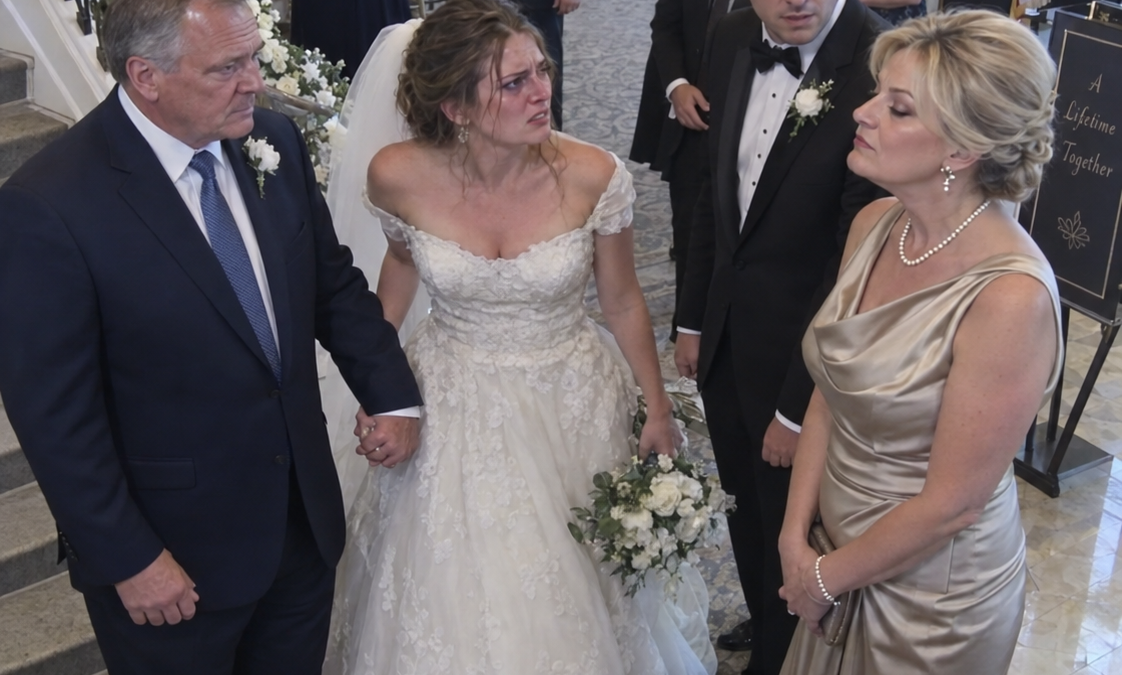
Twenty minutes before my daughter was supposed to walk down the aisle, 300 guests in silk and diamonds were laughing at me. The mother of the groom had just called me a broke old janitor, loud enough for the string quartet to hear. I didn’t flinch. I simply turned to the wedding coordinator, held my daughter’s trembling hand, and said four words that stopped the music and canceled the entire wedding.
Then I leaned in and whispered the sentence that drained the color from every face in that room. By the time they understood who I was, it was already too late.
Let me take you back to the beginning of that afternoon, because the way it started matters.
I was standing at the far end of the ballroom at the Grand Meridian, just inside the tall double doors, in the navy suit I’d bought eleven years ago for my wife’s funeral. It still fit, mostly. The cuffs had gone a little shiny at the edges, and I’d pressed them twice that morning with the same iron Margaret and I bought the year Emily was born.
I wasn’t hiding. I just knew that a man in my position, at an event like this, does best to stay near the exit and out of the way.
The room was a thing to behold. Three crystal chandeliers I knew by heart, because I’d signed off on their restoration, threw warm light over white hydrangeas and ivory roses stacked in towers on every table. A string quartet tuned somewhere near the windows. The air smelled of lilies and expensive perfume, and underneath it all, faintly, of the polish the night crew used on the oak floor.
I’d walked that floor at two in the morning more times than I could count, a flashlight in one hand and coffee going cold in the other.
Somewhere upstairs in the bridal suite, my daughter was getting ready. I’d seen her an hour earlier, standing at the window in her ivory gown with her hair pinned up, and for a moment, I couldn’t speak. She looked so much like her mother that my chest actually hurt.
Margaret used to tuck her hair behind her left ear exactly that way when she was nervous. I told Emily she looked beautiful. She told me not to cry on the dress. I promised I wouldn’t, and I almost kept the promise.
Then the door swung open behind me, and I heard Victoria Whitmore before I saw her.
She had a laugh like a glass being tapped with a spoon, bright and meant to be noticed. She swept in with a cluster of people I recognized from the business pages, men with tanned wrists and women whose jewelry caught the chandelier light, and came to a stop about four feet from me.
She wore champagne silk and a smile that didn’t reach anywhere near her eyes. Her gaze traveled slowly down my suit, from the collar to the shoes, and I watched her arrive at a verdict.
Ryan was beside her, adjusting his cuff links, and she didn’t lower her voice at all.
“Ryan, honey, you really let her father show up to your wedding looking like that?”
Ryan’s ears went red. He muttered something about it being Emily’s day, about not making this a thing, and I felt a small, tired ache for him. He was thirty-one years old, and he still looked at his mother the way a boy looks at a hot stove, unsure whether to touch it or back away.
One of the women in her circle, with a silver bob and pearls the size of grapes, turned to me with polite curiosity.
“And what do you do, Mr. Miller?”
I opened my mouth, and I’ll admit I had an answer ready. A true one, even. But Victoria got there first.
“Oh, him.” She waved a manicured hand as if clearing smoke. “He’s a janitor. A broke old janitor. Poor thing. We’ve been very generous about the whole arrangement.”
A few of them laughed. One man looked at his shoes, but enough of them laughed that the sound rolled around that beautiful room and landed squarely on me.
People assume that kind of thing makes a man angry. It didn’t. Not at first. What I felt was older and quieter. I’d spent thirty years learning that the loudest insult usually says less about the target than about the one throwing it.
But I kept thinking of the cleaning crews on the third floor, the dishwashers, the night doormen, people who carried this whole glittering machine on their backs and heard words like these every single day and never got to turn around and answer.
I let it pass. I really did.
I smiled at the silver-haired woman, gave a small nod, and was about to step outside for some air when I heard the click of heels on the marble behind me, fast and uneven.
Emily had come down the grand staircase in her gown, her bouquet crushed in one fist, and I knew from her face that she had heard every word. Her eyes were bright, and not from happiness.
She didn’t look at Victoria first. She looked at me.
Then she walked straight across the floor, took my hand in front of all those people, and held on so tightly that I felt her ring press into my knuckle.
“Dad is the best man I know,” she said, and her voice shook only once. “He worked double shifts so I could finish college. He taught me to treat the person who cleans the room the same as the person who owns it. If this family can’t show him a basic level of respect, then I don’t need this wedding.”
Ryan stepped forward, hands half raised, saying her name the way you’d say it to a spooked horse. Victoria only rolled her eyes.
“Emily, darling, don’t be dramatic. It was a joke. Nobody is canceling anything on the day of a $400,000 wedding.”
I looked at my daughter’s face, at the girl who once cried over a dead sparrow on our porch, and something in me settled. Not rage. Decision.
I had waited and watched for months, hoping to be wrong about these people. And this was the moment the hoping ended.
I squeezed Emily’s hand, walked to the microphone stand where the master of ceremonies stood frozen, and said, quietly and clearly, “Cancel the entire wedding.”
The room went still.
Victoria laughed.
I leaned toward the startled MC and added, “And tell the hotel manager the owner has arrived.”
Across the ballroom, Mr. Bennett looked up, saw me, and his face changed. He started walking straight toward me.
Four months before that afternoon in the ballroom, I was on my knees in my backyard outside Columbus, pushing tomato cages into soil that hadn’t quite thawed.
It was a gray Saturday in March. My coffee sat going cold on the porch rail, and my neighbor Walt leaned over the fence to tell me, for the third year running, that I planted too early. I told him the tomatoes and I had an understanding. He laughed and went back to his gutters.
That was the whole shape of my life on the street. A quiet man who fixed things, grew things, and waved at the mailman. Nobody there ever asked what I did, and I never volunteered.
The truth is less tidy than the rumor the Whitmores later invented.
I started out at twenty-four in the boiler room of a midsized hotel, hired because I could read a pressure gauge and wasn’t afraid of the dark. I learned every system in that building: electrical, elevators, kitchens, the laundry that ran all night. I worked my way up to chief engineer, then operations.
Margaret used to say I could hear a building the way some people hear music. She was the one who told me to stop working for owners who didn’t care and start buying the places they were ruining. We had almost nothing then, so it stayed a joke between us for years.
Then she got sick.
Eleven years ago, in a hospital room that smelled of antiseptic and lemon cleaner, I held her hand while a machine counted down something I refused to listen to.
After the funeral, the house was so quiet I could hear the refrigerator thinking. I didn’t know what to do with my hands, so I put them to work.
I started a small property management company out of the spare bedroom. Then a second. Then I began buying hotels that banks had written off, one tired building at a time, and fixing them the way I’d fixed boilers, from the bottom up.
The Grand Meridian was the biggest.
Five years ago, it was weeks from foreclosure, its marble stained, its staff demoralized and underpaid. I bought it through Miller Hospitality Group, a holding company with a plain name and a lawyer’s address on its letterhead. My own name appeared on nothing a stranger would ever read.
Today, the building is full, the payroll is fair, and the chandeliers burn warm. I’m prouder of that than of any number on any statement.
I kept going back, though, and I never wore a tie. When I went, I wore a gray work jacket, carried a flashlight, and checked panel rooms and kitchen drains the way I always had.
The staff called me the maintenance guy, and I never corrected them.
I’d learned something over those years that no balance sheet teaches you. If you want to know what a place truly is, watch how it treats a man it believes has nothing to give.
One night, I watched a bellhop carry an elderly woman’s bags to a taxi, refuse her tip, and pay her fare out of his own pocket. I made sure he was promoted by spring. Another night, I watched a shift manager berate a dishwasher over a broken tray until the boy’s hands shook. That manager was gone within the month, and he never knew why.
Only Mr. Bennett and my attorneys knew who I was. And Bennett kept the secret the way a good man keeps anything, without being asked twice.
Emily, my only child, knew I’d done well, but she thought it was the comfortable middle-class kind of well. She had never asked for more, which was exactly how I’d hoped to raise her.
I wanted her to love people for who they were, not for what they might own.
So when she called me that evening in October, breathless and laughing, to say Ryan had proposed on a pier in Annapolis, I had to sit down on the kitchen stool.
“He asked me, Dad,” she said. “I said yes.”
I told her I was thrilled for her, and I meant it. Margaret would have been out of her chair, dancing around the kitchen.
Two weeks later, we all sat down for dinner at the Whitmores’ country club, a place of dark wood and hushed carpet where even the silverware seemed to know its station.
Richard Whitmore shook my hand with a firm, dry palm and then barely spoke the rest of the night. He let his wife do the talking.
Victoria asked questions the way a customs officer does, politely and with a stamp ready.
What did I do for a living? I said I worked in hotel operations, though I named no building. She gave a small, thin smile.
And how did I feel about contributing to a wedding of this scale, considering that families of a certain standing had certain expectations?
I looked at Emily, whose fork had stopped halfway to her mouth. I looked at Ryan, who was studying his bread plate like it held the answer to something.
“I’ll do whatever my daughter needs,” I said.
Victoria heard exactly what she wanted in that sentence. I watched her file me under modest means, and I watched her relax.
I could have corrected her right there. One sentence would have done it. But Emily’s hand was on the tablecloth beside mine, and I thought of how easily money turns a love story into a transaction.
I didn’t want my daughter’s happiness tested by a number. I told myself the truth would come out naturally, in its own time.
Over the weeks that followed, the requests came, always phrased as courtesies.
Victoria wanted the bride’s family to cover the venue, the florals, the string quartet, and the rehearsal dinner because it was only fair. I said yes to all of it.
I wrote the checks in silence and slept badly.
It wasn’t for Victoria’s sake. It was because Emily looked so happy that I couldn’t bring myself to be the cause of a single shadow on her face.
By late spring, I had stopped pretending I was imagining things.
Ryan was not a bad man, and I want to say that plainly because this story would be easier to tell if he were a villain.
He remembered how Emily took her coffee when she came home from her shifts on the pediatric ward with swollen ankles and a head full of other people’s sorrow. He rubbed her feet without being asked and let her talk until the words ran out.
When he looked at her, his whole face went soft and unguarded. I had seen that look once before, in a mirror a long time ago.
But I also saw what happened to that same face whenever his mother’s name lit up his phone. His shoulders rose half an inch. His voice climbed. He became a man waiting to be told what he was allowed to feel.
Victoria never demanded anything outright. She suggested, and suggestions from her arrived with the weight of court orders.
Of the 300 invitations, Emily’s side was allotted twenty-two, and Victoria called it a matter of space.
She sat in on the dress fittings and dismissed the simple ivory silk Emily loved, the one with sleeves like the ones in Margaret’s wedding photograph, as something a bridesmaid would wear.
Emily held her ground on that one, and it cost her three days of icy silence from the Whitmores.
When the seating chart came through, I was placed at table nineteen beside the kitchen doors. I noticed because I knew exactly how much draft that corner gets in the evenings, and I knew nobody picks it by accident.
Then came the prenuptial agreement.
Forty pages delivered by courier, with terms that would let Ryan walk away from any marriage with everything he arrived with and let Emily walk away with her scrubs and her student loans.
Emily called me from the hospital parking lot, and I could hear the wind in the phone and her breath catching. She said Ryan told her it was just paperwork his mother’s lawyers insisted on.
A week later, over brunch, Victoria floated another idea: that after the wedding, Emily might step back from nursing to host charity luncheons and represent the family at Whitmore Logistics functions.
Emily laughed, thinking it was a joke. Victoria did not laugh with her.
That Sunday, Emily came to the house, and we sat on the back porch with the tomato seedlings she used to tease me about now taller than the fence line. She stirred her iced tea much longer than iced tea requires.
“Say it,” she said finally. “Whatever you’ve been not saying for two months.”
I took my time. A father only gets so many of these conversations, and the wrong word can close a door that took twenty-nine years to open.
“A marriage should have two voices, sweetheart,” I said. “Not one voice and an audience.”
Her jaw tightened exactly the way her mother’s used to.
“Ryan is trying, Dad. His mother has controlled everything since he was a boy. Cutting that cord takes time. He’s just keeping the peace until the wedding is over.”
“Maybe.”
“So you don’t believe that?”
“I believe he loves you. I believe that completely.”
I reached over and straightened a seedling that had begun to lean.
“I’m not asking you to cancel anything. I’d never do that to you. I’m only saying, watch him. Watch what he does when pleasing his mother actually costs him something.”
She didn’t answer. She looked out over the yard for a long while. Then she leaned her head against my shoulder the way she did at nine years old when a thunderstorm shook the windows.
We stayed that way until the ice melted.
The day before the wedding, I drove to the Grand Meridian in my gray work jacket, as I had a hundred times before. Mr. Bennett met me in the service corridor outside the linen room, and I knew from the way he held a folder against his chest that something was wrong.
He wouldn’t say it in the hallway. Inside his office, with the door shut, he slid the folder across the desk.
Victoria’s events coordinator had sent an amended agreement that morning.
Bearing Victoria’s signature, it demanded a complimentary suite block for twenty of her guests, an unlimited premium bar, a private chef’s tasting for forty, and the Whitmore name displayed on the ballroom entrance, the programs, the napkins, and the champagne tower.
She had added all of it in language that made it sound like a courtesy the hotel was lucky to extend.
Bennett told me quietly that the banquet captain had been in tears over her tone on the phone, and that two of the longtime servers had asked whether they were required to keep working a party hosted by someone who spoke to them that way.
I read the pages twice. My first instinct, I admit, was to tear them in half.
Instead, I closed the folder and told Bennett we would honor every line exactly as written. No arguments. No complaints. No scenes.
I asked him to tell the staff that nobody would be punished for any look on their faces and that I was proud of them.
He started to speak, and I held up a hand.
“Not yet,” I said. “Let’s see who she is when she thinks it’s finished.”
I walked out through the kitchen because that’s where the truth of a hotel lives. The cooks were already prepping, and a young dishwasher named Marcus nodded at me and kept scrubbing.
The ballroom door stood slightly open, and as I passed, I heard Victoria’s voice floating through the gap, bright and certain, talking to a cousin who was arranging place cards.
“Tomorrow, everyone is finally going to see the difference between the Whitmores and that family,” she said. “I’ve waited a long time for this.”
I stopped in the corridor with my hand on the wall. I didn’t move.
I could hear the cousin murmur something agreeable, Victoria’s laugh, and the soft click of a card being set on a table.
For a long moment, I stood there in the dim light with a flashlight in my pocket and thirty years of patience in my chest. And I felt something shift that I could not undo.
I had come into this expecting to forgive. I left wondering whether forgiving was the same thing as protecting my daughter.
The morning of the wedding began the way most of my mornings do, with coffee on the back porch and a silence I had long ago learned to live inside.
Margaret’s wind chimes hung perfectly still. I stood there a while with the mug warming my hands, and then I said to nobody in particular, “Well, Maggie, here we go.”
I pressed the navy suit for the second time that week, polished my shoes at the kitchen table, and drove into the city with the radio off.
I parked behind the loading dock, as always, partly out of habit and partly as a quiet refusal to make an entrance.
Marcus was out there hauling a rack of glassware, and he held the service door with his hip and gave me a small, careful nod. The kind that says a person has been told something without being told everything.
Inside, the kitchen was a roar of steam, knives, and shouted orders.
The pastry chef lifted a tray to show me Emily’s cake. Lemon and elderflower, built from a recipe Margaret had scribbled on an index card thirty years ago.
I’d passed it to the kitchen weeks earlier through Bennett, with one instruction: Don’t tell anyone where it came from.
My throat tightened, and I told the chef it was perfect.
Around three, I was in the corridor behind the ballroom helping a young server named Dana carry a folding chair for the cellist when Victoria swept around the corner in champagne silk, her phone pressed to her ear.
She ended the call without saying goodbye. Her eyes found my work-worn hands, the chair, my suit, and I saw her do the arithmetic.
“Oh, good. Since you work here anyway,” she said, “maybe you can make sure the champagne actually arrives. The Veuve, not the house pour. Last time they got it wrong.”
“I’ll make sure everything runs smoothly,” I said.
She nodded, satisfied, and pressed her empty flute into my free hand without looking at it.
I took it.
Dana’s face went white beside me, and I gave her the smallest shake of my head. Not yet.
When Victoria’s heels had faded down the hall, Dana whispered, “Sir, I’m so sorry.”
I told her she had nothing to apologize for. Then I set the glass on a tray and carried the chair the rest of the way.
By cocktail hour, the ballroom had filled with that particular hum money makes when it gathers. I took a place near the terrace doors, back to the wall, where I could watch the room without being in it.
I saw Ryan drift from group to group, smiling too wide. I saw Richard Whitmore standing at the edge of his wife’s circle, turning a scotch glass in slow quarter turns, saying almost nothing.
And I saw Victoria working the room like a woman collecting on old debts.
She brought a small group over to me, I think to prove a point.
“This is Emily’s father,” she announced, with a hand on my sleeve that she removed a little too quickly. “He works maintenance right here at the hotel. Isn’t that convenient? Practically family rates.”
A man with a bourbon and a loosened tie leaned in, grinning.
“So, do they knock something off the wedding for you?”
Laughter. Light and automatic. The kind people use to show they belong to the joke.
I let it settle.
“They’ve been very accommodating,” I said.
And that was all.
Over the man’s shoulder, Richard Whitmore lifted his eyes to mine for one second. I saw something move behind them, and I could only call it shame.
Then he looked down into his scotch, and the moment was gone.
I filed it away. People are rarely only one thing, and I had a feeling that man was a case in point.
That was the hour, and nearly the minute, that Victoria said the words you already heard.
The broke old janitor. The ballroom’s laughter. Emily coming down the staircase with her bouquet crushed in her fist, crossing the marble to take my hand.
The way my own voice sounded when I walked to the microphone and canceled the wedding.
What I haven’t told you is what came next.
In the seconds after the silence, Victoria laughed first, short and sharp, an actress finding her mark.
“Oh, Hudson.”
It was the first time in six months she had used my name, and she used it like a coin she was flipping.
“Do be serious. You can’t cancel anything. You work here.”
She looked around the circle, inviting them back into the joke. A few of them gave her uncertain smiles.
“And who exactly do you think you are?”
I considered her for a long moment.
I thought about the young dishwasher in the kitchen. I thought about the check marks I’d made on the amended agreement and the long list of things this woman believed a person could be bought for.
There was an answer sitting right there, simple as a key and a lock.
I didn’t give it to her. I didn’t need to.
“Mr. Bennett,” I said, not to Victoria, but to the room, in the voice I’d once used to call across a boiler floor. “If you would.”
He was already moving.
I’d seen him from the corner of my eye, threading between tables with a pace just short of running, his tie slightly crooked, his hand pressed flat against his jacket.
The guests parted without knowing why. Along the walls, I saw servers lift their heads one by one, and a bartender stopped midpour.
Bennett reached me, drew himself up to his full height, and did something I’d never asked him to do and had never once seen him do in the lobby.
He took my hand in both of his.
“Mr. Miller,” he said, loud enough for the first six tables to hear, “I’m so sorry I wasn’t at the door when you arrived.”
Victoria’s smile hung there on her face. Suspended, not gone, just stranded like a flag when the wind drops.
I watched it happen in small pieces.
Her eyes went from Bennett’s hands to my face, then to the staff who had stopped moving, then back to Bennett as though the answer might be written on his collar.
Beside her, Ryan stared at me as if I’d taken off a mask he hadn’t known I was wearing. Emily’s fingers closed tighter around mine, and I felt her pulse in her palm, quick and bewildered.
For the first time that day, Victoria Whitmore had nothing to say.
Bennett did not whisper. I’ll always be grateful to him for that.
He turned to face the ballroom. Three hundred faces tilted toward him like a field of sunflowers. He raised one hand until the quartet’s last uncertain note died away.
“Ladies and gentlemen, I apologize for the interruption. By direction of the property’s owner, all events in this ballroom are suspended. Effective immediately.”
A murmur ran through the room, the sound of people who suspect they are watching something they will describe at dinner parties for years.
Victoria found her voice again. It came out thinner than before, with a crack in the middle.
“The owner?” she said. “Don’t be absurd. The owner is a holding company out of Delaware. I read the contract myself.”
“Yes, ma’am,” Bennett said gently. “Miller Hospitality Group, which is owned in full by Mr. Hudson Miller.”
He said my name the way you set down something fragile.
Nobody moved.
A fork slid off a plate somewhere and rang against the floor, and it sounded like a gunshot.
I watched the knowledge travel across Victoria’s face in stages. Confusion. Then a flash of denial. Then something close to vertigo as she replayed six months of dinners, fittings, and small cruelties through a new lens.
I almost felt sorry for her. Almost.
“There’s been a misunderstanding,” she said finally, and she laughed, a brittle little sound, reaching for my arm. “Hudson, honestly, if you’d only said something, we would have treated you so differently.”
That sentence, more than any insult, told me everything.
I stepped back. Not far, just far enough that her hand closed on air.
“That’s exactly the problem, Victoria,” I said.
My voice was low, but the room was so quiet it carried to the back wall.
“You’d have treated me differently. Just not better. Money doesn’t make people important. It only gives them more opportunities to show who they already are.”
Richard Whitmore had shifted half a step toward us. His scotch had stopped turning.
Victoria drew a breath and tried a new door, which was indignation.
She said I had deceived them, that I’d let them embarrass themselves on purpose.
I told her I had never said a word that wasn’t true. I’d said I worked in hotel operations. I’d said I would do whatever my daughter needed.
She was the one who heard what she wished to hear. And she was the one who said the rest aloud in front of 300 people with a glass of champagne in her hand.
Then I nodded to Bennett, and he passed me a leather folder he’d been carrying against his chest.
I didn’t open it for show. I opened it because paper is patient and doesn’t flatter anyone.
“The agreement you signed on the fourteenth,” I said, mostly to Bennett, though everyone listened. “The amendments you requested. The complimentary suite block, the unlimited premium bar, your name on the entrance, the programs, the napkins.”
I turned a page.
“And an email from your events office dated three weeks ago, in which you described the bride’s father as, and I’m quoting, ‘the poor maintenance man we’re stuck with.'”
A woman near the front covered her mouth.
The silver-haired lady with the grape-sized pearls took a very slow sip of wine and looked at the ceiling.
“You have every right to hold your own opinions,” I said. “But you wrote them down on my letterhead, using my staff’s time. And then you asked my kitchen to feed 300 of your friends for free.”
I closed the folder.
I could have said much more. I had a lawyer’s memo in my jacket, a list of every fee waived, a ledger of every courtesy.
I kept it to what mattered.
“Here is what will happen. Every dollar my daughter and I paid toward services not yet rendered will be refunded to Emily in full. Today, the ballroom will be cleared with courtesy, and no one will be rushed, because the staff has done nothing wrong, and neither have most of you. The hotel will cover the cost of dinner for any guest who wants to stay, but the Whitmore wedding will not take place in this building.”
Somebody started to speak. Bennett lifted a hand, and it stopped.
That left only the one thing I’d been dreading.
I turned to Ryan.
He stood a few feet away in his perfectly tailored tuxedo, pale as the tablecloths, looking from his mother to me to Emily and back again.
For one fragile second, I thought he might do it.
I watched him gather himself, saw his chest rise and his hand lift toward Emily’s, and I felt something in me open. A small door hope had never quite stopped knocking on.
“Mr. Miller,” he said, his voice strained. “With respect, that was cruel. You humiliated my family in front of everyone we know. You could have told us. You let my mother stand here—”
“Ryan,” Emily said quietly.
He turned to her, and I saw him realize what he’d just said. And to whom.
“Your mother insulted my father in front of 300 people,” she said. “She called him a janitor, and you stood there. Then he stood up for me, and the first thing you did was defend her.”
“Em, that’s not what I—”
“I looked at you, Ryan. All afternoon. I kept looking at you.”
Her voice didn’t rise. That was the frightening part. It dropped, steady, like her mother’s used to when a nurse had to say something that couldn’t be softened.
“I kept thinking, any second now, he’ll step in. Any second. And you never did. You didn’t even try.”
He opened his mouth. Nothing came out.
I watched my daughter look at this man she loved, the boy with her coffee order memorized and a smile that went soft around the edges. And I watched her see him whole and clearly for the first time.
It wasn’t hatred in her face. That might have been easier. It was something closer to grief.
The grief of a person standing in a doorway she’d once thought led somewhere, only to find a wall behind it.
Richard Whitmore set down his glass. He didn’t say a word, but he looked at his son for a long moment, and then at his wife, and there was something in his face I couldn’t read.
It could have been the first honest thing that man had felt in thirty years.
Emily slid her hand out of mine, lifted her gown with both fists, and turned to face the ballroom, her spine straight as a flagpole, her mother’s way.
The ballroom emptied slowly, the way a theater does after a tragedy.
Not all at once, but in clusters, people collecting their wraps, murmuring, glancing back over their shoulders at the three of us standing near the terrace doors.
Bennett’s staff moved among them with trays of water and quiet courtesy, and I noticed that nobody on my side of the service line looked triumphant.
They looked tired and a little relieved, like people who had held their breath for six months and finally been allowed to exhale.
Emily asked for ten minutes alone with Ryan. I offered to stay close. She shook her head, and I understood.
So I went to the kitchen, where Marcus handed me a paper cup of coffee without a word, and I stood among the steel counters and the hum of the dish machine and watched the clock over the pass-through.
It was the longest ten minutes I’d spent since the hospital.
She told me the rest later, in pieces, over weeks.
Ryan found her in the small garden court off the lobby, among the potted boxwoods, and he was crying before he reached her.
He said he was sorry, that he had frozen, that his mother had been like this his whole life and he’d never known how to stand up to her without feeling like the ground would open.
Emily let him finish.
Then she asked him one question, the one I’d been hoping and dreading that she would ask.
“When your mother called my father a janitor, why did you stay silent?”
He had no answer.
He stood there with his hands open, looking at her as if the answer might be written on her gown.
Finally, he told her the truth, which I’ll give him credit for.
He said that since he was a small boy, his entire job in that house was to keep his mother from being angry. If she was angry, dinner was cold. His father went quiet, and the whole house shrank.
So he learned to read the weather in her voice and to say whatever made it clear.
He said he’d never once chosen against her. He hadn’t known he could.
“I know,” Emily said softly. “I think I knew that, too. I just thought love would be bigger than the habit.”
She took off her ring. Not dramatically. She just slid it from her finger, set it in his palm, and closed his fingers over it.
“You’re not a cruel man, Ryan. But you’re not ready to marry me. You’d be asking me to spend my life waiting for the day you finally decide I’m worth the argument.”
He didn’t fight it.
That, she told me, was what broke her heart and also what proved her right.
Victoria took the cancellation like a fire takes dry grass.
Over the following days, she called my attorneys, then my attorneys’ partners. Then, in a move that showed how little she understood me, she called several people she believed could lean on a man like me: a friend on a bank board, a former colleague at the hospitality association, a developer she’d once helped.
She was a woman who had always solved problems with phone calls, and she assumed the whole world worked that way.
What she didn’t know was how thoroughly I’d built my house.
Miller Hospitality Group owned fourteen properties, carried almost no debt, and had never once been late with a payment or a payroll. There was no thread for her to pull.
The calls she placed began to come back in odd ways.
A longtime partner of Whitmore Logistics canceled a lunch meeting. A regional bank asked to review a credit line that had been routine for a decade. A hotel client quietly asked whether they might revisit their contract.
I want to be very clear about this, because people will tell this story differently.
I made none of those calls. I had no hand in it.
What happened to Victoria happened because she had spent years running her business on a reputation, and she spent that reputation in one afternoon, in front of 300 witnesses, on a man she’d mistaken for furniture.
Word travels fast in those circles.
A person who treats a father that way is a person others quietly decide not to depend on.
My lawyer, a sharp, dry woman named Carolyn, who has kept my affairs for twenty years, came to the house one evening with a legal pad and a cup of tea she wouldn’t drink.
She laid out a case against Victoria for the false statements, the contract breaches, the time and resources she’d consumed.
It was a good case. It could have cost her seven figures.
“Hudson,” Carolyn said, “I don’t think you understand how strong this is.”
“I understand perfectly,” I said. “I’m not doing it.”
She put down her pen.
“May I ask why?”
I looked out at the backyard where the tomato cages stood in rows of green.
“I don’t need her money, Carolyn. I never did. What I need is for my daughter to understand that respect isn’t something you negotiate, bargain for, or beg from people who’ve decided you’re small. If I take that woman to court, Emily will learn that the lesson was about winning. It wasn’t.”
Carolyn studied me for a moment, then slid the legal pad into her bag.
“Your wife would have liked this,” she said quietly. “And I think she’d have wanted the lawsuit.”
I laughed for the first time in a week.
“She would have wanted both.”
Emily came home to stay with me for a few weeks.
She slept in her old room under the glow-in-the-dark stars we’d stuck on the ceiling when she was seven. I could hear her crying some nights through the wall, and I didn’t go in.
A father learns eventually that some grief wants company, and some wants a closed door.
I made pancakes in the mornings. She ate them without talking.
And then one morning, quietly, she asked me why I’d never told her the truth about the hotels.
I told her I’d tell her when she was ready.
She looked at me, and I could see her putting it together.
“You weren’t testing anyone,” she said slowly. “Were you? You weren’t setting a trap for Ryan or for his mother.”
“No.”
“You were protecting me.”
I shook my head because it wasn’t quite that either.
“I was hoping you’d be loved for you,” I said. “Just you. The way your mother loved me when I had a boiler room uniform and eleven dollars in my pocket.”
She set down her fork and came around the table. And for a long time, neither of us said anything at all.
Spring came back to Columbus the way it always does, without apology.
By April, the tomato cages were in the ground again, and Walt leaned over the fence to tell me I was planting too early. I told him the tomatoes and I still had an understanding. He shook his head and went back to his gutters.
I stood there a moment with dirt under my fingernails, feeling something I hadn’t felt in a long time.
It wasn’t quite happiness. It was closer to the quiet that comes after a long storm, when you step outside and find the yard still standing.
Emily didn’t rush to fill the empty space. I’d worried she would. Some people meet heartbreak by sprinting toward the next distraction, but my daughter went back to her ward, picked up extra shifts, took long walks along the Scioto in the evenings, and slowly, almost without my noticing, began to laugh again.
One Sunday, I caught her humming in my kitchen while she cut strawberries. An old song of her mother’s.
Neither of us mentioned it. I just turned the radio down a little so she could hear herself.
It was on one of those Sundays, over burnt toast and bad coffee, that she finally asked, “Dad, why didn’t you ever tell me about the hotels, the company, any of it? You let me think we were just comfortable.”
I took my time answering, the way I always do with the questions that matter.
I looked at her across the table, at the hair tucked behind her left ear, and I told her the truth.
“Because I wanted you to know who you were before you knew what I owned.”
She didn’t speak right away. Her eyes filled, and she reached across the table and put her hand over mine.
It was a hand that had held a thousand other hands in hospital rooms. Steady and warm.
“I think I do now,” she said.
That summer, I did something I had been turning over in my mind for years.
I sat down with Carolyn and Bennett at the long table in the Meridian’s boardroom, a room I’d rarely entered in daylight, and I told them I wanted to build something for the people who actually kept the place standing.
Not a plaque. Not a charity gala with a string quartet. Something real.
We called it the Margaret Miller Fund.
It started with four things: scholarships for the children of long-serving employees, an emergency fund for the kind of crisis that doesn’t wait for payday, a pension supplement for staff who’d given the hotel fifteen years or more, and a trade apprenticeship program so a kid who wanted to learn boilers or plumbing or the kitchen could do it with a paycheck and a mentor instead of a mountain of debt.
I’ll never forget the first morning we announced it.
Marcus, the young dishwasher, stood in the back of the staff room with his arms crossed, trying to look unmoved.
When Bennett read out the first scholarship recipients, Marcus’s name was on the list for the culinary program he’d been quietly saving for since he was seventeen.
He looked at the floor. Then he looked at me, and I saw his chin tremble.
I just nodded.
That was the whole conversation. Some things don’t need words.
Emily asked if she could help run it. I’d hoped she would, but I hadn’t wanted to ask.
She cut back her hours at the hospital, not to give up nursing, but to carve out two days a week for the fund.
She sat with the staff, listened to their stories, and read every application twice. She had her mother’s gift for making people feel like the only person in the room.
By autumn, the housekeeping staff were bringing her homemade tamales, and the night doormen were calling her Miss Emily with such obvious affection that I pretended not to notice just to enjoy it.
As for Victoria, I won’t pretend I know every detail. I only know what reached me secondhand.
Whitmore Logistics lost two major clients by Christmas, then a third in the new year. Her seat on a charity board went to someone else. The invitations that used to flood her mailbox thinned to a trickle, and the friends who laughed beside her in that ballroom were suddenly busy.
Richard, I heard, had finally started speaking up in the boardroom.
Ryan had moved into his own apartment and, according to a mutual acquaintance, was in counseling.
I was glad of that. I truly was.
Whatever else he was, he was somebody’s son, and I hoped he’d someday learn to be his own man.
Emily asked me once if I felt satisfied.
We were sitting on the back porch, the wind chimes finally stirring in the evening air.
I thought about it honestly.
“No,” I said. “Satisfaction was never the point. I never wanted her life to fall apart. Sweetheart, I wanted you to stop believing you had to accept disrespect to keep someone you loved. That’s all. That’s the whole thing.”
She was quiet for a while, watching the light go amber across the garden.
A year to the day after that disastrous wedding, Emily asked me to meet her at the Grand Meridian.
I wore my gray work jacket out of habit, and she laughed when she saw me.
We walked together into the ballroom, empty and silent, the chandeliers dimmed to a soft glow, the oak floor shining under the late sun.
The same room. The same long windows.
“It looks smaller somehow,” she said. “And kinder.”
She stood in the middle of the floor and turned in a slow circle, taking it in.
Then she faced me.
“Dad, I’ve been thinking about that day for a year. I used to believe you canceled my wedding, but I don’t think that’s what happened. I think you saved me from marrying into the wrong family.”
I stepped toward her and took her hands.
They were steady, just like her mother’s.
“No, sweetheart,” I said. “You saved yourself. You were the one who took my hand in front of all those people. You were the one who said enough. I only made sure you knew you were worth saving.”
She laughed through her tears and hugged me.
And I held my daughter in the middle of that empty ballroom and felt Margaret there with us, plain as sunlight.
I walked out through the service corridor afterward, past the kitchen, past Marcus, who grinned and called out, “Evening, Mr. Miller.”
I waved.
I wasn’t a hotel owner in that moment. I was a man in a gray jacket, going home to water his tomatoes.
The same father Emily had always known.
Here’s what I’ve learned, and I’ll say it plainly.
A person’s worth isn’t measured by the uniform they wear, the job they do, or the money in their account. It’s revealed by how they treat the people who can give them nothing in return.
If this story touched you, I’d love to hear from you. Leave a comment below and tell me where you’re watching from and whether you’ve ever had to stand up for someone you love.
Your stories matter to me.
If you enjoyed this one, please share it with someone who might need to hear it today and subscribe so you never miss a story like this. We have so many more waiting for you every single day.
Thank you for spending this time with me.
Let’s keep walking this road.








