At my brother’s engagement dinner, my dad introduced me to the bride’s family: “this is our other son he cleans houses for a living.” my mom added: “we’ve given up on him.” the bride’s father froze, looked me dead in the eye, and whispered: “wait… you’re…” he went quiet. the whole table locked up. my dad lost all color.
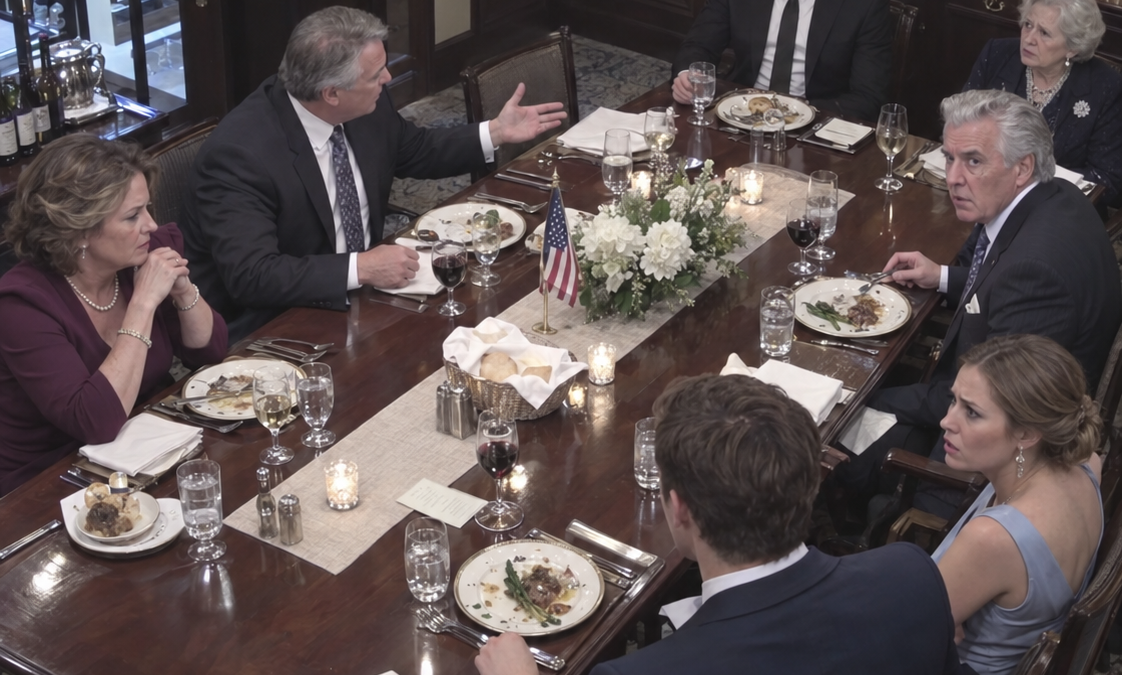
The bride’s father froze. He looked me dead in the eye and whispered, “Wait. You’re him?”
Then he went completely silent.
The entire table went still. My father lost every trace of color in his face.
My name is Harrison Holloway. I’m thirty-two years old, and last Saturday, at my younger brother’s incredibly lavish, over-the-top engagement dinner, my father looked across a mahogany table filled with twenty-three people and told the bride’s extremely wealthy family that I was a complete lost cause who cleaned toilets for a living.
I was sitting right there, perfectly quiet, trying to endure the evening. My parents laughed and publicly humiliated me simply to elevate their golden child of a son.
But there was a massive secret they didn’t know.
The bride’s father, the billionaire real estate tycoon they were so desperately trying to impress, wasn’t a stranger to me.
He was my biggest corporate client.
And over the next forty minutes, my family watched their entire carefully constructed house of lies burn straight to the ground.
Let me take you back to the exact second the bomb dropped. Then, because I owe you the whole story rather than just the highlight reel, I’ll take you back ten years earlier, to where this entire war actually began.
The private dining room at The Birches was suffocatingly warm. It was one of those farm-to-table restaurants situated just outside the city limits that charged an absolute fortune for exposed brick walls, rustic lighting, and portions of food so small they looked like garnishes. Twenty-three people sat around a massive, highly polished mahogany table.
The air smelled heavily of roasted garlic, expensive red wine, and the thick, undeniable desperation of my family to belong to a tax bracket they had absolutely no business being in.
My mother, Margaret, wore a plum-colored dress that definitely cost more than her first car. She sat with her posture perfectly straight and her neck stiff, playing the part of a high-society matriarch. She had spent the entire month leading up to this dinner obsessing over every detail, determined to prove to the bride’s family that the Holloways were people of substance.
My father, Richard, was working the room like a small-town politician running out of campaign funding. He was desperate to impress Clara’s family.
Clara was my younger brother Julian’s fiancée.
And Julian? Julian was doing what he had done every single day of his twenty-eight years on this earth. He sat at the exact center of attention, soaking up the praise, wearing a tailored navy suit that I knew for an absolute fact he had charged to a high-interest credit card because he couldn’t actually afford the lifestyle he projected.
Julian was a mid-level marketing manager who talked like he owned the agency.
We had just finished the appetizers when Winston Kensington leaned forward.
Winston was Clara’s father, the CEO and founder of Kensington Real Estate Holdings, a company that owned commercial properties across the entire Midwest. He was a man who commanded a room without ever needing to raise his voice. He had silver hair, a custom Italian suit, and the kind of quiet, terrifying authority my father had spent thirty solid years trying to fake in front of his coworkers at the insurance firm.
Winston looked at me from the other end of the long table. We hadn’t formally spoken that evening.
I had deliberately chosen a seat at the far end, right beside my elderly grandmother, keeping my head down, my mouth shut, and blending into the background just as my family wanted.
“And you must be Harrison,” Winston said politely, his deep voice cutting effortlessly through the chatter. “Julian hasn’t mentioned much about your line of work.”
Before I could even open my mouth to form a single syllable, my father chuckled.
It was that loud, forced, booming laugh he always used when he was trying to control a narrative or cover up his own deep-seated insecurities.
“Oh, Harrison,” my father said, waving his hand dismissively as though he were swatting a bothersome fly away from his plate. “This is our other son. He cleans houses for a living. Mostly residential stuff, you know. Mops and buckets. He does what he can.”
My mother smiled, her lips pulling tight across her teeth, and chimed in right on cue, like an actress in a well-rehearsed stage play.
“We really tried with him, Winston. We tried to get him to use his college fund for something useful. Maybe get into corporate law or management. But, well, we’ve given up on him. Julian is the real success story of the family. We’re just so incredibly proud of Julian.”
My father nodded in furious agreement, leaning closer to Winston, desperate to establish some connection based on their supposed shared superiority.
“Exactly. We just let Harrison do his little cleaning thing. He’s not exactly climbing the corporate ladder like Julian, with his big promotion and high salary.”
I didn’t react.
I didn’t flinch. I didn’t allow a single ounce of the rage burning inside my chest to show on my face. I simply picked up my crystal water glass, took a slow, measured sip of ice water, and set it back down on the pristine white tablecloth.
I kept my eyes locked entirely on Winston Kensington.
Winston had his heavy silver fork halfway to his mouth. He stopped completely, a piece of roasted asparagus hovering in midair.
His eyes narrowed slightly as he looked at my father, then shifted toward my mother’s fake, painted-on smile. Finally, they locked directly onto me.
I saw the exact split second his brilliant mind began processing the information. I saw the flicker of absolute, unadulterated shock behind his dark eyes.
He slowly lowered his fork onto his porcelain plate.
The clink of heavy silver against the dish sounded like a gunshot in the suddenly quiet room.
Winston leaned forward, ignoring my parents completely. He looked me dead in the eye and whispered, his voice carrying the undeniable weight of an anvil dropping from a great height.
“Wait. You’re him.”
I gave him the smallest possible nod, barely a millimeter of movement, just enough to confirm everything he was putting together in his head.
Winston went completely quiet.
He leaned back in his expensive leather chair and slowly folded his hands over his stomach. The entire table locked up. The silence was thick, heavy, and absolutely deafening. The waiter who had been pouring wine in the corner actually froze midway through the pour.
My father lost all color in his face. His skin turned a sickly, pale gray as he looked back and forth between Winston and me, completely unable to comprehend why the billionaire he was trying so desperately to impress was staring at his massive disappointment of a son with absolute awe.
But to understand why Winston’s reaction broke my family, and why I let them hang themselves in front of twenty-three people without saying a single word to stop them, you need to understand how we got there.
Because that dinner wasn’t just a random misunderstanding.
It was the final act of a ten-year war.
Ten years earlier, I was twenty-two years old, living in Carver, Indiana. Population: nine thousand.
Carver was the kind of small town where everyone knew exactly how much money you made, what kind of car you drove, and what time you turned off your porch lights at night. It was a town built on judgment and keeping up appearances.
My father was a regional claims manager at a midsize insurance firm. He had gotten the job when he was thirty-one years old and stayed in that exact same gray, lifeless cubicle for three decades.
He was terrified of risk, obsessed with the illusion of status, and deeply, deeply insecure about his stagnant career. He lived in constant fear of his superiors and took out that frustration by ruling our household like a petty dictator.
My mother was his loyal echo chamber. She lived for local country club gossip, constantly comparing our family to everyone else’s, always worried about what the neighbors thought of our lawn, our clothes, and our choices.
And then there was Julian.
Four years younger than me, Julian was the absolute golden boy. He played the right sports, dated the right girls, and knew exactly how to manipulate my parents’ fragile egos. Whatever Julian did was spectacular. Whatever I did was either expected or completely ignored.
There’s one specific memory that captures the shape of that dynamic before I get to the night everything finally broke.
When I was sixteen, I spent an entire summer building a small deck off the back of our house, entirely on my own initiative. I taught myself the basics from library books because my father had no interest in helping and even less interest in paying a contractor.
I measured wrong twice, had to redo an entire section of joists, and finished by August with something lopsided but sturdy. Something I was genuinely proud of.
My father’s only comment, when he walked outside to inspect it, was that the boards weren’t quite level and a real contractor would have finished it in a weekend.
Three weeks later, Julian, twelve years old at the time, drew a reasonably competent sketch of a treehouse for a school art project. My parents had a copy of the assignment framed and hung prominently in the front hallway, then took him out for a congratulatory dinner at his favorite restaurant.
I don’t say this to suggest my childhood was one unbroken parade of injustice. There were ordinary happy days, too, moments of real affection that I don’t want to erase from the record simply because the ending turned bitter.
But the pattern was there long before the MBA brochure ever appeared on my placemat. I think it’s worth naming honestly rather than pretending the rot started on that one rainy Thursday.
The fuse for the explosion at that engagement dinner had been lit on a rainy Thursday night in my parents’ kitchen a whole decade earlier.
I had just graduated with a degree in business administration. I came home exhausted, only to discover that my entire future had already been mapped out for me without my consent.
When I walked into the kitchen, a glossy, expensive-looking admissions packet for a local MBA program was sitting directly on my dinner placemat.
“I already paid the application fee,” my father said, not even looking up from his evening newspaper. “You’ll start in the fall, now that you’ve graduated. I talked to a guy at the firm. You can come in as an entry-level analyst. Safe salary, good 401(k). You’ll be set for life. You won’t have to worry about a thing.”
I looked down at the brochure.
It looked like a prison sentence.
A lifetime of gray cubicles, kissing up to bosses who didn’t care about you, and living the exact same terrified, risk-averse life my father had lived. I could already feel the walls closing in around me.
“I’m not going to grad school, Dad,” I said quietly, leaving the brochure on the table and taking a step back.
He slowly lowered his newspaper. The paper crinkled loudly in the quiet room. My mother stopped washing the dishes, her hands freezing in the soapy water.
The silence in that kitchen was thick enough to choke on.
“Excuse me?” he said, his voice dropping an octave and taking on that dangerous, authoritative tone he used whenever he wanted to intimidate us.
I reached into my worn-out canvas backpack and pulled out a thick, heavy binder.
I had spent the last eight months of my senior year researching, calculating, and building a comprehensive business plan. It contained detailed market research, exact cost projections, a realistic twelve-month cash-flow estimate, and a full demographic breakdown of the regional commercial sector.
I set it gently on the table beside his MBA packet.
“I’m starting a commercial cleaning company,” I told him, looking him directly in the eye and refusing to back down. “I’ve already scoped out the Indianapolis market. There’s a massive gap in reliable, high-tier facility maintenance for midsize commercial buildings. Everyone focuses on the massive skyscrapers or the small residential homes. The middle market is wide open. I can start small, do the manual labor myself to keep overhead low, and scale up within two years to hire a dedicated crew.”
My father stared at the binder as though it were a dead rat on his dining table.
He didn’t reach for it. He didn’t open it. He didn’t read a single page of the hundreds of hours of painstaking work I had poured into it.
“You want to scrub toilets?” he asked, his voice dripping with absolute, unfiltered disgust. “I spent twenty years putting a roof over your head, funding your college education, and your big master plan is to be a janitor? You want to drag our family name through the dirt while your brother is applying for pre-law programs?”
“It’s a business, Dad. It’s a highly scalable industry with a massive profit margin if you run it efficiently. I’m not going to be the janitor forever. I’m going to be the CEO of a facility management firm.”
“It’s a joke!” he yelled, suddenly slamming his heavy hand onto the wooden table so hard that the silverware rattled against the plates. “I have colleagues at the firm who are sending their kids to medical school. I have bosses whose sons are getting into investment banking. What am I supposed to tell them at the holiday party? That my eldest son is emptying trash cans for minimum wage? You’re embarrassing me. You’re a complete embarrassment.”
My mother wiped her hands on a dish towel and looked at me with pure, agonizing disappointment, as though I had just confessed to some terrible crime.
“Harrison, please don’t do this to us. Your father works so hard to maintain our image in this town. Just take the MBA. Don’t be difficult. Why can’t you just be more like Julian? Julian never causes these kinds of problems.”
“I’m not being difficult, Mom. I’m building my own life on my own terms.”
My father stood up, his face flushed crimson with rage.
“If you want to be a garbage man, you do it on your own dime. I am not funding a mop-and-bucket operation. You have until the end of the month to pack your things. You’re completely cut off. No inheritance, no safety net, no support. Nothing. We’re done.”
He turned on his heel and walked out of the kitchen, his heavy footsteps echoing down the hallway.
My mother didn’t say a single word to defend me. She didn’t try to stop him. She simply turned her back, picked up a sponge, and went back to scrubbing a perfectly clean plate, acting as though I had already ceased to exist.
I didn’t wait until the end of the month.
I went straight to my room, grabbed two large canvas duffel bags, and packed my entire life in forty-five minutes.
As I loaded my belongings into the trunk of my beat-up Honda in the dark, freezing driveway, the rain began coming down in cold sheets.
Then the front door creaked open.
It was my grandmother, Beatrice.
She was seventy-eight years old at the time, sharp as a tack, and the only person in that entire house who actually saw me for who I was.
She had been living in the small in-law suite at the back of the house since my grandfather passed away. She walked down the wet driveway in her slippers, ignoring the cold rain soaking into her clothes and holding her knitted cardigan tight around her chest.
She didn’t say a word at first.
She walked right up to me, reached into her deep pocket, and pulled out a thick white envelope, pressing it firmly into my hand.
“There’s eight hundred dollars in there,” she whispered, her voice raspy but incredibly strong. “It’s not much. It’s what I could pull from my savings. But it’ll buy your first industrial vacuum and a whole lot of bleach.”
“Grandma, I can’t take your money,” I said, my throat tightening so hard that I could barely speak.
I tried to push the envelope back into her hands.
“Take it,” she commanded, her grip on my hand tightening with surprisingly fierce strength.
Then she handed me something else.
A crisp white cotton handkerchief.
She had embroidered my initials, HH, into the corner by hand, using dark blue thread.
“For the hard days,” she said, tapping my chest right over my heart. “Listen to me, Harrison. Your father is a terrified man. He’s so afraid of failing that he never once tried to build anything real in his entire life. He wants you in that cubicle because if you succeed out here on your own, it proves to him that he wasted his life. Don’t let his fear become your cage. Go build your empire. Prove them all wrong.”
I hugged her tightly, breathing in the faint, comforting scent of lavender and old paper that always clung to her clothes.
I drove away from Carver that night, my tires splashing through deep puddles along the highway. I gripped the steering wheel until my knuckles turned white.
And I didn’t look back once.
Indianapolis was brutal.
It was a baptism by fire.
My first apartment cost $475 a month. It was a tiny, single-room studio above a loud dive bar, with peeling yellow wallpaper, a mattress on the floor, and a radiator that sounded like somebody hitting a metal pipe with a hammer every single night at three in the morning.
I took Grandma Beatrice’s money and bought a used, rusted white van. The heater didn’t work. The air-conditioning was nonexistent. The back smelled faintly of wet dog and old, harsh chemicals.
My first client was a small independent dental clinic on the east side of the city.
They paid me a grand total of two hundred dollars a week.
I was the CEO, the marketing department, the accountant, and the janitor.
I would wake up at four in the morning in the freezing cold, drive to the clinic, and scrub the mint-green bathroom tiles until my hands were raw and blistered. I learned the exact chemical ratio of ammonia and water needed to remove stubborn hard-water stains. I learned how to buff a cheap linoleum floor so perfectly that it looked like pure glass.
My back ached in a deep, agonizing way that didn’t stop even when I tried to sleep on my cheap, lumpy mattress.
By month six, I had hustled my way to five contracts. I was working sixteen-hour days, seven days a week. The physical toll was agonizing, but the financial spreadsheets I kept on my cramped kitchen counter were starting to look beautiful.
The math was working.
At the end of year one, my total revenue was $62,000.
It wasn’t millions.
But it was mine.
I remember the night I finally closed the books on that first full year. I was sitting cross-legged on my apartment floor with a calculator and a stack of invoices because I still couldn’t afford proper accounting software and didn’t yet trust anyone else with my numbers.
When the final total came out to sixty-two thousand dollars and change, I didn’t call anyone to celebrate.
There was no one at that point whom I trusted to actually be happy for me rather than immediately start looking for an angle in the news.
I simply sat there on the floor of that tiny studio, listening to the dive bar’s muffled music thumping through the floorboards below, and allowed myself to feel, for the first time since leaving Carver, something close to pride.
Pride that didn’t immediately curdle into that old, familiar need for somebody else’s approval to make it real.
That was when I hired my first employee.
Her name was Carmen.
She was a single mother from Guatemala who had just finalized a horrific divorce and was fighting a brutal, emotionally draining legal battle for full custody of her two young children.
Her ex-husband was trying to claim she couldn’t provide for them.
She needed flexible hours, a fair wage, and somebody who would treat her with basic human dignity so she could pay her lawyer.
I paid her twenty percent above the industry standard.
She showed up fifteen minutes early every single day, worked with incredible, meticulous precision, and never once complained about the grueling labor.
Carmen taught me a lesson I never forgot.
A business is only as strong as the people holding the mops.
If you take care of your people, they will take care of your clients.
There’s one specific night from that first year I want to tell you about because I think it captures something the highlight version of this story tends to skip over: just how close the whole thing came to falling apart before it ever had the chance to become anything.
It was a Tuesday in February, roughly eight months in, deep enough into a Midwestern winter that the cold had stopped feeling like weather and started feeling like a physical opponent.
I was driving back from the dental clinic at eleven at night, exhausted in that specific, bone-deep way that comes from scrubbing floors for seven hours straight, when the van’s engine made a sound I’d never heard before.
A grinding, metallic shriek.
Then it simply died.
I coasted to a stop on the shoulder of a mostly empty two-lane highway, snow beginning to fall through the beam of my one working headlight.
I sat there for a long moment, my hands still on the steering wheel. And I want to be honest about something: I came closer to quitting during those fifteen minutes on the side of that highway than at any other point in the entire decade that followed.
I did the math in my head, the same brutal arithmetic I’d been running for months.
I had $412 in my checking account. Rent was due in six days, and a tow plus a repair on a van that old could easily run three or four hundred dollars on its own.
Money I didn’t have, with no clear way of getting it.
I remember thinking, with a clarity that frightened me, that my father’s MBA brochure was probably still sitting in a drawer back in Carver.
And it would take exactly one phone call to make all of this stop.
I didn’t make that call.
Instead, I called a tow truck company, watched half my checking account disappear into a flatbed fee, and spent the night sleeping upright in the cab of the truck in the mechanic’s lot because I couldn’t afford both the tow and a motel room.
I remember the mechanic, a heavyset man named Gus, who opened his shop at six the next morning and found me still sitting there. He brought me a cup of coffee without being asked and told me gruffly that he’d give me a payment plan on the repair if I needed one.
I did need one.
I took it.
I paid off that repair bill in four installments over the following two months. I never missed a single payment because missing one would have meant admitting, even privately to myself, that this whole thing had been a mistake.
I think about that night often, more than almost any other single memory from those early years.
Because it’s the moment I understand, in hindsight, as the actual test.
Not the engagement dinner years later, which I walked into already armored and prepared, but that cold shoulder of an empty highway, where nobody was watching, where quitting would have cost me nothing but pride, and where I chose, alone in the dark, to keep going anyway.
I called Grandma Beatrice every Sunday evening without fail.
She asked about my profit margins, my client retention rates, and my liability insurance policies. She didn’t ask when I was getting a real job.
She listened to me.
She validated my existence and my hard work.
Every few months, I would make the mistake of calling my parents, hoping something had changed.
The conversation was always exactly the same.
My father would answer, give a dismissive grunt, and immediately hand the phone to my mother as though speaking to me were a chore.
My mother would ask when I was coming back to the real world, then spend twenty uninterrupted minutes talking about Julian.
Julian had gotten into a prestigious fraternity. Julian had landed an amazing internship at a downtown firm. Julian had bought a new designer watch that cost more than my van.
I took the blinding, sharp pain of their constant rejection and weaponized it.
I poured every ounce of my anger, my grief, and my relentless drive directly into my company.
Year three was a massive turning point for Holloway Commercial Services.
I had grown from just myself and Carmen to a dedicated, highly trained team of twelve full-time employees. We had standard uniforms, a fleet of three reliable vans, and a reputation for absolute perfection.
And then I landed my first true whale.
A midsize tech company in downtown Indianapolis needed a massive, multistory facility cleaned nightly. They were unhappy with their current vendor.
I came in, pitched them aggressively, and won.
The contract was worth $340,000 a year.
I remember sitting in my freezing van in the parking lot outside their towering glass building, staring at the freshly signed contract resting on my steering wheel.
My hands were shaking uncontrollably.
I had done it.
I had officially broken through the barrier of small-time operations. I was running a real, highly profitable enterprise.
I picked up my phone.
I didn’t call Grandma Beatrice first.
Like an absolute idiot, like a wounded, desperate child who still just wanted his dad to look at him and be proud, I called my father.
He answered on the third ring.
“Yeah?”
“Dad, it’s Harrison.”
“I’m busy, Harrison. The lawn mower is acting up again, and your mother is breathing down my neck about the landscaping. What do you want?”
I took a deep breath, looking down at the wet ink on the contract and feeling a sudden surge of hope.
“I just wanted to tell you some news. I signed a new corporate client. The contract is worth $340,000 a year. My company is really growing. Dad, I’m hiring more people. It’s really happening. I did it.”
There was a long, agonizing pause on the line.
The kind of silence that stretches out and makes your stomach drop.
I waited for it.
I waited for the “Good job, son.”
I waited for an “I underestimated you,” or even just a basic “Congratulations.”
Instead, I heard the sputtering sound of a lawn mower engine stalling out in the background.
My father sighed heavily, a wet, exhausted sound into the receiver, as though my success were entirely exhausting to him.
“So,” he said, his voice dripping with the exact same venom and condescension from three years earlier, “how many people are you sending to mop floors now? You know, Julian just got a massive promotion at the marketing firm. They bumped his salary up by fifteen percent. Real corporate money. He’s managing massive accounts. Harrison, he wears a tailored suit to work. He’s really making a name for himself.”
Then he added, “Listen, I have to go fix this carburetor. Tell your mother I need more lemonade if you talk to her.”
Click.
He hung up on me.
He didn’t even say goodbye.
I sat in my freezing van in that empty parking lot for twenty long minutes.
I didn’t cry.
The sadness had completely burned out, leaving only a cold, hard, indestructible resolve in its wake.
That was the absolute last time I ever shared a single detail about my life, my finances, or my business with my parents.
I locked a massive steel door over that part of my heart.
And I threw away the key forever.
The real betrayal, the exact moment that showed me how toxic and rotten my extended family had become under my parents’ constant influence, happened a year later at my Aunt Martha’s funeral.
I drove back to Carver for the service, wearing a clean, perfectly tailored black suit I had bought with my own hard-earned money.
During the somber reception at my parents’ house, I was standing quietly in the kitchen getting a glass of water. The house was packed wall to wall with aunts, uncles, and cousins eating dry sandwiches and gossiping about the inheritance.
My cousin Felix walked in.
Felix was an incredibly arrogant real estate agent who thought selling a few two-bedroom ranch houses in a dying town made him the absolute Wolf of Wall Street.
He had a cheap beer in his hand and a massive, cruel smirk on his face.
He walked right up to me, making sure he was surrounded by half the family, including my Aunt Brenda and Uncle Marcus.
“Hey, Harrison,” Felix said loudly, intentionally raising his voice to ensure the entire living room grew quiet enough to hear him. “I saw a garbage truck driving down Route 9 today. Made me think of you. You still driving around with the bleach and dirty rags, making sure those toilets sparkle for minimum wage?”
A few cousins snickered openly.
Aunt Brenda covered her mouth with her hand to hide a vicious, delighted smile. Uncle Marcus looked down at his expensive shoes, completely unwilling to step in and defend his nephew.
I looked across the crowded living room.
My mother and father were standing right there by the fireplace.
They had heard every single word Felix said.
They didn’t say a thing to defend me.
In fact, my father looked slightly embarrassed that I was even in the room, breathing the same air as his supposedly successful relatives.
He actually turned his back on me.
I looked back at Felix.
I could have told him that my company was now generating over a million dollars in annual revenue. I could have told him that my personal net worth was already triple the value of his entire real estate portfolio and that I didn’t have a single cent of debt.
But I looked at the smug, punchable faces of my family and realized something profound.
They didn’t want me to be successful.
They desperately needed me to be the failure.
They needed me to be the punchline so Julian could look brighter, and so my father’s incredibly mediocre, cowardly life could feel like a massive victory.
If I showed them my success, they would simply find a way to tear it down, belittle it, or falsely claim credit for it.
So I smiled calmly at Felix.
“Yeah, Felix. Still working with the rags. Good to see you.”
I left the funeral reception early, but before I drove back to Indianapolis, I made one more stop.
Aunt Martha’s grave.
I want to tell you about that stop because it’s a detail I’ve never included when I’ve told this story before, and I think it belongs here.
Aunt Martha, my father’s older sister, had never once in my entire childhood treated me the way the rest of the family did.
She lived two towns over from Carver and had worked as a school nurse for thirty-one years. She possessed a quiet, unglamorous kindness that made her something of an outsider in a family that prized appearances above almost everything else.
She used to slip me five-dollar bills at Christmas, telling me to buy myself something nobody else had picked out. And she was the only relative besides Grandma Beatrice who had ever asked me, with what felt like genuine curiosity rather than obligation, what I actually wanted out of life instead of what I was expected to want.
I hadn’t been especially close to her in my adult years. The distance from Carver and my general estrangement from the family had seen to that.
But I’d always regretted not making more of an effort.
Standing at that reception with Felix’s mockery still ringing in my ears, I found that I couldn’t simply drive away without saying a private goodbye of my own.
I drove to the cemetery on the edge of town, found her fresh grave still covered in the day’s flowers, and stood there alone for perhaps twenty minutes in the cooling evening air.
I spoke to her quietly, the way you talk to someone you know can’t actually hear you, but to whom you need to say the words out loud anyway.
I told her I was sorry I hadn’t visited more.
I told her about the company, about Carmen, and about the growing list of contracts I hadn’t shared with anyone in the family because I’d learned the hard way that sharing them only ever invited contempt or exploitation.
I told her that I understood now, standing at her grave, surrounded by a family that couldn’t be bothered to defend me from a smirking real estate agent at her own funeral reception, why she’d always seemed a little apart from the rest of them.
Decency, in a family built on image and hierarchy, tends to isolate the people who actually practice it.
I don’t know that it changed anything in practical terms, but I left that cemetery with clearer resolve than I’d walked in with.
And I think, looking back, that those quiet twenty minutes at Martha’s graveside did more to steady me for the seven years of building that followed than the humiliation inside the house ever could have undone.
Over the next seven years, I built a corporate empire in total, beautiful silence.
Holloway Commercial Services expanded rapidly from Indianapolis into Ohio, then Michigan, then Illinois. We completely stopped doing small clinics and started taking over massive facility management contracts for regional hospitals, sprawling university campuses, and towering corporate headquarters.
I didn’t just have janitors anymore.
I had a highly trained, deeply loyal workforce of 283 employees operating across fourteen different states.
My annual revenue crossed $18 million.
I bought a stunning penthouse downtown, paying for it in cash. I drove a discreet but incredibly expensive Porsche. I established fully funded college accounts for Carmen’s children, promoted her to regional director, and gave her a six-figure salary.
My employee retention rate was eighty-seven percent, the absolute highest in the entire commercial facility sector.
I was a total ghost to my family in Carver.
But in the corporate world of the Midwest, I was a titan.
And that is exactly how I met Winston Kensington.
Eighteen months before that fateful engagement dinner, Kensington Real Estate Holdings put out a highly competitive bid for a massive facility management contract covering forty-seven of their largest commercial buildings across the Midwest.
The contract was worth an astronomical $3.8 million a year.
It was the white whale of the industry.
Every major cleaning conglomerate in the country was bidding on it.
I didn’t send a sales representative.
I went myself.
I walked into Kensington’s boardroom in Columbus, Ohio, wearing a custom navy suit and carrying a fifty-page proposal I had written, audited, and bound myself.
There were six intimidating executives sitting around the massive glass table. Winston Kensington sat at the head, looking like a king holding court.
For two grueling hours, they grilled me.
They asked about supply-chain logistics, liability coverage, employee turnover, and our history of lawsuits.
Winston didn’t say much until the very end of the meeting.
Then he leaned forward, steepling his fingers, his piercing dark eyes locking onto mine.
“Mr. Holloway,” Winston said softly, silencing the room. “Your numbers are impeccable. Your cost projections are aggressive. But I need to know what happens when things go catastrophically wrong at two in the morning in a building with a burst pipe. Who handles it?”
I looked him dead in the eye without blinking.
“My people handle it, sir. Because I pay them a living wage. I provide them with full health care, and I don’t treat them like disposable labor. When a pipe bursts, my regional managers don’t wait for a frantic call from me. They fix the problem because they have ownership in the work.”
I held his gaze.
“I started this company scrubbing mint-green tiles with a toothbrush at four in the morning in a freezing clinic. I know the exact human cost of that labor, and I fiercely protect the people doing it.”
Winston stared at me for a long, heavy minute.
The silence in the boardroom was absolute.
Then a slow, genuine smile spread across his face.
“I have sat across from a hundred CEOs who only care about the bottom line,” Winston said softly. “You’re the first one who actually cares about the foundation. You have the contract.”
We shook hands.
Over the next year and a half, my company managed his buildings flawlessly. Winston and I developed a deep mutual respect. We played golf twice a year.
He knew my business model inside and out, but he didn’t know my family.
He didn’t know my last name was connected to Julian Holloway, the brother who was dating his daughter, Clara.
To Winston, I was simply Harrison, the brilliant CEO of Holloway Commercial Services.
I learned much later, during a conversation with Winston himself roughly a year after the engagement dinner, exactly what had gone through his mind at that boardroom table eighteen months before Julian’s engagement was ever announced.
We were having a quiet dinner at his home, an evening he had insisted on hosting. Winston poured us both a second glass of scotch and leaned back in his chair.
“You want to know the real reason I gave you that contract?” he asked. “It wasn’t the numbers, though the numbers were good. I’ve had a hundred CEOs sit across that table from me with better spreadsheets than yours.”
He paused, studying me.
“What I noticed when you answered that question about the burst pipe at two in the morning was that you didn’t flinch. You didn’t hedge. You gave me an answer that told me you’d actually lived the problem you were solving, not just studied it from a business school case file.”
He swirled the scotch in his glass, watching the amber liquid move.
“I’ve built my entire career learning to spot the difference between people who talk about hard work and people who’ve actually done it with their own two hands. You have calluses under that expensive suit, Harrison. I could see it in the way you carried yourself. Most executives I meet have never done a single hour of the labor their companies are built on. You’d done thousands of hours of it. That’s not something you can fake in a boardroom, no matter how good your proposal is.”
He told me, too, that he’d had his own version of my story.
Not identical, but close enough in shape that he had recognized something in me the moment I sat down across from him.
His father, he explained, had been a shift supervisor at a steel plant outside Pittsburgh. A man who had scraped and saved to send Winston to a state college, only to watch his son abandon a stable accounting job after two years and gamble everything on a single speculative real estate purchase.
It was a rundown apartment building nobody else wanted, bought with borrowed money and pure stubbornness.
“My father didn’t speak to me for almost three years after that,” Winston said. “He thought I’d lost my mind, throwing away security for a pile of bricks nobody else believed in.”
He looked around the room.
“It worked out, obviously. You’re sitting in the house it eventually built. But I never forgot what those three years of silence felt like, waiting for someone I respected to simply believe in me.”
He paused before continuing.
“I think that’s part of why what I saw at that dinner table hit me as hard as it did. I recognized the shape of it immediately. I’d lived a version of it myself.”
I asked whether his father had ever come around, whether the silence had eventually broken in some slow, complicated fashion. I wondered whether something similar might someday happen with my own mother.
“He came to see the second building I ever bought,” Winston said. “Never said much about it. Just walked the halls, ran his hand along one of the load-bearing walls like he was checking my work, and told me on his way out the door that I supposed I hadn’t lost my mind after all.”
He gave a faint smile.
“That was as close to an apology as I ever got. And I decided eventually that it was enough. Some men don’t have the words for it. You learn to read the gesture instead.”
I’ve thought about that conversation many times since.
It helped me understand Winston’s fury at the engagement dinner, not merely as the outrage of a principled businessman defending an associate, but as something much more personal.
It was the reaction of a man who had once stood exactly where I’d stood, waiting for approval that came, if it came at all, in gestures rather than words.
A man who recognized with total clarity exactly what my father was doing to me the moment he heard it out loud.
The illusion finally collided violently with reality on a random Tuesday afternoon.
I was standing in my massive corner office, looking through the floor-to-ceiling windows overlooking downtown Indianapolis, reviewing a major lawsuit one of our competitors was facing for wage theft.
My cell phone buzzed loudly on my mahogany desk.
It was Julian.
My golden brother.
We hadn’t spoken a single word to each other in eight months.
“Hey, Harrison,” he said, his voice painfully fake, dripping with that forced, upbeat tone he always used when he wanted something from someone. “Listen, I’ve got big news. I’m engaged.”
“Congratulations, Julian. That’s great,” I replied, keeping my voice perfectly neutral and masking the absolute lack of emotion I felt toward him.
“Yeah, thanks. So, her parents are throwing this massive, exclusive engagement dinner on Saturday at The Birches in Carver. It’s going to be very high-end. Her family is, well, they’re kind of a really big deal.”
He paused, and I could practically hear him searching for a way to deliver the real purpose of his call.
“Anyway, Grandma Beatrice said she absolutely won’t come unless you’re there. Her health hasn’t been great, and she was adamant. So Mom and Dad wanted me to extend the invite.”
I understood immediately.
He didn’t want me there.
My parents definitely didn’t want me there.
I was the annoying ransom they had to pay just to get my grandmother to attend, simply so the family would look complete.
“Who’s your fiancée?” I asked, looking out the window at the sprawling city skyline and watching traffic move far below.
“Clara. Clara Kensington. Her dad runs a massive real estate empire in Ohio. You wouldn’t know them. It’s way above our pay grade, but they are absolutely loaded.”
He took another breath.
“Just do me a favor, man. Wear something nice, okay? Try not to look like you just came off a shift scrubbing floors. We need to make a good impression on these people.”
I stopped breathing for a solid second.
My hand tightened around the phone.
Kensington.
I turned slowly back toward my desk.
Sitting right there, displayed proudly in a heavy silver frame on the corner of my desk, was a $3.8 million contract signed in thick black ink by Winston Kensington.
“I’ll be there, Julian,” I said smoothly, a slow, dangerous smile creeping across my face that he couldn’t see. “I wouldn’t miss it for the world.”
I hung up.
I didn’t laugh.
I didn’t gloat.
I felt a cold, sharp, terrifying precision settle deep into my bones.
The universe was handing me the perfect storm, a beautifully wrapped gift of absolute karma.
And I was going to ride it straight into the shoreline of my family’s incredible arrogance.
Saturday evening arrived.
I deliberately didn’t drive the Porsche.
Instead, I went to a rental agency and rented a standard, incredibly boring midsize sedan. I wore a simple, unbranded black suit, clean and perfectly presentable but completely unassuming.
I wasn’t going there to show off my wealth.
I was going there to let them show exactly who they truly were.
I drove the three hours to Carver, pulling into the gravel parking lot of The Birches fifteen minutes early.
The private dining room was already buzzing with voices.
As soon as I walked through the heavy wooden double doors, the temperature in the room seemed to plummet.
My mother spotted me first.
She gave my outfit a quick, panicked visual inspection, exhaling a tight breath of relief when she saw I wasn’t wearing a uniform and name tag.
She power-walked over, grabbing my bicep with a grip that actually bruised my skin.
“You’re late,” she hissed, even though I had arrived perfectly on time. “Listen to me very carefully, Harrison. The Kensingtons are incredibly important people. Clara’s mother, Victoria, judges absolutely everything. Do not talk about your messy little business. If someone asks, just say you work in residential services and immediately change the subject. Do you understand me?”
“Hello to you too, Mom. You look lovely,” I said firmly, pulling my arm away from her grip.
My father walked over, barely making eye contact and checking his watch nervously.
“Harrison, go sit at the far end of the table. Stay quiet and let Julian handle the conversation tonight. We can’t afford any slip-ups.”
I bypassed them both without another word and walked straight to the end of the long mahogany table.
Grandma Beatrice was sitting in her wheelchair.
She looked much frailer than the last time I’d seen her, her skin paper-thin and translucent. But her eyes were still ablaze with that fierce, unbroken intelligence.
I knelt down beside her on the hardwood floor.
She gripped my hand with surprising, desperate strength.
“You came,” she whispered, her voice rough with emotion.
“I’d go anywhere for you, Grandma,” I said, pressing a gentle kiss to her warm cheek.
“They’re going to try to make you feel small tonight,” she warned, glaring down the length of the table at my father, who was busy schmoozing a waiter. “Don’t you let them do it, Harrison. You’re worth ten of them.”
“I won’t,” I promised.
I took my seat right next to her.
Across from me were Aunt Brenda and Uncle Marcus.
Brenda gave me a tight, incredibly fake smile that didn’t reach her eyes.
“Harrison, still surviving out there in the dirt? We thought you might have given up by now.”
“I’m doing just fine, Aunt Brenda. Peachy,” I replied, taking a sip of water.
Fifteen minutes later, Julian and Clara arrived, followed shortly by Winston and Victoria Kensington.
The room erupted into loud applause and my mother’s fake, high-pitched laughter.
I stayed seated in the background, perfectly still, watching the absolute circus unfold.
Julian was sweating through his expensive cologne, practically bowing to Winston every time the man spoke. My father hovered around Winston like a desperate, unpaid intern, laughing entirely too loudly at jokes Winston hadn’t even made yet.
Eventually, everyone took their assigned seats.
Julian ended up sitting diagonally across from me.
He placed his expensive smartphone faceup on the table beside his water glass. He was too busy leaning over to kiss Clara’s cheek and play the perfect fiancé to notice his screen light up with a notification.
But I noticed.
A notification banner appeared, bright and clear, on Julian’s phone.
It was a message from a group chat titled Family Dinner, Kensington Prep.
I have 20/20 vision.
The text was from my mother.
Make sure Harrison doesn’t open his mouth about his mop and bucket. We can’t let him embarrass Julian in front of the Kensington real estate money. If he tries to talk, talk over him immediately.
A second message appeared directly beneath it.
This one was from Felix, my lovely cousin.
Don’t worry, Aunt Margaret. If the trash man tries to speak, I’ll distract him with a shiny object or ask him to take out the restaurant’s garbage.
I want to pause here and tell you something about Clara herself.
Because in the version of this story people usually hear, she exists mostly as a detail: the bride whose wedding fell apart, a name attached to the Kensington fortune.
I think that does her a disservice, and I think what she did in the weeks after that dinner deserves to be told.
I hadn’t spoken directly to Clara before that night, beyond the brief, polite exchange of a handshake when she and Julian first arrived.
But roughly three weeks after the engagement officially ended, I received an email from her.
Not a phone call, which I think she correctly guessed I might not answer from an unfamiliar number, but a carefully composed email.
The subject line simply read, I owe you an explanation, if you’ll let me.
She wrote that she’d spent the weeks since the dinner replaying her entire relationship with Julian in a new light.
Small moments that hadn’t registered as significant at the time suddenly clicked into a troubling pattern when viewed through the lens of what she’d learned about my family.
Julian’s occasional offhand comments about his boring brother in facility services.
A dinner months earlier when Julian had actively steered the conversation away from me after Clara’s father casually asked what his brother did for work.
A framed photograph in Julian’s apartment showing just four people: Julian, Richard, Margaret, and Julian’s college roommate.
The roommate had been standing in what should have been my place at a family gathering because I hadn’t been invited. Nobody had thought to mention that when Clara asked about the picture.
“I don’t think I truly understood until that dinner how thoroughly your family had built an entire structure around erasing you,” Clara wrote.
“And I don’t think I fully understood until I watched my own father’s face change at that table how much that pattern should have worried me about the man I was about to marry.
“Not because Julian is inherently a bad person, but because he was raised inside a family that taught him cruelty could be excused as long as it was dressed up as loyalty to the right son. I don’t know what kind of husband that eventually makes someone. I decided I didn’t want to find out.”
She ended the email by saying she hoped my company continued to do well, that she’d heard from her father how much he respected the work, and that she was sorry.
Genuinely sorry.
Not performatively.
She was sorry that the evening meant to celebrate her engagement had instead become the setting where I was finally seen by people who should have seen me a decade earlier.
I wrote back briefly, thanking her for her honesty and telling her I hoped she eventually found a family, whether the one she was born into or one she built, that never once made her feel as though she needed to apologize for existing in the wrong room at the wrong time.
We’ve exchanged a handful of emails since.
Nothing regular, but always kind.
I understand from Winston that she’s doing well and dating someone new, someone who, by all accounts, is considerably less concerned with impressing anyone at all.
But back at that engagement dinner, as I stared at those messages on Julian’s phone, I sat back in my chair and felt my pulse pounding heavily in my ears.
This wasn’t just casual ignorance anymore.
This was a coordinated, premeditated assassination of my character.
They had literally formed a strategy group chat just to make sure I remained the family failure.
They were terrified that my mere existence would somehow pollute their proximity to wealth.
I reached into my breast pocket.
My fingers brushed against the soft, worn cotton of the handkerchief Grandma Beatrice had given me ten years earlier.
The embroidered HH felt rough against my thumb.
I looked up.
Winston Kensington was just taking his napkin off his plate. He hadn’t seen me yet.
The lighting in the back of the room was dim, keeping me perfectly concealed in the shadows.
I didn’t feel anger anymore.
Anger is chaotic. Anger is messy.
What I felt was absolute, surgical, terrifying clarity.
I wasn’t going to cause a scene. I wasn’t going to yell or throw a drink.
I was going to sit perfectly still, eat my expensive dinner, and wait for my father to pull the pin on his own grenade.
And that brings us right back to the moment the appetizer plates were cleared.
Right back to the exact moment my father, bloated with his own fake importance and desperate to impress the billionaire sitting across from him, decided to use me as a stepping stone.
“This is our other son,” my father said to Winston. “He cleans houses for a living. We’ve given up on him.”
Winston Kensington completely and utterly froze.
The heavy, intricately engraved silver fork he was holding in his right hand, with a single piece of oil-roasted asparagus perfectly balanced on its polished tines, simply stopped moving in midair.
I need you to visualize this exact second in time because it was the precise, defining moment when a decade of carefully constructed, incredibly toxic lies began to violently fracture and bleed out onto the pristine white tablecloth.
The ambient restaurant music, some soft, unassuming jazz instrumental, was playing gently through hidden overhead speakers.
The waiters, dressed in crisp white shirts and black vests, moved quietly around the perimeter of the room, pouring incredibly expensive red wine into crystal glasses that caught the dim, rustic lighting of the chandeliers.
And my father, Richard, was practically beaming.
His chest was puffed out so far that his cheap, off-the-rack suit jacket looked as though it might pop a button and send it flying across the room.
He was utterly thrilled with himself, riding a massive, intoxicating high of his own manufactured ego, completely convinced that he’d just delivered the ultimate devastating punchline and secured his permanent place in high society.
He had looked a billionaire real estate tycoon dead in the eye and proudly, arrogantly announced that his eldest son was a pathetic, ambitionless loser who scrubbed dirty toilets for a living.
Winston slowly, methodically, deliberately lowered his silver fork onto his delicate porcelain plate.
The sharp metallic clink of heavy silver against the dish echoed through the sudden, suffocating quiet at our end of the table like a gunshot in an empty canyon.
Winston completely ignored my father’s desperate fawning and painfully eager smile.
He ignored my mother’s perfectly practiced, stiff-necked, high-society posture.
Instead, Winston leaned forward.
He rested his custom-tailored forearms on the edge of the table, his movement slow and incredibly calculated, and locked his dark, piercing, utterly intimidating eyes directly onto mine.
“Wait,” Winston whispered.
His deep, gravelly voice didn’t require volume to demand absolute, unquestioning attention.
It carried a sudden, heavy gravity that silenced the idle chatter of every person sitting within a ten-foot radius.
“You’re him.”
I didn’t smile.
I didn’t gloat.
I didn’t give my parents or my smug brother the satisfaction of seeing any emotional reaction on my face whatsoever.
I simply looked back at the incredibly powerful man who had signed a massive, life-changing $3.8 million commercial real estate contract with my facility management company just eighteen months earlier.
And I gave him a single, microscopic nod of confirmation.
Winston leaned back in his plush, oversized leather chair.
He folded his hands over his stomach, intertwining his fingers in a gesture of deep contemplation.
He looked directly at me, taking in my plain, unbranded black suit.
Then he slowly turned his head toward my father.
And then he looked right back at me.
The silence that fell over that private dining room was so absolute, so suffocatingly thick and heavy, that you could clearly hear the air-conditioning unit humming steadily through the brass vents in the ceiling.
My father’s arrogant, self-satisfied smile began to falter.
The corners of his mouth twitched downward in a sudden spasm of uncertainty. His brow furrowed in genuine confusion.
He looked at Winston, his eyes darting back and forth as he frantically tried to read the room, completely failing to understand why the incredibly wealthy man he was trying to impress was currently staring at me with a look of absolute, unadulterated respect.
“Winston?” my father asked.
His voice had suddenly lost all its booming, artificial confidence. It shrank into a nervous, eager, almost high-pitched tone of panic.
“Is everything all right? Like I just said, Harrison only does a little residential cleaning on the side. He struggles, but we love him anyway. It’s absolutely nothing for you to worry about. Julian is the one you really want to talk to about corporate strategy and big business.”
My father leaned forward, desperation beginning to show through his smile.
“Julian just got that massive promotion and a huge salary bump at his marketing firm. We’re actually talking to a lawyer right now about setting up a specialized trust fund for him once the marriage is finalized, to protect his assets and secure his future.”
My father was digging his own grave with a massive diesel-powered backhoe, and he was far too blind to see the dirt piling up above his own head.
He was recklessly tossing out corporate buzzwords like lawyer, salary, and trust fund, desperately trying to speak the language of immense wealth, a language he didn’t actually understand in the slightest.
Winston slowly turned his head back toward my father.
The look of utter disgust, profound disappointment, and deep, terrifying judgment on the billionaire’s face was so intense it could have melted solid steel.
“Richard,” Winston said, his voice dropping into a dangerously low, rumbling register and abandoning the polite dinner-conversation tone entirely, “are you completely out of your mind, or are you simply a pathological liar?”
My mother gasped audibly.
It was a sharp intake of air that sounded as though she were choking.
Her manicured hand flew to the fake pearls resting against her throat.
“Excuse me?” she sputtered, her perfectly painted, carefully contoured face instantly turning a blotchy, panicked shade of crimson. “Mr. Kensington, I absolutely don’t understand what’s happening right now. We’re just being honest about our family dynamics. We don’t want any secrets between our families before the wedding.”
“I don’t think you understand much of anything about your own family, Margaret,” Winston cut in.
He didn’t raise his voice by a single decibel, but the sheer, crushing authority in his tone seemed to pin her physically against her expensive wooden chair.
She looked as though she’d just been slapped across the face with a heavy brick.
Winston reached into the inside breast pocket of his custom Italian wool suit jacket.
He pulled out a sleek, minimalist, incredibly expensive leather cardholder.
He opened it slowly, slid a single, exceptionally thick business card out with his thumb, and casually tossed it onto the absolute center of the mahogany table.
It was a heavy, premium navy-blue business card with bright, beautifully embossed silver lettering.
It slid smoothly across the polished wood, catching the light from the chandeliers, and stopped right in front of my father’s dinner plate, sitting there like a loaded, ticking weapon.
“The young man you just publicly humiliated in front of my entire family,” Winston said, his voice echoing clearly through the dead-silent room and commanding the terrified attention of every single guest, “is the founder, sole owner, and chief executive officer of Holloway Commercial Services.”
He let the words settle.
“He operates a massive facility management empire across fourteen different states. He employs nearly three hundred people, providing them with full premium benefits, retirement plans, and thriving, competitive wages.”
My mother stared at the card.
Winston continued.
“Eighteen months ago, he walked into my executive boardroom in Columbus completely alone and flawlessly outnegotiated three of the largest corporate facility management conglomerates in the entire country. My real estate holdings company currently pays his firm $3.8 million a year to manage our commercial properties.”
He looked at my father, then back at me.
“He is one of the most brilliant, ethical, and relentless minds I have ever had the absolute pleasure of doing business with.”
The color drained from my father’s face so incredibly fast that I honestly thought he was going to have a massive cardiac event right there over his roasted salmon.
His skin turned a sickly, translucent shade of gray.
His jaw literally dropped open, exposing his bottom teeth.
He stared at the navy-blue business card sitting against the white tablecloth as though it were a live explosive about to detonate and wipe out his entire existence.
And Winston was absolutely not done.
He shifted his piercing, furious gaze directly toward Julian.
My younger brother sat completely frozen in his chair, his mouth slightly open, a piece of artisan bread hovering halfway to his face.
The golden-boy arrogance, that sickening superiority he carried every single day of his life, had been wiped completely from his features, rapidly replaced by pure, unadulterated, paralyzing terror.
“Julian,” Winston said coldly, the profound disappointment in his voice cutting deeper than any jagged knife, “you sat in my living room last month drinking my scotch and told me your older brother was struggling. You looked me directly in the eye and told me he was a low-level janitor who couldn’t get his life together.”
Julian’s hand began to lower toward the table.
“You sat here tonight and let your parents mock him mercilessly in front of my wife and my daughter. Harrison’s company generates over eighteen million dollars in annual revenue. He has the highest employee retention rate in the entire commercial sector. He’s a recognized, respected titan in his industry.”
Winston’s expression hardened.
“And you people sit here and treat him like he’s something you scraped off the bottom of your shoe.”
My cousin Felix, who had been loudly and obnoxiously mocking me at Aunt Martha’s funeral all those years earlier, literally choked on his expensive red wine, coughing violently into his linen napkin.
Aunt Brenda looked as though the floor had dropped out from underneath her chair.
Uncle Marcus stared at me with his eyes practically bulging out of his head, completely speechless.
The silence that followed Winston’s earthshattering declaration was absolute chaos in its quietest, most destructive form.
You could physically feel the massive shift in power, status, and reality inside that room.
The Kensingtons were looking at my family not just with judgment, but with utter, undeniable revulsion.
They saw exactly who the Holloways truly were.
A pack of insecure, toxic, social-climbing frauds.
My mother began stammering, her voice shaking uncontrollably as she desperately tried to rewrite a decade of horrific history in real time.
Her hands trembled violently as she reached blindly for her wineglass, knocking it against her plate and spilling a few drops of red wine onto the pristine white cloth.
“Well, well, Winston, we simply didn’t know the exact scale of this little operation,” she cried, her voice pitching into a hysterical, grating frequency. “Harrison is incredibly private. He never tells us anything about his life or his finances. We always knew he had wonderful potential. Of course we did. We’re his parents. We’re so incredibly proud of him.”
She looked around the table, searching for anyone willing to accept the lie.
“We just thought he was keeping it small to avoid too much stress.”
I decided I’d finally heard enough of her sickening lies.
For the first time that evening, I spoke.
I kept my voice perfectly level, completely devoid of the raging, burning emotion tearing through my chest, projecting a calm, icy authority.
“You didn’t know the scale, Mom?” I asked quietly.
My voice carried effortlessly to every corner of the room.
Every eye snapped directly toward me.
“Seven years ago, I called Dad to tell him I’d signed my first major corporate contract for $340,000. I was ecstatic. I wanted to share it with you. Do you remember what he said?”
My mother didn’t answer.
“He asked me exactly how many people I was sending to mop floors, bragged about Julian’s entry-level marketing salary, and then hung up on me to go fix a broken lawn mower.”
My father swallowed hard.
A thick bead of sweat rolled visibly down his pale forehead.
The sheer, unmitigated panic of being exposed as a complete fraud and a terrible, unsupportive father in front of the wealthy family he had been so desperately trying to leech off was visibly tearing his mind apart.
He scrambled to save face in the most pathetic, cowardly, utterly disgusting way possible.
“Now wait just a damn minute!” my father practically shouted.
He slammed his heavy hand flat onto the table, trying to muster some fake, authoritative outrage to cover his soul-crushing terror.
“Harrison is completely exaggerating. He’s always been incredibly dramatic and sensitive. Winston, yes, he has a successful business, but he absolutely did not do it alone.”
My stomach tightened.
“I gave him his seed money,” my father declared. “I funded his startup when the banks wouldn’t even look at him. I gave him a massive chunk of his early inheritance to get that company off the ground. We supported him financially and emotionally from day one. He’s just trying to make himself look like a self-made martyr to impress you.”
The absolute, staggering, breathtaking audacity of my father’s lie hung in the heavy air of the dining room for exactly two seconds.
Before I could even formulate a verbal response to that disgusting, desperate, completely fabricated claim, Grandma Beatrice moved.
She had been sitting quietly beside me the entire evening, absorbing every word and watching her son destroy his own reputation.
Now she slammed her frail, shaking hand onto the heavy wooden table with a physical force I honestly didn’t know she still possessed.
The sound cracked through the room like a bullwhip.
“You miserable, lying coward!” Beatrice yelled.
Her voice was raspy with age, but it carried the fierce, protective, undeniable rage of a matriarch who had finally reached her absolute breaking point.
My father flinched violently in his chair, recoiling as though he’d been struck across the face with a closed fist.
“Mom, please. You don’t understand modern business.”
“Do not ‘Mom’ me, Richard!” Beatrice snapped, pointing a trembling, arthritic finger directly at his pale, sweating face.
“You never gave that boy a single solitary dime. You handed him a useless MBA brochure he didn’t want. And when he refused to live your pathetic, terrified, miserable, cowardly life, you kicked him out of your house into the freezing rain.”
My father’s lips parted, but she didn’t let him interrupt.
“You completely cut him off. You threatened his college fund. You threatened his inheritance. And you looked him directly in the eye and told him he would be absolutely nothing but a garbage man.”
The entire table of Kensington relatives stared in sheer, unadulterated horror.
Victoria Kensington, Clara’s mother, looked absolutely sick to her stomach, holding a napkin against her mouth.
Clara stared at Julian with wide, terrified, tear-filled eyes, finally realizing that the perfect family she was about to marry into had actually been built on a rotting foundation of pure, unadulterated toxicity.
“I was the one who gave him eight hundred dollars from my own meager savings so he could buy a commercial vacuum,” Beatrice continued, her chest heaving with righteous, furious anger, her eyes blazing with protective fire.
“He built that eighteen-million-dollar empire with his own two hands. He built it scrubbing dirty floors at four in the morning until his hands literally bled, while you sat in your safe, gray cubicle and talked behind his back to your country club friends.”
Her voice rose one final time.
“You do not get to claim a single ounce of his massive success. You have absolutely no right to his glory. You’re a small, petty, deeply insecure man, Richard, and you always have been.”
My father shrank back into his expensive chair.
He physically looked smaller, as though the air had been violently let out of his tires.
The grand, sophisticated, wealthy illusion he had spent thirty years painstakingly constructing in Carver, Indiana, had just been dismantled, shredded, and incinerated in under five minutes.
I want to explain briefly why Grandma Beatrice’s outburst carried the weight it did.
Because to everyone else at that table, it must have looked like simply another furious relative piling on.
But I understood, watching her, that something much older and more personal was finally surfacing.
Beatrice had married my grandfather at nineteen against her own mother’s wishes because he was a machinist with no family money and no prospects beyond what he could build with his own two hands.
Her mother had refused to attend the wedding.
She had spent years afterward making pointed comments about the modest house Beatrice and my grandfather eventually built together, then died decades later without ever acknowledging that the supposedly reckless marriage had produced forty-one years of genuine happiness, three children, and a small but comfortable family business my grandfather built repairing farm equipment.
Beatrice had told me the story exactly once, years earlier, during one of our Sunday phone calls.
Not as advice, exactly, but as context.
“I know what it costs to be told the life you’re choosing isn’t good enough,” she’d said. “I lived it for years before your grandfather finally proved everyone wrong. And even then, my mother never said she was sorry. She just quietly stopped bringing it up. I decided that was going to have to be enough, because it was all I was ever going to get.”
Watching her slam her hand onto that table in the private dining room, I understood that she wasn’t only defending me.
She was finally, at eighty-eight years old, saying out loud everything she’d never gotten to say to her own mother, using my father as a belated stand-in for a grievance that had waited seventy years for its moment.
My mother burst into loud, heaving tears.
But they weren’t tears of remorse for how she had treated me.
They were tears of profound, selfish embarrassment.
She buried her face in her linen napkin, sobbing loudly as she realized that her social-climbing days were permanently, irreparably over.
My father couldn’t take it.
The intense public shame was entirely too much for his fragile, inflated ego to process.
His fight-or-flight response kicked in, and he chose a chaotic, irrational mixture of both.
His face changed from pale gray to a mottled, furious, highly dangerous purple.
He violently pushed back his chair.
The wooden legs screeched against the polished hardwood floor, making several people physically wince at the awful sound.
“Harrison,” he hissed, his voice shaking with uncontrollable, venomous rage. “A word. Right now. In the hallway.”
He didn’t wait for my answer.
He turned on his heel and marched aggressively out through the heavy double doors of the private dining room.
I didn’t rush.
I took a slow, deliberate sip of my ice water.
Then I gently patted Grandma Beatrice’s trembling hand, giving it a reassuring, loving squeeze.
She gave me a firm, proud, unwavering nod, her eyes shining brightly with unshed tears.
I stood up smoothly, buttoned my unbranded black suit jacket with one hand, and slowly, calmly walked out of the dining room, leaving the absolute smoking wreckage of my family behind me at the table.
The long hallway outside was lined with dim, rustic wall sconces and expensive watercolor paintings of peaceful farm landscapes.
My father was pacing frantically back and forth across the expensive carpet, running his hands aggressively through his thinning hair and muttering to himself.
As soon as the heavy wooden doors clicked shut behind me, completely isolating us from the rest of the party, he spun around and lunged toward me.
He stopped just inches from my chest, pointing a violently shaking finger directly at my face.
“You planned this!” he spat, actual droplets of saliva flying from his lips and landing on my lapel. “You orchestrated this entire disgusting, vindictive spectacle to humiliate me. You knew Winston Kensington was going to be here. You deliberately set up your own brother to look like a complete fool on the biggest night of his life. You vindictive, jealous, spiteful little—”
“Stop,” I said.
I didn’t yell.
I didn’t raise my voice by even a fraction of a decibel.
I simply spoke with the exact same cold, absolute, terrifying tone I used when my corporate lawyers were drafting a multimillion-dollar lawsuit against a vendor who had maliciously breached a contract.
Cold, dead, and entirely final.
My father’s mouth snapped shut instantly.
He blinked rapidly, physically stunned by the sheer force of the unbreakable boundary I had just thrown up between us.
“I didn’t plan a single thing, Dad,” I said, stepping closer and forcing him to move back and look up at me. “I didn’t reach out to Winston before tonight. I didn’t announce my net worth to the table to show off. I sat there in complete, absolute silence.”
I held his gaze.
“You were the one who couldn’t wait five miserable minutes to use me as a prop to boost your own pathetic, fragile ego. You introduced me as a total failure. You pulled the trigger on that gun. I just let you look down the dark barrel when it fired.”
“You could have told us,” he said desperately, trying to pivot the blame, his voice cracking under the strain of his own cognitive dissonance. “If you were making that kind of corporate money, you should have told your family. We would have supported you. We would have embraced the business. We would have—”
“You would have what?” I interrupted, my voice turning to absolute, unforgiving ice.
“You would have asked for a massive loan to pay off your mortgage. You would have tried to take complete credit for my grueling hard work, exactly like you did five minutes ago in front of the Kensingtons.”
His mouth tightened.
“Ten years ago, you threw me out into the dark street because you were terrified of what your mediocre coworkers would think of you. You chose your fragile, pathetic social status over your own flesh and blood.”
He looked away, entirely unable to meet my eyes, staring intensely at the rustic floorboards as though the answers to all his failures were written there in the wood.
“You want the real truth, Dad?” I continued, stepping firmly into his personal space and letting ten long years of suppressed facts finally hit the oxygen.
“While you were bragging to the neighbors about Julian’s little entry-level marketing promotions, I was fighting off massive corporate lawsuits from aggressive competitors trying to steal my multimillion-dollar contracts. While you were obsessing over your meager retirement fund, I was setting up fully funded college accounts for the children of the brave immigrants who actually helped me build my company.”
I thought of Carmen, of those early mornings, of the sacrifices she’d made when nobody else was willing to give her a chance.
“People like Carmen, my very first employee. She was going through a horrific divorce and fighting a brutal, terrifying custody battle when you threw me out. Now she’s bought her first house in cash because I pay her a six-figure salary.”
I gestured toward the world beyond the hallway.
“I own premium commercial real estate across the entire Midwest. I drive a Porsche you couldn’t afford with ten years of your gross salary. But I didn’t need you to know a single piece of that, because your approval completely stopped mattering to me the exact night you hung up the phone on me.”
My father stood perfectly still in that dim, quiet hallway.
He looked exactly like a completely deflated balloon.
His shoulders slumped forward heavily. His chest caved inward, and the color never returned to his face.
The horrifying, inescapable realization that he had completely lost control of his carefully crafted narrative, and lost his eldest son permanently in the process, was finally sinking deep into his bones.
“You ruined your brother’s engagement,” he whispered weakly, staring blindly at the floor.
It was a desperate, pathetic final attempt to make me the villain of his completely shattered story.
“No,” I replied calmly, adjusting my cuffs. “Julian ruined his own engagement when he lied to his future father-in-law to make himself look better. You ruined it when you allowed your blinding arrogance to completely obscure reality.”
I paused, letting him absorb every word.
“You all dug this massive, inescapable grave together over the course of ten years. Now you get to lie in it.”
I turned my back on him.
I didn’t wait for a rebuttal.
I didn’t wait for a fake apology.
I walked back to the heavy wooden doors, gripped the brass handles, and pushed them open.
Stepping back into the private dining room felt exactly like walking into a fresh crime scene.
The atmosphere was completely toxic.
Clara, the beautiful bride-to-be, was crying quietly into a linen napkin, her shoulders shaking with silent sobs as she completely refused to look at Julian.
Winston and Victoria were leaning close to each other, speaking in hushed, incredibly serious, urgent tones and entirely ignoring my mother.
Margaret sat completely frozen in her chair, staring blankly at the wall, her expensive mascara running in dark streaks down her pale cheeks.
I walked straight past my mother.
I walked past Julian, who wouldn’t even lift his heavy head to look at me, his face buried deep in his trembling hands.
I stopped at the head of the table, standing tall and confident directly beside Winston Kensington.
“Mr. Kensington,” I said smoothly, ensuring my voice remained highly respectful but incredibly firm. “I sincerely apologize for the dramatic disruption to your daughter’s lovely evening. My company will, of course, continue to provide exceptional, uninterrupted facility services to your commercial properties. But I think it’s best for everyone in this room if I take my leave now.”
Winston stood up immediately.
It was a rare sign of deep, genuine respect from a man of his incredible stature.
He extended his right hand.
“Harrison,” Winston said, his voice warm, steady, and full of admiration, “it’s an absolute privilege to do business with you. Please don’t apologize. The disruption was incredibly enlightening. It saved my daughter from making a catastrophic, life-altering mistake.”
He clasped my hand firmly.
“We’ll be in touch regarding the lease renewals next quarter. Have a safe drive back to Indianapolis.”
I shook his hand.
Then I walked to the far end of the long table and knelt on the hardwood floor beside Grandma Beatrice’s wheelchair.
“I have to go, Grandma,” I whispered, holding both of her fragile, warm hands in mine.
“You go,” she said, a brilliant, fierce, beautiful smile lighting up her wrinkled face and cutting straight through the horrible tension in the room. “You go back to your incredible empire, Harrison. I’m so incredibly proud of the man you’ve become.”
I kissed her forehead gently.
Then I stood up, looked at the table full of my stunned, utterly silent relatives, and delivered my final, unbreakable boundary.
“I love my grandmother,” I said, my voice carrying clearly across the room and leaving absolutely no room for interpretation or debate. “But as for the rest of you, I will never, ever sit at a table where I’m expected to shrink myself just so you can feel tall.”
I looked from one face to another.
“Do not call me. Do not contact my office. We’re done.”
I turned around and walked out of The Birches.
I didn’t look back a single time.
I walked into the cool, refreshing night air, got into my boring, unbranded rental car, shifted into drive, and headed straight back to Indianapolis.
As my tires hit the highway, I felt a massive, crushing weight that I hadn’t even realized I’d been carrying for ten long years lift completely off my chest.
For the first time in a very long time, I felt like I could truly breathe.
Three months passed in absolute, glorious peace.
The fallout from the engagement dinner was rapid and entirely devastating for my family.
Word travels incredibly fast in a small town like Carver, Indiana.
When the Kensingtons officially called off the wedding exactly two weeks later, returning the expensive ring and citing irreconcilable differences in core family values, the local gossip spread like a raging wildfire through dry brush.
Julian’s golden-boy image was utterly and permanently shattered.
He lost access to the billionaire network he’d been banking on to elevate his mediocre career.
My mother was effectively ostracized from her beloved, pretentious country club circle once the real story leaked through the grapevine about how she’d treated her self-made millionaire son.
The wealthy women she used to gossip with suddenly stopped returning her calls, completely icing her out of the homeowners association meetings and charity galas she lived for.
My father stopped going to the local sports bar after work, completely unable to face the whispers and mocking stares of the men he’d lied to for years about his own success and mine.
But I honestly didn’t care about their social ruin.
I wasn’t dwelling on revenge.
I was completely focused on my rapidly expanding business.
And karma, as it turns out, is not only very real, but she has an absolutely brilliant, poetic sense of irony.
I want to address something honestly here, because I think a story like mine can start to sound, in the retelling, like a triumphant fantasy in which every consequence lands perfectly and every villain gets exactly what they deserve, tidily and right on schedule.
Real life resists that kind of symmetry more often than it delivers it.
And I don’t want to give the impression that I orchestrated the building purchase as some calculated second act of revenge against my brother.
I didn’t.
My acquisitions team had been scouting downtown Indianapolis properties for the better part of a year before that particular building ever came up for sale, entirely independent of anything that happened with my family.
The overlap with Julian’s employer was pure coincidence.
The kind of coincidence that, when it happens, feels engineered by some cosmic hand with a very specific sense of humor.
But in reality, it was simply the byproduct of a midsize city where the pool of premium commercial real estate was smaller than people assumed, and where the paths of anyone doing serious business in that world were bound to cross eventually, family or otherwise.
I mention this because I think it matters for anyone hearing my story who might be tempted to go looking for their own engineered moment of comeuppance against a family that wronged them.
That’s not, in my experience, how it actually tends to work.
The satisfaction I felt sitting in my office and looking at that tenant manifest wasn’t the satisfaction of a plan coming together.
It was a quieter, stranger satisfaction.
The satisfaction of watching the ordinary, unglamorous consequences of a decade of hard work continue to unfold according to their own logic, occasionally intersecting by pure chance with the lives of people who had spent that same decade betting against me.
My company, Holloway Commercial Services, had amassed significant capital over the years. We were aggressively looking to diversify our corporate assets.
My legal team and I found a prime piece of commercial real estate located right in the heart of downtown Indianapolis.
It was a massive, modern glass-and-steel mid-rise building holding dozens of lucrative corporate leases.
We aggressively negotiated the purchase, finalized the intensive legal paperwork, wired the massive funds, and bought the building outright for twelve million dollars.
As the new legal owner of the property, my administrative department sent standard automated notices to all the current commercial tenants, informing them of the change in management, the new rent payment portals, and the updated leasing agreements.
I was sitting in my penthouse office, reviewing the massive tenant manifest on my monitor, when I saw a very familiar company name listed on the fourth floor.
Apex Marketing Solutions.
It was the exact mid-level marketing agency where Julian worked.
The agency my father had bragged about for years.
The place where Julian had gotten his massive promotion and huge salary bump.
My brother’s entire career, his entire daily life, was literally operating inside a building that I now owned, lock, stock, and barrel.
Two days after the legal notices went out, my receptionist buzzed my desk phone.
“Mr. Holloway,” she said over the intercom, her voice slightly confused, “there’s a Julian Holloway here in the main lobby. He doesn’t have an appointment, but he says he’s your brother. Should I call security to have him escorted out?”
I leaned back in my ergonomic leather chair.
I looked at the framed, worn handkerchief sitting on my desk.
“Send him up,” I said quietly.
The private elevator doors opened directly into my sprawling executive suite.
Julian walked out slowly and hesitantly, like a condemned man approaching his executioner.
He looked absolutely terrible.
He had visibly lost a significant amount of weight. Deep, dark circles had formed under his eyes, and the tailored suit he wore looked slightly wrinkled, dusty, and defeated.
He walked past the massive glass conference room, past the bustling desks of my highly paid administrative staff, and stepped cautiously into my massive corner office.
He stopped just inside the doorway.
His eyes immediately went to the floor-to-ceiling windows overlooking the entire sprawling city skyline, then to the massive mahogany desk.
Finally, they landed heavily on the keys to my brand-new Lamborghini, parked securely in my private garage downstairs, resting casually beside my open laptop.
All the arrogance, all the deeply ingrained golden-boy superiority, seemed to drain out of his body in real time.
The crushing reality of the situation hit him like a runaway freight train.
He finally realized that his high salary and big promotions were absolute, literal pennies compared to the sprawling corporate empire I had built in total silence.
“Harrison,” Julian started, his voice incredibly dry, awkward, and quiet.
He shifted his weight uncomfortably from foot to foot.
“I… I got the official legal notice from my HR department yesterday. Holloway Holdings bought the building. You’re our new landlord.”
“We did,” I replied evenly, keeping my face perfectly blank and deliberately not offering him a seat. “It’s a very solid investment property. Good location in the financial district. Reliable corporate tenants. The financial yield is excellent.”
He swallowed hard, his Adam’s apple bobbing nervously.
“Harrison, listen. About the dinner. About Clara calling off the wedding and everything completely falling apart. I… I know Mom and Dad were totally out of line. I know they shouldn’t have said those things to Winston. I was just caught in the middle of it.”
He looked at me, searching for some sign of sympathy.
“You know exactly how they are. They get in my head. They always have. I’m sorry.”
It was a pathetic, cheap, incredibly hollow apology.
He wasn’t sorry for what had happened to me over ten brutal years.
He was sorry he’d lost his billionaire fiancée, lost his elevated social standing, and was currently standing in a multimillion-dollar office owned entirely by the brother he’d mocked and belittled his entire life.
“Julian,” I said, folding my hands carefully on my desk, “do you have any idea what Carmen, my regional director, makes a year?”
He looked thoroughly confused by the sudden pivot in the conversation.
“Uh, no. I don’t.”
“She makes a base salary of $140,000 a year, plus massive performance bonuses, full premium health care benefits, and a heavily matched 401(k).”
I watched his expression.
“Ten years ago, she was a single mother fighting a brutal, terrifying custody battle, cleaning dirty toilets for me at four in the morning because she desperately needed to pay her lawyer. She’s deeply loyal. She’s brilliant. And she worked relentlessly for everything she has.”
I stood up, walked slowly around my massive desk, and leaned casually against its polished wooden edge, crossing my arms over my chest.
“You and Mom and Dad spent ten long years looking down your noses at people who do manual labor. You thought putting on a cheap suit and sitting in a cubicle made you inherently superior to the rest of the world.”
He lowered his eyes.
“You let Mom text a group chat telling everyone to silence me so I wouldn’t embarrass you in front of the wealthy people you desperately wanted to impress. You’re not a victim, Julian. You’re a willing participant in their toxicity.”
He looked down at the expensive carpet.
He couldn’t formulate a defense because there absolutely wasn’t one.
The truth was standing right in front of him, undeniable and absolute.
“I accept your apology,” I said quietly, the finality in my voice echoing through the large room. “But a forced apology doesn’t erase a decade of abuse. I’m your landlord now. If your agency pays its lease on time, we’ll have a great, seamless professional relationship.”
I paused, making certain he understood the distinction.
“But as a brother, you have a very, very long way to go before you ever earn a seat at my table. My family is made up of the people who stood by me when I had absolutely nothing. You only showed up today when you realized I had everything.”
Julian nodded slowly.
He didn’t try to argue.
He didn’t beg.
He turned around and walked out of my office, looking completely and utterly defeated.
He walked back toward the elevator, heading down to the fourth floor to work in a small cubicle inside my massive building.
I want to add one small postscript to that encounter, something that happened almost a year later, because it shifted slightly how I’ve come to understand Julian in the aftermath of everything.
His agency’s lease came up for a standard annual review, the kind of routine administrative matter that would normally be handled entirely by my property management team without ever crossing my desk.
But this particular renewal included a note from our leasing manager flagging that Julian had specifically requested a brief in-person meeting rather than simply signing the renewal electronically like every other tenant.
He came up to my office again, a year older and noticeably steadier than he’d been during that first defeated visit.
He’d left Apex Marketing by then for a smaller firm two floors down in the same building.
A lateral move, not a promotion.
Something he told me plainly rather than dressing it up the way the old Julian would have.
“I wanted to tell you something in person,” he said, standing once again just inside my doorway.
This time, I offered him a seat.
And this time, he took it.
“I’ve been seeing a therapist for about a year now. About Mom and Dad, mostly. And about you. And about who I let myself become in that house so I could stay the favorite.”
He looked at me directly.
“I’m not telling you this because I want credit for it. I just wanted you to hear it from me instead of through the grapevine, the way everything else in this family always travels.”
I told him I was glad he was doing the work.
And I meant it.
But I also told him honestly that hearing it didn’t change the terms of our relationship. I still needed to see that change demonstrated consistently over time rather than simply reported to me in a single office visit.
He nodded, said he understood, and left without pushing for anything more than that.
Was it a reconciliation?
Not yet.
Maybe not ever fully.
But it was the first honest conversation Julian and I had had since he was old enough to understand the currency our family traded in.
And I’ve slowly come to think that might be worth something on its own, independent of whatever it eventually becomes.
A full year passed since that defining day in my office.
My parents never called to apologize.
I know for a fact they still try to spin the narrative back in Carver.
My mother tells her few remaining friends that we simply had a minor business disagreement, desperately trying to salvage whatever is left of her shattered reputation.
My father took early retirement from the insurance firm, hiding away in his house, completely unwilling to face the reality of what his own pride destroyed.
I don’t hate them anymore.
Hate requires immense emotional energy, and I absolutely refuse to spend another ounce of my precious energy on people who are deeply committed to misunderstanding me.
I established a hard, impenetrable boundary that night, and I’ve protected my peace fiercely ever since.
Six months ago, I made the absolute best decision of my entire life.
I moved Grandma Beatrice out of my parents’ suffocating house.
I bought her a beautiful, sprawling private suite in a luxury assisted living facility right here in Indianapolis, fully staffed with incredible nurses and private chefs, with a stunning garden where she can sit and read her books in the sun.
I visit her three times a week without fail.
Last month, I was sitting in my car in the facility’s parking lot after a wonderful visit.
She had slipped a small, sealed envelope into my jacket pocket right before I left.
I opened it while sitting behind the leather steering wheel of my Lamborghini.
Inside was a single handwritten letter.
Her cursive was shaky from the severe arthritis in her hands, but the dark ink had been pressed firmly into the thick paper.
Harrison,
I watched you build your life the exact way your grandfather and I always dreamed of building ours.
Your father, unfortunately, inherited all of my fear. But you, my sweet, wonderful boy, you inherited all of my courage.
I’m so incredibly sorry it took me so long to say it out loud in front of them.
You broke the toxic cycle of this family. You built a kingdom out of the dirt they threw at you. Don’t ever let anyone make you feel small again.
The right people already see exactly how tall you stand.
Love always,
Grandma.
I read that letter three times.
And then, sitting alone in the quiet, insulated luxury of my car, I finally cried.
Not out of sadness.
Not out of grief for the family I’d lost.
But out of absolute, overwhelming relief.
I reached into the center console, pulled out the worn, soft white cotton handkerchief with the blue HH embroidered in the corner, and wiped my eyes.
I’d kept that handkerchief on me for ten brutal years.
It smelled faintly of bleach, sweat, and lavender.
It was a constant, grounding reminder of every freezing morning, every aching muscle, every blister, and every single door that had been slammed in my face.
My father tried to bury me.
My mother tried to silence me.
My brother tried to erase me.
But they didn’t realize they were planting a seed.
And from that seed, an unbreakable empire grew.
I want to continue the story a little further than the version I usually tell, because I think what happened in the two years after Grandma’s letter matters just as much as the dinner itself.
The first thing that gradually changed was my relationship with Carmen and the rest of my senior leadership team.
Word of the engagement dinner had inevitably made its way back to the office.
Not because I told anyone, but because Julian, in one of his more self-pitying moments, had apparently vented about it to a coworker at Apex Marketing, who happened to know one of my regional managers socially.
Carmen came into my office about a week after I heard the story had circulated.
She closed the door behind her and sat down across from my desk without waiting to be invited.
“I heard what your family said about you,” she said without preamble. “About us. About the work we do.”
I told her I was sorry she’d heard it secondhand, that I hadn’t wanted the story to become office gossip.
“I’m not upset that I heard it,” Carmen said. “I’m upset that you carried that alone for ten years and never once let any of us see how heavy it was.”
She looked directly at me.
“You gave me a job when nobody else would look at me twice. You paid for my kids’ education. You made me a regional director with a salary I never in my life thought I’d earn.”
Her voice softened.
“And this whole time, you were doing all that while your own family called you exactly what mine used to be called by people who looked down on us back home.”
She paused, and I saw that her eyes were wet.
“I want you to know something, Harrison. You didn’t just build a company. You built a family. A real one. The kind that shows up.”
I didn’t have a response ready for that.
I simply thanked her.
We sat in a comfortable, unhurried silence for a while before she went back to work.
But something shifted in me that day.
It was the recognition that the story I’d been telling myself, the lone-wolf narrative of a man who had built an empire entirely by himself out of spite and stubbornness, wasn’t quite accurate.
I hadn’t built it alone.
Carmen had been there from year one.
Dozens of employees, hundreds by the end, had shown up every single day and made the whole machine run.
Grandma Beatrice had funded the first vacuum.
Winston Kensington had taken a chance on an unknown vendor because both the numbers and the man standing in front of him had checked out.
Without fully realizing it, I had surrounded myself with an entirely different kind of family.
One built on merit and loyalty rather than blood and obligation.
I want to describe one more thing that grew out of that conversation with Carmen, because it became one of the things I’m genuinely proudest of in the years since.
About a month after she came into my office, Carmen suggested, somewhat tentatively, that the company create a formal internal program.
Something structured, not merely the informal generosity I’d always tried to practice.
She wanted it specifically aimed at supporting employees going through the kind of crisis she’d been facing when I first hired her.
Custody battles. Medical emergencies. Housing instability.
The unglamorous disasters that quietly derail people’s lives while the rest of the world expects them to keep showing up to work as though nothing has changed.
We built what eventually became the Holloway Foundation Fund, seeded initially with a portion of my own personal earnings and later expanded through a modest voluntary payroll-matching program that a surprising number of employees opted into once they understood what it funded.
Carmen ran it personally for the first two years, vetting applications, coordinating with employees who needed emergency housing assistance or help covering legal fees, and distributing modest but meaningful grants.
Those grants didn’t come with the kind of public spectacle or expectation of gratitude that so much charitable giving seems to require.
By the time of the engagement dinner, the fund had quietly helped forty-one employees and their families through crises that might otherwise have cost them their jobs, their housing, or worse.
I never once mentioned the fund’s existence to my family.
It wasn’t a secret born out of shame.
Quite the opposite.
It was a secret because it belonged entirely to a life I’d built without them, for people who had never once needed to be convinced I was worth investing in.
I think, if I’m honest, some part of me also didn’t want to hand my father a new angle for the same old argument: that any generosity I showed the world somehow proved I could have afforded to fund his golf club membership or Julian’s overleveraged lifestyle, had I simply chosen to do so.
There’s one more encounter I want to tell you about because I think it closes a loop that had been open since Aunt Martha’s funeral.
About eight months after the engagement dinner, my office received a cold email from a commercial real estate brokerage in Carver.
The email requested a meeting to discuss a potential listing, a small strip mall on the edge of town that had come up for sale.
It was a property my acquisitions team had flagged as a modest but reasonably profitable addition to our portfolio, mostly because it would give us a service foothold in a region we hadn’t previously covered.
I didn’t recognize the agent’s name on the email at first.
It wasn’t until a scheduled video call connected and Felix’s face appeared on my monitor that I understood exactly who I was about to do business with.
He didn’t recognize me immediately, either.
Or rather, he recognized me, but the recognition took a visibly uncomfortable second to fully settle.
It was the way your brain hesitates when you see someone in a context so different from the one you’ve always filed them under that it briefly refuses to reconcile the two images.
Felix, who had spent years selling two-bedroom ranch houses in a shrinking town and calling himself the Wolf of Wall Street, was now looking at the CEO of an eighteen-million-dollar company through a laptop screen.
A CEO who happened to share his last name.
And his blood.
“Harrison,” he said, his voice noticeably smaller than it had been at that funeral reception, cracking slightly on the second syllable. “I… I didn’t realize this was your company.”
He shifted in his chair.
“I mean, I saw the name Holloway Commercial Services on the listing inquiry, but I figured, small world. Common enough name. I didn’t think—”
“It’s fine, Felix,” I said, keeping my tone entirely professional and neutral. “Let’s talk about the property.”
We spent the next forty minutes discussing square footage, zoning restrictions, and asking price, exactly as I would with any other broker.
Felix was, to his credit, competent at his job.
His numbers were accurate, his comparable properties were reasonable, and he didn’t try to oversell the listing the way I’d half expected him to.
Near the end of the call, as we were wrapping up, he hesitated.
Then he spoke quietly, almost as an aside.
“I heard about the dinner. What happened with your dad and Julian and the Kensingtons. It’s all anyone talked about in Carver for a solid two months.”
I didn’t respond right away.
I let the silence stretch, the way I’d learned to do over the previous decade, because I’d found that silence often did more work than any statement I could make.
“I was a real piece of work to you at that funeral,” Felix finally said. “I think about that sometimes.”
He looked down briefly before continuing.
“I was trying to feel big in front of people by making you feel small. And I picked you specifically because I figured you’d just take it the way you always did. I didn’t know anything about what you’d actually built.”
He swallowed.
“I’m not asking you to forgive me or anything. I just want to say I know it was a garbage thing to do, and I’ve thought about it more than you’d probably guess.”
I told him I appreciated him saying so.
And I meant it.
But I also told him honestly that it didn’t change much about how I saw our relationship going forward.
Professional respect and personal trust were two different currencies.
He would have to rebuild the second one slowly, the same way anyone would, through consistent behavior over time rather than a single apologetic phone call.
He said he understood.
We ended up closing on the property three weeks later.
And Felix has, in the time since, been scrupulously professional in every subsequent dealing between us.
I don’t know that we’ll ever be close.
I don’t think either of us particularly needs that.
But I no longer feel the old, sharp flinch of humiliation when I think about that reception in my parents’ living room.
And I think that alone is worth something.
There’s a small coda to the Felix story I want to add.
About six months after that call, Aunt Brenda, his mother, the same woman who had covered her mouth to hide a delighted smile while Felix mocked me at Martha’s funeral, sent me a Christmas card.
It was the first communication I’d received from her in over a decade.
Inside, alongside a generic printed greeting, she’d added a single handwritten line.
Felix told me about your call. I should have said something all those years ago at Martha’s. I’ve thought about that more than I’d like to admit.
I didn’t respond to the card.
I’m not certain, even now, what an adequate response would have looked like.
But I kept it tucked into the same desk drawer where I keep my mother’s occasional voicemails.
A small, imperfect collection of the belated reckonings that decade seems to keep quietly producing, one relative at a time, on no particular schedule I can predict.
There’s one encounter I haven’t yet told you about because it happened more recently than everything else, and because it’s the one I still find hardest to talk about cleanly.
About fourteen months after the engagement dinner, my mother showed up unannounced at my office building.
Not Julian’s floor.
Mine.
The executive suite on the top level.
My receptionist called me, clearly uncertain how to handle the situation, informing me that a Margaret Holloway was in the lobby, insisting she needed to see me, refusing to leave, and beginning to attract attention from the security desk.
I almost told her to have security escort my mother out.
I sat with that impulse for a long moment, weighing it seriously, before finally telling the receptionist to send her up.
My mother looked different than she had at The Birches.
Older, somehow, in a way that fourteen months shouldn’t have accounted for on its own.
Her clothes were less expensive than I remembered, plainer, and there was a tiredness around her eyes that no amount of makeup was fully covering.
She stood in the doorway of my office for a long moment, taking in the same view Julian had taken in months earlier.
The skyline.
The desk.
The visible trappings of a life she had spent a decade insisting couldn’t possibly exist.
“I’m not here to ask you for anything,” she said before I could speak, echoing almost exactly what Julian had said in the same doorway. “I know that’s probably what you’re expecting.”
She hesitated.
“I just… I needed to see it for myself. The company. This office. I needed to understand what we actually threw away.”
I didn’t offer her a seat, the same way I hadn’t offered one to Julian during his first visit.
I wasn’t trying to be cruel about it.
I simply didn’t yet know what kind of conversation this was going to be, and I wasn’t ready to signal, through something as small as a chair, that we were further along in repairing our relationship than we actually were.
“Your father doesn’t know I’m here,” she continued. “He still can’t talk about that dinner. He gets this look on his face, like something inside him just shuts a door every time it comes up.”
She looked toward the windows.
“I think some part of him knows he can never undo what he said. And rather than sit with that, he’s decided to just stop thinking about it entirely.”
She turned back toward me.
“I don’t think he’ll ever apologize to you, Harrison. I’m not saying that to excuse him. I’m saying it because I think you deserve to know that expecting one from him is expecting something that isn’t coming.”
“I stopped expecting it a long time ago,” I told her.
She nodded slowly, looking down at her hands.
“I’ve had a lot of time to think this last year. About the country club and the gossip, and how much of my life I spent worrying about what people who didn’t actually care about us thought of our lawn, our car, our children.”
Her fingers moved against each other.
“I used to tell myself I was proud of both my sons. I don’t think that was ever fully true.”
I remained silent.
“I think I was proud of the version of Julian I could show off, and embarrassed by the version of you I couldn’t control or explain to my friends.”
She looked up.
“That’s an ugly thing to say about your own child. And it’s true. And I’ve had to sit with how true it is for longer than I’d like.”
I want to be honest that I didn’t feel a sudden rush of warmth or forgiveness hearing this.
I felt mostly a kind of tired recognition.
The sensation of finally hearing, a decade late, an admission I’d stopped needing by the time it arrived.
“I’m not asking you to let me back into your life the way it used to be,” she said. “I don’t think that’s possible. And honestly, I’m not sure I’d know how to be that person again, even if you asked me to.”
Her voice grew quieter.
“I just wanted you to know that I see it now. What we did. What it cost. I don’t expect that to fix anything.”
I told her, as honestly as I could, that I appreciated her coming and that I believed she meant what she’d said.
I told her I wasn’t ready to rebuild the relationship we’d had because that relationship had never actually been healthy to begin with.
I had no interest in reconstructing something broken just to have the shape of a mother back in my life.
But I also told her that if she wanted to build something new and different, something smaller and slower, built on actual honesty rather than image management, I wasn’t entirely closed to that.
Provided it happened on terms that didn’t require me to shrink myself again.
She cried quietly, standing in my office doorway.
Then she left.
We’ve spoken a handful of times since.
Brief phone calls. Nothing elaborate.
It isn’t a relationship in any traditional sense yet.
I don’t know if it ever fully will be.
But it’s honest in a way nothing between us had been in over a decade.
And for now, that has to be enough.
One of those calls, about three months after our office visit, is worth including briefly because it was the closest thing to a genuinely light moment my mother and I had shared since the whole ordeal began.
She called on a Sunday evening, the same day of the week I used to call Grandma Beatrice.
It was a coincidence she didn’t seem to notice, and I didn’t point it out.
She asked, somewhat awkwardly, whether I’d be willing to tell her, in plain terms, what my company actually did on a given day.
Because, she realized, she’d never once actually understood the business beyond the word cleaning.
And she was tired of not understanding the one thing that apparently mattered most in my life.
I spent almost forty minutes walking her through it.
Contract structures. Staffing. Logistics.
The difference between residential and commercial facility management.
The particular satisfaction of solving a supply-chain problem at scale.
She asked good questions, the kind that suggested she was actually listening rather than performing interest for my benefit.
Near the end of the call, she said quietly, “I wish I’d asked you this ten years ago at that kitchen table, instead of looking at your binder like it was something you tracked in on your shoes.”
I told her I wished that, too.
And we left it there.
Neither of us pretended that wishing could undo the decade it had arrived too late to prevent.
If there’s one thing I want you to take away from my story, it’s this.
Family isn’t simply defined by shared blood or a matching last name.
Blood just makes you related.
Loyalty, respect, and unconditional support are what actually make you family.
I think about Grandma Beatrice’s letter often.
The line about my father inheriting her fear and me inheriting her courage.
I’ve come to believe that fear and courage aren’t actually opposites in the way people like to imagine them.
They’re closer to siblings born of the same root, splitting apart based entirely on which one you decide to feed.
My father was afraid.
So was I, standing in that kitchen ten years earlier with a business plan nobody wanted to read.
The difference wasn’t the absence of fear.
It was what each of us did with it.
He let his fear build a cage and then spent thirty years making sure nobody else escaped it either.
I let mine become fuel.
I still have that original business card framed on my massive mahogany desk.
The cheap paper, the bad font from that first dental clinic contract.
It sits right beside the multimillion-dollar contracts, a constant, grounding reminder that there is absolutely no shame in honest hard work.
We clean hospitals where premature babies are saved.
We clean corporate towers where global economic decisions are made.
We clean the very foundation of our society.
There’s absolutely nothing lesser about the work we do.
If you’re sitting at a table where people are constantly trying to shrink you, belittle your hard-earned accomplishments, or force you into a tiny box just to make themselves feel comfortable, you need to stand up, push your chair back, and build your own table.
It will be lonely at first.
It will be terrifying.
You will doubt yourself.
But I promise you, the profound peace and success you find on the other side of a toxic family dynamic are worth every single tear you shed to get there.
I visit Grandma Beatrice every week without fail.
And we still talk about profit margins and client retention rates, the same way we did on those Sunday phone calls a decade ago.
Except now she asks the questions from the sunlit garden of a place I bought for her rather than a cramped in-law suite in a house that never once made room for either of us to be fully ourselves.
That, more than a Lamborghini, more than a penthouse, more than the eighteen million dollars, is the thing I’m proudest of.
Not that I built an empire out of spite.
But that I finally built a table with room for exactly the people who had actually earned a seat at it.
I want to end with one more image because I think it says more than any summary could.
Last month, on my thirty-second birthday, Carmen organized a small gathering at the office.
Nothing extravagant.
Just cake in a break room and a handful of senior staff who had been with the company long enough to feel like more than coworkers.
Grandma Beatrice came, too, driven over by the facility’s van service.
She sat in her wheelchair near the head of the conference table, in a spot Carmen had specifically arranged for her.
Closest to the cake.
Closest to me.
Near the end of the small party, Grandma Beatrice handed me a little wrapped box.
Inside was a new handkerchief.
White cotton, the same simple design as the one she’d given me ten years earlier in that freezing driveway.
She’d embroidered new lettering into the corner.
Not HH this time, but small, careful stitching of the words she’d written in that letter.
The right people already see.
Her hands, she told me, weren’t steady enough anymore for anything more elaborate.
But she wanted me to have something new to carry now that the first one had done its job and could finally rest in a frame instead of a pocket.
I keep the original handkerchief framed on my desk beside the first business card, exactly where Julian saw it the day he walked into my office as my tenant rather than my brother.
I carry the new one in my breast pocket now, the way I carried the first, though these days I find I reach for it less often.
Not because the hard days have stopped coming entirely.
Business rarely allows for that.
But because the specific, grinding loneliness that the first handkerchief was meant to steady me through has largely given way to something else.
A table with people at it who actually choose to be there.
Carmen and the 283 employees who show up every day and make the whole machine run.
Winston, who still calls twice a year to set up our golf game and who has, in his own quiet way, become something closer to the father figure I never expected to find.
A sixty-two-year-old man wearing a different last name than mine.
Grandma Beatrice in her sunlit garden, still asking about the numbers.
My father tried to bury me.
My mother tried to silence me.
My brother tried to erase me.
They didn’t realize they were planting a seed.
And from that seed, an unbreakable empire grew.
Not the buildings.
Not the revenue.
Not the Lamborghini in the private garage downstairs.
Though all of that is real, and none of it is something I take for granted.
The empire that actually matters is smaller than that.
And quieter.
And it fits, most days, around one long table with exactly the right number of chairs.
No more and no fewer than the people who have ever actually earned a seat at it.
Before Grandma Beatrice left that evening, with the van service waiting patiently outside, she took my hand one last time.
It was the same grip she’d used in that freezing driveway a decade earlier.
Still surprisingly strong for a woman well into her eighties.
“You know what I think about most, Harrison?” she asked. “When I look at everything you’ve built, it isn’t the money.”
She held my hand a little tighter.
“It’s that you never once let them turn you into them. You had every reason to become just as small and frightened as your father, and you didn’t. That’s the part I’m proudest of.”
Her eyes shone as she looked at me.
“Anybody can get rich if they’re stubborn enough. Not everybody manages to stay kind while they’re doing it.”
I walked her down to the van myself.
I tucked the blanket over her knees the way she used to tuck mine, then stood in the parking lot until the taillights disappeared around the corner.
The new handkerchief was folded neatly in my breast pocket, exactly over my heart.
Exactly where the first one had always been.
I went back upstairs afterward, alone, and sat for a while at my desk in the quiet of an empty office.
I looked at the two handkerchiefs, old and new, and the two business cards, cheap and expensive, all of it arranged deliberately on the same small shelf where I could see them every morning.
Ten years is a long time to carry a grudge.
And a longer time still to carry a promise.
I think, in the end, I only ever really carried one of the two.
The grudge burned itself out somewhere along the way, quietly and without ceremony.
But the promise?
The one I made to myself in that driveway in the rain, with eight hundred dollars and a handkerchief pressed into my palm?
That one I kept.
And I’ve come to believe it was the only inheritance that ever actually mattered.








