At my birthday dinner, mom whispered to my sister: “while everyone’s here… go change her locks”, my sister left without a word, one hour later, she ran back shaking… “mom… there are federal agents…”
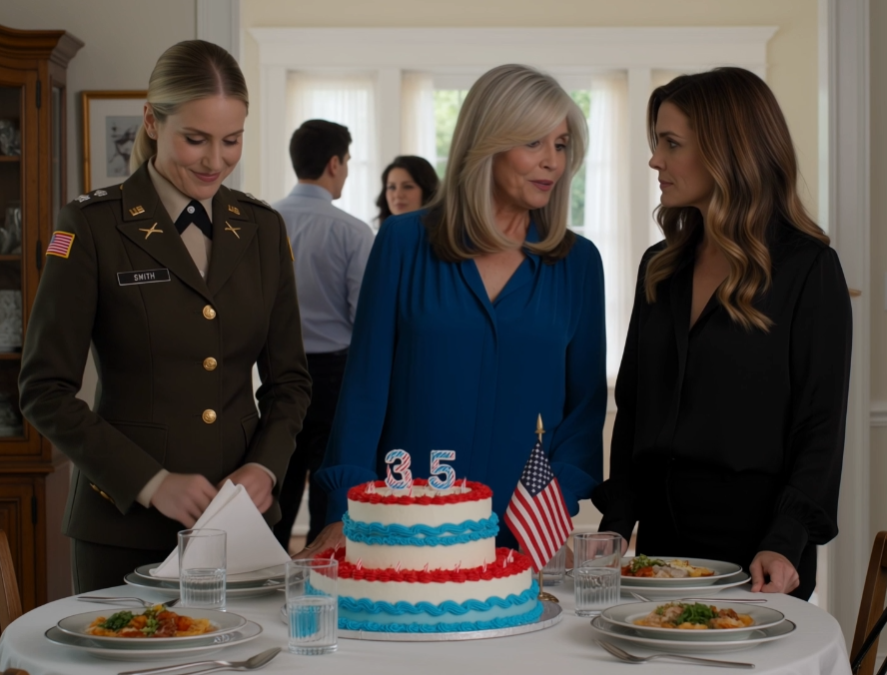
I turned thirty-five on a Friday. That morning started the way most of my birthdays had for the past thirteen years—on base, not at home. I had just finished a weeklong logistics readiness exercise at Joint Base Lewis-McChord. Nothing glamorous. Long hours, heavy equipment, too much coffee, and not nearly enough sleep. It was the kind of work nobody noticed unless something went wrong.
Around noon, my team surprised me with a small cake in the operations office. Someone had stuck a plastic Army flag on top. Captain Lewis took one look at it, laughed, and said, “Budget cuts.”
Everybody laughed. I laughed, too.
Sergeant Morales handed me a paper plate. “Happy birthday, Captain.”
“Thanks.”
“You got big plans?”
“My mom insisted on dinner.”
He gave me that look. “The annual family performance?”
“You said it, not me.”
Morales had met my family once. Once had been enough. He grinned and said, “If you disappear for more than twenty-four hours, we’ll send a rescue team.”
“I appreciate that. Just don’t volunteer any classified information over birthday cake.”
“I’ll try.”
Another laugh. Nothing dramatic, just good people. That was one thing I’d always loved about the Army. Nobody cared where you came from. Nobody cared who your parents were. You showed up, did your job, and carried your share of the responsibility. That was enough.
Before I left, Colonel Michael Harris stopped me in the hallway.
“Captain Brooks.”
“Sir.”
He shook my hand. “Happy birthday.”
“Thank you, sir.”
“You earned the weekend.”
“I’ll try not to waste it.”
He smiled. “Good.”
I grabbed my overnight bag and headed for my truck. On the drive home, I called my son.
Eight-year-old Ethan answered on the second ring.
“Happy birthday, Mom!”
“Thank you, buddy.”
“Grandma made your favorite cake.”
“Did she?”
“Well…” He lowered his voice. “I think it’s actually Aunt Rachel’s favorite.”
I laughed. “I had a feeling.”
“You still coming?”
“I wouldn’t miss it.”
“Can we get ice cream after, if I’m still awake?”
“You always say that.”
“And somehow we always end up getting ice cream.”
“Exactly.”
I smiled through the rest of the call. Whatever else happened that evening, I knew I’d get to see Ethan. That was the part of my birthday I was actually looking forward to.
By the time I pulled into my parents’ driveway, the house was already full. Cars lined both sides of the street. Neighbors, cousins, aunts, family friends—the usual crowd. My mother loved hosting parties. She loved even more making sure everyone knew she was the one hosting them.
The front door opened before I reached it.
“There she is!”
Mom wrapped both arms around me before I could even take off my jacket.
“My birthday girl.” She kissed my cheek. “I’m so proud of you.”
“Good to see you, too, Mom.”
She stepped back and looked me over.
“You came in uniform.”
“I came straight from base.”
“You look beautiful.”
She said it loudly enough for everyone nearby to hear. My mother always knew her audience.
Inside, people clapped. Someone handed me a drink. Someone else wanted pictures. I smiled, shook hands, accepted hugs, and answered the same questions I’d been answering at family gatherings for years.
Rachel walked over a few seconds later. My older sister gave me a quick, light hug that felt almost rehearsed.
“Happy birthday.”
“Thanks.”
“You look tired.”
“I probably am.”
“You should work less.”
“I’ll mention that to the Army.”
She smiled, but it didn’t reach her eyes.
Dad came over last. He hugged me tighter than usual.
“Happy birthday, Em.”
“Thanks, Dad.”
“You doing okay?”
“Of course.”
He nodded too quickly, then looked away.
It was small. Most people would have missed it. I didn’t.
Years in logistics teach you something about details. Tiny inconsistencies matter. A number in the wrong column, a missing signature, a shipment arriving a few hours too early—sometimes those little things tell you more than an entire report. People work much the same way. They usually tell you something is wrong long before they find the words to say it.
Dinner started twenty minutes later.
Roast chicken, mashed potatoes, green beans—exactly what Mom always made. She sat at one end of the table, Dad at the other. Rachel sat across from me, while Ethan squeezed between my aunt and one of my cousins, happily covering practically everything on his plate with ketchup.
Normal. Almost too normal.
People asked about work, and I kept my answers short.
“What do you actually do all day?” one of my relatives asked.
“Mostly paperwork.”
“You wear a uniform for paperwork?”
“Expensive paperwork.”
That got a laugh.
My uncle raised his glass. “To Emma.”
Everyone joined in, even Rachel. She smiled again, perfectly this time. A little too perfectly.
The cake came out after dinner. Candles, pictures, more applause. Mom insisted everyone gather close.
“Family first,” she announced.
She always liked saying that.
While everyone crowded around the table, I reached for the cake knife. That’s when I heard it.
Not because my mother intended me to hear. Not because she wanted my attention. I simply happened to lean in the same direction she did.
Mom bent toward Rachel, lowering her voice until it was barely more than a whisper.
“While everyone’s here…”
She paused.
“Go change her locks.”
I froze for only a second.
Rachel didn’t ask why. She didn’t hesitate. She didn’t even look surprised. She simply nodded once, set down her fork, picked up her purse, and walked toward the front door.
Nobody stopped talking. Nobody asked where she was going. Nobody seemed to wonder why my sister was leaving in the middle of my birthday celebration.
I looked around the table.
My aunt kept cutting cake. My cousins were laughing over something on a phone. Ethan was trying to steal an extra helping of frosting. Mom smiled at everyone as though nothing had happened.
Dad reached for his coffee. His hand missed the handle the first time.
When he finally looked up, his eyes met mine, then immediately dropped.
That wasn’t an accident.
He knew. Or at least he knew enough.
I smiled, kept cutting the cake, passed out slices, and thanked everyone for coming. On the outside, nothing changed. Inside, everything had.
I replayed my mother’s sentence over and over.
Go change her locks.
Not ask her about changing the locks. Not help her change the locks.
Just go change them.
My locks. My apartment.
Why?
I hadn’t given anyone a key in years. Not after Ethan was born. Not after I’d learned that privacy was something you had to protect, especially from people who believed they knew what was best for you.
Mom sat down beside me.
“Aren’t you eating?”
“In a minute.”
“You’ve barely touched your cake.”
“I will.”
She patted my hand. “You work too hard.”
“I’ve heard.”
“You should let family help more.”
I looked at her.
“I’ll keep that in mind.”
She smiled, satisfied, as though she’d just offered me the best advice in the world.
A few days earlier, I’d received a phone call at work. The caller had identified himself as an investigator with the Defense Criminal Investigative Service—DCIS. He asked whether we could schedule a confidential meeting.
He didn’t give me details. He only said my name had appeared during an ongoing financial investigation involving military-related benefits.
At the time, I’d assumed it was a paperwork issue. Those happened, especially when survivor benefits, insurance adjustments, tax records, and deployment histories were involved. Military administrative systems were complicated, and mistakes weren’t unheard of.
But the investigator had specifically told me one thing.
“Please don’t discuss this with anyone until we’ve spoken.”
I hadn’t. Not even with family.
Especially not with family.
At the time, I’d thought he was simply being cautious. Now, sitting at my own birthday table, watching my mother refill coffee as though she’d never whispered anything suspicious, I wasn’t so sure anymore.
Thirty minutes passed, then forty. People started talking about football. Someone turned on music. Kids ran through the backyard. Mom laughed louder than anyone.
Rachel still hadn’t returned.
Exactly one hour after she’d left, the front door flew open.
Rachel stumbled inside looking as though she’d seen a ghost. Her face had lost all its color. Her breathing was uneven, and her hands wouldn’t stop shaking.
Every conversation around the table died on its own.
She didn’t even notice me. She walked straight past my chair toward Mom, bent down, and grabbed the edge of the table.
Then she whispered, just loudly enough for me to hear.
“Mom…”
She swallowed hard.
“They’re already inside.”
Mom’s smile disappeared completely.
For the first time that night, she looked scared.
I grabbed my keys before anyone could ask where I was going. Nobody tried to stop me.
Nobody except Ethan.
He tugged on my sleeve.
“Mom?”
I knelt beside him. “I have to check something.”
“Are you coming back?”
“I’ll call you.”
He nodded, trying to accept that answer.
“Can I still get ice cream later?”
I managed a smile.
“I hope so, buddy.”
He hugged me one more time. Then I stood and walked out.
The cold night air hit my face the second I stepped off the porch. I could hear my mother calling behind me.
“Emma!”
I didn’t turn around.
I kept walking.
My truck was parked across the street. As I climbed inside, I glanced toward the house.
Rachel hadn’t followed me. Through the dining room window, I could still see her standing where she’d stopped. She wasn’t crying. She wasn’t talking. She was simply staring at the floor.
That frightened me more than anything she’d said all night.
Rachel always had an answer. She always had an explanation, a clever remark, or some way to make the situation sound less serious than it was.
Tonight, she had nothing.
The drive to my apartment usually took about fifteen minutes. That night, it felt like five or fifty. I honestly couldn’t tell.
The only thing running through my head was the same sentence.
Go change her locks.
Who sends someone to change another person’s locks? And why tonight?
My phone buzzed as I pulled onto the street leading toward my apartment.
Unknown number.
I answered through Bluetooth.
“This is Captain Brooks.”
“Captain Brooks? This is Special Agent David Collins with DCIS.”
I recognized his voice immediately. We’d spoken briefly a few days earlier.
“Where are you?” he asked.
“I’m about two blocks away from my apartment.”
“Good.”
His voice stayed calm.
“We’ve been waiting for you.”
My grip tightened around the steering wheel.
“What happened?”
“We’ll explain everything when you arrive.”
“Is my son in danger?”
There was a short pause.
“Just come straight here.”
The line went dead.
That wasn’t comforting.
When I turned the corner, I immediately saw flashing lights. Blue and red. More than one patrol car. The entrance to my apartment building was blocked with yellow police tape.
Several neighbors stood outside wearing jackets over their pajamas. Some were filming with their phones.
Great. Nothing spread faster than gossip in an apartment complex.
I parked across the street. The second I stepped out, a uniformed police officer walked toward me.
“Captain Emma Brooks?”
“Yes.”
He checked my driver’s license, then nodded.
“They’re expecting you.”
He lifted the tape so I could walk underneath.
I looked toward my building. Every window on the third floor was lit, including mine.
A maintenance worker stood near the entrance holding a toolbox. It looked like the kind of toolbox Rachel’s locksmith would have carried, except the man holding it now looked nervous enough to quit his job.
Inside the lobby, another officer stopped me.
“Elevators are reserved.”
“I’ll take the stairs.”
“Ma’am—”
“I’m Army.”
“I’ve noticed.”
He stepped aside.
“Third floor.”
I climbed the stairs two at a time.
By the time I reached my hallway, I stopped.
Not because someone told me to. Because I had to.
The entire hallway was full of people.
Two local detectives. Three uniformed officers. A forensic photographer. Someone dusting my front door for fingerprints.
And two people wearing jackets with large yellow letters across the back.
DCIS.
Standing a few feet away was another man in plain clothes. Short haircut, military posture. He noticed me immediately.
“Captain Brooks.”
I walked toward him.
“Special Agent Collins?”
He shook my hand.
“Good to finally meet in person.”
“I’d rather it had been somewhere else.”
“So would we.”
Before I could ask another question, a second man stepped forward and showed me his credentials.
“Special Agent Ryan Foster. Army CID.”
I nodded.
“What’s going on?”
Neither man answered right away.
That silence lasted maybe three seconds. It felt much longer.
Finally, Collins spoke.
“Captain Brooks—”
I took a breath.
“Am I under investigation?”
He looked surprised.
“No.”
I waited.
He continued.
“You are not our suspect.”
I blinked.
“What?”
“You heard me correctly.”
I looked around the hallway again.
“Then why is my apartment full of investigators?”
“Because someone has been using your identity.”
The hallway suddenly felt quieter, even with people moving around us.
I stared at him.
“I don’t understand.”
“We believe someone has used your personal information in multiple financial transactions over the past several years.”
“That’s impossible.”
“I wish it were.”
Foster opened a folder.
Inside were copies of documents. Mortgage records. Loan applications. Bank statements.
My name appeared on every page.
So did my signature.
Except it wasn’t my signature.
Not really.
At first glance, it looked convincing. Close enough to fool most people. But not close enough to fool me.
Years of signing military documents had made my handwriting almost automatic. I knew every curve, every letter, every shortcut I’d developed without even realizing it.
“This isn’t mine.”
“We know.”
Collins pointed toward one of the documents.
“Do you recognize this address?”
I looked.
It wasn’t my apartment. It wasn’t my parents’ house.
It belonged to Rachel’s old real estate office.
“What is this?”
“A business loan.”
“I never signed this.”
“It was approved under your name.”
My stomach tightened.
“How much?”
“About three hundred and eighty thousand dollars.”
I laughed.
Not because it was funny. Because the number sounded insane.
“There has to be a mistake.”
“I wish there was.”
He pulled out another document. Then another.
Retirement accounts. Investment paperwork. Insurance forms.
One after another.
Always my name. Always someone else’s benefit.
My head started spinning.
Then, across the hallway, I noticed movement.
Rachel.
She had somehow made it upstairs. She stood near the elevator with my mother. Both had been stopped by another officer.
Rachel wasn’t looking at me. She was looking at the investigators.
For the first time in my life, I saw genuine fear on her face.
Not embarrassment. Not frustration.
Fear.
The kind you couldn’t fake.
Mom stepped forward.
“Emma!”
An officer raised his hand.
“Ma’am, please stay where you are.”
“I’m her mother.”
“I understand.”
“I just want to speak to my daughter.”
“You can wait.”
Mom looked offended.
She wasn’t used to hearing the word no.
Collins turned back toward me.
“I need to ask you a few questions.”
“Go ahead.”
“Has anyone besides you ever had access to your financial records?”
“No.”
I answered too quickly.
He noticed.
“Think carefully.”
So I did.
Tax returns. Military paperwork. Insurance policies. Benefits. Emergency contacts. Deployment files.
Then something hit me.
Not all at once. Piece by piece, like a puzzle slowly coming together.
Whenever I deployed, Mom always offered to help.
I’ll keep your important papers safe.
You don’t need to worry while you’re overseas.
I’ll organize everything.
At the time, it had sounded thoughtful.
She kept a filing cabinet in her home office. Every folder had a label. Birth certificates. Medical records. Insurance documents. Property taxes.
She loved organizing paperwork.
Or at least that was what I’d believed.
Collins watched my expression change.
“What is it?”
I looked at him.
“My mother.”
“What about her?”
“Every time I deployed…”
I stopped.
My mouth suddenly felt dry.
“I gave her access to everything.”
He didn’t interrupt.
“She had copies of my military orders. My tax records. My insurance paperwork. My Social Security documents.”
I swallowed.
“My survivor benefit documents after my husband died.”
The words sounded different once I said them out loud.
Collins wrote something in his notebook.
“Anyone else?”
I looked across the hallway.
Rachel was still standing beside Mom.
Neither of them spoke. Neither of them moved.
Then I remembered something else.
Years ago, Mom had asked me for copies of my signature. She’d said the bank needed them while I was overseas. I never questioned it.
She was my mother.
Why would I?
Another memory surfaced. Then another.
Every deployment. Every move. Every PCS. Every stack of paperwork she’d insisted on handling for me.
I felt my chest tighten.
This wasn’t one bad decision. It wasn’t one forged signature. It wasn’t one loan.
Someone had been building this for years, and I’d handed them every piece they needed.
I looked at my mother, then at Rachel, then back at the documents in my hands.
Nothing about this had started tonight.
Not really.
It had simply revealed itself tonight.
I leaned against the hallway wall and took a slow breath.
For the first time, I stopped thinking like an officer.
I started thinking like a daughter.
Because this didn’t feel new.
It felt familiar.
Not obvious. Not loud. Just small things stacked on top of one another over time, growing quietly until there was no way to ignore them anymore.
Growing up, people loved my family.
We were the kind of family that showed up early, stayed late, brought extra food, and smiled for pictures. From the outside, everything looked warm, generous, and dependable.
My mother, Margaret, knew how to run a room. She remembered names, birthdays, and little details about people—who liked what, who had children, who was going through a difficult time. She could make anyone feel like they belonged, as long as they didn’t disagree with her.
My dad, Daniel, was quieter. Steady. Reliable. The kind of man who fixed things instead of talking about them. If something broke, he repaired it. If someone needed help, he showed up. People trusted him.
I did, too.
For a long time.
And then there was Rachel, my older sister.
Rachel was the one everyone noticed first. Confident, charming, always ready with something to say. She could walk into a room and own it in thirty seconds. She knew how to make people laugh, how to draw attention, and how to make an ordinary story sound like the most interesting thing anyone had heard all week.
I was different.
I stayed in the background. I listened. I watched. I did whatever needed to be done.
And somehow, without anyone ever saying it outright, that became my role in the family.
I was the one who handled things. The dependable one. The one who didn’t complain, didn’t demand attention, and didn’t make trouble.
It didn’t happen all at once.
It never does.
It starts small.
I remembered one Thanksgiving when I’d just come back from training. Three weeks in the field, cold and exhausted. I walked into my parents’ house carrying a bag of groceries, hoping to sit down for a few minutes before dinner preparations began.
Mom barely looked at me.
“Emma, can you help in the kitchen?”
Rachel was sitting at the table, scrolling through her phone.
I glanced toward her.
“Rachel had a long day,” Mom explained.
I nodded.
Of course she did.
I spent the next three hours cooking, cleaning, preparing dishes, and serving everyone. Rachel told stories and made people laugh. She stayed at the center of every conversation while I moved between the kitchen and dining room, making sure everything was ready.
At the end of the night, Mom wrapped Rachel in a hug.
“I’m so proud of you.”
Then she turned toward me.
“Thank you for helping.”
“Of course,” I said.
Because that was what I always said.
Then there was Rachel’s graduation.
Business degree. Big ceremony. Family everywhere.
Mom cried through almost the entire thing. Dad took pictures as though we were attending a presidential event. When Rachel walked across the stage, everyone stood, clapped, and cheered.
Later that night, we went to dinner.
Mom gave a speech.
“Rachel has always followed her heart.”
Everyone nodded approvingly.
Then she added, “And Emma has always been strong enough to support her.”
People laughed as though it were a compliment.
I smiled like it didn’t bother me.
Because back then, I didn’t think it should.
Years later, it was my turn.
My promotion ceremony in the Army.
Captain.
I’d worked hard for that rank. There had been long deployments, difficult assignments, countless hours of preparation, and responsibilities that didn’t disappear simply because I was tired.
I invited my whole family.
Mom came. Rachel came. Dad came.
They sat in the second row.
The ceremony was simple, clean, and direct. My commanding officer pinned my rank, shook my hand, and spoke about leadership, responsibility, and trust.
Those weren’t just ceremonial words to me. They meant something in the Army. They described what people expected from you when things went wrong, when decisions mattered, and when others depended on your judgment.
Afterward, there was a small reception. Several people from my unit attended. Colonel Harris was there, too.
He shook my hand and said, “You earned this.”
That mattered more than I’d expected.
I looked across the room toward my family.
Mom was talking to someone else. Rachel was checking her phone.
Dad smiled when I walked up.
“Good job, Em.”
“Thanks, Dad.”
Mom turned around.
“Oh, it’s already over?”
“Yeah.”
“That was fast.”
Rachel finally looked up from her phone.
“So you’re a captain now?”
“Yeah.”
“Does that mean more paperwork?”
“Mostly.”
She nodded.
“Sounds about right.”
And that was it.
No celebration. No speech. No moment when they stopped and seemed to understand what I’d accomplished.
Just done.
I didn’t say anything.
I never did.
That’s the thing people don’t understand about betrayal. They imagine it as something dramatic. A terrible argument. A shocking revelation. Someone screaming a secret across a crowded room.
But that’s rarely how it begins.
At first, betrayal looks like small moments you ignore, conversations you brush aside, and choices you explain away because questioning them would be uncomfortable.
You tell yourself they didn’t mean it that way. They’re just stressed. They didn’t realize how it sounded. It’s not worth making an issue out of.
And you keep telling yourself those things until one day, it becomes impossible to pretend they don’t matter.
Back in the apartment hallway, I watched my mother standing behind the police line.
Perfect posture. Controlled expression. Her face composed as though she were waiting for someone to fix the situation and return everything to normal.
That was what she always expected.
Rachel stood beside her, still shaken, still unusually quiet.
That wasn’t normal.
Rachel didn’t stay quiet unless she absolutely had to.
I looked back at Agent Collins.
“How long has this been going on?”
He didn’t hesitate.
“Based on what we’ve found, several years.”
Several years.
I nodded slowly.
That matched what I was starting to understand.
Every deployment. Every move. Every time I’d trusted someone else to handle things while I concentrated on my job.
Mom had always stepped in.
I’ll take care of it.
You don’t need to worry.
I’ll keep everything organized.
And she had.
Everything had always been kept in perfect folders, with perfect labels, arranged in perfect order.
Too perfect.
Then something else hit me.
Hard.
Not an emotional memory this time. A detail. Something specific, sharp, and legal.
I straightened.
“Wait.”
Collins looked at me.
“What is it?”
I forced myself to think about the situation logically.
What would someone need to accomplish all of this?
Access. Documents. Signatures. Authority.
Not just copies of paperwork. Some form of permission, or something that looked enough like permission to get through a bank’s procedures.
My stomach dropped.
“There was a power of attorney.”
Collins paused.
“Explain.”
“Years ago, before one of my deployments…”
I ran through the memory in my head.
Mom had insisted the document was just a precaution.
It’s in case something happens.
It’ll make things easier.
You won’t have to worry about anything back home.
So I’d signed it.
Limited scope. Or at least that was what I’d believed.
It allowed her to handle some of my financial paperwork while I was overseas.
“Do you still have a copy?” Collins asked.
“I should.”
The word should suddenly didn’t sit right with me.
I walked past the investigators and into my apartment. They let me through.
My bedroom looked untouched.
Except for one thing.
The safe.
Fireproof steel, bolted inside my closet.
Its door was open.
I knew I hadn’t left it that way.
I stepped closer.
Inside were folders, documents, passports, and insurance paperwork. Everything appeared to be in place, except for one section.
I reached for it and began flipping through the papers. Then I checked again, slower this time.
The folder labeled LEGAL was still there.
But something inside it wasn’t.
I pulled everything out, set it on the bed, and went through the contents again. Carefully. Deliberately.
The document should have been there.
There was no reason for it not to be.
Unless someone had taken it.
I stood still, holding the folder and staring at the place where a piece of paper used to be.
Then I turned toward the hallway.
Toward my family.
Toward the people who had always said they were helping me.
And for the first time, I knew exactly what was missing.
I held the folder for another few seconds before closing it carefully, almost as though the act still mattered.
When I stepped back into the hallway, Agent Collins was already watching me.
“You found something.”
“Something’s missing.”
“What?”
“A power of attorney.”
He didn’t react immediately, but Foster did. The Army CID agent stepped closer.
“Who had it?”
“My mother.”
Collins nodded once.
“That lines up.”
“With what?”
He motioned toward my living room.
“Let’s sit down.”
We ended up using my own dining table.
The same table where I’d eaten dinner with Ethan. The same place where he spread out his schoolwork, finished his homework, and sometimes asked me questions I couldn’t answer without looking them up.
Now it was covered in documents.
Printouts. Bank records. Loan approvals. Transaction logs.
Collins pushed a stack toward me.
“I need you to look at these.”
I sat down.
I didn’t rush. I didn’t panic.
The situation was unfamiliar, but the process wasn’t.
In the Army, when something goes wrong, you don’t guess. You reconstruct what happened, step by step, until the facts begin to form a sequence.
Timeline first.
Always timeline.
I grabbed a pen.
“Start from the earliest transaction.”
Collins flipped to the first page.
“Four years ago.”
I nodded.
That was right after my last deployment overseas.
“Date?”
“June twelfth.”
I wrote it down.
“Next.”
He kept going.
I built the sequence one transaction at a time. Dates, amounts, locations. Transfers going out, accounts receiving them, authorizations attached to the movement of money.
Within minutes, patterns began to form.
The same accounts. The same routing numbers. The same clusters of activity.
Not random.
Never random.
I circled a group of transfers.
“These three happened within forty-eight hours.”
“Yes.”
“Same authorization?”
Collins checked.
“Looks like it.”
I tapped the paper.
“That’s not panic spending.”
Foster leaned against the wall.
“What is it?”
“Planning.”
He straightened slightly.
“Go on.”
I pointed toward the next page.
“Whoever did this knew when the funds would be available. That means they understood the structure.”
I looked up at both agents.
“This isn’t someone guessing.”
Next came the signatures.
I pulled several documents closer. Loan applications, authorization forms, contract approvals.
My name.
My signature.
But not mine.
I placed two pages side by side.
“This one is closer.”
Collins leaned in.
“How can you tell?”
I pointed to the capital B in Brooks.
“What about it?” he asked.
“I never close the loop.”
He looked again.
“These do.”
“Exactly.”
I flipped to another document.
“Here, the spacing is off. And here, it’s too clean.”
Foster crossed his arms.
“Too clean?”
“Real signatures aren’t perfect.”
I took a blank sheet of paper and signed my name. Fast, naturally, without thinking about it.
Then I signed it again.
The two signatures were recognizable, but they weren’t identical.
“See that?”
Collins nodded.
“The pressure changes.”
“Right.”
I tapped one of the forged signatures.
“This looks copied.”
“From what?”
“Probably a scanned document.”
The room seemed to grow quieter.
Because that possibility meant something important.
Whoever had forged those signatures might have had access to original documents bearing my real handwriting.
We moved on to account numbers, routing numbers, and reference numbers.
Most people would have skimmed the pages.
I didn’t.
I went line by line, cross-checking and comparing, looking for inconsistencies.
Then I found one.
“Wait.”
Collins looked up.
“What?”
I pointed at a transfer.
“This account.”
“Yeah?”
“It’s not new.”
“What do you mean?”
“I’ve seen it before.”
“Where?”
I closed my eyes for a second.
Not guessing.
Remembering.
“In a property file.”
“Your property?”
“No.”
I opened my eyes and looked at him.
“Rachel’s old business.”
Foster pushed himself away from the wall.
“You’re sure?”
“I handled some of her paperwork years ago.”
“Why?”
“She asked for help organizing things.”
“And you did?”
“Yeah.”
“Did you have access to her accounts?”
“No. But I saw the account number once.”
“And you remember it?”
I looked at him.
“I don’t forget numbers.”
Collins flipped to another document.
“These withdrawals.”
I scanned the entries.
Regular intervals. Consistent amounts. The transactions didn’t resemble impulsive spending or random withdrawals.
They were structured.
I pointed at the pattern.
“That’s not her.”
“Who?” Collins asked.
“Rachel.”
“Why not?”
“She doesn’t think like this.”
Foster raised an eyebrow.
“You sound confident.”
“I am.”
“Explain.”
“Rachel spends when she needs something. These withdrawals are scheduled.”
I tapped the page again.
“Same day every month. Same amount. Same account.”
Collins nodded slowly.
“So who does something like that?”
I didn’t answer right away.
Because I already knew.
We shifted to the benefits next.
Military records.
That part felt different from the beginning.
Collins opened another folder.
“These are the accounts tied to your service.”
I leaned forward, already tense.
He laid out the documents.
Survivor benefits. Insurance payouts. Retirement contributions. GI Bill allocations.
Everything tied to my name. Everything tied to my service.
And one by one, those accounts had been touched.
Adjusted.
Moved.
Redirected.
“Start with this one,” Collins said.
He pointed to a statement.
I read it.
Then I read it again.
“No.”
Collins didn’t speak.
“This isn’t right.”
“Tell me what you see.”
“That withdrawal shouldn’t exist.”
“Why not?”
“Because I never authorized it.”
“Check the signature.”
I didn’t need to.
I already knew.
Fake.
The same pattern. The same flaws. Different document, same hand behind it.
Then I saw something else.
A number I recognized instantly.
Not from paperwork.
From memory.
From something much harder to forget.
I picked up the page.
My hands didn’t shake, but they suddenly felt heavier.
“This account…”
Collins waited.
“It’s my husband’s.”
The room seemed to stop moving.
Nobody interrupted.
Nobody rushed me.
“This is the survivor benefit account.”
“Yes,” Collins confirmed.
“And these withdrawals?”
I flipped the page.
Month after month. Year after year.
Money disappearing.
Not small amounts. Not accidental mistakes.
Deliberate, systematic withdrawals made carefully enough to avoid attracting attention.
I swallowed.
“How much?”
Collins didn’t answer immediately.
He turned the page himself.
Then another.
Then one more.
And there it was.
The total.
I stared at it.
I did the math in my head anyway, even though there was no need. I didn’t need a calculator. I didn’t need someone to confirm the number.
It was gone.
Not some of it.
All of it.
Everything that account was supposed to protect.
Everything that was supposed to help Ethan. His future. His college education. The opportunities his father would have wanted him to have.
Gone.
I sat back in my chair.
I didn’t speak. I didn’t move.
Across the room, through the doorway, I could see Rachel.
She was still standing there, still watching, still not saying a word.
For the first time, I wasn’t looking at her like a sister.
I was looking at her like a variable in a much bigger equation.
And she didn’t fit.
Not alone.
Not careful enough. Not patient enough. Not someone with the kind of discipline needed to build a system like this and maintain it over several years.
This had taken time, planning, control, and structure.
Rachel hadn’t built it.
She’d simply used it.
I looked back at the documents, the account numbers, and the spaces where money used to be.
One question kept returning.
Not how.
Not when.
Not even who.
Just one.
Where did it all go?
I pushed the documents back across the table. Not hard, just enough to create some space between me and the numbers.
Then I stood.
“Where’s my dad?”
No one answered right away.
I didn’t wait.
I walked past Collins, past Foster, and straight down the hallway.
Dad was still in the living room, sitting in the same chair. He looked as though he hadn’t moved since I’d left the birthday party.
He looked up when I walked in.
For a second, he smiled.
Habit.
Then he saw my face.
The smile disappeared.
“Emma?”
“Did you sign anything?”
No buildup. No warning. Just straight to the question.
He blinked.
“What?”
“Did you sign anything in my name?”
His eyes shifted.
Just a little.
That was enough.
“No.”
Too fast.
Too clean.
Too practiced.
I stepped closer.
“Think carefully.”
“I am thinking.”
“Then try harder.”
“Emma—”
“Did you sign anything?”
My voice didn’t rise.
It didn’t need to.
He leaned back in his chair and crossed his arms.
A defensive posture.
“I don’t know what you’re talking about.”
I nodded slowly.
“Okay.”
I reached into my bag, pulled out one of the documents, and placed it on the coffee table.
Then another.
Then another.
Loan agreements. Authorization forms. Bank transfers.
All bearing my name. All carrying signatures that weren’t mine.
I stepped aside.
“So explain that.”
He didn’t touch the papers.
He didn’t even look at them.
He stared straight ahead, as though ignoring the documents long enough might somehow make them disappear.
“Daniel.”
Mom’s voice came from the doorway.
Sharp. Controlled.
A warning.
Not to me.
To him.
I turned toward her.
“Don’t.”
She took a step forward.
“Emma, this isn’t—”
“Don’t.”
She stopped.
Dad finally lowered his eyes to the papers.
The signatures.
The mess sitting right in front of him.
His shoulders dropped slightly.
That was new.
I looked at him again.
“Did you sign them?”
He swallowed.
“I…”
Another pause.
Longer this time.
“I signed some things.”
There it was.
Not everything.
Not all at once.
Just enough truth to begin.
I didn’t react.
“What did you sign?”
“Just paperwork.”
“What kind of paperwork?”
“Financial stuff.”
“That’s not an answer.”
He rubbed his hands together nervously.
“I thought it was temporary.”
I leaned forward.
“Temporary what?”
He looked at Mom.
She shook her head slightly.
A silent instruction.
Don’t say it.
He looked back at me.
Too late.
“Your mother said we just needed to move some things around.”
“Move what?”
“Money.”
“Whose money?”
He didn’t answer.
He didn’t have to.
I already knew.
“My money.”
Silence settled over the room.
“Daniel.”
Mom again.
Her voice was tighter this time.
Dad flinched.
Actually flinched.
I stared at him.
“Say it.”
He closed his eyes.
“We were going to put it back.”
I let those words sit between us for a second.
Then I laughed.
Not loudly.
Not angrily.
Just in disbelief.
“Put it back?”
He nodded.
“That was the plan.”
“Whose plan?”
He didn’t answer.
I looked at Mom.
She didn’t look away.
“Yours?”
She managed a small, barely controlled smile.
“Emma, we were helping Rachel.”
“By stealing from me?”
“That’s not what this is.”
“What is it, then?”
“It’s family.”
I shook my head.
“No.”
I pointed toward the papers.
“That’s fraud.”
Dad spoke again.
“We didn’t think it would go this far.”
I turned back toward him.
“How far did you think it would go?”
He had no answer.
Because there wasn’t one.
The next morning came too fast.
I hadn’t slept. I hadn’t even tried.
I drove straight back to base.
Same road. Same truck. Same familiar surroundings.
Everything looked normal.
Until I began noticing that it wasn’t.
The gate guard scanned my ID, glanced at his screen, and paused before waving me through.
That pause.
I noticed it.
Inside the building, things felt different.
People still said good morning, but not in quite the same way. The greetings were quieter, shorter. Some people who usually spoke to me didn’t say anything at all.
I walked into the operations office.
Morales was already there.
He looked up.
“Hey, Cap.”
He stopped for a second, then continued.
“You good?”
“Yeah.”
“You sure?”
“Yeah.”
He nodded, but he didn’t look convinced.
Two other officers were standing beside the coffee machine. They stopped talking when I walked in.
That wasn’t subtle.
That was obvious.
I ignored it.
I sat at my desk, turned on my computer, entered my credentials, and waited.
The screen didn’t load.
I frowned and tried again.
Same result.
Morales walked over.
“Something wrong?”
“System’s not letting me in.”
“That’s weird.”
He leaned over and checked the screen.
His expression changed.
“That’s not a glitch.”
I looked at him.
“What is it?”
He hesitated.
Then he said it anyway.
“You’ve been flagged.”
I stared at him.
“For what?”
“I don’t know.”
“Find out.”
He nodded and walked off.
I stayed at my desk, hands resting on the surface, waiting.
Not moving.
Not reacting.
Just waiting.
A few minutes later, Morales returned.
He was walking more slowly this time.
“Cap?”
“Yeah?”
“They pulled your access.”
“All of it?”
“Looks like it.”
I leaned back in my chair.
That wasn’t standard.
That wasn’t routine.
It meant one thing.
The investigation had reached the Army, and the Army was responding fast.
Too fast.
Another officer walked into the room. He didn’t look at me. He went straight to his desk and began typing as though nothing unusual was happening.
Except everything was.
Morales lowered his voice.
“They’re saying it’s financial.”
I nodded.
“I figured.”
“You want to tell me what’s going on?”
“Not yet.”
He respected that.
He stepped back.
“All right.”
But he didn’t go far.
He stayed close, just in case.
About ten minutes later, a staff sergeant appeared beside my desk.
“Captain Brooks.”
“Yeah?”
“They need you upstairs.”
“Who’s they?”
He shifted his weight.
“Command.”
Of course.
I stood, smoothed my uniform, and followed him into the hallway.
I didn’t rush. I didn’t stall. I simply moved.
The hallway felt longer than usual, every step louder, every door heavier.
When I reached the office, the door was already open.
I stepped inside.
Colonel Harris was sitting behind his desk.
He didn’t stand when I entered. He didn’t need to. There was something about the way he carried himself that made the room seem to adjust around him.
“Captain Brooks.”
“Sir.”
I remained at attention, not because I needed reminding of protocol, but because I needed the structure.
Right now, structure mattered.
Two other officers were in the room, one from finance and one from legal. Both were watching me as though I’d already become a problem they needed to manage.
Harris didn’t look at them.
He looked at me.
“At ease.”
I relaxed slightly.
“Close the door.”
I did.
The click sounded louder than it should have.
Harris folded his hands on the desk.
“Start talking.”
No accusation. No assumptions.
Just direct.
I appreciated that.
“There’s an ongoing federal investigation, sir.”
“I’m aware.”
“My identity has been used in multiple financial transactions.”
“Also aware.”
I nodded.
“DCIS and Army CID are involved.”
“Good.”
He leaned back.
“Now tell me something I don’t know.”
I didn’t hesitate.
“My family is connected.”
Something changed in the room.
The finance officer glanced up. The legal officer stopped writing.
Harris didn’t move.
“Explain.”
“My sister appears in the transaction chain.”
“And your parents?”
“My father admitted signing documents.”
“And your mother?”
I paused.
Not because I didn’t know.
Because saying it out loud made it real.
“She had access to everything.”
Harris nodded once.
No dramatic reaction. No judgment.
Just processing.
“Are you involved?”
“No, sir.”
“Have you benefited in any way?”
“No, sir.”
“Can you prove that?”
“Yes, sir.”
“How?”
“I have independent records.”
That got his attention.
“What kind of records?”
“Backups.”
He leaned forward.
“Explain.”
“In logistics, we don’t trust a single source.”
I kept my voice steady.
“We verify everything. Supply chains, movement logs, authorization documents. Everything gets tracked.”
Harris nodded.
“Continue.”
“A few weeks ago, something didn’t feel right.”
“What?”
“I couldn’t reconcile a small discrepancy in my personal financial records.”
“How small?”
“Two thousand dollars.”
The finance officer blinked.
“That’s not small.”
“It is when you’re used to tracking millions of dollars in military equipment.”
Harris almost smiled.
“Go on.”
“So I started checking. Line by line, account by account. I found more inconsistencies.”
“Enough to prove anything?”
“No, sir. Not then. But enough to worry me.”
I paused before continuing.
“So I did what I always do. Redundancy.”
Harris watched me.
“I made copies.”
“What kind of copies?”
“Everything I could verify. Financial records, insurance documents, military benefits, tax returns. Digital and physical copies.”
“Where are they?”
“Stored separately. Encrypted. Timestamped.”
The legal officer finally spoke.
“Where are these copies now?”
“Safe.”
Harris cut in.
“Safe where?”
“Not at my apartment.”
That was all I gave them.
Not because I didn’t trust Harris. I did. He had earned that trust.
But I also trusted procedure.
And procedure said you limited exposure, protected original evidence, and didn’t tell more people than necessary where sensitive material was being kept.
Harris nodded.
“Good.”
He looked toward the other officers.
“That’s exactly what I’d expect from one of my officers.”
The finance officer cleared his throat.
“Sir, her system access has already been suspended.”
“I know.”
“Standard protocol.”
“I said I know.”
Harris didn’t raise his voice.
He didn’t need to.
“Until this investigation is complete—” the officer began.
Harris held up one hand.
“She keeps operational access.”
“Sir—”
“I’ll take responsibility.”
The room went quiet.
That was not a small decision.
Harris was accepting responsibility at a level that could affect his own career if things went wrong.
He turned back toward me.
“Can you continue your duties?”
“Yes, sir.”
“Can you stay objective?”
“Yes, sir.”
“Can you separate family from mission?”
I didn’t hesitate.
“Yes, sir.”
He nodded.
“Then get back to work.”
Outside the office, Morales was waiting.
He didn’t bother pretending otherwise.
“Well?” he asked.
“I’m still here.”
He exhaled.
“Good.”
“Access is partially restored.”
“That was fast.”
“Colonel Harris.”
Morales smiled.
“Yeah. That tracks.”
We walked back to the operations room.
This time, people didn’t avoid eye contact.
They watched.
The atmosphere was different. Still cautious, but less distant.
I sat down, entered my credentials, and logged back into the system.
My access returned.
Not everything.
But enough.
Enough to do my job. Enough to keep working. Enough to stay in control of something when so much of my personal life had suddenly become uncertain.
That mattered.
Across town, things were moving, too.
Just not in my favor.
Rachel sat in her car outside the bank.
The engine was off. Her hands rested on the steering wheel, and she sat unnaturally still, staring at the building as though it might somehow give her the answers she needed.
It didn’t.
Her phone buzzed.
She ignored it.
It buzzed again.
She looked at the screen.
Mom.
She answered.
“What?”
“You need to calm down.”
“Calm down?”
“Lower your voice.”
“I just walked into a federal investigation.”
“You shouldn’t have gone there.”
“You told me to.”
A pause followed.
Margaret adjusted her tone, regaining that familiar control.
“Did you touch anything?”
“No.”
“Did anyone see you?”
“Yes, Mom. The entire police department saw me.”
Another pause.
“Listen to me carefully.”
Rachel rolled her eyes.
“I am listening.”
“You need to fix this.”
“Fix what?”
“Whatever Emma has.”
Rachel frowned.
“What do you mean?”
“She has something.”
“How do you know?”
“Because they were already there.”
Rachel’s grip tightened on the steering wheel.
“So what?”
“So she got there first.”
Rachel leaned back.
“That doesn’t make sense.”
“It does.”
Margaret lowered her voice.
“Emma doesn’t miss details.”
Rachel didn’t argue.
Because that part was true.
“She’s been tracking this,” Margaret continued.
Something cold settled in Rachel’s chest.
“Then we’re screwed.”
“No.”
Margaret’s voice sharpened.
“We’re not.”
“Then what do we do?”
“We find what she has.”
Rachel laughed without amusement.
“Good luck with that. They’re in her apartment.”
“Not everything would be there.”
Rachel stopped.
That landed.
“Then where?”
Margaret didn’t answer immediately.
She was thinking, calculating the way she always did.
“Emma trusts systems. She won’t rely on just one place.”
Rachel’s mind began moving faster.
“If she made copies…”
“She did.”
Rachel nodded slowly.
“Then she kept one close and one somewhere else.”
She looked at her reflection in the windshield.
For the first time since this had started, she wasn’t simply reacting.
She was planning.
“Okay.”
Margaret’s voice softened.
“There’s still time.”
Rachel didn’t answer.
She already knew what she was going to do.
Back at base, I was finishing a report.
Normal work. Routine. Familiar.
That helped.
Focus. Structure. A task with a beginning, an end, and a set of procedures I could follow.
Then my phone buzzed.
Unknown number again.
I stepped outside to answer.
“This is Captain Brooks.”
Silence for a second.
Then a familiar voice.
“Emma.”
“Rachel.”
Her voice sounded different.
Too calm.
“Where are you?” she asked.
“Why?”
“I just want to talk.”
“You can talk right now.”
“No.”
A pause.
“Not over the phone.”
I leaned against the wall and watched a convoy roll past.
“You’ve had plenty of chances to talk.”
“This is important.”
“So is everything else right now.”
“Emma…”
She lowered her voice.
“Do you have copies?”
There it was.
No more pretending.
No more acting as though this was some misunderstanding.
Straight to the point.
I didn’t answer.
I didn’t need to.
The silence said enough.
She exhaled slowly, trying to sound controlled.
“You do.”
I still didn’t speak.
She gave a short laugh. Not happy. Not nervous. Just an acknowledgment that she understood what my silence meant.
“Okay.”
Another pause.
“Then I guess I’ll have to find them.”
I straightened.
“You don’t want to do that.”
“We’ll see.”
The line went dead.
I looked at my phone for a second before putting it away.
Across the street, the sun was beginning to go down.
Everything looked normal. People moving. Cars passing. Life continuing the way it always did.
But somewhere out there, Rachel had already made a decision.
And I knew exactly where she was going next.
I didn’t rush home.
That was my first decision.
Not emotional. Not reactive.
Deliberate.
I finished what I was doing at base, completed my report, logged my actions, and left a clean record of my work.
That was what you did when things got messy.
You stayed clean.
By the time I returned to my apartment, it was already dark.
The police tape was gone. So were the patrol cars.
The hallway was quiet again.
Too quiet.
I didn’t go straight inside.
I stopped at the end of the corridor and watched.
Listened.
Nothing.
No movement. No voices. No obvious signs of forced entry.
But my front door was unlocked.
That told me enough.
I stepped inside slowly.
I didn’t turn on the lights right away. I let my eyes adjust to the darkness.
The air felt different.
Not wrong, exactly.
Disturbed.
Like someone had been there recently.
I closed the door behind me, locked it, then switched on the lights.
The living room looked untouched.
Couch in place. Table clear. Nothing knocked over.
Whoever had come inside hadn’t panicked.
They’d searched carefully.
Systematically.
I moved toward my bedroom.
Same thing.
Drawers open, but their contents hadn’t been dumped onto the floor. The closet door sat slightly out of place again.
Not chaos.
Control.
I walked straight to the closet.
I didn’t hesitate. I didn’t check anything else first, because I already knew what the person had been looking for.
The safe was still there.
Its door was closed this time.
That was new.
I crouched down and opened it.
Empty.
Completely empty.
Not a single document left inside.
I sat back on my heels and let that settle.
Then I nodded once.
Because that was exactly what I’d expected.
Rachel had come back.
Of course she had.
And she’d found the safe.
Of course she had.
But what she hadn’t found mattered far more.
I stood, walked to the dresser, and pulled open the bottom drawer.
I lifted a stack of old uniforms, reached underneath, and pulled out a small external SSD.
Black.
Unmarked.
Still there.
I turned it over in my hand.
Calm.
Steady.
Then I crossed the room, grabbed my laptop, and connected the drive.
I entered my password.
The system loaded.
I opened the encrypted files.
Everything was there.
Every file. Every scan. Every document I’d copied weeks earlier.
Multiple versions, timestamped and organized.
I leaned back in the chair and exhaled slowly.
Rachel had taken the originals and the physical copies.
But she was too late.
She always was.
Because Rachel never thought far enough ahead.
She reacted.
I planned.
That was the difference between us.
I picked up my phone and dialed Collins.
He answered on the second ring.
“Agent Collins, it’s Brooks.”
“I was expecting your call.”
“She came back.”
“Your sister?”
“Yeah.”
“What did she take?”
“Everything in the safe.”
A pause.
“Anything critical?”
“Not anymore.”
“You made copies.”
“Yes.”
“Good.”
I heard typing on his end.
“We’ll need access to those.”
“You’ll get it.”
“Where are you now?”
“At the apartment.”
“Stay there.”
“I’m not going anywhere.”
Twenty minutes later, Collins and Foster were back inside my place.
This visit was quieter than the first. Less urgency, more focus.
I handed over the SSD.
Foster connected it to his laptop and began scanning through the files.
Collins walked through my apartment. He wasn’t searching for evidence this time so much as confirming what had happened.
After a few minutes, he returned.
“She was looking for this.”
He nodded toward the SSD.
“I figured,” I said.
“You were right to move it.”
“I didn’t move it.”
He looked at me.
“I never kept everything in one place.”
That earned a small reaction.
Approval.
Foster turned his laptop screen toward us.
Files were open. Transaction records. Financial statements. Copies of documents.
Everything we’d been looking for.
“These match what we already have,” he said.
“Good.”
He continued scrolling, comparing the information against other records.
Then he stopped.
He zoomed in, scrolled again, and opened another file.
Something changed in his posture.
“Wait.”
Collins stepped closer.
“What is it?”
Foster didn’t answer immediately.
He clicked another file, then another, before pulling up a separate record.
“That’s new.”
I leaned forward.
“What is it?”
He turned the screen slightly so I could see.
“This account.”
I scanned the information.
At first, I didn’t recognize it.
Then I saw the name.
And everything inside me went still.
“No.”
Collins looked at me.
“You know this one?”
I didn’t answer immediately.
I didn’t want to be wrong.
I read the information again, more slowly this time.
Carefully.
Then I nodded.
“Yeah.”
“What is it?”
I swallowed.
“My son’s.”
The room seemed to shift.
Not physically. Nothing had moved.
But everything felt different.
Foster clicked deeper into the file, opening the transaction history.
Dates. Amounts. Transfers. Withdrawals.
Everything looked clean. Everything appeared authorized, at least on paper.
“College savings account,” Collins said aloud, confirming what we were both looking at.
I leaned closer, my hands flat against the table, trying to keep myself steady.
Foster scrolled through the entries.
“First activity was about eight months ago.”
“That’s not possible.”
“It is.”
I shook my head.
“No. I set that account up years ago. It’s supposed to have been untouched.”
He pointed toward the entries.
“Regular movement. Small at first, then larger. Then structured.”
Just like the other accounts.
Same pattern.
Same method.
Same person behind it.
I felt something shift inside me.
Not shock. Not confusion.
Something colder.
More precise.
Up until that moment, a part of me had still been trying to make sense of what my family had done. I’d wondered whether they truly understood the consequences. Whether the situation had spiraled beyond their control. Whether something that had started small had somehow turned into a disaster nobody knew how to stop.
But this wasn’t accidental.
This wasn’t just desperation.
This was a choice.
Repeated.
Calculated.
Targeted.
They hadn’t just taken from me.
They’d taken from him.
From my son.
From his future.
From something that had absolutely nothing to do with their problems.
I straightened slowly, keeping my voice under control.
“How much?”
Foster didn’t soften the answer.
He gave me the number.
I didn’t react.
Not visibly.
But something locked into place inside me right then.
I looked at Collins, then at Foster, then back at the screen.
Finally, I looked down at my hands.
Still steady.
Good.
I needed them steady.
Because everything after this had to be done right.
No hesitation. No second-guessing. No more assumptions about what my family might or might not have intended.
I reached for the SSD, closed the laptop, then looked at Collins again.
“What do you need from me?”
Before either agent could answer, I stood.
“Get your coat.”
Collins looked at me.
“Where are we going?”
“My parents’ house.”
Foster raised an eyebrow.
“Now?”
“Yes.”
Collins studied my face for a second.
Not my words.
My tone.
Then he nodded.
“All right.”
The drive felt shorter this time.
Not because the distance had changed, but because I wasn’t trying to understand anymore.
I’d already understood.
Now it was about ending it.
When we pulled up outside my parents’ house, the lights were still on.
Of course they were.
Mom didn’t go to bed early when something was wrong. She stayed awake, thinking, planning, looking for a way to regain control.
I stepped out of the car.
Collins and Foster followed.
I didn’t wait for them.
I walked straight to the front door, opened it, and went inside.
No knocking.
No hesitation.
Mom was in the kitchen.
Dad sat at the table.
Rachel stood near the counter.
All three turned toward me at the same time.
The room went quiet.
I stepped farther inside and closed the door behind me.
“This ends tonight.”
Mom recovered first.
“Emma—”
“No.”
One word.
Flat.
Controlled.
She stopped.
That didn’t happen often.
I moved farther into the room. Collins and Foster remained behind me, visible but silent.
Mom noticed them.
Her eyes flickered.
Then she smiled the way she always did when strangers were watching.
“Officers, I think there’s been a misunderstanding.”
Collins didn’t respond.
He didn’t even move.
Her smile faded quickly.
Mom turned back toward me.
“Emma, we need to talk.”
“We are talking.”
“Not like this.”
“This is exactly how we’re doing it.”
Dad shifted in his chair.
“Emma, maybe we should sit down.”
“No.”
I didn’t raise my voice.
I didn’t need to.
Rachel crossed her arms.
“You brought them here?”
“I didn’t have to.”
She scoffed.
“You’re really going to do this?”
I looked at her.
“Yes.”
She gave a short, sharp laugh.
“You’re unbelievable.”
“That’s not new.”
Mom stepped forward.
“Emma, listen to me.”
“I am.”
“You don’t understand what’s going on.”
“I understand enough.”
“No, you don’t.”
Her voice softened.
The familiar shift from control to concern.
“You’re tired. You’ve been under a lot of stress. This is overwhelming.”
She reached for my arm.
I stepped back.
She froze.
That was new.
I’d never stepped away from her like that before.
Not so deliberately.
Not without apologizing.
Her expression changed for a second. Then she adjusted again.
“Sweetheart—”
“Don’t.”
That word landed harder than anything else I’d said.
She inhaled slowly.
“This is still your family.”
“I know.”
“Then act like it.”
I nodded.
“I am.”
She frowned.
“No, you’re not.”
“Yes, I am.”
I looked at all three of them.
“Because family doesn’t steal from each other.”
Silence.
Rachel rolled her eyes.
“Oh my God. Here we go.”
I didn’t look at her.
“Family doesn’t forge signatures. Family doesn’t drain bank accounts.”
I took a breath.
“Family doesn’t touch a child’s future to fix their own problems.”
That one hit.
Rachel stopped moving.
Mom’s face tightened.
Dad looked down.
Mom spoke again.
“This was never about hurting you.”
“I know.”
“It was about helping Rachel.”
“I know.”
“And we were going to fix it.”
“When?”
She hesitated.
That was enough.
“When exactly were you planning to fix it?”
“Emma—”
“No. I want a date.”
“That’s not fair.”
I nodded.
“You’re right. It’s not.”
Rachel stepped forward.
“You think you’re better than us.”
I finally looked at her.
“No.”
“Yeah, you do.”
“No, Rachel.”
“You always have. You just hide it better.”
I held her gaze.
“Rachel, this isn’t about that.”
“It is.”
“No. This is about what you’ve done.”
“You’re choosing them over us.”
I shook my head.
“I’m choosing the truth.”
She laughed again.
“You sound like a poster.”
“I sound like someone who just found out her family has been lying to her for years.”
“That’s dramatic.”
“Is it?”
I pointed toward Collins.
“Do you want him to explain it to you?”
Rachel didn’t respond.
Mom stepped between us again.
“Emma, please.”
Her voice cracked.
That was real.
Not controlled. Not planned.
Real.
Tears followed. Quick, almost efficient. My mother knew how to cry when she needed sympathy.
But this time, there was something else in her expression.
Fear.
“We didn’t mean for it to go this far.”
“You already said that.”
“We can fix this.”
“How?”
“We’ll pay it back.”
“With what?”
She didn’t answer.
Rachel cut in.
“I can handle it.”
“How?”
“I’ll figure it out.”
“You already did.”
She didn’t like that.
“Don’t talk to me like that.”
“Then stop giving me reasons to.”
Dad finally spoke again.
“Emma, please.”
I looked at him.
“Do you understand what you signed?”
He swallowed.
“I thought—”
“I know what you thought.”
I kept my eyes on him.
“You thought Mom had a plan. You thought it would be temporary. You thought it wouldn’t affect me. You thought it wouldn’t matter.”
He nodded slowly.
Defeated.
“I was wrong.”
“Yes.”
That hurt him.
I saw it.
But I didn’t stop.
“Being wrong doesn’t fix this.”
“I know.”
“Then say it.”
He looked up at me.
Actually looked at me.
For once, he didn’t glance toward Mom before answering.
“We took your money.”
His voice was quiet.
“And we lied to you.”
He paused, swallowing again.
“We used your name.”
Then he closed his eyes.
“We hurt you.”
I nodded.
“Yes.”
Mom stepped closer again.
“This doesn’t have to destroy us.”
I looked at her.
“It already did.”
She shook her head.
“No.”
“Yes.”
“Families go through things.”
“Not like this.”
“You don’t know that.”
“I do.”
I stood still, looking at the woman who had spent my entire life telling me what family meant.
“Because I’m not doing this anymore.”
She stopped.
“What does that mean?”
It was simple.
Clear.
Final.
I didn’t rush it.
I didn’t dramatize it.
I just said it.
“No.”
That was it.
One word.
No explanation. No argument. No apology.
Just a boundary.
Rachel stared at me.
Mom blinked.
Dad looked away.
Something changed in that kitchen.
The balance that had existed between us for as long as I could remember shifted.
And this time, it didn’t shift back.
I reached into my bag, pulled out the SSD, and held it for a second.
Then I handed it to Collins.
“This is everything.”
He took it carefully.
“Are you sure?”
I looked at him.
“Yes.”
“You understand what this means?”
“I do.”
Foster stepped forward, took the drive, and sealed it in an evidence bag.
Professional.
Careful.
Final.
Mom watched the entire thing, tears still in her eyes.
“Emma, don’t do this.”
I didn’t answer.
Because I already had.
Collins spoke instead.
“Mrs. Brooks, we’ll be in touch.”
Rachel stepped forward.
“Wait.”
Foster stopped her.
“That’s enough.”
For once, she froze.
She didn’t try to push past him.
We walked toward the door.
I didn’t look back.
Not at first.
Then I stopped.
Just for a second.
I turned.
Dad was still sitting at the kitchen table, his hands folded, his head down.
Mom stood beside him.
She wasn’t touching him.
Rachel stood across from them, alone.
Three people.
Same room.
Different distances.
I took in the scene for a moment.
Then I opened the door and stepped outside.
The air felt different.
Clearer.
Colder.
Real.
Collins walked beside me.
“We’ll be contacting you about the next steps.”
I nodded.
“What kind of steps?”
He didn’t answer right away.
Then he said two words.
“Grand jury.”
I didn’t react.
I simply walked to my truck, opened the door, sat down, and closed it.
For the first time all night, everything was quiet.
I kept my hands resting on the steering wheel.
I didn’t start the engine right away.
I just sat there, letting those words settle.
Grand jury.
Not a warning.
Not a threat.
A process.
And once it started, it wasn’t something that could simply be stopped halfway because someone felt uncomfortable with the consequences.
The building didn’t look like much.
Gray concrete. Glass doors. Nothing dramatic about the entrance. No sign announcing the weight of what happened inside.
That was how places like this worked.
Quiet on the outside.
Decisions on the inside.
Collins met me at the entrance.
“You’re early.”
“I don’t like being late.”
“I figured.”
We walked inside together.
Security was tight.
Phones collected. Bags checked. Everything logged.
Standard procedure.
Inside, the atmosphere felt controlled.
No unnecessary noise. No distractions.
Just people moving with purpose.
We stopped outside a conference room.
Foster was already there.
He handed me a folder.
“These are the key points.”
“I’ve read everything already.”
“I know.”
He looked at me.
“This is different.”
He wasn’t wrong.
Reading evidence was one thing.
Saying it out loud, in front of people whose decisions could change several lives, was another.
The room was larger than I’d expected.
Not dramatic.
Nothing like television.
Just a long table, chairs, and twelve people from different backgrounds and age groups.
Regular people.
Watching.
Listening.
Evaluating.
No one smiled.
No one frowned.
Their expressions remained neutral.
That was what made it feel real.
You couldn’t tell what they were thinking.
You couldn’t measure their reactions or anticipate what they wanted to hear.
You could only give them the facts.
They started with the basics.
Name.
Rank.
Position.
Service history.
I answered every question.
Clear. Direct. No unnecessary words.
Then they moved to the documents.
Emails. Bank records. Authorization forms.
Each record laid out, connected to the others, pointing toward the same pattern.
Intent.
Access.
Control.
“Captain Brooks, did you authorize these transactions?”
“No.”
“Did you sign these documents?”
“No.”
“Do you recognize the accounts involved?”
“Yes.”
“How?”
“Through prior exposure and the recent investigation.”
“Explain.”
So I did.
Step by step.
The timeline. The signatures. The account numbers. The patterns of transactions.
Everything I’d walked Collins through at my dining table, I now explained to the people sitting in front of me.
I didn’t try to make it emotional.
I didn’t need to.
The facts were enough.
That was what they needed.
Then came the witnesses.
The apartment manager was nervous. He kept adjusting his tie as he explained how Rachel had shown up with paperwork, claiming she had authorization to change my locks.
She’d told him the matter was urgent.
He’d believed her.
Of course he had.
The documents looked real.
That had been the point.
The locksmith came next.
A straightforward man with simple answers.
“She told me to change the locks,” he explained.
“Did she seem authorized?”
“She had papers.”
“Did you question it?”
“No.”
“Why not?”
“People change locks all the time.”
Fair enough.
He’d done his job.
Nothing more.
Nothing less.
Then came the bank representative.
More formal.
More precise.
The questions turned toward the financial accounts, the transfers, and the approvals.
Each transaction was traced back to the same identity.
Mine.
Each document carried a signature.
Each authorization had been processed.
And each one was wrong.
Collins presented the digital records.
My backups.
Timestamped.
Encrypted.
Verified.
Every file matched the corresponding information investigators had obtained independently.
Nothing added.
Nothing missing that mattered.
Consistency.
That was what built a case.
Then they brought in Rachel.
She didn’t look like herself.
The confidence was gone.
The control was gone.
She seemed smaller somehow, sitting down with her hands folded and her eyes lowered.
They began with simple questions.
Name.
Relationship.
Role.
At first, she tried to explain.
“I didn’t know everything.”
“I was just following instructions.”
“I thought it was legal.”
The usual explanations.
Then they showed her the timeline.
The transfers.
The signatures.
The accounts tied directly to her.
That was when things changed.
Her answers became shorter.
Less confident.
More careful.
Finally, she stopped trying to explain.
“I took the money.”
Silence.
Nothing dramatic.
Just stillness.
“Did you act alone?”
She hesitated.
For a second, she looked up.
Then she lowered her eyes again.
“No.”
“Who else was involved?”
Another pause.
Longer this time.
“My mom.”
Margaret didn’t sit the way Rachel had.
She didn’t shrink.
She didn’t hesitate.
She walked into the room as though she still believed she could manage the situation, control the conversation, and guide everyone toward the conclusion she wanted.
That confidence didn’t last.
They presented the power of attorney.
The original document.
The missing copy.
The access it granted.
The timing.
The way it had been used.
Everything connected to her.
She didn’t deny it.
Not exactly.
She reframed it.
“I was helping my family.”
“Rachel needed support.”
“Emma was never harmed.”
That last statement didn’t land well.
Not in that room.
Not with the evidence sitting in front of them.
“Mrs. Brooks, were you aware these actions were unauthorized?”
“I believed I had the right, based on our family relationship.”
“That is not a legal basis.”
She didn’t respond directly.
Instead, she shifted her explanation again.
The blame began moving.
Subtly at first.
Then more clearly.
“Daniel signed documents.”
“Rachel handled the accounts.”
“I trusted them.”
She spread the responsibility among the other people involved, trying to reduce the weight of her own role.
That was what she’d always done.
Dad was the last one.
He looked more tired than I’d ever seen him.
He sat down without looking around. He didn’t try to control anything. He didn’t try to read the room or guess what anyone expected from him.
He simply sat.
They asked him the same questions.
He didn’t dodge.
Didn’t reframe.
Didn’t shift blame.
“I signed documents.”
“Did you know what they were for?”
“Not fully.”
“Did you question them?”
“No.”
“Why not?”
He finally looked up.
“Because I trusted my wife.”
That was it.
No defense.
No complicated excuse.
Just the truth.
Simple.
Late.
But real.
When the testimony was over, they asked me to step outside.
I did.
Another hallway.
The same quiet.
The same stillness.
Collins joined me.
“You did well.”
“I told the truth.”
“That’s all we needed.”
I nodded.
“Is it enough?”
He didn’t answer immediately.
Then he said, “Yes.”
A few days later, I was back at base.
Same desk.
Same computer.
Different feeling.
My access had been fully restored.
No restrictions.
No flags.
Just normal.
And somehow, normal felt strange.
Morales leaned over my desk.
“So you’re not a criminal?”
“Not today.”
He grinned.
“Good. Glad we cleared that up.”
People weren’t whispering anymore.
They spoke to me the way they had before, as though nothing unusual had happened.
But something had.
Later that afternoon, I was called upstairs again.
Same office.
Same door.
Different outcome.
Colonel Harris stood this time.
“Captain Brooks.”
“Sir.”
He handed me a document.
“Effective immediately.”
I took it and read it.
Then I read it again.
Promotion.
Official.
Signed.
Approved.
I looked up.
“Sir?”
“You earned it.”
“This wasn’t exactly the timing I expected.”
He nodded.
“It rarely is.”
I held the paper in my hand.
For a moment, I couldn’t think of anything to say.
Then I looked at him.
“Thank you, sir.”
He studied me.
“You held your line.”
“I did my job.”
“You did more than that.”
He paused.
“Don’t forget it.”
I nodded.
“I won’t.”
That night, I sat in my apartment.
Same couch.
Same room.
But it didn’t feel the same anymore.
I looked around at the walls, the furniture, the familiar space where Ethan and I had built our routines.
Everything was still there.
Nothing looked broken.
But something had ended.
I stood, walked to the window, and looked out over the parking lot.
Same cars.
Same lights.
Same ordinary evening.
But I already knew I wasn’t staying there.
Later, I tightened the last screw and stepped back.
The new lock clicked into place.
Clean.
Solid.
Done.
Ethan stood behind me, watching the door as though I were working on some fascinating project he didn’t quite understand.
“Mom?”
“Yeah?”
“Why are you changing them?”
I looked at him.
“They’re brand new,” he added.
I smiled a little.
“Yeah.”
“So why?”
I wiped my hands on a towel, glanced toward the door, then looked back at him.
“Because locks don’t just protect houses.”
He waited.
“They protect peace.”
He thought about that for a second.
Then he nodded as though it made perfect sense.
Kids do that.
They don’t overcomplicate things.
Sometimes they just understand what matters.
The new house wasn’t bigger than the apartment I’d left behind.
It wasn’t fancy.
It didn’t need to be.
It was quiet.
Close to base. Close to Ethan’s school. Close enough to everything that mattered and far enough away from everything that didn’t.
No investigators standing in the hallway.
No courtrooms.
No financial records spread across the dining table.
Just space.
Time.
And silence that actually felt like peace.
I don’t think about that birthday the same way anymore.
Not the party.
Not the whisper.
Not even the moment when everything I’d believed about my family began to fall apart.
Because the truth is, it didn’t fall apart in one night.
It took years.
Years of small things.
Small choices.
Small lies.
Years of me letting those things slide because it was easier, because they were family, because I’d convinced myself the little moments didn’t matter.
Until they did.
People like to say family comes first.
I used to believe that without question.
Now I think it depends.
Family doesn’t get a free pass.
Not to lie.
Not to take what belongs to someone else.
Not to cross boundaries that should never be crossed.
Loyalty isn’t silence.
And love isn’t permission.
If someone uses those words to justify hurting you, that isn’t family loyalty.
That’s control.
The Army taught me a lot.
How to lead.
How to stay calm under pressure.
How to make decisions when things don’t make sense.
How to look at a difficult situation and separate what I know from what I only suspect.
But this was different.
This taught me something the Army had never needed to teach me.
How to protect myself.
And how to protect my son.
Not from strangers.
From people I trusted.
That’s harder.
But it’s necessary.
I don’t hate them.
That’s not how this ends.
I don’t spend my evenings thinking about revenge or imagining what they might have lost because of the decisions they made.
I think about what I kept.
My name.
My career.
My integrity.
And my son’s future.
That’s enough.
More than enough.
Setting boundaries isn’t selfish.
It can feel that way at first, especially when you’ve spent your entire life being the person who says yes.
The one who helps.
The one who handles everything.
The one who fixes problems before anyone else has to deal with them.
But there’s a point where helping becomes enabling.
A point where fixing becomes covering.
And that’s where you stop.
That’s where you say no.
Not loudly.
Not dramatically.
Just clearly.
And you don’t take it back.
If you’ve ever dealt with family drama like this, if you’ve ever been the person everyone expected to carry the weight, then you probably understand more than you wish you did.
If you’ve ever had to choose between keeping the peace and protecting yourself, you already know how difficult that choice can be.
You don’t need someone to explain it to you.
Sometimes you just need someone to tell you that you’re not wrong for protecting what matters.
I called this a family revenge story, but the truth is, it isn’t really about revenge.
It’s about truth.
It’s about accountability.
It’s about standing your ground when standing your ground matters most.
And yes, sometimes it feels like family drama you never signed up for. Sometimes the people who should have protected you become the very people you need protection from.
But how you handle it, the decisions you make once you know the truth—that part belongs to you.
If this story felt real to you, if it reminded you of something you’ve gone through or something you’re still dealing with, take a second and think about what you’ve been protecting.
And what protecting it has been costing you.
Thank you for staying with me through this story.
I mean that.
And if you want more stories like this—real ones, honest ones, the kind that don’t sugarcoat difficult truths—go ahead and subscribe.
It helps more than you think.
And I’ll see you in the next one.








