At my baby shower sister pushed me down stairs and said miscarriage is your gender reveal, mom laughed and cleaned the blood, i called 911, they had no idea what is coming…
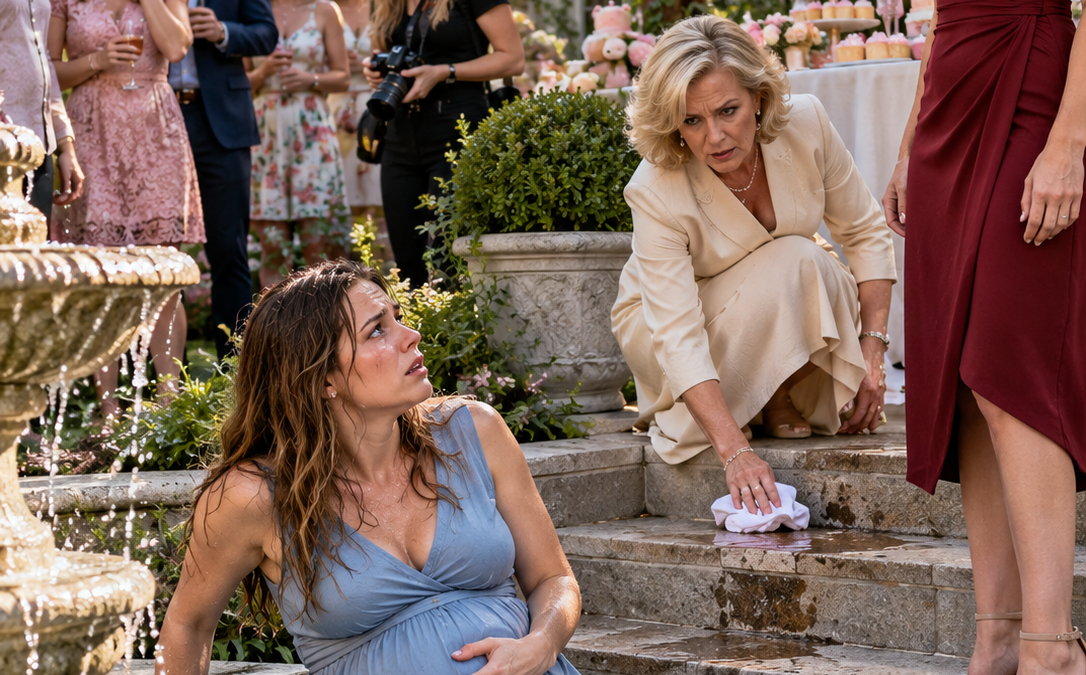
Celeste is never going to babysit again. Not this year, not next year, not ever. And she is definitely never going to be alone in a room with my daughter.
I remember the exact moment my mother realized I meant it. We were standing in her kitchen four days after I came home from the hospital, and she looked at me like I had just spoken a foreign language.
“But she’s your sister,” my mother said, as if that single fact was supposed to erase everything else.
I looked at her and said, “And you’re my mother, and neither one of those words means what you think they mean anymore.”
Six weeks earlier, I was 35 weeks pregnant, standing on my parents’ back patio at a nursery reveal party my mother had insisted on hosting, when my own sister put both hands on my shoulders and shoved me backward down four stone steps into a garden fountain.
I split my scalp open on the fountain’s edge. I felt something tear low in my belly that had no business tearing. And while I lay there bleeding onto decorative gravel my mother had chosen specifically because it photographed well, my mother’s first move was not to call for help. It was to grab a stack of cloth napkins off the dessert table and start wiping down the stone steps before anyone else could see what her favorite daughter had actually done.
But there was one thing neither of them accounted for.
The party planner my mother had hired kept a small wireless security camera mounted on the pergola to protect her equipment from theft, and it had been quietly recording the entire patio in silence since before the first guest arrived.
Before I tell you exactly how that footage ended up destroying both of their lives in the space of about six months, hit that like button if you believe some people forfeit the right to call themselves family. And tell me in the comments where you’re watching from tonight, because I want you to hear the whole thing.
My name is Naomi Marsh, and I need to back up to explain how a nursery reveal party turned into a felony case, because none of it makes sense without understanding exactly what my sister Celeste and my mother had spent 31 years building between the two of them, with me standing just outside the frame the entire time.
I work as a certified court reporter, which means my entire professional life is built around one single, unglamorous principle: the record has to be exact.
Not a fair summary. Not the general gist. Not what everyone in the room agrees probably happened. The actual words, in the actual order, with nothing softened and nothing added.
I have spent a decade transcribing depositions where two people describe the same afternoon so differently, you’d think they lived on separate planets. And every single time, the only thing that ever actually settles the argument is a recording nobody got to edit afterward.
I did not know, sitting in a stenographer’s chair years before any of this happened, that I would eventually need that exact same principle to save my own daughter’s life.
Celeste is two years older than me, and she has been the center of gravity in our family since before I have any memory of existing separately from her orbit.
I can trace the specific mechanics of it back to a summer when I was maybe eight and Celeste was ten, when she broke a neighbor’s greenhouse window throwing rocks at nothing in particular, panicked, and blamed it on a stray baseball from a game that wasn’t even happening that day.
My mother paid for the glass in cash before my father found out there had been an incident at all and told the neighbor a stray dog had probably knocked something loose overnight.
I remember being furious in that small, powerless way an eight-year-old is furious, watching Celeste get sent to her room for exactly the length of one sitcom episode, while I got a full lecture two weeks later for accidentally leaving my bike in the driveway overnight.
I didn’t have language for the arithmetic yet, but I understood it perfectly well even then. Certain mistakes in our house came with real consequences. Others came with a cover story and a checkbook.
That pattern repeated itself for the next two decades in a hundred smaller versions. A fender bender blamed on someone else’s parking. A missed rent payment absorbed quietly by my mother without explanation. A shouting match at a family wedding that somehow became, by the next morning, a story about how stressed everyone had been that week.
I never once connected any of it, watching that pattern replay itself for 20 years, to the shape of a Sunday afternoon that hadn’t happened yet.
She was the pretty one, the charming one, the one my mother introduced first at every gathering, the one whose moods dictated the emotional weather in our house the way a low-pressure system dictates a coastline.
I was the reliable one, which in our family has always been a polite way of saying the one whose feelings could be safely deprioritized because she wouldn’t make a scene about it.
Celeste had two miscarriages in her twenties, both early, both devastating in the private way these things are devastating. And I want to say clearly before anything else that I have never once treated that history as anything other than a real and painful loss.
But my mother turned Celeste’s grief into a kind of permanent currency our entire family was expected to keep paying into indefinitely, long after Celeste herself had moved into a stable marriage and eventually a stable life that had nothing left to do with those losses except the shape they carved into her.
When I got pregnant with Iris, three years into my own marriage to Theo, a high school history teacher with the specific patience of a man who spends his days explaining the same material to teenagers who don’t want to hear it, something in the family shifted.
Three years into my own marriage to Theo, a high school history teacher with the specific patience of a man who spends his days explaining the same material to teenagers who don’t want to hear it, we had built a life that felt solid in a way very little from my childhood had.
We’d met at a deposition, of all places, an unglamorous personal injury case where he was testifying as a character witness for a former student and I was the court reporter typing every word into a record neither of us expected to think about again once the transcript was filed.
He caught up with me afterward in the parking garage, not to flirt exactly, just to ask with genuine curiosity whether it ever felt strange being the only person in the room with zero opinion about what anyone said.
I told him it felt like the opposite of strange. It felt like the one place in my life where nobody got to argue with what actually happened.
He said that sounded like something he wanted more of in his own life.
We married two years later in a small ceremony my mother somehow still managed to reorganize around Celeste’s schedule, moving the date twice to accommodate a work trip that turned out, we learned much later, to have never actually existed.
When I got pregnant, I watched my mother’s face do something I hadn’t seen before. Relief mixed with something else I couldn’t name yet.
It took me most of the pregnancy to understand what that something else actually was.
It was calculation.
My mother had spent years managing Celeste’s grief by managing everyone else’s joy around her. And my pregnancy was the first real test of whether that system could survive an event she couldn’t fully choreograph.
The pressure started small, the way it always does.
My mother mentioned almost in passing that Celeste had always dreamed of being in the room when a niece or nephew was born, that it would mean so much to her given everything she’d been through.
I said gently that I wanted the room to be just me and Theo, which is an entirely normal thing for any expectant parent to want.
My mother’s face tightened in a way that told me the conversation wasn’t actually over, just paused.
Then came the godmother conversation.
And my mother’s face tightened in a way that told me the conversation wasn’t actually over, just paused.
I remember looking around that dinner table afterward and realizing my father hadn’t said a single word through the entire exchange, which had become its own kind of language in our family over the years, his silence functioning as a quiet, permanent vote for whatever my mother had already decided.
He is not a cruel man. I want to be fair to him even now. He is simply a man who learned decades ago that disagreeing with my mother in front of Celeste cost him more peace than it was ever worth. And he chose that peace, meal after meal, for as long as I can remember.
I used to resent him for it quietly. By the time all of this happened, I mostly just felt sorry for a man who had spent 30 years mistaking silence for neutrality, never once noticing that neutrality, applied consistently enough in one direction, stops being neutral at all.
Then came the godmother conversation, which Celeste raised herself over a dinner I hadn’t realized was an ambush until it was already underway. She explained at length why she felt she deserved the role more than my two closest friends, both of whom had shown up for every single hard year of my adult life without once needing to be asked.
She listed her reasons like she’d rehearsed them in the car: that she was blood and my friends weren’t, that she’d understand things about raising a daughter that childless friends simply couldn’t, that after everything she’d lost, she deserved something to hold on to that felt like moving forward instead of backward.
My mother nodded along at each point like a woman watching her own closing argument delivered by someone else.
I sat there with a fork halfway to my mouth, realizing the entire dinner—the specific restaurant, the specific seating putting me directly across from both of them—had been engineered days in advance for exactly this moment.
Theo found my hand under the table before I’d even fully registered how cornered I felt.
I told Celeste I hadn’t decided yet, which was true, and which she heard as a lie because, in her experience, undecided from me had always eventually resolved into whatever she wanted anyway.
By the time we reached 35 weeks, my mother had planned an outdoor nursery reveal party at her own house, ostensibly to celebrate finding out we were having a girl, though I had actually told her the sex privately three weeks earlier and specifically asked her not to make a production out of it.
She made a production out of it anyway because my mother has never once in her life let a request from me outrank an opportunity to stage something.
She hired an event coordinator and part-time photographer named Teresa Nunes, strung fairy lights across the back patio, set up a dessert table with pink and white pastries, and invited roughly 40 people, most of whom I would not have chosen to tell about my own pregnancy in the first place.
I spent the morning of the party telling myself it would be fine. That 40 people and two hours of polite conversation was a small price to pay for avoiding another fight with my mother so close to my due date.
Theo helped me into a maternity dress I’d bought specifically because it didn’t require me to stand for long stretches. And he kept checking on me every 20 minutes or so with a small private signal we’d worked out: a hand briefly against my lower back.
Are you okay?
Without ever needing to say the words out loud in front of anyone.
The fairy lights were pretty. The pastries were genuinely good. For the first 40 minutes, I almost let myself believe the afternoon might actually pass without incident, which in hindsight feels like exactly the kind of hope that exists purely so its absence can hurt more later.
Celeste arrived already tense.
I could see it the moment she walked through the side gate. The particular set of her jaw that meant she’d been rehearsing something in the car.
She found me within the first 20 minutes, pulled me toward the far end of the patio near the little decorative fountain my mother had installed two summers earlier, and told me she’d heard through my mother that I still hadn’t confirmed her as godmother.
I told her that was true and that I wasn’t going to be discussing it at a party in front of 40 guests.
She said I owed her an answer given everything she’d been through.
I said her losses were real and I was sorry for them. And none of that obligated me to hand her a role in my daughter’s life.
Her face did something I’d seen before, but never aimed quite so directly at me, a kind of controlled contempt she usually reserved for people outside the family.
I could see Theo across the lawn, deep in conversation with my father about a clogged gutter, entirely unaware anything was happening near the fountain. And some small practical part of my brain even then was calculating how many guests stood close enough to overhear us, whether I could redirect this entire conversation somewhere less visible before it became the thing everyone remembered about the party instead of the actual reveal.
I didn’t get the chance.
Celeste had never once in 31 years cared whether an argument had an audience. If anything, an audience made her sharper.
“You’ve turned this pregnancy into your whole personality,” she said.
I told her that was rich coming from someone who had spent three years turning her grief into a permanent Very Important Person pass.
I regret how sharp that came out.
Even now, even knowing everything that happened next, I regret it, because it gave her an opening she used immediately and viciously.
She stepped closer, close enough that I instinctively put a hand over my stomach, and said, “Careful. Wouldn’t want the nursery to go to waste.”
I remember the exact temperature of that sentence.
Cold in a way the warm evening air had no business allowing.
Before I could even process it fully, both of her hands hit my shoulders hard, deliberate, and the world tipped sideways.
I don’t remember the actual fall the way you’d remember a normal memory in sequence, start to finish. I remember pieces.
The stone edge of the top step catching my heel.
My own hand flying out toward a railing that wasn’t there.
The specific sickening weightlessness of four steps happening much too fast.
Then the hard, wet shock of the fountain’s low stone rim against my hip and my scalp. Water splashing up cold against skin that had gone strangely numb.
And then, underneath all of it, a tearing sensation low in my abdomen that I would spend the rest of that night unable to stop thinking about.
Time did that strange elastic thing it apparently does during genuine emergencies, stretching two or three seconds into something with its own separate weather system.
I remember the specific blue of the sky directly above me, one thin contrail crossing it, absurdly, perfectly ordinary, while everything at ground level had just become the opposite of ordinary.
I remember thinking with a clarity that still unsettles me that I needed to keep my hands over my stomach no matter what else happened next, as though my own two hands could somehow do what the fountain’s stone edge had just failed to prevent.
Someone screamed near the dessert table.
I heard my own breath go short and ragged.
Then I looked down and saw blood threading pink through the fountain water, and everything in me went very, very quiet and very, very cold.
Celeste stood at the top of the steps.
For one full second, maybe two, I watched something like horror cross her face—the real, unrehearsed kind, the kind that tells you a person has genuinely just done something they cannot take back.
Then my mother arrived.
And instead of coming toward me, she went straight past me to the top step, already reaching for the stack of cloth napkins someone had left on a side table, and began wiping at the wet stone as though the problem in front of her was a spill instead of her daughter bleeding into a fountain eight months pregnant.
“Everybody just calm down,” my mother said in the exact tone she uses for a wine stain on the good tablecloth.
I stared up at her from the water and said, “Call 911.”
She said, “You slipped, Naomi. You’re confused.”
Celeste came down two of the steps, hovering, and said it was an accident. She didn’t mean it like that. I’d startled her.
That is when Teresa Nunes, who had been photographing the dessert table 20 feet away, came around the hedge with her camera still in her hand and saw exactly what my mother was doing to the steps.
“Ma’am, stop touching that,” she said, sharp and immediate, the voice of someone who has worked enough events to recognize a scene being altered when she sees one.
My mother snapped at her to stay out of it.
That was the moment I understood with total clarity that my mother was not panicking.
She was managing.
She was doing to a crime scene exactly what she had spent 30 years doing to every uncomfortable truth in our family: smoothing it, softening it, making it disappear before anyone outside the house could see its actual shape.
I got my phone out with hands that wouldn’t stop shaking and dialed emergency services myself.
“My sister pushed me down the stairs,” I told the dispatcher. “I’m 35 weeks pregnant, and I’m bleeding.”
My mother said, “Naomi, stop. This doesn’t need to be a whole thing.”
The dispatcher’s voice sharpened immediately.
“Ma’am, I need you to stay as still as possible. Is anyone with you who is not causing you harm?”
Teresa knelt several feet away and said, “I’m here. I won’t touch her.”
“Everyone else needs to stop moving and stop touching anything at that scene,” the dispatcher said, loud enough that my mother clearly heard it through the phone speaker because she paused with a napkin still in her hand.
She didn’t stop for long.
She kept wiping more carefully this time, as if precision might make it less visible.
I stared at her and said, “Mom.”
She didn’t answer me.
Celeste kept repeating that it was an accident, that I’d stumbled backward into her hands, each version slightly different from the one before it, the way a lie sounds when someone is building it in real time instead of reciting something rehearsed.
Then my mother said the sentence that would end up sitting at the center of the entire case against her.
She said it clearly enough that my phone, still connected to dispatch, picked up every word.
“I’m not going to let the police destroy Celeste’s whole life over one bad moment.”
The patio went silent.
Even Celeste looked at her.
The dispatcher’s tone changed instantly.
“Ma’am, I need you to stay on the line with me. Officers and paramedics are already on the way.”
Theo came through the side gate at a dead run less than four minutes later. He’d been parking cars down the block with my father, who had wandered off from the party 20 minutes earlier to deal with an overflowing gutter and had missed the entire thing.
Theo saw me in the fountain, saw the blood, saw my mother with a wadded, pink-stained napkin still in her fist, and went a color I had never seen on him before.
Teresa stopped him gently before he could pull me up himself.
“Leave her for the paramedics. Don’t move her,” she said, and stayed exactly where she was until the sirens turned onto the street.
My father arrived back from the gutter just as the ambulance pulled away. Theo told me later that the look on his face, arriving to find his own driveway full of flashing lights and his wife nowhere in sight, was the first time in years he’d seen my father move faster than a careful, measured walk.
He rode to the hospital separately with my mother, apparently in near-total silence, because by then even he had started to sense that whatever she’d told him in the car did not fully match what he’d find waiting once they arrived.
The paramedics worked fast and said very little, which frightened me more than shouting would have.
They got monitors onto my belly within minutes, and I watched one of them go very still while reading the screen. The specific stillness of someone deciding how much to say out loud in front of a frightened family.
Theo asked what was happening.
“We’re moving quickly,” one of them said, which is the sentence medical professionals use when the honest answer is worse than they’re ready to give you yet.
As the ambulance doors were closing, the paramedic looked at Theo and said, “We’ve called ahead to obstetrics. We’re not just transporting your wife. We’re preparing the hospital for a possible emergency delivery.”
I lay there gripping Theo’s hand while Celeste’s voice looped in my head.
Wouldn’t want the nursery to go to waste.
For the first time since I’d hit that water, I let myself be afraid she might actually get what she wanted.
The hospital moved with a kind of controlled urgency I will never be able to fully describe to anyone who hasn’t lived through it.
Nurses. Monitors. A doctor asking short, precise questions while someone else started an IV in my arm.
Then the fetal heartbeat on the monitor changed its rhythm, and the whole room’s energy shifted with it.
The doctor looked at the screen, then at me.
“Naomi, we’re seeing signs of placental abruption, which means the trauma from the fall may have partially separated the placenta. I need you to understand that we may have to deliver tonight.”
I said I was only 35 weeks.
He said he knew.
He said waiting carried real risk for both of us.
I closed my eyes and heard Celeste’s voice again.
And Theo, somehow reading exactly what was happening behind my eyes, leaned close and said, “She is not getting that, Naomi. She is not taking our daughter.”
The emergency cesarean happened less than an hour later.
Nothing about it resembled the calm, softly lit delivery I’d pictured for months.
Bright lights. Urgent voices. Theo’s face inches from mine, telling me to keep looking at him and nowhere else.
And then, underneath all of it, the smallest possible sound, a thin, furious cry that somehow filled the entire room.
“A girl,” someone said.
And for two or three seconds, they let me see her.
A tiny, impossibly small face. Tiny curled fists.
Then they carried her straight to the neonatal unit.
I cried before they’d even finished wheeling her out.
“Is she okay?” I kept asking.
“She needs help breathing and close monitoring,” a nurse told me gently. “But she’s here. She’s here.”
I held on to those two words the way you hold on to a railing you should have had on those stairs in the first place.
The neonatal unit itself has a particular layered sound I don’t think I’ll ever fully stop hearing somewhere in the back of my mind. Monitors set to slightly different rhythms, punctuated every so often by an alarm that turns out to mean nothing urgent at all. A sensor slipping half a centimeter. A baby three isolettes over simply stretching.
I learned to recognize which alarms belonged to Iris within the first two days, the specific cadence of her monitors becoming as familiar to me as her own eventual cry would be.
A nurse who took an early liking to us explained every wire and every number on the display without once making me feel foolish for needing it explained twice.
And on the fourth day, she taught me how to do kangaroo care properly.
Skin to skin.
Iris’s tiny diapered body settled directly against my bare chest under a warmed blanket while the monitors kept their steady, reassuring rhythm beside us.
I sat in that chair for nearly two hours, barely moving, feeling her tiny rib cage rise and fall against mine.
And for the first time since the fall, I felt something in my own chest unclench that I hadn’t fully realized was still clenched.
Theo took a single photograph of the two of us that afternoon. Not for anyone else. Just for us.
And it remains, to this day, the only photograph from that entire period I’ve ever actually printed and framed.
While I lay in recovery, Celeste and my mother were already rewriting the afternoon.
My mother texted relatives that I’d lost my footing near the fountain. Celeste told anyone who would listen that I’d stumbled backward into her while reaching for something, that she’d actually tried to catch me.
They started quietly asking guests leading questions.
“You didn’t really see what happened, right? Everyone was over by the dessert table.”
They weren’t investigating anything. They were planting doubt in advance, the way people do when they can already feel the ground shifting under a story they’ve built too quickly.
But they had a serious problem they hadn’t accounted for.
The 911 call existed in full, and police had already requested it before either of them finished their first round of phone calls.
The recording captured me identifying Celeste by name within the first ten seconds.
If you have ever wondered whether staying calm and simply telling the truth into a phone actually matters in a moment like that, I promise you it does more than almost anything else you could do.
Because panic fades from a recording the moment it’s transcribed.
But a clear, steady fact just sits there unchanged for as long as anyone needs to listen to it again.
It captured Celeste’s own account changing twice in under a minute.
It captured the dispatcher explicitly ordering everyone to stop moving and stop touching the scene.
And it captured my mother, clear as anything, saying she wasn’t going to let police destroy Celeste’s whole life over one bad moment.
She had spent 30 years managing every difficult truth in our family into something smaller and more comfortable.
This time, she’d managed to say the worst possible sentence directly into a recording device while actively tampering with a scene.
Two days later, she and Celeste showed up at the hospital.
I didn’t find out until Theo walked into my room looking like he’d swallowed glass.
“They’re downstairs,” he said.
My whole body went rigid.
“Who?”
“Your mother and Celeste.”
I asked what they wanted.
He said my mother had asked to see the baby. Said she was the grandmother, as if that title alone unlocked a door nobody else got a vote on.
I laughed once, and it came out uglier than I meant it to.
Celeste had apparently chimed in behind her, saying she was the aunt, that I couldn’t keep her away forever.
Theo told them calmly and without raising his voice that Iris had almost grown up without either a grandmother or an aunt because neither of them had called for help while she was in danger.
Security walked them out.
I heard my mother shouting something about grandmothers and rights all the way down the hallway.
And for the first time, I understood something important.
She still believed this was a family disagreement, something that could eventually be smoothed over with enough pressure and enough apologizing to the right relatives.
She had no idea yet how wrong she was.
That same afternoon, an attorney named Miriam Block came to see me, recommended by one of Theo’s colleagues whose sister had gone through something similar years earlier.
She was calm and precise.
Theo’s colleague had warned him gently beforehand that Miriam wasn’t the kind of attorney who offered comforting speeches or promised outcomes she couldn’t guarantee. What she offered instead was total, unflinching clarity about exactly what the process would require and how long it would likely take.
That turned out to be precisely what I needed.
More than sympathy. More than outrage on my behalf.
A person who could look at the worst afternoon of my life and immediately start organizing it into categories a court would actually recognize.
She was calm, precise, and entirely unimpressed by the phrase family matter, which my mother had apparently already used with her once over the phone before I’d even agreed to retain her.
“Your mother genuinely believes this is still a private disagreement,” Miriam told me, sitting beside my bed with a folder already three inches thick.
I looked through the glass toward the NICU hallway, where my daughter was alive because a team of strangers had moved fast, not because either of the women downstairs had lifted a single helpful finger.
“Make sure she understands it isn’t private anymore,” I said.
Miriam opened her folder and told me she was filing for an emergency protective order that same day.
For the first time since the fall, I felt something solid forming around me and Iris, a wall neither of them was going to be able to talk their way past.
The police went back to my mother’s house the next morning.
By then, she’d convinced herself she had erased the worst of it. Wiped the stone steps. Gathered the ruined napkins into a trash bag. Moved a broken piece of the fountain’s decorative tile out of sight.
What she couldn’t erase was the pergola camera.
Teresa had mentioned it to responding officers almost as an afterthought, a small wireless unit she’d mounted months earlier to protect her lighting equipment from theft at outdoor events, quietly recording video with no audio the entire time.
Nobody at that party, including my mother, had any idea it existed.
It had captured the entire patio in silent, wide-angle footage.
Nobody at that party, including my mother, had any idea it existed.
I found out much later, once Teresa and I had become genuinely close, that she’d started keeping that camera running at every event specifically because of an incident two years earlier at a different client’s party, where a piece of her lighting rig had gone missing and the client’s family had spent weeks trying to convince her she’d simply never brought it in the first place.
She told me she’d learned the hard way that some families will happily rewrite an entire afternoon rather than admit anything unflattering happened on their property.
And she’d decided, quietly and without telling any of her clients, that she’d rather have an unbiased witness running in the background than depend on anyone’s memory, including her own.
It had captured the entire patio in silent, wide-angle footage, including four full seconds of Celeste stepping forward and shoving me squarely in the shoulders before I ever touched the top step.
Teresa gave her statement without hesitation and without a shred of family loyalty clouding a single word of it.
She told police she’d looked up from her camera bag in time to see Celeste’s hands make contact. Saw me go backward. Saw my mother reach the top step within seconds and begin wiping instead of checking on me.
She had no reason to protect either of us and no reason to lie for either of us.
She had simply been working, and she told the truth about what she’d seen the way any competent professional tells the truth about their own field of view.
My mother tried to explain her own behavior as panic.
Investigators asked why the panic had continued well after a 911 dispatcher specifically instructed her to stop altering the scene.
Panic explains a first reaction.
It does not explain a second one delivered against direct instruction.
Celeste’s motive turned out to be almost insultingly simple once investigators pulled her messages with my mother from the weeks before the party.
No money. No inheritance dispute. Just naked entitlement dressed up as grief.
She had complained for weeks that I was cutting her out, that Theo and I were making decisions without asking her opinion first, that I’d refused to hand her the godmother role the moment she demanded it.
In one message pulled directly from her phone, she’d written to my mother, “She acts like I don’t matter in this baby’s life at all.”
My mother had replied, “I’ll talk to her. She needs to stop shutting family out.”
It wasn’t proof they planned an assault together.
It didn’t need to be.
It was proof of exactly what the underlying fight had always been about: control, access, and a shared belief that my boundaries existed purely as an inconvenience to be managed around.
I learned most of this sitting in a plastic chair beside my daughter’s incubator, watching wires and monitors surround a body so small it barely seemed real.
For the first several days, I wanted my mother and Celeste to feel the full crushing weight of what they’d done. Wanted them ashamed in some permanent, visible way.
Then I looked at Iris, at her impossibly small hand curling around nothing, and something in me simply stopped needing that anymore.
My job wasn’t to make either of them understand.
My job was to keep this specific, exact, tiny person safe.
That was when Miriam called to say the protective order had been granted.
It covered both my mother and Celeste: no contact, no approaching the hospital, no using other relatives as a relay.
For the first time in my entire life, the phrase we’re family carried absolutely no weight against a piece of paper with a judge’s signature on it.
The pressure started before I was even discharged, disguised at first as concern.
An aunt called Theo directly.
A cousin messaged Miriam’s office asking if there was any room for a private resolution.
One of my mother’s oldest friends sent me a long, meandering text about how stress makes family say things they don’t mean.
Then the language shifted, the way it always does once the soft approach fails.
Celeste made one terrible mistake.
Your mother panicked.
Anyone would have panicked.
You don’t want your daughter growing up without any family at all.
That last one finally got an answer out of me.
I called my aunt back and let her finish her opening in the same gentle, concerned voice everyone had suddenly adopted around me.
“I’m not defending what happened,” she said.
“Then don’t,” I told her.
“I’m only saying you should think about the future.”
“I am.”
“Your daughter deserves a family.”
I looked through the NICU glass at Iris, sleeping under warm lights, still small enough that every twitch made my chest tighten.
“My daughter almost grew up without a mother at all because of family,” I said.
My aunt went quiet.
I kept going.
“If Celeste had pushed harder, if I’d landed differently, if the ambulance had taken six more minutes, if the doctors had waited even twenty—”
My voice cracked, and I had to stop for a second before I could finish the thought.
“Stop using the word family like it erases what actually happened on those steps,” I told her.
She didn’t argue with that.
She just stopped calling.
A second cousin tried a slightly different angle a few weeks later, sending a long message about how important it was for children to know where they came from, how a family history mattered even when parts of it were complicated.
I wrote back a single line.
Iris will know exactly where she came from. She just won’t be spending unsupervised time with the parts of it that hurt people.
I didn’t hear from that cousin again either, though I later learned through a mutual relative that the message had been forwarded around to several others as an example of how unreasonable I was being.
Which told me almost everything I needed to know about how thoroughly my mother had already managed to reshape the narrative among people who hadn’t been there and hadn’t seen the footage.
The next approach came through lawyers, which somehow felt both more honest and more insulting at once.
Miriam arrived at the hospital one afternoon carrying a fresh folder.
“Celeste’s attorney reached out,” she said.
I felt something curdle in my stomach immediately.
“What does she want?”
“To make this go away as quietly as possible,” Miriam said.
“That’s generous of her.”
Miriam didn’t dignify the sarcasm with a reaction.
“She’s offering to cover your uninsured medical costs, contribute toward the NICU expenses, pay additional compensation on top of that, enter a court-monitored anger management program, and provide a written apology.”
For a moment, I said nothing at all.
The NICU bills genuinely terrified me. Theo and I had decent insurance, but decent insurance and zero unexpected expenses are two very different financial realities, and we were staring down deductibles, missed work, therapy, follow-up appointments, transportation.
None of it was something either of us had budgeted for in any version of this year we’d imagined.
I hated that money had any place at all in this conversation.
“What’s the catch?” I asked.
Miriam said it wasn’t small.
“She wants certain matters handled privately going forward, meaning she doesn’t want you publicly characterizing what happened in a way that could affect her legal position.”
I looked at her steadily.
“She shoved me down four stone steps while I was 35 weeks pregnant.”
“Yes.”
“She told me not to bother with a nursery because it might go to waste.”
“Yes.”
“My daughter was born early and spent weeks in the NICU because of it.”
“Yes.”
“And she wants to pay me to help make that sound smaller than it was.”
Miriam leaned forward.
“She cannot buy her way out of the criminal process. That was never yours to sell in the first place. But she is legally allowed to propose civil terms.”
I thought about it seriously because I did not want to reject something purely out of pride while my daughter’s medical bills kept arriving.
If Celeste legally owed restitution or civil damages, refusing that out of principle would have hurt exactly one person, and it wasn’t going to be her.
I told Miriam I would accept whatever compensation was legally owed, but I wasn’t signing anything that softened what actually happened.
“I’m not calling it an accident,” I said.
“I assumed that.”
“I’m not helping either of them protect a reputation they no longer deserve.”
“Understood.”
“She can pay what the law says she owes. I’m not selling her a gentler version of the truth to go with it.”
Miriam wrote that down and told me it was a strong position to hold.
It was also the first position I had ever taken in this family that nobody could successfully guilt me out of.
Celeste’s attorney came back once more after that, testing whether a slightly higher number might soften my position on the wording.
Miriam relayed the offer in the same flat professional tone she used for everything.
And I remember laughing briefly and without much humor at the idea that a bigger check was supposed to make me more willing to call an assault a misunderstanding.
I told her to tell them the number wasn’t the problem.
The problem was that no amount of money was ever going to make me describe my own daughter’s premature birth using a word softer than what actually caused it.
That was the last settlement conversation either side ever raised again.
My mother’s letter arrived a week later, sent through her attorney since the protective order blocked any direct contact.
Six handwritten pages.
It opened, My sweet Naomi, and I nearly stopped reading right there.
She wrote about raising me and Celeste, about how difficult Celeste had always been as a child, about how she had spent her whole life trying to protect both of her daughters equally.
Then came the sentence that made me set the letter down for a moment.
I was only ever trying to protect both my girls.
Both.
One of her girls had been bleeding into a garden fountain.
The other had put her there.
And somehow, in my mother’s accounting, protecting both of us had translated into wiping blood off decorative stone before anyone checked whether my baby was still alive inside me.
She wrote that she’d panicked, that she never imagined I’d be delivering that night, that she hadn’t understood how serious the fall actually was in the moment.
Then she wrote, “I only cleaned because people were stepping everywhere, and I didn’t want things to get any more chaotic than they already were.”
I laughed out loud reading that line, an ugly involuntary sound, because I could still hear the dispatcher’s exact words in my head.
Stop moving and stop touching the scene.
My mother had heard those same words in real time and kept wiping anyway.
The letter closed with, “Someday your daughter will ask why she doesn’t know her grandmother, and I hope you’re prepared to live with whatever answer you give her.”
That line came closer than anything else in six months to making me tear the whole letter into pieces.
I hope you’re prepared to live with whatever answer you give her.
I have thought about that specific line more than almost anything else my mother ever wrote to me.
Mostly because, infuriatingly, she wasn’t entirely wrong that the question would eventually come.
Iris will ask someday why she has no grandmother on my side. Why family gatherings on that branch of the tree simply don’t exist for her the way they do for some of her friends.
I’ve already decided, long before she’s old enough to ask, exactly what I’ll tell her.
Not the full legal weight of everything, not at first, but the true shape of it.
That her grandmother and her aunt made a choice once, in a single terrible moment, to protect each other instead of protecting her mother.
And that some choices are large enough that they simply cannot be undone by time or apology or the passage of enough birthdays.
I won’t tell her to hate them.
I don’t.
Not anymore. Not really.
Hatred takes more daily maintenance than I’m willing to keep paying for people who no longer occupy any real space in my life.
I’ll tell her the truth plainly, the same way I’d transcribe it for anyone else.
And I’ll let her decide as an adult what, if anything, she wants to do with that information once it’s fully hers to carry instead of mine.
That line came closer than anything else in six months to making me tear the whole letter into pieces.
Instead, I handed it straight to Miriam.
“She’s hoping this helps her case,” I said.
Miriam read through it once, then read the last page again more slowly.
“It might help ours more,” she said.
“How?”
“Because she’s still explaining her own conduct instead of denying it. She never once says she called for help.”
“No.”
“She never says she checked on the baby.”
“No.”
“She never says she tried to stop Celeste.”
“No.”
I leaned back against the pillow.
That was the entire exhausting truth of my mother in one paragraph.
Her version of motherhood had always meant shielding Celeste from consequences, even when shielding her required abandoning me on the ground in front of 40 witnesses.
I never answered the letter.
There was a smaller, stranger problem that took weeks to resolve alongside everything else, which was what to do with the gifts.
Several guests, including my mother, had brought wrapped presents to that party, stacked on a table near the dessert spread. Most of them nobody thought to collect once the ambulance left, and they sat forgotten in my parents’ garage for nearly two months while the legal process moved forward around them.
My aunt eventually asked carefully what I wanted done with them. Whether I wanted them shipped. Whether I wanted them simply discarded. Whether the ones from my mother and Celeste specifically needed some kind of separate handling.
I thought about it longer than the question probably deserved.
In the end, I asked her to have every gift not from my mother or Celeste forwarded to our house and told her the two remaining boxes could stay exactly where they were indefinitely, unopened in that garage for as long as either of them chose to keep them.
I never found out what was inside either box.
And I’ve never once felt the smallest flicker of curiosity about it since.
Some things simply don’t need opening to already be understood completely.
A stuffed rabbit or a set of matching onesies wrapped by hands that weeks later would either shove me down a set of stairs or wipe my blood off them carries a kind of weight no amount of tissue paper can offset.
Theo asked me once gently whether I felt any guilt refusing gifts that had presumably been bought with genuine excitement before any of this happened.
I told him excitement and safety are two completely different things, and that I was no longer interested in accepting objects from people who had already shown me, in the most concrete way imaginable, exactly how little my safety weighed against their own comfort.
The case kept moving in its own slow, methodical way.
Teresa’s statement held firm under every follow-up interview.
The 911 recording held.
The medical timeline connecting the fall directly to the emergency delivery held.
But it was the pergola footage that ended Celeste’s original story completely.
Investigators didn’t just have a witness describing a shove from memory.
They had four seconds of silent video showing her hands making contact and me going backward down the steps, timestamped, unedited, recorded by a camera she hadn’t even known was pointed at her.
Her attorney’s strategy shifted almost overnight.
Instead of insisting I’d simply lost my footing, they began arguing she had acted impulsively in the heat of an argument.
As though impulse made the stairs any shorter.
As though a moment of anger made a premature delivery any less serious.
It didn’t.
And the footage made sure nobody serious was going to pretend otherwise.
I watched the language shrink in real time across three separate rounds of her attorney’s filings, and it fascinated me almost as much as it enraged me, in the detached professional way I sometimes can’t help but notice patterns even inside my own life.
Push became contact.
Contact became a physical disagreement.
The fall became an incident.
The premature delivery became a complication.
Even the original cruel sentence on the patio steps got recharacterized at one point as a poor attempt at dark humor under stress.
As though cruelty stops being cruelty the moment someone claims they were only joking.
I’ve spent a decade of my professional life transcribing exactly this kind of language shrinkage in depositions, watching grown adults reach for smaller and smaller words the moment they sense the actual scale of what they did closing in around them.
It never works.
A transcript, once it exists, doesn’t care how gently you’d prefer to describe your own hands.
There was a point about two months into the investigation when Miriam mentioned something in passing that I ended up thinking about for a long time afterward.
Teresa’s pergola camera, it turned out, had been quietly recording every outdoor event at my mother’s house for the better part of a year, footage Teresa kept temporarily for her own liability purposes before routinely deleting it.
That meant there was footage sitting on a drive somewhere of other gatherings, too. Other family arguments. Other unflattering moments that had nothing to do with the case against Celeste and my mother. Moments involving relatives who had never hurt me and had no idea any of it existed.
Miriam asked, almost as a formality, whether I wanted her to request the full archive in case it contained anything else useful.
I told her no.
Miriam showed me the footage itself only once in her office several weeks earlier, warning me beforehand that I didn’t have to watch it if I didn’t want to, that plenty of clients in my position chose not to.
I told her I needed to see it.
She turned her laptop toward me and pressed play, and I watched, in silent, slightly grainy, wide-angle color, my own sister step forward and push me down four stone steps in under two seconds.
I watched my body go backward at an angle no still photograph could ever have fully captured.
Watched my mother reach the top step within moments, not toward me, but toward the mess.
I sat perfectly still through all four seconds, then asked Miriam to play it again.
She did without question.
I watched it a third time after that, not because I doubted what I’d seen, but because some deep, stubborn part of me needed to confirm with my own eyes that the version of events I’d been holding on to through weeks of gaslighting and softened language actually matched something real and external and undeniable.
It did.
Every single detail.
I remember feeling something settle in my chest that afternoon.
Not relief exactly.
Something closer to vindication, the specific physical sensation of finally having proof for something you already knew was true but had started to doubt anyway because two people you loved kept insisting otherwise, loudly and repeatedly, in the days right after it happened.
I think that particular kind of doubt, the kind family manufactures specifically to make you question your own memory of your own body, is one of the cruelest tools available to people who know they’ll never be believed once real evidence surfaces.
My mother and Celeste had counted on exactly that doubt taking root before anyone thought to check a pergola for cameras.
It hadn’t.
And once it hadn’t, nothing either of them said afterward carried any real weight ever again.
Miriam asked, almost as a formality, whether I wanted her to request the full archive in case it contained anything else useful.
I told her no.
I wanted exactly the four seconds that mattered, timestamped and clearly relevant to what had happened to me and Iris, and nothing beyond that.
I did not want to go digging through a year of unrelated footage looking for extra ammunition against people who hadn’t earned it.
And I did not want to become the kind of person who used a surveillance camera as a weapon simply because one happened to be pointed in a useful direction that one time.
Miriam respected the boundary immediately.
The case was strong enough on its own merits.
I didn’t need to make it bigger than it actually was.
And I had spent enough of that spring listening to my mother use that exact same instinct to justify erasing evidence that I refused to build my own justice on it, even aimed at people who deserved it far more than I did.
I found out something else that spring, almost by accident, that reframed a piece of my mother I’d never fully understood.
My father mentioned it once quietly over coffee, clearly uncertain whether he should be telling me at all.
My mother had grown up the older of two sisters herself, and her own younger sister, an aunt I’d met only a handful of times at distant family funerals, had been badly injured in a car accident as a teenager.
An accident my mother had technically caused by insisting on driving despite a fresh learner’s permit and a storm neither of them should have been out in.
My grandmother, according to my father, had spent years afterward quietly rearranging the entire family around protecting that younger daughter from any further harm—financial, emotional, or otherwise—at nearly any cost, including costs paid directly by my mother, who had been expected for the rest of her adolescence to simply absorb whatever consequences her sister couldn’t be allowed to face.
My father said he thought, though he was careful to say he was only guessing, that my mother had spent her entire adult life recreating the one family structure she genuinely understood from the inside.
One daughter who gets protected no matter what.
And one daughter who is simply expected to carry the weight of it.
Except this time, she got to be the one holding the power instead of the one paying the bill.
It didn’t excuse a single choice she’d made on those patio steps.
My father said that part twice, unprompted, before I could even ask.
But it did explain, in a way nothing else ever had, why a grown woman who loved both her daughters in some genuine, complicated way had still chosen, instinctively and immediately, to protect the one who caused the harm instead of the one bleeding in the fountain.
Word had also spread quietly through the courthouse where I worked, the way these things always eventually do, and I braced myself for a certain amount of awkwardness once I returned to the job.
Instead, my supervisor, a blunt, no-nonsense woman named Carol who had transcribed testimony in that building for nearly 30 years, pulled me aside on my first day back and said only this:
“I’ve typed the word family into more sentences describing violence than almost any other word in the English language. Don’t let anyone tell you it means something it clearly didn’t mean that afternoon.”
Then she handed me a lighter caseload for the first month back and never brought it up again unless I did first.
Meanwhile, Iris kept improving in that slow, nonlinear way premature babies do.
Two steps forward. One step sideways.
Small victories that felt enormous at the time.
One afternoon, a nurse told me she’d gained enough weight that I could hold her for longer than a few minutes.
I sat in the vinyl NICU chair while they carefully transferred her onto my chest.
Still so small. Still tangled in wires. But warm and alive and unmistakably present against my skin.
Her tiny fingers curled against me.
I started crying.
The good kind this time.
Theo sat beside us without saying anything for a while, and then he said quietly, “She made it.”
I looked down at our daughter’s face and said, “Yes.”
And something inside me that had been braced tight for weeks finally, slowly began to loosen.
Celeste’s cruel little sentence had circled in my head for days after the fall.
The nursery going to waste.
Now I finally had the actual answer to it.
A girl alive, fighting, breathing on her own a little more each day.
That was the only reveal that had ever mattered.
A week later, doctors told me I was well enough to go home.
Iris wasn’t.
Walking out of that hospital without her felt like abandoning something, even though every nurse assured me it was temporary, that she was improving exactly on schedule for a baby her size.
Before I left, a nurse handed me the NICU visitor authorization form.
I read through the blank lines.
Authorized visitors: Theo Marsh. Naomi Marsh.
And two lines beneath that for anyone else I wanted to add.
There had been a version of me months earlier who would have automatically written my mother’s name on the first line and Celeste’s on the second because that’s simply what the roles had always demanded.
Grandmother. Aunt.
Titles I’d been trained since childhood to treat as automatic keys rather than privileges anyone actually had to earn.
I left both lines empty and wrote in Teresa’s name instead, and one close friend who had shown up at the hospital every single day without once being asked.
The nurse glanced at the form.
“Anyone else?” she asked.
“No.”
“You’re sure?”
I looked through the glass at my daughter, small and stubborn and alive.
“Yes,” I said, and signed it.
That signature meant more to me than any apology either of them could have written on a hundred pages.
Celeste stopped calling it an accident eventually, not because honesty had finally caught up with her conscience, but because the evidence left her nowhere left to stand.
The 911 recording had me naming her within seconds.
Teresa had watched her hands make contact.
My mother’s own voice on that same call was busy worrying about Celeste’s future instead of my daughter’s survival.
And now the pergola footage existed, too, silent and unambiguous.
Four seconds that made every previous version of the story collapse at once.
Her attorney tried the impulsive argument angle for a while, framing it as a single reckless moment rather than a deliberate act, but the courts were considerably less interested in softer language than my family had always been.
A shove is a shove regardless of what adjective gets placed in front of it.
And a woman 35 weeks pregnant does not become less pregnant because the person who pushed her happens to feel sorry about it two months later once a camera surfaced.
The criminal case resolved without turning into the kind of long, theatrical trial you sometimes see dramatized elsewhere.
And honestly, I was relieved.
I didn’t need a spectacle.
I needed real consequences.
Celeste eventually accepted responsibility through a formal plea tied directly to the assault and received a substantial custodial sentence.
Not some fantasy number pulled from an outraged comment section, but real years she would actually have to serve, along with long-term no-contact restrictions covering both me and Iris and restitution ordered wherever the law allowed it.
The conviction itself would follow her for the rest of her life in ways no amount of charm had ever been able to talk her way around before.
My mother’s case looked different, and it should have.
She hadn’t pushed me.
I have never once claimed otherwise.
Not to police. Not to Miriam. Not here.
But she had tampered with a scene after being explicitly instructed to stop, had supported a false account of what happened, and had attempted to interfere with the investigation afterward.
And investigators had the 911 recording, her own statements, her letter, and Teresa’s testimony, all pointing in the same direction.
Her sentence was shorter than Celeste’s, appropriately so, but it was still real, including a custodial component of her own and a supervised probationary period once it ended, with the same no-contact restrictions remaining permanently in place regarding me and my daughter.
My mother had spent her entire life making consequences disappear for the daughter she decided needed protecting.
This time, for the first time in either of their lives, she couldn’t make her own disappear along with them.
There was still a single unavoidable hearing I had to sit through in person.
The plea hearing itself, where Celeste stood before a judge and formally accepted the terms Miriam and the prosecutor had negotiated.
I hadn’t seen her in person since the party.
She looked smaller than I remembered, dressed plainly, her hair pulled back in a way that stripped away every bit of the polish she’d always carried like armor.
She didn’t look at me when she came in.
I sat in the second row beside Theo and listened to a prosecutor read a summary of the charges in a flat procedural voice that somehow made the whole afternoon sound simultaneously smaller and more real than it had ever felt living through it.
When the judge asked Celeste directly whether she understood what she was pleading to, she said yes, quietly, and then unprompted added that she was sorry.
The judge asked if she wanted to say anything further.
She turned around in her seat finally and looked at me for the first time in months.
“I’m sorry, Naomi,” she said. “I didn’t mean for any of it to go that far.”
I didn’t respond because the courtroom wasn’t the place for it, and because I’d already decided weeks earlier exactly what I owed her in that moment, which was nothing beyond my own silence.
My mother wasn’t present that day.
Her own hearing came separately three weeks later, and I chose not to attend it at all.
Miriam offered to represent my interests either way and told me afterward, factually and without embellishment, that my mother had cried through most of it and had, in her own final statement, said she only ever wanted to protect her family.
Nobody in that courtroom apparently asked her which parts of her family she meant.
The civil side dragged on longer than either legal case, the way these things always seem to.
NICU care was expensive in a way that still occasionally takes my breath away when I think about it.
My own treatment, the follow-up scans, the physical therapy for a hip that still aches on long days—none of it came cheap.
And Theo and I had both missed significant work during those first difficult months.
We pursued whatever compensation the law actually entitled us to.
Insurance covering part of it. Civil claims addressing the rest. Restitution filling in what could legally be ordered.
Nobody handed us a fortune.
That was never the actual point of any of it.
The point was simple and honestly small compared to everything else: that Theo and I were not going to be left carrying every financial consequence of a choice Celeste had made entirely on her own, alone, with nobody else forcing her hand.
That outcome split the rest of the family cleanly down the middle.
I want to be honest that the decision to let the criminal process run its full course rather than quietly negotiating something private the way my mother clearly assumed I eventually would was not an easy or obvious one for me in those first days, whatever it might look like from the outside now.
There was a version of me, exhausted and still bleeding through bandages, who genuinely wondered whether pursuing this fully meant I was choosing to be the one who finally, permanently broke our family apart.
As though it hadn’t already been broken for years underneath a very convincing coat of paint.
I said something like that to Theo one night, still half-drugged on pain medication.
He said quietly, but without an ounce of hesitation, that I hadn’t broken anything.
I’d simply stopped being the only person expected to hold the pieces together with my own two hands while everyone else got to stand back and admire how well it looked from a distance.
That sentence did more for me in that moment than anything Miriam or any doctor said in those first two weeks combined.
I wasn’t destroying a family.
I was finally putting down something I’d been carrying alone for three decades without anyone ever once asking if my arms were tired.
That outcome split the rest of the family cleanly down the middle.
Some relatives finally understood exactly what they’d been quietly excusing for years.
Others still wanted some version of reconciliation softened with enough time and enough forgetting.
A cousin called me months later, her voice careful, almost apologetic in advance.
“When do you think your mom might be able to meet the baby?” she asked.
I looked across the room at Iris asleep against Theo’s chest.
Healthy now. Heavier. Still monitored a little more closely than a full-term baby might have needed, but thriving.
“She can’t,” I said.
“For now?”
“No,” I answered. “Not for now. Not ever.”
She lost that privilege the moment she chose to clean blood off a garden step instead of checking whether her granddaughter was still alive.
I know that answer sounds harsh delivered over a phone to a cousin who never hurt me directly.
And I have turned it over in my own head plenty of times since, wondering whether I owe the wider family a gentler version of the boundary just because they weren’t the ones standing on that patio.
I’ve decided I don’t.
Every soft, hedged answer I ever gave anyone in that family growing up was exactly how Celeste and my mother learned that my boundaries were provisional, negotiable, subject to review if enough people pushed at once.
I was not going to make that same mistake with the one boundary that actually mattered.
There was a long silence on the line.
“I understand,” my cousin finally said.
I don’t think she fully did, but she stopped asking after that, and eventually most of the rest of the family did too.
My mother requested a single supervised meeting through her attorney a few months later.
Ten minutes only, she promised.
No mention of the case. Just an apology and a chance to see the baby’s face once.
I refused.
Celeste made a nearly identical request once her sentence began allowing limited outside-contact requests, and I refused that too.
I didn’t owe either of them a redemption scene, and my daughter was never going to be used as proof that either of them had finally changed.
Change, if it was ever going to happen, was something they were going to have to manage entirely without access to us.
That was their responsibility now.
Not mine.
And certainly not hers.
Celeste’s attorney tried once more, months into her sentence, framing the request differently this time, suggesting a therapist-mediated letter exchange instead of an in-person visit, something supervised and slow and reversible if it went badly.
Miriam relayed it to me exactly as flatly as she relayed everything else, without any editorializing about whether I should consider it.
I sat with that specific version of the request longer than I expected to because it was admittedly a smaller ask than the others had been.
And smaller asks have a way of feeling more reasonable purely by comparison.
I decided against it anyway in the end, not because I thought a letter could do any lasting harm on its own, but because I recognized the shape of the request itself.
Another attempt, gentler this time, to reopen a door I had already closed for reasons that hadn’t changed at all, just because the method of asking had gotten softer.
A locked door doesn’t become unlocked because someone knocks more politely.
Theo asked me once, gently, on a quiet night after Iris had finally fallen asleep, whether I was sure I was okay with never seeing either of them again.
I thought about it honestly before answering.
“I’m not okay with what happened,” I told him.
“That’s not what I asked.”
“I know.”
I looked toward the nursery door.
“But I’m okay with the boundary.”
That distinction mattered enormously to me.
Still does.
I could grieve the mother and sister I’d once believed I had and still refuse them any further access to the family I actually had now.
I could miss pieces of who I used to think they were and still recognize completely and permanently who they had shown themselves capable of becoming the second real pressure was applied.
Theo had his own reckoning with all of it too.
Quieter than mine. Less visible. But real.
He told me once months later that the hardest part for him hadn’t been the fall itself or even the fear in that delivery room, but the specific moment standing in a hospital hallway listening to my mother shout about grandmothers.
Realizing with total finality that the family he’d married into, the one he’d spent holidays with for years trying his best to be liked, simply wasn’t going to exist for him anymore in any meaningful way either.
He grieved that loss on his own schedule, mostly privately, occasionally over a beer with a friend from work who’d been through something similar with his own in-laws.
I think it mattered to him in the end that I never once asked him to pretend the loss wasn’t real just because I’d been the one directly harmed.
Grief doesn’t require a hierarchy of who’s allowed to feel it most.
His own parents reacted with a kind of quiet, unwavering clarity that surprised me a little, given how little history they actually had with the specifics of my family.
His mother called within a day of hearing what happened and said simply, “Whatever you need, whatever that looks like, we’re behind it completely. No questions. No gentle suggestions about reconciliation down the road.”
She showed up at the hospital with a casserole and a bag of my favorite snacks and asked exactly nothing about the legal case, focusing entirely on whether I was sleeping and whether Iris was gaining weight.
His father, a quieter man by nature, simply told me once gruffly over coffee months later that he’d raised two sons and would have expected either of them to end up in a courtroom himself before he’d have expected them to shove a pregnant relative down a flight of stairs.
And that the fact my own mother had chosen to clean a scene instead of check on me told him everything he needed to know about where his own loyalty belonged going forward.
Months later, cleaning out a kitchen drawer, I found the original party-planning notebook from that afternoon.
Guest list. Dessert order. Seating notes scrawled in my mother’s handwriting.
Beside her own name, she’d written Grandma in careful cursive.
Beside Celeste’s, Aunt Cece, with a small heart drawn next to it.
I stared at those two words for a long time, remembering how permanent, how automatic they’d once felt.
Titles I’d never once questioned, the way you never question the load rating on a bridge you’ve crossed a thousand times without incident.
Then I looked toward the living room, where Iris lay sleeping in her bassinet while Theo graded a stack of essays at the kitchen table.
Safe.
Quiet.
Entirely unaware of any of it.
I closed the notebook.
Biology had handed both of them titles.
It had never once guaranteed them access, and it had certainly never made either of them safe to be around.
Family, I understood now with total clarity, was never defined by who demanded a place at the table.
It was defined exclusively and without exception by who could actually be trusted once they were sitting in it.
My mother and my sister had both failed that test decisively.
And neither of them would ever get the chance to fail it again with my daughter.
A year after that party, Iris smashed both hands into her first birthday cake and shrieked with laughter when frosting landed on Theo’s shirt.
And I promise you that sound did more for me than any courtroom verdict, any written apology, any six-page handwritten letter ever could have.
She was alive.
Loud.
Curious.
Stubborn in exactly the way her father insists came entirely from my side of the family.
That first year hadn’t been easy in the ways nobody warned you about ahead of time.
Specialist appointments.
Nights I woke up at 3:00 in the morning purely to confirm she was still breathing.
Something Theo did too, though he’ll never fully admit how often.
Sometimes I still heard the faint rhythmic beeping of NICU monitors in my dreams.
Sometimes an ordinary staircase in a stranger’s house made my whole body go tense before my brain had caught up enough to explain why.
Iris hit most of her developmental milestones a little later than the chart suggested, which her pediatrician assured us repeatedly was entirely normal for a baby born five weeks early, and which I nonetheless tracked with the same exacting, slightly obsessive precision I bring to every transcript I’ve ever produced.
First real smile: ten days later than average.
First time rolling over: nearly three weeks later.
First tooth: right on schedule, which felt like an oddly specific relief given how far behind everything else had felt for months.
Theo teased me gently about the spreadsheet I kept, half joking that I’d turned our daughter’s infancy into a deposition record.
I told him that was probably the most accurate description of my own coping mechanism anyone had offered me all year.
Watching her catch up milestone by small milestone felt like watching proof accumulate in real time that she was going to be fine.
That four seconds on those steps were not going to define the entire rest of her life the way they’d briefly threatened to define mine.
The fall had left physical reminders of its own.
A hip that still complains after long days.
One side of my lower back that never quite released the tension it picked up on those stone steps.
Doctors told me some of it might fade with time and some of it might simply be permanent.
I made my peace with that.
Physical therapy took the better part of five months, twice a week at first, with a patient therapist who never once rushed me through an exercise even when I could see the clock ticking toward her next appointment.
She was the one who first pointed out gently that I flinched every single time she asked me to step backward off a low platform.
A completely ordinary part of the exercise routine that apparently my body had decided, permanently and without consulting me, belonged in the same category as those four stone steps.
We worked around it slowly, retraining something that had nothing to do with muscle and everything to do with memory.
I started seeing a therapist of my own around the same time, mostly at Theo’s gentle insistence.
And I remember telling her in one of our early sessions that I didn’t feel like I deserved to still be shaken by any of it since Iris had survived, since the case had gone the way it needed to go.
She told me something that stuck with me for the rest of that year.
That surviving a thing and being unaffected by it are two entirely different outcomes.
And that expecting yourself to skip straight to the second one just because you managed the first one is its own quiet form of cruelty toward yourself.
Healing was never about pretending nothing had happened to me.
It was about making sure what happened no longer got a vote in what I chose to do next.
We kept the first birthday small on purpose.
No rented venue.
No guest list padded out with people who shared our last name purely by accident of birth.
We held it in our own backyard.
A few balloons. A homemade banner. A cake Theo had absolutely no business attempting himself.
And only the people we actually trusted.
Teresa came.
Our friendship had grown slowly and naturally in the months after the case.
First an occasional check-in text, then meals dropped off while Iris was still in the NICU, then regular visits that had nothing left to do with courtrooms or depositions at all.
By that first birthday, she wasn’t the event coordinator who happened to witness an assault anymore.
She was simply Teresa, someone Iris already recognized and reached for.
A handful of relatives came too.
The ones who had apologized without demanding I forgive anyone on their behalf.
The ones who never once carried a message from my mother or Celeste.
The ones who understood that respecting a boundary meant leaving it alone rather than quietly testing its edges.
Others weren’t invited.
Nobody asked why.
That silence, strangely, was its own small kind of healing.
I think people sometimes imagine a boundary like mine as a single dramatic wall built once and never touched again.
But it was really more like maintenance.
Small and ongoing.
A birthday invitation list revisited every year.
A holiday season navigated without a single mention of two names that used to anchor every gathering we ever had.
Some years that maintenance felt effortless, barely a decision at all anymore.
Other years, usually around the holidays, it required a conscious, deliberate act of will, noticing the old habit of wanting to call my mother about something small and unimportant and choosing again not to.
I don’t think that particular kind of vigilance ever fully disappears.
I’ve simply gotten much faster at recognizing it for what it is: an old reflex asking to be indulged rather than an actual change in what I know to be true.
Nobody spent that afternoon discussing court dates or custody restrictions or anything that had happened on those patio steps.
People talked about ordinary things instead.
How much Iris had grown.
Whether she looked more like me or Theo.
Why she kept flinging the same wooden block off her high-chair tray and then looking genuinely startled every single time it hit the ground.
At one point, Teresa laughed and said she clearly inherited my stubbornness.
One of the relatives who’d come, an older cousin of my father’s who’d known me since I was in diapers myself, pulled me aside briefly near the dessert table and said quietly that he’d always liked my mother well enough, but that he’d known something was wrong with how that family operated since long before any of this happened.
That he’d simply never had the standing to say so out loud at any holiday dinner where it might have mattered.
He said he was proud of me in the specific understated way older relatives sometimes deliver the sentences that end up meaning the most.
I didn’t cry.
But it was close.
And I found myself grateful all over again for the small, deliberate guest list we’d chosen.
People who showed up because they actually wanted to be there, not because the title obligated them to.
At one point, Teresa laughed and said Iris clearly inherited my stubbornness.
Theo said, “That’s absolutely not coming from my side.”
And I threw a napkin at him.
Everyone laughed.
And I remember thinking quite clearly that I had forgotten how good ordinary laughter could feel once it wasn’t laced with something cruel underneath it.
Just before we cut the cake, Miriam called.
I almost let it go to voicemail, but she never calls during a family event unless something actually needs saying.
I stepped into the hallway.
“Everything okay?” I asked.
“Yes,” she said. “Just a final update for the file. Celeste’s no-contact order remains fully in effect. No changes, no new requests filed.”
I exhaled slowly.
“And my mother?”
“Same. Her supervised probation conditions remain active. No access to you or Iris, and no new requests from her side either.”
That last part actually surprised me a little.
For months, my mother had tried letters, requests filtered through counsel, careful promises of good behavior.
Then, gradually, silence.
Maybe she’d finally understood the answer would never change no matter how she phrased the question.
Or maybe she’d simply run out of angles to try.
Either way, the outcome sat exactly where I needed it to sit.
“Thank you,” I told Miriam.
“How’s the birthday going?” she asked.
I looked back toward the yard, where Iris was attempting to pull a paper party hat directly off Theo’s head with both fists.
“Perfect.”
“Go enjoy it.”
And I hung up.
That was the entire update, tucked neatly into 30 seconds between two ordinary moments of an ordinary afternoon.
I walked back outside.
Nobody asked who had called.
Nobody made the day about anything except a one-year-old smearing frosting into her own hair with total commitment.
Somebody, I think it was Walt, asked at one point whether we were doing presents after the cake.
Theo said, “Eventually, once she stops trying to wear the wrapping paper as a hat.”
Everyone laughed, and Iris, entirely unbothered by the joke being at her expense, went back to smearing frosting somewhere new.
Later, watching her demolish that cake, I understood something about what my own version of revenge had actually turned out to be.
And it looked nothing like what I might have imagined in that hospital bed six months earlier.
It wasn’t making my mother jealous of pictures she’d never receive.
It wasn’t making Celeste imagine everything she was missing.
It wasn’t even reminding either of them that Iris had survived, because they already knew that much from the case file alone.
The actual revenge, if you want to call it that, was quieter and considerably more permanent than anything I could have staged on purpose.
Their lives simply stopped mattering to ours.
They didn’t get this birthday.
They won’t get the first steps, or the first stumbling attempt at a full sentence, or a single ordinary Tuesday afternoon.
They don’t get to reappear years from now and rewrite themselves as the loving grandmother and doting aunt they never once earned the right to be.
They lost access permanently because they proved, in the space of about four seconds on a set of stone steps, exactly how unsafe they actually were.
And somewhere in that backyard, watching my daughter destroy a cake with both fists, I finally stopped feeling even a flicker of guilt about protecting the one thing they had come very close to taking from me entirely.
I’d started mentoring a newer reporter at the courthouse around that same time, a nervous young woman named Priyanka who kept apologizing every time she asked a clarifying question about formatting a transcript, as though needing help made her somehow less competent at the job.
I found myself more than once telling her the exact same thing I wished someone had told me years earlier.
That the entire value of what we do lives in refusing to soften anything for anyone’s comfort.
That an accurate record isn’t cruel just because it’s uncomfortable for the person it describes.
I don’t think I fully understood how much I believed that principle professionally until I had to apply it personally, refusing to let my own mother’s letter or Celeste’s shrinking vocabulary rewrite four seconds of silent footage into something gentler than what it actually showed.
Priyanka asked me once carefully, clearly having heard some version of my story through the courthouse grapevine by then, whether it ever got easier separating the personal instinct to soften things for people you love from the professional instinct never to soften anything at all.
I told her the honest answer.
Which is that it doesn’t get easier, exactly.
You just get faster at recognizing the moment you’re about to make an exception you’ll regret, and faster at refusing to make it.
She actually wrote that down in the small notebook she carries for exactly this kind of thing.
And I felt, watching her do it, a small, unexpected sense of continuity, as if some version of what happened to me might end up quietly useful to someone else’s life eventually, in a form none of us could have predicted from inside a garden fountain at 35 weeks pregnant.
That evening, after everyone had gone home, the house looked like a disaster.
Wrapping paper everywhere.
Dishes stacked in the sink.
One stray balloon drifting slowly along the ceiling.
Iris had fallen asleep against Theo’s shoulder somewhere in the middle of the cleanup.
“Good day,” he said, looking at me over the wreckage of the kitchen.
“The best.”
“Even with this mess?”
“Especially with this mess.”
Because it was our mess, built entirely out of our own choices, in our own home, around our own child.
Nobody else owned any part of it.
Nobody got to claim a piece of it simply because they shared a name with somebody in the room.
I thought, standing in that wrecked kitchen with frosting still drying somewhere on my own collar, about the version of this exact evening that would have existed if I’d taken Celeste’s settlement offer.
If I’d softened the letter my mother wrote into something I could quietly forgive.
If I’d let either of them talk their way back into a supervised visit six months in.
That version of tonight would have included two extra names on the guest list and an entire second layer of vigilance running underneath every single interaction.
Watching for the next boundary test.
The next photo request.
The next casual comment about how far we’d all come.
This version had none of that underneath it.
Just cake and wrapping paper, and a one-year-old who had absolutely no idea how much quiet architecture had gone into building her this particular kind of ordinary evening.
Celeste once told me, standing on those patio steps, that my nursery might go to waste.
She was wrong.
My daughter survived.
And so did I, in every sense that word can carry.
My mother believed that wiping blood off a garden fountain could somehow make what her favorite daughter did simply disappear.
She was wrong about that too.
She scrubbed the wrong thing entirely.
She could clean the stone.
She could never touch the 911 recording.
Never erase Teresa’s testimony.
Never talk her way around four seconds of silent footage from a camera she didn’t even know existed.
Never undo what the doctors documented.
Never escape the consequences that eventually caught up with both of them.
And she could not, no matter how many careful letters she wrote, erase the exact moment I finally stopped believing that motherhood entitled her to permanent, unquestioned access to my life.
A family tree can tell you exactly who shares your blood.
It has never once told you who is actually safe to stand beside on a set of stairs.
I learned that difference the hard way in a garden fountain at 35 weeks pregnant, listening to my own mother decide out loud that cleaning up a mess mattered more than checking whether I was still breathing.
I would like to tell you that lesson cost me nothing.
But that would be its own kind of lie.
And I have spent enough of this year around people who tell those.
It cost me a mother and a sister in every meaningful sense of those words.
It gave me, in exchange, the exact and total certainty of who is actually allowed near my daughter and why.
And it turns out that certainty is worth infinitely more than either of those titles ever was.
If there’s one professional habit I’ve never once managed to leave at the office, it’s this:
Every relationship in my life now gets measured, at least a little, against the same standard I apply to a transcript.
Does the record match the behavior?
Do the words people say about loving you actually correspond to what they do when loving you becomes inconvenient?
My mother spent 31 years telling me, in a hundred different ways, that family meant unconditional protection.
And then, the first time protecting me actually cost her something, she reached for napkins instead of a phone.
That’s the whole transcript, really.
The entire case reduced to its simplest possible line.
Somebody says a word.
Somebody’s actions define, later, in exact and undeniable detail, whether that word ever meant anything at all.
I know now which people in my life passed that test.
And I no longer extend automatic credit to anyone based on a title alone.
Not mother.
Not sister.
Not grandmother.
Not aunt.
The credit gets earned the same way everything else in my professional life gets certified: through an accurate, unedited record of what someone actually did when it mattered.
Have you ever had to learn the hard way exactly which parts of your family were never as safe as the label suggested?
Tell me where you’re watching from tonight, and if this one meant something to you, hit subscribe, because I have more of these stories to tell, and I’d like you here for the next one.
And if you’re currently the one still holding the pieces together for everyone else, still writing the soft, hedged version of your own boundaries so nobody has to feel uncomfortable at your expense, I hope some part of tonight’s story gives you permission to stop long before it takes a fountain full of blood to make the decision for you.
You don’t need a courtroom, a 911 recording, or a camera nobody knew existed to justify protecting yourself.
You’re allowed to start with nothing more than the plain, quiet certainty that you deserve better than what’s currently being asked of you.
That certainty was always going to be enough on its own, long before anyone else agreed with it.
Mine certainly was.
Four seconds and one silent camera later.
Whether my mother ever chose to believe it or not, that’s the whole record, start to finish.
And I’m not changing a word of it for anyone.
Not for a settlement check.
Not for a six-page letter.
Not for anyone still waiting for me to soften it.
That waiting can go on as long as it needs to.
It changes nothing.
The record was already exact the day I made it.
Nothing more to add.








