At my 40th birthday party, my brother crushed my 9-year-old son’s ribs with a baseball bat, just because my boy refused to let his son borrow a bike, my parents defended him, i didn’t argue, i acted, my whole family screamed in panic, one month later, in court, the judge announced my sentence as…
I’ve learned to be both mom and dad, figuring out how to style his hair for school pictures and how to handle talks about bullies and friendships.
My relationship with my older brother, Marcus, has always been complicated. He’s two years older than me, 42 now, and for as long as I can remember, he’s treated me like competition rather than family.
As kids, he’d steal my toys, blame me for things he broke, and once pushed me off my bike, causing me to need 12 stitches in my chin. The small scar remains as a permanent reminder of his cruelty.
My parents always downplayed his behavior.
“Boys will be boys.”
“He’s just playing around.”
Or my father’s favorite: “Toughen up, Andy.”
The pattern continued into adulthood. When I got a scholarship to college, Marcus told everyone I’d only received it because I played the sympathy card as the younger brother. When I got my first architectural award, he “accidentally” knocked it off the shelf at our parents’ house during a family dinner, shattering it beyond repair.
He apologized profusely, but I caught the smirk when he thought no one was looking.
Marcus married Heather right out of high school. She’s cut from the same cloth—manipulative, entitled, and always the victim. Their son, Tyler, is ten, just a year older than Ethan, and has been raised with no boundaries or consequences.
The last time the boys were together before my birthday, Tyler broke Ethan’s Nintendo Switch controller in a rage because he lost a game.
Instead of making Tyler apologize or offering to replace it, Heather said, “Well, maybe Ethan shouldn’t be so competitive. Tyler’s sensitive.”
Financially, Marcus has always struggled. He bounces between jobs, never keeping one for more than a year or two. He blames bosses, coworkers, the economy—never himself. Meanwhile, he’s constantly asking our parents for loans that never get repaid.
His latest venture was a landscaping business that seemed to be more about driving around in a company truck than actual landscaping. The few clients he had often complained about unfinished work.
My parents, Harold and Eleanor, have enabled Marcus his entire life. When teachers called about his behavior, my mother would bake them cookies and charm them into giving him another chance. When he wrecked his first car three weeks after getting his license, my father bought him another one. When he needed money for a down payment on his house, they took it from their retirement fund.
Meanwhile, I worked through college, saved for years to buy my first home, and never asked them for a dime.
“Your brother needs more support,” my mother would say. “You’ve always been the independent one, Andy. You don’t need our help like he does.”
This twisted logic meant that my self-sufficiency was punished while Marcus’s irresponsibility was rewarded.
Just last Christmas, my parents gave Marcus and his family an all-expenses-paid trip to Disney World. Ethan and I received sweaters and a $100 gift card to share.
When I mentioned the disparity, my mother said, “Well, Marcus has been having a tough year with the business. We thought his family needed a vacation to reconnect.”
I bit my tongue for Ethan’s sake, not wanting to cause a scene during the holidays.
Despite everything, I maintained a relationship with my parents and brother. Not because I craved their approval anymore—I’d given up on that years ago—but because I believed Ethan deserved to know his grandparents and uncle.
I thought I could manage the dysfunction and protect my son from the worst of it.
I was catastrophically wrong.
I’ve never been one for big celebrations, especially when they center around me. Turning 40 wasn’t something I particularly wanted to commemorate. But Ethan had other ideas.
Three months before my birthday, he started planning what he called “Daddy’s Big 40 Bash.” His enthusiasm was infectious, and I couldn’t bring myself to dampen his spirits.
“It’s a really big deal, Dad,” he insisted. “Halfway to 80. We have to make it special.”
I compromised by renting a pavilion at Preston Park, about 15 minutes from our house. It had a playground nearby, grills for barbecuing, and enough space for the 30 or so people Ethan had ambitiously put on the guest list.
I kept it relatively simple: burgers and hot dogs, a cooler full of drinks, and a cake from my favorite local bakery.
The morning of the party, Ethan woke me up at 6:30, too excited to sleep any longer.
“Happy birthday, Dad!” he shouted, jumping onto my bed with a small package wrapped in newspaper comics—his trademark wrapping style.
Inside was a handmade picture frame decorated with dried pasta painted in a rainbow of colors. The photo inside showed the two of us from our camping trip last summer, both of us grinning with marshmallow smeared on our cheeks from s’mores.
“I made it at Kevin’s house when you thought I was just playing,” he explained proudly. “His mom helped me with the hot glue gun, but I did everything else myself.”
I hugged him tightly, genuinely moved by his thoughtfulness. That frame now sits on my nightstand, one of my most treasured possessions.
What Ethan didn’t know was that I had been saving for months to buy him something special, too. Not because it was my birthday, but because he deserved it.
Since January, I’d been putting aside money from each paycheck to buy him the mountain bike he’d been dreaming about—the metallic-blue Trailblazer XR with front suspension and disc brakes that he’d pointed out in every sporting-goods-store window we passed.
At $800, it was significantly more than I would normally spend on a non-Christmas, non-birthday gift. But seeing his face when I wheeled it out from the garage that morning made every extra shift and skipped lunch worth it.
“But, Dad,” he said, eyes wide with disbelief. “It’s your birthday, not mine.”
“Sometimes the best gift is seeing someone you love happy,” I told him. “Besides, you’re getting too big for your old bike. Those knees are nearly hitting the handlebars.”
He ran his hands reverently over the frame, tested the brakes, and rang the bell.
“Can I ride it now? Please?”
We spent the next hour before party preparations riding around the neighborhood, Ethan getting used to the gears and handling of his new bike. I reminded him about responsibility—locking it up, not leaving it in the yard, keeping it clean and maintained.
He nodded solemnly at each point.
“I promise I’ll take super good care of it, Dad. It’s the best thing ever.”
Little did I know that this bike would become the catalyst for the worst day of our lives.
We arrived at the park early to set up. A few friends from work showed up to help: James from structural engineering and his wife Lisa, Diane from the front office, and Tomas, my project partner for the last three years.
They brought coolers, extra folding chairs, and decorations that included an enormous banner reading, ANDY’S OLD NOW, with a cartoon of a walker.
My parents arrived around noon, an hour before the party was scheduled to start. They brought enough gifts to fill the trunk of their car, an overcompensation that made me uncomfortable.
My father clapped me on the back a bit too heartily.
“Forty, eh? Getting up there, son. Better start checking that prostate.”
My mother fussed over Ethan, complaining that he looked too thin and interrogating me about his eating habits.
I was setting up the portable speaker when I heard the distinct rumble of Marcus’s oversized pickup truck. He parked haphazardly, taking up two spaces, and sauntered over with Heather and Tyler in tow.
They were 45 minutes late, but acted as if they were doing me a favor by showing up at all.
“Happy birthday, little brother,” Marcus said, dropping a small, hastily wrapped package on the gift table. It looked suspiciously like a last-minute gas-station purchase. “Forty hit you hard, huh? Those gray hairs are really coming in.”
Heather gave me a perfunctory hug, her attention already elsewhere.
“Nice setup. Kind of basic, but nice.”
Tyler didn’t bother with pleasantries. The moment he spotted Ethan’s new bike propped against a tree, his eyes locked onto it like a heat-seeking missile.
“Whoa, is that the new Trailblazer?”
He sprinted over without waiting for an answer.
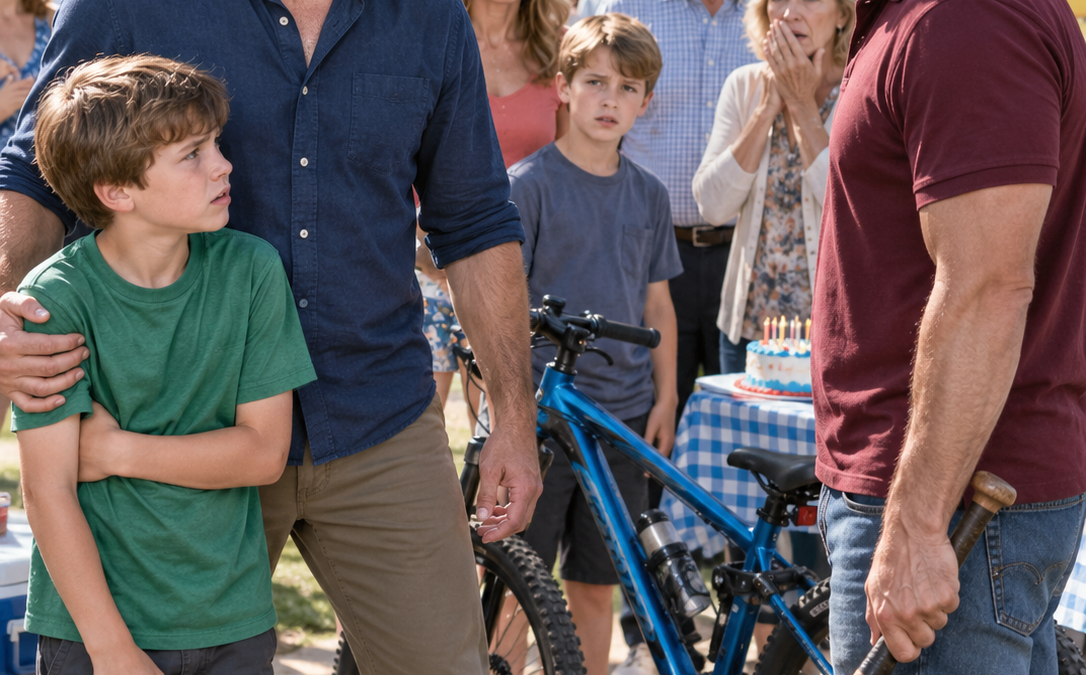
Ethan had been proudly showing the bike to my coworker Tomas’s son, but his body language changed immediately when Tyler approached. He shifted slightly, positioning himself between Tyler and the bike.
I recognized the defensive posture. Ethan had learned from experience that his cousin rarely respected boundaries.
“My dad just got it for me today,” Ethan said, his voice polite but guarded.
“Let me ride it,” Tyler demanded, already reaching for the handlebars.
“I don’t think that’s a good idea,” Ethan replied. “I’m still getting used to it myself. But you can ride my old one if you want.”
He pointed to his previous bike, which we’d brought along for exactly this purpose—to have an extra for the other kids.
Tyler’s face contorted.
“I don’t want your stupid old bike. I want to try this one.”
I could see the tension escalating and moved closer, hoping to defuse the situation before it got out of hand.
I had no idea just how badly things would deteriorate, or how quickly.
The tension between the boys grew thicker as more guests arrived. Tyler kept circling back to Ethan’s new bike like a shark, making comments just loud enough for everyone to hear.
“It’s not even that cool. And my dad could buy me three of those if he wanted to.”
Ethan tried to ignore him, showing remarkable restraint for a nine-year-old. He stayed close to the bike, though, clearly worried about what his cousin might do.
Around 1:30, when most of the guests had arrived, Heather cornered me by the drinks cooler. Her voice had that saccharine tone she used when trying to manipulate a situation.
“Andy, don’t you think Ethan should let Tyler take a quick turn on his new bike? It would be the polite thing to do.”
“Ethan already offered Tyler his old bike,” I replied, keeping my voice even. “The Trailblazer is brand new, and Ethan’s still getting used to it himself. I think it’s reasonable for him to want to be the first one to really ride it.”
Her smile tightened.
“Well, I think you’re teaching Ethan to be selfish. Family should share with family.”
“I’m teaching Ethan that his boundaries deserve to be respected,” I countered. “And that it’s okay to say no sometimes, even to family. Especially since Tyler has a history of not being careful with Ethan’s things.”
I reminded her about the Nintendo Switch controller incident from Christmas.
“That was months ago,” she snapped. “You really know how to hold a grudge.”
I excused myself to check on the food. James had taken over grilling duty and was flipping burgers with expert precision. I thanked him and began arranging buns and condiments on a nearby table.
From the corner of my eye, I could see Marcus watching my interaction with Heather, his expression darkening. He whispered something to my father, who nodded sympathetically.
The next 20 minutes were deceptively peaceful. People ate, chatted, and a few of my friends presented me with gag gifts about turning 40—reading glasses, anti-aging cream, and a cane with a horn attached.
Ethan beamed with pride as everyone complimented his organizational skills.
For a brief moment, I thought we’d dodged the bullet of family drama.
It was time for cake. I headed to the cooler where we’d stored it, away from the afternoon sun. The pavilion was about 30 feet from where Ethan had parked his bike.
I had just lifted the cake box when I heard Tyler’s voice rise in a whining demand.
“Just let me ride it once.”
Then Ethan’s firm but polite response.
“No, Tyler. I already told you. You can use my old bike.”
I placed the cake on the table and was about to head over when a commotion erupted. There was the sound of a scuffle, followed by Tyler’s angry shout.
“You’re such a baby! My dad says your dad spoils you.”
I moved faster, but was momentarily blocked by a group of guests.
What happened next would replay in my nightmares for months.
There was a sickening crack, followed by Ethan’s scream—a sound no parent ever wants to hear. It cut through the party chatter like a knife.
By the time I pushed past the stunned guests, Ethan was on the ground, curled into a fetal position, wheezing and crying.
Standing over him was Marcus, a baseball bat from the sports equipment we’d brought for the kids gripped in his hands.
Time seemed to slow down.
I dropped to my knees beside Ethan. His face was contorted in pain, tears streaming down his cheeks. He couldn’t speak. He couldn’t catch his breath.
When I gently tried to help him sit up, he screamed again, his hand clutching at his right side. Even through his T-shirt, I could see the unnatural indentation where his ribs should have been.
“Call 911!” I shouted to no one in particular.
Lisa, James’s wife, already had her phone out and was speaking urgently to an emergency dispatcher.
I looked up at Marcus, who still held the bat.
“What did you do?”
My voice didn’t sound like my own.
His response chilled me to the bone.
“The kid needs to learn some respect. Tyler asked nicely to use the bike, and your precious son was being a little [ __ ] about it.”
My father stepped forward, his face concerned, but not horrified. Not nearly horrified enough for what had just happened.
“Now, I’m sure Marcus didn’t mean to hit him that hard. It was just a tap to get his attention.”
A tap?
Ethan couldn’t breathe. Each shallow inhalation made him wince and whimper.
“He swung a baseball bat at my nine-year-old son,” I said, my voice dangerously quiet. “Over a bicycle.”
Heather pushed through the gathering crowd. Instead of checking on Ethan, she went straight to Tyler, who was watching the scene with wide eyes.
“It’s okay, honey,” she said loudly. “None of this would have happened if Ethan had just shared like we asked him to.”
I couldn’t believe what I was hearing. The cognitive dissonance was staggering.
My mother knelt on Ethan’s other side, but her words weren’t for him.
“Marcus has always had a bit of a temper. He doesn’t think sometimes when he’s angry. I’m sure he feels terrible.”
Marcus didn’t look terrible.
He looked annoyed, as if Ethan’s injury was an inconvenience to him. He’d placed the bat down, but hadn’t moved to help or express remorse.
The paramedics arrived in less than ten minutes, though it felt like hours. They were efficient and gentle with Ethan, asking me questions about allergies and medical history as they stabilized him.
When they lifted his shirt to examine his side, several people gasped. The bruising was already spreading across his pale skin, dark purple and angry.
“Significant trauma to the rib cage,” one paramedic murmured to his colleague. “Possible pneumothorax. We need to transport immediately.”
As they prepared to load Ethan into the ambulance, two police officers arrived. They began questioning witnesses while a third paramedic asked me directly what had happened.
I told him plainly, pointing to Marcus.
“My brother hit my son with a baseball bat because my son wouldn’t let his cousin borrow his new bike.”
Marcus immediately started defending himself to the nearest officer.
“It wasn’t like that. The kids were arguing. I was just trying to break it up. The bat barely touched him. He’s being dramatic.”
Several of my friends stepped forward, contradicting his story. Tomas, who had seen the whole thing, was particularly vocal.
“That’s a lie. The kids were just talking, and you walked up and swung at the boy. I saw the whole thing.”
As I climbed into the ambulance with Ethan, I heard my mother telling an officer, “There’s been a misunderstanding. We’re family. We can sort this out ourselves.”
The doors closed, and the last thing I saw was Marcus, arms crossed, looking irritated as an officer took down his information.
My parents flanked him protectively, like they had his entire life.
The ride to Boston Children’s Hospital was the longest 12 minutes of my life.
Ethan’s pain medication had started to kick in, but he was still terrified, his small hand gripping mine with surprising strength. The paramedic monitored his oxygen levels and spoke in soothing tones about the hospital having the coolest rooms with TVs and video games.
I tried to smile for Ethan’s sake, but inside I was seething with rage and fear.
In the emergency department, things moved quickly. A trauma team was waiting for us. They whisked Ethan away for X-rays and a CT scan while a compassionate nurse named Michael guided me through paperwork, insurance details, and medical-history questions.
When I explained what had happened, his professional demeanor cracked slightly, revealing shock and disgust.
“Your brother did this deliberately?” he clarified, clearly having trouble processing the information.
“Yes,” I replied flatly. “Because my son wouldn’t let his cousin borrow his new bike.”
Michael placed a gentle hand on my shoulder.
“Dr. Rivera will be with you shortly to discuss your son’s injuries. And just so you know, we’re mandated reporters. Child Protective Services will need to be involved, and the police will want to take your statement.”
I nodded numbly.
Of course there would be consequences.
There should be consequences.
The fact that Marcus was my brother didn’t change what he had done.
Dr. Rivera, a petite woman with kind eyes and a serious demeanor, arrived with Ethan’s scan results 30 minutes later.
The news was worse than I’d feared.
“Ethan has four broken ribs on his right side,” she explained, pointing to the images. “One has partially punctured his lung, causing what we call a pneumothorax. Essentially, air is leaking into the space between his lung and chest wall. He also has some internal bleeding that we need to address.”
My vision blurred with tears.
“Will he be okay?”
“He needs surgery to repair the damage and drain the air and blood. We have an excellent pediatric thoracic surgeon, Dr. Patel, preparing now. Ethan’s young and otherwise healthy, which works in his favor, but these are serious injuries. Recovery will take time.”
She paused, choosing her words carefully.
“Mr. Parker, the force required to cause this kind of damage to a child’s ribs is significant. This was not an accident or a tap. Whoever did this used extreme force with a weapon.”
I was allowed to see Ethan briefly before surgery.
He lay in a hospital bed that made him look even smaller than he was, an oxygen mask covering half his face, tubes and wires connecting him to various machines.
When he saw me, he tried to smile.
“Dad,” he whispered through the mask. “Am I in trouble?”
My heart shattered.
“No, buddy. You’re not in trouble. Not at all.”
“But Uncle Marcus was really mad. And Grandma said I should have shared.”
I took his hand, careful not to disturb the IV.
“Listen to me, Ethan. You did nothing wrong. Nothing. Uncle Marcus was wrong. What he did was very, very wrong.”
His eyes filled with tears.
“It really hurts, Dad.”
“I know, buddy. The doctors are going to fix you up. I’ll be right here when you wake up. I promise.”
As they wheeled him toward surgery, a police detective introduced herself as Maria Wilson. She had kind eyes but a firm handshake.
“I’d like to take your statement when you’re ready, Mr. Parker.”
I recounted everything while Ethan was in surgery. Detective Wilson recorded our conversation and took meticulous notes.
When I finished, she looked at me with genuine sympathy.
“Your brother is already claiming it was an accident, that he was using the bat to point and it slipped. But multiple witnesses contradict that account. We’ve taken him into custody on felony charges of aggravated assault and child endangerment.”
A weight lifted from my chest.
At least the police were taking this seriously.
The surgery lasted three hours. Dr. Patel, a tall man with steady hands and a reassuring voice, explained that they had successfully repaired Ethan’s lung, stopped the bleeding, and stabilized his ribs with a special plate that would dissolve as he healed.
“He’ll need to stay in the hospital for at least a week, possibly longer, depending on how his recovery progresses.”
I settled into the chair beside Ethan’s bed in the pediatric ICU, prepared for a long night.
Around 9:00, I heard familiar voices in the hallway.
My parents had arrived.
They entered hesitantly, my mother’s eyes red from crying, my father looking older than I’d ever seen him. But their first words made it clear that their distress wasn’t primarily for their injured grandson.
“They’re keeping Marcus in jail overnight,” my father said without preamble. “They won’t even set bail until tomorrow.”
My mother clasped her hands together.
“Andy, this has all gotten out of hand. Marcus feels terrible. It was an accident. He was just trying to discipline Tyler for throwing a tantrum, and Ethan got in the way.”
I stared at her in disbelief.
“That’s not what happened, Mom. Multiple people saw Marcus deliberately hit Ethan with a bat. My son has four broken ribs and a punctured lung. He just had major surgery.”
“Well, yes, and that’s awful,” she conceded, glancing at Ethan’s sleeping form. “But pressing charges against your own brother? That’s going too far. We’re family.”
“Family doesn’t send children to the hospital over a bicycle,” I replied, my voice tight with controlled fury.
My father stepped closer, adopting the authoritative tone he’d used throughout my childhood.
“Marcus made a mistake. A serious one, yes, but he’s facing years in prison. Is that really what you want for your brother?”
“What I want,” I said slowly, “is for my son to feel safe. What I want is for there to be consequences for nearly killing a child. What I want is for you two, just once, to hold Marcus accountable instead of making excuses for him.”
My mother started crying in earnest.
“He asked us to tell you how sorry he is. He’s your brother, Andy. Blood. You can’t turn your back on blood.”
Looking at Ethan’s bruised face, the monitors tracking his vital signs, the drainage tubes emerging from his small chest, something crystallized within me.
A lifetime of accepting their warped family dynamic shattered.
“I’m not turning my back on blood,” I said quietly. “I’m protecting it. Ethan is my blood, too. He’s a child who deserves to be safe. If you can’t understand that, then you need to leave.”
“You’d choose this vendetta over your family?” my father demanded.
“I’m choosing my son over people who think it’s acceptable to hospitalize him for not sharing a bike. Now, please go. Ethan needs rest. And frankly, so do I.”
After they left, I called Sarah Thompson, a lawyer friend who specialized in family law. Despite the late hour, she answered and listened to my story with growing horror.
“Andy, I’ll help you however I can,” she promised. “We’ll get a restraining order first thing tomorrow, and I have colleagues in criminal law who can make sure the prosecutor knows the full severity of the situation.”
That night, as I watched Ethan’s chest rise and fall, I made a decision.
This wasn’t just about protecting him from Marcus. It was about breaking a generational cycle of enabling abuse.
The realization brought with it a strange sense of clarity and purpose. For the first time in my life, I could see my family for what it truly was—and what it needed to become.
The next morning, while Ethan slept, I met with the hospital’s social worker, Detective Wilson, and two representatives from Child Protective Services. They explained the legal process ahead and helped me understand the implications of pressing charges against Marcus.
“Your brother is currently facing felony charges of assault with a deadly weapon and child endangerment,” Detective Wilson explained. “Given the severity of Ethan’s injuries and the multiple witnesses, the district attorney is taking this very seriously.”
I nodded, steeling myself for what I knew would be a difficult road ahead.
“I want to pursue every possible legal option. Not just criminal charges, but a restraining order as well.”
The CPS representative, a woman named Jasmine Taylor with warm brown eyes and a no-nonsense demeanor, nodded approvingly.
“We’ll be conducting our own investigation. But from what we’ve gathered so far, a restraining order seems appropriate—not just against your brother, but potentially his wife and son as well, given their involvement in the incident.”
Over the next few days, as Ethan began his painful recovery process, I threw myself into building our case.
Sarah Thompson connected me with Jonathan Reeves, a prosecutor with the district attorney’s office who specialized in cases involving child victims. He visited us at the hospital, speaking gently with Ethan and taking detailed notes.
“The evidence against your brother is substantial,” Reeves assured me. “Multiple eyewitnesses saw him strike Ethan with the bat. The medical evidence supports that this was a forceful, deliberate blow, not an accident. And we have statements from several guests who heard him justify the attack afterward.”
But as strong as the assault case was, I wanted to ensure Marcus faced full accountability.
After Reeves left, I called David Mercer, a private investigator Sarah had recommended. It wasn’t cheap. His retainer alone was $3,000, but I couldn’t put a price on Ethan’s safety and justice.
“I need you to look into my brother’s finances and activities,” I explained. “He’s been struggling with money for years, but always seems to have enough for new trucks and vacations. I have a feeling he’s involved in something illegal.”
Mercer was thorough and discreet.
Within a week, he had uncovered disturbing information.
Marcus had been systematically stealing from our parents for years. Bank records showed numerous transfers from their accounts to his—money they thought was for his business or mortgage payments, but that actually went to gambling and luxury purchases.
Worse, he’d been committing tax fraud through his landscaping business, reporting only a fraction of his income and paying employees under the table.
“There’s more,” Mercer told me during a visit to the hospital. “I found connections to a contractor who’s been under investigation for using substandard materials in municipal projects. Your brother’s company has been doing landscaping for these projects, and there’s evidence he’s been signing off on environmental-compliance documents without actually performing the required work.”
The information was a gold mine.
I passed it all to Detective Wilson, who brought in the financial crimes unit. They were eager to expand their investigation, especially when it connected to the ongoing contractor-fraud case.
Meanwhile, I was preparing for another type of confrontation.
My parents had been calling and texting incessantly, alternating between guilt trips and anger. They’d visited Ethan once more, bringing extravagant gifts and treating him with exaggerated kindness while subtly suggesting he might have misunderstood what happened.
Ethan, still heavily medicated, hadn’t picked up on their manipulation, but I had.
After they left, I decided it was time for a final reckoning.
I contacted a tech-savvy friend who helped me set up discreet recording devices in my parents’ house. Massachusetts is a two-party-consent state for recordings, so I couldn’t secretly record our conversation for court purposes, but I could use it to protect myself from gaslighting and manipulation.
I arranged to meet them at their home after Ethan was discharged from the hospital, ostensibly to discuss how we would move forward as a family.
While these plans were in motion, I focused on Ethan’s care.
The doctors were amazed at his resilience. After ten days, he was released with strict instructions for home recovery: no school for at least three weeks, no physical activity for two months, regular follow-up appointments, and pain management.
I transformed our living room into a comfortable recovery space with a hospital-bed rental, his favorite blankets and stuffed animals, and a new gaming system to keep him entertained during the long hours of mandatory rest.
The day before our planned family confrontation, I sat down with Ethan for a serious conversation about the future. I needed to know his feelings before making final decisions.
“Buddy, how would you feel if we didn’t see Uncle Marcus, Aunt Heather, and Tyler anymore? Or maybe not as often as before?”
Ethan was quiet for a moment, absently petting Rocket, our tabby cat, who hadn’t left his side since he came home.
“Would we still see Grandma and Grandpa?”
I took a deep breath.
“I’m not sure yet. They’re very angry that Uncle Marcus is in trouble. They think we should forgive him and pretend nothing happened.”
Ethan’s face crumpled slightly.
“They think it was my fault, don’t they? For not letting Tyler use my bike.”
“Some people make excuses for others when they do bad things,” I explained carefully. “It’s not about you. It’s about them not wanting to admit that Marcus did something terrible.”
He nodded slowly.
“I don’t want to see Uncle Marcus again. He scares me. And Tyler is always mean to me anyway.”
He hesitated, then added in a small voice, “But I’ll miss Grandma and Grandpa if they still love me.”
My heart broke for him.
“They do love you, Ethan. They just don’t know how to love in a healthy way sometimes. We’ll figure it out, okay? The most important thing is keeping you safe.”
That night, I finalized my strategy.
This wasn’t about revenge anymore. It was about protection and justice.
Marcus needed to face consequences for his actions. My parents needed to understand that their enabling behavior would no longer be tolerated. And most importantly, Ethan needed to see that violence and abuse weren’t something he had to accept, even from family.
I gathered all the evidence—medical reports, witness statements, financial documents—and prepared for what would be the most difficult confrontation of my life.
But for the first time since my childhood, I wasn’t afraid of standing up to my family.
I had something worth fighting for.
The morning of the confrontation, I dropped Ethan off at James and Lisa’s house. They had become invaluable friends during this ordeal, offering support without question or judgment.
Their daughter, Mia, was close to Ethan’s age and had made him a giant get-well card signed by his entire class.
“Take all the time you need,” Lisa assured me, giving me a quick hug. “We’ve got movies lined up, popcorn ready, and Dr. Garcia approved all the activities. He’ll be fine.”
I arrived at my parents’ house exactly at noon, as planned.
The recording devices were already in place—one in the living room where we’d likely talk, one in the kitchen, and one in my father’s study in case the conversation moved there.
I wasn’t proud of the deception, but years of gaslighting and manipulation had taught me to protect myself.
My mother answered the door, her expression wavering between hostility and artificial pleasantness.
“Andy, come in. Your father’s in the living room.”
She attempted to hug me, but I stepped past her, maintaining emotional distance.
My father sat in his usual recliner, reading glasses perched on his nose, newspaper in hand—a picture of normalcy that seemed obscene given the circumstances.
He nodded curtly as I entered.
“How’s Ethan?” my mother asked, taking a seat on the sofa.
“Recovering,” I replied simply. “Four broken ribs don’t heal overnight.”
“Well, children bounce back quickly,” my father said dismissively. “When you were five, you fell out of that oak tree in the backyard and broke your arm. Barely slowed you down.”
The comparison between an accidental fall and a deliberate assault with a weapon was so absurd that I almost laughed.
Instead, I took a deep breath and dove straight to the heart of the matter.
“Marcus’s bail hearing is tomorrow. His lawyer is trying to get the charges reduced to simple assault, claiming it was an accident and that Ethan’s injuries are being exaggerated.”
I watched their reactions carefully.
My mother looked relieved.
“That’s good news. Hopefully this can all be resolved quickly.”
“It won’t be,” I said flatly. “The prosecutor has multiple eyewitness statements and comprehensive medical evidence showing that Marcus deliberately struck Ethan with enough force to break four ribs and puncture a lung. This wasn’t a tap or an accident. It was a violent assault on a child.”
My father’s face reddened.
“Now you listen here. Your brother made a mistake. A serious one, yes, but he doesn’t deserve to have his life ruined over it. He’s got a business, a family—”
“A business where he’s committing tax fraud and signing off on fraudulent environmental-compliance documents,” I interrupted. “Yes, the financial crimes unit is investigating that, too. They’re very interested in his connection to Peterson Construction.”
The color drained from both their faces.
My mother’s hand flew to her throat.
“What have you done?” she whispered.
“I’ve done what you should have done decades ago. I’m holding Marcus accountable for his actions.”
My father stood abruptly.
“This is a witch hunt! You’ve always been jealous of your brother. Always trying to make him look bad to make yourself look better.”
I remained calm, which seemed to infuriate him further.
“This isn’t about me or my feelings toward Marcus. This is about a grown man who assaulted a child and has shown zero remorse. It’s about decades of enabling dangerous behavior. And it stops now.”
“He said he was sorry,” my mother cried.
“No, Mom. He didn’t. Not to me. Not to Ethan. You said he was sorry. There’s a difference.”
My father paced the room, his agitation growing.
“So what do you want? Money? Is that it? Name your price to drop these ridiculous charges.”
The suggestion was so offensive that, for a moment, I couldn’t speak.
When I found my voice, it was deadly quiet.
“I want justice for my son. I want him to know that when someone hurts him, even family, there are consequences. I want him to understand that he deserves to be safe and respected. No amount of money can buy that.”
“You’re destroying this family!” my mother sobbed. “Over what? A few bruises?”
That was the breaking point.
I pulled out my phone and showed them the photos of Ethan’s injuries—the massive purple bruising across his torso, the incisions from surgery, the drainage tubes, the pain etched on his young face.
“This is what Marcus did to your grandson,” I said, my voice shaking with controlled rage. “This is what you’re defending. Not a few bruises. Traumatic injuries that required major surgery and will take months to heal. Injuries that could have killed him if the broken rib had punctured his lung more severely.”
They stared at the photos in horror, finally confronted with the reality they’d been denying.
In the stunned silence, I laid out my terms.
“I’m not dropping the charges. I’m supporting the prosecutor in seeking the maximum penalty. I’m obtaining a permanent restraining order against Marcus, Heather, and Tyler. And unless you can acknowledge what Marcus did and stop making excuses for him, that restraining order will include you as well.”
“You can’t keep us from our grandson,” my father blustered, but his voice lacked conviction.
“Family court will decide that. But ask yourselves this: What kind of grandparents defend the man who put their grandson in the hospital? What message does that send to Ethan?”
I stood to leave, having said my piece.
“The choice is yours. Support your grandson or continue enabling your son’s violence. You can’t do both.”
As I reached the door, my mother called after me, her voice broken.
“Marcus said… he said Ethan was taunting Tyler, refusing to share. He said he just lost his temper for a moment.”
I turned back, meeting her eyes.
“And you believe that justifies what he did? That any provocation from a nine-year-old child deserves that response?”
She had no answer.
“That’s what I thought,” I said softly, and left.
The next six weeks were a whirlwind of legal proceedings, medical appointments, and rebuilding our lives.
Marcus’s bail was set at $500,000, far more than he could afford. The evidence against him was overwhelming, and when the financial-crimes investigation began to uncover the full extent of his fraudulent activities, his lawyer pushed for a plea deal.
The district attorney, however, refused to budge on the assault charges.
“We’re sending a message that child abuse will not be tolerated regardless of family relationships,” Jonathan Reeves told me after a particularly tense court hearing.
My parents attended every proceeding, sitting on the opposite side of the courtroom from Ethan and me. They looked increasingly haggard as the evidence mounted.
My mother attempted to approach me once in the hallway, but the protective order I’d obtained kept her at a legal distance. She sent a letter instead, filled with conflicting emotions—grief over the family rupture, anger at my “overreaction,” and tentative acknowledgment that Marcus’s actions had been excessive.
It wasn’t the full recognition of the harm done that I needed to see, but it was a small crack in her denial.
Finally, the day of Marcus’s sentencing arrived.
The courtroom was packed, not just with family and friends, but with media representatives. The case had garnered local attention as an example of family violence and the justice system’s response.
Marcus sat at the defense table wearing a suit that seemed too large for him after six weeks in county jail. He didn’t look at me once.
Heather sat directly behind him, her expression alternating between tears and glares in my direction.
Ethan had asked to speak to the judge, a request that had surprised and worried me. But Dr. Ramirez, his therapist, thought it might be empowering for him.
“As long as he’s prepared for any outcome, having his voice heard can be healing.”
Judge Sandra Ortiz, a stern woman with silver-streaked black hair, called the court to order. The proceedings moved quickly through the formalities until it was time for victim-impact statements.
Ethan approached the podium, looking tiny but determined in his dark-blue suit.
The judge smiled gently at him.
“Take your time, young man. Just tell us how this has affected you.”
Ethan’s voice was clear and strong, belying his nervous fidgeting.
“Before my uncle hit me with the bat, I wasn’t scared of him. I just didn’t like going to his house because my cousin was mean to me. But now I have nightmares. I’m scared when I hear loud noises. I couldn’t play at recess for two months because my ribs hurt too much.”
He paused, gathering his thoughts.
“The worst part wasn’t the pain, though. It was that my grandparents said it was my fault for not sharing my bike. It made me feel like I deserved to get hurt.”
His voice broke slightly.
“Nobody deserves to get hurt like that. Not for a bike. Not for anything.”
There wasn’t a dry eye in the courtroom when he finished. Even the court reporter was discreetly wiping away tears.
When it was my turn to speak, I focused on the broader impact.
“My son shouldn’t have to fear family gatherings. He shouldn’t have to wonder if setting a boundary will result in violence. And he certainly shouldn’t have to question whether the adults in his life will protect him or blame him when he’s harmed.”
I looked directly at Marcus for the first time.
“My brother didn’t just break Ethan’s ribs. He broke his trust in family, his sense of safety, and his understanding of love. Those injuries may take far longer to heal than his physical wounds.”
The judge listened attentively, taking notes throughout.
When the defense presented its arguments, focusing on Marcus’s otherwise clean record and “momentary lapse in judgment,” she interrupted repeatedly with pointed questions about the force used and his lack of immediate remorse.
Finally, it was time for sentencing.
Judge Ortiz removed her glasses and addressed the courtroom.
“In my 23 years on the bench, I have seen many cases of family violence. They are always tragic. But what makes this case particularly disturbing is not just the severity of the physical assault—though using a baseball bat on a child is horrific enough—but the aftermath.”
She turned her gaze to my parents, who shrank visibly in their seats.
“Instead of immediate remorse and a desperate attempt to make amends, the defendant and his supporters attempted to minimize the assault and blame the victim, a nine-year-old child.”
She paused.
“Family loyalty is admirable, but not when it becomes complicity in abuse. Not when it teaches children that violence is acceptable if committed by someone who shares your blood.”
Looking back at Marcus, she delivered the sentence.
Eight years in state prison, with eligibility for parole after five years. Upon release, a permanent restraining order prohibiting contact with the victim. Mandatory anger-management and parenting classes, and financial restitution for all medical expenses and therapy costs.
The courtroom erupted in murmurs.
Marcus slumped in his chair.
Heather let out a wail of protest.
My parents sat in stunned silence.
As we left the courtroom, Detective Wilson approached us with news about the financial-crimes investigation.
“We’ve just executed search warrants on your brother’s business records and home office. The evidence of fraud is substantial. He’ll be facing additional charges.”
I nodded, feeling no satisfaction, only relief that justice was being served.
“What about my parents? Were they involved?”
She shook her head.
“Not criminally, as far as we can tell. They appear to have been victims of his financial manipulation, not accomplices. They might want to consult with a financial adviser, though. The preliminary findings suggest he’s drained significant amounts from their retirement accounts.”
Outside, reporters waited with cameras and microphones.
I declined all interviews, shielding Ethan from the attention.
As we walked to the car, I noticed my parents standing alone by the courthouse steps, looking lost and suddenly old.
My father raised a hand in a hesitant wave.
After a moment’s hesitation, I nodded in acknowledgment.
Not forgiveness. Not yet.
But a small opening for what might come.
In the car, Ethan asked a question that had clearly been on his mind.
“Dad, is our family broken forever now?”
I considered my answer carefully.
“Some parts of it are, buddy. But families can change and grow. We can build new connections with people who respect and protect each other. And maybe someday the broken parts can heal, too, if they’re willing to change.”
He nodded thoughtfully.
“Like my ribs. Dr. Patel said they’ll heal stronger where they broke.”
“Exactly like that,” I said, hoping it was true.
The months following the trial brought significant changes to our lives.
The first and most immediate was our move from the suburban neighborhood where we’d lived for six years to a new townhouse across town. I wanted Ethan to have a fresh start in a place without painful memories.
And the truth was, I needed it, too.
The old house felt tainted somehow, as if the violence that had occurred at the birthday party had followed us home.
Our new place was smaller, but brighter, with a community pool and playground nearby. It was also in a different school district, which meant Ethan could start fifth grade without being “the kid whose uncle broke his ribs.”
Children can be cruelly curious, and the local media coverage had made anonymity impossible at his old school.
The first night in our new home, we ate pizza on the floor amid half-unpacked boxes.
Ethan seemed lighter somehow, as if the physical distance from our old life had lifted an invisible weight from his shoulders.
“Dad,” he said contemplatively, chewing a slice of pepperoni pizza. “Do you think Uncle Marcus is sorry now?”
The question caught me off guard.
“I don’t know, buddy. Sometimes people don’t understand the harm they’ve caused until they face serious consequences.”
He nodded, surprisingly mature for his age.
“His consequence is pretty serious.”
“Yes, it is. But so were your injuries.”
I hesitated, then added, “Are you sorry he’s in jail?”
Ethan considered this, his forehead wrinkling in thought.
“Not really. Is that bad?”
“No. It’s honest. You don’t have to feel sorry for someone who hurt you and never apologized.”
He seemed satisfied with this answer, and we moved on to discussing which box might contain his favorite Spider-Man nightlight.
Finding a good therapist for Ethan became my top priority.
Dr. Ramirez, who had prepared him for the trial, was excellent, but located near our old home. After interviewing several candidates, we connected with Dr. Lily Chen, a child psychologist specializing in trauma recovery.
She had a warm office filled with art supplies and therapeutic games. Most importantly, Ethan felt comfortable with her immediately.
“Healing isn’t linear,” she warned me during our initial consultation. “Ethan will have good days and bad days. Nightmares, anxiety, fear of conflict—these are all normal responses to trauma. Our goal is to give him tools to process these feelings, not to erase the experience.”
I enrolled in therapy, too, partly to work through my own trauma and guilt, partly to learn how best to support Ethan.
My therapist, Dr. Alan Friedman, specialized in family systems and helped me navigate the complex grief of losing my birth family while building a healthier chosen one.
“You’re carrying a lot of guilt,” he observed during one session. “You believe you should have protected Ethan better.”
“I should have,” I insisted. “I knew what Marcus was capable of. I should never have allowed him near my son.”
“And yet, you maintained the relationship because you believed family was important for Ethan. You made the best decision you could with the information you had at the time.”
It took many sessions before I could begin to forgive myself.
The truth was, I had been programmed from childhood to normalize Marcus’s behavior, to make excuses for him, just as my parents did. Breaking free from that conditioning wasn’t as simple as flipping a switch.
The first holidays without extended family were strange but peaceful.
For Thanksgiving, instead of the tense, formal dinner at my parents’ house that had been our tradition, we invited James and Lisa’s family over, along with Tomas and his wife, Sophia.
We cooked together, played board games, and created new traditions free from the undercurrent of tension that had always characterized family gatherings with Marcus present.
Christmas presented a more complicated challenge.
My parents sent gifts for Ethan—expensive ones, delivered by courier with cards full of generic holiday wishes but no mention of the rift between us.
After much deliberation, I allowed Ethan to keep them.
“They’re still your grandparents,” I explained. “Being angry with them doesn’t mean rejecting their gifts. But we’ll write thank-you notes together that are polite but honest.”
His note, painstakingly written in his improving handwriting, read:
“Thank you for the Xbox games. I’m having fun playing them. I miss you sometimes, but I’m still sad that you thought it was my fault when Uncle Marcus hurt me. Dad says people can change if they want to. I hope you want to.
Merry Christmas,
Ethan.”
My parents’ response came three weeks later.
A handwritten letter addressed to Ethan, but clearly meant for me as well.
“Dear Ethan,” my mother wrote. “We owe you an apology. What happened at your dad’s birthday party was not your fault. Uncle Marcus was very wrong to hurt you, and we were wrong to make excuses for him.
“We’ve been thinking a lot about what your dad said to us, and he was right. We didn’t protect you the way grandparents should.
“We’re getting counseling now to understand why we’ve made these mistakes for so long. We miss you both very much and hope that someday you’ll feel safe enough to see us again.
“We will respect whatever decision your dad makes about this.
“With love,
Grandma and Grandpa.”
It wasn’t a perfect apology, but it was a start.
I showed it to Dr. Friedman, who agreed it showed promising signs of genuine reflection.
“The acknowledgment of Ethan’s innocence and their failure to protect him is significant. So is their respect for your boundaries. These are positive first steps.”
Ethan’s physical recovery progressed steadily.
By spring, he was cleared for most activities, though contact sports were still off-limits. The special plate the surgeons had inserted to stabilize his ribs was dissolving as planned, and his lung function had returned to normal.
The only visible reminder of his ordeal was a thin surgical scar that would fade with time.
His emotional healing was less straightforward, but equally encouraging.
The nightmares became less frequent. He grew more confident in setting boundaries with friends at school, and slowly, he stopped flinching at sudden movements or raised voices.
One unexpected bright spot emerged from the darkness.
My cousin Diana, whom I hadn’t seen in years due to a falling-out with Marcus, reached out after hearing about what happened. She had her own stories about Marcus’s bullying and my parents’ enabling, and had distanced herself from the family long before I did.
We reconnected over coffee while Ethan was in school, and soon she and her husband, Kyle, became regular visitors, bringing their twin daughters, who were a year older than Ethan.
Having extended family who understood and validated our experience was healing in ways I hadn’t anticipated.
As summer approached, I faced a decision about my parents.
They had continued therapy, sent respectful cards on birthdays and holidays, and made no attempts to circumvent the boundaries I’d established. Their counselor had reached out with their permission to suggest a supervised visit if Ethan and I felt ready.
I discussed it with Dr. Chen, who recommended a careful, structured approach.
“If you decide to allow contact, it should be in a neutral location, time-limited, and with clear expectations about appropriate topics. And most importantly, Ethan needs to have a voice in the decision.”
When I broached the subject with Ethan, his response surprised me.
“I think I want to see them, but only if you’re there the whole time, and only if they promise not to talk about Uncle Marcus.”
We arranged a one-hour meeting at a public park.
My parents arrived early, looking nervous and subdued. My father, once an imposing figure in my life, seemed diminished somehow. My mother had lost weight, and her usually perfect hair had visible gray streaks she’d stopped coloring.
The reunion was awkward, but not hostile.
They didn’t try to hug Ethan, but let him set the physical boundaries. They asked appropriate questions about school and his interests, avoiding any mention of Marcus or the court case.
When Ethan showed them how he could do a full pull-up on the playground equipment—a post-recovery milestone he was proud of—they applauded with genuine enthusiasm.
As we were leaving, my father pulled me aside.
“Thank you for this. I know we don’t deserve it.”
“This is for Ethan,” I replied, not unkindly but firmly. “He deserves to know his grandparents if they can be healthy and supportive in his life.”
He nodded, accepting the condition.
“We’re trying to be better. Not just for Ethan, but for ourselves, too. The counselor helped us see how our relationship with Marcus has been destructive for everyone, including him.”
It was the most self-aware statement I’d ever heard from my father.
It didn’t erase decades of damage, but it offered a glimmer of possibility I hadn’t expected.
As we drove home, Ethan was quiet, processing the encounter.
Finally, he said, “They seem different. Sadder, but nicer, too.”
“People can change when they realize they’ve been wrong,” I replied. “It takes time and work, though. We’ll see if they keep trying.”
“Like how I’m working on not being scared all the time?”
“Exactly like that. You’re doing the work every day, and I’m so proud of you for it.”
He smiled, a genuine, unguarded expression that had become more frequent in recent months.
“Dad, I think we’re going to be okay.”
Looking at him—resilient, thoughtful, brave beyond his years—I knew he was right.
The path hadn’t been easy, and there would be challenges ahead. Marcus would eventually be released from prison. My relationship with my parents would require ongoing boundaries and vigilance. Ethan would continue to process his trauma as he grew.
But we had broken the cycle.
We had stood up for what was right, even when it meant standing alone. We had built a new definition of family based on respect and protection rather than obligation and excuses.
And most importantly, Ethan knew with absolute certainty that he was worth protecting, that his boundaries mattered, and that love should never come with bruises.
A few weeks later, on a bright Saturday morning, I watched from our driveway as Ethan rode his bike down the street, confident and free.
The Trailblazer that had been at the center of so much pain now symbolized something else entirely—his recovery, his independence, and our new beginning.
As he circled back toward me, his face split in a wide grin, I felt a peace I hadn’t known was possible after so much heartache.
Family isn’t always who you’re born to. Sometimes it’s who you choose to keep in your life and who you choose to leave behind.
The hardest lesson I learned through all of this is that protecting your child sometimes means losing other relationships, even ones you thought were unbreakable.
But watching my son heal and thrive made every painful choice worth it.
Have you ever had to make a difficult decision to protect someone you love? How did you find the strength to stand firm when others pressured you to back down?
Share your story in the comments below. And if this story resonated with you, please hit the like button and subscribe to hear more about our journey toward healing.
Remember, your worth is never determined by those who hurt you, but by the courage it takes to protect yourself and those you love.
Thank you for listening, and take care of yourselves and each other.








