At my 18th birthday i locked my $3 million inheritance into a trust. at breakfast, my brother hugged me. “thank you for my house!” i froze. mom smiled. “we wanted it to be a surprise.” dad had already signed a purchase agreement using my inheritance as the payment. i took a sip of coffee. “you might want to call the realtor…”
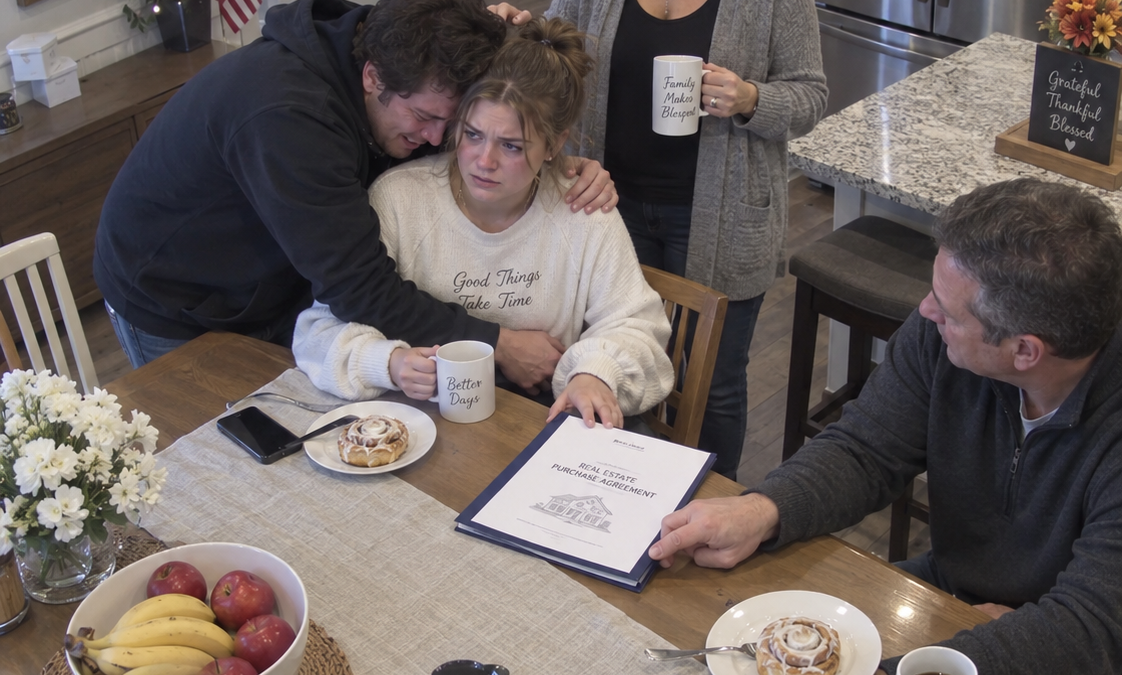
At my 18th birthday, I locked my $3 million inheritance into a trust.
At breakfast, my brother hugged me.
“Thank you for my house.”
I froze.
Mom smiled. “We wanted it to be a surprise.”
Dad had already signed a purchase agreement using my inheritance as payment.
I took a sip of coffee.
“You might want to call the realtor.”
My name is Poppy Bennett. I am 18 years old.
This morning, my brother hugged me so hard that coffee spilled over the rim of my mug.
“Thank you for my house,” he said, already crying happy tears.
My mother smiled, the smile she uses for company.
“We wanted it to be a surprise.”
My father set a signed purchase agreement beside my plate.
$1.5 million.
Closing in three hours.
My $3 million inheritance listed as the payment.
No one had asked me a single question.
They never did.
I was the easy one. The responsible one. The daughter who always understood and never made trouble.
They still believed the money was where they had left it. They still believed I would sign whatever they put in front of me.
I set my mug down carefully.
“You should call the realtor,” I said. “Right now.”
There’s something I need to tell you before this goes any further.
What happened next is the reason I stopped being the easy one forever.
Let me back up, because a moment like that doesn’t come out of nowhere. It gets built, one small assumption at a time, over years, until the people building it forget they ever needed your permission at all.
I grew up in a suburb north of Columbus, Ohio, in a beige house with a two-car garage and a lawn my father edged every Sunday. From the outside, we looked like nothing unusual. Two parents, two children, a family that showed up to church potlucks and paid its bills.
And in a way, that was true.
My parents weren’t cruel in the way people picture when they hear the word. They didn’t hit us. They didn’t scream.
What they did was quieter than that, and harder to point to, because it lived inside a single word.
The word was sensible.
That was me. Poppy, the sensible one. Poppy, who didn’t need a fuss.
From the time I was small, my parents divided the family into two kinds of people, and they did it without ever saying it out loud.
There were the people you worried about, and the people you counted on.
My older brother, Miles, was someone you worried about.
I was someone you counted on.
It sounds like a compliment when you say it fast. It took me years to understand it wasn’t one.
Miles is eight years older than me. He was 26 that autumn, and he had been, for as long as I could remember, the family’s ongoing project.
Miles was the artist. Miles had a gift. Miles felt things more deeply than the rest of us, which was a phrase my mother used whenever Miles quit something.
And Miles quit a lot of things.
He quit college twice. He moved to Chicago to paint, then to a different apartment in Chicago when the first one didn’t work out, then to a studio he was going to turn into a business, then out of the studio when the business didn’t happen.
Every time the ground gave out under him, the whole family rushed to catch him.
That was just how it worked.
That was love in our house.
Love was catching Miles.
I want to be careful here, because it would be easy to make my brother the villain of this story. And he isn’t. Not really.
Miles was raised to believe the world would always tilt itself in his direction. And to a child, that isn’t cruelty. It’s just water. You don’t question the temperature of the water you grow up in.
He genuinely thought everyone got caught the way he got caught.
It never occurred to him that some of us were doing the catching.
I was doing the catching.
I just didn’t know yet how literally.
There’s a memory I keep coming back to.
I was 16, and I picked up a weekend job at a hardware store two neighborhoods over, stocking shelves and cutting keys and learning the difference between a flat washer and a lock washer.
I liked it.
I liked knowing where things went. I was proud enough of that first paycheck that I brought it home and set it on the kitchen counter like it meant something.
My mother glanced at it.
“Good for you, honey. See? You don’t need us to make a fuss.”
Then she went back to a phone call about Miles’s rent.
That was the whole thing right there.
Miles’s crisis got phone calls.
My paycheck got a glance and a sentence that sounded kind and landed like a door closing.
I didn’t cry about it. Crying wasn’t a thing that worked in our house.
What I did instead was start a notebook.
Not a diary. I’ve never had the patience for feelings on paper.
A notebook.
I wrote down my shifts, my hours, what I earned, what I spent.
It was a small, boring habit, and my family found it boring.
I let them.
Because the boring habit was the only thing in that house that was entirely mine. Nobody borrowed from it. Nobody had opinions about it.
It was just numbers.
And numbers don’t lie to you.
They don’t tell you you’re being sensible.
That habit is the reason I’m able to tell you this story.
Hold on to it. It comes back.
There’s one more thing from that time I never told anyone, because at the time it seemed too small to say out loud.
The winter I was 15, my school ran a program, a summer thing, a few weeks at a college campus for kids who were good at math. The kind of thing that looks like nothing and quietly changes the trajectory of a life.
It cost money. Not a fortune, but money.
I brought the form home and left it on the counter.
My mother looked at it and said in her gentlest voice, “Honey, I don’t think this is a year for extras. You understand?”
And I did understand.
Because understanding was my whole job.
What I didn’t say, what I filed away instead, was that three weeks earlier, my parents had co-signed a lease on a Chicago apartment for Miles, a place he lived in for four months before he moved again.
There was money for that.
There was always money for the person you worried about.
There was never money for the person you counted on, because counting on someone is just a nicer way of taking them for granted.
I threw the form away myself so no one would have to.
That was the year I stopped asking for anything.
Not because I’d stopped wanting things.
Because I’d learned what asking got me.
The thing about being the sensible one is that nobody ever asks you anything, either.
They tell you.
When Miles needed a guest room converted into a studio one summer, nobody asked whether I minded losing a room I used for homework.
They told me I’d understand.
When we skipped a family vacation because money was tight after one of Miles’s rescues, nobody asked me how I felt about it.
They told me I was old enough to get it.
There’s a sentence my mother used to say to Miles, warm and reassuring, whenever a big decision was on the table.
“We’d never do that without asking you.”
I heard her say it to my brother a dozen times.
She never once said it to me.
I noticed that the year I turned 17, sitting at the dinner table while my parents mapped out a plan to help Miles move back closer to home.
They talked over the top of my head like I was furniture that agreed with the room.
And I remember thinking very clearly, without any drama at all:
They have never asked me for a single thing.
They’ve only ever assumed.
I didn’t know then how much that assumption was about to cost them.
To understand what happened at that breakfast table, you have to understand where the money came from.
And to understand that, you have to understand my grandfather, because he’s the one person in this story who ever handed me something instead of taking it.
His name was Walter Bennett, my father’s father, and he built things for a living.
He ran a mechanical contracting company. Heating, cooling, ventilation, the guts of buildings that nobody thinks about until they stop working.
Bennett Mechanical.
He started with a truck and a toolbox and grew it into something with a warehouse and a name people in the trades respected.
My grandfather had grease under his fingernails until the day he sold the company.
And even after, out of habit.
When I was a kid, I spent summers at his workshop.
Not the company. His own shop.
A detached building behind his house where he kept the tools he loved too much to leave at work.
Miles hated it out there.
Too dusty, too loud, nothing to do.
But I loved it.
I loved handing him wrenches and learning the names of things and watching a broken machine become a working one under his hands.
He talked to me while he worked.
Not down to me. Just to me.
Like I was a person worth talking to in that house.
That was rare enough that I noticed it.
On my eighth birthday, he gave me a key.
A small brass key on a plain ring, worn smooth. He pressed it into my palm and closed my fingers over it.
It was a key to the workshop.
“A key means somebody trusts you to lock up after yourself,” he told me. “You’re the one I trust with mine.”
I still have that key.
I want you to remember it.
It’s the most important object in this entire story.
And the first time you see it, it’s just a birthday present from a grandfather to a kid.
My grandfather sold Bennett Mechanical the year I was nine.
It was a good sale, a big one, the kind that changes a family’s math.
And here’s what he did with a piece of it.
A piece worth $3 million.
He didn’t split it among his children. He didn’t fold it into some family fund.
He set it aside in a trust for one person.
For me.
I didn’t understand the shape of it until much later. And even then, I only understood the parts one needed to understand in order to act.
But the bones of it were simple.
My grandfather put $3 million into a trust with my name on it.
And he wrote it so that the money became fully, completely mine on the day I turned 18.
Not 25.
Not 30.
Eighteen.
While he was alive, he managed it himself, with the help of a financial adviser named Frances Whitaker, who’d handled his money for 20 years.
Everyone called her Fran.
I want to describe the day he told me the trust existed, because I’ve never told this part before, and I think it belongs here.
I was 12.
We were sitting in his workshop, and he was showing me how to true up a bicycle wheel, spinning it slowly and watching for the wobble, tightening a spoke a quarter turn at a time.
He didn’t look up from the wheel when he said it.
“You know I’ve set some money aside for you, don’t you, Poppy? A good amount.”
I told him I didn’t know that.
He nodded like that was the answer he expected.
“It’s not for right now,” he said. “It’s not for your parents, either. Even though your father is going to be the one holding on to it for a while after I’m gone. It’s for you, when you’re old enough that nobody can talk you out of it being yours.”
He spun the wheel again, checking his work.
“Money is like this wheel, Poppy. If it’s not true, it wobbles the whole time it’s spinning. And everybody around it can feel something’s wrong, even if they can’t say what. I want yours to spin true. That’s the whole plan.”
I didn’t understand what he meant.
Not really.
Not for years.
I understood it perfectly the night I sat on my bedroom floor with four years of statements spread out in front of me.
Why 18?
I asked my grandmother that years later, and she gave me an answer I’ll come back to.
But at the time, all I knew was what my grandfather told me once, quietly, near the end.
He got sick when I was 13.
It went fast.
And in one of the last conversations we had that was really a conversation, when it was just the two of us and the beeping machines, he took my hand and said something I didn’t fully understand for four more years.
“When you turn 18,” he said, “the first thing you do is call Fran. Before anything else. Before you let anybody talk you into anything.”
His grip was weak, but his eyes were clear.
“Promise me you call Fran first.”
I promised.
I was 13, and I would have promised him anything.
He died a few weeks later.
And I put that promise somewhere in the back of my mind and mostly forgot the reason for it.
Because I didn’t have the reason yet.
Here is what changed when my grandfather died.
While he was alive, he’d managed the trust himself. When he passed, the job of holding it temporarily until I came of age fell to the next name on the paperwork.
My father.
Glenn Bennett became the trustee of my $3 million, responsible for keeping it safe and untouched until the day it became mine.
I’m going to say that plainly, because it matters.
My father was supposed to be the guardian of that money.
Not the owner.
The guardian.
There is an enormous difference between those two words.
And the entire tragedy in my family is that my parents never once, in four years, believed there was.
I want to tell you about the funeral briefly, because I think it explains something about how my father understood himself from that day forward.
At the reception afterward, in our own living room, I overheard my father talking to one of his old college friends, a man named Doug, whom I’d met maybe twice in my life.
My father had his hand on Doug’s shoulder, and he was speaking in the low, important voice men use when they want to sound like they’re not bragging.
“Dad set us up pretty well. Honestly, there’s a good chunk that’s technically earmarked for Poppy down the road, but practically speaking, it’s family money. It’ll all get used where it’s needed.”
I was 14, standing near the doorway with a plate of funeral casserole I wasn’t eating.
And I remember the sentence landing in me like a stone dropped into still water.
Practically speaking, it’s family money.
I didn’t understand yet why it bothered me so much.
Only that it did.
I didn’t write it in the notebook. I wasn’t keeping the notebook yet. Not really, not in the way it would become.
But I think that sentence was the first one I ever filed away without meaning to.
It sat there for three years before I understood what it had actually been.
They had a phrase for the money.
My father said it so often that it stopped sounding like anything.
“It’s all one pot, Pop,” he’d say while paying a bill, while talking about the future, while explaining why something couldn’t happen that year.
One pot.
As if my grandfather’s gift and my father’s checking account and the family’s whole financial life were a single body of water, and it was only an accident of paperwork that my name sat on top of it.
I heard one pot for years.
Somewhere around the time I turned 17, I started, very quietly, to count what was in it.
Now, stay with me, because this is where I started to notice that something in my house had begun to move.
It started with paper on the kitchen counter.
The summer I turned 18, my parents started house hunting.
That in itself wasn’t strange.
People look at houses.
What was strange was how they talked about it.
It was for Miles.
That was the story.
Miles needed to finally settle down, put down roots, have a place of his own. And my parents were going to help him find one.
Fine.
My parents helping Miles was the most natural sentence in the English language. I’d been hearing versions of it my whole life.
But the listings that showed up on the counter didn’t quite match the story.
I noticed that the way you notice a picture hanging slightly crooked.
One afternoon, there was a printout by the coffee maker, and someone had gone through it with a pencil, underlining features.
The feature they had underlined twice, with a little star beside it, was a main-floor bedroom with its own bathroom.
An in-law suite.
I stood there with my coffee and looked at that little pencil star for a long time.
Why would a house for Miles need a room for my parents?
I didn’t ask.
That’s the thing you have to understand about me, and about how this all unfolded.
My whole life had trained me not to ask.
To observe instead.
To file things away in the boring notebook part of my brain and wait until the picture was complete.
So I filed it.
In-law suite. Pencil star.
And I kept watching.
The phone calls were the next thing.
My parents had never been secretive people, mostly because they’d never imagined I was paying enough attention to need secrecy from.
But that summer, conversations started stopping when I walked into the kitchen.
Not dramatically.
Just a lowered voice.
“Oh, we’ll talk later.”
A subject changed a beat too smoothly.
Once, coming in from the garage, I caught the tail end of my father on the phone before he heard me.
“As long as it clears right after her birthday,” he was saying, “we’re fine.”
After her birthday.
I only had one birthday coming up.
I went upstairs and sat on my bed and thought about that sentence the way you’d worry a loose tooth.
As long as it clears right after her birthday.
Clears.
That was a money word.
That was a word about a transaction completing.
And it was tied somehow to me turning 18, to the exact moment my grandfather’s trust stopped being something my father held and became something that was mine.
I told myself I was reading into it.
I was good at telling myself that sensible people don’t jump to conclusions.
But the notebook part of my brain had already started writing it down.
Then Miles started texting me.
My brother and I were never close, exactly. But we weren’t enemies.
He loved me in the distracted way you love someone you’ve never had to actually see.
That summer, his texts got bright and constant, full of exclamation points and photos of paint swatches and links to furniture.
And underneath the excitement was something that made my stomach drop the first time I really read it.
Pop, I still can’t believe you’re doing this for me! You’re the best sister a guy could ask for!
I read it four times.
Doing this for me?
What was I doing for him?
I hadn’t done anything.
I hadn’t agreed to anything.
No one had asked me anything.
But somewhere, in some conversation I hadn’t been part of, my parents had told my brother a story.
And in that story, I was the generous one.
I was giving.
I was doing this for him.
They had spent my agreement before I ever gave it.
They had told Miles I was happy about a decision no one had ever let me make.
I didn’t text back right away.
I sat with my phone in my hand and felt something cold and clear settle into me.
Something that wasn’t quite anger yet.
It was more like focus.
My brother was thanking me for a gift I hadn’t chosen to give, using money I hadn’t chosen to spend.
And he was crying happy tears over it.
And he had no idea that any of that was strange, because Miles didn’t know the money was mine.
He thought it was ours.
One pot.
The last thing I saw before I understood the real size of what was happening was an envelope.
It came in the mail, and it sat on the kitchen table for exactly one evening before it disappeared into my father’s office.
And in that one evening, I read the return address.
A title company.
The kind of company that handles the closing of a house sale, that moves the money and records the deed.
Not a company you talk to when you’re browsing.
A company you talk to when you’ve decided.
And printed on the envelope, in the little window, was a date.
A closing date.
The morning after my birthday.
That was the night I stopped telling myself I was reading into it.
Something wasn’t coming.
Something had already been set in motion, with a date attached.
And the date was chosen around me, the way everything in my life had always been chosen around me, as if I were furniture that would agree with the room.
I lay awake, and I made a decision.
Not a plan yet.
Just a decision.
I was going to find out exactly what my family had done.
And I was going to do it the way I did everything.
Quietly.
Completely.
Before I said a single word out loud.
By the next morning, I had the shape of it.
And the shape was worse than I’d let myself imagine.
I did what I was good at.
I got into the details.
Over three days, while my parents relaxed into the belief that their sensible daughter was as calm and uninvolved as ever, I read everything I could find in the house that wasn’t locked.
And a few things that were.
Because my grandfather had taught me how a simple lock works.
And my father was not a careful man about his office.
Here’s what I pieced together.
My parents had signed a purchase agreement on a house.
Not a modest house.
A million-and-a-half-dollar house in a market where that number buys something with a circular driveway and a room to spare.
The agreement listed my father as the buyer, paying cash.
And the closing, the day the money would actually change hands and the house would become theirs, was scheduled for the morning after I turned 18.
Why that morning?
Because that was the first morning the money would be legally, finally mine.
My father, the trustee, could not simply take $3 million out of my grandfather’s trust and buy a house with it while I was still a minor.
That would have been theft, plain and obvious.
And even my father understood the difference between managing and stealing well enough to know he couldn’t do that.
So he built the whole thing around a single assumption.
The money would become mine at 18.
And I, sensible, agreeable, easy Poppy, would sign whatever paperwork moved it where they wanted it to go that very morning, as a kind of birthday gift for the family.
Because I always did what they assumed I’d do.
They hadn’t asked me.
They’d scheduled me.
And the house wasn’t just for Miles.
That little pencil star told the truth.
The story didn’t.
The in-law suite. The main-floor bedroom. The room a 26-year-old painter would never need.
That was for my parents.
They were going to move in, too.
My grandfather’s $3 million was going to buy a home for my brother and a retirement for my mother and father.
And my role in it was to hold a pen and smile.
I found the purchase agreement in a folder in my father’s desk, and I read the number twice.
Then I sat down in his office chair because my legs weren’t entirely cooperating.
$1.5 million.
Cash.
Closing in a matter of days.
There was more in that folder.
And each thing I read made the picture sharper and worse.
There was a receipt for the earnest money, the deposit that tells a seller you’re serious.
$75,000.
And clipped behind it, a statement from a home equity line of credit drawn on our house.
The beige one with the two-car garage.
Dated the same week.
My father had borrowed against the roof over our heads to put down a deposit on a house he intended to buy with my money.
He had bet the home we lived in on the assumption that I would sign.
There was a printout of an email chain with the title company.
All business.
All confidence.
My father writing like a man who had a million and a half dollars ready to move.
Because in his mind, he did.
It was sitting in a trust account with his name on it as trustee.
And he’d shown that account to the seller as proof he could pay.
The account was real.
The money was real.
The only thing that wasn’t real was his right to spend it.
And nobody in that email chain knew that but him and me, now sitting in his chair with a folder open on my knees.
There was one more document in that folder I haven’t mentioned.
And it took me the longest to understand, because on its face it looked entirely innocent.
It was a printed itinerary for a trip.
Flights to a coastal town in Florida.
A rental with a pool.
Dates set for six weeks after closing.
Nothing about it referenced me at all.
No explanation of why it was tucked behind the purchase agreement rather than filed somewhere ordinary, like the rest of the family’s travel plans.
It took me a full day of turning it over before I understood what I was looking at.
It wasn’t a family vacation.
It was a retirement trip.
The kind you plan the moment a major weight lifts off your shoulders.
The kind you book the second you’re finally certain the money that’s about to make your life easier is actually, definitely coming.
My father hadn’t just been confident the closing would happen.
He’d already started planning what he’d do with the relief of it.
The way you plan a party before you’ve actually won the thing you’re celebrating.
That itinerary told me more about the certainty behind their assumption than the purchase agreement itself did.
The purchase agreement was a plan.
The itinerary was a man who no longer thought of it as a plan at all.
It was already, in his mind, simply what was going to happen next.
As settled and ordinary as a sunrise.
I want to tell you I stayed cold through all of it.
But there was a moment right then when I didn’t.
I thought about my grandfather’s hands on a wrench and the money he’d set aside so carefully.
And what he’d say if he could see his son using it as collateral for a lie.
I put the folder down and cried for about a minute, quietly, in an office chair.
For a man who’d been dead for years and was still the only one who’d protected me.
Then I wiped my face and kept reading.
Because crying is a thing you spend once.
And I had work to do.
But that wasn’t the part that broke something open in me.
The part that broke something open was the notebook part.
Because once I knew what to look for, I went and got my shoebox.
I’d been keeping copies of the trust statements for four years.
That sounds more sophisticated than it was.
The statements came to the house every year.
Addressed to Glenn Bennett, Trustee for the Benefit of Poppy Bennett.
My name was right there on the envelope.
It was, in the most literal sense, my mail.
So when they arrived, I read them.
And because the boring part of my brain doesn’t trust anything it can’t check later, I photographed them and kept the copies in a shoebox under my bed with my old paychecks and my grandfather’s key.
Four years of statements.
Nobody in that house knew the shoebox existed, because nobody in that house had ever once wondered what I did with my time.
I spread them out on my bedroom floor.
And I did the math my father never imagined I could do.
The trust was supposed to be untouched.
Held safe.
$3 million sitting there, growing quietly, waiting for me.
That’s what a guardian does.
He guards.
It wasn’t $3 million anymore.
Over four years, in withdrawals of $10,000 and $15,000 and $20,000 at a time, someone had taken $185,000 out of my grandfather’s trust.
The withdrawals had a rhythm to them.
And the rhythm was familiar, because I had grown up inside it.
I laid the dates next to what I remembered, and the picture assembled itself with a kind of sick clarity.
Spring of one year, a big withdrawal.
That was the season Miles’s studio lease went bad and my parents helped.
Late autumn of another.
That was around the time Miles got the newer car, the one that appeared in the driveway with a bow while I was taking the bus to my hardware store job.
A cluster the following spring.
That was when Miles’s credit card debt got sorted out and everyone talked about it in hushed, protective tones.
I added it up.
Roughly $120,000 of my inheritance had already gone to rescuing my brother.
Not to his childhood.
Not to some shared family need.
But to bailing out an adult man in his twenties.
Over and over.
With money that belonged to me.
Taken by a father who was supposed to be guarding it.
Spent in service of the same favoritism I’d been swallowing my whole life.
The house wasn’t the first time my parents had spent my money.
It was just the first time I could prove it.
I sat on my floor for a long time.
I want to tell you I felt rage, and part of me did.
A clean, hot line of it.
But mostly what I felt was that cold focus again.
Sharper now.
Because here’s what four years of a boring notebook teaches you.
When something is finally, undeniably clear, you don’t make a scene.
You make a record.
You verify before you react.
Because a reaction is a thing you spend once.
And a record is a thing you can use.
I thought about my grandfather’s voice.
When you turn 18, the first thing you do is call Fran. Before anybody talks you into anything.
I finally understood why he’d made me promise.
He knew his son.
He’d known for years.
He’d set the money to become mine at 18 not as a gift of trust, but as an act of protection.
A locked door with a timer on it.
And he’d left me the one instruction that could open it safely.
I found Fran Whitaker’s number where I’d copied it four years earlier, onto the inside back cover of my notebook, in the handwriting of a 13-year-old who didn’t know what she was writing down.
I closed the shoebox.
I put my grandfather’s key in my pocket because I wanted it with me for this.
Then I went out to my car so no one in the house would hear.
And I called Fran Whitaker.
Her office picked up on the second ring.
I braced myself for a stranger.
What I got was a woman who, the moment I said my name, went very quiet.
And then very gentle.
“Poppy,” she said. “Walter told me you’d call. He made me promise to pick up when you did.”
Something in my chest loosened and tightened at the same time.
Even after he was gone, my grandfather was still somehow the only adult in my life who’d planned for me instead of around me.
I told her what I’d found.
All of it.
The house.
The closing date.
The in-law suite.
The story my parents had told Miles.
The $185,000 missing from the statements in my shoebox.
I laid it out in order, calmly, the way I had laid the papers on my floor.
Fran listened without interrupting until I ran out of words.
When she finally spoke, she said the sentence that changed everything.
“Poppy, I want to be very clear with you, because I don’t think anyone has been. On your birthday, that money becomes entirely yours. Not the family’s. Yours. No one can spend it for you. No one can force you to spend it on anything for anyone. Not your father, not your mother, not a purchase agreement with someone else’s signature on it.”
She paused.
“Do you understand what I’m telling you? They cannot make you do this. They can only assume you will.”
I did understand.
It was the first time in my life someone in a position of authority had told me that a decision was mine to make.
But Fran wasn’t finished.
And her voice shifted.
“Careful now. There’s something in the account history you should see. As trustee, your father was required to keep the trust intact. There have been withdrawals over the last four years. Substantial ones.”
“$185,000,” I said.
There was a silence on the line.
“You already knew?”
“I’ve been keeping the statements,” I said. “For four years.”
I heard her exhale.
And when she spoke again, there was something new in her voice.
Something that sounded almost like respect.
“Then you understand better than most adults would. Those withdrawals were a breach of his duty as trustee. That money was supposed to be untouchable.”
She hesitated.
“I have the full accounting. Every entry, going back to when he took over. If you want it, it’s yours. It’s your record to have.”
A few days later, an email arrived from her office.
The subject line was plain, and it has stayed with me.
Trust Accounting: 2021 to Present — For Your Records.
I opened it in my car, again away from the house, and scrolled through it slowly.
Every withdrawal my father had made.
Dated.
Itemized.
Official.
And when I laid Fran’s document next to the photographs in my shoebox, the numbers matched down to the dollar.
My boring habit and her official record told exactly the same story.
And there was nothing anyone could ever say to make that story go away.
That’s the thing about a real receipt.
The strongest one isn’t the longest document.
It’s the simplest number that can’t be argued with.
Fran gave me options.
She was good about that.
She never once tried to make my choices for me.
She laid out what I could do the way you’d lay out tools on a bench.
I could confront my father with the accounting.
I could involve lawyers, pursue the breach, make him answer for the $185,000.
I could go loud.
I sat with that for a while.
And then I told her the thing I’d already known since I sat on my bedroom floor.
“I don’t want to ruin him,” I said. “I want it to stop. I want the money safe, and I want it to be mine, and I want them to never be able to reach it again. That’s all.”
I meant it.
I could feel even then how easy it would be to reach for the cruelest version of this.
My father had handed me the weapon himself in the form of that accounting.
But I didn’t want to burn my family to the ground.
I wanted to walk out of the fire they’d built and take what was mine with me.
There’s a difference.
And I’ve never regretted knowing it.
“All right,” Fran said.
And I could hear her deciding to trust me the way my grandfather had.
“Then we do the one thing that makes all of it moot. We lock it before anyone can ask you to unlock it.”
What she proposed was simple and legal and complete.
The moment I turned 18 and the trust became mine, we would move all of it, everything that was left, into a new trust.
One with my name as the sole beneficiary and Fran as the independent trustee.
Structured so that no single person could move large sums on a whim or under pressure.
Not even me.
In a weak moment at a breakfast table with my brother crying happy tears.
Any real distribution would have to go through a process.
Through daylight.
It wasn’t about keeping the money for myself.
It was about making sure that when someone tried to rush me into a decision I hadn’t chosen, the answer could simply be:
That’s not how this works anymore.
We would name it after him.
The Walter Bennett Legacy Trust.
My grandfather’s protection made permanent in his own name.
“The paperwork will be ready to go,” Fran told me. “It executes the minute you’re legally 18. Not a minute before. I won’t cut a corner, and neither will you. But the second it’s yours, we move it.”
I asked her the question that had been sitting under everything.
“And the house? The closing the next morning?”
“The house was never yours to fund,” she said simply. “Your father signed that agreement as the buyer. Your name isn’t on it. If the money he was counting on isn’t there, that’s his problem to solve, not yours. All you have to do is not solve it for him.”
I understood then how the whole thing had been built.
And how quietly it could come apart.
My father had used a trust account, the $3 million he was guarding, as proof of funds to convince a seller he was a cash buyer.
The seller and the realtor believed him because the money was real and the account was real.
What they didn’t know was that the money wasn’t his.
And that his entire plan for actually getting it depended on a daughter signing a wire the morning of the closing, out of habit.
Out of being easy.
If I simply moved the money the night before, there would be nothing to wire.
The closing would arrive.
The funds wouldn’t.
And the house of assumptions would fall in on the man who built it.
I wouldn’t have to push it.
I’d just have to step out of the way.
“So I go home,” I said. “And I act like nothing’s wrong.”
“Can you do that?” Fran asked, not unkindly.
I almost laughed.
“Fran,” I said, “I’ve been doing that my whole life.”
That was the moment it stopped being an investigation and became a plan.
And for the first time I could remember, I wasn’t the one waiting to find out what my family had decided.
I was the one who knew something they didn’t.
I want to describe the days immediately after that phone call with Fran, because I think the mechanics of what actually happened behind the scenes matter. They don’t get talked about enough in stories like this one, which tend to skip straight to the confrontation.
Fran and I spoke three more times before my birthday, each time with me sitting in my car in a different parking lot. The grocery store. The library. Once, absurdly, in the lot of the hardware store where I’d had my first job, as if some part of me needed to be near the place where the notebook habit started while I finished building the thing it had made possible.
The second call was about the mechanics of the new trust itself. Fran walked me through the difference between a revocable structure, which I could theoretically unwind myself later if I wanted to, and the version she was actually recommending, which built in real friction. Any distribution over a certain modest threshold would need her sign-off as independent trustee, with a cooling-off period attached, even for requests I made myself.
I asked her why I’d want to make it harder for myself to access my own money.
“Because 18-year-olds get talked into things,” she said, without any judgment in her voice. Just fact. “Not because you’re not smart. Because you’re 18, and you’ve spent your whole life being the person other people’s needs flow through. That habit doesn’t disappear the moment the money is legally yours. It disappears when you build a structure that doesn’t require you to fight that habit alone, in the moment, at a kitchen table with someone crying in front of you.”
I thought about Miles’s welcome mat sitting in its packaging by the door, and I told her to build it exactly the way she was describing.
The third call was shorter, almost administrative, going over the actual mechanics of the transfer. What time it would execute, how she’d confirm it to me, what the paperwork would look like on the other end so I’d recognize it if I ever needed to produce it.
It was in that call that she told me something I’ve held on to since.
“Your grandfather asked me once, years before he got sick, what I thought made money dangerous to a family. I told him I thought it was secrecy. Money nobody talks about honestly ends up owning the people around it instead of the other way around.”
She paused.
“He disagreed with me. He said it wasn’t secrecy. It was assumption. He said secrecy at least admits there’s something to hide. Assumption doesn’t even do that much. Assumption just walks in and takes the good chair at the table like it always belonged there.”
I didn’t fully understand what she meant until I was sitting across from my father, watching him assume, right up until the moment the assumption ran out of road.
The last stretch before my birthday was the strangest three days of my life, because all I had to do was keep being the person they already thought I was. It turned out to be the easiest performance in the world, because it wasn’t a performance at all.
I set the table. I nodded along. I let my mother tell me again how uncomplicated I was.
“See?” she said to my father one evening, watching me clear the dishes without being asked. “Nothing rattles Poppy.”
She meant it as praise. She’d always meant it as praise. And for the first time, I let the words land without flinching, because I finally understood what they’d never understood.
They thought my calm meant I wasn’t paying attention.
It meant the opposite.
It had always meant the opposite.
Miles drove down from Chicago that week, five and a half hours to be there for the closing. He arrived glowing. He hugged me in the driveway and held up his phone to show me a photo of a welcome mat he’d already bought, a soft gray one with a little house stitched into the corner.
“Is that insane?” he said, laughing. “I bought a welcome mat for a house I haven’t closed on. Tell me that’s insane.”
“That’s not insane,” I said.
And I meant it.
It was one of the harder moments of that whole week, because he was so happy, and his happiness was built on a lie he didn’t know he was standing on.
He was decorating a house I was about to make disappear. He thought I was giving it to him. He’d bought a welcome mat to thank me.
And I couldn’t say a word, because saying a word would have unraveled the one thing keeping the money safe.
Their belief that nothing had changed.
That first evening, Miles insisted on cooking dinner for the whole family, something he’d never once done in all the years I’d lived alongside him. It was a slightly overambitious pasta dish he’d found a video for online.
I remember standing in the kitchen doorway, watching him move around a space he barely knew how to navigate, humming to himself, genuinely happy in a way I don’t think I’d seen since we were both very small children, before either of us had fully learned our assigned roles in that house.
He kept narrating what he was doing to nobody in particular.
“And now we let that reduce. And this is the part where I usually burn it. But not tonight. Tonight everything’s going right.”
I remember thinking, watching him, that some part of this was going to be genuinely hard to take away from him, regardless of how badly he deserved to know the truth eventually.
He wasn’t celebrating theft. He didn’t know it was theft. He was simply, for one evening, a person who believed his family had finally, spontaneously decided to be generous with him for no complicated reason at all.
And I understood, standing in that doorway, that I was the only person in the house who knew exactly how short that particular evening’s happiness was going to last.
He asked me at one point, stirring the sauce, whether I’d want to come visit once he’d settled in, whether I’d help him pick out furniture for what would technically, on paper, be his room upstairs. Though he’d already started talking about it as our place, a phrase that included me in it without ever once having asked whether I wanted to be included.
I told him I’d think about it, which was technically entirely true.
I was thinking about it every single hour that week, just not in the direction he assumed.
That’s the cost people don’t tell you about. When you protect yourself from a family like mine, you don’t just carry the weight of what they did. You carry the weight of the ones who didn’t know.
Miles’s welcome mat sat by the door in its packaging, and every time I passed it, it cost me something.
I thought about telling him. I want to be honest about that, because it was the hardest choice I made in that whole stretch. Harder than the money, harder than the silence.
Twice, I sat on the edge of my bed with my brother’s name pulled up on my phone.
And twice, I put the phone down.
If I told Miles the truth, that the house was mine to give or not give, that our parents had lied to him, that the money had been his sister’s before it was ever a house, he would have believed me.
And he would have been unable to hide it.
Miles had never in his life been able to hold a secret across a dinner table. One look at our mother’s face and he’d have blurted it out, and the whole thing would have come apart before it was safe.
So I chose the money over my brother’s warning.
I chose a locked door over the kind thing.
I’ve made my peace with it, mostly, but I won’t pretend it was clean.
Protecting yourself from people who love you badly sometimes means letting someone you love walk a little further into the dark before you can turn the light on.
I didn’t like the person that made me those three days.
I just liked her better than the person who signed whatever got put in front of her.
And I was afraid.
I need you to know that, too, because it would be easy to make myself sound like I moved through all of this made of glass and certainty.
I didn’t.
There was a night two days before my birthday when my father came into the kitchen while I was at the counter, stood a little too close, and said, “You’re quiet lately, Pop. Everything okay?”
For one cold second, I was sure he’d found the shoebox. Sure he could see the whole plan sitting behind my eyes.
My heart pounded so hard I thought he’d hear it.
“Just tired,” I said. “Big week.”
He patted my shoulder, told me to get some sleep, and walked away.
And I stood there shaking, because I’d almost given the whole thing up over nothing.
Being the one who knows more than everyone else in a room is not the clean, cold feeling movies make it look like.
It’s mostly just holding very still while your hands want to tremble.
The night before my birthday, my father made a toast at dinner.
He wasn’t a sentimental man, so it caught everyone a little off guard when he stood up with his glass.
“To new keys,” he said. “And new beginnings. All of us under one roof.”
My mother beamed. Miles teared up.
I lifted my glass with everyone else and thought about the word keys and the word all.
And I understood that my father had just told the truth out loud without knowing it.
All of us under one roof.
Not a gift to my brother.
A plan for everyone, funded by me.
My mother leaned over to me before we went up to bed. She squeezed my arm the way she did when she wanted something to feel like affection.
“Wear something nice tomorrow morning, sweetheart,” she said. “It’s going to be a big day. A special day.”
She smiled.
“There’s a surprise.”
“I’ll wear something nice,” I told her.
I went up to my room. I took out my grandfather’s key and set it on the nightstand where I could see it.
I sat on the edge of my bed with my phone in my hand.
And I waited.
I watched the numbers change.
Somewhere across town, in an office that had gone dark hours ago, Fran Whitaker had queued everything up.
At 11:41 that night, my phone was still dark, and my heart was going harder than I wanted to admit.
I wasn’t as calm as I’d let everyone believe.
I was 18 now, and I was about to do something irreversible to my own family, alone in the dark, in a house full of people who loved me in the way you love a resource.
I thought about my grandfather closing my fingers over that key.
Somebody trusts you to lock up after yourself.
At 11:58, my phone lit up.
Transfer complete.
Walter Bennett Legacy Trust.
$3 million, minus what my father had already taken, moved out of the account he controlled and into a trust that answered to no one but the process my grandfather would have wanted.
It was done two minutes before my birthday ended.
Hours before a closing my father still believed would happen.
The money was somewhere he could never reach again.
I sat there and breathed.
I picked up my grandfather’s key and held it, and I understood that the shape of my whole life had just quietly changed.
And no one downstairs had any idea.
My parents were asleep, certain.
My brother was asleep, grateful.
And I was awake, holding a brass key.
The only person in that house who knew that someone had finally locked the door.
Somebody was going to have to lock up after this family.
It turned out to be me.
I set out my grandfather’s coffee mug for morning, the chipped one I had taken from his workshop after he died.
I was going to need the coffee.
Then I turned off the light.
The kitchen the next morning smelled like cinnamon rolls.
The ones from the tube that my mother only made on birthdays.
That detail matters, because it’s how they wanted the morning to feel.
Warm.
Ordinary.
Safe.
There were candles on the counter and a small stack of wrapped presents and a banner that said 18 in gold letters.
My mother was humming.
My father was in a good mood, which for him meant he was reading something on his phone and occasionally chuckling.
Miles was practically vibrating.
I came down in something nice, like I’d been told.
I poured coffee into my grandfather’s mug.
And I sat.
“There she is,” my mother said.
She came around the counter and kissed the top of my head.
“Eighteen. Our sensible girl. All grown up.”
She said it the way she’d said it a thousand times.
And for the last time, it didn’t touch me at all.
That false warmth lasted about 90 seconds.
Then Miles couldn’t hold it anymore.
He crossed the kitchen and threw his arms around me so hard I felt the coffee slosh over the rim of the mug and burn my hand.
And he said the thing I had known was coming and still wasn’t ready for.
“Thank you for my house.”
He was crying happy tears, his face against my hair.
“I still can’t believe you’re doing this. You’re the best sister a guy could ask for, Pop. The best.”
I held very still.
I set the mug down so I wouldn’t spill more of it.
“My house,” I said, keeping my voice light. “That’s a big surprise.”
“We wanted it to be,” my mother said.
She gave me the smile she used for company, the polished one, the one that didn’t reach her eyes.
“We’ve been planning it for months. We wanted today to be perfect.”
And then my father did the thing that turned a warm kitchen into the room where everything changed.
He slid a folder across the table next to my plate, the way you’d hand a child a birthday card.
“Part of your present,” he said, pleased with himself. “There’s just a little paperwork to make it official. Nothing to worry about.”
I opened the folder.
I already knew what was in it, but I opened it anyway, because I needed them to watch me look.
The purchase agreement.
$1.5 million.
My father’s signature at the bottom as the buyer.
The closing time printed at the top.
Three hours away.
I looked at it for a moment.
Then I looked up and asked my first small question, in the same tone I’d have used to ask for more coffee.
“Whose name is on this as the buyer?”
My father blinked.
It wasn’t the question he had prepared for.
“Mine,” he said. “For now. That’s just how these things are done, Pop. You’ll sign the transfer this morning, we wire the funds before the closing, and by this afternoon it’s all handled.”
He said it smoothly.
But I watched a little crease appear between his eyebrows.
The one that showed up when a machine wasn’t behaving the way he expected.
“And where is the money coming from for the wire?” I asked.
My mother laughed.
A bright, brittle sound.
“Sweetheart, don’t worry about the details. It’s your grandfather’s money, from the trust. It’s all one pot, remember? We just need your signature to move it. You’ve always understood how these things work.”
There it was.
One pot.
Said out loud at the table for the last time.
“I do understand how these things work,” I said. “That’s what I want to make sure of.”
I turned a page in the folder slowly.
I could feel all three of them watching me, and I let the silence stretch a beat longer than was comfortable.
Because comfortable was theirs.
And I’d decided to stop lending it to them.
“When did you sign this?” I asked without looking up.
My father shifted.
“A few weeks ago, to hold the house. These deals move fast, Pop. You have to be ready.”
“A few weeks ago,” I repeated. “So you committed to a million-and-a-half-dollar purchase in your name weeks before I turned 18. Before the money was even legally mine to give.”
I looked at him.
“What if I’d said no?”
He laughed, but it wasn’t a real laugh.
It was the sound a man makes when a question lands somewhere he hadn’t built a floor.
“Why would you say no, Poppy? This is a good thing. Nobody’s saying no.”
“Nobody asked me anything I could say no to,” I said. “That’s a different thing.”
I turned another page.
“The house has a main-floor bedroom with its own bathroom. An in-law suite.”
I looked at my mother.
“Who’s that room for?”
For half a second, no one said anything.
And then my mother, who had spent months managing this and was too pleased with how it was going to see the cliff, filled the silence the way anxious people do.
“Well, that’s the beauty of it,” she said. “It’s big enough for all of us. The downstairs suite is perfect for your father and me, so we’re close, so we can all be together, and Miles has the whole upstairs.”
Then she stopped.
She heard it a half second too late.
Her mouth closed.
I let the quiet sit.
“So it’s not Miles’s house,” I said. “It’s everyone’s house.”
I glanced at my brother, who had gone still, the happy tears dry on his face.
A small, confused line appeared between his eyebrows that looked exactly like my father’s.
“Did you know that, Miles? That Mom and Dad are moving in, too?”
Miles started and stopped and looked at our mother.
“You said it was for me.”
“It is for you, honey,” my mother said quickly. “It’s for all of us.”
The power in that room had already started to move.
I could feel it.
The way you feel the temperature drop before rain.
Three minutes earlier, they had all of it, and I’d had none.
Now something was sliding across the table toward me, and they could feel it, too.
And they didn’t know why.
My father tried to steer the machine back on course.
“Poppy, this is a good thing,” he said, firmer now.
The trustee voice. The father voice.
“This is your grandfather’s money doing something for this family. It’s what he would have wanted. Now, the transfer paperwork—”
“The money moved last night,” I said.
I said it quietly.
I didn’t stand up.
I didn’t raise my voice.
I just set it down in the middle of the table like a stone.
My father stopped.
“Moved?” he said. “Moved where?”
“Somewhere the one pot can’t reach,” I said. “It’s in a trust now. My name and only my name. It happened last night before midnight. It’s done.”
The kitchen was very quiet.
The cinnamon rolls were burning slightly. I could smell them.
Nobody moved to take them out.
“That’s not possible,” my father said.
But his voice had lost something.
“You don’t have the—you can’t just—Poppy, you don’t understand how any of this works.”
“I called Fran Whitaker,” I said. “Grandpa’s adviser. The successor trustee. I called her weeks ago.”
I watched my father’s face when I said her name.
Watched him understand that this had not happened this morning.
That it had been happening for weeks underneath him, while he toasted new beginnings and my mother told me nothing rattled me.
“I know about the accounting, Dad. I know about the $185,000 you took out of the trust over the last four years. I know where $120,000 of it went.”
I looked at my brother gently, because none of this was his fault.
“I have every statement. I’ve had them for four years.”
Miles made a small sound.
“What? $120,000?”
Nobody answered him.
My mother had gone pale.
My father had put both hands flat on the table, like a man steadying himself on a boat.
“What $120,000?” Miles said again, louder. “Mom?”
I watched my brother’s whole face begin to change as the pieces moved into place in front of him.
He’d spent his adult life being caught.
And he’d never once asked what the net was made of.
Now he was asking.
“The studio. The car. When you paid off my cards, you told me that was you. You said it was yours.”
His voice climbed.
“Whose money was that?”
“Miles, this isn’t the time,” my mother started.
“Whose money?”
The silence answered him.
I saw the exact moment it hit him, the way you see a wave finally reach someone standing on the shore.
Every gift he’d ever been given. Every rescue he’d ever been grateful for.
All of it paid for with his sister’s inheritance, taken from a trust by a father who was supposed to be guarding it.
And he’d said thank you for all of it to the wrong people.
He put his hand over his mouth.
He looked at me.
And I have never seen anyone look so sorry so fast.
My father was still trying to hold the wheel of a car that had already left the road.
“This is a family matter,” he said. “We can fix this, Poppy. Whatever you did last night, it can be undone. We’ll call Fran together. We’ll sit down. We’ll—”
“It can’t be undone,” I said.
“That was the point.”
And then, into that silence, my father’s phone rang.
The screen lit up on the table where he’d set it faceup, and we all saw the name.
Denise Howerin.
The realtor.
He didn’t move to answer it.
He just stared at it.
“You should get that,” I said.
It kept ringing.
My father’s hand hovered over the phone and didn’t pick it up, because I think some animal part of him already knew what she was calling to say.
When it finally went to voicemail, the kitchen felt smaller.
A few seconds later, it rang again.
The same name.
Insistent now.
This time, he answered.
He put it to his ear and said, “Denise,” in a voice that was trying very hard to sound normal.
I couldn’t hear all of it, but I heard enough.
Because Denise Howerin was the kind of realtor who talked loud enough to fill a room she wasn’t in.
“Glenn, I’ve been trying to reach you. The title company still hasn’t received the funds. We’re supposed to close at eleven, and there’s nothing in escrow. I need to know we’re clear. Glenn, are we clear?”
Clear.
My father looked at me across the table.
I looked back at him.
And I said the thing I’d rehearsed in my head a hundred times and had never been sure I’d have the nerve to say.
“You should tell the truth, Dad,” I said quietly. “There’s no money coming. There was never going to be unless I gave it. And I’m not going to. You should call it off before the sellers keep your deposit.”
I paused.
“That’s the part you still don’t understand. You put $75,000 down on that house. Where did that come from?”
My mother’s head turned toward my father.
Slow dawning.
“Glenn,” she said. “The deposit. Where did the deposit come from?”
My father didn’t answer her.
He didn’t have to.
I’d already found the paperwork in his office, and I said it for him because he’d never have said it himself.
“The line of credit on this house,” I said. “You borrowed against the house we’re sitting in to put down a deposit on a house you were going to buy with my money.”
I looked straight at him.
“And it’s a cash deal, Dad. No financing contingency. If it falls through because the buyer can’t fund it, the sellers keep the deposit. All $75,000 of it.”
The phone was still going in his hand.
Denise’s voice, tiny and far away.
“Glenn? Glenn, are you there?”
My father set the phone down on the table without ending the call, like he’d forgotten it existed.
He looked at me.
And for the first time in my life, I saw my father genuinely at a loss.
A man who had spent months building something on the assumption that the ground under him, me, would hold, discovering that the ground had made its own decision.
“Why would you do this?” he said.
It wasn’t quite a question.
“To your own family?”
And that was the moment I’d been walking toward my whole life without knowing it.
Because he’d said it perfectly.
He’d said the exact sentence that revealed how he saw the entire thing.
To your own family.
As if I were the one taking something.
As if the money had always been theirs and I’d stolen it back.
I didn’t yell.
I want you to know that.
Everything in me had gone very still and very clear.
“You never asked me,” I said. “Not once. Not about the house. Not about the money. Not about any of it. You told Miles I agreed to something I was never asked about. You spent $120,000 of what Grandpa left me and never told me it was gone. You scheduled my signature like it was a chore I’d do without being asked, because I always did.”
I stood up then, slowly, and picked up my grandfather’s mug.
“I didn’t do anything to my family. You did it to me. I was just the only one who noticed I wasn’t part of the family you meant.”
I looked at my mother, who was crying now.
Real tears.
Not the company smile.
I looked at Miles, who was staring at our parents like he’d never seen them before, which in a way he hadn’t.
“Call the realtor back,” I said. “Tell her the truth. It’s the only thing left that you can still do right.”
Then I walked out of the kitchen, past the welcome mat still sitting in its packaging by the door, and out into the cold, bright morning.
Behind me, I heard my father’s phone still faintly saying his name.
Because what happened after I walked out of that kitchen wasn’t something I did to my family.
It was something my family had been doing to itself for years and had only managed to hide because there had always been money to cover it.
I drove to my grandmother’s house.
Lorraine Bennett, my father’s mother, lived 20 minutes away in the house she’d shared with my grandfather, with the workshop still standing out back.
I hadn’t planned to go there.
I just started driving, and that’s where the car went.
When she opened the door and saw my face, she didn’t ask what was wrong.
She stepped back and said, “Your grandfather told me you’d come to me one day. Sit down. I’ll make coffee.”
I sat at her kitchen table, the brass key in my pocket, and I told her everything.
She listened the way Fran had listened, without interrupting, her hands folded around her own cup.
When I finished, she was quiet for a long moment.
And then she told me the thing my grandfather had never gotten a chance to.
“He didn’t leave it to you to be cruel to them,” she said. “People are going to say that once this gets around. That Walter cut his own son out. That’s not what he did.”
She turned her cup slowly.
“He gave your father chances. Money, mostly, over the years. And he watched what your father did with them. Near the end, he told me, ‘Lorraine, Glenn doesn’t hold money. It holds him. If I leave it in that house, it’ll be gone in five years, and Poppy won’t see a dime of it.’”
She looked at me.
“So he made it yours. And he made it yours at 18 so it would leave your father’s hands as fast as the law allowed. He didn’t do it because he loved them less. He did it because he knew.”
I asked her then the question I’d carried since I was 13.
“Why 18 specifically? Why not wait until I was older, more settled, further from the reach of a house that had never once asked me anything?”
My grandmother was quiet for a moment, turning her cup in her hands.
Then she told me something I hadn’t expected.
“He and I fought about that, actually,” she said. “The only real fight we ever had about the whole arrangement. I wanted 25. I told him 18 was too young. That you’d still be living under Glenn’s roof. Still be vulnerable to exactly the kind of pressure you just described to me.”
She looked toward the window.
“Walter said that was precisely why it had to be 18. He said if he made you wait until 25, your father would have seven more years to work on you. Seven more years of ‘one pot.’ Seven more years of you being the sensible one who understood how these things worked.”
She paused.
“He said the longer the money sat close to Glenn without being yours, the more thoroughly Glenn would convince himself it already was his. And the harder it would be for you to ever pull it back out of that story.”
I sat quietly, listening.
“Eighteen wasn’t about you being ready, exactly. It was about getting the money out of your father’s hands before the story calcified any further.”
He’d used that word, calcified, like it was a wound healing wrong.
She smiled a small, sad smile.
“He was right, wasn’t he? About all of it?”
I told her he was.
I told her about the pencil star on the listing, about the phrase clears right after her birthday, about the folder in my father’s office and the closing date printed in a little window.
She nodded slowly through all of it, like a woman confirming something she’d suspected but never had the proof for.
“There’s one thing he wanted you to have that isn’t money,” she said. “The workshop. His tools.”
She glanced toward the back of the property.
“And your father’s already been on the phone with me twice this week trying to get me to sell it because he says he needs the cash.”
Her jaw set.
“Now I understand why.”
The consequences didn’t arrive all at once, like a wave.
They arrived the way water finds the cracks that were always there.
The closing collapsed that morning.
Of course it did.
There was no money to wire, and my father, in the end, did call Denise Howerin back, though not so much to tell the truth as to try to buy time he didn’t have.
The sellers kept the deposit.
$75,000 borrowed against my parents’ own home, gone in an afternoon with nothing to show for it.
That was the first crack.
And it was one my father had made himself months earlier, when he’d been so certain of me that he’d bet his own house on my signature.
But the $75,000 was just the visible part.
The line of credit he’d borrowed it from still had to be paid back every month, on top of a mortgage they were already stretched to carry.
My parents had been living, I came to understand, much closer to the edge than any of us knew.
Closer than my mother had let herself know.
The house for Miles hadn’t only been about Miles, or even only about a comfortable retirement.
It had been about getting ahead of a problem.
About using my $3 million to plug a hole that had been widening for years.
When you build your life around money you don’t actually control, you don’t find out until the money’s gone that you were never standing on solid ground.
My mother figured it out before my father admitted it.
I heard about it later in pieces, from my grandmother and from Miles.
The fights that fall weren’t about me.
They were about the line of credit and the second mortgage my father had quietly taken, and the ways he’d been moving money around for longer than my mother had let herself see.
I hadn’t caused any of that.
I’d just removed the thing that was hiding it.
The money I moved wasn’t a hole in my parents’ life.
It was the plug they’d been using to keep anyone from seeing there was one.
My grandmother told me about one of those fights in particular, one she’d overheard when she’d stopped by unannounced to drop off a casserole, back before anyone in that house had fully sorted out where they stood with each other.
My mother had apparently accused my father of hiding the true state of their finances from her for years, of letting her believe they were simply comfortable rather than quietly, precariously dependent on a trust that was never theirs to depend on.
My father’s defense, as my grandmother reported it, was that he’d never lied.
Exactly.
He just never corrected the impression.
The same impression he let Miles carry about the house.
The same impression he’d let me carry my whole childhood about where I stood in the family’s actual priorities.
“It’s the family motto, apparently,” my grandmother said dryly when she told me this. “Never lying, just never correcting. I don’t know how your father managed to raise two children and still not understand that those are the same thing, practiced patiently enough.”
By the new year, my parents had to put the beige house on the market.
The one I grew up in.
The one my father had borrowed against.
Not because I’d taken anything from them, but because a deposit they’d lost and the debts they’d been carrying finally came due at the same time, without my grandfather’s money to keep them afloat.
They’d built their whole life on the quiet assumption that $3 million would always be there to catch them, the way they’d always caught Miles.
When it wasn’t, the ground they’d never actually been standing on simply showed itself.
There’s a grim honesty in that.
And I felt it more than I felt satisfaction.
Watching a thing collapse isn’t the same as pushing it over.
I hadn’t pushed.
I just stopped being the wall they leaned on.
I want to describe the day the beige house sold, because I found out about it in a strange, roundabout way that says something about where our family stood by then.
A woman from my accounting program, a classmate named Bridget, mentioned offhandedly one afternoon that her aunt had just bought a house north of the city.
A nice place.
Beige.
Two-car garage.
Needed some updating, but good bones.
She showed me a photo her aunt had sent, excited about the purchase.
And I recognized the kitchen instantly.
The same counter where the folder had sat.
The same window over the sink where my mother used to stand washing dishes while Miles’s crises got phone calls.
I didn’t say anything to Bridget.
I just looked at the photo for a long moment and felt something settle in me that wasn’t grief exactly, and wasn’t satisfaction either.
It was closer to the feeling you get finishing a long-division problem and finding the remainder comes out clean.
The house had a new family in it now.
People who had no idea what happened at that kitchen table, who would just live there ordinarily, the way houses are supposed to be lived in.
I asked Bridget carefully, casually, whether her aunt had mentioned anything about the sellers.
She said only that they’d seemed like a nice enough older couple, a little sad to be leaving.
The kind of sellers who linger at the final walkthrough, touching doorframes and light switches like they’re saying goodbye to something more than a structure.
I didn’t tell Bridget that the nice older couple was my parents.
I didn’t tell her about the kitchen or the folder or the closing that never happened in that house, though it had, in its own delayed and different way, finally happened in this one.
Not a purchase, but a sale.
Not a beginning, but an ending.
My father handing over the same set of keys he’d once assumed would multiply into a second set for a house he’d never actually be able to pay for.
I went home that evening and sat with the strange symmetry of it for a long time.
The house he tried to buy with money that wasn’t his had collapsed before it ever became real.
The house he actually owned, the one that had been real the whole time, the one that held 18 years of dinners and phone calls about Miles and a paycheck glanced at and set aside, was the one that finally, quietly had to go.
I won’t tell you the whole neighborhood turned against them, because that’s not what happened.
And I promised myself I’d tell you this straight.
Some people took my side. Some people took theirs. There were relatives who decided I was a cold girl who’d punished her family over money, and who said so, and who I’ve simply let believe it because the labor of correcting them is labor I no longer volunteer for.
Some people said nothing at all, which is what most people do most of the time.
My father kept his job. My mother kept her friends. Life didn’t end for them. It just got smaller and more honest, which for people who’d lived on a story was its own kind of loss.
That’s how consequences actually work, I’ve learned.
Not a courtroom. Not a crowd.
Just a slow arrival of the truth into rooms that have been keeping it out.
I want to mention one specific relative, my aunt Carol, my mother’s sister, because she’s the one who took the harshest line against me, and because I think her reaction taught me something useful about how families protect a story that keeps them comfortable.
Carol called me once, about a month after breakfast, not to check on me but to explain at length why I’d been wrong.
“You could have talked to them first,” she said. “You could have given them a chance to make it right before you went and locked everything up like that. That’s not how family works, Poppy. Family talks things through.”
I asked her calmly whether she had said the same thing to my father.
Whether he should have talked to me before he signed a purchase agreement with my money as payment. Before he borrowed against his own house on the assumption I’d cover it. Before he let his son believe for months that a gift I’d never agreed to was already mine to give.
Carol didn’t have an answer for that.
She simply repeated, a little less certainly, that family talks things through, as though repeating it might make it retroactively true of everyone in that kitchen except me.
I told her I understood she needed to believe that, and that I hoped she’d think a little harder about which direction the talking had actually failed to go.
We haven’t spoken much since.
I don’t think that’s a loss I need to grieve.
Some relationships, it turns out, were never actually about me at all. They were about maintaining a version of the family that made everyone comfortable except the one person doing all the maintaining.
Miles called me two days after breakfast.
I almost didn’t answer.
When I did, he was crying.
But they weren’t happy tears anymore.
“Is it true?” he said. “That the money was yours? That it was always yours?”
“Yes,” I said.
“That the car and the studio and the—all of it?”
His voice broke.
“That it was your money? That they told me you wanted to give me the house and you never even knew?”
“Yes,” I said again, gently, because I could hear that this was breaking something in him that needed to break.
“They told you a story, Miles. You didn’t know. I never blamed you for not knowing.”
There was a long silence on the line.
And then my brother said something I hadn’t expected, something that told me he wasn’t the person our parents had raised him to be.
Or at least, he didn’t have to stay that person.
“I don’t want it,” he said. “The house. Any of it. I don’t want a house that cost me my sister.”
He was crying hard now.
“I gave the agent back the little key. The sample key, the one they give you before closing. I drove over and I put it on the desk and I left. I don’t want it, Pop.”
I sat with the phone against my ear and felt something I hadn’t felt toward my brother in years.
Not the old, tired resentment.
Something closer to hope.
For the first time in our lives, Miles and I were on the same side of a table.
We talked for another hour that night, longer than we’d spoken in a single sitting in years.
Maybe ever.
He told me things I hadn’t known.
How much it actually cost him emotionally to always be the one everyone worried about. How exhausting it was to constantly be catching himself in free fall and never once being trusted to land on his own.
“You think being the favorite is easy,” he said at one point. “But nobody ever let me find out what I was actually capable of, because there was always a net. I never had to. And not having to is its own kind of prison, Pop.”
He paused, struggling with the words.
“You at least knew what you could do because nobody was ever going to do it for you. I never got to know that about myself until about two days ago.”
I told him that was probably the most honest thing either of us had said to the other in a decade.
He laughed, a wet, surprised sound, and said he thought that was probably true.
We didn’t solve everything on that call.
We didn’t need to.
It was enough that night to simply be two people finally telling each other the truth instead of the story our parents had assigned each of us to perform.
My mother tried once to make it about her.
She came to my grandmother’s house, where I’d been staying, and stood in the doorway and told me through tears that everything she’d done, she’d done to protect this family.
“I was trying to keep us together,” she said. “I was trying to give everyone a home.”
“You gave everyone a home but me,” I said. “You gave away my home to build one for everyone else. And you were so sure I’d hand it over that you never even asked.”
I looked at her.
“That’s not protecting the family, Mom. That’s just deciding I don’t count as one of the people who gets protected.”
She didn’t have an answer for that.
I don’t think there is one.
She left, and I let her leave.
I didn’t chase after her to make it easier, because making it easier for everyone else was a job I’d finally quit.
I want to add one more detail about that visit, because I’ve turned it over so many times since that I’m no longer sure I got it entirely right the first time I told it to myself.
Just before she turned to go, my mother said something quieter, almost to herself, that I almost missed.
“I don’t even know when I decided you’d be fine with it,” she said. “I think I just always assumed you would be. I don’t remember ever actually checking.”
I didn’t say anything to that.
I let her hear the silence of me not saying anything, which felt in that moment more honest than any response I could have manufactured.
Because that sentence, more than anything else she said that day, was the truest thing she offered me.
Not an apology.
Not quite.
But an accidental confession of exactly the mechanism that had run my entire childhood.
I don’t remember ever actually checking.
Eighteen years.
And that was a whole operating system laid bare in eleven words.
I’ve thought since that if she’d led with that sentence instead of ending on it, if she’d sat with it a little longer instead of turning immediately back toward her own hurt feelings, something different might have been possible between us.
She didn’t.
She turned it into a small, wounded aside and then went back to explaining herself.
I don’t know if she noticed she’d said the truest thing in the room and then walked straight past it.
My father came a week after that, and his approach was different because he was a different kind of person than my mother.
He didn’t cry.
He came with a plan, the way he always did.
He laid it out at my grandmother’s kitchen table like a proposal to a business partner.
If I would just move a portion of the money back.
Not all of it. He wasn’t being unreasonable.
Just enough to close on the house at a lower price, or to cover the line of credit, or to make the deposit loss go away.
Then we could put this behind us.
We’re family.
Family finds a way.
He’d even, he said magnanimously, forget about how I’d embarrassed him.
I let him finish.
Then I asked him one question.
“Do you know what you took, Dad? $185,000. Over four years, out of a trust you swore to protect. And you’re sitting here asking me to give you more and calling it forgetting how I embarrassed you.”
I stood up.
“I’m not going to report you. I want you to hear that, because it’s the most generous thing I have left in me. I’m not going to make you answer for the accounting, and I could. But I’m not giving you a dollar, and I’m not sitting at your table. And this is the last version of this conversation we’re ever going to have.”
He looked at me for a long moment.
And I watched him understand, finally, that the girl he’d built his plans on didn’t exist.
And maybe never had.
“Your grandfather turned you against us,” he said quietly, gathering his coat.
“No,” I said. “He just left me a way out before I knew I’d need one. What you do with a door like that is on you, not him.”
He left.
My grandmother didn’t say anything.
But she reached over and squeezed my hand, and that was enough.
I want to add one detail from that visit that I left out at the time, because it took me months to understand why it bothered me as much as it did.
Before he stood up to leave, my father looked around my grandmother’s kitchen.
Smaller than ours. Older. The linoleum worn thin in front of the sink where three generations of Bennetts had stood doing dishes.
And he said, almost to himself, “Dad always did make things harder than they needed to be.”
I didn’t respond to that in the moment.
I let it sit the way I’d learned to let things sit.
But I thought about it for a long time afterward, because I think it was the truest thing my father said in that entire conversation.
And he said it as a complaint.
He meant that my grandfather had built a trust with cooling-off periods and independent trustees and a structure specifically designed to be difficult to move quickly.
And that this difficulty was an inconvenience, an obstacle, a kind of stubbornness on a dead man’s part.
I understood it as the opposite.
My grandfather had made things harder than they needed to be.
He’d made them exactly as hard as they needed to be.
Because he understood, with a clarity my father never once managed, precisely how easy a son would otherwise find it to convince himself that hard things were simple.
That other people’s money was practically his own.
That a daughter’s careful silence meant agreement rather than observation.
Difficulty, in my grandfather’s hands, wasn’t an obstacle.
It was a kindness aimed at a version of me he’d never get to meet, built years in advance out of nothing but a clear-eyed reading of his own son’s character and a willingness to act on what he saw rather than simply hoping it would improve with time.
Miles’s road was longer, and it went the other direction.
He didn’t try to bargain.
He went quiet for a while, and then he started slowly doing the hardest thing a person raised to be rescued can do.
He stopped needing rescuing.
It didn’t happen in a scene.
It happened in a hundred small, unglamorous choices over that winter.
But it happened.
And I watched it happen.
And it changed what I thought was possible between us.
I want to tell you about one of those small choices specifically, because it’s the one that convinced me he’d actually changed rather than simply performing change for my benefit, the way our parents had performed concern for guests at a dinner party.
For anyone, really, whenever an audience mattered more than the truth.
About four months after breakfast, Miles called me.
Instead of his usual bright, nervous chatter, he sounded genuinely uncertain.
Almost shy.
“I need to tell you something before you hear it from someone else,” he said. “I applied for a real job. A boring one. Warehouse logistics. Nothing artistic about it at all. I start Monday.”
I told him that sounded like good news.
He laughed.
A short, surprised sound.
“It doesn’t feel like good news. It feels like admitting something. Like admitting the painting thing was never going to work. And I just kept it going because everyone kept paying for it to keep going, and nobody ever made me find out what happened if they stopped.”
He was quiet for a moment.
“I think I needed someone to stop, Pop. I just wish it hadn’t had to be you. And I wish it hadn’t had to cost you what it cost you to do it.”
I want to add something I didn’t tell him on that call, though I’ve thought about telling him since.
Part of what made that conversation land so hard for me was recognizing in his voice an early version of a fear I’d carried in my own way for years.
The fear that if you finally stopped performing the role your family had cast you in, whatever came next might reveal there was nothing underneath the performance at all.
I’d spent 18 years being sensible because I was terrified of what would happen if I stopped.
And there turned out to be nothing sensible left.
Just a girl who’d never once been given room to find out what she actually wanted.
Miles had spent his own 18 years being the artist, the one who felt things deeply.
And I think some part of him had been just as terrified that underneath the role there might be nothing at all.
Just an ordinary man who needed a warehouse shift and a steady paycheck like anyone else.
A fear so large our parents had spent his whole life letting him avoid ever testing it.
We’d been raised as opposites.
Catcher and caught.
But underneath both roles was the exact same fear, dressed in different clothes.
I think that’s the real reason we finally understood each other once the money stopped being the only language either of us had been given to speak in.
I told him I understood both halves of that sentence, and that I didn’t need him to apologize for needing catching when he was young.
That wasn’t his fault any more than my own hunger for a shoebox full of proof had been mine.
What mattered now was what he did with the fact that nobody was going to catch him anymore.
He took the warehouse job.
He kept it.
Six months later, he got promoted to a shift lead position.
A title that would have meant nothing at all to the version of him who used to talk about managing massive accounts back when he was still chasing an art career that never quite materialized into anything steady.
To this version of him, the title meant something.
Because he’d earned it doing work nobody had ever told him was beneath him.
Work he’d once considered exactly the kind of thing our parents used to whisper about me doing at that hardware store.
I never pursued my father for the $185,000.
I want to be honest about that, because people always ask.
I had the accounting.
Fran told me I had every right.
I could have made him answer for it in ways that would have followed him for years.
I chose not to.
Not because he deserved mercy.
I’m still not sure he did.
But because I’d already gotten the only thing I actually wanted.
Which was out.
The money was safe.
It was mine.
My name was on the door and no one else’s.
And chasing him would have meant tying my life back to his for years to come.
I’d spent 18 years tangled in that family’s needs.
I wasn’t going to spend my adulthood there, too.
Even to win.
That was the boundary.
Not revenge.
Just a locked door and me on the right side of it.
That winter, I did three things with the money my grandfather left me.
And none of them were the things my parents had planned.
The first was the smallest.
And it mattered the most.
I paid for my own education.
I’d been about to start an accounting program at a state school, working part-time to cover what scholarships didn’t, the way I’d always covered things.
Instead, I paid the tuition outright from a trust with my name on it.
And the first receipt I ever generated with my own inheritance was my own name on a class roster.
It’s a small thing.
It undid something enormous in me.
The first thing I ever bought with my grandfather’s money was my own name in a place I had chosen, doing something I had chosen.
I remember sitting in the financial aid office that fall, watching the woman behind the desk process a payment.
An ordinary transaction she’d probably processed a thousand times before, meaning nothing unusual to her at all.
To me, it felt like watching a door swing open that I’d spent years assuming was simply painted onto a wall.
Decorative.
Nonfunctional.
The kind of door you learn not to bother trying, because everyone around you has quietly agreed it doesn’t open.
I paid in full.
No loans.
No scholarship applications.
No working weekends at a hardware store to cover the gap.
I walked out of that office into the parking lot and sat in my car for a while before I could make myself drive home.
Not crying, exactly.
Just sitting with the strange, unfamiliar sensation of a decision that belonged entirely to me, start to finish, with no one else’s fingerprints on it anywhere.
The second thing was the workshop.
My father, still scrambling for cash that fall, had kept pressing my grandmother to sell my grandfather’s property, or at least the shop out back.
My grandmother, who did not need my help but let me give it anyway, made him a different offer.
The workshop stayed.
I put money into it.
My money, through Fran, through daylight.
And over that winter, we cleaned it out and fixed the roof and got the old furnace running again, the one my grandfather had built half of himself.
Lorraine and I did a lot of it by hand.
It was cold work.
And I loved it the way I’d loved handing him wrenches when I was eight.
I want to describe one particular Saturday from that renovation, because it’s the day I understood the workshop wasn’t just a building I was preserving out of sentiment.
We were pulling up a section of the old plywood flooring near the back wall, replacing boards that had rotted from decades of melted snow tracked in on work boots.
Underneath one of the boards, my grandmother found a small tin rusted at the seams.
The kind of thing that had clearly been hidden there deliberately rather than lost by accident.
Inside were a handful of old receipts, brittle and yellowed, from the earliest years of Bennett Mechanical.
A receipt for a used truck, dated decades before I was born.
$800.
A sum that must have felt at the time like the entire weight of the world.
My grandmother held it for a long moment, turning it over in her hands.
“He kept this,” she said, “because it was the first big thing he ever bought with money he’d earned entirely himself. No family money behind it. No favor called in.”
She looked down at the faded paper.
“He used to say a person only gets a few of those in a lifetime. Purchases that are completely, uncomplicatedly theirs. And you ought to keep proof of the ones you get, because most of what you buy after that gets tangled up with somebody else’s expectations eventually.”
She looked at me.
“I think that’s why he built the trust the way he did. He wanted you to have one of those. One purchase, one decision that nobody else’s fingerprints were on. I think the tuition was supposed to be that. I think he’d be glad it was.”
I put the tin back under a new board in the same spot, sealed it, and replaced the board with four screws I turned by hand rather than using the drill.
Because it felt like the kind of thing that deserved to be done slowly.
The day it was finally ready, I stood at the door with my grandfather’s brass key in my hand.
I’d carried that key through the whole thing.
In my pocket at the breakfast table.
In the car.
At my grandmother’s kitchen.
For years, it had meant something someone gave me.
A trust I’d been handed.
Now I turned it over in my fingers and slid it into the lock of a workshop that, one way or another, was mine to keep the lights on in.
It fit.
It turned.
The door opened.
“He always said you’d be the one to keep it running,” my grandmother said behind me.
Her voice caught.
“He was right.”
I stood in the doorway of my grandfather’s workshop and understood that the key had changed meaning without ever changing shape.
It had never really been about the workshop or the money or any lock at all.
It had been about being trusted.
About being seen.
Someone had looked at a quiet, watchful, boring little girl and decided she was the one you handed the key to.
The key had always fit.
I just never tried the lock myself.
The third thing I did was harder to see, because it wasn’t a purchase.
It was a decision about who got to sit at my table now.
My parents were not at that table.
I didn’t scream it or announce it.
I just stopped making room.
I didn’t cut them off with a speech.
I cut them off with an absence, which is quieter and more permanent.
They knew where I was.
They knew how to reach me.
They mostly didn’t.
And when they did, it was to explain themselves.
I’d learned by then that I didn’t owe anyone the labor of receiving their explanation.
I want to describe what my new table actually looked like, because I think it matters that I built one at all rather than simply retreating into a life with no table in it.
Sunday dinner started again that spring.
But at my grandmother’s house instead of the beige one.
Smaller.
Quieter.
No banner.
No company smile.
Fran came once at my invitation and sat at that table like she belonged there, because by then she did in every way that counted.
Miles came most weeks, bringing something he’d usually burn slightly, the same earnest, overambitious energy he brought to that first pasta dinner.
Except now it was for a table that actually wanted him there for who he was rather than for what he might eventually inherit.
Bridget from my accounting program came sometimes, too, once she’d heard enough of the story in careful pieces to understand why an 18-year-old kept such an old, chipped coffee mug on her kitchen counter like it was a relic.
Sadie’s mother dropped by once with a pie, invited on impulse after a Saturday at the workshop ran long, and stayed for two hours talking to my grandmother about nothing in particular.
The easy, unremarkable kind of conversation that had never once happened in the house I grew up in, where every gathering had an agenda even when nobody said so out loud.
That table was smaller than the one I’d left.
It held fewer people.
And none of them by obligation.
Every single person who sat down at it did so because I decided deliberately that they belonged there.
Which is a very different thing from a table people arrive at simply because the paperwork says they’re family.
Not everyone from that first kitchen made it to the new one.
That was the point.
A family shouldn’t be a place you have to earn your seat by giving away everything you have.
But Miles made it.
Not right away.
Not without conditions.
And not because I forgave him all at once.
He earned it slowly by becoming someone who didn’t need catching.
He got a job.
A real one.
Unglamorous.
Steady.
He stopped calling our parents for rescues, which was harder for him than it sounds, because being rescued had been his whole identity.
The way being sensible had been mine.
We were both, in our different ways, learning to be people no one had let us be.
He’d come by the workshop sometimes on weekends.
He wasn’t handy at all.
He’d sit on an overturned bucket and talk while I worked.
And it was, in its clumsy way, the closest we’d ever been.
There’s a particular Saturday I keep returning to from that stretch, when he asked me out of nowhere whether I was ever going to actually forgive him.
Not our parents.
Just him.
For the years he’d spent taking without ever once asking who was paying.
I told him I thought forgiveness was a strange word for what was actually happening between us.
Because forgiveness implies a debt being canceled.
And I didn’t think he owed me a debt in the way our father did.
Our father had taken deliberately.
Knowingly.
With a folder and a closing date and a plan built around my signature.
Miles had taken the way a person takes air, without ever once being told there was a limited supply, without ever once being shown the meter.
“I’m not forgiving you for something you did on purpose,” I told him. “I’m just watching you become someone I actually want at my table, which is a different thing entirely. And honestly, a better one.”
He sat with that for a long time, turning a socket wrench over in his hands without using it for anything.
Then he said quietly, “I think that might be the nicest thing anyone in this family has ever said to me. Even though it’s basically, ‘You weren’t villain enough to need forgiving. You were just careless enough to need watching.’”
I told him that was exactly right.
And that I thought he understood himself better in that one sentence than our parents had managed in 30 years combined.
If you’ve been holding your breath waiting for the part where I forgive everyone and we all cry and hug at a big dinner, that part isn’t coming.
And I need you to be okay with that.
The way I finally became okay with it.
Some doors you leave open a crack.
Some you lock and you keep the key.
And the keeping is its own kind of peace.
It’s spring now.
A little over half a year since that birthday, though it feels like a lifetime ago.
I’m in my second semester.
I like it more than I expected to.
It turns out that the girl who kept four years of statements in a shoebox was always going to be at home in a room full of ledgers.
There’s a professor who told me, after I fixed an error in a problem set that had gotten past everyone, that I had an unusually good eye for what doesn’t add up.
I didn’t tell her how I got it.
I just said thank you.
Some skills you don’t explain.
You just let them finally be worth something.
I want to describe one particular class, because it was a moment when I understood the trust hadn’t just protected my money.
It had, somewhere along the way, quietly built me a future I wouldn’t have found otherwise.
It was a forensic accounting elective, an odd little upper-level course full of graduate students I had no real business sitting among, taught by a retired auditor who’d spent 30 years finding exactly the kind of thing I found in my father’s office folder.
Money that was supposed to be somewhere and wasn’t.
On the first day, he asked the room, half joking, whether anyone had a personal reason for taking the class beyond fulfilling a requirement.
I don’t know what made me raise my hand.
I’d never told anyone at school any of it.
But I found myself saying, in the plainest words I could manage, that I’d once had to figure out on my own, using nothing but photographs of statements kept in a shoebox, whether someone I trusted had been taking money that wasn’t theirs.
The room went quiet in the particular way rooms go quiet when people sense a real story sitting behind a short sentence.
And the professor looked at me for a long moment.
“Well,” he said, “you’re probably going to find this class easy, then. Most people spend a career learning what you apparently taught yourself with a shoebox and a grudge.”
I told him it wasn’t a grudge.
It was a notebook.
He laughed and said that was, in his experience, usually the same thing, just better organized.
I’ve thought about that exchange often since.
I don’t think he was wrong, exactly.
I think a grudge and a well-kept record can look identical from the outside.
The difference, I’ve come to believe, is what you do once you have the proof.
A grudge wants to burn something down.
A record just wants to be true.
I built a record.
I think that’s the only reason any of what came after was survivable, for me or for Miles or even, in some smaller way, for my parents.
On weekends, I open the workshop.
I’ve started teaching a couple of neighborhood kids how to fix things.
A lamp.
A bike.
A wobbling chair.
The way my grandfather taught me.
Not talking down to them.
Just talking to them.
Handing them the tool and letting them find out they’re the kind of person who can be trusted with it.
There’s one girl, nine years old, quiet, the kind of kid who watches everything and says nothing, who reminds me so much of myself at that age that it aches a little.
Last week, she got a stubborn bolt loose that I’d left for her on purpose.
And the look on her face when it turned, like she’d discovered a door in a wall she thought was solid, was worth more to me than any number in any account.
I gave her the job of locking up that afternoon.
I handed her the key and watched her understand what it meant.
Somebody trusts you.
I think my grandfather would have liked that.
I think it’s the truest way I know to spend what he left me.
Her name is Sadie.
And I should tell you a little more about her, because in a strange way, she’s become one of the reasons I keep opening that workshop every Saturday, even on the weeks I’d rather sleep in.
Her mother works two jobs, and Sadie spends a lot of her time being the responsible one in her own house.
The way I was.
An older brother who needs watching.
A younger sibling who needs minding while their mother’s at work.
A whole small economy of quiet competence that nobody in that house has ever quite thanked her for out loud.
I didn’t ask her about any of that directly.
I just noticed it.
The same way people should have noticed it in me and mostly didn’t.
And I started, without really deciding to, making sure the workshop was a place where nothing was expected of her except curiosity.
No chores to prove herself with.
No thank-yous required for doing what an adult should have done anyway.
Just a bench and tools and someone who talked to her instead of at her.
A few weeks ago, her mother came by to pick her up and lingered in the doorway for a minute, watching Sadie carefully test a bolt to see if it had actually seated right, the way I’d shown her.
“She talks about this place all week,” her mother said. “I don’t know what you’re doing over here, but keep doing it.”
I told her I wasn’t doing much of anything.
Just handing over a wrench the way somebody once handed one to me.
Her mother looked at me for a second longer than the sentence really warranted.
“That’s not nothing, though,” she said. “That’s the whole thing, Poppy.”
I think about that a lot, too.
That’s the whole thing.
I’ve come to believe she’s right.
The money is still there.
That’s the strange part.
The part I didn’t expect.
I barely think about it.
It sits in the trust with my grandfather’s name on it, quiet and safe, doing exactly what he wanted it to do.
Which was never to make me rich.
It was to make me free.
I use it carefully, through Fran, for things that build a life instead of patching a hole.
Most days, I forget it exists.
That’s how I know it worked.
The $3 million was never the point.
If it had been, my parents would have won, because they understood money and I was only 18.
The point was that they looked at me my whole life and saw someone they could decide for.
And they’d been wrong.
Being right about that was worth more than the money ever could be.
My mother sent a card at Christmas.
I didn’t open it for a week.
And when I did, it said she missed me and hoped I was well.
It didn’t say she was sorry.
Because she still doesn’t understand what for.
I didn’t write back.
Maybe someday.
The door’s locked, not walled up.
There’s a difference.
And I get to be the one who decides it.
I want to describe one more thing about that Christmas, because it’s the moment I understood more clearly than at any point since the breakfast itself exactly how differently my mother and I had come to see the same year.
Miles told me a few days later that our mother had asked him, almost wounded, why I hadn’t at least called on a holiday after everything the family had been through.
He said he tried gently to point out that the family hadn’t been through something the way a family goes through a flood or an illness.
Something that happens to everyone equally and draws them together in shared misfortune.
The family had done something specifically, deliberately, to one member of it.
And that member had every right to decide how much of herself she wanted to keep offering to the people who’d done it.
Our mother hadn’t really absorbed that distinction, he said.
She still talked about what happened the way you talk about weather.
A thing that simply occurred, that everyone was equally a victim of, rather than a plan she had personally helped build and personally chosen not to question.
Month after month.
Listing after listing.
Pencil star after pencil star.
I don’t say this to paint her as a monster.
I’ve thought about her more charitably than that in my calmer moments, turning over what Fran once told me about how rarely people build a false story about themselves on purpose.
How much more often they simply arrange the available facts into the shape that lets them keep sleeping at night.
I think my mother genuinely believed, and may still believe, that she was the family’s glue.
The one holding everyone together.
Smoothing the friction.
Making sure nobody felt left out.
Even while she was, in fact, the primary architect of exactly whose feelings got centered and whose didn’t.
I think that belief is probably the thing standing between her and the apology I might actually be able to hear someday.
Not because I need the apology to move on.
I’ve already moved on in every way that matters.
But because I think, for her own sake, she’ll need to eventually see the shape of what she did clearly enough to name it, rather than filing it away as an unfortunate season the family simply weathered together.
I don’t know if that day is coming.
I’ve stopped organizing my life around waiting to find out.
Miles came by the workshop last weekend.
He brought coffee.
And he brought the welcome mat.
The gray one with the little house stitched in the corner, still in its packaging, that he’d bought for a house that never happened.
“I couldn’t throw it away,” he said, a little embarrassed. “It felt wrong. And then I thought, you have an actual door now.”
So we put it down at the entrance of my grandfather’s workshop.
A welcome mat bought for one house, laid at the threshold of another.
And it looked exactly right.
I made coffee in my grandfather’s chipped mug, the one I’d set out on the counter the night before everything changed.
And I stood in the doorway of the shop he’d built, and I turned his key over in my hand one more time.
“A key means somebody trusts you,” he’d told me a lifetime ago, closing my small fingers over it.
I used to think that meant somebody else.
Somebody else who trusts you.
I finally understand it differently now.
Standing in my own doorway in the cold, clean spring air, with a mat at my feet and a mug in my hand and a lock that answers only to me.
I understand that the person who has to trust you in the end is you.
Sadie showed up not long after Miles left that day, her mother dropping her off for the afternoon the way she’d started doing most Saturdays.
She saw the new mat by the door and asked whose house it used to be for, in the direct, unfiltered way nine-year-olds ask things adults have learned to dance around.
I told her it used to be for a house that never got bought.
That my brother had carried it around for almost a year because he couldn’t quite let go of it.
And that we’d finally found the right door for it after all.
She thought about that for a second.
The way she thinks about everything.
Turning it over like a bolt she was checking for the right thread.
“So it just needed the right house,” she said. “Not a different mat. Just a door that actually wanted it.”
I told her that was exactly right.
And that she’d understood it faster than most of the adults I knew.
She looked pleased with herself in a quiet, contained way.
She looks pleased with everything like that.
Then she asked if we could get back to the bike, because the chain still wasn’t sitting right and there was work to do.
We spent the rest of that afternoon exactly the way I hoped to spend most of the ones still ahead of me.
Hands busy.
Radio playing something neither of us had chosen, but neither of us minded.
The particular, unhurried quiet of two people who trust each other enough not to fill every silence with talking.
When her mother came to collect her at dusk, Sadie ran ahead to the car and then turned back halfway across the gravel.
She called out the way kids do when a thought arrives too fast to hold on to politely.
“Same time next week?”
“Yes,” I told her. “Same time next week.”
I watched the car pull away and stood for a while longer in the doorway of a building my grandfather had built with his own hands and left quietly, deliberately, to the one person in his family he trusted to keep its lights on.
I think about that exchange more than I probably should.
A door that actually wanted it.
I spent 18 years being handed things I hadn’t asked for.
Decisions made around me instead of with me.
Gifts that turned out to be debts wearing a bow.
It took a stubborn bolt and a nine-year-old with more clarity than most of my relatives to put the whole thing into six words.
Not a different mat. Just a door that actually wanted it.
That’s what the trust turned out to be in the end.
Not a fortune.
A door.
And for the first time in my life, it was one I got to choose to open myself, on my own schedule, for exactly the people I decided belonged on the other side of it.
They thought I’d sign whatever they put in front of me.
They were so sure that they built their whole lives on it.
I never had to say much at all.
I just stopped being easy and let the quiet say the rest.








