At her funeral, my uncle stood up and called grandma “a simple woman with a simple life,” she left a letter to answer that, the attorney slid it across the desk and said: “she was very specific.”
That’s how I understood it as a kid. I understand it differently now, but I try not to spend too much time in that room.
My grandmother’s house smelled like cedar and dish soap and something warm I’ve never been able to name. She kept a vegetable garden in the backyard that she tended every morning before six, rain or shine. She repaired her own appliances. She drove the same Buick for nineteen years. She bought her clothes at consignment shops and didn’t apologize for it.
She also never talked about money. Not once, not in a way that felt like it mattered to her, which is why I think everyone assumed she didn’t have any.
My uncle, my mother’s older brother, had been managing what he called the family finances for as long as I could remember. This mostly meant that he had opinions about everything and control over very little, but he spoke with such confidence that people tended not to look too closely.
He was the kind of man who arrived at family dinners and immediately rearranged the seating, who told the waiter what everyone else should order, who referred to my grandmother’s house as “the property” when discussing holiday plans, as if she were a caretaker of something that belonged to him.
She never argued with him. She’d set a plate in front of him, ask if he wanted more bread, and change the subject when he started talking about what she should do with her assets.
I used to think she was being submissive. I was wrong about that, too.
She got sick in February of last year. Not suddenly. Slowly. The way some illnesses work, where you have time to prepare, but the preparation never feels real until it’s too late to do anything with it.
I drove up to see her every weekend. My uncle came twice.
He sat in the armchair by her bed and talked about the house—whether she’d thought about the roof, whether she’d updated her will, whether she understood what probate was going to look like.
She listened. She asked if he wanted coffee.
He said no. He was watching his intake.
The second time he came, he brought a folder.
“Just some documents,” he said. “To make things easier for everyone.”
She looked at the folder. She looked at him.
“I have my own attorney,” she said.
He laughed like she’d said something charming and a little naive.
She did not laugh.
She died on a Tuesday in April.
It was raining, which felt both too obvious and exactly right.
She left behind a house with new pipes and a roof that had been replaced two years prior, a garden that her neighbor was already volunteering to tend, and a small cedar box on the shelf above her bed with a note on top that said my name.
Inside the box was an envelope sealed with a second note that said, “Take this to Garfield and Associates on Elm. Ask for Mr. Whitmore’s colleague. Tell them I sent you.”
I almost missed it.
I almost didn’t open the cedar box at all because my uncle was there at the house that evening, already moving through rooms, already speaking in the past tense about everything she owned.
“The bedroom set is probably worth something,” he said from the doorway. “I’ll have someone look at it.”
I tucked the envelope into my jacket pocket without saying anything.
The funeral was four days later.
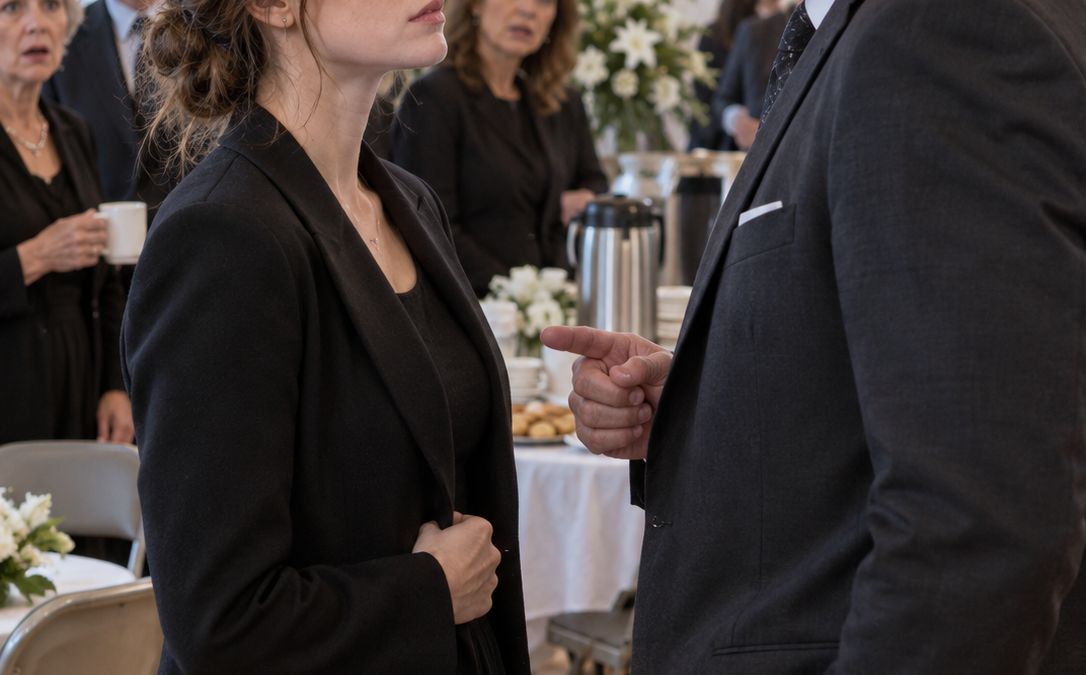
It was small. She would have wanted it small, and the reception afterward was held in the church hall, which smelled like coffee and old hymnals and the particular sadness of folding chairs.
My uncle gave a speech.
He talked about her frugality, her simplicity, her contentment with what little she had. He said she’d lived a quiet life and left a quiet legacy, and that what mattered wasn’t money or possessions, but family, which was the one thing she’d always had in abundance.
He smiled when he said it.
He looked around the room. He expected people to nod.
Most of them did.
My uncle is the kind of man people nod at.
I sat in the third row and held my coffee cup with both hands and stared at the floor tiles and thought about the envelope inside my jacket.
After the service, he came and found me. He’d been drinking—not obviously, but enough that his gestures had gotten bigger and his voice had gotten quieter, which was somehow worse than if he’d been loud.
“She had a policy,” he said. “Small one. I’m the beneficiary on record. I just wanted you to know so there’s no confusion later.”
“Okay,” I said.
“She was a simple woman. She would have wanted things handled simply.”
“I know what she wanted,” I said.
He looked at me for a moment. Then he patted me on the shoulder and went to find more coffee.
I drove home.
I put the envelope on my kitchen table. I left it there for three days because I was grieving and because some part of me was afraid that whatever was inside it was going to change something I wasn’t ready to have changed.
On the fourth day, I opened it.
It was a letter—her handwriting, small and exact, the way she did everything. Behind the letter was a business card for Garfield and Associates, and behind that, a single sheet of paper that looked like some kind of financial summary.
I didn’t understand what I was reading at first.
The numbers didn’t make sense to me in the context of who I thought she was.
I read it three times.
I turned it over as if there might be a correction on the back.
There wasn’t.
I picked up the phone and called the number on the business card.
The person who answered was Mr. Whitmore’s colleague—a woman, actually, named something I wrote down wrong and have since lost, which feels appropriate.
She had a calm, measured voice, the kind that could deliver very good news or very bad news with equal composure.
She confirmed my name. She confirmed my grandmother’s name.
“We’ve been expecting your call,” she said. “When can you come in?”
I went in the next morning.
The office was on Elm Street, on the third floor of a building that looked like it had been there since before the city grew up around it. There was a plant in the waiting room that was so large and healthy it looked almost aggressive.
The receptionist offered me water.
I said yes and then didn’t drink it.
They walked me through everything.
My grandmother had been a client of the firm for twenty-six years. She had retained them shortly after my grandfather died, when she was fifty-three years old, with what the attorney described as a very clear sense of what she wanted to accomplish.
What she had accomplished over the next twenty-six years was this:
She had invested carefully, consistently, without drama or announcement.
She had bought index funds and held them.
She had taken a portion of her monthly household budget—the money my grandfather had left her to manage the house—and instead of spending all of it, she had moved a percentage of it every single month.
Every single month.
Into accounts that no one knew about because no one had thought to ask.
She had also, it turned out, owned the house free and clear, having quietly paid off the mortgage eleven years ago.
My uncle did not know this.
He had assumed there were still payments being made.
He was wrong about a great many things.
The number on that sheet of paper was real.
I asked the attorney to confirm it.
She did.
I asked her to confirm it again.
She looked at me with patient kindness, the way you look at someone who’s just received news that requires a moment to settle.
“Your grandmother was very specific,” she said. “She wanted it structured so that you would have access to everything immediately. She also wanted it structured so that the process would be transparent.”
“What does that mean?” I asked.
She slid another sheet of paper across the desk.
It was a letter to the estate, addressed to all surviving family members, to be delivered by the firm on the day probate was initiated.
My grandmother, in her careful, small handwriting, had chosen to tell everyone exactly what she’d done and exactly why she’d done it.
She had written it with no anger and no cruelty.
She had simply stated clearly what her life had looked like, what had been taken for granted, and what she had quietly chosen to protect—who she was leaving things to, and why.
She mentioned me by name.
She mentioned my uncle by name.
She was not unkind about him.
She was simply honest.
And at the bottom of the letter, in the same small handwriting, she had written:
“I was never a simple woman. I was a quiet one. Those are not the same thing.”
I sat in my car in the parking garage for forty minutes after that meeting.
I didn’t cry, which surprised me.
I mostly just sat there and thought about her garden and about the cedar smell of her house and about the way she used to hand me a cup of tea without asking if I wanted one because she already knew.
She knew a lot of things she never said out loud.
I thought about all the times my uncle had spoken over her at dinner. All the times he’d explained her own situation back to her. All the times he’d referenced “the property” as though she were its custodian rather than its owner.
As though her whole life were a temporary holding situation that he was eventually going to inherit.
She had let him believe that.
For twenty-six years, she had let him.
I don’t know if that was patience or strategy or just a private kind of amusement she kept to herself.
Maybe all three.
She had that streak in her, a dry humor she only showed in small doses, usually when she was doing something that required no acknowledgment whatsoever—like tending her garden before six in the morning, like replacing a roof without mentioning it, like building a life no one saw coming.
The letter went out from the firm two days before the probate hearing.
My uncle received his copy by certified mail.
He called me that evening.
I let it go to voicemail.
He called again the next morning.
I let that go, too.
The third time, he left a message.
His voice was very controlled, which meant he was working very hard to keep it that way.
He said there must be some mistake. He said the estate hadn’t been handled properly. He said he had questions.
I called the attorney.
She said this was not unusual and that everything was in order, and that if my uncle wished to contest anything, he was welcome to retain his own counsel.
He did not contest anything.
I don’t know what he expected to find, but I think he went looking and found nothing to hold on to.
The probate office visit was the one that stayed with me.
The woman who came back from the back room—the one who’d looked at me like I’d handed her something radioactive—returned with a supervisor.
The supervisor confirmed everything.
They were professional and efficient and kept glancing at me with an expression I couldn’t quite read until I realized what it was.
It was respect.
Not for me, exactly.
For what she’d built. For the sheer, quiet deliberateness of it.
I thought about my uncle calling her a foolish old woman.
I thought about the word sentimental.
I thought about how he’d arranged his face into something sympathetic at the funeral and talked about her simple life and her quiet legacy.
She had known he would say something like that.
I am almost certain she had known, and she had decided that the best answer wasn’t an argument.
It was a document.
A record.
A firm on Elm Street that had been keeping her secrets for twenty-six years and was now methodically setting the record straight.
I still have her cedar box.
The envelope is gone. The attorney kept it as part of the estate records, but the box is on the shelf above my own bed now.
It smells the same—cedar and something faintly warm I’ve never been able to name.
I went back to her house one time before the estate was settled, just to walk through it.
The neighbor had kept up the garden.
The tomatoes were coming in.
I stood in the kitchen for a long time, where the light comes in at an angle in the late afternoon and makes everything look like it’s been burnished.
I thought about all the mornings she’d stood there before I was awake. All the decisions she’d made quietly at that counter, with her coffee and her composure and her long, clear view of exactly what she was doing.
She was never waiting to be rescued.
She was never hoping someone would notice.
She was just working steadily, privately, with no interest in being seen until the moment she chose to be.
I inherited her garden, too.
Technically, I don’t know yet if I can keep it going. I’ve never been particularly good with gardening, but I’m learning.
I get up early. I go before six, while it’s still cool.
And I do the things she taught me to do.
The watering. The weeding. The patience of it. The attention it requires.
I think that’s the thing I keep coming back to.
Not the number on that sheet of paper. Not the look on the probate clerk’s face, or the silence on the other end of the phone when my uncle got the letter, or the way the attorney said, “Your grandmother was very specific,” like it was something she’d been waiting to tell me.
What I keep coming back to is simpler than all of that.
She showed up every single morning.
She showed up to the garden, to the work, to the long, quiet accumulation of a life that was entirely and deliberately hers.
She did it without applause.
She did it without recognition.
She did it with a cup of tea and a cedar box and a firm on Elm Street and an absolutely ironclad sense of what she was building and why.
My uncle called her a foolish old woman.
He said she’d been sentimental.
He stood in a church hall and told a room full of people she’d lived a simple life.
She had left a letter to correct that just once, clearly, in her own words, and then she let the numbers speak for the—








