At a meeting with my future in-laws at my very own hotel, she pushed the bill at me: “as the bride’s father, you should pay.” her husband sneered, “what, you can’t afford it?” before i could reply, the manager bowed: “sir, your meeting room is ready.”
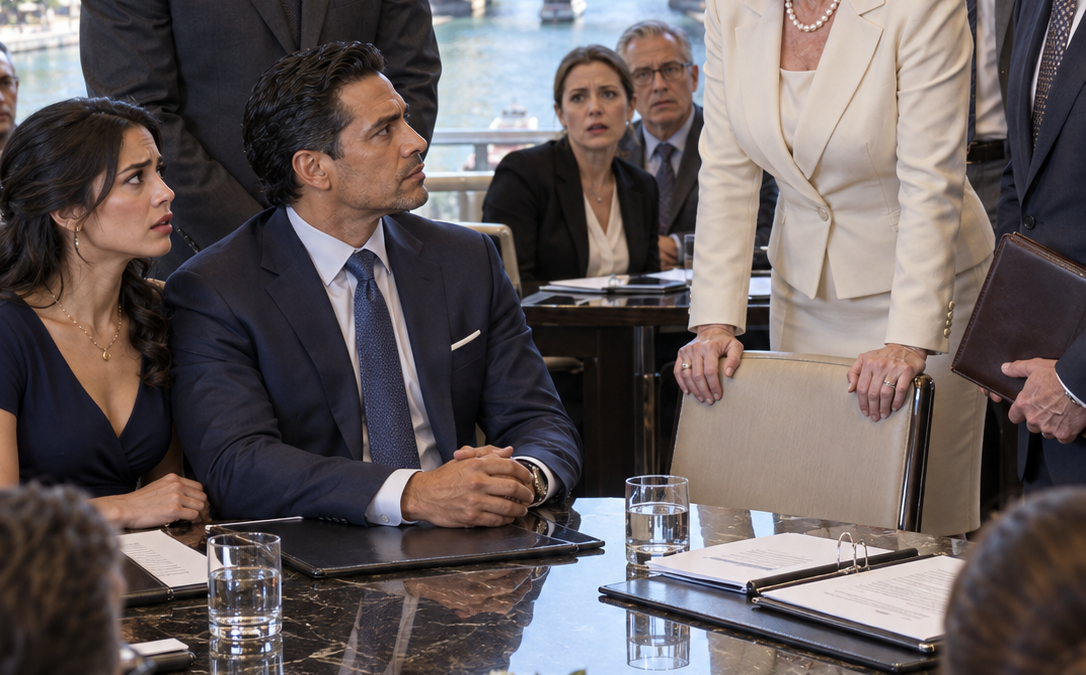
The woman across from me slid a check toward my plate with two fingers, the way you’d push a dirty napkin off a table.
$4,860.
Her husband laughed. Then she said it without even looking up. “The father of the bride knows to pay.”
I looked at that number, and I looked at them, and I felt something go very quiet inside me. They thought they were humiliating a man who couldn’t afford his daughter’s wedding. They had no idea I could hear the building breathing around them. Every wall, every chandelier—mine.
Let me take you back to that evening, to the part where I was still just a father in his good navy jacket, trying to be easy to like.
The dinner had been Margaret Carter’s idea. She called it a small family conversation, parents only, a chance to sort out logistics before the wedding picked up speed. Elena was in Denver for a work conference, and Daniel had flown out with her, which meant nobody would be there to soften the edges. When Margaret asked me to suggest a place, I named the Howerin, a boutique hotel on the Chicago River. And I said it the way a man mentions a restaurant he once read about.
She chose the private room off the main dining area, the Vesper Room, with its walnut paneling and the long window overlooking the water. I did not mention that I had picked that walnut myself eleven years earlier, after arguing with a contractor for two weeks about the shade.
Before the Carters arrived, I stopped in the lobby for exactly ninety seconds. Thomas Lewis, who had managed the Howerin for fourteen years, met me by the front desk with his hands folded behind his back. Earlier that week, I had asked him to treat me like any other guest that night, and he had not liked it.
“Sir, if something goes wrong,” he began.
“Nothing will go wrong, Thomas. It’s dinner.”
He gave me the look of a man who knows when he is being lied to out of kindness, and then he nodded and let me go.
The truth is, I had my reasons. Elena had asked me months ago to let people meet me before they met my balance sheet, and I had promised her I would try. I wanted the Carters to sit across from a father, not a portfolio.
Richard Carter shook my hand a second too long, the way a man does when he wants you to feel the grip. His eyes went to my wrist, to the plain steel watch my late wife had given me on our tenth anniversary, and I watched him file it away under the wrong heading.
Margaret kissed the air beside my cheek. Pearl earrings, a cloud of lilac perfume, a smile that stopped well short of her eyes. She looked around the Vesper Room the way you’d look over a rental car before signing.
Our server was a young man named Marcus, one of the best I have, and I could see him working hard not to look at me for too long.
Margaret did not open with pleasantries. She opened the wine list. A 2015 Pyak, $640, then a second bottle before the first had been poured. Lobster for Richard, the dry-aged ribeye for her. And when Marcus turned to me, I ordered the roasted chicken.
It was the cheapest thing on the menu, and also the thing I eat at home on Sundays.
Margaret’s eyebrow rose a quarter inch.
“Santiago, please,” she said. “Order what you like. We’re celebrating.”
“I did,” I said.
Over the appetizers, the questions began. They came sweetly folded inside compliments, the way a pickpocket says, “Excuse me.”
“Hospitality?” Richard repeated when I told him what I did. “That’s a big word for a small business, isn’t it?”
I said it kept me busy.
Margaret wanted to know where I lived, whether I owned or rented, and how Elena might be looked after once she moved into the Carters’ world. I answered each question in a sentence or less.
Somewhere around the lobster, I stopped listening to their words and started listening to their rhythm. And what I heard was an appraisal. They were not getting to know me. They were pricing me.
I thought about Lucia then. She died when Elena was eleven. And for years afterward, every difficult room I walked into, I imagined her sitting beside me, one eyebrow raised, waiting to see whether I would lose my temper.
Lucia would have taken one look at Margaret Carter and ordered the chicken, too.
So I kept my hands flat on the tablecloth and my voice level, and I thought of Elena in Denver, laughing on the phone that morning, so happy, so sure these were good people. I was not going to be the reason that sureness cracked. Not over dinner. Not yet.
Dessert arrived in a parade. A chocolate tart, a crème brûlée, a plate of cheeses Richard barely touched. Then two glasses of vintage port. When Marcus finally set the leather folder down at the center of the table, nobody reached for it. The silence stretched long enough for me to hear the ice settle in a water glass.
Then Margaret placed two fingers on the folder and slid it across the linen until it stopped against my bread plate.
She did not look at me when she said it.
“The father of the bride knows to pay.”
I opened the folder.
$4,860.
Across the table, Richard let out a short, delighted laugh.
“Don’t tell me you can’t swing it, Santiago.”
The heat climbed up my neck, slow and familiar. The same heat I had felt at nineteen when a landlord called me “boy” while I scrubbed his hallway floor. I let it pass through me.
“Is that what you two think of me?” I asked.
“Don’t be dramatic,” Margaret said, dabbing her mouth. “It’s tradition. The bride’s family hosts. Frankly, we’ve been generous to overlook how modest all of this has been.”
I thought about the nights I’d slept on a cot behind that front desk, back when this building was a failing hotel with a leaking roof and my name on a loan.
I was still deciding what to say when the door opened.
Thomas Lewis stepped inside, stopped beside my chair, and lowered his head.
“Excuse me, sir. The boardroom is ready.”
Nobody breathed.
Margaret’s hand froze on her napkin. Richard’s glass hung an inch above the table.
I stood, buttoned my jacket, and left the folder exactly where it was.
“I’ll be back,” I said.
I walked down the corridor thinking of only one thing: the Carters had no idea whose roof they were under.
If you want to understand why I sat through that dinner with my hands flat on the tablecloth, you have to understand how I came to own the tablecloth.
Lucia died on a Tuesday in March of an aneurysm nobody saw coming. She was thirty-nine. I was forty-three, working as an assistant manager at a roadside motel outside Joliet, and I got the call between a plumbing complaint and a double-booked room.
I remember finishing the shift. I don’t know why. Maybe because I didn’t know what else a man does with his hands when the floor has gone out from under him.
Elena was eleven, and she sat on the stairs that night in one of Lucia’s cardigans, the sleeves hanging past her fingertips. She asked me whether we were going to have to move.
It was the strangest question, and I understood it perfectly. She was asking whether the world was going to keep taking things.
“No, mija,” I told her. “We stay.”
That was the promise, and it turned out to be an expensive one.
The owner of that motel, a man named Gus Papus, was sixty-eight and tired, and tired of me asking whether he’d ever sell. One winter, he finally said yes, at a price that was not a price so much as a dare.
The Sundowner Motor Lodge had twenty-two rooms, a sign missing three letters, and a roof that wept in every storm. I borrowed against everything I had, which was a paid-off Buick and Lucia’s life insurance money I had sworn I’d never touch.
It felt like spending her. I still think of it that way, if I’m honest.
I did everything myself. I scrubbed tubs at five in the morning and drove Elena to school at seven-thirty, then came back to fix a boiler with a flashlight in my teeth. I learned to snake drains from a YouTube video someone’s cousin recommended.
At night, I did the books at the front desk while Elena did her homework on the other side of the counter, her feet on the rungs of a stool, her pencil tapping when she was stuck.
Guests would see a little girl in a school uniform and a tired man with grease on his sleeve, and they’d leave better tips than they’d planned. I never corrected the story they made up about us. It was close enough to true.
The Sundowner paid for itself in four years.
Then came a bank officer who laughed at my first application and a second bank that didn’t. Then the Howerin, a worn-out Chicago hotel with water damage on three floors and a lobby that smelled of wet carpet.
I slept on a cot behind its front desk for most of a year.
Thomas Lewis, a young night manager with a perfectly pressed collar who had refused to quit even when the previous owner stopped paying him, was the first person I hired.
I’d like to say I knew what I was getting. I only knew he stayed.
Success didn’t arrive like a thunderclap. It came like a tide, a few inches at a time, until one morning I realized I was standing in water.
A third property, a fourth, a management company with a name on a door: Alvarez Hospitality Group, which still strikes me as faintly ridiculous when I see it printed on a letterhead.
By the time Elena was in high school, I could have bought her anything. I chose not to.
It wasn’t stinginess, and it wasn’t some stern lesson I’d read about in a book. I had watched what money did to people in my own hotels. I had seen the children of wealthy guests treat my night clerks like furniture. And I had seen their parents teach them to do it with a glance, a sigh, a snapped finger.
I wanted my daughter to grow up knowing what a dollar weighed.
So she took the bus, and she worked summers at a frozen yogurt shop. When she got into Northwestern, she received a partial scholarship and took a part-time job at the campus library. And every semester, I quietly closed the gap through a financial aid office that had been told to say nothing.
She never knew. I’m not sure it was entirely fair to her, and some nights I still wonder.
The one time she came close to asking, she was twenty and home for winter break. She stood in the kitchen with a mug of coffee and said, “Dad, I’ve been looking at what other people’s parents pay for. How are we doing this?”
I looked at the stove, which was twelve years old.
“We’re doing it carefully,” I said. “Your mother would be proud of you. Do you know that?”
She let it go.
Elena has always known when I’m closing a door gently.
Years later, the night she told me she was in love, I said what I’d been rehearsing since she was a child.
“I want you loved for who you are, mija. Not for what’s sitting in your father’s bank account.”
She smiled.
“Dad, nobody’s loved me for your bank account. I didn’t know there was one.”
“Good,” I said, and poured a glass of wine so she wouldn’t see my face.
Daniel Carter was a pleasant surprise. Soft-spoken, a little awkward, the kind of man who remembers how you take your coffee after hearing it once. He worked in commercial real estate finance and talked about his job with a self-deprecating shrug.
When Elena had a cold, he showed up with soup and didn’t stay to be thanked.
I watched him closely, the way a father does, and I kept coming back to one detail. When he looked at my daughter, he didn’t glance at anyone else to see if they approved.
His parents were another matter.
The first time I met Margaret and Richard, at a country club brunch with linen napkins folded into swans, Richard asked what I did before the soup had been served.
“I work in hospitality,” I said.
Margaret asked where I lived.
“Evanston,” I said, which was true.
And I did not say that the house was a modest brick colonial I’d bought in 2009 and never upgraded.
Over the next few months, the questions kept coming, always at an angle, always disguised as small talk. What did I pay for my house? Would I be contributing to the wedding, and how much, and in what form? Had I considered what Elena might one day expect to inherit?
Margaret asked that last one while buttering a roll, as if she were asking about the weather.
I gave them the shortest true answers I had.
“I make my living in hospitality. I’m comfortable. I’ll help where I can.”
Each time, I watched Richard’s face settle a little lower, a man rounding down. And each time, I let him.
I kept telling myself I was being patient. Elena had asked me to let people meet the man before the balance sheet, and I had promised her I’d try. And a promise to my daughter is the only kind I have ever known how to keep.
So I let Richard think my watch was cheap. I let Margaret think my silence was shame. I let them believe, without a word of correction, that the quiet man in the navy jacket was running out of road.
Somewhere in the back of my mind, though, I had begun to count. Not the money, never the money. I was counting the number of times Daniel’s parents spoke about my daughter as if she were a transaction, and the number of times Daniel looked at his plate.
I did not tell them that every plate they had eaten from belonged to me.
The boardroom on the fourth floor had been booked for weeks, and I wasn’t going to cancel it because two people downstairs had mistaken me for a man with a cheap watch.
Priya Naier, my chief financial officer, was already seated at the head of the long oak table with a laptop open and a cold cup of tea at her elbow. Beside her sat Greg from construction and a pair of lenders on a video screen.
We were forty minutes late into a conversation about the Lakeshore property, a tired old hotel in Milwaukee we had been negotiating for since spring.
I took my chair, and the room rearranged itself around me, as it always does, in small ways. Greg sat up straighter. Priya slid a folder across the wood.
I noticed the folder. I almost laughed.
“Everything all right, Santiago?” Priya asked, reading my face the way she has for nine years.
“Dinner with the in-laws,” I said. “Go ahead.”
For twenty minutes, I was exactly who I am when no one is pricing me. I asked about the roof and about the elevator contractor, and whether the lender’s number accounted for the asbestos survey. I turned down a clause I didn’t like.
When the lender signed off, I felt the old familiar ache in my shoulders and the old familiar steadiness underneath it. And I understood that I had needed this room tonight, the way a man needs to touch a wall in the dark.
Thomas Lewis was waiting in the corridor when I came out.
“Sir, Mr. Carter’s son is in the lobby. He’s asking for you. He just got in from the airport.”
I stopped walking.
Elena had told me Daniel would be in Denver through Friday.
“He’s alone?”
“Yes, sir. He looks like he ran here.”
I found him standing under the lobby chandelier, still wearing a rumpled gray suit, his carry-on bag at his feet and his tie pulled loose.
Daniel is a tall young man, but he stood there with his shoulders curved forward like a boy outside a principal’s office. When he saw me, he took a quick step in my direction and then seemed to think better of it.
“Mr. Alvarez. Santiago.” He swallowed. “Elena told me Mom was setting up this dinner. I caught an earlier flight. I’m so sorry. I tried to get here before…”
He gestured vaguely upstairs, toward the whole terrible evening.
“Mom texted me a picture of the dessert menu. She was joking. She thinks it’s funny.”
“Does she?” I said.
“I’m so sorry about the check. They shouldn’t have done that. It was out of line. It was…”
He stopped, and I watched him hunt for a word that was large enough and could not find one.
“I’m sorry.”
I studied him for a moment. His apology was real. I could tell because there was nothing polished in it. Men who are performing remorse always know exactly where to put their hands.
“Daniel, let me ask you something,” I said. “Do you think I should pay that bill?”
He opened his mouth. Nothing came out of it.
The silence was longer than I expected, and it was the loudest thing in the lobby.
A bellman wheeled a luggage cart past us, and the wheels ticked across the marble. Daniel looked at the floor, then at the front desk, then at his own shoes.
“I think,” he said finally, “that they shouldn’t have asked you like that.”
It was not the answer to my question, and we both knew it.
He was a decent young man, but he had learned long ago how to survive his mother. And surviving is not the same as standing up.
“Wait here,” I said gently. “I have to take care of something.”
I told myself I was going to the Vesper Room to settle the check. That was a lie, though, a small one. I had left the folder where it was because I wanted to see what Margaret and Richard did when they thought the man at the end of the table had gone for good.
The Vesper Room has a service door tucked behind the paneling, a narrow passage my staff used to move trays without disturbing the guests. I have walked through it a thousand times.
Tonight, I stopped at the threshold and listened, which is not something I’m proud of, and I would do it again.
Margaret’s voice came first, low and brisk, the voice of a woman reviewing quarterly numbers.
“He left the bill, Richard. He’s gone to find a way to cover it, or he’s gone to find an excuse. Either way, it tells us what we need to know.”
“What did that man in the suit want?”
“The manager? Some arrangement. Everyone has an arrangement.”
I heard ice moving in a glass.
“If he truly has money, he’ll have to prove it. People like that always say they’re comfortable. Comfortable is a word men use when they have a mortgage.”
Richard cleared his throat.
“I’ll tell you what worries me. Daniel’s thirty-one. He’s going to be running my firm in ten years. The last thing he needs is to marry into a family with no…”
He paused, searching for the phrase.
“No runway. I don’t care how smart the girl is. A man like that, with that watch, probably leans on his daughter by forty.”
“Which is why we need to see the books.”
Margaret’s tone sharpened into something almost eager.
“Elena’s trust, her father’s house, what he plans to give her. I heard him mention to Daniel that he’d help with a place after the wedding. A house. That’s not nothing. If we’re giving our son’s name to this family, we’re entitled to know what we’re getting.”
What we’re getting?
I stood very still in that narrow passage, one hand on the cool brass of the door handle.
I thought of Elena at eleven in her mother’s cardigan. I thought of her twenty-nine-year-old self laughing on the phone from Denver, certain that she had found a family.
And I understood with a clarity that felt almost physical, like cold water in the chest, that Margaret and Richard were not worried about the cost of a wedding.
They were underwriting my daughter.
They were reading her like a prospectus.
Not once had either of them said her name.
I could have walked through that door. I could have said Thomas’s name, let the staff pour in, and ended the evening in four seconds flat. I have the kind of power that makes such things easy.
But I had spent decades learning that a sudden victory teaches nobody anything, and that a man who wins too quickly is often just a man who got to leave early.
What I wanted to know was not what Margaret and Richard were. They had just told me.
What I wanted to know, what I could not stop wondering, was what Daniel would do when the money left the table.
I let the door close without a sound and went to find him.
I took Daniel to the only room in the Howerin where nobody would think to look for us, a narrow office behind the front desk with a desk lamp, a coffee maker, and a framed photograph of the lobby the day we reopened.
I hadn’t decided what I was going to say. I had only decided that I was done being polite about the question.
He sat on the edge of the visitor’s chair as if it might be taken away. I poured two cups of coffee neither of us wanted and set one in front of him.
“Daniel, I’m going to ask you something, and I’d like you to answer before you think about how it sounds.”
“Okay.”
“If I had nothing, if I lost the house and the savings tomorrow, would you still marry my daughter?”
“Yes.”
He said it before I finished the sentence, his whole face in it.
“Of course, Santiago. I’d marry her in a courthouse with a vending machine in the corner.”
I believed him, and that was exactly what made the next question hard to ask.
“And if I told you I won’t be paying for the wedding?”
The cup stopped halfway to his mouth.
I watched it happen. A flicker, and then a recalculation. The way a man glances at a gauge he’s been told not to look at.
“I mean, the venue deposits are already… My parents have been expecting…”
“Expecting?”
“I didn’t mean it like that.”
He set the cup down, and his hand wasn’t steady.
“They’ve planned a certain kind of day. I don’t know how to tell them it might not be that day.”
There it was. Not greed, but fear, which is harder to forgive because it looks so much like love aimed at the wrong person.
I had seen it in good employees who spent years afraid of one difficult guest.
I thought of Lucia’s raised eyebrow, and I could almost hear her: Give the boy a door and see if he walks through it.
“Here’s what I’m going to do,” I said. “Elena and I will agree on one number. I’ll give it to the two of you, not to your mother, not to a planner. What it covers is up to you. If the day costs more, you and Elena decide what that’s worth. Nobody else gets a vote, including me.”
“That’s fair,” Daniel said too quickly, and then, more quietly, “They won’t like it.”
“I imagine not.”
He was right.
Margaret called at seven the next morning, and she didn’t say hello.
“Daniel tells me you’re capping the wedding. I want to be clear, Santiago, that this is a family event, and families don’t negotiate like contractors.”
“It isn’t a negotiation, Margaret. It’s a number.”
“You’re trying to control this wedding. I’ve seen it before. Men who can’t afford a gesture make a rule instead.”
I was standing in my kitchen in Evanston, in my socks, looking at that twelve-year-old stove.
“Maybe,” I said. “Or maybe I’d like my daughter’s wedding to belong to her.”
Richard took the phone. I heard his chair creak, a man settling in to lay down a card.
“My son deserves a family that knows how to conduct itself.”
“Then let’s start there,” I said. “Let’s start with how this family treats my daughter.”
I hung up before he could answer and stood holding the phone, shaking a little, which surprised me. Some part of me, it seemed, was still nineteen and scrubbing a landlord’s hallway.
The call that actually changed things came at noon from a woman named Colleen Briggs, the planner Elena had hired. She had a careful, apologetic voice, the voice of a professional trying to stay on the right side of a fight.
“Mr. Alvarez, I debated whether to call, but I’d be doing Elena a disservice if I didn’t.”
“What is it, Colleen?”
“Mrs. Carter has sent me three emails since Monday. She wants the guest list revised.”
“Revised how?”
“She’s asked me to remove eleven names.”
Paper rustled.
“Tasha Green, Imani Wallace, a Mrs. Okafor. She described them as, and I’m quoting, ‘not the caliber we want in the photographs.’ She’d like Mr. Carter’s business associates in their place. She also asked that Elena’s side be seated toward the back.”
I sat down slowly at the kitchen table.
Tasha was Elena’s college roommate, who once drove four hours in a snowstorm the night my daughter’s first boyfriend broke her heart. Imani had held Elena’s hair back at nineteen and never mentioned it again. Mrs. Okafor was the library supervisor who had hired a frightened scholarship kid and taught her to run a department.
These weren’t names on a list.
They were the people who had helped me raise her.
Elena landed from Denver that afternoon, and I drove to O’Hare myself. In the car, I handed her my phone with Colleen’s forwarded emails and said nothing.
I watched her read them at a red light on Mannheim Road, the screen lighting her face from below. Her jaw tightened at the second email. At the third, she laid the phone face down on her knee and looked through the windshield for a long time.
“‘Not the caliber,'” she said at last, her voice almost flat. “Mrs. Okafor taught me how to balance a budget when I was eighteen.”
“I know, mija.”
“I kept making excuses. The pearls, the comments about my shoes. I thought she’s anxious. She’s old-fashioned. She’ll warm up.”
She turned to me, and her eyes were bright but dry, which is how Lucia’s always got when she was truly angry.
“She isn’t only judging you, is she? She’s editing me.”
I didn’t answer.
I put my hand over hers on the console, and we sat through the green light until someone behind us honked.
I scheduled the meeting for Thursday at ten in the Riverside Room on the sixth floor, the largest space the Howerin has. The table seats twenty-two, and the whole east wall is glass, so the river sits in the room like another guest.
My email to the Carters was four lines long.
“Elena and I would like to review the wedding arrangements together. Please join us.”
Margaret replied within the hour, and I could read her satisfaction in every comma. She assumed she was being summoned to a negotiation she had already won.
I got there at eight, long before anyone else, and stood at the window while the housekeeping carts rattled down the hall behind me.
Priya arrived first, with a leather portfolio and a look of grim amusement. Greg came next, then our general counsel, a quiet woman named Ruth Feldman, and finally Thomas Lewis, who had put on his best charcoal suit and stood beside my chair like a man guarding a door he’d been waiting years to close.
“You don’t have to do it this way, Santiago,” Priya said very softly.
“I know.”
“Then why?”
I thought about it.
“Because Elena has spent a month making excuses for these people. I’d like her to hear them without the excuses.”
Elena came at a quarter to ten in a navy dress and no jewelry except her mother’s thin gold chain. She kissed my cheek, glanced at the faces around the table, and understood everything in about two seconds.
She did not say a word.
She took the chair on my right and folded her hands, and I have never been prouder of her stillness.
Daniel arrived with his parents but a half step behind them. He looked like he hadn’t slept. Margaret came through the doors in a cream suit with her chin lifted, already composing her first sentence, and Richard followed with a leather folder tucked under his arm like a man bringing his own evidence.
They had prepared to meet a father who needed persuading.
They had not prepared for an audience.
I watched Margaret’s eyes travel the table. Priya, Greg, Ruth, a stack of binders, and a court reporter’s silent chair that Ruth had insisted on and I had allowed.
Richard slowed. His eyes landed on Thomas Lewis, who stood perfectly straight with his hands behind him, and whatever he’d been about to say dissolved in his throat.
“Please sit,” I said. “Thank you for coming.”
Thomas stepped forward. His voice was calm and formal, the voice he uses to introduce keynote speakers.
“Mr. and Mrs. Carter, may I present Mr. Santiago Alvarez, owner and managing partner of Alvarez Hospitality Group, which owns the Howerin and six other properties across the Midwest.”
Nobody spoke.
Richard lowered himself into a chair without seeming to decide to.
Margaret remained standing for another second, one hand on the chair back, her knuckles pale against the cream sleeve.
I will admit I had imagined this moment for days, and I had expected to feel triumph. What I felt was closer to tiredness, and underneath it, a small, stubborn grief, because a person had to be shown a title before she would see a man.
“Sit, Margaret,” Richard muttered.
She did.
I did not stand. I did not gesture to the skyline or the portraits on the wall. I simply opened the first binder and turned it toward them.
“These are the vendor contracts Mrs. Carter signed through the planner. A floral quartet, a champagne tower, an ice sculpture of two swans. Together, they exceed the figure Elena and I agreed on by roughly $61,000.”
I turned a page.
“This is the revised guest list she sent on Monday. Eleven of Elena’s friends were struck from it. Next to the strikes is a note about photographs.”
Margaret’s mouth opened.
“I was trying to help the planner. These things are very delicate.”
“I’m sure they are.”
I kept my voice even.
“I also have the emails.”
Ruth slid a thin stack across the table.
Margaret looked at it, and I watched her recognize her own phrasing.
Not the caliber we want.
A faint color rose from her collar to her cheekbones and stayed there.
“Santiago,” Richard began, in the tone of a man reaching for his old confidence. “I think there’s been a misunderstanding about intent.”
“No, Richard. I think there’s been an understanding about intent. I just heard it a little too well.”
Daniel flinched.
Elena didn’t move.
I let the silence stand, as I’d learned to do in a thousand tense lobbies, until it did the work for me.
Then I said, “I can pay for all of it. I want you both to understand that. The swans, the champagne, the string players, every item on these pages. It wouldn’t dent me.”
Margaret exhaled through her nose, and something like relief crossed her face.
She thought we had reached the part where I surrendered.
“But I won’t buy your respect,” I said. “I’m not sure it’s for sale. And if it is, I’m not interested in the price.”
Her relief curdled.
I reached into my jacket and drew out a folded sheet of paper, creased where it had lain in my pocket for six days.
I flattened it on the table with my palm, smoothed it once, and slid it across the walnut to Richard, the exact motion Margaret had used on me.
$4,860.
Your dinner.
Richard looked at the bill and then at me. I saw him understand that I had kept it.
I had not paid it, not out of pettiness, but because I wanted him to hold it in his own hands once he knew whose room he had eaten it in.
“You asked whether I could afford it,” I said. “I can. That was never the question.”
I turned to Margaret then, and I tried to be kind about it because kindness is the only force that has ever made me feel strong.
“The question is whether people who treat my daughter’s friends as photographs and her father as a line item are in any position to call a dinner like that a family meal.”
Nobody breathed.
Out on the river, a tour boat slid beneath the window, its passengers waving at a building that had no idea they existed.
Elena reached under the table and took my hand.
Nobody in that room moved for what felt like a full minute.
Then Margaret did what I should have predicted. She reached for the nearest weapon, and the nearest weapon was her son.
“Daniel.”
She didn’t turn her head.
“Stand up. We’re leaving, and you’ll be reconsidering this engagement because I will not have my family humiliated in front of a conference table of strangers.”
Daniel did not stand.
I watched his hands, which were pressed flat against his thighs as if he were trying to hold himself in the chair.
My own hands had done exactly that at the dinner a week earlier.
“Mom,” he said.
“Don’t ‘Mom’ me. Your father and I have spent thirty years building a name, and she…”
Margaret’s chin jerked toward Elena.
“She comes with a father who plays games with bills and hides behind a dormant suit. If the money isn’t coming, if the arrangement isn’t going to be what we discussed, then this wedding is a mistake, and you know it.”
Richard said nothing.
He was staring at the bill on the table, turning it over with one finger as if the back might explain the front.
Elena spoke then, and I have replayed her voice in my head more times than I can count.
“Daniel.”
Not loud. Level, and almost gentle.
“I’m not going to ask you to choose between me and your parents. I don’t think that’s fair to you, and I don’t want to marry a man I had to win from his mother.”
Margaret made a small sound of contempt.
Elena didn’t look at her.
“What I need to know is simpler. I need to know which family you’re building. Whether it’s the one at this table that you grew up in, or the one you and I make. Because I can’t marry into the first one. I won’t.”
The skyline hummed softly through the glass. Somewhere down the hall, a housekeeping cart rolled by, the wheels ticking over the seams in the carpet.
I should say what I was feeling, because it wasn’t what you’d think.
I wasn’t rooting for the Carters to fall.
I was terrified.
I was a father watching his daughter’s whole future balanced on the next sentence out of a young man’s mouth.
And I could not help her.
I could only sit there with my hand wrapped around hers beneath the table and let him decide who he was.
Daniel stood up.
Margaret’s face brightened for half a second.
He walked past her chair, around the end of the table, and stopped beside Elena.
Then, very slowly, he turned and faced his mother.
“Mom, I love you. I’m going to keep loving you. That’s not changing.”
His voice cracked on the second sentence, and he pushed through it.
“But you asked the guest list to be cut without telling her. You told the planner her friends weren’t the right caliber. You sat across from her father and made him a joke. And I let you. I let you for months because it was easier than saying no.”
“Daniel,” Richard said, a warning.
“No, Dad.”
He took a breath.
“If you can’t respect Elena, you don’t get to decide anything about our marriage. Not the guest list, not the venue, not where we live or what we spend. You can come and be part of our life, and I hope you will, but you’d be coming as our guest.”
It was the plainest speech I have ever heard, and it landed like a dropped plate.
Margaret stared at her son as though someone had replaced him. Her lips trembled, and for one unguarded second, she looked less like a duchess and more like a woman who had just realized the child she raised was a person.
“You’re choosing her over us.”
“I’m choosing to be a husband,” Daniel said. “I’m sorry it feels like the same thing to you.”
Richard pushed his chair back with a scrape that rang in the hush.
He did not look at me.
He stood, buttoned his jacket with stiff, angry fingers, and said to nobody in particular, “We’ll see about this.”
Then he walked out, and after a pause that was almost theatrical, Margaret followed, her heels striking the carpet like a countdown.
The doors slid shut behind them.
Priya let out a long breath.
Greg stared at his binder.
Thomas Lewis, who had not moved a muscle for forty minutes, finally unclasped his hands.
Elena sat very still.
Then she turned to Daniel and put her forehead against his sleeve, and he wrapped an arm around her, and neither of them said anything at all.
I excused myself.
I walked to the end of the corridor, stood at the service window, and watched the Carters’ black sedan idle at the curb for nearly two minutes before it pulled away.
I felt hollow.
I had won something, I supposed, but nothing about it felt like winning.
It felt like watching a building come down that I had helped weaken, even if I hadn’t built the cracks.
I went home that evening and ate roasted chicken alone at the kitchen table under the light above my twelve-year-old stove, trying to convince myself it was over.
At 9:40, someone knocked on my front door.
Daniel stood on the porch in the same rumpled suit, his hands jammed in his pockets. He had been crying, and he had the decency not to hide it.
“I don’t know if I should be here,” he said.
“Come in.”
He sat at my kitchen table, the same one where Elena used to do her homework, and he turned his hands over and over, looking at the palms.
I put the kettle on because I didn’t know what else to do with my hands.
“I’m not here to ask for money,” he said at last. “I’d like to be very clear about that. I’m here because I watched you today, and I’m trying to figure out how to be the kind of man who doesn’t need a conference room to be taken seriously.”
I looked at him for a while.
Steam rose from the kettle behind me.
“You don’t need to defend me, Daniel,” I said. “I’ve been defended against better than your mother. I’ve survived worse landlords.”
A short, wet laugh escaped him.
“What I need,” I went on, “is for you to defend the person you chose. Every day, in rooms where I’m not sitting at the table, in rooms where it costs you something and nobody gives you a medal.”
He nodded slowly.
He didn’t promise. He didn’t say a word of the kind young men say to old men at kitchen tables.
He just sat there and let it settle on him.
And I think that was when I started to believe him.
I poured the tea.
We drank it in silence, and the quiet between us felt, for the first time, like the quiet of two people on the same side.
The wedding took place on the second Saturday of October in the Riverside Room, with ninety guests, a six-piece band, and not a single ice swan.
Elena and Daniel built it themselves over eleven weeks of spreadsheets at my kitchen table. Colleen Briggs mediated with the patience of a diplomat.
They argued over chairs and over whether a taco truck was tacky, and they settled on a long dinner of family-style plates because Daniel said he wanted people close enough to pass the salt.
The total came in under the number Elena and I had agreed on. Every dollar was written down where all four of us could see it.
I stood at the back of the room an hour before the doors opened, watching Thomas Lewis straighten the place cards by hand.
The glass wall was gold with late sun, and the river moved beneath it like it had somewhere to be.
Tasha Green sat in the second row in a green dress, already crying. Imani Wallace had brought a flask of something she swore was for the toast.
Mrs. Okafor sat in the front, very upright, her purse on her knees, the way a woman sits when she’s been given a seat she did not expect.
Margaret and Richard arrived early.
They had been told they would sit in the second row behind the aisle as guests.
Margaret wore a simple navy dress and no pearls, and without the armor, she looked smaller and older and unsure where to put her hands.
Richard shook my hand briefly, with no grip at all.
Neither of us mentioned the Thursday in the Riverside Room.
There is a courtesy in leaving some things unsaid, and I was willing to extend it for Elena’s sake.
When Elena came down the aisle, I forgot every plan I’d made for my face.
She wore Lucia’s thin gold chain at her throat, and she was laughing at something Daniel had mouthed at the altar.
And I thought, with a clarity that nearly buckled my knees, she looks like her mother when she isn’t being careful.
I had walked her halfway down the aisle before I trusted my voice enough to say what I’d been practicing in the car.
“Your mother would have ordered the chicken,” I whispered.
She squeezed my arm.
“Dad, don’t make me cry yet.”
Later, when the plates were cleared and the band eased into something slow, Daniel nodded at me from the head table, and I stood with a glass in my hand and a sheet of paper I never looked at.
“I’m not a speaker,” I said. “I’m a man who fixes boilers, so bear with me.”
A ripple of warm laughter moved through the room.
“I’ve owned a lot of rooms in my life. I know what they cost. I know what the carpet costs, and the linen, and the lights over our heads. Money can pay for a room. It can pay for a dinner. It can even pay for a wedding, if that’s the kind of thing you want from it.”
I let my eyes pass once over the second row and then back to my daughter.
“What it can’t buy is dignity. That has to be earned, and it has to be given, and nobody gets to hand it to you in a leather folder.”
The room had gone very quiet.
“Elena, I didn’t build these hotels so you could tell people your father was rich. I never wanted that. I built them so you’d never have to live your life afraid of what other people think about you. And tonight, looking at the man standing next to you, I think I can finally stop worrying.”
I raised my glass.
Daniel’s eyes were wet, and he didn’t hide it.
When I sat down, Mrs. Okafor reached across the table and patted my wrist once, firmly, as she once must have patted a frightened student on her first day.
Margaret found me after the cake, out on the terrace, where the wind off the river carried the smell of cold water and cut grass.
She stood a few feet away with her arms folded, and for a while she only watched the lights on the far bank.
“I’m not here to ask you for anything,” she said at last. “I want that understood.”
“All right.”
“I’ve been telling myself for weeks that I was protecting my son.”
Her voice was stiff, unpracticed, as though the words had not been used in a long while.
“I think I was protecting myself from being the sort of woman I thought other people would look down on. It’s a poor way to live. I didn’t realize I’d been doing it to your daughter.”
She paused.
“I’m sorry, Santiago. For the dinner, for the list, for all of it.”
I wish I could say I forgave her on the spot.
I’m not that man, and I never claimed to be.
“I don’t need you to kneel, Margaret,” I said. “I need you to treat my daughter like a person, not an investment. Do that for thirty years, and we’ll talk about the rest.”
She nodded once, and something in her shoulders came down an inch.
It was not absolution.
It was a beginning, and I have learned to respect those.
Four months later, a cream envelope arrived at my house in Evanston.
Inside was a single page in Daniel’s careful handwriting.
He and Elena had put down a deposit on a small brick house on the North Side. Two bedrooms and a yard, bought entirely with their own savings.
“We wanted you to hear it from us,” he wrote. “We don’t need help. We just wanted you to know we’re okay.”
I read it standing at the kitchen counter beneath the light above the old stove.
Then I opened the drawer where I had kept a folded sheet for a year, a signed gift of money I’d planned to hand them after the wedding.
I held it for a long moment.
Then I tore it in half, and in half again, and I felt lighter than I had in ten years.
I hadn’t stopped wanting to help my daughter.
I had simply learned she no longer needed rescuing.
She had a husband who stood beside her in rooms where nobody was watching.
People ask now and then whether I enjoyed that day in the Riverside Room, whether I savored it.
I tell them the truth.
I never cared about the $4,860.
I only wanted to know, the moment money landed on that table, who would look at my daughter and who would only look at what they could take from her.
I got my answer, and I’d say it was worth every dollar.
If this story stayed with you, I’d love to hear where you’re watching from. Leave a comment below and tell me whether you’d have paid that check or slid it right back across the table.
We share stories like this every single day about families, about pride, and about the quiet moments that show who people really are. So subscribe and hit the bell so you never miss one.
Thank you for spending this time with me.








