At 5 thanksgivings my brother introduced my son as “the bastard”; last year, with 17 relatives listening and his hand in mine, he added: “he’s not a cousin, he’s a mistake we feed”; i said: “say it again, slowly”; he did, my 7-year-old put his fork down and asked her one question, her chair hit the floor and my father followed his out to the…
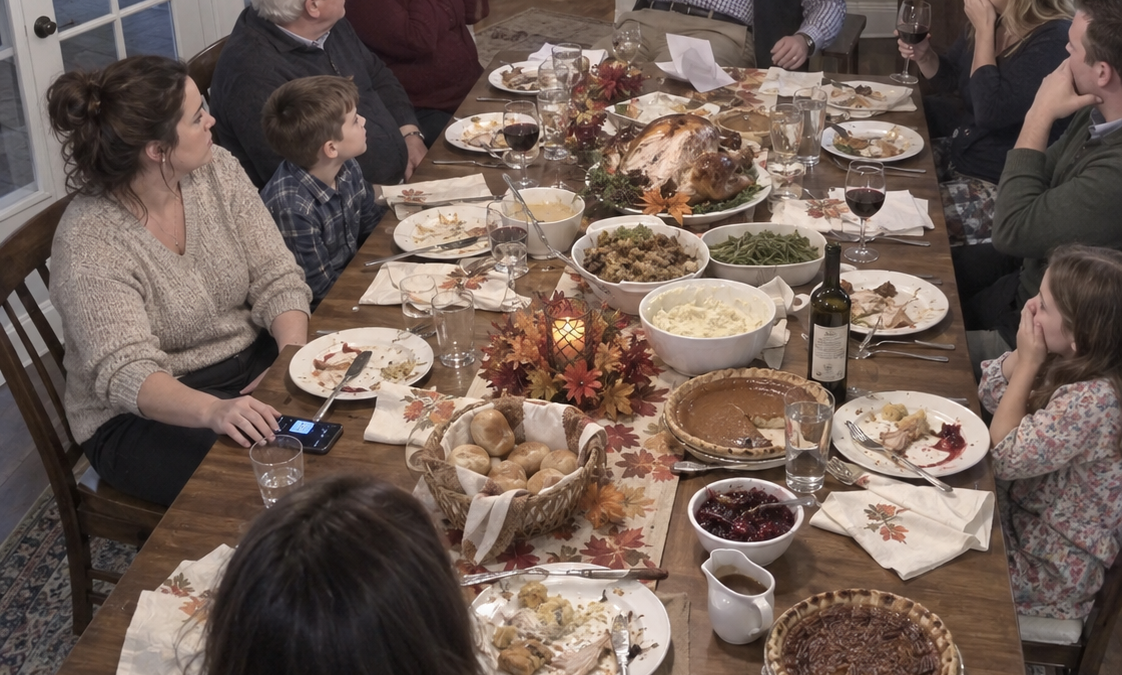
For five Thanksgivings, my brother introduced my son as “the bastard.” Last year, with seventeen relatives listening and my son’s hand in mine, he added, “He’s not a cousin. He’s a mistake we feed.”
I said, “Say it again slowly.”
He did.
Then my seven-year-old put down his fork and asked him one question. My brother’s chair hit the floor, and my father followed him outside.
Corbin had stood at the head of my father’s table with a butter knife in his hand, tapped his water glass twice, and started the introductions. He did it every Thanksgiving. A card table was shoved against the good one, two pies were cooling on the sideboard, and seventeen relatives sat with their forks already raised. My son and I were there, too, while my brother walked his voice around the room like a man giving a tour of a house he owned.
I was sitting on the folding chair at the corner, the aluminum one from the garage with the cracked green webbing. It was the same chair I had carried in from the porch myself an hour earlier because nobody else ever remembered to.
The dining room smelled of sage and the candle my mother lit every year, the one nobody had ever asked her to stop lighting. The good tablecloth had a coffee ring near the salt that had been there since before I could reach the table on my own.
Nineteen dishes took up more room than sixteen good chairs and a card table could reasonably accommodate. The sweet potatoes were on the sideboard beside the pies, and Milo’s plate already had a smear of cranberry sauce along the rim before anyone had said grace. That was what happened when a seven-year-old was told to wait and did his best.
Outside, sleet had started falling, the kind that ticked against the windows instead of coming down quietly. Somebody’s coat was still dripping on the hook by the door because nobody had thought to move it.
“Renee, my wife. Harper, my daughter. Fourth grade, all A’s. Dad, obviously. Mom. Aunt Marlene, who drove down from Canton in the rain.”
Corbin’s hand traveled around the curve of the table. There were nineteen dishes on it. I had made every one of them.
I had gotten off my shift at the hospital at eleven the night before and started the stock at midnight. That morning, I’d carried the last of the food up my father’s porch steps in two trips while Renee held the door with her foot and told me the gravy smelled like last year’s.
Then Corbin’s hand stopped at the end of the table.
“And that’s the bastard.”
Milo was seven. His left hand was in mine beneath the tablecloth, where it had been since we sat down. His right hand held a fork straight up because he’d been told twice to wait for grace.
Nobody moved. Aunt Marlene reached across the table for the cranberry sauce. Then Harper looked up from her plate, her chin greasy, and asked, “What’s a bastard?”
Her father answered her.
Corbin turned toward his own nine-year-old daughter and used his patient voice, the one he used for reading logs. He spoke slowly enough for a child to write down every word.
“He’s not a cousin, sweetheart. He’s a mistake we feed.”
Milo’s hand tightened in mine. Not a squeeze. A grip, the kind a child makes when he’s standing on a dock.
Renee snorted into her wine and said, “He’s not wrong.”
Aunt Marlene let out one short bark of laughter into her napkin, then covered it with a cough.
And my father, sixty-nine years old, sitting at the head of a table he had presided over for forty years, looked down at the turkey I had spent two days brining and said, “Let’s eat before it goes cold.”
I set down my water glass and turned my phone faceup on the tablecloth beside the salt. Then I pressed the red circle.
I’d looked up the law two Thanksgivings earlier, after a smaller version of the same joke. I had been sitting in my car in that very driveway, my phone screen bright against the darkness.
Ohio is a one-party consent state. It had taken me four minutes to learn that, and the information had stayed in my head for two years, the way you remember where you’ve put a fire extinguisher you hope you’ll never need.
I was in the room. That was the only requirement.
I was always in the room.
“Say it again,” I said slowly.
The entire table heard me. My father heard me. Somebody’s fork touched a plate and stopped. Nobody reached for anything else.
Corbin had his messenger bag hooked over the back of his chair, with his notary stamp in the front pocket. Aunt Marlene had brought a car title that needed signing after pie. My brother never went anywhere without his seal.
He smiled at me the way he used to when we were children, right before telling our parents about something I’d supposedly done but hadn’t. Back then, being believed over me was the only kind of winning he knew.
He had already told Mom his version. Now he leaned forward and gave it to me.
“He is not a cousin.”
He paused long enough to park a truck in the silence.
“He is a mistake that we feed.”
I said nothing. I kept my hand exactly where it was.
For five years, I had come to that table because Milo wanted a cousin. A boy who is told he isn’t one will eventually believe it if the only evidence to the contrary is that his mother keeps bringing him back.
Then my son put down his fork.
He laid it flat against the tablecloth the way I’d taught him. He looked up the length of that table, past the good candlesticks and the two pies, and asked my brother one question.
“Uncle Corbin, if I’m a mistake, why did you need my signature?”
I want you to understand something.
I did not know what he meant.
Corbin’s chair hit the floor. It didn’t scrape backward. It went over, his bag still hanging from it, and his notary seal clattered onto my father’s rug.
He was through the kitchen and out the side door before Harper had finished turning around to look.
Nobody at that table spoke for as long as it took the overturned chair to stop rocking on its side. I have never in my life heard nineteen relatives go that quiet that quickly.
My father stood up. He didn’t look at Milo. He didn’t look at me.
He went after Corbin.
I picked up the empty gravy boat and carried it into the kitchen because that was what I was for. I stood at the sink and watched through the window above it while my brother leaned against the fender of his truck, both hands planted on the metal, his shoulders working like a man trying to breathe his way out of something.
His breath showed in the cold.
Every year, I’d stood at that exact window looking out at that exact driveway.
Then my father opened the passenger door of Corbin’s truck, reached into the glove compartment, and took out a blue zippered bank pouch. He slipped it inside his coat.
I stood with my hands motionless beneath the running water, trying to understand the shape of what I’d just seen without yet knowing what it was.
There is a particular kind of dread that comes from watching two people you love handle something together that clearly does not include you.
Behind me, Aunt Marlene said, “Well, somebody pass the rolls.”
Milo picked up his fork again because nobody had told him not to.
My brother didn’t come back to the table for thirty-five minutes. When he finally did, he didn’t sit down. He stood at the sideboard cutting the second pie into nine pieces for nineteen people. The pie server slipped from his hand twice before Renee took it away and finished.
That was last Thanksgiving. November 27.
I have thought about that blue pouch every day since. More than any other single object in this entire year. More than a pen, more than a roasting pan, more than any piece of paper Nolan ever arranged in careful rows across his conference table.
I want to be honest about what I did next, because I didn’t scream and I didn’t cry.
I ate.
I served pie. I washed my father’s dishes in my father’s sink for an hour and twelve minutes, working through every roasting pan and gravy-crusted platter with the same methodical attention I’d have given a hundred trays back at the hospital.
Somewhere around the fortieth minute, I realized my hands had already made a decision my mouth hadn’t caught up with.
When Corbin came back inside, I told him the stuffing had turned out dry.
He said, “It always does.”
Milo had signed something. I had until April to find out what, and Corbin had until April to sign it again.
My name is Dana. I’m thirty-one.
I run the kitchen at a hospital where I feed 406 people a day: patients, staff, and families camped out in waiting rooms who forget to eat until somebody puts a tray in front of them. I schedule sixty-one line items a week, and in nine years, I have never once sent up a tray with the wrong allergy card attached.
That number matters to me more than almost any other number in this story. You’ll understand why later.
For five years, my family had been telling a room full of relatives that they fed me.
If that sentence made your jaw tighten, stay with me. This one takes a year to land, and it lands on more than one of them. And if you’d hit subscribe before we reach the part where a stamp comes out of a bag, I’d take it as a kindness.
Here is what I knew while driving home that night, and it was almost nothing.
Route 18 was wet. Milo had a plate of leftovers on his lap beneath a paper towel, and he hadn’t said a word since we passed the church. In the rearview mirror, I could see him turning something over between his fingers.
“Buddy, you’re not in trouble,” I said.
It wasn’t a question. I had already decided it wasn’t going to be one.
“Uncle Corbin said it was a secret grown-up job.”
Milo held something up where I could see it in the headlights of the car behind us.
A pen.
A cheap white stick pen with a blue clip and printing down the barrel.
“He said I was helping the family. Am I still helping?”
I pulled into the parking lot of a closed garden center, put the car in park, and turned around in my seat.
The printing on the pen read Maple Fork Credit Union. Beneath that were the words Route 8 Branch, followed by a phone number.
“Tell me about the job,” I said.
Milo told me it had happened in the spring. He remembered because he was still wearing his light jacket.
Uncle Corbin had picked him up from aftercare on a Thursday, something that had never happened before, and bought him a milkshake at the place with the cow on the sign.
Chocolate. It was the only flavor Milo had ever ordered in his life, and Corbin hadn’t even asked.
Then they’d gone somewhere with a rope line and a lady behind glass. Grandpa Roy had already been there in his good jacket.
They gave Milo a card and told him to write his name.
He wrote Milo. The lady said his L was backward and laughed in a nice way, so he wrote it again underneath and got it right.
Uncle Corbin said, “Good man.”
Then Uncle Corbin told him not to tell his mother because it was a surprise, and surprises only worked when you kept them secret.
He had kept it for eight months.
Eight months of a milkshake he’d never mentioned. Of a card he’d never shown anybody. Of carrying a secret the size of a bank account inside a seven-year-old’s chest because a grown man had asked him to and called it being trusted.
A boy who had been called a bastard at his own grandfather’s table had kept a secret for the man who called him that because, for one afternoon, that man had needed him.
And being needed had felt good.
“You were helping,” I said. “You’re done helping now. I’ve got it.”
“Okay.”
A mile later, he asked, “Can I keep the pen?”
“No. I need to borrow it. You’ll get it back.”
I still have that pen in a drawer. At that point, it was the only thing my brother had ever given my son.
Three days later, on Sunday, Corbin called me eleven times between noon and four. I didn’t answer. I was at work covering a call-off and plating three hundred trays of turkey that had been ordered back in July.
Every time my phone lit up on the stainless-steel counter beside the ticket rail, one of my cooks glanced at it, then at me.
“Pull the next rack,” I said.
At 4:19, Corbin stopped calling and sent a text instead.
Dana, I was drunk and I was off, and I’m sorry. Let me give you $2,000 for Milo for Christmas. Just make him stop saying that at family things, please. It’s not what it sounded like.
I read it twice, standing in the walk-in with the door resting against my shoulder.
Eleven calls were panic.
Two thousand dollars was a number.
Nobody offers a number for something that supposedly isn’t what it sounded like.
I took a screenshot, went back onto the line, and finished my racks.
During my break, I sat in my car in the employee lot and dialed the number printed on a child’s pen.
The fraud department at Maple Fork was closed until Monday. A recording told me my call was important. I wrote the business hours on the back of my hand in Sharpie, the way I do with anything I refuse to forget.
Then I sat there with the engine off until the windows went white.
On Monday, the woman in the fraud department asked for Milo’s Social Security number and date of birth.
Then she went quiet for so long I could hear her keyboard stop.
“Ma’am,” she said. “How old did you say he is?”
Let me back up, because you need to understand why a woman lets someone call her son that for five years and keeps showing up with nineteen dishes.
I was twenty-three when I had Milo. His father was a man named Dean Colby who worked at a quarry and left this county three weeks before Milo was born.
He never came back. Never called. Never signed a thing.
There is a blank space on my son’s birth certificate where his father’s name should be.
In my family, that blank became a job title.
My mother stopped putting out my school pictures. My father said one sentence to me in the hospital parking garage.
“You know what people will say.”
Then he said nothing else about it for eight years, which, in the Wickham family, counts as generous.
Corbin is eight years older than I am. For most of my childhood, that age difference made all the decisions for both of us.
He got a car first. His curfew was extended first. He went to community college first, the one our father called sensible, and I watched him come home most weekends anyway, his laundry bag slung over one shoulder as though the sensible plan hadn’t quite worked out.
Growing up, I never felt as though I was competing with him for anything because there was nothing to compete for.
He simply had it, whatever it was, first.
And I was still a kid learning how to write my last name in cursive.
When I was twenty-three, Corbin was thirty-one, married, struggling, and had just been passed over for the second time at the tax office.
Then he found something he could be better than me at.
He had never been better than me at anything before.
So I did what the youngest child does.
I made myself necessary.
I learned to cook the way our grandmother cooked, and then I learned to do it better. I brought the food. I carried it up the steps myself. And I sat wherever I was put.
There were sixteen good chairs in my father’s dining room. There had been sixteen for as long as I could remember. The card table at the end handled the overflow.
Every year since Milo had been old enough to sit at a table, one of us had eaten on the aluminum folding chair from the garage, the one with cracked green webbing and a leg that shifted on the rug.
It was mine every year.
Nobody assigned it. It was simply waiting beside my place whenever I came out of the kitchen carrying the gravy.
Every year, Corbin said, “We’ve got to get you a real one.”
And every year, we didn’t.
Grandma Vera used to drag a chair next to mine on purpose. She’d sit with her plate balanced on her knees and tell my father that the head of the table was wherever the food came from.
She died in March 2024.
After that, nobody sat next to me.
That was why I kept going. Not because of the chair, but because of the idea that if I stopped bringing my son, they would have won the argument about what he was without ever having to say it aloud.
I want to tell you the exact minute that ended, because it wasn’t at the Thanksgiving table.
It was Monday, December 1, at 8:52 in the morning, in my car, with a woman from a credit union’s fraud department on speakerphone.
“Ma’am, I’m showing three accounts associated with that Social Security number,” she said. “A share account opened this past March, a Visa opened in April, and a member signature loan opened in May for $15,000.”
She paused.
“The share account lists a joint owner named Milo S. Wickham. The other two are in his name.”
I didn’t say anything for a moment.
I was sitting in my driveway with the engine running and the heat on. I watched my breath fail to fog the windshield because the defroster was working, and I remember thinking, in a voice inside my head that didn’t sound like panic yet, that I needed to remember every single word of this call in order.
“He’s seven.”
“I understand. How was—”
She stopped herself.
“Ma’am, I’m going to need you to come in.”
I asked if I could come that morning. She said the earliest appointment was at one o’clock. I told her I’d take it, then called the hospital and told my sous-chef I had a family emergency, which was the truest sentence I’d said all week.
The Route 8 branch of Maple Fork Credit Union had a rope line for four people and a bowl of butterscotch candies on the counter.
The fraud officer’s name was Evette Marlo. She wore a cardigan and reading glasses on a beaded chain. She placed three photocopies on the desk in front of me and turned them around so I could read them right side up.
The first was a membership signature card dated March 6.
There were two signatures in the box at the bottom. The top one was a child’s printing pushed against the line.
Milo.
The L was facing the wrong way. Somebody had drawn a light pencil X through it.
Beneath that, on the second line, were the same four letters again. Correct this time. Slower. The O pressed too hard into the paper.
The next signature on the card belonged to Corbin D. Wickham, listed as joint owner.
The third line said Sponsoring Adult, and my father’s name appeared beside it.
Roy T. Wickham.
The same cramped handwriting that had signed my report cards.
“A minor can hold a joint account with an adult member,” Evette said. “It’s very normal. We do it for grandparents constantly.”
She slid the second page across the desk.
“This is a parental consent form.”
It was a half-sheet form with my name typed at the top.
Dana L. Wickham. Custodial Parent.
At the bottom was a signature that wasn’t mine and had never been mine.
My D looks like a mountain range. This D was a scribble with a loop.
Beside it, pressed into the paper hard enough to leave an impression, was a round purple stamp.
Corbin D. Wickham. Notary Public. State of Ohio. My commission expires June 11, 2026.
“He notarized himself,” I said.
Evette took off her glasses and set them down very carefully, the way you put down something you’re worried you might otherwise throw.
“He notarized his own consent form for his own account, with his own name in the joint-owner box.”
“Ma’am, I want to be careful about what I say before an investigator looks at this.”
“Then show me the third page.”
The third page was a $15,000 member signature loan dated May 8, in the name of Milo S. Wickham.
The date of birth typed on the document would have made him twenty-four years old.
Sixty payments.
Three made.
Nothing since August.
I asked what happened to a loan that stopped receiving payments. Three payments, then nothing, month after month, while a seven-year-old went to school and came home without the slightest idea that a number was quietly getting worse somewhere with his name attached to it.
“It charges off,” she said. “And it reports to all three bureaus.”
She looked at me over the tops of her glasses.
“Ma’am, under both names.”
Somewhere in a database that would follow him into apartment applications, car loans, and jobs that required background checks, my seven-year-old son already had a credit history.
Three trade lines.
$19,268 past due.
A file older than his second-grade class picture.
I did three things that afternoon before I allowed myself to drive home, and I want to be specific about them because, for the next nine months, I didn’t do a single thing I couldn’t put a date on.
First, I began the process of placing a protected-consumer credit freeze on my son at all three credit bureaus. A parent has the right to do that. It requires a certified copy of the child’s birth certificate, a copy of the parent’s license, and about a month of waiting for each bureau.
I started the first one in the parking lot, with Milo’s birth certificate spread flat across my dashboard so the app’s camera could read it. My hands were so cold by then that I had to take the picture three times before it focused.
Second, I filed an identity-theft report through the Federal Trade Commission’s website on my phone. I wrote the case number on the back of my hand, beneath the Sharpie from Sunday.
Third, I wrote a request in longhand on the back of the branch’s own letterhead, demanding certified copies of every document containing my son’s Social Security number.
I walked it back inside and made Evette date-stamp my copy.
My brother’s notary commission was listed on the Secretary of State’s website. It took me about nine seconds to find it because anyone with a phone can look up a notary in Ohio.
But I wanted something else.
I drove to the county recorder’s office on East Market and asked the clerk about it. I stood at the counter holding a number I’d pulled from a machine, still folded between my fingers, forty minutes after I’d walked in.
A Monday afternoon in that building moved at exactly the speed you’d expect from a place that files things for a living.
“That’s a notary’s own book,” the clerk explained. “His journal. Nobody keeps it at the courthouse. He keeps it in his desk. He’s supposed to write down every single thing he stamps.”
She chewed her gum.
“You’d be shocked how many don’t.”
Corbin kept one.
Corbin kept a beautiful one.
He’d shown it to us at Easter three years earlier, a black bonded ledger with a ribbon bookmark. He told the entire table that a notary journal was the only thing standing between this country and chaos.
I didn’t go looking for it.
Not then.
A thing like that, you only get to ask for once. And you ask through somebody with a bar number.
I drove home and made Milo grilled cheese, cut diagonally because that’s the only correct way.
While he ate, I sat across from him and didn’t say a word about any of it.
He asked if we were going to Grandpa’s for Christmas.
I told him I didn’t know yet.
He said, “Harper’s getting a phone.”
There was a shoebox on the top shelf of my closet with a rubber band around it. Everybody has one. Mine held Milo’s hospital bracelet, the lease from our apartment on Ridgewood, and eight years of anything important that had arrived in an envelope with a window.
I had already been through that shoebox twice that night, working backward through the years.
I hadn’t looked at most of those papers since the day I’d filed them away.
At one in the morning, sitting on my closet floor with the light on, I found what I’d been looking for.
And when I did, I had to sit down on the carpet.
Spring of 2022.
A notice from the Internal Revenue Service, one page generated for tax year 2021.
My return had been rejected electronically because the dependent Social Security number listed on it had already been claimed on another accepted return for that year.
I remembered the phone call about it the way you remember a smell.
I’d called Corbin because Corbin did everybody’s taxes.
He worked at Fenwick and Voit and had a plaque naming him a top preparer three years running. He kept it angled slightly toward the entrance to his cubicle, where clients walking in could notice it without his having to point it out.
When I called about the IRS notice, he’d sighed the way he always sighed.
“Oh, honey, that’s a glitch. They’ve been doing that all season. It’s a database thing with hyphenated names.”
Our name wasn’t hyphenated.
He told me to print the return, mail it the old-fashioned way, and not worry if the refund took a little longer.
So I did.
It took longer, and eventually it came. I bought Milo a bed with a rail on it.
Sitting on the closet floor that night, I kept thinking about Corbin’s tone on the phone.
Not just the lie.
The tone.
He’d known what that letter was before I finished reading it to him because he was the one who had caused it to exist.
And he’d already had an explanation ready.
Since that night on the carpet, I’ve tried to remember exactly how his voice sounded. The closest I can come is this: it was the tone you use with someone you’ve already decided isn’t going to check.
Not cruel. Not even particularly careful.
Just efficient.
The way you’d explain a printer jam to somebody you didn’t expect to ask a second question.
I had never asked a second question about anything he told me in my entire life.
He knew that about me before I knew it about myself.
The next morning, I requested my own tax transcripts, Form 456T, one for every year from 2020 through 2024.
Because I no longer trusted anything that passed through a family member’s hands, I asked for the documents to be mailed to my workplace, addressed to the kitchen manager, where incoming mail had to be signed for.
Nolan told me later what to look for.
I found it before he told me because it wasn’t subtle.
The transcripts took twenty-nine days to arrive. They came in a bundle held together by a rubber band.
I read them standing in the loading dock hallway, with the walk-in compressor running behind me.
Tax year 2020.
Tax year 2021.
Tax year 2022.
Tax year 2023.
Tax year 2024.
Every single year, the same code appeared on my own account.
The dependent claimed on my return had already been claimed on another return accepted by the service before mine.
Five years.
Five times somebody had gotten hold of my son’s Social Security number first, in February, while I was still waiting for my W-2.
The transcripts didn’t say who. They weren’t allowed to say who.
But every February, I had a phone in my hand when the same man sent the same three words to the same family group chat.
I’m open early.
Five Thanksgivings. Five introductions. Five times Corbin had stood at that table and told seventeen people that my son was a mistake they fed, while telling the federal government in writing, under penalty of perjury, that Milo lived in his house.
Because that’s what the claim required.
Not love. Not blood.
Residence.
More than half the year under his roof, eating his food.
Corbin had gotten paid for feeding my son every April for five years.
He’d gotten paid for feeding a child who had never spent a single night in his house.
And every November, he’d stood up and made a joke about it in front of that same child.
I sat down on an overturned milk crate in the loading dock hallway.
I didn’t cry because Rico came around the corner carrying a hotel pan, and I had to tell him the tilt skillet was down and to hold the gravy for the four o’clock trays.
He came back ten minutes later without the pan and put a cup of break-room coffee on the shelf beside me.
The bad coffee. The kind nobody really wants.
He didn’t ask what was wrong.
Rico had worked that line for six years and had learned the way people learn in kitchens: some things get talked about on their own schedule, or not at all.
“Trays are covered,” he said. “Take ten if you need it.”
I took ten minutes and went back to work because a kitchen manager feeding 406 people a day doesn’t actually have ten minutes.
Not really.
Not even on the worst day of her year.
Rico never asked me about it again. Not that day, and not in the days that followed.
Every single one of the seven times I had to leave the line without explanation that year, a tray of something I hadn’t ordered appeared at my station within the hour.
No note. No comment.
Just Rico’s particular way of letting me know he’d noticed.
But before I went back onto the line that first day, I did one thing.
I texted my brother.
Are you doing my taxes again this year?
He answered in ninety seconds.
Of course I am. I always do. Love you.
Nolan Feld’s office was above a hearing-aid store. He charged $250 an hour and wouldn’t take a retainer under $3,000.
Aunt Marlene had recommended him, of all people, because he’d handled a contract dispute for one of her neighbors.
I’d almost refused to call. By then, I didn’t trust anything that came to me through my family.
But a recommendation from a neighbor’s contract dispute was still cleaner than anything with Wickham attached to it.
So I made the appointment.
The waiting room had two mismatched folding chairs and a coffee table covered with last year’s magazines, still fanned out as though someone had carefully arranged them once and never touched them again.
I remember sitting there the first time with a grocery bag on my knees and realizing I recognized the chairs before I recognized anything else in the room.
I’d brought Nolan a plastic grocery bag containing every document I had.
He spread them across his conference table in rows, like a man sorting the pieces of a jigsaw puzzle by the colors along their edges.
He was quiet for a long time.
Then he pulled one page toward him and placed his finger on the purple stamp.
“This,” he said, “is the one that ends him.”
He glanced at the loan papers.
“The loan is bigger. The loan is money. Money is a fight.”
He tapped the stamp twice.
“A notary can’t notarize an instrument he has a beneficial interest in. He’s a joint owner named in the document he notarized. That’s not a gray area, Miss Wickham. That’s the first page of the handbook.”
Then he pointed to the signature above it.
“And if that signature isn’t yours, then what he notarized was a forgery he needed for himself. That makes him a principal, not a witness.”
“What happens to him?”
“To his commission? The Secretary of State can pull it.”
Nolan sat back.
“To his career? He has a preparer tax identification number. The Justice Department can go to a federal judge under Section 7407 and enjoin him from ever preparing a return for money again. And the service can pull that number the same week.”
He looked at me.
“To his freedom? That depends on a prosecutor and how good his lawyer is. But forgery and identity theft involving a minor in this state are felonies. And the minor part isn’t a garnish. It’s a sentencing factor.”
I asked him what I needed to do.
“Nothing fast,” he said. “That’s the hard part.”
He arranged the papers into a neater row.
“You’ve got a five-year pattern and one hard document. And a pattern is worth more than a document if you can show it’s still running.”
He looked at me over the papers.
“Is it still running?”
“He just texted me that he’s doing my taxes again.”
Nolan took off his glasses and cleaned them on his tie for a while.
“Miss Wickham,” he said, “I’m going to say something, and then I’m going to give you the ethical version of it.”
What he said first was simple.
Let him.
Here is what I didn’t do, and it cost me more than anything I did.
I didn’t tell my father what I was building.
I kept quiet through Christmas, which Milo and I spent at my apartment with a nine-dollar tree from the Kroger lot. Milo had chosen it because it was the ugliest one there, and he said somebody had to.
I kept quiet through New Year’s, when Corbin posted a photograph of his family wearing matching plaid pajamas.
The caption read, Everyone I feed.
I kept quiet when my father called on January 2 and told me, in the same voice he’d used in the hospital parking garage, that whatever had happened at Thanksgiving was over and we weren’t going to discuss it again.
“He apologized,” my father said.
“He offered you $2,000. That’s an apology from him.”
“That’s an apology?”
Then I asked what he’d taken out of Corbin’s glove compartment.
The line stayed open.
I could hear the television in his den, the weather guy who was always talking about clipper systems.
“That’s his business,” my father finally said.
“You’re on the card, Dad.”
“What card?”
“Sponsoring adult. Maple Fork. March sixth. Your handwriting.”
I’ve replayed his answer maybe six hundred times, usually while I’m driving, usually at a red light long enough for the whole exchange to finish before the light turns green.
Because one day, I’m going to have to explain that answer to my son.
“He said it was so he’d have something,” my father told me. “So he’d have a start. He said you’d be too proud.”
Too proud.
As though the thing standing between my son and a five-figure debt was my own vanity, rather than the fact that nobody had ever once asked whether I wanted my seven-year-old to have a start built on a signature I’d never given.
“And then he stopped paying it in August.”
“I don’t know anything about August,” my father said.
Then he hung up.
My father was a man who had never hung up a phone on anyone. Not a telemarketer. Not his own mother during her last confused year. Not anybody I’d ever seen in my entire life.
Until that morning.
Harper turned ten on January 24.
There was a party at the trampoline place on Cleveland-Massillon Road. Milo had been talking about it ever since Harper told him at Christmas that he could be on her team for the dodgeball portion.
But the invitation never came.
I found out at school pickup on a Friday, when another mother in the car line said, “It’s so nice that all the cousins get to be together.”
Then she made a face like she’d stepped on something.
I called Corbin from the school parking lot. Milo was in the back seat, and I kept the phone off speaker while watching his face in the rearview mirror.
I wanted to see whether anything he overheard changed his expression.
“We’re keeping it family,” Corbin said.
There were pans clattering in the background.
“Don’t make a thing of it.”
“He’s family, Corbin.”
A cabinet closed.
“Do you want me to say it in front of your kid, or do you want to let it go?”
I let it go.
I said, “Fine,” and hung up.
Then I drove Milo to the trampoline place anyway.
I paid twelve dollars for an hour of open jump on a Saturday afternoon while the party rooms were full.
He bounced alone in the far corner, where the younger kids played, jumping against a wall of foam blocks.
Every few minutes, he stopped and looked through the glass at the room with the balloons.
I sat on a bench meant for parents watching toddlers and didn’t look away from him once, because that particular Saturday it felt like the only job I had left.
On the way home, he asked, “Did I do the wrong thing at Thanksgiving?”
I pulled over.
There is a rule I have about lying to my son, which is that I don’t.
And there’s a rule about weight, which is that I don’t put mine on him.
“You did the exact right thing,” I said. “You asked the true question. Grown-ups fall over when you do that, and it’s not your fault they’re not screwed down.”
He thought about it, chewing the end of his seat belt the way he does when he’s working something out.
“Is Uncle Corbin in trouble?”
“Not yet.”
That was the last thing I told my son about it for five months.
And I need you to hold on to the word yet, because on February 14, I called my brother and asked, in my nicest voice, if he could squeeze me in before the rush.
Three days before that call, on February 11, the counselor at Fairlawn Elementary had left a voicemail asking if I could come in at my convenience.
That’s what schools say when something isn’t convenient at all.
Her office had a beanbag chair and a poster of a cartoon volcano labeled with feelings.
She had a folder.
She turned it around so I could read it right side up, which was the second time in ten weeks somebody had done that to me.
Inside was a worksheet.
Milo’s second-grade class was doing a unit on families. The prompt at the top of the page read:
My family takes care of me by…
Beneath it, in my son’s pencil handwriting, with the capital letters he still couldn’t stop putting in the middle of words, he’d written:
My mom feeds 400 people at the hospital and she feeds me too. My other family feeds me because I am a mistake. That is what they’re for.
The counselor said he’d been very matter-of-fact about it.
Then she told me he’d asked her a question afterward. She’d written it down because she thought I would want to hear his exact words.
She read from her legal pad.
He wanted to know whether a mistake could be unmistaken, or whether it stayed a mistake forever, like a tattoo.
I thanked her.
I said I’d handle it at home. I said we didn’t need a referral.
Then I asked if I could keep the worksheet.
She offered to make me a copy.
“No,” I said. “I’d like the original.”
She studied me for a moment.
Then she gave it to me.
I went back to see her once more on my own at the end of May, after the determination letter and before the soft opening. I wanted to ask whether she’d noticed anything about Milo’s classroom behavior that I should be watching for.
She pulled out a different folder, a thinner one.
A week earlier, the class had done a self-portrait project. Most of the children drew themselves beside a house, a pet, or their favorite food.
Milo had drawn himself standing beside a table surrounded by empty chairs.
Only one chair had a stick figure sitting in it.
He’d labeled it Mom.
The counselor said it wasn’t necessarily a red flag. Children processed things sideways, and she wanted me to have the drawing.
I keep it in the same drawer as the worksheet now.
I’ve never shown it to anybody, including Milo.
That first day, I sat in my car in the visitor parking space with the worksheet lying across my steering wheel and the engine turned off.
And I want to be honest about what happened there, because it was the hinge on which the whole year turned.
I stopped being angry.
Anger had gotten me to a fraud desk, a lawyer’s conference table, and three credit freezes. Anger is loud, and it’s also fast. Eventually, it burns itself out.
What came after it was quiet.
And it had a calendar in its hands.
I had a five-year pattern, a forged parental consent form bearing my brother’s own seal, a charged-off loan, a federal identity-theft report, and a lawyer who’d told me the hardest part would be moving slowly.
I also had a brother who prepared everybody’s taxes during the first week of March every year, as faithfully as a man going to church.
I looked down at my son’s handwriting and said one word aloud in the empty car.
“Okay.”
That was the entire announcement I made.
It was the only one anybody got.
Then I drove home, made Milo grilled cheese, and told him the worksheet was wrong. I told him we were going to fix it, that the fixing part was mine, and that the being-okay part was his.
I called Nolan before I called Corbin and told him what I wanted to try.
He stayed quiet on the line for a long time. Then he said it was either the smartest thing a client had ever suggested to him or the riskiest, and he wasn’t entirely sure which.
He needed me to understand that anything I obtained that day had to be obtained cleanly, on my own, without any promise that it would hold up in court and without coaching from him beforehand that a judge might later call staging.
The day before, I’d practiced my sentences aloud in my car during my lunch break in the hospital parking lot.
I practiced them the way you practice a speech you’re afraid will sound rehearsed unless you rehearse enough to make it sound natural.
I’d been in a bad place since Thanksgiving.
I’d spent December scaring myself with things I’d found on the internet.
Dad was right. The family couldn’t take another year of it.
I repeated each sentence until it sounded like something I would actually say, because every single word was true.
I didn’t want to hand my brother a performance.
I wanted to hand him the truth, arranged in a particular order.
On February 14, I called Corbin and asked, in the nicest voice I had, whether he could squeeze me in before the rush.
I want to be careful describing what happened next because this is the part where I looked as though I’d given up.
I need you to know that I never once said anything I didn’t mean.
I told him I’d been in a bad place since Thanksgiving. That was true.
I told him I’d spent December scaring myself with things I found on the internet. That was true, too.
I told him Dad was right, that the family couldn’t survive another year of it. I told him I was tired and wanted to come in and have him do my taxes the way he always had.
I told him I wanted us to be okay.
All of that was true, in the way a photograph of one corner of a room is true.
He cried.
My brother cried on the phone for four minutes.
I know it was four minutes because I watched the timer on my phone the whole time, sitting on the edge of my bed with the phone pressed against my ear and my face arranged into nothing at all.
There was nobody there to see it anyway.
Then he said, “I knew you’d come around. You always do.”
And there it was.
The tone from 2022.
The one that already had an explanation ready.
His office at Fenwick and Voit was a cubicle with a nameplate and a window looking out over a strip-mall parking lot.
He had a candy dish on the desk. Behind him, in a black frame, hung his notary commission with the state seal.
He prepared my return in twenty minutes.
Head of household. One dependent. Standard deduction. The earned income credit I qualified for on a kitchen manager’s salary.
Then he stopped with his hand on the mouse.
“I’m going to leave Milo off,” he said.
I made myself keep my expression exactly where it was.
“Why?”
“Because your account’s flagged, honey, from that mess in 2021. If we put him on, it kicks out again and you wait nine months for your money.”
He was already clicking.
I watched my filing status change on the screen from head of household to single.
“I’ll fix it on my end like last time. You’ll get more back this way anyway, because of how the credit sits.”
That is a sentence a person says aloud only when nobody has ever asked him a follow-up question in his entire life.
“Okay,” I said.
I signed the authorization he pushed across the desk, my hand steadier than I’d expected.
The pen was a cheap office pen from a cup beside the candy dish, nothing like the one I already had waiting in my bag.
Then I asked him for the two things I’d really come for.
“There’s one more thing, and then I’m done,” I said. “The bank thing with Milo’s name on it.”
Corbin’s hand stopped moving.
“I’m not fighting about it. I don’t want to know why. I want his name off it. He’s seven. Whatever it is, take him off, and I’ll never bring it up again at Dad’s or anywhere else.”
You could see it happen across his face.
Relief, with a solid floor suddenly appearing beneath it.
He thought he’d just bought himself the entire year for the price of a phone call.
“That’s it?” he asked.
“That’s it.”
“I’ll call them Monday.”
He laughed and leaned back in his chair. The candy dish caught the light for a moment.
Then he said something I will hear in my head for the rest of my life.
“God, Dana. All that over a savings account.”
I didn’t correct him.
I let the sentence sit there in his own office, with nobody else there to witness it.
And in that exact moment, I understood that I was the only person alive who would ever know how much that sentence had actually cost.
“One more thing,” I said. “Write it down for me. Just a sentence, so I can show Dad I’m letting it go and he’ll stop calling me.”
My brother, the man who never went anywhere without his seal, the man who had once told an entire Easter table that his notary journal was the only thing standing between this country and chaos, pulled a sheet of his own letterhead from the printer.
He wrote four lines.
The statement said that the Maple Fork accounts opened in the name of Milo S. Wickham had been opened by him, that he would contact the credit union to have Milo removed, and that he took full responsibility for the balances.
He signed it.
And because signing something had never been enough for a man like my brother, he reached into his bag and stamped it.
Then he handed it across the desk with two fingers, the way you hand somebody a napkin.
I put it in my bag beside my son’s worksheet.
I drove to a UPS store, made three certified copies, and mailed one to Nolan with a cover sheet.
I didn’t smile until I was back in my car.
Because here is what my brother was going to do on Monday.
He was going to call the fraud department at Maple Fork Credit Union on a recorded line and ask them to remove a minor child’s name from a charged-off $15,000 signature loan.
There was already a file open under that Social Security number containing a federal identity-theft report, my affidavit, and a photocopy of the parental consent form he’d notarized for himself.
There was also a note stating that the custodial parent had requested every document in writing.
I hadn’t told him any of that.
I hadn’t told anybody.
I’d simply asked him to make the call.
Evette Marlo called me on Thursday, March 5, at 7:40 in the morning, while I was counting a milk delivery.
“Ms. Wickham,” she said. “I’m not able to discuss another member’s communications with you.”
“I understand.”
“I’m calling to tell you that our investigator has referred the file.”
I put my clipboard on top of the milk crates.
“Referred to who?”
“That I can tell you. The Summit County Sheriff’s Office, Financial Crimes. And because of the account documentation, we’ve also made a report to the Secretary of State’s Notary Division.”
She paused.
And I swear her voice changed shape.
“Ma’am, someone will contact you. It may be a while. These take a while.”
“Thank you,” I said.
I hung up, signed for forty gallons of two-percent milk, and went into dry storage.
I stood between the shelves for exactly one minute.
Then I came back out and told Rico the delivery was short two crates and he needed to call the vendor.
The fuse had been lit on March 5.
Nothing happened for eight weeks.
That’s the part nobody tells you.
You do the hardest thing you’ve ever done. You hand a stranger a folder that took you three months to build.
And then the world does absolutely nothing.
Your family keeps having birthdays.
On March 22, my mother turned sixty-six. I went to her house with a cake I’d made from scratch and a pork loin in Grandma Vera’s roasting pan.
That pan was cast iron, with a lid, and weighed eleven pounds empty. It was the only thing of Vera’s I’d received because I was the only person who wanted it.
After dinner, Corbin stood in my mother’s kitchen holding a dish towel.
“Hey,” he said, “you should let me hang on to Nana’s pan. Harper’s getting into cooking.”
Harper was ten and had never turned on a stove in her life.
“Sure,” I said.
I washed the pan, dried it, and rubbed it with oil using a paper towel, exactly the way Vera had taught me.
Then I carried my grandmother’s roasting pan out to my brother’s car, set it in his trunk, and said, “Thank you for having us.”
And I meant it.
Because I needed every person in that house to go to bed that night believing one thing.
That I had folded.
My father walked me to my car. He stood with his hands in his jacket pockets while Milo climbed into the back seat.
“That’s my girl,” he said. “That’s the Dana I know.”
“Good night, Dad.”
“You did the right thing. You’ll see. Family bends.”
I studied him for a moment longer than I had to, looking at his good jacket, the same one he’d worn to the credit union in March.
I thought about a blue zippered pouch disappearing beneath it in the rain.
“Some of them do,” I said.
Then I got in my car.
On April 2, during my lunch break, I mailed three certified envelopes from the post office on Ridgewood. All three had green return-receipt cards.
The first went to the Internal Revenue Service in Fresno, California.
It contained a Form 14157 complaint against a paid tax preparer, a Form 14039-B concerning a dependent’s stolen Social Security number, the preparer’s identification number, five years of my transcripts, and a written narrative.
Nolan made me rewrite the last line of that narrative twice until not a single adjective remained.
The second envelope went to the Ohio Secretary of State’s Notary Division.
It contained a complaint, the parental consent form, the loan document showing my brother as joint owner, and a copy of the letter he’d signed and stamped himself in February.
The third envelope went to my brother from Nolan’s office.
It was two pages long and said almost nothing except that his client was represented and that all future communication regarding Milo S. Wickham should go through him.
I stood at the post office counter and collected three green receipts with date stamps.
I slipped them into my wallet behind my driver’s license.
There are nine of those cards in my wallet now.
That whole spring, those cards were what I had instead of telling anybody anything.
And for the next six weeks, while those envelopes did whatever envelopes do inside buildings with flags flying above them, my brother had the best spring of his life.
Milo turned eight on April 12, a Sunday, so we held his party the Saturday before.
Four boys from his class came over. I’d decorated a sheet cake at two in the morning using a piping bag from work.
At 4:15, the mail arrived.
There was one card in the stack with a hummingbird stamp on the envelope.
It was addressed to The Wickham Boy.
Not Milo.
Not Milo S. Wickham.
My brother had written my son’s name as a category in his looping handwriting on an envelope he’d had to lick closed.
Milo pulled it from the stack himself because he was eight, and to an eight-year-old, mail arriving with your address on it feels like winning a jackpot.
He read the front.
Then he looked at me.
Then he looked at the friends standing in my kitchen with frosting on their faces.
And he made a decision no eight-year-old should have to make in less than a second.
He held the card for three or four seconds, just long enough for me to see him deciding something behind his eyes.
It was the same thoughtful expression I’d later see at the license bureau.
“It’s a coupon,” he said.
He put it in the drawer with the takeout menus and went back outside.
Inside was a ten-dollar bill and a card that said:
Thinking of you.
It was signed Uncle C.
I put the card and the money into a plastic sleeve and wrote the date on it.
I didn’t spend the ten dollars.
If you want to know what a person like me does with a spring like that, that’s what she does.
She puts it in a sleeve.
Eight days later, my brother quit his job.
I heard about it from Aunt Marlene, who had suddenly decided we were close.
She’d reached that decision sometime around February, I think, without ever announcing it, the way relatives sometimes start including you in their weeks without bothering to ask if you want to be included.
Before that Thanksgiving, Marlene had been somebody I saw twice a year, hugged politely, and didn’t think about in between.
She never once asked why I wanted to know the things I kept asking her to tell me.
Even now, I don’t think she’s realized that half of what felt like gossip to her was reconnaissance to me.
Corbin had walked out of Fenwick and Voit on a Monday without giving notice.
Then he’d signed a two-year lease on the end unit at Fairview Commons Plaza, between a vape shop and a place that did eyebrows.
C. Wickham Tax and Notary Services.
He’d ordered a sign from the vinyl shop, gold lettering on a maroon background, with Notary Public printed beneath his name in larger letters.
And my father had put up the money.
Forty thousand dollars borrowed against the house on Elmcrest, the house he’d lived in since 1981 and paid off in 2009.
Marlene repeated the number twice, slowly both times, the way you’d read out a phone number to somebody writing it down.
She wanted a reaction.
When I didn’t give her one, she said, “Well, he’s proud of him.”
I did react.
I reacted for about four seconds, sitting in my car in the hospital parking lot with one hand flat on the steering wheel and the engine ticking as it cooled.
I let myself have those four seconds before putting the car in reverse and heading back toward a walk-in refrigerator full of produce that didn’t care what my family had just done.
By the time I clocked in, my hands were steady again.
That steadiness had become less something I noticed and more something I simply expected from myself.
Then I did the arithmetic that mattered.
It wasn’t the $40,000.
It was this:
A person who signs a two-year lease and borrows against his father’s house is a person who believes, all the way down, that nothing is coming.
Corbin held a soft opening on May 2.
There were photographs.
A ribbon, a pair of scissors with a bow tied around them, and fourteen people, including my mother, my father, and Harper in a dress.
My brother stood in the middle holding the scissors above his head like a trophy.
Behind him, on the counter in a little wooden holder, sat a fresh stack of business cards.
My father was in the second row, his hands folded in front of him, looking at Corbin the way I’d wanted him to look at me since I was twenty-three.
I know all this because Harper posted the pictures.
Milo found them on my phone while looking for a dinosaur video. I had to sit beside him on the couch while he scrolled through fourteen more photographs of the ribbon cutting before losing interest and going back to searching for dinosaurs.
My thumb hovered over the screen the whole time.
I could have taken the phone away.
I didn’t.
Milo studied one picture for a while.
“Does Grandpa go to Uncle Corbin’s new store instead of Thanksgiving?”
“No, buddy.”
“Because there’s a store now,” he said, trying to work it out. “So maybe that’s where they eat.”
I told him Thanksgiving was still at Grandpa’s.
I didn’t tell him that on May 2, while my brother was cutting a ribbon, an envelope from Maple Fork Credit Union was already sitting in my mailbox on Ridgewood.
It was only a few miles away, unopened, because I’d worked a double shift and hadn’t gotten around to checking the mail.
I opened it that night while standing in the hallway with my keys still in my hand.
Determination of Fraudulent Account Activity.
Three accounts opened March 6, April 2, and May 8.
Closed and charged off as fraud.
All obligations of the minor, Milo S. Wickham, voided in full.
Trade-line deletion requests submitted to all three consumer reporting agencies.
Total loss to the institution: $19,268, referred for restitution.
At the bottom was a paragraph I read maybe nine times.
Documentation obtained during the investigation had been provided to the Summit County Sheriff’s Office and separately to the Ohio Secretary of State’s Notary Commission Division.
A member communication dated February 16 was included in the referral.
February 16.
The Monday he’d called them for me.
I went into Milo’s room and sat on the edge of his bed while he slept, one arm hanging over the side.
And I did the only celebrating I allowed myself that entire spring.
I said his whole name aloud in the dark.
“Milo Silas Wickham owes nothing.”
Owes nothing.
Eight years old, and clean as a plate.
The letter about Corbin’s notary commission came thirteen days later.
It didn’t come to me.
Aunt Marlene called on a Sunday and asked if I’d heard, then told me everything without waiting for an answer.
Corbin had received a letter from Columbus concerning his commission. He’d told everyone it was a clerical issue, a renewal backlog because his commission expired on June 11 anyway and the state was slow.
Everybody knew the state was slow.
“He’s got that little office to run,” Marlene said. “You can’t do that work without the stamp.”
“No,” I said. “You can’t.”
There’s a particular feeling that comes from knowing something inside a family where nobody tells you anything.
It wasn’t what I expected.
It wasn’t power.
It was a kind of loneliness with an excellent view.
Most days, it looked like me standing at my kitchen counter unloading the dishwasher while my phone sat facedown on the table, a case number in the Notes app, and answering my mother’s questions about whether I’d started Christmas shopping yet in the same voice I used for everything else.
There was nobody I could hand any of it to.
Nolan had it, but Nolan had it the way a doctor has your chart.
I had it the way you have a stone inside your shoe that you’ve decided not to mention until you’re somewhere you can actually take the shoe off.
I kept walking on it all winter.
A kitchen manager doesn’t get to remove her shoes in the middle of a shift, and neither did I.
Because I knew what the letter from Columbus was.
Nolan had told me what it would look like when it arrived.
Notice of complaint.
Notice of hearing.
Notice that a renewal application had been suspended pending disposition.
And my brother stood in a plaza between a vape shop and an eyebrow place, telling our aunt it was a backlog.
Every day he kept that sign lit, he was spending money that was going to have a lien on it.
I didn’t warn him.
I want to be plain about that because people ask.
I didn’t warn my brother, and I wouldn’t warn him now.
But I did warn one person, and it wasn’t for his sake.
On May 29, a detective named Ronda Mills called my father at eight in the morning and asked him to come in and talk about a signature card.
I know the date because my father called me at 8:20, and there was a crack running through his voice that I hadn’t heard since the hospital parking garage.
“Dana, what did you do?”
His voice had gone thin, the way it does when he’s more frightened than angry and hasn’t yet decided which one to lead with.
“I gave the credit union the documents they asked me for in December.”
“They’re saying I’m a witness.”
“You are a witness, Dad. You signed it.”
“I signed it because he asked me to.”
“I know.”
He was breathing hard. In the background, I could hear the television and the weather guy.
“They asked me about a pouch,” he said.
And there it was.
Six months later, the blue pouch was finally sitting out in the open, as though it had been on the table the whole time.
“Dad, what’s in the pouch?”
He went silent long enough that I thought the call had dropped.
“It’s a payment book,” he said. “It’s a payment book and the member’s copy of the card. The one he wrote wrong the first time.”
He stopped.
“He was going to throw it in the burn barrel. Dana, I took it so he wouldn’t do something stupid.”
“Where is it now?”
“In my garage. In the coffee can.”
Then I told him the only thing I was going to say to him about it that entire year.
I didn’t raise my voice. I’ve never once raised my voice to my father in my life.
“Do not move it. Do not mail it. Do not hand it to him. When Detective Mills asks you where it is, tell her the truth and let her come get it.”
“He’s your brother.”
“So are you.”
I stayed quiet for a long time.
Then my father said the only truly honest thing he said to me between November and June.
“I know what I did,” he said. “I just don’t know when I did it.”
Detective Mills collected a folder from my father’s garage on June 3.
Inside a blue zippered bank pouch were a coupon payment book with three stubs torn out and a voided membership signature card bearing a six-year-old’s name written twice.
The first time, the L faced the wrong way.
Nolan told me later that a pouch like that, saved instead of destroyed, was the kind of thing prosecutors dream about and defense attorneys lose sleep over.
Because it wasn’t a document that could have come from just anywhere.
It wasn’t something a stranger could have planted.
It existed because a father who’d signed something he didn’t fully understand had gotten frightened enough six months earlier to save it instead of burning it.
My father isn’t a smart man about paperwork.
He has never once been a smart man about paperwork.
But some instinct in him, the same one that had driven me to my driver’s test on a Saturday morning without complaining once about the gasoline, had told him to keep the coffee can instead of emptying it.
I don’t think he understood until Detective Mills stood in his garage that the instinct had been the only honest thing he’d done in that entire mess.
That same afternoon, a certified letter arrived at Nolan Feld’s office from a man in Elko, Nevada.
Nolan called me at work.
His voice was pitched a register higher than its usual courtroom command.
“Are you sitting down?”
“No. I’m at a steam table. Say it anyway.”
Here’s what had happened.
And I need you to understand that it happened for the most boring reason imaginable.
To pursue restitution for a minor and clear up the last piece of Milo’s file, Nolan needed an affidavit establishing paternity or a documented refusal.
So back in April, he’d done what lawyers do.
He’d sent a letter to the last known address of Dean Colby, care of a quarry company’s payroll department, with a form and a stamped return envelope.
He hadn’t expected anything.
Dean wrote back.
Four pages by hand, in pencil.
It was the kind of careful block printing you use when you haven’t written a complete letter to anyone in a very long time and want to make absolutely certain the words can be read.
He said he’d thought about it for eight years.
He wasn’t asking for anything, and he would sign whatever we wanted.
He said he’d left in March 2018 and spent three weeks sleeping in his truck in a Walmart parking lot in Wheeling before heading west.
Then he told us something else.
The week before he left, he’d received an email from my brother.
He’d printed it.
He included the printout.
It was dated March 4, 2018, sent from Corbin’s old work address.
Two paragraphs.
Nine sentences.
It said everybody in the family knew the baby wasn’t Dean’s.
It said I’d been seeing somebody at the restaurant.
It said the Wickhams would take care of the situation.
And it said that if Dean had any self-respect, he wouldn’t make us all say it to his face.
Nine sentences.
That’s what it took.
My brother hadn’t just called my son a mistake for five Thanksgivings.
He had built that mistake in 2018, in nine sentences, before Milo even had a face.
Then he stood at a table every November and charged the family admission to look at what he’d made.
I read Dean’s four handwritten pages in my car in the employee parking lot, with the door open and one foot on the asphalt.
I got through them twice before I had to put them facedown on the passenger seat.
For eight years, I’d carried one sentence underneath everything I did.
He looked at what was coming and decided it wasn’t worth staying for.
I’d built an entire personality around that sentence.
I’d cooked for people who despised me because of that sentence.
Every folding chair I’d ever sat on, I’d sat on because some part of me had agreed with the verdict.
But it wasn’t a verdict.
It was a forgery, like everything else my brother had ever notarized.
I’ll tell Milo about those four pages someday.
Not this year.
Maybe not for several more years.
I’ve decided it’s the kind of truth that needs to land on a child old enough to hold two contradictory facts about the same man at once.
That his father left.
And that his father had also been lied to about why staying was even worth considering.
I keep those four pages in the same drawer as everything else.
Some nights, I take them out and read them again. Not because I need reminding of what they say, but because I need reminding that the version of the story I lived with for eight years was never the true one.
A true version had existed the whole time, unread, inside a truck in a Walmart parking lot in Wheeling.
I didn’t tell my son what his father had written.
Not yet.
An eight-year-old can’t hold something like that while he’s also carrying a birthday card addressed to a category.
Instead, I did something smaller.
I took Milo to the license bureau on a Saturday to get his state identification card. He’d been asking for one ever since a boy in his class got one.
While the woman typed his information into the computer, I said, “Read me your whole name off the screen.”
He read it.
“Milo Silas Wickham.”
Silas was Grandma Vera’s father’s name.
“You’ve got three names,” I told him. “And every one of them belongs to somebody. Nobody gets to shorten you into a word.”
“Can I get the picture where I’m not blinking?”
They gave him a second try.
He blinked in that one, too.
He kept it anyway.
For a week, he carried that card around in his backpack as though it were made of something far more precious than laminate, showing it to anybody who would stand still long enough.
I let him.
Because six months earlier, a different piece of plastic bearing his name had belonged to a debt he’d never signed for.
I wanted the first card he ever felt proud of to be one that only said who he actually was.
My brother’s notary commission expired on June 11.
The state of Ohio didn’t renew it.
The letter used the phrase pending disposition of complaint, which Nolan said were the most expensive four words in the administrative code.
It arrived at a maroon-and-gold storefront where a man still had twenty months left on his lease and a line of clients who needed documents stamped.
Corbin kept stamping.
I know that because a man named Otis, who ran the eyebrow business next door and had never met me in his life, ended up being the person who reported it.
Otis had brought over a bill of sale for a car. Corbin notarized it with an expired seal and told him the renewal was in the mail.
Otis went home and typed Corbin’s name into the state’s online lookup, the way anyone with a phone could.
The listing said Corbin wasn’t in good standing.
Otis got scared about his own car title and called Columbus.
I met him once, months later, entirely by accident at a gas station on Route 8, not far from where the storefront used to be.
Marlene had described him to me over the phone: closely cropped hair, a gold chain, always wearing his shop scrubs, even when he wasn’t working.
I recognized him before I’d fully decided whether to say anything.
I thanked him.
At first, he didn’t know who I was.
Then he did, and he grew a little uncomfortable, the way strangers do when a piece of paperwork they’ve filed turns out to have a family attached to the other end of it.
“I wasn’t trying to get anybody in trouble,” he said. “I was just trying to make sure my own title was good.”
I told him that was exactly the right reason and that he’d done more good than he’d ever know.
He didn’t ask what I meant.
I didn’t explain.
He got in his car and gave me a small wave through the windshield as he drove out, the kind you give someone you’ve decided you like without completely knowing why.
I stood beside the gas pump for a little longer, thinking about how many strangers had quietly held up my son’s life that year without ever realizing they were doing it.
That wasn’t luck.
That was what happened when a man whose entire authority came from a purple circle kept pressing it into paper after the state had told him to stop.
Every day he kept his office open, he made his own file thicker.
The IRS is slower than a county and quieter than a state.
And it doesn’t knock.
It writes.
The first notice went out during the last week of June.
It didn’t come to me.
It went jointly to Corbin and Renee Wickham at their house on Thistledown.
It concerned tax years 2020 through 2024.
The notice proposed adjustments to the child tax credit, the earned income credit, and the credit for other dependents.
Five years deep.
I know the numbers because Aunt Marlene read them to me from the paper on their kitchen counter.
Twice, the way she read everything.
$27,860 in credits and refunds, plus accuracy penalties and five years of interest.
A total of about $39,400, joint and several.
That’s a phrase that means the government doesn’t care which one of you is sorry.
Renee Wickham had signed every one of those returns.
She was a licensed public insurance adjuster. She spent her working life explaining to people that a signature was a statement.
Their pontoon boat went up on Facebook Marketplace on June 28 for $18,600.
It sold nine days later.
I remember when they bought it.
Corbin had brought pictures to Easter and passed his phone around the table. Everybody said the right things about it.
Harper had asked whether Milo could come out on the boat sometime.
Milo said yes so quickly that he embarrassed himself, the way little children do when they want something too openly.
He was never invited.
I hadn’t thought about that again until I stood in my lawyer’s office holding a grocery bag full of paperwork.
And I want to say aloud the thing I only ever said to Nolan.
They bought that boat in the summer of 2023 with a tax refund.
The refund was larger than it should have been by an amount I could name to the dollar because I had the transcript.
The reason it was larger was that they’d told the federal government they were feeding my son.
They floated that boat on Portage Lakes for two summers with my child’s name holding it up.
My brother started calling me on July 2.
Thirty-one calls in six days.
I watched most of them ring out on the kitchen counter while I chopped vegetables.
A few I deliberately let go to voicemail, standing beside the phone just to see whether he’d say anything worth keeping.
He never did.
Every message was some version of the same three words.
“Call me back.”
His voice grew a little less steady every time.
Then he came to my building.
I was on the third-floor landing carrying two bags of groceries when I heard the buzzer downstairs going off again and again.
I looked down the stairwell and saw Corbin standing in the vestibule with his hand flat against the panel, pressing every button in the row.
I went downstairs.
I didn’t let him through the interior door.
I stood on my side of the glass with a bag of groceries against my hip, milk sweating through the plastic.
He’d lost weight in a way that didn’t look good on anybody.
His hair needed cutting.
“They took my commission,” he said.
“I know.”
“Do you know what that does to me? I have a lease, Dana. I have a lease, and I have Dad’s money in that place.”
“I know.”
“Say something else.”
He hit the glass with his open palm, hard enough that the sound carried up the stairwell behind me.
“Say literally anything else.”
I stood there longer than I needed to, feeling the cold milk through the bag against my hip, and thought about all the things I could have said.
All the receipts.
All the dates.
All the dollar figures I’d been carrying that would have flattened him in a single sentence.
Instead, I said the only two sentences I’d been carrying since a school counselor had turned a folder around.
“He kept your secret for eight months because you made him feel needed. That’s the part you should be talking to somebody about.”
Corbin started crying.
He cried the way he always had, loudly and suddenly, somehow already looking for somebody to hand him a tissue before the first tear actually fell.
My brother’s crying was an entire weather system.
Through it, he said, “You could have come to me. You could have come to me first, and we could have fixed it in the family.”
“I did come to you on February fourteenth. You told me to let you handle it. Then you stamped it.”
I picked up my grocery bags.
“Dana, please.”
“He’s eight,” I said. “He doesn’t even know what he wrote on a worksheet.”
Then I went upstairs.
There is one thing I didn’t do, and I need to put it here in the middle of the story rather than at the end, where it would look like a pretty bow tied around everything.
Nolan had drafted a letter to the Ohio Department of Insurance and the bonding carrier that covered Renee Wickham’s public adjuster license.
The letter laid out the fact that a licensed adjuster had signed five federal tax returns claiming a child who hadn’t lived in her home.
It sat in a plain manila folder on Nolan’s desk for four days, unsent, exactly where he’d left it after I told him I needed to think.
Nolan said it was accurate and supported by evidence.
He said it would likely end Renee’s career in Ohio.
And he said that if I wanted the letter sent, it would go out the same day.
I sat with that decision for four days.
Harper Wickham was ten years old.
She had a nut allergy that had put her in an ambulance twice.
The insurance covering the epinephrine pen in her backpack came through her mother’s employer.
I told you at the beginning that in nine years, I’d never once sent a tray up from the hospital kitchen with the wrong allergy card attached.
That wasn’t a coincidence, and it wasn’t modesty.
It was the one rule I’d never let anger talk me out of on my worst shift or my best.
I wasn’t going to make this the year I finally broke it just because the child on the other end of that mistake happened to share my brother’s last name instead of wearing a patient’s wristband.
I told Nolan not to send the letter.
I didn’t do it because I’d forgiven Renee Wickham for laughing into her wine and saying, “He’s not wrong.”
I didn’t do it because I’m a good person.
I did it because there was a line on my side of this, and it ran exactly where a ten-year-old girl’s medicine was.
The entire point of everything I’d done that year was that children shouldn’t have to pay for what adults sign.
Renee still owed $39,000.
She’d still sold her boat.
She just got to keep her job.
And she would never know why.
On July 9, a box arrived from a probate attorney in Cuyahoga Falls.
I’d requested Grandma Vera Wickham’s estate file back in May for the dullest possible reason.
Probate records were public, and I wanted to know whether my son’s name had ever appeared anywhere in that family on a document that actually mattered.
It took eight weeks and cost me sixty dollars in copying fees.
The file was four inches thick.
Almost all of it was nothing.
The will. The inventory. The bond.
Then I found a list showing $6,000 in savings bonds distributed to each of Vera’s two great-grandchildren in the spring of 2024.
I read that line three times before it landed.
Nobody had ever mentioned it to me.
Not at a holiday. Not on a phone call. Not in passing.
My son was one of those two great-grandchildren, and nobody had ever told me.
That is a conversation I’ll have with my father someday, when I’m a different kind of tired.
Clipped inside the back cover was a plain white envelope, its corners soft with age.
My grandmother’s handwriting was on the front.
It didn’t say my name.
It said:
For the one who cooks.
The attorney’s cover memo explained that the decedent had left it with the office in 2019, with instructions that it be released with the estate file and not before.
I put it in the drawer beside the pen.
The same drawer that had slowly filled throughout that year with things I couldn’t yet bear to look at directly.
A plastic sleeve. A card with a hummingbird on it. A folder from a school counselor.
I’d like to tell you I opened Grandma’s envelope that night.
I didn’t.
I didn’t open it for the rest of that summer.
By then, I’d become very good at leaving things untouched until they were ready.
And now I need to go back because I skipped something on purpose.
I’ve been skipping it for ten minutes.
My father turned seventy on June 20.
The party had been on the family calendar since Easter.
It was held at Fairlawn Grange Hall, with sixty-one people, a rented coffee urn, and my brother organizing everything.
I didn’t go.
It was the only invitation I’d turned down in eight years.
I sent a card instead. I worked a double shift.
Afterward, I sat in my car and let myself feel exactly as sick about it as I was, because my father was seventy years old, and he only got so many birthdays.
And because the man who had signed the Sponsoring Adult line was also the man who’d driven me to my own driver’s test.
Corbin had told him Milo wasn’t coming.
Marlene let that slip on the phone.
“We’re keeping it mostly adults, and it’s a lot for a little boy.”
So I stayed home with my son and made him breakfast for dinner, his favorite meal in the whole world.
At 7:40 that evening, my father called from the parking lot of the Grange Hall.
I could hear sixty-one people behind him.
“He stood up,” my father said. “He stood up in front of everybody.”
Corbin had made a speech thanking his father for believing in him.
He’d told the room the office was doing great.
I didn’t say anything.
“Dana,” my father said, “when is it going to happen?”
Standing at my sink with water running over a pan, I understood that my father had known for two weeks and had gone to his own birthday party anyway.
He’d sat there and eaten cake.
“I don’t decide that,” I told him. “A prosecutor does. But I know what I mailed, and I know when I mailed it. That’s all anybody gets to know.”
He said my name once more.
Then he said, “There’s a chair here with nobody in it.”
And he hung up.
The Summit County grand jury returned an indictment on August 7.
Four counts.
Forgery. Tampering with records. A misdemeanor count involving the improper use of a notary seal. And identity fraud.
The bill of particulars noted that the person whose identity had been used was six years old at the time.
That wasn’t decoration.
Nolan told me it was the first thing a judge would read twice.
The journal came into it, too.
In the end, the sheriff subpoenaed that black bonded ledger with the ribbon, the one my brother had held up at Easter and called the only thing standing between this country and chaos.
Every notarial act he’d ever performed appeared in that book in his own handwriting.
Except two.
There was no entry for March 6.
There was no entry for February 14.
Nolan told me later that a missing entry proved more than a false one would have.
A false entry was a lie you could argue about.
A missing entry meant that the man keeping the record had known, at the exact moment he was supposed to write something down, that writing it down was the one thing he couldn’t afford to do.
Corbin was summoned, not arrested.
He was arraigned on August 12 in a courtroom with a rubber plant.
He wore the navy blazer he’d worn to Grandma Vera’s funeral.
He said, “Not guilty,” in a voice I could hear from the fourth row.
The judge set a trial date in February and told him not to notarize anything.
I sat close enough to see the back of his neck.
It looked exactly the same as it had at every Thanksgiving I could remember.
I recall thinking that was the strangest part of the whole morning.
How ordinary the back of a person’s neck can look on the worst day of his life.
My father sat in the second row beside my mother.
He turned around once.
I gave him nothing because I didn’t have anything to give him yet.
On Sunday, August 16, my father called and asked me to come to the house.
“It’s the family,” he said. “Everybody’s coming. Marlene, the Hendrys, your Uncle Grady. We just want to sit down together, Dana. That’s all it is.”
“What’s on the table, Dad?”
He didn’t answer for a second.
Then, because he wasn’t a particularly good liar, he told me Corbin’s attorney had drafted something.
A family impact letter.
Seventeen signatures from relatives asking the prosecutor to consider that the situation had been an internal family financial misunderstanding, that no child had been harmed, and that a conviction would devastate a ten-year-old girl who’d done nothing wrong.
They wanted my name at the top.
They needed my name at the top.
Because a fraud case involving a minor victim isn’t improved very much by the signatures of seventeen people who aren’t that minor’s mother.
“Okay,” I said. “I’ll come at four. And I’m bringing Milo.”
“Dana—”
“He’s the one it happened to. If seventeen people are going to sign a piece of paper about whether a child was harmed, they can do it with a child in the room.”
I made a pie.
I want that on the record.
I made a sour-cream apple pie with a walnut crumb topping, my grandmother’s recipe, the one from the same card in the same shoebox.
Because apparently I’m incapable of entering that house empty-handed, even when its occupants have spent an entire summer trying to bury my son’s name in a database.
Milo held the pie on his lap during the drive, both hands flat against the plate.
When we arrived, the dining room still had sixteen good chairs.
And the aluminum folding chair was there, brought in from the garage.
Somebody had already set it beside my usual place.
I sat in it.
The letter was waiting on the table inside a plastic sleeve.
My brother sat three places down, his hands folded in his lap. He didn’t look up once.
Renee wasn’t there.
Harper wasn’t there.
Uncle Grady stood before everybody had even settled into their seats.
He did that at every family gathering that required a toast or an apology. He had a comfort in front of a room that he’d never once earned through anything he’d actually done in it.
He’d worn a suit for the occasion.
He was the only person there who had.
He did the talking because, in my family, the person who does the talking is usually the one with the least to lose.
He talked about forgiveness.
He talked about how the state didn’t understand families.
He talked for six minutes.
At the end of his speech, he slid the plastic sleeve down the table toward me using two fingers, the way you hand somebody a napkin.
I didn’t touch it.
Instead, I reached into my bag and took out my own envelope.
I laid three pages faceup on my father’s tablecloth and turned them around so everybody could read them right side up.
The first was Maple Fork’s fraud determination.
Three accounts.
$19,268.
The obligations of a seven-year-old child, voided.
The second was the letter from Columbus refusing to renew my brother’s notary commission.
The words unauthorized use of a seal appeared in the middle.
Attached was a photocopy of the parental consent form, my name typed at the top, somebody else’s handwriting at the bottom, and a purple circle pressed hard enough into the paper that you could feel it with your thumb.
The third was an email dated March 4, 2018.
Nine sentences long.
Sent to a man who had been sleeping in his truck.
Nobody read that one aloud.
Marlene read it silently and covered her mouth with her hand.
Uncle Grady read it twice.
Then he removed his glasses and looked at my brother for a very long time.
He didn’t put them back on.
My father didn’t pick up the paper at all.
He stared at it lying on the tablecloth the way you look at something you already know will hurt if you touch it.
He kept his hands flat on either side of his plate.
He didn’t say another word for the rest of the meeting.
Milo sat beside me with his hands under the table and his feet not quite reaching the floor.
He’d brought a small plastic dinosaur in his pocket without telling me.
I only discovered it because I could feel him turning it over and over against his knee while everybody else talked.
The same small, private movement he’d made with a pen in the back seat of my car eight months earlier.
“Here’s what I’m signing,” I said.
I put down a fourth page.
This one I’d typed myself the night before, sitting at my kitchen table long after Milo had gone to bed.
I’d rewritten it four separate times until every sentence said something I could stand behind for the rest of my life without flinching.
It was nine lines long.
It said I would not be signing the family’s letter.
It said I’d never asked anyone in this family to be punished and had never asked anyone in this family for money.
It said that my son’s name was Milo Silas Wickham.
It said that no one in the room had used that name in five years.
And it said that from that day forward, no one in the family would speak to him, speak about him, or hand him a card until they had said all three words aloud.
At the bottom, it said I would keep bringing food to that house on the day I was invited by somebody who could say them.
Then I put down my pen.
His pen.
The white stick pen with the blue clip and Maple Fork Credit Union printed along the barrel.
I’d carried it in my bag since December for a reason I couldn’t have explained to anyone in January.
“That’s what he signed with,” I said. “That’s the pen. It’s on the table if anybody wants it.”
Aunt Marlene began crying.
My mother got up and went into the kitchen.
She stood at the sink and ran water over something that was already clean.
A serving spoon, I think.
It was the same sink where I’d stood washing dishes for an hour and twelve minutes the previous November.
Her back was to all of us.
Her shoulders were making small, repetitive movements that had nothing to do with dishes.
Three seats away, without raising his head, my brother finally spoke.
“Milo, I’m sorry.”
Just those words.
Eight months too late, in the wrong room, and for the wrong reason.
My son looked up at him.
Then he looked at me.
“Can I have pie?”
We had pie.
It was very good pie.
The walnut crumb topping held its shape even after sitting out through everything that happened before anybody finally cut it.
Nobody signed anything.
That’s the moment where this story is supposed to end, with a woman driving home from a table, her spine straight.
But it didn’t end there.
And what happened next is the part I still can’t get through without stopping.
The house on Thistledown went on the market on August 12.
I found out the same way I’d found out nearly everything that year.
Marlene called.
She was crying because she’d helped Corbin pick out the paint for that house in 2016.
Thirty-nine thousand dollars owed to the IRS.
Nineteen thousand owed to a credit union that wasn’t going to forget.
A dead lease on a plaza storefront with twenty months left.
A gold-lettered sign on a room that the vinyl shop would charge money to remove.
Forty thousand dollars borrowed against my father’s house, now tied up in a business that couldn’t legally perform half the services advertised on its own sign.
And there was one more thing.
That one was mine.
Nolan had filed a civil action in July on my son’s behalf, through me as his next friend, because Ohio allowed a parent to do that when somebody used a child’s identity.
Statutory damages.
Actual damages.
Attorney’s fees.
Nolan’s number was $41,900.
He told me we’d get a judgment.
And a judgment meant a lien.
A lien on top of what the federal government had already filed against that house meant the house would have to be sold instead of the debt being paid through an installment plan over six years.
That was my last move.
I’d made it in July with a pen in a lawyer’s office.
I made it deliberately.
I’ve never pretended otherwise.
Milo learned about the house on a Thursday because Harper texted him from her mother’s phone.
Two lines.
We are moving.
I don’t get to go to Fairlawn anymore.
He came into the kitchen doorway holding the phone out in both hands as though it were hot.
“Is this because of us?”
I turned off the burner.
Then I sat down at our table so my face would be lower than his, which is something I do.
“It’s because of what your uncle did,” I told him. “Not because of you. Not ever because of you.”
“But the money part?”
He was eight.
He wasn’t stupid.
He stood very straight when he said it, the way he stands when he’s been building up to a question for a while.
“The money part is us.”
So I told him the truth in the smallest words I had.
I explained that the court said there was money that belonged to him because somebody had used his name.
That the money was his.
And that taking it was part of the reason his uncle’s house would have to be sold instead of kept.
He thought about that for a long time.
Then he looked at the phone again and laid it facedown on the table.
It was something he’d watched me do a thousand times.
I hadn’t realized he’d learned it.
“Isn’t it enough money for a room?”
“What?”
“For Harper to keep her room,” he said. “Is it enough for that?”
The kitchen clock was loud.
I know exactly how loud because I listened to it for a long time while trying to make my mouth work.
It was a cheap clock from the hardware store, the kind with a second hand that ticks instead of sweeping.
I’d owned it for nine years without ever noticing the sound.
Except for that afternoon, standing beside the stove with the burner off and my son’s question resting on the table between us like something that needed a plate of its own.
“Buddy—”
“Uncle Corbin said they feed me.”
He wasn’t crying.
That’s the part I want you to hear.
He was working something out.
“So can we feed them with mine?”
I didn’t answer right away.
I got up from the table and ran the tap until the water turned cold.
Then I filled a glass I didn’t need, just so my hands would have something to do while I found my voice.
Because an eight-year-old should never have to watch his mother fall apart over a question he’d asked in complete good faith.
Eight years old.
Five Thanksgivings standing at the end of a table, being introduced as a category instead of a person.
A worksheet in a counselor’s folder asking whether a mistake could be unmistaken.
And the first thing my son did when he was finally handed something of his own was try to give it to the girl who always got the good chair.
I called Nolan that night and told him to dismiss the civil case.
He argued with me for twenty minutes, which was what I paid him for.
Then he stopped arguing and asked what I wanted in exchange, because he’d been doing this for thirty years and knew I didn’t give things away for nothing.
“Two things,” I said.
I wanted a signed statement of facts in Corbin’s own handwriting, listing every account, every year, and every document.
Those were the facts the prosecutor was going to receive anyway, but I wanted my brother to have to write them himself and live with the knowledge that those pages would be sitting in a drawer somewhere for the rest of his life.
And I wanted the name written on the top line, above the facts.
Not addressed to me.
Addressed to my son.
I want to be very clear about what I didn’t do because people get this part wrong.
I didn’t ask for the criminal case to go away.
It had never been mine to negotiate.
The four counts stood.
The February trial date stood.
The loss of his notary commission stood.
The federal injunction that came down in September, barring him from ever preparing another tax return for money, stood.
It stands now.
It will still stand when he’s eighty.
I gave away the one thing on that table that belonged to my son because my son had asked me to.
And I made my brother hold his name in his hand while accepting it.
Corbin came to my apartment on August 19 at six in the evening.
He brought Grandma Vera’s roasting pan.
He set it on the top step without a word, the way you return a casserole dish to a neighbor you aren’t speaking to.
It had been scrubbed down to bare metal with something abrasive.
Rust had begun forming along the seam of the lid.
Harper had never turned on a stove in her life.
I carried the pan inside, placed it on the counter, and came back out.
I didn’t thank him.
Corbin couldn’t notarize his own signature.
So a woman from the UPS store on Ridgewood came to my porch with a stamp and a logbook.
She charged five dollars for the notarization and another ten to drive out.
Corbin wrote for a long time.
The evening was warm, and the crickets had started.
He sat on my top step with the pages on a clipboard across his knees and wrote three and a half pages.
Every time he reached a number, he stopped and stared toward the driveway before writing it.
The screen door opened behind me.
Milo came outside in his socks, holding an orange Popsicle, the kind that stains his mouth for an hour no matter how carefully he eats it.
He’d heard Corbin’s truck.
He looked at his uncle sitting on the steps with a clipboard, then at the woman holding the stamp.
He didn’t ask a single question.
He was a child who had learned what paperwork looked like.
Corbin turned halfway around to look at him. The clipboard slid against his knee.
There was ink on the side of his hand.
“Milo, I’m—”
“You don’t have to feed me anymore, Uncle Corbin.”
My son wasn’t trying to be cruel.
I need you to understand that, because I’ve thought about it every day since, and I’m his mother.
I would have known if there had been cruelty beneath those words.
There wasn’t.
He’d spent five Thanksgivings being told he was an expense.
He’d spent one August learning that he could pay.
And now he was letting his uncle off the hook in the only way an eight-year-old knows how.
Literally.
Corbin put the pen down on the clipboard.
His mouth moved, but nothing came out.
The woman from the UPS store looked down at her shoes.
“Okay, bye,” Milo said.
He went back inside with his Popsicle.
The screen door banged shut the way it always did.
My brother finished signing.
The notary stamped the pages.
Then Corbin Wickham sat on my front steps in the dark for another minute and a half with his face buried in his hands.
I stood there and let him.
I want to tell you that some part of me wanted to sit down beside him.
I’ve thought about those ninety seconds more than almost any other minute and a half of that entire year, trying to be honest with myself about what I felt while I watched my brother cry on my front steps in the dark.
Ten feet from the place where my son had just released him from a debt he never should have been made to carry.
What I felt wasn’t satisfaction.
It was closer to watching weather happen to somebody.
The kind you can’t do anything about and wouldn’t know how to stop even if you wanted to.
I didn’t sit beside him.
I didn’t put a hand on his shoulder the way I once would have, before a purple stamp taught me what his hands were actually capable of holding.
When he finally stood, I said the only thing I said to him that entire evening.
“Harper’s room is paid for. Don’t tell her it was you.”
That night, at midnight, I opened my grandmother’s envelope.
I sat at my own kitchen table with my son asleep down the hall.
Inside was a single sheet of paper, written on both sides in the handwriting that used to appear on the backs of my school pictures.
Grandma Vera had written it in 2019, when Milo was one.
She’d addressed it to nobody by name because Vera Wickham wasn’t a fool, and she knew what a lawyer’s file was for.
She wrote that she’d sat in a folding chair on purpose for thirty years.
The first Thanksgiving after she married into the family in 1955, they’d given her the folding chair.
She’d taken it.
By the time anybody noticed, she’d made herself the only person in the family who knew how to prepare the food.
After that, it didn’t matter what chair she sat in.
Because the head of the table was wherever the food came from.
She wrote that she’d watched them begin doing the same thing to me when I was twenty-three.
She’d been too old, too tired, and too much a mother to that man to stop it.
And she was sorry.
Then, in the final paragraph, my grandmother wrote this:
They will tell you they are feeding you. Count the plates. Honey, count who carried them in. You will find that you have been the one setting that table since you were nineteen years old. And everything they gave you, they gave you out of a dish you brought.
I sat at my kitchen table with that page in front of me.
And finally, seven months too late, I cried.
Not the composed kind.
The kind where you have to put both hands flat against the table because your shoulders can’t hold themselves up for a minute.
The kind I’d never let myself cry at a fraud desk, in a lawyer’s office, or in a courthouse hallway because there had always been another thing that needed my face to remain steady.
At midnight, in my own kitchen, there was no next thing.
There was only a dead woman’s handwriting telling me she’d watched the whole thing happen and hadn’t been strong enough, at the end of her own life, to stop it while she was still standing.
And it wasn’t about my brother at all.
It was about every folding chair.
Every single one.
Going all the way back to 1955.
And how long it can take a family to notice that it’s been eating off the same tired woman’s back the entire time.
Here’s where everybody is now, as of this week.
Nolan called me the week before to tell me the prosecutor’s office had reached out about a plea agreement.
They wanted to know whether I wished to weigh in on the number of counts.
I told Nolan the same thing I’d told him about the civil case in August.
It had never been mine to negotiate.
The only thing I wanted the prosecutor to know was that the statement of facts my brother had written and signed on my front steps in August was true.
Every line of it.
And the prosecutor could use it however he needed to.
I didn’t go to the plea hearing.
I worked a double instead.
By that point in the year, working doubles felt less like avoidance and more like a habit I’d built deliberately. It gave me somewhere to put my hands while the parts of this situation that weren’t mine to control went forward without me.
Corbin pleaded guilty on October 9 to two of the four counts.
Third-degree felony forgery.
Third-degree felony identity fraud.
He was sentenced three weeks ago.
Five years of community control.
Two hundred hours of community service.
Restitution of $19,268 to the credit union, paid at $400 a month.
And a felony record in a county where he’ll have to put it on every application he fills out for the rest of his life.
He works at a call center on Arlington now, in a building with two hundred desks.
Nobody there knows what he used to be able to do with a piece of paper.
Marlene drove past the building once on purpose.
She told me it was the kind of place with a shared parking lot and a security badge you had to swipe at a turnstile.
She sat outside for a minute, just looking at it, before making herself drive away.
Some things you can’t unsee once you’ve gone looking for them.
His notary commission is gone.
The finding sits in a state database anybody can search in nine seconds.
His tax preparer number is barred.
He can no longer do the one thing he was good at.
And he was good at it.
That’s the part I actually feel something about.
Renee kept her job and her license.
She doesn’t know why.
She sold her boat.
Now she drives Harper twenty-two minutes each way to Fairlawn Elementary because they’re renting in Barberton.
I told the district Harper still had family in the attendance zone.
Which she does.
She has us.
Marlene tells the story to everybody now.
At every family gathering that still happens, she tells it again, embellishing it a little more each time.
She has a version where she stood up at the table.
Nobody corrects her.
My mother started calling me on Sundays.
Not to say anything in particular.
She asks what I made for dinner and tells me about a television program she watched.
She asks whether Milo still likes dinosaurs or whether he’s moved on to something else.
It’s the way you ask about a child you’re trying to catch up with after missing too much.
The first time she called, three Sundays after the sentencing, she was quiet for almost a full minute after I answered.
Then she said, “I should have put your pictures back out a long time ago.”
I told her it wasn’t too late.
She’s said Milo’s name eleven times since then.
I count.
My father put the house on Elmcrest up for sale in September.
The sale closed a week before Halloween, and the money went toward paying off what he’d borrowed against it.
He lives in a two-bedroom place in Copley now, with a garage he keeps too clean.
Last month, he called and asked whether he could take Milo Silas to the license bureau when he turned sixteen, the way he’d taken me to get mine.
He said the whole name.
He said it twice, in case I’d missed it the first time.
I said yes.
Then I said, “Not until then.”
He said, “That’s fair.”
And he didn’t hang up.
Neither did I.
We listened to each other breathe for a while.
That’s the most my father and I have ever managed.
Dean Colby signed everything he was sent.
He asked for nothing and got nothing.
He’s written three times since June, enclosing eight dollars in each letter.
Milo keeps those letters in a shoebox on the top shelf of his closet, with a rubber band around them.
One day, when he’s ready, he’ll open a drawer and discover that I’ve kept every single thing, too.
I put the old folding chair out by the curb that same week.
The aluminum one with the cracked green webbing.
The chair that had been mine every year for eight years without anybody ever formally assigning it to me.
A man in a pickup truck took it before the garbage collection came.
I hope somebody’s using it.
I hope it holds somebody up at a table where it’s just furniture and not a verdict.
I bought a table in September.
Not a big one.
Oak, with six chairs, from a place in Norton that sells other people’s furniture.
It cost $110, including delivery by two men who didn’t want to take their shoes off but did anyway.
Milo picked it.
He walked around the entire showroom twice before choosing the one with six chairs.
When I asked why he wanted six when there were only two of us, he counted on his fingers.
“You, me, Harper, Grandma, Grandpa if he’s nice, and one for whoever cooks.”
“I’m whoever cooks,” I told him.
“Then one for a friend.”
None of the chairs fold.
We’re hosting Thanksgiving this year.
It’s November 26, and there’s a list on my refrigerator with nineteen dishes written in my handwriting.
Milo has added two more in his.
One of them is simply the word ROLLS followed by three exclamation points.
My father is coming.
My mother is coming.
Marlene is coming.
I already know she’ll tell the version of the story where she stood up at the table.
I’ve decided not to correct her because some people need the version where they were braver than they actually were.
It costs me nothing to let her keep it, as long as she says my son’s name correctly when she tells it.
Corbin isn’t coming.
I didn’t invite him.
I’m not going to pretend that leaving him off the invitation list felt like nothing.
It didn’t.
It felt like closing a door I’d built slowly with my own hands, deliberately, over eleven months.
And it still felt like a door closing.
Last week, Milo asked me what he should say when people arrived.
I told him he didn’t have to say anything.
“No,” he said. “But what if I want to introduce them?”
So we practiced.
He stood at the end of our new table in his socks and worked his way around the empty room, giving everybody a name and something they did.
“Grandpa Roy. He drove me to get my ID.”
“Grandma Joan. She calls on Sundays now.”
“Aunt Marlene, who drove down from Canton in the rain.”
Same as always.
Because some lines are worth keeping even when everything around them has changed.
When he reached my chair, he stopped for a second, as though deciding how much of it he wanted to say aloud.
“My mom,” he said to the empty room, “who feeds 406 people a day and me.”
Then he reached the last chair.
The one nobody had claimed yet.
He looked at me and said, “And that’s for whoever’s hungry.”
The sunflowers along the fence in the hospital courtyard came up in August, the way they do every year.
A patient’s family planted them there a decade before I started working at the hospital, according to a woman who’s worked the front desk since before either of us can remember.
Nobody has ever taken them out.
A hospital is exactly the kind of place that learns to leave certain things alone once they’ve proved they’ll keep coming back on their own.
I ate lunch out there most days in August, sitting on the bench closest to the tallest row.
I didn’t think about my brother once while I sat there.
By then, that had stopped being remarkable enough for me to notice.
I still feed 406 people a day.
My son has three names, no debts, and a state identification card showing him blinking.
I’ve told you all of this the way I told it to the detective, in order, with dates, because that’s the only way I know how to hold something this large.
But if you’re still here, you’re probably not here for the dates.
You’re here because somebody in your family has a word for you.
Maybe it’s a joke they’ve been making since you were a child.
Maybe it’s a chair they always put you in.
Maybe it’s a name they use for you at the exact moment a child becomes old enough to write it down.
Maybe it’s the way they say, “We’re helping her out,” when you’re the one who shows up early, leaves last, and carries everything in from the car.
I’m not going to tell you to blow up your family.
I didn’t blow up mine.
I asked for documents.
I kept receipts.
I said very little.
And I let the people who had seals do the rest.
It took nine months, and it cost me my father for a year.
I got him back.
Mostly.
Some years, you don’t.
I want you to know that going in, in case yours turns out to be one of those years.
I think about my grandmother a lot at that new table.
More than I expected to, considering she died before I ever bought it.
I think about the thirty years she spent on a folding chair she’d chosen for herself on purpose so nobody else would have to sit in one.
I think about how she never once made it my job to notice what she’d done for me until she was gone and the truth was written down somewhere I couldn’t argue with it anymore.
I don’t know whether I’ll ever be as generous as she was toward the people who put her there.
I don’t think I have to be.
She didn’t ask me to forgive anybody.
She asked me to count.
I’m going to tell you what my grandmother told me because she was right.
And it took me thirty-one years to be able to read it.
Count the plates.
Count who carried them in.
And when a child at your table asks a true question, don’t be one of the people who reaches for the cranberry sauce.
If a name came into your head while you were listening, tell me about it down in the comments.
I read them, usually around four in the morning after a double shift.
I’ve never once thought somebody was overreacting.
I’ve thought more than once that you might have been the only person in your entire family who ever counted a place at the table before I did.
Thank you for staying with us all the way to the end of this one.
Take care of the smallest person in your house.
I’ll see you at the—








