At 18, my parents said: “quit school and help pay your sister’s tuition or get out”; i chose school; mom said: “then you’re no son of mine”; seven years passed; then they showed up at my office demanding i save her career; i looked at mom and said: “i thought i wasn’t your son…”
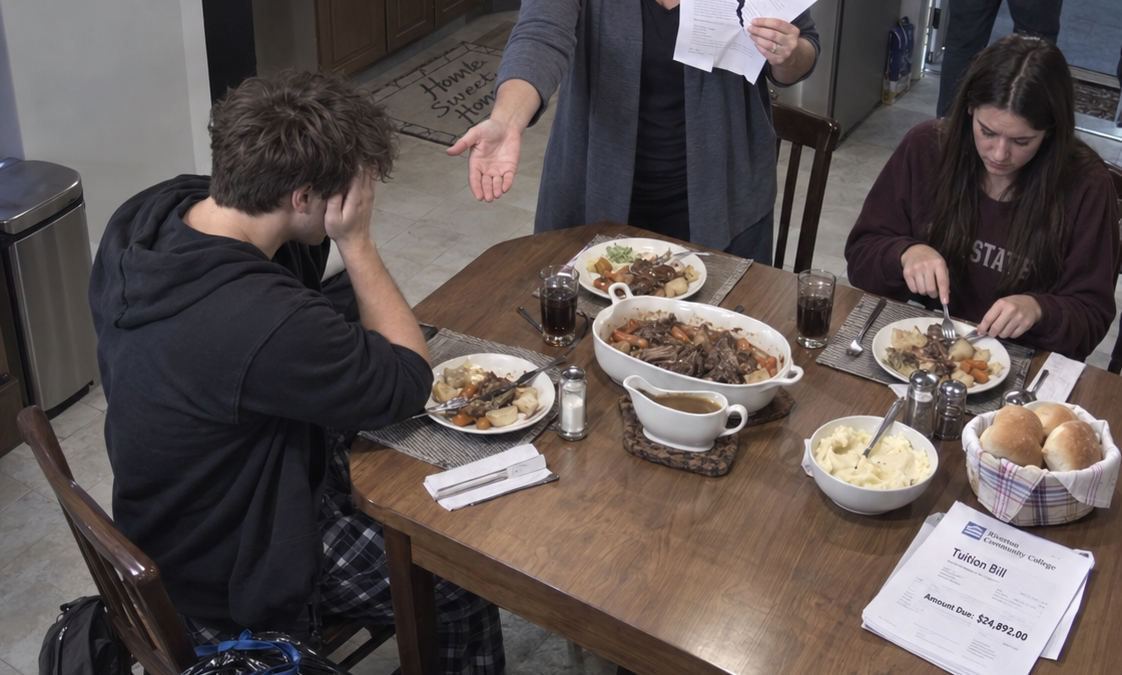
“Quit school and help pay your sister’s tuition,” my mother said, sliding the bill across the table. “$31,800 a year. Your share is $1,250 a month. Or get out.”
I chose school.
She held out her hand for my house key. “Then you’re no son of mine.”
My father turned the radio up in the garage and stayed there until I was gone. I left with two trash bags and a scholarship letter I had to tape back together.
Seven years. No birthday. No call.
Then the front desk told me my parents were downstairs after driving fifty-five miles. Not to apologize. They were there to tell me my sister’s career was collapsing, and I was going to save it.
I looked at my mother.
“I thought I wasn’t your son.”
She had the next line ready. She always does.
They thought they’d come to collect. They had no idea what I’d been keeping, or that this was the day their favorite sentence finally stopped working.
My name is Corbin Hail. I’m twenty-five years old. If someone in your family ever priced your future, then showed up years later with a new bill, this is for you.
Four weeks before that Tuesday, I was on the third floor reading essay number 187. I run the scholarship program at the Ashwell Community Foundation in downtown Indianapolis.
It’s a three-story brick building with a front desk that knows everyone’s coffee order. Every year, about 400 high school seniors from central Indiana apply to us. Thirty of them get $5,000 a year for four years. The board has been meaning to raise that number since 2019.
In the first round, I read the essays blind. No names, no schools, just a county and a story. That was my idea back when I was the coordinator. It pushed our award date from early April to May 1. It’s easier to be fair when you don’t know who anyone is.
And I’ve never once regretted the extra administrative headache that rule creates every single spring, because the alternative is a version of fairness that depends entirely on which names happen to sound familiar to whoever’s reading that year.
Adrienne Foss, our vice president of programs, taught me the only rule that matters.
“Read everyone like it’s the only one, Corbin. For that kid, it is.”
The Ashwell office runs on a rhythm I’ve come to love more than I probably should admit to anyone who isn’t already the kind of person who color-codes a spreadsheet for fun.
Every January, we open the portal and the applications trickle in slowly at first, then flood in during the final week, the way water finds every crack in a foundation right before a storm. Every March, the essays come to me in batches assigned by a random number generator so no reader ever sees the same county twice in a row—a system I built specifically after noticing my first year reading blind that I’d unconsciously started reading faster through counties I recognized.
Every April, the names come back. Every May, thirty kids find out their lives just got a little more possible.
I’ve read essays about parents in prison, essays about siblings who didn’t make it to eighteen, essays about kitchens with no food in the refrigerator at all, let alone a wall of honor-roll certificates.
I never once, in four years of reading blind, mentioned my own family to a single one of them. Not because I was hiding it, but because the essays were never about me, and I’d learned early that the moment you make someone else’s hardest year about your own, you stop actually listening to them.
It had been a long February.
On the last Saturday of the month, our application portal went down for four hours the day before the recommendation deadline. I sent an apology email to every counselor and teacher with a letter still pending. I aged a year that weekend.
By the third week of March, I’d read 186 essays.
Number 187 stopped me cold.
Applicant 260,212. Delaware County.
A girl who worked twenty-four hours a week behind a grocery-store deli counter. Her mother worked nights. She wanted to be a nurse. She wrote about doing homework on overturned milk crates in the stockroom during her break.
Then, in the fourth paragraph:
“My counselor told me the mature choice is to let your family lean on you first.”
I read it three times, the way you reread a sentence that has landed somewhere it isn’t supposed to be able to reach anymore.
I highlighted it in yellow. I scored the essay five out of five. Then I typed a note in the margin:
Who told her this?
Then I deleted it.
Readers aren’t allowed to leave personal comments. That’s a rule I wrote, too, back when I still believed a rule could keep a feeling contained if you just wrote it down clearly enough and filed it in the right binder.
Before I left that night, I opened the bottom drawer of my desk. Under the stapler, there’s a letter on our old letterhead with the green oak leaf in the corner. It’s taped down the middle with packing tape that has gone the color of weak tea.
I didn’t take it out.
Some people keep a photo in their desk.
I keep a receipt.
On my way out, I walked past the wall of scholar photos in the lobby. I didn’t look at the third row.
I never do.
My mother said that sentence to me across a pot roast when I was eighteen.
Nineteen days later, I found out who had taught it to a stranger’s daughter.
To understand why one sentence could stop me, you have to understand the refrigerator in my parents’ kitchen.
It was covered.
Honor-roll certificates. A dance recital program. A newspaper clipping from the time my sister Camille read a poem at a school board meeting.
Everything on that fridge belonged to her.
My report cards went in the junk drawer next to the batteries and the takeout menus. My mother said she didn’t want the fridge to look cluttered.
Camille is four years older than I am. In our house, she was the sensitive one, the gifted one, the one who needed things.
I was the easy one.
My mother actually introduced me that way to people at church.
“This is Corbin. He’s my low-maintenance one.”
I packed my own lunches starting at nine.
When Camille turned sixteen, she got a used Corolla with a bow on it. When I turned sixteen, I got a bus pass and a job application from the pizza place on McGalliard Road.
Nobody thought that was unfair because I didn’t complain.
And I didn’t complain because I’d learned early what happened when you did.
Whenever there was an argument in our house, my mother ended it the same way.
Camille needed the car and I needed a ride to a baseball game.
“Family comes first.”
Camille wanted the bigger bedroom.
“Family comes first.”
It sounded like a rule for everybody.
It never once meant me.
“Corbin’s fine,” she’d say. “Corbin’s always fine.”
Being fine was my job in that house, a job I held down without a single day off for eighteen years.
Nobody told me it came with a bill, or that the bill would eventually come due in a lobby I hadn’t even built yet.
To be fair to my sister, she wasn’t all bad.
Before every baseball game, Camille would sit me down on the edge of the tub and tape my throwing hand, wrapping the athletic tape tight along the two fingers where the seams cut worst so I wouldn’t blister midgame. She’d pull it tighter than it needed to be, and I’d complain.
“Toughen up, Corb.”
That was the only nickname anyone in my family ever gave me.
My father was a maintenance technician at a plant on the east side of Muncie. He was kind in the way a quiet house is kind. He didn’t yell. He didn’t take sides.
When voices got loud in the kitchen, he went out to the garage and turned on the radio he kept on his workbench. It was an old gray thing spattered with paint. Usually the Reds game, sometimes classic rock.
“Let your mom handle it, kiddo,” he’d say on his way out the door.
In our house, you could measure an argument by how loud the Reds game got.
There was one more pattern, and I didn’t see it until much later.
Things that went wrong for Camille were always somebody else’s fault.
A science-fair form the school lost. A late fee the library made up. A college application a teacher forgot to send.
My mother would get on the phone, and by dinner the story had changed.
There’s one memory from around that same era I still think about more than almost any other.
I was eleven, and I’d spent three months building an entry for the regional science fair—a working model of a water-filtration system made from scavenged bottles and activated charcoal. I worked most evenings at the kitchen table after Camille had already gone up to her room.
The night before the fair, my mother told me, almost as an afterthought while loading the dishwasher, that she and my father couldn’t make it because Camille had a regional dance competition two towns over and someone needed to drive her.
I told her it was fine, the way I always told her everything was fine, and I stood alone at my display table the next afternoon while other kids’ parents crowded around asking questions and snapping photos.
I won second place in my division.
When I got home that evening and told my parents, my father asked, without looking up from the television, whether Camille’s team had placed.
When I said I didn’t know, he seemed almost disappointed in me for not having paid closer attention to a competition he hadn’t even bothered to ask me about attending.
In February of 2019, Camille was finishing her psychology degree at Ball State. She wanted to be a school counselor.
Ball State’s master’s program turned her down.
My mother told everyone Camille had chosen Lynwood University instead, a private school in Anderson. Lynwood offered her a graduate assistantship. It would have covered her tuition in full.
She just had to sign the contract and send it back by March 1.
In the middle of March, the assistantship was gone.
“Those people lost her contract,” my mother said at dinner. “And now we’re supposed to find $31,000.”
A few days later, a new letter from Lynwood went up on the fridge, right in the center where the honor-roll certificates used to be.
I remember the two lines that mattered.
Tuition: $31,800.
Assistantship: $0.
My mother called it the bill.
She said it like it had arrived by itself.
She looked at that number for a long time.
Then she looked at me.
On Monday, April 6, we unblinded the finalists.
It’s my favorite day of the year. Usually, forty names appear where there were only numbers. Forty kids become real.
I ran the standard report for incomplete files.
The deadline to finish a finalist file was Friday, April 17. The committee would meet the Friday after that.
Six files were missing something. A transcript, a signature, the usual.
Applicant 260,212 was Madison Cole, Prairie Creek High School, Muncie.
My high school.
Her essay was the milk-crate essay. The mature-choice essay.
And her file was missing the one document a student can’t produce on her own: the counselor recommendation.
I clicked on it.
Recommender: Camille Hail, school counselor.
Status: Not received.
It sat in a small red box on my screen.
I hadn’t seen my sister’s name in seven years.
There it was in red, like a warning light on a dashboard.
I’ll be honest about what I did next because it matters later.
I didn’t call anyone. I didn’t text anyone.
I opened the activity log, which I’m allowed to see for any file because making sure these letters come in is my job.
The portal had sent Camille a request on January 20.
Reminders went out on February 10 and February 24.
Then the outage apology on March 1.
Four emails.
Every one of them ended the same way because that’s how I built the template:
Thank you for everything you do for your students.
Corbin Hail
Scholarship Program Manager
The log also shows when a recommender clicks the link.
Camille had opened it on January 21, February 11, and February 25.
The form had never been started.
Not one field.
I send reminders to hundreds of counselors a year. The system does it for me. I had never looked at who was on the other end of this one.
Three times my sister had opened an email from me.
Three times she’d closed it.
I sat back from the desk. My coffee had gone cold without my noticing.
Then I did what I would tell anyone on my team to do.
I wrote to Adrienne.
It took me eleven minutes, and most of that was deleting adjectives.
Subject: Disclosure — Finalist 260,212.
The counselor on this file is my sister. We haven’t spoken since 2019. I’m stepping away from it.
Her reply came back in under five minutes.
Understood. Thank you for telling me first. Don’t open it again.
I took my hand off the mouse.
From then on, Adrienne handled every email on Madison’s file. I didn’t see the log again.
I didn’t need to.
I’d already seen everything that mattered.
On Wednesday, Adrienne mentioned, in the careful way she mentions things, that a family member of one of our finalists had called. She’d confirmed the facts.
That was all I was allowed to know, and that was fine.
Recusal isn’t a door you leave open a crack.
I went home that night and didn’t sleep much.
I kept thinking about a girl doing homework on a milk crate, waiting for a letter from someone who kept closing the email.
Four days later, my sister was on leave.
Eight days later, my parents were standing in my lobby.
But I’m getting ahead of myself, because seven years earlier, I was the one waiting on a letter.
It came on Friday, April 5, 2019.
A white envelope with a green oak leaf in the corner.
I opened it standing at the mailbox.
Dear Corbin,
On behalf of the Ashwell Community Foundation, it is my pleasure to inform you…
$5,000 a year, renewable for four years.
$20,000.
Signed by Adrienne Foss.
I’d been accepted to IUPUI, the big public campus downtown in Indianapolis. I’d already paid the $150 enrollment deposit myself in tips from the pizza place, mostly in fives.
Ms. Delacroy, my school counselor, had written my recommendation. When I told her I’d applied for the Ashwell scholarship, she’d said, “Good. Now let me do my part.”
I didn’t put the letter on the fridge.
I knew better.
I taped it to the inside of my closet door, where I’d see it every morning and nobody else would.
And I did see it every morning before school. I opened that door and read the first line again.
Not because I’d forgotten it.
Because it was the first thing in that house that was only mine.
I only showed one person.
Camille came into my room that weekend to borrow a phone charger, and I opened the closet door like I was revealing a prize on a game show.
She read the whole thing.
She was quiet for a second.
Then she asked, “Does Mom know?”
“Not yet.”
She nodded like she was filing that away.
The next two weeks were strange.
My mother was nice to me.
Not dramatic nice. Small nice.
She asked about my baseball schedule. She bought the cereal I liked. She asked if I needed anything for graduation.
At the time, I thought maybe the fridge had finally run out of room for Camille.
On Tuesday, April 23, my phone buzzed during lunch. I stepped out of the cafeteria to answer it.
It was a woman’s voice, warm and very precise.
“Corbin, this is Adrienne Foss from the Ashwell Foundation. I need to ask you something directly. Are you still planning to accept your award?”
“Yes. Of course.”
“Good. I’m going to email you the acceptance form. I’d like you to sign it yourself and get it back to us by Friday.”
There was a pause.
“I just need to hear it from you, Corbin. Not anyone else. You.”
I thought it was a policy thing. I thought all scholarship people talked like that.
I mailed the form the next morning.
I never asked why she’d said not anyone else.
For years afterward, I filed that phone call away under strange but well-meaning, one more small mystery from an adult world that didn’t owe me an explanation for how it operated.
That Friday, my mother made an announcement at dinner.
Sunday pot roast. All four of us.
“The family needs to talk.”
I knew what it was about, or I thought I did.
Camille’s tuition bill had been on the fridge for five weeks, and nobody had said a word about how it would get paid.
I figured they were going to ask me to be understanding, maybe to help a little over the summer.
So I did what I always did.
I prepared.
I got out a manila folder and wrote COLLEGE on the tab in black marker.
Inside, I put a budget I’d built on the library computer.
IUPUI would cost about $19,000 a year with housing. The Ashwell award. A small merit scholarship from the university. A federal student loan. Twenty hours a week of work.
It added up.
Barely, but it did.
I was eighteen.
I thought if I showed them the math, they’d see I wasn’t going to cost anybody anything.
I brought a spreadsheet to my own sentencing.
Sunday, April 28, 2019.
Pot roast. Potatoes. The gravy boat my grandmother gave my parents as a wedding present.
All four of us at the kitchen table like a family on a cereal box.
My mother waited until everyone had a plate.
Then she stood up, took the Lynwood letter off the fridge, sat back down, and slid it across the table to me.
“Quit school and help pay your sister’s tuition.”
She said it the way you’d say pass the salt.
$31,800 a year, printed in black at the bottom of the page.
My mother tapped it once with her fingernail.
She had the plan all worked out.
I would defer my enrollment at IUPUI for two years. The distribution center out by the highway was hiring at $14.50 an hour full-time. From that, I’d give the family $1,250 a month.
Two years.
$30,000.
Camille would finish her master’s degree with no loans hanging over her. My parents would cover the rest.
“And then it’s your turn,” my mother said. “Two years? That’s nothing at your age.”
I opened my folder.
I slid my budget across the table the way she’d slid hers.
I explained the Ashwell award, the merit scholarship, the loan, the part-time job.
I showed her that I could do it without taking a dime from anyone.
She didn’t look at it.
“Family comes first, Corbin. The mature thing is to let your family lean on you first.”
Across the table, Camille cut her pot roast into smaller and smaller pieces.
She didn’t look up from her plate.
Not once.
That’s how I knew she’d heard this plan before I had.
“Camille can take out graduate loans,” I said. “Everybody does. That’s what they’re for.”
“Loans are for families who don’t help each other.”
“What about my loans?”
“You won’t need loans,” my mother said, “if you’re not in school.”
My father set down his fork.
He pushed his chair back very carefully, like he didn’t want to scrape the floor.
He went out through the laundry room into the garage.
A few seconds later, I heard the radio come on.
Then I heard it get louder.
It stayed that loud for the rest of the night.
“When did we decide this?” I asked.
“The family decided.”
“When?”
I looked at Camille.
I looked at the door to the garage.
“When did the family decide?”
Nobody answered.
I closed my folder.
My hands were cold.
I remember that because it was April and the kitchen was warm.
“I’m going to school.”
My mother’s face didn’t change.
That was the frightening part.
“Then you can get out.”
I didn’t say anything.
She stood up.
She walked out of the kitchen and up the stairs, and I heard my closet door open.
When she came back down, she was holding my letter.
The tape still clung to the corners where she’d pulled it off the door.
She held it up so I could see the oak leaf.
“This is $5,000,” she said. “Your sister needs thirty-one.”
Then she tore it in half, top to bottom, and dropped both pieces on my placemat next to the potatoes.
Camille finally looked up.
My mother held out her hand, palm up.
“Key.”
I had one house key on a red lanyard from a baseball tournament.
I took it out of my jeans pocket and put it in her hand.
She closed her fingers around it like she’d been waiting all night to.
“Then you’re no son of mine.”
She said it without raising her voice.
That’s how I knew she meant it.
I went upstairs and packed clothes, my school stuff, the photo of my grandmother from my dresser.
Two black trash bags, because we didn’t own a suitcase that wasn’t Camille’s.
I called my best friend Marcus, and his mother, Nancy Whitfield, got on the line.
“I’m coming. Don’t carry anything heavy down those stairs by yourself.”
Marcus and I had been friends since seventh grade, mostly because we sat next to each other in a boring history class and started passing notes about a video game neither of us could actually afford.
By high school, his house had quietly become the place I went whenever mine felt like too much, though neither of us ever called it that out loud.
Nancy ran a home daycare out of her basement. Six kids under five. Chaos and finger paint and a television permanently tuned to something with a theme song.
She’d folded me into that chaos so seamlessly over the years that by the time I actually needed a couch to sleep on, it barely felt like a request at all.
While I was packing, my mother carried the rest of my room out to the curb.
My bedroom lamp. My baseball glove. A box of books.
She set them next to the recycling bins for Tuesday pickup.
Camille stood on the stairs as I came down with the bags.
She was holding the railing with both hands.
“You’ll be back in a week,” she said.
She said it like she was trying to help.
I went back into the kitchen one more time.
I picked up both halves of the letter from the placemat, wiped a little gravy off the corner with my sleeve, and put them in my folder.
Nancy’s minivan pulled up at 10:40 that night.
She got out and put both trash bags in the back herself.
She didn’t ask what happened.
She didn’t have to.
As the minivan pulled away, I looked back at my bedroom lamp on the curb next to the recycling.
The garage light was on.
The radio was still going.
Seven years later, the night my parents came to my lobby, I did something I’d refused to do for a long time.
I searched my sister’s name.
It took about four seconds to find Willowline College Consulting.
A clean website. Soft blue colors. A photo of Camille in a cardigan on a front porch, laughing at something just out of frame.
The tagline was across the top in script:
Your student deserves a counselor who has time.
Packages started at $2,500.
College-list building. Essay coaching. Priority access.
I scrolled through the Instagram account.
Congratulations posts. Acceptance letters held up to the camera.
One said, “So proud of our Prairie Creek senior on her early-action admission.”
Another thanked “our Prairie Creek families for a great season.”
Our Prairie Creek families.
My sister was selling her time to the students she was already paid to help.
And somewhere on her caseload was a girl who couldn’t get one letter out of her.
Then I looked at the school staff page.
I don’t know why.
I think I needed to see it written down.
Camille Hail, school counselor. Students A through K. Room 114.
Room 114 was Ms. Delacroy’s office.
I knew that door.
I’d sat on the other side of it, crying about a FAFSA form while she typed a letter that saved my life.
Madison had been my sister’s student all along, in the same office where someone once wrote a letter for me.
Now I understood why the district had put her on leave so fast.
A missed letter is a complaint.
A school counselor charging her own students for college advice is a policy violation.
There was one more thing I wanted to know.
Indiana keeps a public business registry. Anyone can search it.
Willowline College Consulting LLC formed in 2024.
Registered agent: Pauline Hail.
The address listed was the house I grew up in.
The one with the fridge.
The one with the curb.
So this wasn’t only about Camille’s career.
It was about the family’s money.
I closed the laptop.
I made tea I didn’t drink.
For seven years, I told myself my family was simply finished with me.
It was easier than knowing they’d just moved on to the next bill.
Now, back to that Tuesday, April 14, a little before noon.
I was at my desk rereading the committee agenda for the fourth time when the front desk called up.
“Corbin, there’s a couple down here. They say they’re your parents.”
There’s a specific kind of quiet that happens inside your body when a sentence like that lands.
My hand stayed on the keyboard.
I remember that.
I remember deciding to save the document before I stood up, as if a spreadsheet was the thing that needed protecting.
The elevator takes about twenty seconds to go down three floors.
I’ve timed it.
That day, it took about a week.
I watched the numbers change from three to two to one and thought, absurdly, about whether I had spinach in my teeth.
When the doors opened, I saw my mother first.
She was wearing her good camel coat, the one she wore to funerals and parent-teacher conferences, and she was standing in front of the wall of scholar photos.
My father stood by the glass doors, holding his work cap in both hands, turning it slowly by the brim.
My mother was standing eight inches from my eighteen-year-old face.
The 2019 class.
Third row.
She hadn’t noticed.
She turned when she heard my shoes on the tile.
She looked me up and down the way she used to check whether I was dressed right for church.
She didn’t say hello.
She didn’t say my name.
“Your sister’s been put on leave.”
Paid leave for now, since Friday, because some girl’s aunt had “decided to make a scene,” and then three other families had jumped on it. A bunch of jealous mothers upset about her little business on the side.
I didn’t know yet what the little business was.
I filed it.
“You’re in that world now,” my mother went on. “Scholarships, counselors. They’ll listen to you. You make a call, you tell them it’s a misunderstanding, and this goes away.”
My father looked at the floor.
The cap kept turning.
“Your sister needs you,” my mother said. “Whatever happened before, this is bigger than that.”
Whatever happened before.
Seven years folded into two words.
Not one question about where I lived.
Whether I was okay.
What happened to the kid who left with two trash bags.
Just the assignment.
I kept my voice at the level I use with upset parents on the phone.
Even. Low.
“Mom, I can’t discuss any applicant with you. I can’t discuss any counselor either.”
“Oh, don’t.” She said it sharply. “It’s your foundation scholarship. Don’t pretend you don’t know.”
So she knew where I worked.
She knew what I did.
I wondered how long she’d known.
“I do know,” I said. “That’s why I stepped away from it. The day I saw her name, I disclosed it and recused myself. I’m not involved. I’m not allowed to be involved.”
She stared at me like I’d said something in another language.
“Recused,” she said. “From your own sister.”
Then she said it.
I could see it coming, the way you can see a car signal before it turns.
She squared her shoulders and lowered her voice the way she always did right before she won.
“Family comes first, Corbin.”
That was her favorite sentence.
For twenty-five years, it had worked every time.
It had gotten Camille the car, the bedroom, the rides, the benefit of every doubt.
It had gotten my mother out of every argument she ever started.
I looked at her.
“I thought I wasn’t your son.”
It came out quieter than I expected.
It didn’t shake.
It just sat there in the lobby between us, next to the potted fern and the visitor sign-in sheet.
The front desk went very still.
Somewhere behind me, a printer finished a job and stopped.
My mother didn’t even blink.
She had the next line ready.
She always does.
“Don’t be dramatic. That was seven years ago.”
As if the sentence had an expiration date.
As if I was the one who’d kept it too long.
I didn’t answer.
For the first time in my life, I didn’t reach for the thing that would make her comfortable.
I just stood there.
And her favorite sentence stood there with me.
And nothing happened.
No one moved.
It didn’t work.
She waited for me to fold.
When I didn’t, she picked up her purse from the bench and hooked it over her arm.
“You’ll call when you’ve calmed down,” she said. “You always come around.”
I never had.
She just never noticed.
She walked to the glass doors.
My father held one open for her.
Then he paused, just for a second, and his eyes went to the wall of photos.
To the third row.
He’d noticed.
Of course he had.
“You look good, kiddo.”
That was all.
He followed her out.
My mother stopped with one foot on the sidewalk and looked back at me over her shoulder like she’d almost forgotten something.
“Camille always said you’d end up somewhere like this,” she said, “handing out other people’s money.”
The door swung shut behind her.
I stood in the lobby long enough that the receptionist asked if I wanted a glass of water.
“No, thank you.”
I was thinking about one word.
Always.
My sister had been watching me a lot longer than I’d been watching her.
Then came the part nobody warns you about.
My financial aid was built on my parents’ income. We’d filed the FAFSA back in October, when I still lived at home, and my father had signed it.
As far as the federal government was concerned, my parents were going to help me pay for college.
They’d made it very clear they weren’t going to pay a dime.
There’s a process for that.
It’s called a dependency override.
A financial-aid office can treat you as an independent student if someone in standing documents what happened.
A counselor. A social worker. A pastor.
I went back to room 114 and sat across from Ms. Delacroy and tried to explain it without crying.
I didn’t manage.
She handed me a box of tissues and pulled her keyboard closer.
“A counselor’s letter is supposed to open a door, Corbin,” she said. “Let me write you one.”
She wrote it that afternoon.
It was one page on school letterhead, and it said in plain language that I’d been put out of my home for choosing college.
IUPUI approved the override in July.
As an independent student, I qualified for a Pell Grant of just over $6,000.
With the Ashwell award, a campus job, and one small loan, the math worked.
In August, Nancy drove me to campus.
I moved into my dorm with two trash bags, my folder, and a lamp Nancy said she’d been meaning to get rid of anyway.
It took one letter from one counselor to get me through that door.
My dorm room that first semester was a cinder-block box on the fourth floor with a window that looked out over a parking garage.
I shared it with a business major named Trevor, who kept a mini-fridge stocked entirely with energy drinks and never once asked why my side of the room had exactly one lamp, one milk crate turned into a nightstand, and no family photos taped to the wall the way everyone else’s side did.
I didn’t mind the questions he didn’t ask.
I’d spent eighteen years learning how to take up as little space as possible, and a roommate who left me alone in that particular way felt, at the time, like a kindness rather than an absence.
I ate a lot of meals alone that year, timing them for the gaps between the dining hall’s busiest hours.
Not because I was ashamed, exactly, but because eating with a group meant fielding the question every eighteen-year-old gets asked eventually:
“What does your family think of your major?”
I hadn’t yet built an answer that didn’t require explaining more than I wanted to explain to someone I’d known for three weeks.
Ms. Delacroy called me twice that first semester just to check in.
Both times, I found myself talking longer than I meant to because she was the only adult from my old life who’d ever actually asked the follow-up question instead of accepting whatever answer made the conversation shorter.
Seven years later, a counselor would decide not to write one.
My first two years at IUPUI, I worked the night sort at the FedEx hub by the airport, 11:00 p.m. to 3:00 a.m., five nights a week, $16.50 an hour.
I’d sleep four hours, go to a 9:00 a.m. class, and sleep again in the afternoon with a towel over my eyes.
The other sorters were mostly students and a few retirees who liked the overnight quiet.
A woman named Denise showed me how to tape a split box so it would survive a trip across the country.
“Crooked’s fine,” she said. “It just has to hold.”
I learned to eat standing up.
I learned you can do a statistics problem set on a conveyor-belt break if you really have to.
Denise had worked that same night sort for eleven years by the time I met her. Ever since her own kids had grown up and moved out, and the overnight quiet had become, in her words, “the only part of the day that actually belonged to her,” she used to bring an extra thermos of coffee every Tuesday specifically for whichever student looked most like they were about to fall asleep standing at the conveyor belt.
More nights than I’d like to admit, that student was me.
She never asked why a kid with a full course load was working an eleven-to-three shift five nights a week instead of just taking out a bigger loan like everyone else seemed to manage.
I never explained it.
But she started leaving an extra granola bar in my locker most Fridays without comment.
The same quiet, unasked-for consistency I’d later recognize in Nancy and Adrienne.
People who simply decided to show up for me without ever needing the whole story first.
In October of that first year, there was a money order in my campus mailbox.
$400, made out to me.
No return address. No name.
Just a scrap of paper folded around it with two words in square, blocky capital letters:
FOR BOOKS.
I called Nancy to thank her.
She was quiet for a second.
“Wasn’t me, honey.”
I figured it was Adrienne. It seemed like the kind of thing she would do and never mention.
I never asked her.
I spent the money on two textbooks and a winter coat.
I never found out who to thank.
In the spring of 2021, Ashwell emailed all its scholars about a paid internship.
$15 an hour. Fifteen hours a week. Half of it remote because of the pandemic.
I applied that night.
Adrienne hired me two weeks later.
She never once mentioned that I’d been one of her scholars. She treated me like staff from the first day.
I didn’t know yet what that restraint had cost her.
I was good at it.
I’d spent my whole life making sure paperwork didn’t get lost.
It turns out that’s a marketable skill.
In my first month, Adrienne found me reading the sixty-page policy manual at lunch with sticky tabs on half the pages.
“You’re the only intern I’ve ever had,” she said, “who reads the policy manual for fun.”
That fall, Ashwell hung our 2019 class photo in the lobby.
For four years, I took the long way around it.
There’s a version of the graduation story I never tell in the shorter recaps, the part where I almost didn’t walk at all.
IUPUI’s commencement fell on a Saturday in May, the same weekend as a mandatory training shift I’d already agreed to cover at the FedEx hub.
For about a week, I genuinely planned to skip the ceremony entirely and just have my diploma mailed, the way you’d handle any other piece of paperwork.
Nancy found out from Marcus, who found out from me in an offhand comment I hadn’t meant to be a confession.
She called me that same night and told me, in the specific tone she reserved for things she considered non-negotiable, that she had already found someone to cover my shift and that I would be putting on the cap and gown whether I liked it or not.
I told her it felt strange to walk across a stage for people who weren’t my actual family.
She told me family was exactly the word for what she and Marcus were planning to do that weekend, and that I didn’t get a vote on whether they showed up.
I graduated in May of 2023.
They sat in the bleachers with a homemade sign spelling my name in glitter glue.
Nancy came and cried and took pictures with her phone, yelling loud enough when they called my name that the dean actually paused and smiled toward our section before continuing down the list.
She used a disposable camera, too, because she said phones took pictures that never actually got printed.
Every one of those twenty-four photographs is still in a shoebox in my closet, next to the one that used to hold $400 I never got to thank anyone for in person until seven years later than I should have.
Ashwell hired me as scholarship coordinator that June.
That was when I pushed for the blind first round and a finalist window so no kid would lose an award because some adult missed a deadline.
In January of 2025, I became the program manager.
Some things I changed.
Some I didn’t.
Every Mother’s Day since 2020, I’ve sent Nancy white hydrangeas.
The card always says the same thing:
Happy Mother’s Day. Thank you for the couch.
I never deleted my mother’s number.
It’s still in my phone under Mom.
It never rang.
Not once.
Not on my birthday.
Not on hers.
On my first day as manager, I brought the taped letter from home and put it in my bottom desk drawer.
I kept that letter in my drawer the way people keep a fire extinguisher.
I never planned to need it.
I just needed to know it was there.
Camille picked a diner off I-69 in Anderson, twenty minutes from her, forty from me.
Some things about my family apparently simply don’t ever change.
It was Thursday night, a little after eight. The parking lot was already half empty by then.
I got there first, the way I always seem to get everywhere first with her, and took a booth by the window.
The place had pie in a glass case that had probably been rotating the same six flavors since the Reagan administration, and a waitress who called absolutely everyone “hon,” including a man who was clearly her husband.
Both of them moved through that diner with the practiced ease of people who had worked the same shifts together for twenty years and never once needed to say so out loud.
Camille came in wearing a gray hoodie that said PRAIRIE CREEK COUNSELING across the front.
I don’t know if she chose it on purpose.
She’d cut her hair short to her jaw.
Her nails were bitten down, which was new. She’d always had perfect nails, the kind our mother used to point out to relatives as evidence of good breeding.
Seeing them chewed down to nothing told me more about the last seven years than anything she said for the rest of the night.
She slid into the booth.
She looked at me for a long moment.
“You cut your hair?”
Seven years.
And those were the first words.
“So did you.”
For a second, I saw her at fifteen, wrapping tape too tight around my fingers on the edge of the bathtub.
Then she picked up the menu, and it passed.
She ordered a slice of cherry pie.
She didn’t touch it the entire time.
“I’m not here to fight,” she said. “I’m here because you’re the only one who can make this go away.”
I waited.
She took out her phone, opened a file, and turned the screen toward me.
A PDF.
The file name said Cole Rec Final.
The date under it said February 26.
“I wrote it,” she said. “I wrote it in February. I thought I sent it. I emailed it to you on the twenty-seventh. Your work address. It must have gotten stuck.”
“Stuck?”
“Your portal went down. You sent everybody that outage email yourself.”
She leaned in.
“So just upload it. Staff can do that, right? Mark it received by email on the twenty-seventh. The outage ate it. Nobody gets blamed. Madison gets her letter. The complaints fall apart.”
She said the next part like she’d been practicing it in the car.
“It helps the kid, Corbin. That’s the whole point. Everybody wins.”
I noticed she said the kid.
Not Madison.
Not her student.
The kid.
And here’s the thing I have to admit.
For about three seconds, it sounded almost reasonable.
Madison would get her letter.
The committee would never know.
The system I built would swallow one small lie and keep running.
Then the details came back, the way details always come back to me.
“The outage was February twenty-eighth. Four hours on a Saturday.”
Camille blinked.
“Your email was supposedly the twenty-seventh. Friday. The portal was up all day Friday. And the letters don’t come by email. They come through the portal. That’s the whole reason the portal exists.”
She sat back.
Her jaw worked.
“You were always like this,” she said. “Dates. Numbers. You used to correct Dad’s lottery math.”
“Somebody had to.”
Then, more quietly, I said, “Also, I’m not on that file. I recused myself the day I saw your name. I can’t upload anything. I can’t even open it.”
“You can’t?”
She repeated it.
“Or you won’t.”
“Both.”
She looked out the window at the parking lot.
The neon from the sign made her face look pink and tired.
“There’s an honest version,” I said. “You go home tonight. You log into the portal. You submit the letter late, and you write one sentence at the top: I missed the deadline, and I’m sorry.”
“Adrienne reads every explanation.”
“It would still help Madison. It might help a lot.”
“And it would hurt me.”
“Yes. Send it late and tell the truth. It’ll cost you something. That’s the deal everyone else gets.”
She laughed, but there was nothing in it.
“If I say I missed it, I’m admitting everything. You know there are three other families, right? Three.”
I didn’t say anything.
She tilted her head and did our mother’s voice.
It was a very good impression.
It always had been.
“Family comes first, right?”
The waitress came by and set the check in the middle of the table.
$14.60.
One coffee.
One untouched slice of pie.
Camille didn’t move.
Before I even thought about it, my wallet was out and my card was on the tray.
I’d paid before I even noticed.
Seven years, and my hand still knew the way to her bill.
In the parking lot, she stopped by her car.
She had her keys in her fist, the way people carry keys at night.
“You know what Mom will do if this doesn’t go away?”
She didn’t wait for an answer.
She got in her car.
For a second, through the windshield, she looked like she might roll the window down and say something else.
Something true.
Then she backed out.
When I got home, there was an email in my work inbox.
It had come in at 9:52 that night from Camille’s personal Gmail.
There was a PDF attached.
The subject line said:
Resending Cole Rec.
Resending.
There had never been a first time.
Friday morning, I got to my desk at 8:03 and opened the email again.
I had opened the PDF once the night before. I’d read the first line—It is my pleasure to recommend—and closed it.
It felt like reading someone else’s mail.
In a way, it was.
I sat there for seven minutes.
I know because I watched the clock in the corner of my screen change seven times.
I thought about what forwarding it meant.
My sister had handed me something, and I was about to hand it to my boss.
Every instinct I’d grown up with said that was betrayal.
You don’t tell.
You fix it quietly or you swallow it.
But I wasn’t eighteen.
And this wasn’t the kitchen.
I hit Forward and wrote four sentences.
Adrienne,
Last night I was asked to upload the attached with a February 27 received date. I haven’t. I won’t. I haven’t opened finalist 260,212 since April 6.
Her reply came four minutes later.
Come see me at noon.
Adrienne’s office is on the corner, with a window that looks out on a parking lot and one stubborn maple tree.
She had the PDF printed out on her desk.
Her reading glasses hung on a beaded chain around her neck, and she put them on before she said anything.
“First,” she said, “you did exactly the right thing. Second, I want you to know how this goes so you’re not guessing.”
She walked me through it.
Our policy has a section for exactly this situation.
When a school official fails to submit a required recommendation, a finalist can name a substitute recommender.
Adrienne had already emailed Madison that morning and given her until Wednesday, April 22.
She’d also emailed Camille as the counselor on record.
The foundation could not accept a letter sent outside the portal after the deadline with a claim of earlier submission that no one could verify.
So Madison would be okay.
That was the first thing I felt.
Relief.
Like a muscle unclenching.
Then Adrienne tapped the printout with one finger.
“There’s something else. Second paragraph.”
She turned it toward me.
Someone had circled a word in red pen.
It was Adrienne’s red pen. I’d know it anywhere.
Kayla has shown remarkable resilience.
“Her name is Madison,” Adrienne said.
It says Kayla.
The same paragraph recommended a gap year to support her family.
A template.
My sister had a template.
She’d written it for someone named Kayla and pasted it into a letter for Madison without reading it closely enough to change the name.
And the template told a poor kid to stay home.
I thought about the three other families.
Somewhere in there was a Kayla, too.
Adrienne’s email meant that by Monday, my mother would know exactly who had forwarded it.
On Monday at 2:15, she proved it.
My mother called the foundation’s main number and asked for, and I’m quoting the front desk here, “whoever is in charge of scholarships, not my son.”
They put her through to Adrienne.
I didn’t hear the call.
I found out afterward when Adrienne knocked on my open door, came in, and sat down in the chair across from my desk.
She never sits in that chair.
She’s a stand-in-the-doorway person.
“Your mother called me,” she said. “I’m handling it. Please don’t contact her about it.”
“What did she say?”
Adrienne considered how much to tell me.
“That you’ve always been jealous of your sister. That we should accept Camille’s letter. And that the family has decided to handle this privately.”
She said the last part slowly, the way you repeat a phone number so you won’t forget it.
Then she took off her glasses and let them hang on the chain.
“Corbin, there’s something I should have told you a long time ago. Give me a day.”
She got up and left before I could ask what she meant.
Adrienne had never once said something like that to me in five years.
Tuesday afternoon at 4:30, she asked me to come to her office.
She closed the door behind me.
Adrienne doesn’t close doors.
There’s a sign on it that says:
IF IT’S OPEN, COME IN.
It’s always open.
She had a single sheet of paper face down on her desk.
“Our database keeps contact records for seven years,” she said. “Every June, anything older than that gets purged. This one would have been gone in about seven weeks. I printed it yesterday.”
She turned it over.
It was a record from our donor and applicant system, with our logo in the header.
The green oak leaf.
April 22, 2019.
Call from applicant’s mother. Pauline Hail requested we withdraw the applicant’s award. Stated the family decided he’ll work. Advised we must hear directly from applicant. Will call student. AF.
I read it twice.
My hands were flat on the desk, and my thumbnail had gone white from pressing.
I looked at the initials at the bottom.
AF.
Adrienne had typed it herself.
Then I read the date again.
April 22.
Six days before the pot roast.
“Not anyone else,” I said.
Adrienne nodded.
“You remember?”
I remembered everything.
The cafeteria noise.
The warm, precise voice.
I just need to hear it from you, Corbin. Not anyone else. You.
“You?”
I thought it was a policy.
It was a woman who had just gotten off the phone with my mother, deciding to go around her.
“Why didn’t you tell me?”
My voice came out smaller than I wanted.
“Not then. I understand then. But I’ve worked for you for five years.”
Adrienne folded her hands on the desk.
“In 2019, you were eighteen and still living in that house. I didn’t know what it would cost you to know. So I did the one thing I could do. I made sure the decision was yours.”
“And after that?”
“After that, you never once mentioned your family. Not at your interview. Not at a holiday party. Not on a single bad day. I decided that was your door to open, not mine.”
She paused.
“Then your mother called my line and used the same words, and I realized I’d been keeping a door closed that you didn’t know existed.”
I had one more question.
And I hated it.
“The internship. Was that because of this?”
Adrienne almost smiled.
“You were the only applicant that year without a typo.”
I laughed.
It came out wet.
Then I sat very still because something was rearranging itself inside me, like furniture being moved in a room upstairs.
For seven years, I’d told the story one way.
My mother gave me a choice.
I chose school.
She punished me for it.
It was a terrible story, but it had a certain dignity.
I had chosen.
She hadn’t given me a choice at that dinner.
She tried to take the choice away first.
Quietly.
On a Monday.
The dinner was what she did when the quiet way didn’t work.
I thought about my mother that week in 2019.
Nice to me.
Buying my cereal.
Asking about graduation.
She hadn’t been softening.
She’d been waiting to hear back.
Adrienne let me sit there.
She didn’t fill the silence.
After a while, she slid a box of tissues an inch closer and went back to her email, which is one of the kindest things anyone has ever done for me in an office.
I went back to my office and shut my own door.
I opened the bottom drawer.
I took out my taped letter and laid it on the desk next to the printout.
Two pieces of paper.
The same green oak leaf.
Seventeen days apart.
My letter hung inside my closet door for twenty-three days.
On day seventeen, my mother called to cancel it.
And only one other person in that house had ever read it.
Before I tell you who showed up the next day, tell me in the comments: Were you ever given a choice that turned out to be decided before you walked into the room? How old were you when you figured it out?
Wednesday at 12:10, my phone rang.
The screen said Dad.
He never called me.
Not once in seven years.
I stared at it until the fourth ring.
“I’m in your parking lot.”
He was parked in the back row in his white work truck with the plant’s logo on the door.
He’d taken a half day.
He’d driven fifty-five miles.
He got out when he saw me coming and stood there with his hands in his jacket pockets like a man waiting for a bus.
He’d gotten older.
The gray had reached his eyebrows.
“Your mother doesn’t know I’m here.”
He reached into the truck and came out with a paper bag.
Two sandwiches.
Ham and Swiss.
Wrapped in wax paper, folded at the ends the way he’d always folded them.
My father made me exactly one lunch a year when I was a kid.
The first day of school.
Every other day, I made my own.
But on the first day, there was always a sandwich in wax paper with the ends folded like a present.
We sat on the tailgate.
I held my sandwich and didn’t unwrap it.
His hands were the same.
Wide. Cracked at the knuckles. A small burn scar on the left thumb from a welding job before I was born.
He talked about the plant. About a new supervisor. About the Reds bullpen.
I let him.
I think he’d been practicing those sentences the whole drive so he wouldn’t have to say the other ones.
When he ran out, I asked the only question I’d brought.
“Did you know she called the foundation?”
He looked at the building.
At the back door.
At anything but me.
“I was in the garage,” he said finally. “I had the radio off for once. The kitchen window was open.”
“You heard her.”
“I heard her.”
“And you didn’t say anything.”
He rubbed the back of his neck with one hand.
“You always landed on your feet, Corbin. Since you were little, I figured you’d land.”
It was almost the same sentence my mother used.
Just softer.
It turns out you can abandon someone gently.
I wanted to be angrier.
What I felt was tired and eleven years old and sorry for him all at once.
That’s the trouble with gentle people.
They make you do the hard part.
“I did land, Dad,” I said. “I just had to do it without you.”
He nodded slowly, like he’d known that was coming and had driven fifty-five miles to hear it anyway.
Then he said what he’d actually come to say.
“Just don’t make your mother say it out loud in front of people. Whatever this is, she can’t take that.”
“She said it out loud in front of me.”
He didn’t answer.
He opened his mouth, and for a second I thought something else was coming.
“Your things,” he said. “That night, I—”
He stopped.
He looked at his watch, though I don’t think he saw it.
“I should get back.”
He climbed into the truck.
I stood there holding a sandwich in wax paper.
As he pulled out, the radio came on loud.
Some things my father could only say by turning something up.
That night at 11:06, my phone rang again.
The number from the diner.
I almost let it go.
Then I thought about a scrap of paper that said FOR BOOKS and all the people I’d never thanked.
I picked up.
“I’m sitting outside my own school,” Camille said. “I’m not even allowed in the building.”
Her voice was different.
Lower.
No performance in it.
It sounded like the voice she used to use in the dark when we shared a room for one summer while our parents painted hers.
“Where are you?”
“The back lot by the gym. There’s one light on in there. Somebody always forgets to turn it off.”
She laughed a little.
“I used to report it. Now I’m just sitting here looking at it.”
I waited.
I’ve learned that people tell you more when you let the quiet do the asking.
“Adrienne emailed me,” Camille said. “She said Mom knows you forwarded it. She’s been on the phone with Aunt Pamela for two days.”
“I know. She called Adrienne.”
“Of course she did.”
I had one question, and I’d been carrying it since Tuesday afternoon.
“Camille, who gave Mom the foundation’s number?”
The silence on the line went on long enough that I checked whether the call had dropped.
“I found it for her,” Camille said. “I looked it up on the website and wrote it on a sticky note. I was twenty-two. I thought you’d be home in a week.”
You’ll be back in a week.
She’d said it on the stairs, holding the railing with both hands.
She hadn’t been trying to help.
She’d been telling me the plan.
“There’s more,” she said. “If I’m doing this, I’m doing all of it.”
“Okay.”
“Lynwood didn’t lose my contract.”
The assistantship.
“It was due March first. I didn’t send it. I was scared of the job. It was in the research office, and I’d barely passed statistics, and I thought everyone would find out I was a fraud. So I left it in my glove box.”
“Mom told everyone they lost it.”
“I know. And I let her.”
March 1.
The same deadline as Madison’s letter seven years later.
“And the reminders,” she said, her voice cracking on the word. “Every one of them had your name at the bottom. Corbin Hail, scholarship program manager. I’d open it and see your name, and I’d close it every time. Like if I didn’t look at it, you weren’t real. Like you hadn’t done all of it without us.”
I leaned my head against the kitchen cabinet.
The refrigerator hummed.
“Mom takes thirty percent of Willowline,” she added. “She does the billing. Dad’s hours got cut again last year. It’s their retirement now. That’s why she’s like this.”
“You told Madison the mature choice was to let her family lean on her first.”
Nothing.
“That’s Mom’s sentence, Camille. Word for word. That’s what she said to me the night she tore up my letter.”
“I know.”
Barely a whisper.
“I didn’t even hear it until her aunt read it back to me in the principal’s office. I heard it come out of that woman’s mouth, and I thought, That’s not mine. And then I realized it was.”
We were quiet for a while.
I could hear her breathing and the tick of her turn signal, which she’d left on for no reason.
“Do you still play?” she asked.
“Baseball?”
“I worked nights until I didn’t have to. Then I forgot to start again.”
“I used to tape your hand too tight.”
“Toughen up, Corb.”
She was crying quietly, the way people cry in cars.
For one terrible second, I almost said, Do you want me to drive up?
I didn’t.
But I wanted to.
“Don’t tell Mom I called.”
“I won’t.”
For one night, my sister and I had a secret again.
It lasted until 7:10 the next morning.
At 7:10 on Thursday morning, a complaint came in through the Report a Concern form on our website.
It was from Camille.
Adrienne called me at 8:30 and read it to me because I was named in it and I had a right to know.
It said Camille had emailed her recommendation to me directly on February 27.
It said I had deliberately withheld it.
And it said, in a sentence I will remember for the rest of my life:
I believe my brother deliberately withheld my submission because of a personal family matter.
It had my mother’s commas.
My mother punctuates like she’s pausing for applause.
Last night, Camille told me the truth for forty minutes.
By sunrise, she’d put the opposite in writing.
Somewhere between 11:06 and 7:10, somebody had sat my sister down at a kitchen table.
I didn’t have to guess who.
“Here’s how this works,” Adrienne said.
She was using her procedure voice, which I’ve always found calming, even when it’s pointed at me.
“Our operations director reviews every complaint about staff. She’ll pull the email archive. You’ll write a statement, just the facts, by noon tomorrow. And, Corbin, you won’t talk to anyone in your family about the complaint while it’s open.”
“I understand.”
“I know you do. I’m saying it so it’s on the record that I said it.”
I went back to work because there was work.
Six finalist files.
Five of them now complete.
A committee packet to finish.
I proofread the same page three times and couldn’t have told you a single word on it.
I thought about calling Camille.
I didn’t.
Partly because Adrienne had told me not to.
Mostly because I knew who would really be on the other end of that call, even if it was Camille’s voice.
At 3:40, Adrienne forwarded me a one-paragraph summary from IT.
Every email that comes into our system is archived automatically.
They’d searched for anything from Camille’s work address or personal address on any date to anyone at the foundation.
There was exactly one.
No messages from this sender prior to April 16, 2026, 9:52 p.m.
The resending email.
The only email she’d ever sent us.
Four emails from me.
One from her.
That was the entire correspondence between my sister and my workplace.
And the one she’d sent was a lie.
“The archive clears you,” Adrienne said when I stopped by her door. “It won’t stop your mother’s next idea.”
She wasn’t wrong.
She almost never is.
That night, I was standing at my kitchen counter eating cereal for dinner when my phone lit up.
8:14 p.m.
Mom.
I’d never changed the name in my phone.
I’d never had to.
It had never rung.
I let it ring three times.
Then I answered because I wanted to hear what she’d say.
“Hi, honey.”
My mother had never called me honey.
Not when I was sick.
Not on my birthday.
Not once.
Camille was sweetheart.
I was Corbin, said the way you’d read a name off a list.
“Hi, Mom.”
“I’ve been thinking,” she said.
Her voice was warm.
It was the warmest I’d heard it in my life.
“About all of this. About how we got here. I think we’ve both said things.”
We had not both said things.
“Mother’s Day is coming up. The tenth. I want you to come home. I’ll make the pot roast. Your aunts will be there.”
Then:
“And, Corbin, Grandma Alice’s quilt is still in the cedar chest. The double wedding ring. It was always meant for you. I never told you that.”
I sat down on the kitchen floor.
I didn’t decide to.
My knees just did it.
My grandmother made that quilt the year I was born.
I used to trace the rings with my finger when I was little at her house while she watched her programs.
It had pale yellow rings on a white field and one corner where she’d run out of yellow and used green.
I thought it went to Camille years ago.
“And I’ll tell Aunt Pamela and the girls,” my mother said, “that I was wrong about you. That I was too hard on you. I’ll say it.”
It was everything I’d wanted since I was eighteen.
She was saying it in the voice she used on dental patients with overdue balances.
Then she got to the point.
“All you have to do is tell them Camille sent it to you. Not your work email. Your personal one. Or a text back in February. You didn’t pass it along because of our history, and you feel terrible. That’s all.”
“They can check.”
“They can’t check your phone.”
“Mom—”
“You’ll get a warning. A letter in your file. That’s it. You’ll survive a warning, Corbin.”
Her voice dropped.
“You always survive.”
Then:
“Camille doesn’t.”
I pressed the heel of my hand against my eyes.
“Let me think about it.”
It was the first time in my life I hadn’t said no to her right away.
She heard it.
I could tell because she let the silence sit for a moment, the way a salesman does when you ask about the financing.
“Think about it tonight,” she said. “Call me tomorrow.”
Then:
“I love you, honey.”
She hung up before I could answer.
I’m not sure what I would have said.
At 11:40, I was at my kitchen table with my laptop open.
The taped letter was next to it.
I had taken it out of my desk drawer on Tuesday after Adrienne’s office, and it had been in my tote bag ever since.
I opened a new email to Adrienne and started typing.
Adrienne,
I need to correct something.
Camille sent her recommendation to my personal email in February, and I failed to forward it. I let our family history affect my judgment. I’m very sorry.
I read it back.
It was clean.
It was believable.
It was the kind of email I would believe if one of my coordinators sent it to me.
I let myself picture it.
Mother’s Day.
The quilt folded on my bed.
My mother saying I was wrong to my aunt in the living room while I pretended not to hear.
My family.
Finally.
Then I made myself picture the rest.
Diane Cole, Madison’s aunt, the woman who’d done the right thing, would become a liar who’d blamed an innocent counselor.
The three other families would get a polite letter saying it had all been a misunderstanding.
Camille would go back to room 114 on Monday.
Next spring, some other kid would get the letter about Kayla.
And Madison, in a file I wasn’t allowed to open, would get a recommendation telling the committee she should stay home.
And me?
I’d be paying my sister’s bill again.
Not $1,250 a month this time.
My name.
I highlighted the whole draft.
I deleted it.
Then I opened a blank document and typed a heading.
Statement of Corbin Hail
April 24, 2026
It was shorter than the lie.
The truth usually is.
I sent my statement to Adrienne and our operations director at 8:52 on Friday morning.
It was one page.
Dates.
Times.
What Camille asked me to do at the diner.
What I did instead.
No adjectives.
At 9:30, the scholarship committee met in the boardroom on the third floor.
Seven volunteers.
A pot of coffee.
Forty files.
I’d built that packet.
I knew Madison’s file was complete because the cover sheet said so.
That was all I knew.
At 10:20, Adrienne looked down at her list.
“Next is 260,212. Corbin, if you’d step out.”
I stood up, took my coffee, and left.
The door clicked shut behind me.
I answered emails that didn’t need answering.
At 11:42, my desk phone rang.
The front desk.
“Corbin, your family’s here again.”
A pause.
“There are three of them this time.”
When the elevator opened, my mother was standing in the middle of the lobby in the camel coat.
Camille stood a step behind her, wearing sunglasses indoors.
My father had gone straight to the wall of scholar photos. He was standing in front of the 2019 class with his cap in his hands.
“We want to see whoever’s in charge,” my mother said loudly enough for the front desk, the mail carrier, and a donor signing in for a lunch meeting.
Adrienne came down two minutes later.
She didn’t hurry.
She didn’t look surprised.
“Mrs. Hail, I’m Adrienne Foss. We spoke on Monday.”
She gestured toward the small conference room off the lobby, the one with glass walls that everyone here calls the fishbowl.
“I can give you ten minutes. I’ll tell you now that the foundation won’t discuss any applicant and will respond to your son’s complaint in writing.”
“We’re here to clear this up like a family,” my mother said.
She walked into the fishbowl as if she’d booked it.
Camille followed.
I followed Adrienne.
My father didn’t come in.
He stayed by the wall reading names.
My mother didn’t sit.
She put both hands on the back of a chair and turned to me.
Her voice changed.
It went soft.
The voice from the phone.
“Corbin, tell her. Tell her Camille sent it to you and you sat on it. You were upset. It’s understandable. Then we can all go home.”
She smiled at me.
“Sunday pot roast. Family comes first.”
Everyone in that glass room looked at me.
Adrienne had a closed folder in front of her and didn’t say a word.
I had wanted this my whole life.
My mother, in public, asking me to come home.
“No.”
Just that.
It didn’t echo.
It just landed on the table.
My mother’s smile stayed where it was for a second too long, like a picture on a screen after the power goes out.
Then it went.
“He’s been jealous of his sister since he was twelve years old,” she said to Adrienne. “Everybody in our family knows it. You don’t know him. You’ve got your records and your little database, and you think that tells you who people are.”
“Mrs. Hail,” Adrienne said evenly, “our email archive shows no message from Camille before April 16.”
“Records.”
My mother’s voice rose.
“You people and your records. I called you people once before, and you didn’t listen then either.”
The room went completely quiet.
Out in the lobby, the donor’s pen stopped moving.
Adrienne took off her reading glasses.
She let them fall on the chain.
“I remember, Mrs. Hail,” she said softly. “I took the call.”
Camille turned and looked at our mother like she was seeing the back of a painting for the first time.
My mother recovered fast.
She always does.
She turned on her.
“Camille, tell them you sent it.”
Camille took off her sunglasses.
Her eyes were red.
“I didn’t send it.”
Then, louder:
“Mom, I didn’t send it. I didn’t send anything.”
She swung toward me, and her voice cracked open.
“You’re supposed to fix it. That’s what you’re for.”
There it was.
Not an accusation.
A job description.
Twenty-five years of our family in five words, said out loud in a glass room.
“I know,” I said. “That’s why I left.”
Nobody spoke.
“I sent my statement to the foundation at 8:52 this morning,” I told my mother. “It says exactly what happened. That’s the only thing I have to give you.”
Then I reached into my tote bag and took out my letter.
I unfolded it and laid it flat on the table between us.
The green oak leaf.
The crooked strip of packing tape down the middle, gone yellow with age.
The torn edges that didn’t quite line up.
My mother looked down at it.
I watched her recognize it.
I watched her recognize her own hands.
“You didn’t just call them,” I said. “When the call didn’t work, you tore it up. I’ve kept it for seven years.”
They had come to collect.
This was what I’d been keeping.
My mother’s mouth opened.
Nothing came out.
For the first time in my life, she didn’t have the next line.
She turned toward the glass wall.
She yanked the door open and called into the lobby.
“Dale, say something.”
My father was still standing at the wall of photos.
He didn’t turn around right away.
When he did, he looked at my mother, then at me through the glass, then back at the wall.
“That’s a nice picture of him,” he said.
That was all he had.
Adrienne stood up.
“I’m going to ask you to leave the building now.”
My mother picked up her purse.
“You’re choosing strangers over your own family.”
“No,” I said. “I’m choosing not to lie for you.”
She walked out.
Camille followed, then stopped with one hand on the glass door and looked back at me.
“Is she going to get it?”
“Madison?”
She nodded.
“That’s not mine to tell you.”
She nodded again, like maybe she’d needed someone in our family to say it.
Through the front windows, I watched them cross to the curb.
My father stopped at the truck and looked up at the building for a long moment.
Then he got in.
Seven years ago, my mother walked me to the door.
This time, somebody walked her to it.
And it didn’t have to be me.
On Monday, Camille withdrew her complaint, one line through the same form she’d used to file it.
On Friday, May 1, the foundation posted its thirty new scholars on the website at nine in the morning.
I read the list the same way everyone else did, on my phone in the break room with a coffee I forgot to drink.
Madison Cole.
Prairie Creek High School.
I read her name twice.
Then I put my phone facedown on the table and sat there for a minute with my hand flat on top of it like it might float away.
On Tuesday, May 5, the operations director sent me a memo closing the complaint anyway.
Withdrawn complaints still get a finding.
That’s another rule I wrote.
Finding: Unsubstantiated. No evidence of any submission prior to April 16, 2026.
I printed it.
I don’t know why.
Old habits.
The following Friday, I got a text from my aunt Pamela.
I hadn’t heard from her since Christmas of 2018.
Your mom says you got Camille fired.
The news had traveled the way news travels in my family.
Camille had resigned the day before, Thursday, May 7, effective the last day of the school year, before the district finished its review.
Willowline refunded six families $2,500 each.
$15,000 gone from the retirement plan.
My mother filed the paperwork to dissolve the company herself.
Then she told everyone at church, everyone at the dental office, and my aunt Pamela that I had sold out my own sister to protect my job.
I wrote back one line.
Camille wasn’t fired. She resigned. All I did was refuse to lie.
Pamela didn’t answer.
I didn’t expect her to.
I learned something about my mother’s own childhood almost by accident years after all of this, from Pamela of all people, during one of the rare conversations we still had before she stopped answering my texts entirely.
She mentioned, almost in passing, that their own mother—my grandmother—had favored Pamela growing up in the exact same way my mother had favored Camille.
The good dresses.
The piano lessons.
The assumption that my mother, being the practical one, the reliable one, simply didn’t need the same softness the family reserved for her sister.
My mother had worked two jobs through her twenties to put herself through a two-year program while Pamela’s college was paid for outright, and nobody in that family had ever once acknowledged what that unevenness had cost her.
It didn’t excuse a single thing she did to me.
It didn’t make the torn letter any less torn or the pot-roast ultimatum any less deliberate.
But it did explain, in a distant and clinical way, why she’d spent her entire adult life building the exact same unfair architecture around her own children that had been built around her.
As if repeating the pattern with someone else—finally sitting in the favored seat—might retroactively make it fair, instead of just handing the debt down another generation with a different name attached to it.
My mother didn’t call again.
The quilt stayed in the cedar chest.
On Mother’s Day morning, I picked up my phone twice to call her.
Both times, I put it down.
Not to punish her.
I just finally understood there was nothing I could say that she would hear.
On Mother’s Day, I drove fifty-five miles to Muncie.
Not to the house on the north side.
To a small blue ranch house with a crooked mailbox, where a woman had once scrambled eggs without turning around.
For six years, I’d sent Nancy white hydrangeas.
This year, I carried them up her front steps myself.
She opened the door in her slippers and cried before she said hello.
We sat on her porch with iced tea.
She asked about work, and I told her some of it.
Not the file.
Just the shape of it.
My mother.
The lobby.
The letter on the table.
Nancy listened the way she always has.
With her whole face.
When I finished, she set her glass down.
“You know, you were never a guest on that couch.”
I did know.
But it’s different when someone says it out loud.
Then she looked out at the street for a while, like she was deciding something.
“Your dad called me once,” she said. “The fall after you left. September, I think. He wanted the address of your dorm.”
I stared at her.
“He made me promise not to tell you he called.”
She smiled a little.
“I figure seven years is long enough for a promise.”
$400.
Square, blocky capitals.
FOR BOOKS.
For seven years, I’d been thanking the wrong person in my head.
I heard months later, through Nancy of all people, that Camille had eventually taken a job at a community college in Anderson, advising students on transfer credits rather than counseling teenagers through the exact kind of family pressure she’d once helped weaponize against a stranger’s daughter.
It wasn’t dramatic work.
Nothing like the polished Instagram photos from Willowline’s brief life.
But Nancy said Camille seemed lighter doing it.
The way people look when they finally stop performing a version of themselves they can’t actually sustain.
I never asked Camille directly whether the job was some kind of penance she had assigned herself, or just the first opening that came along once her old credentials became radioactive in every school district within an hour of home.
I decided it didn’t matter which.
Either way, she was finally doing something that didn’t require anyone else to pay for it.
On Wednesday, May 13, Camille texted me from the diner number again.
It was long for her.
She said she’d written letters to all four families.
Real letters.
On paper.
Mailed with stamps.
She said she wasn’t going back to school counseling for a while and that she’d told Mom she didn’t want to talk about Willowline anymore.
She said Mom hadn’t taken that well.
The last line said:
I wrote the kid a letter. I spelled her name right.
I read it at a red light and had to pull into a gas station to finish breathing.
I wrote back:
Thank you for telling me.
That was all.
It was enough.
It was the first thing my sister had ever sent me that didn’t need anything back.
That Saturday morning, the leasing office in my building called.
“Hi, Corbin. A man left a box for you at the front desk. He said he couldn’t stay.”
A minute later, a text came in from Nancy.
Your dad called me for your address. I hope that was okay.
The box was sitting on the counter in the leasing office.
An old cardboard box from a plant-supply company, sealed with masking tape.
Across the top, in square, blocky capital letters, it said:
CORBIN’S ROOM.
I knew that handwriting.
I’d been holding a scrap of it in my memory for seven years without knowing whose it was.
I carried it upstairs, set it on my kitchen table, and cut the tape with a steak knife.
My bedroom lamp was on top, wrapped in a beach towel.
The shade had a dent on one side from where it hit the curb.
Under it was my baseball glove, stiff and cracked.
A stack of my high-school notebooks.
And, in a sandwich bag, my old house key, still on the red lanyard.
At the bottom, flat against the cardboard, was a thin slip of paper.
A customer receipt for a postal money order.
$400.
October 2019.
Payable to Corbin Hail.
Clipped to it was a work order from the plant, folded in half.
On the back, in the same square capitals:
SHOULD HAVE SIGNED IT.
DAD.
I sat down at the table with the receipt in one hand and the key in the other.
He’d pulled my things off the curb that night.
He’d kept them in the garage for seven years.
Ten feet from the radio.
He’d saved everything but me.
And then, quietly, where no one could see him do it, he tried to save a little of me, too.
I found an outlet by the couch and plugged in the lamp.
The switch was stiff.
I clicked it once.
Nothing.
Twice.
The old bulb flickered, thought about it, and came on.
Warm and yellow.
Exactly the way it used to be on my nightstand.
I called my father.
He picked up on the second ring.
“I’m in the garage.”
It was May.
There was a Reds game that afternoon.
I waited for the sound of it behind him.
It never came.
“Radio’s off,” he said.
We didn’t say much.
We didn’t have to.
For the first time in my life, I could hear my father breathing on the other end of the line instead of a ball game.
There’s a particular kind of quiet that settles over a life once the last complaint has been closed and the last relative has stopped texting.
It took me most of that summer to stop flinching every time my phone lit up with an unfamiliar area code.
Some old part of me still braced for a version of my mother’s voice I no longer had to answer to.
I spent that quiet stretch doing almost nothing dramatic at all.
Fixing the dent in my father’s old lampshade with a can of spray paint from the hardware store.
Finally framing the twenty-four graduation photographs Nancy had taken with her disposable camera instead of leaving them loose in a shoebox.
Calling my father on Sunday afternoons just to talk about nothing.
The Reds bullpen.
A leak under his kitchen sink.
The ordinary maintenance of an ordinary life.
He never once turned the radio on during those calls anymore.
I never asked him why.
Some questions are better left as something you simply notice rather than something you make someone explain out loud.
On the last Friday of May, Adrienne stopped by my desk with a stack of thank-you cards from our new scholars.
We always get them.
Some are typed.
Some have stickers.
One year, a kid sent us a drawing of a cow.
“Thought you’d want these,” she said, and left them on my keyboard.
The fourth card was addressed:
Dear Ashwell Team,
It was written in blue ink, in handwriting that leaned hard to the right like it was in a hurry to get somewhere.
It was from Madison Cole.
She thanked us.
She said her mom had cried in the car.
She said she’d sent her Purdue deposit the same afternoon, which meant it went in on May 1 with hours to spare.
Then this:
My award letter is on our fridge at our house. That’s where the important things go.
I read that line three times.
I’ve never met her.
I probably never will.
That’s how it’s supposed to be.
I think about that a lot in this job.
The fact that the whole system is built to work precisely because most of us never meet.
One hundred eighty-seven essays a year and thirty letters mailed out to kids I’ll only ever know as a county and a story.
And somehow that distance is the entire point rather than a flaw in it.
I used to think family meant the people who watched you grow up.
I’ve come to think it just means the people who show up consistently enough that you stop bothering to keep score.
Whether or not they share your last name.
Whether or not there was ever a fridge with your name on anything at all.
Somewhere on a fridge I’ll never see, there’s a letter with the same green oak leaf as mine.
Nobody tore hers.
People sometimes ask me, when I tell a shorter version of this story, whether I ever regret refusing my mother that day in the glass conference room.
Whether the quilt and the pot roast and the sentence I’d wanted my whole life were worth walking away from for the sake of a girl I’d never met.
I don’t regret it.
Not for a single morning since.
The version of my family I could have bought back that day was never actually on offer.
It was a rental, due back the moment I stopped being useful.
The same arrangement I’d been living under since I was eight years old and my report cards went into a junk drawer next to the batteries.
What I have instead is smaller and stranger and entirely real.
A father who finally turns the radio off when it matters.
A friend’s mother who still calls me honey without meaning anything transactional by it.
A sister who wrote one true letter to a stranger and asked for nothing back.
And a stack of thank-you cards on my desk every May from kids who will never know my name attached to anything except the one printed at the bottom of an email reminding them someone is still paying attention.
That night, I took my letter out of my tote bag, where it had been since April.
Saturday morning, I made coffee and stood in my kitchen in my socks.
My father’s lamp was on in the corner of the living room, even though it was daylight.
I’d stopped turning it off.
The house key was in my kitchen drawer next to the spare batteries and the takeout menus.
Not in a shrine.
Not in the trash.
Just a key to a house I don’t live in, among things I actually use.
I took a magnet off the fridge.
I put my letter up next to my grocery list.
The green oak leaf.
The crooked tape.
My refrigerator doesn’t have much on it.
A dentist reminder.
A photo of Nancy and a paper crown from her birthday.
A takeout menu I keep meaning to throw away.
And now one letter.
My mother was right about one thing.
Family comes first.
It just took me seven years to figure out who mine was.
The people who never sent me the bill.
The people who showed up with sandwiches and disposable cameras and thermoses of coffee and a job they never once mentioned they’d already known me from.
If you’re still paying a bill somebody else ran up in your name, I hope this is your sign that you’re allowed to stop.








