At 15, mom abandoned me at gate 42 with $200 and a birth certificate, “you’ll manage,” she said—before walking off with her new husband, but the name on that paper? it led to a billionaire father, a private jet…
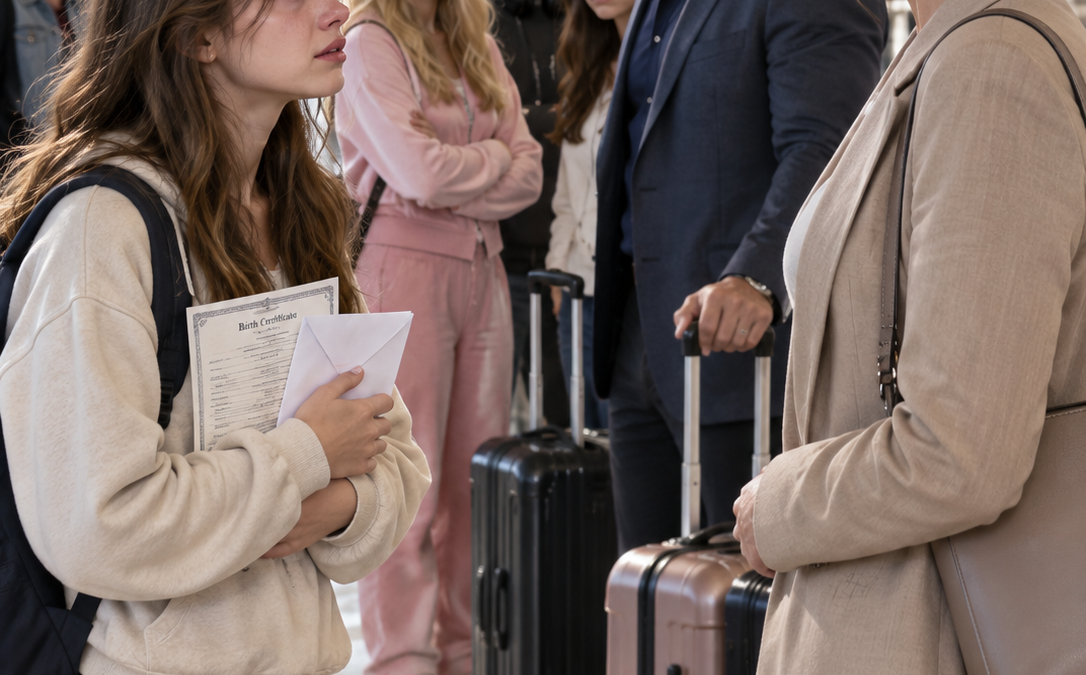
My name is Brin. When I was fifteen, my mother left me at Gate 42 of Los Angeles International Airport, leaving me with only $200 and a birth certificate I had never seen before.
She pulled her suitcase straight toward the boarding gate, where her new husband and his three children were already waiting. I stood there in the middle of a crowd of strangers with one question drilling into my head: How could a mother abandon the child she had once held in her arms every night?
But what turned everything upside down was the name on that birth certificate—and the man my mother had claimed for ten years had disappeared.
Have you ever had a family member hide a truth that completely changed your life? Leave a comment if you’ve ever felt abandoned inside your own family. Hit like and subscribe to join me in uncovering the picture that only looked perfect, and revealing what my mother never wanted me to know.
I grew up with my mom in a tiny two-bedroom apartment on the third floor of an old building on the edge of Anaheim. That place always smelled of burnt toast, and the ceiling fan clicked endlessly, but to me, it was a full world.
Every night, Mom came home late, exhausted, carrying a paper bag with cheap burritos from the corner shop. She would sink into the peeling leather chair in the living room, kick off her shoes, sigh, and ask, “So, what did my girl learn today?”
I would light up, telling her everything from the stars to how a classmate slipped in gym class.
She listened, her tired eyes sometimes glowing as if I were the only candle left burning in a room that had been dark for years. Even when money was tight, she always gave me the last piece of food. And I used to believe that as long as it was just the two of us, everything would be fine.
But no matter how many dinners we shared, there was one thing she never told me about my father.
When I was seven, curiosity pushed me to ask, “Where’s my dad, Mom?”
She didn’t look up. She kept wiping the counter and answered flatly, “He didn’t want to.”
I didn’t press further. But that answer was like a claw carving a wound inside me that never quite healed.
All my life, I had never seen my father. No birthdays, no cards, no phone calls. Just one photo, torn at the corner, hidden in a rusty tin box at the bottom of Mom’s dresser drawer.
In it, I was a toddler sitting on a man’s shoulders. His face had been ripped away, leaving only a shirt collar and an arm holding me tightly.
I peeked at that photo many times in secret. Once, Mom caught me. She snatched it back, shoved it into the box, and said, “Don’t dig up what’s over, Brin.”
Every time I asked, she gave vague replies like, “One day you’ll understand. Not everyone who brings a child into the world wants to be a parent.”
And I believed her—or at least I thought I had to.
I was a good kid, always at the top of my class, never late, always cleaning the dishes after dinner. But as I grew older, the distance between me and my mother widened in ways I couldn’t name.
I wasn’t allowed to go to friends’ houses.
Mom said, “You don’t know who their parents are, or if it’s safe.”
I wasn’t allowed a phone of my own until I was fourteen. And even then, she checked my call log every week. No social media. No private passwords. No weekend camping trips. No sleepovers.
Even when I got selected for a city-level presentation team, Mom refused to let me go because it was “too far,” even though it was barely a twenty-minute drive.
I knew she worried. She had raised me alone, worked herself sick, stayed awake on nights when we didn’t have enough for rent.
But sometimes, I couldn’t help wondering.
Was it really worry?
Or was she afraid someone would find me?
Once, I overheard her on the phone.
“No, I don’t agree to share anything. Tell them I’ve moved.”
Her voice was tense, nothing like the way she spoke to friends. I still remember how she locked her phone and stared at the screen as if it were dangerous.
I wanted to ask, but I knew she’d only answer with a shake of her head and a clipped phrase.
So over time, I learned to stop asking, stop digging, stop searching. I carried those questions silently, like a bruise no one else could see.
Until I was fifteen, I had no idea how much of my life had been quietly suffocated. I only knew how to live obediently, safely, in a way that made Mom feel at ease.
But obedience didn’t protect me from loneliness, or from the strange dreams of a faceless father, or from the feeling that I was someone’s secret.
I didn’t know that the day at Gate 42 would change everything. That from one act of abandonment, I would trace the thread back to the missing part of my life.
And that the man I thought didn’t want me had been searching for me all along.
I still remember the first night Mom brought him home.
She wore a tight black dress, the kind I’d never seen her in, and a heavy new perfume that clung to every corner of our tiny apartment. I sat at the table in my worn public-school uniform, eating instant noodles, when the door opened.
He walked in carrying a bouquet of flowers, smiling like he had just stepped out of a mouthwash commercial.
“Brin,” Mom said brightly, her voice higher than usual. “This is Todd. I told you about him.”
I had never heard his name before, so I nodded politely.
Todd extended a hand. A shiny watch gleamed on his wrist, and his deep voice sounded more like a business deal than a greeting to his girlfriend’s daughter.
“Nice to meet you. I heard you’re really smart.”
I murmured a small yes and glanced at Mom.
She was fixing her hair, her eyes sparkling like a teenager in love.
From that night on, Todd appeared more and more. And each time he did, another piece of my old world was pushed aside.
Mom started coming home later, dressing up more, laughing more—but not with me.
She stopped buying the cheap pizza we used to share every Saturday. Instead, there were cocktail nights at Todd’s house, where I was shoved into his daughter’s room.
Aubrey was sixteen, and she looked at me like I was a stain on her white carpet.
“My dad really knows how to pick,” Aubrey once whispered to her sister as I entered. “Another one to split the inheritance.”
I pretended not to hear.
Todd had three kids: Aubrey, Dylan, and Khloe. All blond, dressed like magazine models, with sharp voices and eyes that always measured me.
They lived in a house so big that I got lost walking from the kitchen to the backyard. The walls were covered with family portraits, none of which had a place for me.
Even when Mom moved in with Todd, dragging me along, I still didn’t have a place. They gave me a small room downstairs, far from Mom’s.
No one asked if I even wanted to move.
“Are you okay?” Mom asked me that first night we slept in Todd’s house.
I nodded.
She stroked my hair, but her hand felt cold.
“As long as you behave,” she said, “everything will be fine.”
I didn’t know what “behave” meant anymore.
Was it keeping quiet when Aubrey scolded me for using the shared bathroom? Was it not complaining when Mom skipped my school awards night to have dinner with Todd’s business partner?
Or was it never asking why I was suddenly banned from the second floor because, as they put it, “That’s family space”?
Mom switched from hand-brewed coffee to machine espresso, from sneakers to high heels, from canvas totes to designer handbags.
And I switched from being her daughter to being a guest.
One night, I watched her stand in front of the mirror for hours—perfume, curls, even fake eyelashes. I lingered at the doorway, uncertain.
“Mom, I think I have a headache. Maybe I can stay home tomorrow.”
Mom looked at me through the mirror. Her heavily made-up eyes narrowed for a few seconds.
“You shouldn’t skip school randomly, Brin. Living in Todd’s house isn’t like before. Everything needs to be in order.”
I bit my lip.
“I just feel a little dizzy.”
Mom turned, placed her hands on my shoulders, and squeezed gently.
“I know you’re not used to it, but this is an opportunity for both of us. Todd has means. He can give you more than I ever dreamed of, but you need to cooperate.”
Cooperate.
I was thirteen.
And from that moment on, I became part of Mom’s strategy to secure her place in Todd’s family.
I didn’t dare cause trouble. I didn’t do anything that would make Mom lose face.
I cleaned the dishes, studied on my own, never asked her for rides, never made noise, never complained.
But no matter how hard I tried, I was still a shadow lost inside that four-story house.
One day, I secretly returned to our old apartment, the place where Mom and I used to live. The door was locked. A new FOR RENT sign hung out front.
I was holding a strawberry popsicle I had just bought, and it tasted like nothing.
I missed the mom who hugged me through movie nights. The mom who made me laugh when I was upset about a B+. The mom who stayed up all night waiting for my fever to break.
That woman was gone.
And I began to understand that in Todd’s house, I had no role. I was only the condition attached to a woman fighting to keep her spot next to a wealthy man.
I started shrinking, speaking less, smiling less.
Every time I walked past Todd’s family portraits, where my face never appeared, I asked myself, Who am I really in my own life?
The first day at my new school, a prestigious private school in a wealthy suburb, it poured rain.
No one took me there.
Mom had left early to go with Todd to a breakfast with the board, as she had said the night before.
I asked, “What about me?”
She waved her hand as if pacifying a child begging for candy.
“The bus stop is just a few blocks away with signs. You’re grown now, Brin.”
My coat soaked through. My cheap canvas shoes grew heavy with water as I was swallowed by the line of Range Rovers, Teslas, and shiny SUVs parked in front of the school.
Groups of students stepped out of cars in crisp clothes, expensive backpacks on their shoulders, perfume drifting faintly through the rain.
I couldn’t tell if it was the cold wind or their stares that made me shiver more.
In class, the teacher introduced me as a transfer student with excellent grades. Polite applause followed, but I saw the eyes of a few girls flick down to my worn-out shoes, my damp hair, and my peeling Android phone on the desk.
They didn’t need to say a word.
I knew I didn’t belong.
That afternoon, back home, I set my bag down in the kitchen to pour some milk. I had just filled half a glass when Todd’s voice came from behind me.
“That’s enough, Brin. You’ve used almost half the carton already.”
I froze, the bottle stiff in my hand.
He didn’t raise his voice, but the way he spoke—light, sharp, and cold—made me feel like an unwelcome guest.
“I’m sorry. I didn’t know,” I stammered.
Todd pulled out his phone and walked away.
Mom was at the top of the stairs. She looked at me, then gave a small smile.
“Everything here is carefully considered. You understand? It’s different now. You can’t just eat whatever you want.”
I said nothing. I just poured the milk back into the carton, then dumped the rest from my glass down the sink.
Moments like that kept repeating.
Another time, I asked Mom for permission to see a movie with the only group of new friends who talked to me.
She looked at me, her eyes never leaving her iPad screen.
“You should focus on studying instead of wasting time. Todd doesn’t like teenage girls hanging around theaters at night.”
I nodded.
But later that evening, I saw Khloe, Todd’s youngest daughter, posting photos from a movie outing with her friends.
Mom’s excuse was, “Khloe’s a good student. She knows how to balance things.”
And me, with straight A’s, was always the one who needed adjusting to fit in.
Some mornings, I woke up early to bake for Mom, knowing she had an important meeting. But before the bread had even cooled, Todd would remark, “The kitchen smells too sweet. That’s not healthy. Hopefully there’s no sugar in that.”
Mom would stuff the bread into her purse and whisper, “Next time, make less. Things work differently in this house.”
I heard that line so often it became etched into my head.
This is a new life.
Try to adapt.
But the more I tried, the more exhausted I became.
One evening, Mom left her laptop open in the kitchen while she went upstairs to take a call.
I only meant to search for a recipe.
Honestly, I just wanted to make something Todd would approve of.
I didn’t touch her emails, but the window was already open. The subject line glared back at me in bold, punching me in the chest:
NON-DISCLOSURE ABOUT PATERNAL CONTACT REQUIRED FOR CONTINUED SUPPORT.
I didn’t understand everything, but the word paternal was clear.
And so was support.
I clicked it open.
It was an email from someone named Camila Moore, the coordinator of transitional financial support for a private trust called the Montgomery Family Foundation.
The message outlined the conditions for continued funding for Susan and her daughter, Brin, including a commitment to no contact with the biological father and no disclosure of his identity to any third party, including Brin herself.
My vision blurred.
I couldn’t tell how many times I read it over.
There was no father’s name. No address.
But there were lines that burned through everything I had ever believed.
We appreciate that you have honored this agreement for the past ten years.
Ten years.
I snapped the laptop shut when I heard Mom’s footsteps on the stairs.
I couldn’t breathe. Couldn’t ask. Couldn’t keep pretending to be the clueless little girl.
That night, I lay awake staring at the ceiling, my heart pounding.
Somewhere out there was a man.
My father.
The man I had been told had walked away.
But if he wanted to return, why had Mom kept quiet?
And why would a foundation named Montgomery have to pay money to keep me in the dark?
I knew something was wrong days before the trip was even mentioned.
At dinner that night, Todd tapped his wineglass against the porcelain plate as if he were giving an award speech.
“We’re going to Europe. A month. Italy, France, Switzerland. Boutique hotels, private cruises, itineraries booked a year ahead. A real vacation.”
The whole table erupted.
Aubrey laughed and clapped. Khloe immediately asked if she could go shopping in Milan. Dylan shot me a sly look before grabbing another piece of lamb.
Mom smiled and raised her glass.
“Our family deserves this trip.”
I looked up, waiting for something.
A glance.
A word.
An acknowledgment.
But no.
They discussed plane seats, luggage, fall coats.
I sat there invisible.
Only when it was Mom and me in the kitchen did I quietly ask, “What about me?”
She turned, still drying glasses.
“This trip isn’t for you, Brin. The destinations are adult-oriented. Lots of moving around. Todd thinks you should stay.”
Todd thinks.
I repeated it so quietly I wasn’t sure she heard.
“This is time for me and Todd’s kids to bond more. You understand, don’t you? You need to learn independence.”
Inside, I started piecing together every doubt I had carried for years.
The glass of milk.
The worn shoes.
The email I shouldn’t have read.
All of it forming into one chilling truth.
I was being pushed out.
Still, I never expected what would happen on departure day.
That morning, Mom knocked on my door early, unusually cheerful.
“Get up. Put something comfortable on. We’re going to the airport.”
I froze.
“I thought you said I wasn’t going.”
She smiled softly.
“I changed the plan. But first, you need to come with me. I have something to ask of you.”
I got dressed, suspended between hope and doubt.
Something wasn’t right, but my heart still clung to a fragile thread of light.
Maybe Mom had changed her mind.
Maybe Todd had agreed.
Maybe this time, I would be seen as part of it.
We arrived at LAX in a rented SUV. Todd and his kids sat up front, chatting away. Mom and I rode in the back, side by side.
Her hand gripped her purse tightly.
At the check-in counter, Todd handed over the passports.
Five of them.
None for me.
I turned to Mom.
“Mom, where’s my passport?”
She pulled me aside, her face tense.
“You won’t be on this trip, Brin. I booked you a ticket to Florida. Aunt Linda’s summer house is there. You used to like it, remember?”
“I thought I was just staying home.”
Mom sighed, her voice soft, like she was coaxing a child throwing a tantrum.
“You need some time to think, to settle yourself. I’ve arranged everything. A month isn’t long. It’ll be good for you in the long run.”
I stepped back.
“I’m not going.”
Mom frowned.
“Don’t make a scene.”
“This is the airport. I’m not going anywhere. I’m not luggage you can drop off and pick up whenever you feel like it.”
She glanced around, then pulled a white envelope from her purse.
“There’s $200 here, a plane ticket, and—”
She took out a folded sheet of paper.
“—a copy of your birth certificate. You might need it at Aunt Linda’s.”
I looked at the paper, my hands trembling.
It wasn’t the first time I’d seen my birth certificate, but it was the first time Mom had handed it to me like baggage.
“Why do you have a copy? Why bring it to the airport? You planned to leave me from the start, didn’t you?”
She shoved the envelope into my hand, then placed her hand on my shoulder, squeezing gently.
“You’re a smart girl. You’ll manage. I know you’re strong.”
Then she turned her back and walked quickly toward the security gate, where Todd and his kids were waiting.
I stood there surrounded by streams of travelers, loud announcements, and blinking flight boards.
The one person who had once protected me—Mom—had now chosen to let go.
I sank into a plastic chair near Gate 42, the white envelope trembling in my hands. The cold from the tile seeped through my jeans. People rushed past like shadows, hurried and invisible.
I unfolded the birth certificate again.
One name now burned brighter than any other line.
Father’s name: Elias Montgomery.
My heart pounded so hard it blurred my vision.
I had heard that name before.
Not from Mom.
On the internet. On TV. On billboards at airports.
Montgomery Media Group, a major West Coast media empire that owned news channels, digital platforms, and dozens of radio stations.
No.
It couldn’t be him.
I rummaged through the envelope.
Alongside the certificate was a smaller scrap of paper, scribbled by hand with an emergency contact number.
I had never seen it before. I didn’t know why Mom had written it down, or whether she had ever meant to use it—or destroy it after dropping off the package.
My finger hovered over the digits.
Half of me wanted to throw it away.
The other half screamed inside me.
If not now, when?
I pressed call.
The line rang once.
Twice.
I was about to hang up when a woman’s voice answered, professional, steady, surprisingly calm.
“Office of Elias Montgomery. This is Dana. How may I help you?”
My throat locked. It took me several moments to speak.
“I am Brin. Elias might be my father.”
Silence for a few seconds.
Then Dana’s voice softened, still clear, like someone used to handling emergencies.
“Where are you, Brin?”
“LAX. Gate 42.”
“Are you safe?”
I looked around.
“I… I don’t know.”
Dana drew in a quiet breath on the line.
“Stay right there. Don’t move. He’s coming within the hour.”
“You mean he…?”
Her voice no longer sounded like a secretary’s. It sounded like someone who already knew this story and had been waiting for the ending.
“He’s been searching for you for nearly ten years.”
I lowered the phone onto my lap.
I waited.
One hour felt like an entire winter.
By the time the loudspeaker called my name for the third time, an airport officer escorted me through side passages to the private arrival zone.
There, under a sky shifting colors, a silver-white jet with an encircled M emblem descended.
No crowds.
No noise.
Only wind and my own racing heartbeat.
The plane door opened.
A man stepped out.
Tall and lean, in a white shirt and a gray overcoat. His salt-and-pepper hair was neatly cut. Sunset traced the edges of his face like a painting, so familiar that I couldn’t breathe.
I didn’t know whether to step forward or stay frozen.
He, too, paused, studying me.
Not shocked.
Not doubtful.
But as if he had finally found what he had lost.
“Brin.”
I nodded, my eyes stinging.
He walked closer, not too fast, not pressing in. He lifted his hand and rested it on my shoulder, as if waiting for permission.
His palm was warm—a hand I didn’t remember ever touching me, yet it felt like breath returning to my lungs.
“I don’t know where to begin,” he said, his voice low. “Except… I’m sorry.”
A hundred questions surged inside me, ready to burst.
Why?
Where were you?
Why not sooner?
But all I managed was one.
“Is it true you’ve been the one searching for me?”
His eyes reddened.
Not from the wind.
“Not a day I didn’t search. Not a year I didn’t send letters, gifts, files to the old address. All returned.”
I broke.
Tears streamed down my face, unstoppable, like a river long dammed.
He gently took the small suitcase from my hand.
“Come home with me. You have time. I’ll tell you everything.”
I never thought I’d set foot in Seattle, a city I’d only pictured with rain, chill winds, and steel bridges.
But as Elias’s car carried me from the airport along a lake reflecting the fading light, I didn’t feel afraid.
I felt calm.
He stayed beside me, silent for most of the ride. Now and then, he glanced at me in the mirror with a look I had never seen in anyone in fifteen years.
The look of someone who had lost the most precious thing in his life and was trying to give it space to return.
Perched on a hillside, his home faced the water.
Not too big, but designed to be lived in, not shown off. Dark wood. Wide glass doors. Trees all around.
“We won’t talk seriously tonight,” Elias said as he opened the door. “You need time to rest, to eat, to breathe. Those matter more than answers right now.”
I still wasn’t used to him calling me daughter.
But when he opened the room at the end of the upstairs hall, I couldn’t stop myself from stepping inside.
“This is your room,” he said, his voice low but gentle, as if he were afraid to break something fragile in the air. “Since you were five.”
The room felt frozen in time.
The walls were painted pale blue. The curtains were patterned with clouds. A small bed stood beneath a faded teddy-bear quilt.
On the wall by the window hung a wooden frame.
Inside was a crayon drawing: a man with dark hair holding the hand of a tiny girl.
At the bottom, in clumsy childish letters, were the words:
ME AND DAD WATCHING WHALES.
My knees buckled.
“I… I drew this when I was five.”
I barely recognized my own shaking voice.
Elias stayed behind me.
“Yes. Back then, you loved whales so much you begged to go to the pier every weekend.”
I didn’t remember.
Or rather, I no longer dared to believe those memories had ever been mine.
I reached out and touched the glass as if I were touching an old, forgotten version of myself.
“After your mom took you away, I tried to reach out. Calls, letters, gifts, emails, everything,” Elias said, his voice steady, not bitter. “At first she answered. Then she blocked me. Then she hired lawyers to erase my name from every record connected to you. Even your school barred me from contact.”
I turned back.
“You didn’t give up?”
“No. I didn’t know if you would still remember me. But I knew one thing. If you ever tried to find me one day, I would not have disappeared.”
He walked to the small bookshelf by the desk.
Each shelf held a box of letters labeled by year.
All the way to now.
I opened the box marked 2017.
Inside were dozens of envelopes, some with cartoon stamps, some as big as gift boxes, all addressed to me in neat, familiar handwriting—as if I had seen it every day, though I never had.
“They never reached me,” I whispered, my lips so dry the words barely came out.
“I know.” Elias sighed. “When everything was returned, I kept them. One day, I needed you to see that I didn’t want you to think your dad forgot.”
I pulled out a pale purple envelope, its seal half torn.
Inside was a birthday card. The cover showed a whale wearing a party hat.
Inside, it read:
Happy 10th, Brin. I hope today you blow out candles loud, eat plenty of cake, and wish for beautiful things. I’m always here, even if you don’t see me.
At the bottom was a clean signature.
Dad, Elias.
I set the card down and walked to a small cabinet near the bed.
Inside was a box of old crayons. On its lid was a note:
Brin’s first art set.
I laughed through my tears.
“I used these to draw a three-legged dinosaur.”
Elias smiled.
“I still have that page framed in my office.”
His voice stayed calm.
No bitterness.
Only regret.
Regret lined with unconditional love.
“I don’t understand. Why did Mom do that? Why erase you completely from my life?”
Elias didn’t answer right away. His eyes went distant.
“Maybe because I hadn’t succeeded at the right time. When she needed stability, I was still just a man with nothing but ideas. And then… then I succeeded. And by then, coming back wasn’t easy anymore. I think instead of explaining, she chose to erase.”
I don’t know how long I sat in that room.
A room left empty for ten years, but still holding warmth that had never left.
Every corner, every detail proved I had never been forgotten.
Only that someone had deliberately cut the thread between me and the truth.
The next morning, Elias knocked softly on my door.
Outside, Seattle was still misty, like it had woken from a damp dream.
“Still sleepy?” he asked gently. “There’s someone I want you to meet.”
I shook my head, pulled the thin blanket aside, and got out of bed.
An hour later, I was sitting inside a wood-paneled office. It was simple yet professional, with brown leather chairs, warm golden light, and closed file cabinets.
Across from me sat a woman in a deep-blue coat, her silver hair tied neatly back, her eyes sharp but not cold.
“I’m Miriam Roth,” she said, extending her hand. “Your father’s personal attorney, and possibly your legal ally in the months ahead, if you allow it.”
I hesitated, then shook her hand.
Miriam wasn’t like the lawyers I’d imagined. No flowery language. No excessive sternness. Just someone who knew exactly where she stood and what she was doing.
“I’ve reviewed the files,” she said, opening a leather folder. “And I need to ask you a few things before we proceed. All confidential. Nothing to worry about. Do you remember clearly when your mother left Elias?”
“I was little, but I remember she said we had to move because my dad wasn’t stable enough. I only brought a teddy bear and a backpack.”
“Did you ever hear your mom say anything about not allowing Elias to see you?”
Slowly, I said, “She always told me he didn’t want me anymore. That he had another family, other children, and had forgotten me.”
Miriam jotted notes quickly, then asked, “Did you ever receive letters, gifts, or calls from Elias in the past ten years?”
I shook my head.
“Not once.”
She nodded as if confirming what she expected, then placed a thin file on the table, pulled from her case.
“Brin, there’s something you need to know. We investigated irregular payments in Todd’s accounts, the man your mother now lives with. One of them came from a finance firm linked to Montgomery Media Group about eight years ago.”
I frowned.
“You mean from Elias?”
“Not directly, but very close. That money was transferred as a business grant to a company Todd registered after marrying your mother. Attached to it was an informal agreement signed by Susan, your mother.”
She paused, sliding the file toward me.
“I’m sorry, but you need to see this.”
I took it.
Inside was a scanned copy of a handwritten agreement, clearly signed by Susan.
The content was brief but unmistakable.
In exchange for startup funding for her partner, Party A, Susan agreed not to maintain or reestablish any contact between her daughter, Brin, and the biological father, Elias Montgomery.
I didn’t realize I was gripping the page so hard until my knuckles turned white.
“You mean my mother sold my silence for Todd’s money?”
Miriam didn’t answer.
Elias took the chair beside me, never interrupting.
He let me absorb each piece of truth as if he knew I needed space to face it myself.
I took a deep breath, then said softly, “What do you think I can do?”
“Legally, you can restore custodial rights. Request the court to review all prior records. Even though you’re nearly sixteen, in cases of fraud, coercion, or interference with access to a lawful parent, the court still allows reassessment.”
I clenched my hands.
“I want to do it.”
“Then we’ll start immediately. But there’s one more matter.”
She pulled out another folder.
“I’ll represent you in filing a financial claim regarding the support Elias sent but you never received, and the misused grant funds. This isn’t about retaliation. It’s about creating a clear record and, more importantly, protecting you going forward.”
Elias finally spoke, his voice steady and low.
“I don’t want you to fight your mother as if she were the enemy. But the truth is still the truth, and you deserve to know and decide.”
I looked at him, then at Miriam.
“I’ll sign.”
When the pen touched the first page, I felt my hand tremble slightly.
But for the first time in years, I wasn’t afraid.
My mother appeared at the doorway of Elias’s law office in a faded floral dress, looking like she had walked out of a high-school parent meeting.
Plain, a little unkempt, but her eyes were cold and calculating.
Todd followed behind her, his shirt buttoned to the top, leather shoes polished, his face trying to stay calm even as his jaw twitched.
I settled into the chair at the head of the table, Elias and Miriam Roth beside me.
Mom glanced at me, then slid her gaze past my father as if he were a stranger before saying coldly, “You’re being fooled, Brin. He only wants to use you to polish his public image. Rich men always have a reason to suddenly find their daughters.”
I didn’t answer right away.
Slowly, I pulled out a folder I had prepared, placed it on the table, and nudged it toward them.
“This is a bank statement from 2013. Recipient: Todd Allison. Amount: $380,000. Note: Corporate restructuring costs for family business.”
I paused.
My mother blinked but tried to keep her face steady.
“And here is a recording of a phone call from March 12th of that year.”
Todd said, “You only need to keep the girl quiet. In return, my company won’t run out of funding anymore.”
“That’s his voice. You don’t need audio forensics to recognize it.”
Todd’s face flushed red, then drained white.
My mother shrank back in her chair, her hands trembling.
She whispered, “I tried. I had no choice.”
“You didn’t abandon me once, Mom.
“You abandoned me every time you kept quiet while they treated me like an outsider. Every time you saw me pushed away from the table. Every time Todd called me extra baggage and you turned away. Every time I waited in the dark for you to come home and you chose to stay with someone else.
“I’m not eight years old anymore, blaming myself for bothering the adults. I’ve learned to read silence, and you never spoke up for me.”
My mother broke into tears, but no one reached over to wipe them away.
Todd lowered his head, eyes averted, knowing it was far too late.
Elias finally placed his hand gently on my shoulder.
A wordless touch.
Steady, as if to say, I’m here.
I drew a deep breath—not to calm myself, but to mark the moment.
I no longer needed to prove anything to anyone.
The truth was enough.
Mom bowed her head, covering her face.
I didn’t hate them.
But I would no longer trap myself inside their false pity. No longer let them define my existence.
I wouldn’t close my eyes to pain.
But I chose to open them and walk toward the light, even if I had to do it alone.
And this time, I wasn’t alone.
Elias’s hand still rested on my shoulder like a door that had opened late, but steadily.
I don’t remember exactly where I began again.
Maybe it was the sunlit third-floor apartment.
Or maybe it was the morning I signed up for classes at the community college near Green Lake, where it took me nearly ten minutes to write my name on the form because my hands shook so badly.
Maybe both.
Seattle offered a different rhythm.
Not as frantic as New York, not as cold as Chicago.
Here, I could walk through a park with a camera in my hand and not feel like a stranger.
Here, I didn’t need anyone to know who I was in order to feel that I existed.
I chose to study psychology.
It might sound vague, but I didn’t plan to become a counselor or therapist.
I just wanted to understand.
To understand why people we call family can hurt each other so easily.
To understand why some kids are left at airports and no one thinks it’s serious.
And above all, to understand myself.
Alongside the theory classes, I enrolled in a basic photography course.
At first, it was just to pass the time. But then I realized that waiting for the right light, catching that moment when someone laughs for real—it was like the journey of finding myself again.
You can’t rush it.
You can’t force it.
You have to let it happen.
I started carrying my camera everywhere.
Sometimes I quietly snapped a corner of a café, or the sunlight rolling over an old woman’s shoulder as she read the paper in the park.
I never aimed to become a professional photographer.
I only wanted to hold on to the moments no one could ever take from me.
One autumn evening, as leaves covered the sidewalks and the wind off the lake grew sharper, I opened a personal blog.
I named it From Gate 42.
Gate 42 was where I had been left at twelve.
But I didn’t name it to reopen a wound.
I named it because I wanted to write about what came after.
Because a gate isn’t only for departures.
It can also be a beginning.
My first post was short, just a few hundred words.
I wrote about my first morning in Seattle, the toast I burned, and the jazz drifting from a neighbor’s radio.
But at the end, I wrote:
“Being abandoned doesn’t define who you are. It’s only the beginning of choosing your true family.”
I didn’t know who would read it.
But the act of writing—the sound of the keys clicking like footsteps on an unnamed road—was enough to let me breathe easier.
Elias sometimes picked me up after class.
He didn’t ask much. He only smiled when I told him I got an A on my first essay.
He didn’t argue when I said I wanted to pay tuition myself with scholarships and part-time work.
“It’s up to you,” he said. “As long as you know you’re doing it for yourself.”
I also visited Miriam once a month, bringing a few printed photographs: a bridge in the morning fog, the silhouette of a mother and child holding hands in the rain, a coffee cup with a faint lipstick mark on the rim.
She studied each one closely, then said, “You don’t just shoot with your eyes. You shoot with memory.”
I smiled, but I didn’t deny it.
Because it was true.
So that’s how I stepped out from the memory of Gate 42 and into a life I chose for myself.
Not through dramatic revenge or endless accusations, but through each day lived honestly, each boundary reset, each moment I dared to believe I was worthy of a decent family—even if it didn’t begin with blood.
I don’t tell this story to blame anyone.
I tell it to remind myself, and maybe to remind someone listening, that sometimes salvation doesn’t come from others’ forgiveness.
Sometimes it comes from stopping the punishment of yourself.
What about you?
Have you ever felt left behind? Have you ever chosen a family of your own through a friend, a stranger, or even yourself?
I’d love to hear your story. Leave a comment below and tell me what you think.
And if you recognize a piece of yourself in this story, don’t forget to follow the channel, because there are so many more journeys of courage, choice, and the ways we rise again from the ruins.
Family stories don’t always start beautifully.
But if we’re brave enough, we can rewrite the ending.
Softer.
Truer.
Freer.








