After the divorce, my wife threw me and the kids out without a cent on Christmas eve; with tears, i went to use the old card my father had left me, but the banker turned pale and shouted: “sir, quickly, look at this!”; i was in shock when i discovered that…
My name is Nolan Ashford. I’m thirty-five years old.
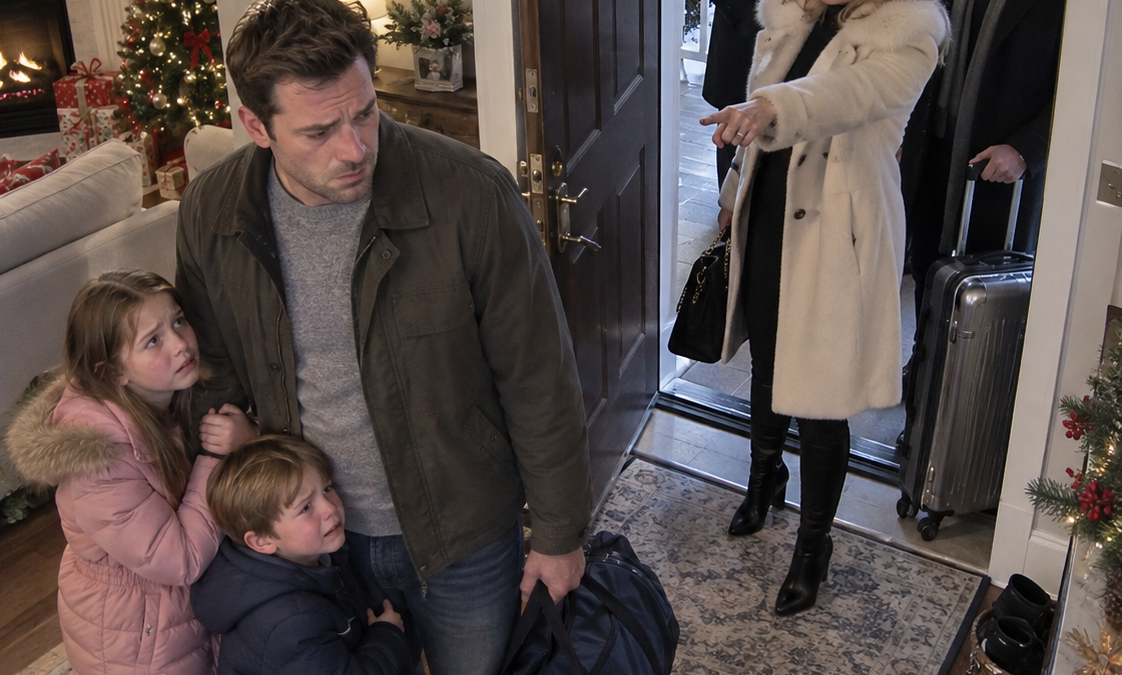
Exactly one year ago, on Christmas Eve, my ex-wife threw me and our two young children out into the freezing snow, leaving us with absolutely nothing. I was on my knees on the hardwood floor, begging her to give us just one more night so my children could wake up in their own beds on Christmas morning.
Her parents stood in the driveway that night and told me, “You should have thought about that before you wasted fifteen years being a useless stay-at-home loser.”
They laughed at me in front of the moving crew and her new twenty-six-year-old boyfriend, who was already carrying his expensive luggage into the home I had maintained for a decade. But there was one thing they didn’t know. They had no idea about the worn, faded piece of plastic sitting at the very bottom of my wallet, left to me by my late father.
And right now, as I sit here telling you this story, they are the ones facing federal charges, complete and utter bankruptcy, and begging for a mercy they never showed me.
Before I tell you exactly what happened and how the truth came to light, hit the like button if you believe in absolute justice. And let me know where you’re watching from in the comments below.
Right now, Vanessa is somewhere inside a federal facility, marking days off a calendar. Her parents are living in a rented condo a fraction of the size of the walk-in closet where they used to store their winter coats. And Bryce, wherever he ended up, has almost certainly never told a single person the real reason he left three suitcases and a set of car keys behind on a driveway in the middle of a Chicago winter.
I don’t share any of that to gloat, exactly, though I won’t pretend there isn’t some satisfaction buried in it. I share it because I want you to understand, before this story even really gets going, that the version of me who begged on a hardwood floor for one more night in that house no longer exists. And neither does the family who thought they could throw him away for free.
Now, let me take you back to where this nightmare reached its breaking point.
I stood at the bank counter, unable to stop my hands from shaking. The chill of the polished marble floor seeped through the thin soles of my worn-out shoes. My nine-year-old daughter, Ellie, gripped my left hand so tightly that her small knuckles had gone completely white. My six-year-old son, Leo, had his little arms wrapped fiercely around my right leg, his face buried deep in my winter coat because he simply couldn’t stop crying.
The heavy wall clock above the tellers read exactly 7:45 p.m. Most families in America were home by then, carving their holiday hams, drinking hot cocoa by the fireplace, and placing perfectly wrapped presents beneath glowing Christmas trees. Not us. We were standing in a nearly empty bank lobby, minutes from closing time, with absolutely nowhere to go.
We didn’t have a car anymore. The only vehicle in my name had been the minivan, which Vanessa’s lawyer had somehow argued was a marital asset she needed more than I did. So the three of us had walked eleven blocks to the nearest bank branch through ankle-deep snow. Leo had eventually become too exhausted to keep moving on his own, so I’d carried him the last four blocks, my arm going numb beneath his weight while Ellie’s small, cold hand remained clamped in mine.
I remember passing a house with a lighted Nativity scene in the front yard, its plastic figures glowing softly against the snow. Ellie had asked in a small voice whether we were going to have Christmas at all that year, and I’d told her yes, absolutely yes, with a confidence I did not remotely feel. Some instinct told me that whatever came next, the one thing I still had control over was whether my children heard fear in my voice or steadiness. And I was determined, whatever it cost me, to give them steadiness.
I dug frantically through my wallet, praying for a miracle I knew didn’t exist. I had exactly twelve dollars in cash. Twelve dollars to my entire name. My ex-wife, Vanessa, had meticulously made sure of that during our brutal divorce settlement six months earlier.
Just two hours ago, I’d had a roof over my head, a house where my children’s stockings hung by the chimney and the scent of pine needles filled the living room. But Vanessa had shown up with her new lover, Bryce, and demanded that we leave immediately, claiming a vicious legal loophole in our real estate agreement.
My chest tightened so hard I could barely draw a breath. How was I going to feed my children that night? Where were we going to sleep? The local shelters were full, and the temperature outside was dropping below freezing. Every safety net I thought I had was completely gone.
I looked down at Ellie. She looked up at me with big, terrified brown eyes. She didn’t ask any questions. She simply trusted me to fix everything, completely and without hesitation. That broke my heart more than anything else that entire freezing night.
A father is supposed to be the wall standing between his children and the harsh realities of the world. But Vanessa had dismantled my wall brick by brick, leaving me completely exposed and powerless.
As I rummaged through the worn leather folds of my wallet, my fingers brushed against something hard in a hidden back slot. I pulled it out. It was an old, faded debit card, the plastic peeling slightly at the edges, its magnetic strip scuffed from years of sitting unused.
My father, Emmett, had given me that card six years earlier, shortly before he passed away from a sudden and aggressive heart condition. I remember that afternoon in his hospital room vividly: the sterile smell of bleach and medicine hanging heavy in the air, the machines beeping in a steady, agonizing rhythm, counting down the last moments of a good man’s life.
He’d been a retired accountant, a man who lived modestly, saved aggressively, and never flaunted a dime. He reached into his bedside drawer with a trembling hand, pulled out the card, and pressed it firmly into my palm. His grip was surprisingly strong for a dying man. His voice was raspy, but his eyes were sharper than a razor.
“Nolan,” he’d said, staring directly into my eyes. “Do not use this card unless you absolutely have to. Only swipe it when you have nothing left. Do you understand me? When you have absolutely nothing left.”
I’d asked him what it was, wondering whether it might be a secret college fund for the children or some small emergency stash he’d kept hidden from the government. He had only shaken his head slightly, closed his eyes, and whispered into the quiet room.
“You will know when the time comes. Keep it safe. Keep it hidden from her.”
He died exactly three weeks later. The funeral was a blur of black suits and empty condolences, and through it all, Vanessa complained about the cost of the casket and how the memorial service was interfering with her busy schedule.
I never used the card. Between the funeral arrangements, the overwhelming grief, and my desperate attempts to keep my fractured marriage afloat, I’d completely forgotten about it. I assumed it was connected to an old account containing maybe a few thousand dollars, something meant to cover emergency repairs or a rainy day.
But standing there now, homeless on Christmas Eve, with two freezing, sobbing children clinging to my legs, I figured this officially qualified as having nothing left. It was my final lifeline, the absolute bottom of the barrel.
I took a deep breath, trying to steady my racing heart, and stepped up to the counter, wiping a stray tear from my cheek. I had to be strong. I had to find a way to get us through that night, even if it meant swallowing the last ounce of my shattered pride.
The banker behind the thick pane of security glass was an older gentleman whose gold name tag read Mr. Hutchkins. He had kind, tired eyes behind thick spectacles and was already beginning to shut down his computer terminal for the holiday, probably looking forward to going home to his own family.
“Excuse me,” I said, my voice cracking despite my best efforts to sound strong and composed. “I need to check the balance on this card, or see if it even works anymore. It’s been inactive for years.”
I slid the card across the counter, my hand trembling so violently that the plastic clattered against the glass partition.
Mr. Hutchkins offered a warm, sympathetic smile, clearly seeing the desperation radiating from me. He picked up the card and examined it, turning it over as his brow furrowed slightly at the vintage bank logo, one that hadn’t been used in more than a decade.
“Let me take a look, sir. Just give me one moment.”
He swiped the card through his terminal, and I held my breath, silently praying for just enough money to cover a cheap motel room and some fast food. A hundred dollars, fifty dollars, anything that would get my children out of the biting wind.
Mr. Hutchkins stared at his screen. His fingers, which had been resting casually on the keyboard, suddenly froze in midair. He leaned closer to the monitor, the blue light reflecting off his thick glasses, and began typing a rapid sequence of commands, his eyes darting across the display.
Then he stopped completely.
I watched the color drain from his face, as if someone had pulled a hidden plug and emptied every ounce of blood from his head.
“Is… is there a problem?” I asked, my stomach dropping. “Is the account closed or empty? Please, sir, just tell me.”
Mr. Hutchkins didn’t answer right away. He looked up at me, his eyes wide with a mixture of profound shock and sheer panic. Then he glanced nervously around the lobby, making sure the armed security guard by the door and the one remaining teller across the room were safely out of earshot.
“Sir,” he whispered urgently, his voice tight and strained, “I need you to come with me right now. Please bring your children and step into my private office immediately.”
“What’s wrong?” I asked, pulling Ellie closer as every protective instinct in my body flared. “What did you find? Is it stolen?”
“Please, sir, trust me. You need to see this. We absolutely cannot discuss it out here.”
He hurried out from behind the teller station, bypassed the security gate, and ushered us down a softly carpeted hallway toward a heavy oak door marked Branch Manager.
My mind raced. Was the card flagged? Had my father been involved in something illegal? As I followed him into his office and heard the heavy door click shut behind us, I couldn’t help wondering how my life had spiraled into this exact, terrifying moment.
I’d thought the worst was over when Vanessa threw me out.
I was so incredibly wrong.
To truly understand the absolute destruction of my life, you have to understand exactly how it was built.
Fifteen years ago, I was twenty years old, a top-tier architecture student at a prestigious university. I had a full academic scholarship, a portfolio stuffed with modern residential designs, and a clear path toward joining a major architectural firm in the city.
That was the year I met Vanessa.
She was twenty-one, a business major with a fierce, blinding ambition I foolishly mistook for passion. We met at a university networking mixer. I was the quiet guy sketching structural columns in the corner. She was the magnetic force commanding the center of the room.
She walked right up to me, studied my drawings with sharp, calculating eyes, and said, “You’re going to build empires one day, and I’m going to sell them.”
It was utterly intoxicating. No one had ever believed in me like that.
We fell in love fast and hard, marrying two years later, right out of college, in a small ceremony her wealthy parents, Preston and Cordelia, refused to pay for because they thought I was beneath her.
Our wedding day itself should have told me everything I needed to know. In hindsight, the signs were obvious, though at the time I interpreted them as nothing more than young love overcoming obstacles. Preston and Cordelia refused not only to pay for the ceremony but even to attend the rehearsal dinner. They sent word through Vanessa that they had a prior country club commitment they couldn’t reschedule. A commitment that turned out, as we learned much later through a mutual friend, to be nothing more than a Saturday golf game.
Vanessa cried about it for exactly one night. The next morning, she set her jaw and told me we didn’t need them, that we were going to build something bigger than anything her parents could ever buy into.
I believed her completely.
I stood at the altar of a small chapel we’d rented for a few hundred dollars, looking at a woman who seemed, in that particular moment, genuinely unbothered by her own family’s cruelty. I mistook that resilience for strength rather than recognizing it, as I eventually would, as the same cold, transactional detachment she’d absorbed while growing up in that house, now aimed for the very first time in my direction instead of theirs.
Vanessa landed a junior position at a massive commercial real estate brokerage, while I was interning at a respected local architecture firm, steadily working my way up the ladder.
Then the first major curveball hit.
Vanessa received a massive promotion, one requiring constant travel, late-night client entertainment, and eighty-hour workweeks, at almost exactly the same time we discovered she was pregnant with Ellie.
She sat me down at our small, scratched kitchen table one rainy Tuesday night.
“One of us has to step back,” she said, her tone entirely rational and devoid of warmth. “My earning potential right now is astronomical. We can’t afford a high-end nanny, and my parents certainly won’t help us raise a child. If you take a few years off to raise the baby, I can build our wealth and secure our future. Once we have millions in the bank, you can go back to architecture and start your own firm.”
I loved her deeply. I wanted our child to have a parent at home, to experience the presence I had never fully enjoyed growing up.
The day I actually packed my drafting tools into a cardboard box in the attic is a memory I’ve never fully shared with anyone, not even Vanessa. By the time I would have needed to explain how it felt, she’d already stopped asking.
I had a real offer on the table that spring, a junior position at a respected firm downtown specializing in sustainable residential design. It was exactly the kind of work I’d built my entire senior thesis around.
I remember sitting in our car in the firm’s parking lot on the morning of my final interview, watching other young architects walk inside with portfolios tucked under their arms. I called to cancel because Vanessa’s promotion announcement had come through that same week, and someone needed to be the one who stayed flexible.
I told myself it was temporary, a two- or three-year pause at most, the kind of sacrifice couples make for each other all the time. I didn’t know yet that a pause without a return date eventually becomes the whole story, and that nobody was going to hand me back the version of myself I’d folded up and put away in that box.
I stored my expensive drafting tools in the attic and became a stay-at-home dad, trading complex structural blueprints for baby bottles and diaper changes, high-stakes client meetings for pediatrician appointments and playdates.
I truly believed we were a team, sacrificing equally to build a beautiful life together.
I didn’t realize I was just building her throne.
The years slipped by in a blur of domestic routine. Vanessa’s career exploded beyond our wildest expectations. We moved into a sprawling, custom-built house in an exclusive gated community. She drove a luxury SUV that cost more than most people made in five years. I drove a practical, dented minivan to haul groceries and soccer gear.
When Leo was born three years later, my temporary hiatus became permanent. I managed the massive household, cooked every meal from scratch, handled the landscaping, meticulously balanced the household budget, ran the school carpools, and organized the homeowners association meetings.
I was working from dawn to midnight, but because I wasn’t bringing home a corporate paycheck, my value in her eyes began to evaporate completely.
The shift in her demeanor was gradual at first, then violently sudden. The sweet, ambitious woman I’d married turned cold, calculating, and exceptionally cruel, making offhand comments about my clothes, my hobbies, and my complete lack of corporate ambition.
Our tenth wedding anniversary fell on a Tuesday. I’d spent two weeks planning a small dinner at home after the children were in bed, cooking the exact meal we’d eaten on our first date, a detail I was fairly certain Vanessa herself had forgotten.
She texted me at six that evening, saying a client dinner had run long and she wouldn’t be home until close to midnight. When she finally walked in, still smelling faintly of a restaurant I didn’t recognize, she glanced at the two plates of cold food sitting on the table. All she said was that she’d assumed I would have eaten without her. Then she went straight upstairs to bed.
I sat alone at that table for a long time afterward, the candles burning down to stubs, doing the quiet, humiliating math of exactly how many moments like that I’d absorbed without comment over the years. I came up with a number too large to say aloud to anyone, including myself.
But the real, soul-crushing torture came from her parents, Preston and Cordelia.
They had never liked me, but once Vanessa became the sole breadwinner, they stopped hiding their contempt. They viewed me as nothing more than the hired help sleeping in their daughter’s bed.
During one particularly excruciating Thanksgiving dinner, surrounded by their wealthy, elite friends, Preston tapped his crystal wineglass with a silver fork to get everyone’s attention. He looked at me with absolute disdain and loudly asked, “So, Nolan, still playing house? Have you thought about getting a real job yet? Or is living off my daughter’s salary your long-term retirement plan? I suppose mopping floors is easier than working for a living.”
The entire dining room fell silent.
I looked at Vanessa, desperately waiting for her to defend her husband, the father of her children.
She didn’t.
She simply sipped her expensive red wine, offered a tight little smile, and let the humiliation wash over me. My face burned with shame, but I swallowed my pride for the sake of the children sitting quietly at the nearby kids’ table.
That Thanksgiving wasn’t an isolated incident. It was merely the loudest one.
A few months earlier, I’d been dragged to a country club brunch for one of Cordelia’s charity fundraisers. A woman I’d never met asked me, with genuine curiosity rather than malice, what I did for work. Before I could even answer, Cordelia laughed lightly and answered for me.
“Oh, Nolan keeps himself busy around the house,” she said, patting my arm the way someone might pat a well-behaved dog.
The woman’s polite smile flickered into something closer to pity before she excused herself to refill her mimosa.
I drove home that day replaying the exact tone of that sentence. Keeps himself busy. As though raising two children and running an entire household were some hobby I’d taken up to pass the time rather than a full-time job nobody else in that family was willing to do.
Vanessa, sitting beside me in the car, didn’t say a word in my defense that day either. She scrolled through emails on her phone for the entire ride home. I remember understanding, with a kind of quiet dread I wasn’t yet ready to name, that her silence in those moments was never an accident.
There was a particular parent-teacher conference for Ellie’s second-grade class that I still think about more than almost any other afternoon from that decade.
Her teacher had specifically requested that both parents attend because Ellie had been struggling with reading comprehension. I’d rearranged an entire week of appointments and carpools to make sure I was free, only for Vanessa to text me twenty minutes beforehand, saying a client call had run over and I should go without her and fill her in later.
I sat alone in that tiny elementary school chair, built for someone a third my size, listening to the teacher gently explain a learning plan. I nodded and took notes for two, then drove home afterward with the distinct, hollow feeling of having just performed an entire marriage by myself in a room with no audience.
When I recapped the meeting for Vanessa that night, she listened for about ninety seconds before pivoting to a story about her own day.
I remember standing in the kitchen doorway watching her talk, understanding with a clarity I wasn’t ready to act on that I had somehow become the only person in that house still showing up for the marriage we supposedly shared.
I had become a homemaker, the manager of a luxurious glass cage where I had absolutely no power. No retirement account, no savings in my name, no college fund for the children that I controlled, and no voice.
I was entirely dependent on a woman who despised me.
What almost nobody in that house ever knew, not even Vanessa in the later years, was that I never actually stopped designing.
I kept a small sketchbook in the linen closet, hidden behind the spare towels. On nights when the children were finally asleep and the house had gone quiet, I’d sit at the kitchen table for twenty or thirty stolen minutes, drawing floor plans for houses that would never get built, additions to buildings that didn’t exist, and structural solutions to problems no client had ever presented to me.
It wasn’t productive in any measurable sense, and I never mentioned it to anyone. Some part of me understood, correctly, that Vanessa would have found a way to frame it as evidence of exactly the sort of unfocused hobbyism her parents already accused me of.
Looking back at those sketchbooks now, dozens of them stacked in a box in my new office closet, I can see clearly that I was never actually the man who’d given up architecture. I was simply a man who’d been forced to practice it in secret, in thirty-minute increments, for fifteen years, waiting for a version of his life where he wouldn’t have to hide the one thing that still felt entirely, unmistakably his.
Six months ago, the glass cage finally shattered.
Vanessa came home on a Tuesday evening, threw a thick, intimidating manila envelope onto the marble kitchen island, and coldly announced that she was filing for divorce.
There was no discussion, no suggestion of couples counseling, just a calculated precision strike against my life.
When we finally got to court, I was completely blindsided by the sheer malice of her strategy. Her lawyer, Damon Reyes, was a slick, aggressive bulldog of an attorney who wore thousand-dollar suits and had a reputation for destroying lives. He presented stacks of complex financial documents that made absolutely no sense to me or my cheap, court-appointed attorney.
Vanessa claimed her real estate business had taken a massive, catastrophic hit because of market fluctuations. She presented ledgers suggesting she was practically drowning in corporate debt and barely keeping the lights on.
The judge, a stern man who clearly favored the breadwinner, looked at me, a man with a fifteen-year gap in his professional résumé, and showed zero mercy.
“Mr. Ashford,” Damon Reyes had argued in court, his voice dripping with condescension as he paced the floor, “you have contributed absolutely nothing to the financial growth of this marital estate. You’ve been a dependent, a financial anchor, dragging my client down for fifteen years. You have no salary, no investments, and no marketable skills.”
The court awarded Vanessa the primary business assets because she supposedly needed them to recover from her massive debts. I was denied alimony because Reyes successfully argued that my lack of employment was a personal choice, not a marital sacrifice. I received a pathetic, minimal cash settlement that wouldn’t cover a year of rent, and we were awarded joint custody.
Crucially, Vanessa retained full ownership of our primary residence. The only tiny concession the judge made was allowing me to stay in the guest room until January, giving me a few months to find a minimum-wage job and a cheap apartment.
I walked out of that courtroom a completely broken man, stripped of my dignity, my assets, and my future.
My own attorney, a tired, overworked man named Gerald who was handling forty other cases that same month, had told me in the hallway before we went in that judges in this county rarely sided with a father who’d left the workforce voluntarily, no matter how the arrangement had actually been negotiated within the marriage. He’d advised me to brace myself for a difficult outcome rather than expect a fair one.
I remember sitting at that table, watching Damon Reyes work the room like a seasoned performer, occasionally gesturing toward me with a kind of theatrical pity, as though I were a cautionary tale rather than an actual person sitting eight feet away from him.
When the judge read the final asset division aloud, I kept waiting for someone in that room—a bailiff, a clerk, anyone—to react the way I was reacting internally, with disbelief that fifteen years of unpaid labor could simply be assigned a value of zero on a legal document.
Nobody did.
The attorneys began gathering their folders, and I sat there for a full minute after everyone else had already stood up, unable to make my legs cooperate with the rest of my body.
Now, sitting and shaking in the bank manager’s private office, those painful memories brought back others, memories of my father that flooded through me with stunning clarity.
Emmett was a quiet man, an old-school corporate accountant who noticed absolutely everything. During the last year of his life, his visits to our sprawling house had become incredibly tense. He would sit in the living room and watch Vanessa closely, observing the dismissive way she spoke to me, the way she constantly tapped at her phone, and the endless parade of expensive designer bags and shoes she bought while simultaneously claiming the household budget was extremely tight.
“Nolan,” my father had warned me during one of our final coffees together at a cheap diner downtown, leaning across the table with his eyes full of worry, “something is deeply wrong with her numbers. I crunch numbers for a living, son. The lavish lifestyle she’s living doesn’t match the financial stress she claims to have. You need to protect yourself. You need to demand access to the business accounts. She’s hiding something from you.”
There was one particular evening, maybe eight months before he died, when my father asked to see our household bank statements. He framed it casually, saying he wanted to help me set up a better budgeting system now that Leo was in preschool.
I remember feeling a flash of embarrassment as I handed them over, because even then some part of me suspected what he’d find. Or rather, what he wouldn’t find: any account, anywhere, with my name as the primary holder.
He went through three months of statements at our kitchen table in almost total silence, occasionally circling a number with his pencil. When he finally looked up at me, his face had lost all its usual warmth.
“Nolan, you don’t have a single dollar in this house that isn’t routed through her first,” he said quietly. “That’s not a marriage, son. That’s a dependency. And dependencies like this one don’t resolve themselves peacefully. They resolve when the person holding the leash decides she doesn’t need the dog anymore.”
I told him he was being dramatic, that every couple structured their finances differently. He simply nodded slowly, put his pencil down, and told me he hoped to God he was wrong, in a tone that made it clear he already knew he wasn’t.
I’d fiercely defended her. I’d told him he didn’t understand how modern commercial real estate worked, that the bags were gifts from clients and the trips were business write-offs.
I was so incredibly naive, so desperate to believe that my massive sacrifice—giving up my career, my identity, and my youth—actually meant something to her.
I willfully ignored the glaring red flags because acknowledging them meant admitting that my entire adult life had been a pathetic lie.
I snapped violently back to reality in Mr. Hutchkins’s office.
The banker was pulling a heavy, reinforced steel lockbox out of a hidden floor safe behind his mahogany desk.
My father had known.
He’d seen the devastating storm coming long before the first drop of rain ever fell on me. He’d spent his dying days preparing a lifeboat for a son who was too blind to see that the ship was sinking.
To fully grasp the gravity of what Mr. Hutchkins was about to show me, you need to know exactly what happened two hours before my arrival at the bank.
It was 5:30 p.m. on Christmas Eve. The sky was pitch-black, and heavy, wet snow was falling rapidly, blanketing the neighborhood.
I was sitting on the living room floor, carefully wrapping cheap dollar-store toys for Ellie and Leo, trying so hard to make the holidays feel normal and protect their innocence for just one more day.
We had a firm, legally binding agreement that I had until January 5 to move out of the house. I’d swallowed my pride, lined up a grueling job interview at a local hardware store for the second week of January, and found a small, cramped two-bedroom apartment in a bad part of town that I could barely afford with my meager settlement.
Suddenly, the harsh, blinding glare of LED headlights swept across the living room window, followed immediately by the aggressive screech of expensive tires sliding on the icy driveway.
I dropped the wrapping paper and looked out through the frosty window.
My blood ran completely cold.
It was a brand-new, custom black Porsche, a luxury vehicle costing more than a hundred thousand dollars. A car Vanessa had sworn under oath in court that she could never afford.
She stepped out of the driver’s side wearing a pristine, fur-lined winter coat. Out of the passenger side stepped Bryce. He was twenty-six, a junior broker at her firm, wearing a tailored Italian suit and a smug, arrogant grin that made my stomach churn.
I’d suspected an emotional affair for more than a year, but whenever I brought it up, she brutally manipulated me into questioning my own judgment, calling me insecure, paranoid, and crazy.
Now he was parking in my driveway, carrying his overnight bags.
Following closely behind the Porsche was a large commercial moving truck, and behind that came Preston and Cordelia’s silver Mercedes.
A heavy knot of dread formed in my stomach.
I walked to the front door and opened it just as Vanessa was raising her manicured hand to unlock it.
“What is going on?” I demanded, planting my feet and blocking the doorway. “You’re not supposed to be here until next week. We have a signed agreement.”
Vanessa didn’t even have the decency to look me in the eye. She shoved a crisp, legally stamped piece of paper hard against my chest.
“Plans changed, Nolan. Damon found a beautiful little clause in the final divorce decree. Since you failed to pay the gas utility bill in full by the fifteenth—a bill that remains in my name—you are in strict breach of the temporary occupancy agreement. I have the absolute legal right to terminate your stay immediately to protect the financial standing of the property.”
“The utility bill was fifty dollars short because I had to buy winter boots and groceries for the kids!” I yelled, my voice echoing through the freezing air. “I told you I’d pay the rest on Monday.”
Preston and Cordelia stepped onto the porch, their expensive shoes crunching in the snow. Preston looked me up and down with absolute, unfiltered disgust.
“Always full of pathetic excuses, aren’t you, Nolan? Step aside. Bryce needs to get his furniture moved into the master bedroom before the snow gets worse. You’re trespassing on my daughter’s property.”
Bryce smirked, wrapping a possessive arm around Vanessa’s waist and looking at me like I was trash stuck to his shoe.
“Sorry, man, but it’s time for the real man of the house to actually take over. Why don’t you go pack your little bags?”
A massive surge of rage swept through me, so intense that my vision blurred at the edges. I gripped the wooden doorframe until my knuckles turned stark white, using every ounce of willpower not to strike him.
“You absolutely cannot do this today. It’s Christmas Eve. The kids’ presents are under the tree. Their stockings are hung up. We have nowhere to go.”
Hearing the shouting, Ellie and Leo came running down the wooden stairs.
Leo’s face lit up when he saw his mother.
“Mommy, are you here for Christmas? Are you going to open presents with us?”
Vanessa finally looked down at her six-year-old son, but her eyes were completely dead, devoid of any maternal warmth.
“No, Leo. I’m moving back in tonight with Bryce. Your father needs to pack your things right now. You’re leaving.”
“Leaving?” Ellie asked, her voice trembling as she backed away, realizing exactly what was happening.
Every step in the accumulating snow felt like walking on jagged shards of glass. My children were crying silently, their tears freezing on their red cheeks.
Before I finally gathered a few packed bags from the guest room, Cordelia followed me upstairs, apparently unwilling to let the moment pass without one more twist of the knife.
She stood in the doorway, watching me fold Leo’s small collection of shirts into a duffel bag. Her arms were crossed, and her expression was somewhere between disgust and satisfaction.
“You know, Nolan, in my day, a man who couldn’t provide simply didn’t get to complain about the consequences,” she said, adjusting one of her heavy gold earrings. “Vanessa gave you fifteen good years of her life and her money. I’d say you got the better end of that arrangement by a wide margin.”
I didn’t answer her.
I just kept folding, my hands moving mechanically while some distant part of my brain cataloged the sentence for later, the way you catalog evidence. Some instinct in me had already started treating every cruel thing that family said as a receipt I might eventually need to produce.
I felt like the biggest, most pathetic failure of a father in the history of the world.
The memory loosened its grip on me as Mr. Hutchkins’s voice drew me back into his office.
“And I’m afraid that’s not all,” he continued, his voice tight with righteous anger as he turned to a clear, high-definition photograph.
It showed Vanessa and her sleazy lawyer, Damon Reyes, sitting close together in a dimly lit, high-end restaurant. Next to the photograph was a bank wire transfer receipt.
“Your father’s investigator breached the offshore accounts. He found undeniable proof that Vanessa wired Damon Reyes seventy-five thousand dollars.”
Tears streamed freely down my face, splashing onto the thick parchment paper. A raw, guttural sob ripped from my throat.
Ellie and Leo, sensing my overwhelming emotion, wrapped their arms around my waist.
Vanessa wanted a war.
She was about to get a massacre.
The morning of December 26 broke with a bitter, unforgiving cold, the kind of deep, biting frost that seemed to seep through the thin rubber soles of worn-out shoes and settle permanently into the marrow of your bones.
Chicago was covered in a thick, suffocating blanket of gray, slushy snow, a stark reminder of the harshness of the world outside.
But for the first time in more than a decade, I did not feel the chill.
I woke early on a small, lumpy pullout couch in Mrs. Whitaker’s spare room. The floral wallpaper was peeling slightly at the corners, and the radiator clanked loudly, but to me, it felt like a five-star luxury suite.
From the tiny kitchen down the narrow hallway, I could smell thick bacon frying and hear the low, comforting hum of the television.
Ellie and Leo were awake, wrapped in heavy knitted blankets, sitting cross-legged on the rug and watching animated holiday cartoons.
They were safe. They were warm.
And as I stood in front of the small, cracked bathroom mirror, splashing freezing tap water onto my tired face, I looked at my reflection and saw a man finally waking up from a fifteen-year nightmare.
Mrs. Whitaker had lived two doors down from our old house for as long as I’d known the neighborhood. She was a widow in her seventies who used to bring over a plate of oatmeal cookies whenever she saw a moving truck arrive for one of the endless renovation crews Vanessa hired.
She’d noticed me struggling with the stroller more than once in those early years. Something about the quiet, patient way she’d offered to hold a door or carry a grocery bag had made her one of the only people in that entire gated community who ever treated me like a person rather than a fixture.
It was a small kindness that cost her nothing and ultimately meant more to my children’s survival that winter than she ever fully understood.
When I called her from the bank parking lot that Christmas Eve, my voice barely holding together, she didn’t ask a single question beyond whether the children were warm enough.
She had the porch light on and the pullout couch already made up by the time our cab pulled up outside her modest brick house twenty minutes later.
She refused to take a cent of the small settlement money I offered her that week. She told me flatly that she’d raised three sons of her own and buried a husband who had never once lifted a finger around the house. Watching a father fight that hard for his children, she said, was worth more to her than any rent I could offer.
I carefully put on the only decent suit I had left, a dark navy two-piece I’d bought years earlier for a rare date night Vanessa had ended up canceling. It hung a little loose on my frame now, a physical testament to the months of severe stress-induced weight loss I’d endured during the divorce.
I tied my tie with trembling hands, took a deep, grounding breath, then walked into the kitchen and kissed my children gently on their foreheads. I told them I had some incredibly important errands to run and would be back before dinner.
I thanked Mrs. Whitaker profusely for her lifesaving kindness. The sweet elderly woman simply patted my cheek with her flour-dusted hand and told me to go do what a father needed to do.
I walked out into the icy city streets to hail a cab, heading downtown toward the towering glass-and-steel skyscraper that housed the prestigious law firm of Cross and Whitmore Litigation.
I was carrying my father’s locked metal box inside a battered leather briefcase, holding it against my chest so tightly that my knuckles ached.
This was not just a briefcase anymore.
It was a loaded weapon.
And after fifteen years of taking incoming fire, I was finally ready to pull the trigger.
The cab ride felt like an eternity. My mind raced through a thousand terrifying scenarios. What if the evidence wasn’t enough? What if Vanessa had already moved the money again?
I forced myself to take slow, measured breaths. My father was the most meticulous man I’d ever known. He had trusted this firm. I had to trust them, too.
Walking into that elite law firm was like stepping onto another planet entirely.
The massive, cavernous lobby on the fortieth floor was lined with imported, highly polished Italian marble that perfectly reflected the expensive recessed lighting. The air smelled faintly of fine leather, fresh espresso, and unchecked corporate power.
For fifteen years, Vanessa had aggressively conditioned me to believe I did not belong in places like this, that my only true domain was the kitchen island and the frantic school drop-off line.
But as I walked across that marble floor, my stomach did not drop.
I was no longer the subservient, beaten-down husband begging for emotional scraps.
I was the client.
And I was holding a multimillion-dollar inheritance that was about to fund the most aggressive lawsuit the city had ever seen.
Vivien Cross did not disappoint in the slightest.
She was a formidable, terrifyingly sharp woman in her late sixties, with striking silver hair cut into a sleek, no-nonsense bob. She wore a tailored charcoal suit that commanded absolute authority the moment you laid eyes on her.
She stood from behind her massive, custom-built mahogany desk as the young receptionist escorted me into her sprawling corner office, which offered a breathtaking panoramic view of the frozen city skyline.
She bypassed the formal handshake entirely and gave me a firm, appraising look that seemed to pierce right through my chest.
“Nolan,” she said, her voice rich and steady, carrying the undeniable weight of decades of ruthless legal warfare. “You have your father’s eyes. Emmett was a brilliant, meticulous, deeply honorable man. We worked together on several complex corporate audits decades ago. He knew this exact day would come, and he prepared us both for it. Please, sit down. We have a massive mountain of work to do, and I do not like to waste time.”
I sat in the heavy, tufted leather chair opposite her and unlocked the briefcase, laying the contents of the lockbox on her pristine desk exactly as my father had arranged them.
I presented the offshore bank statements, the complex international wire transfers, the damning high-definition photographs of Vanessa and Damon Reyes, and the explosive hundred-page dossier meticulously compiled by Marcus Feld, the former FBI forensic accountant my father had hired.
Vivien brought in two associates that same afternoon: a sharp young man handling the federal side and a quiet, methodical woman who specialized exclusively in tracing marital assets.
Together, the three of them built what Vivien called a chain-of-custody timeline, mapping every single wire transfer against the exact dates of Vanessa’s sworn financial disclosures in the original divorce filing.
The pattern that emerged was almost elegant in its arrogance.
There was a transfer to a Cayman Islands shell account dated four days before a court filing claiming declining revenue, followed by another transfer four days after the settlement was finalized. It was as though Vanessa and her father had simply assumed nobody on the other side would ever bother cross-referencing a calendar.
Marcus Feld’s original hundred-page dossier, the one my father had commissioned years earlier, turned out to be so thorough that Vivien’s team barely needed to add anything beyond formatting it for federal court.
I remember her saying, almost with professional admiration, that in thirty years of practice, she’d rarely seen a private investigator’s report clean enough to survive cross-examination without a single follow-up subpoena.
One document from that dossier stayed with me longer than the rest.
It was a simple internal memo from Vanessa’s own brokerage, dated almost three years before the divorce filing, outlining a restructuring plan for her personal compensation. In her own handwritten margin notes, she’d stated that it was specifically designed to minimize her visible income in the event of—and this was the exact phrase she’d written—”a future marital dispute.”
Three years.
She had been quietly engineering an exit strategy from our marriage for three years while I was still packing school lunches and believing every word she told me about building our future together.
Vivien pointed out, almost clinically, that this single memo alone would likely have been enough to void the divorce settlement, since it proved premeditation stretching back years rather than a panicked reaction to a failing business.
But stacked alongside everything else, it became less a smoking gun and more a complete, undeniable confession, written in Vanessa’s own hand, dated, timestamped, and sitting in a filing cabinet the entire time, waiting for someone to finally go looking.
Vivien put on a pair of sharp, wire-rimmed reading glasses, picked up a heavy silver fountain pen, and began sifting through the documents.
For a full forty-five minutes, the only sound in that sprawling office was the crisp, methodical turning of thick paper and the occasional sharp scratch of her pen.
I expected moral outrage, or perhaps shock at the sheer audacity of the betrayal.
Instead, her expression settled into a cold, terrifying, predatory smile.
“This is a genuine masterpiece of corporate fraud, Nolan,” she finally said, tapping her polished fingernail against the thick Cayman Islands bank ledger. “Your ex-wife is incredibly greedy, but she is not nearly as smart as she arrogantly thinks she is. She left a paper trail a mile wide.”
She straightened the documents in front of her.
“Let me break this down for you. She systematically funneled over eight point two million dollars through highly illegal dummy LLCs, shell companies specifically created to artificially deflate her personal salary during your divorce proceedings. She claimed her real estate brokerage was failing while quietly stuffing millions into offshore holding companies.”
She slid another sheet across the desk.
“And here is the absolute nail in her coffin. She paid a highly documented seventy-five-thousand-dollar cash bribe to her attorney, Damon Reyes, who then used a portion of that money to manipulate a court-appointed appraiser, purposely undervaluing your marital assets to make it look like there was nothing to split. This is a massive federal offense carrying severe mandatory minimum prison sentences. And finally, she explicitly used marital funds to purchase luxury real estate under Bryce’s name, specifically to hide those assets from the family court.”
“Can we actually use it?” I asked, leaning forward, desperate for legal validation. “The divorce is already finalized. She owns everything on paper. She literally threw me out into the snow on Christmas Eve because the law explicitly said she could.”
Vivien took off her glasses, folded her hands, and looked at me with absolute, unbreakable steel in her eyes.
“Nolan, in the eyes of the law, fraud vitiates everything. That means when a legal agreement—any agreement, no matter how final it seems—is obtained through intentional, malicious deception, the entire contract is rendered completely null and void.”
She paused, allowing the words to settle between us.
“We are not just going to politely appeal your divorce settlement. We are going to completely obliterate it from the public record. We are going to burn her empire to the ground and salt the earth. But first, we need to let her get very comfortable. We need to set a trap of complete complacency.”
Vivien explained the intricate legal mechanics with brutal, clinical clarity.
If we tipped our hand too early, if we sent a standard warning letter or filed a routine motion in family court, Vanessa might panic and aggressively move the offshore funds deeper underground, into untraceable cryptocurrency or foreign trusts that even the FBI would struggle to locate.
We needed to secure a secret ex parte emergency injunction from a federal judge to freeze every penny she had access to globally, without giving her any prior notice whatsoever.
That highly complex legal process would take exactly one week to prepare and execute.
During that excruciating week, I had to play the part of the defeated, broken man. I had to swallow my pride entirely and let Vanessa publicly believe she had completely won.
And oh, did she ever believe it.
Through the tight-knit neighborhood grapevine, I heard exactly how Vanessa was spending the week between Christmas and New Year’s.
She was throwing a massive, lavish holiday party at the house.
My house.
The beautiful home I had meticulously maintained, cleaned, repaired, and decorated for ten long years.
According to my former neighbor, a kind woman named Renee who texted me live updates and even sent a few discreet photos, Vanessa went all out.
She hired a private catering company, a string quartet, and an open bar. She invited all her high-end commercial real estate clients, her wealthy, arrogant country club friends, and, of course, her toxic parents, Preston and Cordelia.
She paraded Bryce around the grand living room like a shiny new trophy, proudly introducing the smug twenty-six-year-old as the new senior vice president of her brokerage firm.
Renee sent me one photograph from that party that I still can’t quite look at without a strange, hollow feeling.
It was a shot of the living room mantel, where Ellie’s handmade felt stocking—the one she’d glued glitter letters onto in first grade—had been taken down entirely and replaced with a matching set of expensive embroidered stockings clearly purchased that same week.
In another photograph, Bryce stood by the bar, holding court with two of Vanessa’s clients and gesturing broadly toward the house as though he already owned half of it. Preston stood a few feet away, beaming at him like a proud father-in-law auditioning a replacement son.
Renee told me later that at one point during the party, someone had asked Vanessa in front of a small crowd whether the rumors about her ex-husband were true, that he’d simply refused to work for fifteen years.
Vanessa had sighed theatrically and said that some men just weren’t built for real responsibility.
Apparently, the line earned knowing, sympathetic laughter from half the room.
I read that part of Renee’s message twice, sitting alone in Vivien’s conference room with a folder of federal wire fraud evidence open in front of me.
Something settled in my chest that wasn’t quite anger anymore.
It was closer to a grim, patient certainty that the laughing would stop soon enough.
Vanessa was incredibly arrogant, utterly intoxicated by her own perceived brilliance and untouchable wealth.
Renee texted me that Vanessa had loudly told everyone, over expensive imported cocktails, that I had finally moved on. She intentionally painted herself as the generous, long-suffering ex-wife who had graciously allowed her deadbeat, lazy husband to stay in the guest room until his absolute refusal to get a real job finally forced her to kick him out for the sake of the children.
She had absolutely no idea that while she was toasting her brilliant future in my living room, standing directly in front of the stone fireplace where she had maliciously burned my son’s handmade angel ornament, I was sitting in a fortieth-floor boardroom with a team of elite forensic accountants meticulously tracking every single stolen dollar.
She was dancing happily on top of an active landmine, completely oblivious to the ticking clock vibrating right beneath her expensive designer shoes.
I spent New Year’s Eve sitting on the worn carpet with Ellie and Leo in Mrs. Whitaker’s small, warm kitchen. We drank cheap sparkling apple cider from plastic cups, ate leftover cookies, and played endless rounds of board games.
As the clock struck midnight, I held them tight and made a silent, unbreakable vow.
The era of the helpless, stay-at-home victim was officially dead.
The architect was back.
And I was about to completely redesign our entire reality from the ground up.
The massive, crushing hammer of justice finally fell on January 2 at exactly 9:00 a.m.
I was sitting in Vivien’s imposing office, drinking a cup of strong black coffee and watching the digital clock tick forward, second by agonizing second.
Down at the federal courthouse, an emergency closed-door hearing had just concluded. Armed with my father’s mountain of undeniable forensic evidence, a federal judge had reviewed the documents and, utterly appalled by the blatant corruption, signed the emergency freezing injunctions without a single second of hesitation.
At exactly 9:05, the international banking network executed the sweeping court orders.
Vanessa’s primary checking and savings accounts were instantly frozen solid. Her massive corporate business accounts were locked down completely. The hidden offshore payment accounts were flagged, restricted, and seized by international banking authorities cooperating with the federal mandate.
Even Bryce’s dummy LLC accounts, holding the stolen real estate commissions and secret property deeds, were seized pending a massive federal investigation.
In the span of sixty seconds, Vanessa went from a multimillionaire real estate mogul to a woman who literally could not use her debit card to buy a cup of coffee.
At exactly 9:30, my cell phone rang, vibrating violently against the heavy glass conference table.
The caller ID flashed Vanessa’s name in bright red letters.
Vivien smiled a terrifyingly calm smile and pressed the record button on a heavy digital audio recorder placed at the center of the desk. In our state, single-party consent laws allowed me to legally record any call I was part of.
I took a deep breath and answered.
“Hello, Vanessa.”
“What did you do?”
The sheer volume of her frantic screech forced me to pull the phone away from my ear.
“Nolan, what the hell did you just do to my life? My credit cards are declining at the office. My accountant is screaming at me on the other line, telling me the feds just walked into my brokerage with empty cardboard boxes. What did you tell them?”
“I have absolutely no idea what you’re talking about, Vanessa,” I replied calmly, following Vivien’s explicit instructions to let her panic and incriminate herself on tape.
“Do not play stupid with me! The bank manager just told me there’s a complete federal freeze on all my accounts pending a massive fraud investigation connected to our divorce settlement. You pathetic, lying loser! You went to the cops, didn’t you? You made up some insane, vindictive story because you’re bitter I threw you out in the snow on Christmas Eve!”
“I didn’t make up any stories, Vanessa,” I said, my voice dropping into a low, cold register I didn’t recognize as my own. “I just handed over the documentation for the eight point two million dollars’ worth of offshore wire transfers you desperately tried to hide in the Cayman Islands. Oh, and I also handed over the receipt for the seventy-five-thousand-dollar cash bribe you paid Damon Reyes to rig the marital asset appraisal during our divorce.”
There was a dead, suffocating silence on the line.
“That is completely impossible,” she finally stammered, the aggressive venom draining from her voice and being replaced by raw, naked terror. “Nobody knows about that money. Those servers were heavily encrypted. Bryce set up those shell accounts himself. You’re bluffing.”
Before Vanessa reached the point of implicating her own father, she tried one more angle. Her voice suddenly softened into something almost pleading.
“Nolan, think about the kids. If I go to prison, who’s going to explain that to them? Do you really want to be the reason their mother is gone?”
I let the question hang in the air for a moment, aware that Vivien was watching me carefully from across the desk. Then I answered in the same flat, even tone I’d maintained throughout the call.
“I’m not the reason you might go to prison, Vanessa. The wire transfers are the reason. I didn’t write a single one of them.”
She let out a short, bitter laugh that contained no humor at all.
“You’ve changed,” she said. “You used to be soft.”
“I used to be quiet,” I corrected her. “There’s a difference, and you spent fifteen years counting on me never learning it.”
I felt a massive surge of vindication wash over my bruised soul.
“My father knew,” I said. “He spent the last three years of his life paying a former FBI forensic investigator to track every single dirty penny you moved. He left me a multimillion-dollar inheritance, Vanessa, a trust fund you could never touch. I did not walk out of that house on Christmas Eve with nothing. I walked out with an army, and that army is currently dismantling your entire life, brick by brick.”
Then the second most beautiful twist dropped right into my lap.
Vanessa panicked, completely losing her grip on reality and any basic instinct for self-preservation.
“You cannot do this to me!” she sobbed. “My parents set up the Cayman route. Preston told me exactly how to structure the LLCs so you couldn’t touch the real estate commissions in the divorce. He hired the overseas broker. He facilitated the wire transfers through his country club connections. If you take this evidence to a judge, you’re not just ruining my life. You’re going to put my father in federal prison for tax evasion. They co-signed the offshore transfers. Nolan, you’re going to destroy my parents!”
Vivien’s eyes widened with absolute professional delight. She pointed a manicured finger directly at the audio recorder, silently mouthing the words, Gotcha.
Vanessa, in her blind panic, had just explicitly implicated her own wealthy parents in a massive federal conspiracy, entirely on the permanent record.
“That sounds like a severe personal problem for Preston and Cordelia,” I replied coldly, feeling no sympathy for the people who had treated me like garbage for a decade. “Maybe they can request to share a federal cell block. Have a nice day, Vanessa.”
I hung up without waiting for her reply.
I did not yell. I did not curse her out. I simply let the deafening silence completely destroy her.
Two hours later, Vivien received an urgent, frantically typed email from Damon Reyes, Vanessa’s ruthless, thousand-dollar-an-hour bulldog of a lawyer, the man who had mercilessly humiliated me in open court and called a dedicated father a worthless financial anchor.
He was suddenly begging for a secret meeting, not to defend his client but to sell her out and save his own skin.
Reyes aggressively offered to turn over all his private, legally privileged communications with Vanessa, promising emails proving she had fully premeditated the financial fraud years in advance. All he wanted in exchange was for us to drop his name from the federal bribery complaint.
He was a cowardly rat, rapidly abandoning a sinking luxury yacht.
Vivien simply printed his desperate email, attached a clear copy of the wire transfer proving he’d taken the illegal bribe, and forwarded the entire chain directly to the state bar association’s ethics committee and the district attorney’s office.
Damon Reyes’s disciplinary hearing before the state bar association happened a few weeks after Vanessa’s sentencing. Vivien mentioned it to me almost in passing, since by that point neither of us had much emotional energy left to spend on him.
He was permanently disbarred.
The ethics committee found that the bribery evidence alone, independent of anything in the criminal complaint, was sufficient grounds for the harshest sanction available. He was later indicted separately on federal charges related to the appraiser bribe, facing his own potential prison sentence entirely apart from Vanessa’s.
I heard secondhand through Renee that he briefly tried to establish a consulting practice advising other attorneys on litigation strategy, an irony nobody in the local legal community seemed to find particularly funny. The practice folded within a few months once word spread.
I felt nothing resembling satisfaction when I heard any of this, only the same flat, administrative closure I’d started to associate with each domino as it fell. One more piece of the machine that had nearly destroyed my family had been quietly ground down to nothing by the same systems it had once so confidently believed it could manipulate forever.
We were taking absolutely no prisoners.
But the most satisfying twist of the entire day came late that afternoon.
I received a text message containing a video from Renee, my former neighbor, who had a clear view of my old house.
The text read, “You will not believe this. Bryce just dragged three massive designer suitcases out the front door. Vanessa was screaming on the front lawn in her pajamas, physically begging him to stay. He threw his bags in the trunk of an Uber and sped off. He left his expensive car sitting in the driveway with the keys on the hood.”
I watched the video twice, just to savor the moment.
The golden boy. The twenty-six-year-old replacement. The arrogant man who’d stood on my porch on Christmas Eve and told me to get off his property.
The absolute second he realized the shell accounts were permanently frozen, the money was gone, and Vanessa was facing severe federal prison time, he packed his expensive tailored suits and ran like an absolute coward.
He didn’t love her. He never loved her.
He loved the eight million dollars.
And now that it was completely gone, so was he.
Vivien mentioned to me once, almost in passing, that the full dossier Marcus Feld had compiled contained several other details that never made it into any court filing.
Personal indiscretions, embarrassing texts, and financial recklessness that had nothing to do with the fraud itself. Material that could have destroyed what little remained of Vanessa’s reputation far beyond what the federal charges had already accomplished.
She asked carefully whether I wanted any of it leaked to the local press, which had already started sniffing around the story, given how easy it would have been to arrange.
I told her no.
Not out of any remaining tenderness for Vanessa, but because I understood, watching Ellie and Leo slowly rebuild their sense of safety, that their mother’s public humiliation had a ceiling beyond which it would stop protecting them and start simply following them around for the rest of their childhoods, attached to a story that would always have their names in it, too.
I wanted her held accountable under the law, fully and without mercy. I didn’t need the entire city to know things that belonged to no one but her.
And I’ve never once regretted drawing that particular line, even on the nights when it would have been easy to erase it.
Before I continue, thank you for staying with me this far. If this story is resonating with you, drop the number two in the comments so I know you’re still here, and hit subscribe if you haven’t already.
Two excruciatingly long months later, the bitter, freezing winter had finally thawed into an early, crisp spring.
I walked through the heavy wooden double doors into the grand, wood-paneled courtroom of the state superior court. It was the exact same building, the exact same room where I had been brutally stripped of my dignity, my assets, and my future just eight months earlier.
This time, the air felt entirely different.
I wore a sharp, custom-tailored charcoal suit. My posture was straight, my head held high, with Vivien Cross sitting confidently beside me and a mountain of undeniable forensic evidence stacked neatly in thick, tabbed binders on the heavy oak table.
Vanessa sat on the opposite side of the aisle.
The physical transformation was deeply jarring. The expensive fur coats, heavy designer jewelry, and incredibly arrogant aura she used to project were completely gone.
She looked entirely hollowed out, her hair pulled back into a messy, careless knot that revealed gray roots she could no longer afford to dye. She wore a plain, slightly wrinkled, off-the-rack blouse.
With Damon Reyes disbarred and facing his own severe criminal charges, she was represented by a nervous, young, overworked public defender because all her corporate and personal assets remained completely frozen by the federal government.
Directly behind her, sitting rigidly in the public gallery, were Preston and Cordelia. They stared blankly at the floor, looking absolutely terrified and broken.
The IRS had aggressively raided their massive country club estate three weeks earlier. Agents carried boxes of files past a driveway lined with the same expensive cars Preston used to point toward as proof of everything I’d failed to achieve.
The authorities had acted swiftly on the audio recording in which Vanessa explicitly implicated her parents in the offshore tax evasion scheme.
Their bank accounts were frozen, their exclusive country club memberships publicly revoked. They faced total financial ruin after decades spent building a reputation that turned out to depend entirely on nobody ever looking too closely at how it was funded.
The presiding judge was Judge Ashworth, a no-nonsense woman with sharp, intelligent features and a fierce reputation for aggressively punishing courtroom perjury and fraud.
She struck her heavy wooden gavel, the loud crack instantly silencing the tense room.
Before she issued her final ruling, Vanessa’s public defender asked for a brief moment for his client to address the court.
Vanessa stood, her hands visibly shaking, and delivered a short, halting statement about how she’d only ever wanted to secure a better future for her children, how the pressures of running a business alone had pushed her into decisions she deeply regretted.
She never once used the word fraud.
She never once mentioned the eviction, the snow, or the two children crying on the porch.
Judge Ashworth let her finish without interrupting. Then she removed her glasses and looked at her for a long moment before responding.
“Mrs. Ashford, I’ve read the wire transfer records, the bribery documentation, and the transcript of your own recorded phone call three times each. Nothing in what you’ve just told this court explains why an eight-year-old and a five-year-old were standing in freezing snow on Christmas Eve while you moved a new partner into their bedroom.”
The judge’s expression remained stern.
“I’d encourage you to spend some of the years ahead of you being honest with yourself about what actually happened here, because the version you just gave me will not serve you well in front of a parole board, either.”
Vanessa sat back down without another word. For the first time in the entire proceeding, she looked less like a woman fighting for herself and more like a woman who had simply run out of anything left to say.
“Mrs. Ashford,” Judge Ashworth began, her voice echoing through the courtroom with heavy, righteous authority, “in my twenty-five years sitting on the bench in family court, I have rarely, if ever, seen a case of such calculated, malicious, and comprehensive marital fraud.”
The courtroom was perfectly still.
“You did not just lie to your husband, which is a moral failing. You systematically and deliberately lied to this court, which is a severe criminal failing. You intentionally fabricated massive corporate debt to hide your true wealth. You aggressively hid over eight million dollars in untraceable offshore accounts, and you actively bribed an officer of the court to permanently deprive the dedicated father of your children of his fundamental legal rights.”
Vanessa stared blankly at the defense table, a single pathetic tear cutting through her pale makeup. She trembled visibly, unable even to look up at the bench.
“You painted a highly deceptive picture of a struggling, stressed businesswoman burdened by a lazy, useless dependent,” the judge continued, casting a brief, withering glare toward Preston and Cordelia, who were cowering in the gallery, “while actively funding a secret life of extreme luxury with stolen marital funds, willfully aided and abetted by your parents.”
She leaned forward slightly.
“This honorable court was deeply manipulated, and the concept of justice was severely mocked in my courtroom. I will not allow that to stand under any circumstances.”
The young public defender attempted a weak plea for leniency, claiming his client had been under severe professional stress.
Judge Ashworth cut him off with a sharp, dismissive wave. Her patience for the theater of that courtroom had clearly been exhausted long ago.
“Save your breath, counselor. The financial records are absolute, undeniable, and utterly damning. There is no defense for what happened here.”
She picked up her heavy fountain pen.
“Therefore, I am voiding the original divorce settlement in its entirety, retroactive to the exact date of filing. I am ordering the immediate, court-supervised liquidation of the defendant’s entire commercial real estate portfolio.”
My heart hammered in my chest as she turned her attention toward me.
“Mr. Ashford, based on the true valuation of the marital estate, you are hereby awarded five point two million dollars in direct restitution, including your rightful fifty-percent share of the hidden assets, severe punitive damages for the extreme emotional distress inflicted upon you, and the full, unconditional recovery of all your legal fees.”
Vanessa let out a quiet, broken sob, burying her face in her shaking hands.
“Furthermore,” the judge continued, her stern voice softening just a fraction as she looked directly at me, “based heavily on the defendant’s documented financial instability, her massive criminal exposure, and the incredibly cruel eviction of minor children during a severe winter holiday, I am awarding full, sole physical and legal custody of the children, Ellie and Leo, to their father, Nolan Ashford.”
I stared at her, scarcely able to breathe.
“The defendant will have strictly supervised visitation rights only, pending the final outcome of her impending federal criminal trial.”
A massive, suffocating weight that had been crushing my chest for a decade finally lifted.
I did not gloat. I did not turn around to laugh at Preston and Cordelia’s devastated faces.
I simply closed my eyes, took a deep breath, and silently thanked my father.
He had reached far beyond the grave to protect his family.
He had given me the sword I needed to slay the dragon.
I stopped by Vivien’s office one last time about a month after the sentencing, mostly to thank her properly, since our entire relationship up to that point had been conducted at the frantic pace of an active legal war.
She poured two glasses of sparkling water instead of the usual coffee, waved off my attempt to formally thank her, and told me something I’ve carried with me ever since.
“Nolan, in thirty years of doing this, most of my clients want revenge dressed up as justice. They want the other side humiliated more than they actually want to be made whole. You never once asked me for that. You asked me to get your children’s future back and to make sure the truth was on the permanent record.”
She studied me for a moment.
“That’s a much rarer request than you’d think. And it’s the reason this case is the one I’ll actually remember.”
I didn’t have a particularly clever response to that, so I simply thanked her again and told her my father had chosen well when he trusted her with all of this.
She nodded in the brief, efficient way she did everything, then told me Emmett had known exactly what he was doing right up until the very end, in more ways than either of us would probably ever fully understand.
A full year has passed since that defining day in court.
The dust from the massive explosion has completely settled, and the landscape of my life is entirely, wonderfully unrecognizable from that frozen, desperate night when I stood shaking in the bank lobby.
Vanessa was ultimately sentenced to four grueling years in a federal minimum-security prison for aggressive tax evasion, wire fraud, and blatant perjury. It was a sentence her new public defender tried and failed to reduce twice on appeal, each time running into the same wall of documentary evidence that had made the original case, in Vivien’s words, essentially unwinnable from the very beginning.
Her once-thriving real estate brokerage completely collapsed under the crushing weight of the federal investigations.
Preston and Cordelia narrowly avoided serving actual prison time on the condition that they fully cooperate with federal prosecutors and make immediate restitution. They were forced to liquidate their massive estate, sell off their luxury cars, and pay millions in federal fines, effectively reducing the arrogant aristocrats to living in a small, rented two-bedroom condo on a strict, fixed income.
The high-society friends they cherished so much abandoned them the second the scandal broke. Not one of them so much as called to check in, which struck me, when Renee mentioned it, as its own quiet form of justice.
The exact same conditional loyalty Preston and Cordelia had spent a lifetime perfecting had finally turned around and pointed directly at them.
I learned something about Preston almost by accident from a distant cousin of Vanessa’s who reached out to me months after the sentencing. Not to apologize, but simply, it seemed, to talk to someone who would understand.
She told me Preston hadn’t actually been born into money at all. He’d grown up in a cramped apartment above his own father’s failing shoe repair shop and had spent his entire adult life constructing an increasingly elaborate performance of old-money ease, specifically to outrun the memory of it.
Cordelia’s family had money, and marrying into it had apparently required Preston to erase almost every visible trace of where he’d actually come from, right down to correcting his own accent in his twenties.
Knowing that didn’t make me feel a shred of sympathy for the man who’d stood on my porch and called me pathetic while his own daughter’s children stood freezing in the snow.
But it did help me understand, in a distant, clinical way, why he’d needed Vanessa’s wealth and status so desperately that he was willing to help her hide millions of dollars and implicate himself in federal fraud rather than let anyone see even a hint of the family struggling again.
Some people spend their entire lives so afraid of returning to where they started that they’ll burn down anyone standing between them and the appearance of having arrived somewhere else.
As for me, I took my father’s incredible trust fund and the massive court settlement and finally built the beautiful life I had always deserved to live.
I did not buy a flashy luxury vehicle or a sprawling, cold mansion to show off to the neighbors. That was not who I was, and it certainly wasn’t what my children needed.
Instead, I purchased a beautiful, warm, four-bedroom Craftsman home in a quiet, tree-lined, family-friendly neighborhood with excellent public schools.
Ellie painted her room a bright, vibrant purple, and Leo covered his walls with glowing space posters and dinosaur decals.
The day we moved into that house, I let Ellie and Leo run through every empty room before a single piece of furniture arrived. Their footsteps echoed off the bare walls and hardwood floors as they shrieked with laughter, claimed bedrooms, and argued cheerfully over who got the window seat.
I stood in the empty living room watching them, a rolled-up floor plan tucked beneath my arm. I’d sketched it myself months earlier, during the worst of the legal proceedings, back when I had no idea whether any of it would actually come true.
And I felt something settle in my chest that I hadn’t felt in longer than I could accurately measure.
Mrs. Whitaker came by that first evening carrying a casserole dish. She stayed for two hours, sitting on a folding chair in the otherwise empty dining room, watching Leo build a fort out of moving boxes while Ellie showed her, with tremendous seriousness, exactly which wall she planned to paint purple.
I remember Mrs. Whitaker catching my eye at one point from across the room and simply nodding.
It was a small, satisfied nod that said more than any sentence could have. The nod of someone who had watched the entire arc of the story unfold from a spare bedroom with peeling floral wallpaper and had never once doubted how it would end.
I fully funded my children’s college accounts, locking the money away securely where absolutely no one could ever touch it.
The funds were structured through an irrevocable trust Vivien established specifically so that no future spouse, no future lawsuit, and no future version of me making a bad decision under stress could ever accidentally put their education at risk the way mine had been left entirely exposed for fifteen years.
But more importantly, I dusted off my old architectural blueprints, rediscovered the deep passion Vanessa had maliciously convinced me was a useless hobby, and, with Vivien’s legal guidance, established my own boutique residential architecture firm.
I rented a small, sunlit office downtown, hired two talented junior draftsmen, and started taking on small, meaningful design projects.
Within six months, word of mouth spread rapidly about my meticulous attention to detail and creative vision. By the end of the first year, I’d had to turn away more projects than I accepted.
It was a genuinely strange problem to have after a decade of being told, in ways both loud and quiet, that I had no marketable skills at all.
My very first paying client at the new firm was, fittingly enough, a single mother named Josephine. She’d come into a small inheritance and wanted to convert an unused garage into a livable in-law suite for her aging father.
It was a modest project that most established architecture firms in the city wouldn’t have bothered returning her calls about.
I took the job personally, spending an entire weekend on the initial sketches instead of the usual few hours. Something about her description of wanting her father to have his own dignified space, his own door, his own kitchen, resonated with me in a way I didn’t fully examine until months later.
When the renovation was finished, she stood in that converted garage with tears in her eyes, telling me it was the first time in years she’d seen her father look genuinely at peace in a room.
I remember driving home that evening and thinking, for the first time since the divorce, that I had built something with my own two hands that nobody could ever repossess, undervalue, or hide behind an offshore account.
That feeling, more than the five point two million dollars sitting in restitution, was the thing that finally convinced me I was actually going to be fine.
I was finally building the exact empires Vanessa had once mocked me for abandoning.
I was no longer a transparent ghost trapped in a luxurious glass cage.
I was the master of my own house, the active architect of my own destiny.
I started seeing a therapist about three months after the ruling, mostly at the gentle insistence of Vivien, of all people. She’d mentioned once, during a case update, that she’d watched enough clients walk away from a legal victory only to collapse quietly under the weight of everything they’d never processed.
She didn’t want that happening to me.
My therapist was a calm, patient woman named Dr. Reyes. And yes, I noticed the coincidence of the surname the first time she introduced herself and had to explain why I flinched.
We spent our early sessions almost entirely on the specific, disorienting experience of being financially erased inside your own marriage while still being physically present in the house every single day.
She helped me understand that the shame I’d carried for fifteen years—the shame of not earning, not providing, not mattering in the way Preston and Cordelia measured mattering—had never actually been mine to carry in the first place.
Unpaid domestic labor was still labor. And a partnership where only one person’s contribution got counted on a balance sheet was never a partnership to begin with.
It took me longer than I expected to stop apologizing aloud to near strangers for the fifteen-year gap on my résumé.
Learning to simply state it as a fact rather than a confession was, in its own quiet way, almost as satisfying as the day the judge read her ruling.
Ellie struggled the most during the first few months after we moved into the new house. She woke up some nights convinced she’d heard a car in the driveway, and I spent many of those early mornings sitting on the edge of her bed, reassuring her over and over that nobody was coming to move furniture into her room while she slept.
Her school counselor recommended a weekly play therapy session. Over time, the nightmares began to thin out, eventually replaced by an almost fiercely protective attachment to our new front door.
She insisted on being the one to lock it every single night, checking it twice.
It was a small ritual I never once discouraged because I understood exactly what it was actually about.
Leo processed everything differently, mostly through an intense, temporary obsession with building elaborate blanket forts in the living room, fortresses with multiple walls and only one entrance.
I remember watching him direct me to reinforce a particular corner one Saturday afternoon and realizing, with a lump in my throat, that my six-year-old son was quietly rebuilding, with blankets and couch cushions, the exact sense of safety his mother had torn down in about four minutes on a snowy porch.
On a warm, golden Sunday afternoon in late September, I loaded the children into my new SUV and drove out to the peaceful cemetery on the edge of town.
We brought a massive, beautiful bouquet of white lilies, my father’s absolute favorite flower.
Ellie and Leo ran ahead of me, their joyful laughter echoing through the quiet, rolling green hills.
They were happy.
Genuinely, deeply, profoundly happy.
I stood in front of Emmett Ashford’s polished granite headstone and gently brushed a few fallen golden autumn leaves away from his carved name.
“We did it, Dad,” I whispered, the gentle wind rustling the ancient oak trees above me. “You saved us. You were right about absolutely everything. I finally woke up. I finally became the man you always knew I could be.”
That evening, after I tucked the children into their warm beds and kissed their foreheads, I walked into my home office, poured myself a small glass of whiskey, and opened the heavy steel floor safe installed behind my drafting desk.
Sitting right next to my legal documents was a small square box wrapped in faded blue paper.
It was the mysterious gift my father had left in the bank vault, with strict written instructions that it was to be opened only when the war was finally, undeniably over.
My hands trembled slightly as I carefully peeled back the brittle blue paper and opened the worn velvet case.
Inside rested my grandfather’s vintage gold pocket watch, a beautiful, heavy heirloom our family had proudly passed down for generations before my father locked it away.
Tucked carefully behind the silk lining of the lid was a small handwritten note.
The handwriting was unmistakably familiar.
Nolan,
Time is the absolute only currency that truly matters in this brief life.
You spent fifteen years generously giving your precious time to someone who did not value your beautiful soul. Now the rest of your time belongs entirely to you.
You are a brilliant architect, a fierce protector, and a wonderful father. Never let anyone else design your life for you ever again.
You are my greatest legacy.
Now go build something beautiful.
I held the heavy gold watch in my palm, feeling its steady, rhythmic ticking against my skin, exactly like a heartbeat.
I sat there for a long while, simply listening to it, thinking about how many quiet, unremarkable Tuesday evenings my father must have spent building the exact framework that saved us.
Hiring an investigator nobody knew about. Filing paperwork nobody would read for years.
All of it invisible labor, performed with no guarantee it would ever matter.
It was exactly the same patient, unglamorous way I’d once folded laundry and packed lunches, with no guarantee anyone would ever notice, either.
I understood, holding that watch, that we’d both spent years doing work the people around us dismissed as small. And the people who dismissed it had simply never bothered to ask what any of it was quietly building toward.
I could feel the watch ticking against my skin, steady as my own heartbeat.
I was thirty-six years old, and my life was finally, truly beginning.
There’s a specific difference in how I parent now that I don’t think I could have articulated a year ago, before any of this happened.
During the marriage, every ounce of care I poured into Ellie and Leo carried a small, invisible asterisk. A quiet hope that if I did it well enough, consistently enough, invisibly enough, it might eventually translate into being seen, valued, and kept.
I was performing devotion, in a sense, even though the devotion itself was completely genuine, because some part of me was always auditioning for a role I never actually got to keep.
Now, when I sit on the floor helping Leo glue together a diorama at eleven at night, or when I stay up late reworking a floor plan so I can take Ellie to her Saturday morning soccer game without missing a client call, none of it comes attached to the hope of being rewarded for it.
It’s simply what a father does.
Full stop.
No asterisk. No audience. No ledger being kept anywhere except the one that actually matters, which is whether my children go to bed every night certain that someone is going to be there in the morning.
You can draw the most detailed blueprint in the world, but if you build it on a cracked foundation, it doesn’t matter how beautiful the walls look. The whole structure eventually comes down.
I spent fifteen years decorating a house I never actually owned any part of.
Now I only build on ground I’ve tested myself.
Sometimes the universe has to ruthlessly strip away everything you mistakenly think you love in order to show you exactly what you’re truly made of.
I lost a highly toxic marriage, a superficial, exhausting lifestyle, and a completely false sense of security.
But I gained the absolute, unconditional respect of my children, the soaring success of my own independent career, and, most importantly, my own unshakable self-worth.
There’s a particular kind of quiet that settles over a house once every court date, every process server, and every anxious call from Vivien’s office has finally worked its way through the system and gone silent.
It took me longer than I expected to stop flinching every time an unfamiliar number lit up my phone at an odd hour.
Some old part of my nervous system still braced for a voice that no longer had any real power to reach me.
I spent that first quiet year rebuilding a version of normal that had nothing dramatic in it at all.
Weekend trips to the hardware store, with Leo riding in the cart and asking endless questions about every tool on the shelf.
Ellie’s Saturday soccer games, where I finally got to be the parent standing on the sideline instead of the one explaining, yet again, why the other parent couldn’t make it.
I still keep that first battered plastic suitcase, the one my father never got a chance to see me carry through the snow that Christmas Eve, tucked into the corner of my office closet next to the sketchbooks.
Not because I need the reminder of how bad things got, but because I like having proof, physical and undeniable, that a man can walk into a bank with twelve dollars and a stranger’s forgotten kindness and eventually walk out with an entire life rebuilt from the studs up.
I keep my father’s pocket watch on my desk now instead of in a drawer. It sits next to a small, framed copy of one of those secret sketchbook pages, a floor plan I drew on a Tuesday night eleven years ago for a house I never expected to actually live in.
Every client who sits across from me in that office eventually asks about the watch.
And I’ve settled on a short version of the answer that doesn’t require explaining the entire story.
I tell them it belonged to my father. That he believed time was the only currency that actually mattered. And that I try to run my firm the same way he ran his life.
Quietly, honestly, and always with something set aside for the day someone else needs rescuing.
I think about Ellie and Leo growing up in a house where nobody’s love comes with a hidden invoice attached.
And I understand now that this, more than the settlement, more than the courtroom victory, more than watching Preston and Cordelia’s empire collapse into a rented condo, is the actual inheritance my father left me.
He didn’t just leave me the money to fight the war.
He left me proof, from his deathbed, that a quiet man paying close attention for years can still, in the end, outplan everyone who ever underestimated him.
Emmett never got to meet the man I eventually became, the version of me sitting in that fortieth-floor office with a legal team at my back instead of a defeated shrug on my shoulders.
But I think he’d built enough patience over his own quiet, careful life to know exactly how this would end, even from a hospital bed, even three weeks before he ran out of time to see it happen himself.
If this story moved you, hit that like button, subscribe for more, and tell me in the comments: Have you ever faced something similar with your own family? Have you ever been pushed so far into a corner that you had to fight back against the very people who were supposed to love and protect you?
I read every comment on these stories, and if any part of this reminded you of your own life, whether you’re the one still standing in the snow or the one who finally found your own version of that old, faded card, I want to hear it.
Because none of us get through something like this by staying quiet about it forever.








