3 days after my husband’s funeral, my daughter-in-law slid a pen across my kitchen table and smiled: “sign the house over to your son, or you’re going into a home by friday.” my son stared at his phone. i smiled and called my husband’s old lawyer. but when he opened his briefcase… what i saw left me frozen.
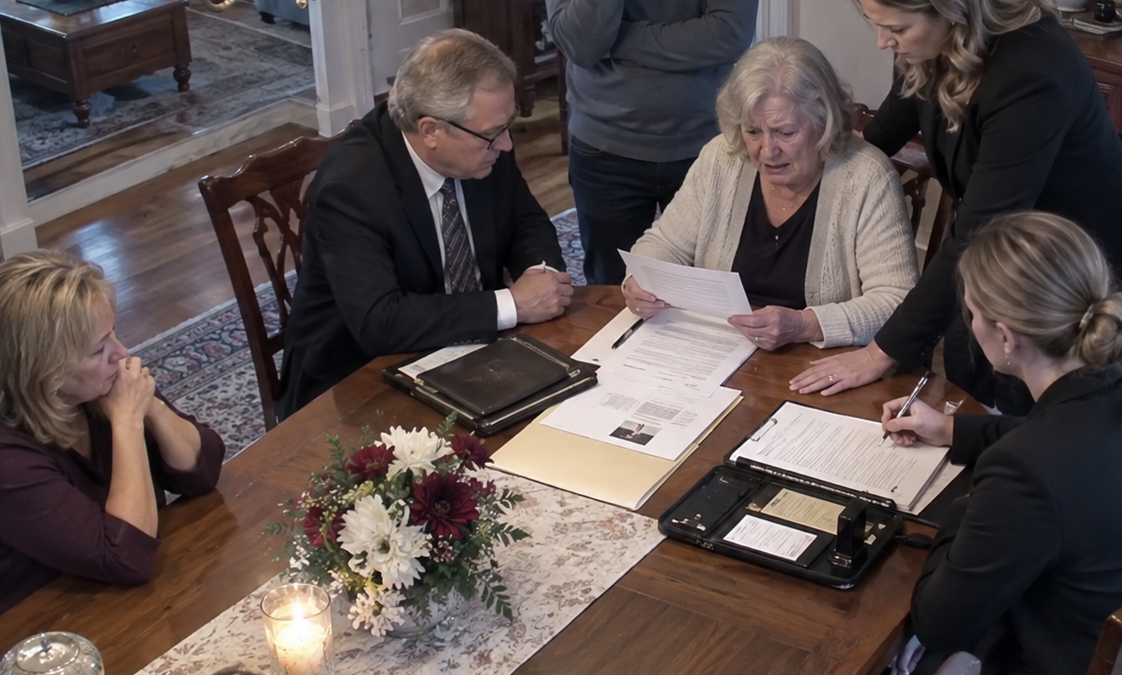
Three days after we buried my husband, my daughter-in-law slid a pen across my kitchen table and smiled.
“Sign the house over to your son, or you’re going into a home by Friday.”
My son stared at his phone. I looked down at the pen before I understood the words, because I knew that pen. It was Walter’s—a black fountain pen with a scratched silver clip. The one he kept in the top drawer of his desk and used for exactly three things in forty-one years: our marriage license, the deed to this house, and the last check he ever wrote to the bank.
Brooke had gone into his drawer to get it.
I smiled then, not because anything was funny, but because I suddenly heard Walter’s voice telling me what to do. I picked up my phone and called his old lawyer.
Forty minutes later, Arthur Klein set a brown leather briefcase on my kitchen table and opened the latches. On top was a sheet of paper with my signature at the bottom. My handwriting. My name.
And I had never seen that paper in my life.
Welcome back to Calm Drama Stories. Here, we share family stories about betrayal, quiet courage, and the people who finally stand up for everything they spent a lifetime building. If a story like this has ever touched your own family, you’re not alone, and you’re welcome here. Drop a comment, and be sure to subscribe.
A week before that kitchen table, at four o’clock in the morning, Walter asked me to open the bedroom window so he could hear the rain. It was the middle of October in Zanesville, Ohio, and the night was cold enough that the hospice nurse would have scolded me. But the nurse had gone home at midnight, and Walter had been asking for very few things by then.
His heart had been failing for most of the year. Congestive heart failure, the cardiologist called it, as if it were a weather report. By October, he slept in the hospital bed we’d rented and set up in our bedroom facing the window, because he said he’d spent seventy years looking at walls and wanted to look at the yard.
I pushed the sash up six inches. The air came in smelling of wet leaves and the neighbor’s wood smoke. Walter closed his eyes and listened to the rain on the gutter he had replaced himself in 2009, standing on a ladder I held while he told me not to worry.
“Maggie,” he said.
“I’m here.”
“Come sit.”
I sat on the edge of the bed. His hand found mine, and I remember how light it was. Walter had big hands, machinist’s hands, then carpenter’s hands after he retired. Those hands had built the bookshelves in our living room, the porch railing, and half the furniture in our son’s childhood bedroom. Now one of them felt like a bird resting in my palm.
“When I’m gone,” he said, “don’t sign anything for anybody.”
I almost laughed. “Anything? The funeral home will hand me a stack of papers.”
“Read them. The bank will want things. Read them. And if anybody pushes paper at you that you don’t understand, you don’t sign it. You call Arthur.”
“Even the Christmas cards?” I asked, because that was how we talked to each other. Forty-one years of teasing.
He didn’t smile. That was what I noticed later. Walter always smiled at my jokes, even the bad ones. That night, he just held my hand tighter and said, “Promise me. Not the bank, not anybody. Not Danny.”
I thought it was the medication talking. I thought it was a dying man’s fear that his wife, who had never handled the plumbing or the car, would be cheated by some stranger.
So I said, “Whatever you say. I promise. Go to sleep.”
I should tell you that I was not a woman who needed protecting from paperwork. For thirty-one years, I was the chief accountant at Muskingum Valley Hospital. I reconciled budgets that would make your head spin. I found a $12,000 billing error in 1996 that three auditors had missed because a column of numbers was off by a pattern only I seemed to notice.
Walter used to say I could smell a wrong number from across a room. He was the one who made things. I was the one who made things balance.
We bought our house on Lynen Hollow Road in 1987, a brick ranch with a full basement and a detached garage, for $68,500. It was more than we could afford. We paid on it for twenty-seven years.
When we made the last payment in 2014, Walter threw a party in the backyard. He invited the whole street, grilled bratwurst, and at sunset took the paid-off mortgage note out of a manila envelope and burned it in the grill while everyone clapped.
Our son Daniel was twenty-eight then. He gave a toast.
“To the house that’s finally ours.”
I remember thinking it was a sweet thing for him to say. I remember thinking he meant the family.
The garage was Walter’s kingdom. After he retired from the machine shop, he turned it into a woodworking shop with a pegboard of tools, a table saw, and a tall green filing cabinet where he kept his project plans, along with a green ledger notebook he wrote in with a carpenter’s pencil.
That fall, he had been making a rocking horse for our granddaughter Lily, who was eight. He’d carved it from white oak. The body was done, smooth as glass. The head was finished, with flared nostrils and a carved forelock that Lily said looked like a cowlick.
He hadn’t finished the mane. He had a bundle of real horsehair from a farm supply store in Dresden sitting in a paper bag on the bench, and he kept saying he’d get to it when he felt stronger.
He didn’t feel stronger.
Around six in the morning, the rain stopped. I was still sitting on the edge of the bed, and I dozed off with my head against the rail. When I woke up, the room was gray and quiet, and his hand was cool in mine.
I knew before I looked at him.
I closed the window. I don’t know why that was the first thing I did. Then I called the hospice line, and then I called our son.
The next four days belonged to Brooke.
I don’t say that bitterly, or I didn’t at the time. Brooke was thirty-six, my son’s wife of eleven years, and she was the most organized person I had ever met. She owned a home decor boutique on Main Street called Linen and Lark, and she ran her life the way she ran that store, with color-coded calendars and a voice that never seemed to need to rise.
She arrived at seven that morning with coffee and a legal pad. By noon, she had called the funeral home, the church, the newspaper, and Walter’s sister Carol in Columbus. By evening, she had a spare key to my house on her keyring.
“In case you need anything,” she said. “You shouldn’t be alone in here at night, Mom. Danny and I will be in and out.”
She took over the mail, too.
“You don’t need to deal with bills right now,” she said, scooping up the stack from the box at the end of the driveway. “I’ll sort out what’s urgent.”
I was grateful. I was so tired I could barely remember whether I’d eaten. Grief makes you clumsy in a way nobody warns you about. You put the milk in the cupboard. You forget the name of a cousin you’ve known for thirty years. You stand in the shower until the hot water runs out and you don’t notice.
On Thursday, two days after Walter died, I sat in the selection room at Bryant and Son’s Funeral Home with my hand on a cherry casket.
Walter would have hated that casket. He would have knocked on the side panel and said it was veneer over particleboard and nobody should pay that kind of money for something that goes in the ground.
I chose it anyway because the oak one looked too much like his workbench, and I couldn’t stand it.
Brooke stepped out halfway through to take a phone call. She was gone about fifteen minutes. I didn’t think anything of it. People were calling her constantly that week.
Small things started happening that I didn’t understand until later.
My pill organizer, the plastic one with the days of the week, moved from the kitchen windowsill to the cabinet over the stove. When I couldn’t find it, Brooke found it for me and said gently, “You skipped Tuesday and Wednesday, Mom. That’s okay. It’s a lot.”
I was sure I hadn’t skipped them, but I was also sure I’d put the milk in the refrigerator, and I’d found it in the cupboard that morning. So what did I know?
On Friday evening, after Brooke made spaghetti for everyone, I came into the kitchen and smelled gas. One of the back burners was turned to the lowest setting, the flame out.
Brooke came in behind me, turned it off, and said, “Oh, Mom,” in a voice so soft and sad that I felt ashamed.
I hadn’t touched the stove all day. I knew that. But she said it like she’d caught me, and my son was standing in the doorway looking at me like he was worried.
The shame got there faster than the certainty.
At the funeral on Saturday, I forgot the name of Walter’s second cousin from Cambridge. My mind just went blank while I stood in the receiving line with my hand out.
He was kind about it, but I heard Brooke behind me a few minutes later talking to my sister-in-law.
“She’s been a little foggy,” Brooke said. “We’re keeping an eye on her.”
Carol, Walter’s younger sister, was seventy-two and sharp as a tack. She came over to me after the service and held both my hands.
“Don’t you let anybody tell you how to grieve,” she said.
Then she laughed through her tears.
“You know, he sent me a picture every single anniversary. Forty-one years, every June. You at the lake, you at the beach, you with a birthday cake on your face. Like he was bragging.”
“He was bragging,” I said. “He was.”
“Lucky man,” she said.
Daniel didn’t say much to me that week. He hugged me at the graveside, and his whole body felt stiff, the way he used to feel when he was a teenager and had done something he hadn’t told me about yet.
He spent a lot of time on the back porch with his vape pen and his phone. I thought it was grief. He was his father’s son, and Walter had never known what to do with his feelings either, except to go out to the garage and build something.
Lily found me in the garage the evening after the funeral. I was sitting on Walter’s stool, which I’d never done before because it was his.
She climbed onto the workbench next to the rocking horse and put her hand on its smooth oak head.
“Is Grandpa going to finish him?” she asked.
I didn’t know what to say to that, so I told her the truth.
“No, honey, he’s not.”
She thought about it. Then she patted the horse’s cowlick.
“Then he needs somebody else to finish him.”
“I suppose he does.”
On Tuesday evening, three days after the funeral, Brooke and Daniel came over at six. Lily was at a friend’s house.
Brooke carried a tote bag from her store, the kind with the little lark stitched on the side, and she set it on the kitchen table next to the tuna casserole my neighbor Ruth had brought over, which none of us had touched.
“Sit down, Mom,” Brooke said. “We need to talk about what happens next.”
I sat. Daniel sat across from me and put his phone faceup on the table, which I’ve always thought is a rude thing to do at a table, and I’d told him so when he was sixteen.
Brooke stayed standing for a moment. Then she pulled out the chair beside me and sat close, knee to knee, the way a nurse sits when she’s about to tell you something you won’t like.
“This house is too much for you,” she said. “You know it is. The basement stairs, the yard, the gutters. Walter did all of that, and Walter’s not here.”
“I know Walter’s not here, Brooke.”
“Of course you do.”
She put her hand on my wrist.
“That’s why Danny and I have been looking into options.”
She reached into the tote and laid things on the table one at a time, the way she’d lay out merchandise on a display.
A glossy brochure for Willow Crest Senior Living out on Maple Avenue. A printed form with the Willow Crest logo at the top that said RESIDENT INTAKE, with my name already typed in. A receipt for a $2,000 deposit marked ROOM HOLD THROUGH FRIDAY, OCTOBER 24.
And a single sheet of legal paper with the heading QUITCLAIM DEED.
Our address on Lynen Hollow Road was typed into the property description. The grantor line read Margaret A. Hail, and the grantee line read Daniel W. Hail.
Then she took Walter’s pen out of her pocket, uncapped it, and slid it across the table toward me.
She smiled when she did it.
That’s the part I remember most. She smiled the way she smiled at customers.
“Sign the house over to your son,” she said. “Or you’re going into a home by Friday.”
“Memory care?” I said.
I’d turned the brochure over and seen the words on the back page. Willow Crest had a memory care wing.
“Whose memory are we talking about, Brooke?”
She didn’t flinch. She opened a small notebook with a floral cover.
“I’ve been writing things down since Walter passed. I didn’t want to, but somebody has to. October fifteenth, you missed your blood pressure pills. October seventeenth, you left a burner on and the kitchen filled with gas. October eighteenth, at your own husband’s funeral, you couldn’t remember Walter’s cousin’s name. You’ve put the milk in the cupboard twice. Mom, we’re scared for you.”
I listened to that list, and something cold moved through me, because every single thing on it, Brooke had been there.
She’d found the pills. She’d found the gas. She’d been standing behind me in the receiving line.
I’d thought she was helping me.
She’d been taking notes.
“Danny,” I said. “Look at me.”
My son did not look at me. He kept his eyes on his phone. His thumb moved on the screen, scrolling and scrolling, like there was something on there more important than his mother being told she was losing her mind at her own kitchen table.
I watched his thumb for a long moment.
I think that was the worst moment of the whole evening, worse than anything Brooke said. My boy, who used to crawl into our bed during thunderstorms, would not lift his eyes.
That was when I smiled, because standing in the middle of all that cold, I heard Walter.
If anybody pushes paper at you that you don’t understand, you don’t sign it. You call Arthur.
For the first time in a week, I knew exactly what to do next.
I picked up my phone.
Brooke put her hand flat on top of it before I could lift it off the table.
“Who are you calling?” she asked, still in that soft voice.
I slid the phone out from under her palm. It wasn’t hard. She hadn’t expected me to pull.
“Walter’s lawyer,” I said. “Since we’re doing paperwork.”
Something crossed her face then, for half a second. Not fear exactly. More like a person doing arithmetic very fast.
Then it was gone, and she leaned back in her chair.
“That’s fine,” she said. “Have him explain it to you. It’s all perfectly standard.”
Arthur Klein had been Walter’s friend for fifty years and his lawyer for thirty. He was seventy-four, semi-retired, and walked with a cane since his hip replacement, but he still kept an office above the old jewelry store on Main Street.
He answered on the second ring.
When I told him that Brooke was at my kitchen table with a deed, he was silent for a long time.
Then he said, “Don’t sign anything. I’ll be there in forty minutes, Maggie. Walter told me this might happen.”
I put the phone down.
“He’s coming,” I said. “Walter told him this might happen.”
Daniel looked up at that. Finally.
His face had gone the color of skim milk.
Brooke said, “Danny,” very quietly, and he looked back down.
We waited. Nobody ate the casserole. Brooke made a phone call in the hallway that I couldn’t hear. Daniel went out on the back porch and vaped in the cold.
I sat at the table with Walter’s pen in front of me and didn’t touch it.
When Arthur’s headlights came up the driveway, I let him in through the front door. He had his cane in one hand and a brown leather briefcase in the other, an old one with brass latches, the kind nobody makes anymore.
He nodded at Brooke in the hallway.
“Mrs. Hail,” he said to her. “Daniel, I need a few minutes with my client.”
“We’re family,” Brooke said. “Anything you need to say to Mom, you can say in front of us.”
“Margaret is my client,” Arthur said. “You’ll excuse us.”
Brooke held his gaze for a beat. Then she and Daniel went into the living room.
I heard the television come on, low.
Arthur sat across from me at the kitchen table, set his briefcase down where the brochure had been, and opened the latches.
On top was a photocopy.
At the head of the page, it said OPEN-END MORTGAGE. In the corner was a recording stamp from the Muskingum County Recorder’s Office dated June 2022.
Below that, the lender’s name appeared in green: Tri County Federal Credit Union.
A credit line amount of $185,000.
Our address on Lynen Hollow Road.
And at the bottom, two signatures.
Walter J. Hail.
Margaret A. Hail.
I looked at my own name, and I could not move.
It’s a strange thing to see your own signature on something you’ve never signed. It looked like mine. The tall loop of the M. The way I’ve always crossed the t in Hail with a little dash that runs off to the right.
Somebody had studied it.
Somebody had practiced.
I sat there in my own kitchen, in the house I had paid off and watched my husband celebrate, and I felt like the floor had tilted under the chair.
Below the signatures was a notary block.
State of Ohio. County of Muskingum.
Before me, a notary public, personally appeared Walter J. Hail and Margaret A. Hail, known to me or satisfactorily proven.
Signed and sealed this fourteenth day of June, 2022.
Kelsey A. Dunn, Notary Public.
The accountant in me came back before the rest of me did. It started counting before I told it to.
June 14, 2022.
That was two days before our thirty-eighth wedding anniversary. We were married on June 16, 1984.
For our thirty-eighth, Walter had taken me to Hilton Head Island in South Carolina for a week. We drove down on the eleventh and came home on the eighteenth.
On the fourteenth, we were playing mini golf in the afternoon, and Walter lost on purpose, and I let him think I didn’t know.
“We weren’t here,” I said.
My voice sounded thin and far away.
“Arthur, we weren’t even in Ohio.”
“I know,” he said.
He reached into the briefcase and set down a second sheet.
A hotel folio from a resort on Hilton Head, June 11 through June 18, 2022.
Guests: Walter and Margaret Hail.
Walter kept the receipt. He kept everything.
“Kelsey Dunn,” I said. “Kelsey Dunn is Brooke’s best friend. She was a bridesmaid at their wedding. She does mobile notary work on the side.”
“Yes.”
“And the signature.”
I touched the W of Walter’s name with one finger. The W leaned forward, and the tail of the final e curled under itself.
I had seen that curl before.
I had seen it in 2002, on the bottom of a report card that came home with a D in chemistry, signed with Walter’s name in handwriting that wasn’t Walter’s.
Daniel had been sixteen. He’d practiced his father’s signature on notebook paper for a week.
We’d found the practice sheets in his trash can.
Walter grounded him for a month, and then he went out to the garage and didn’t talk for two days.
“That’s Danny’s,” I said. “That’s how Danny writes his father’s name.”
Arthur didn’t answer.
He didn’t need to.
“How long has Walter known?”
“Since February.”
Arthur folded his hands on top of the briefcase.
“He went on the county recorder’s website to check on the transfer-on-death affidavit you two filed in 2016. The one that leaves the house to Daniel after you’re both gone. He wanted to make sure it was recorded properly before he got too sick to fix anything.”
Arthur nodded at the mortgage.
“He found that instead. He came to me the next day. As a named borrower on the account, he had the right to request the loan file. We got copies. He compared the dates to that receipt. He knew who signed it within about a minute.”
“February,” I said. “That was eight months ago.”
“He left you a letter.”
Arthur took out a white envelope.
On the front, in Walter’s square carpenter’s printing, shakier than I’d ever seen it, were the words:
For Maggie, only if they come for the house.
Underneath that envelope was a smaller one.
For Danny.
I happened to look up then, through the kitchen doorway and into the hall.
Brooke was standing there.
I don’t know how long she’d been there. The television was still on in the living room behind her.
She wasn’t looking at me.
She was looking at the table, at the photocopy lying flat between Arthur and me, at the green Tri County Federal Credit Union logo printed across the top.
Her face was perfectly still.
Then she met my eyes.
She knew that I knew.
I could have stood up right then and screamed at my son. I wanted to. Every part of my body wanted to march into that living room and slap the phone out of his hand.
But Arthur put his hand on my arm and said, very low, “Read the letter first, Maggie. That’s what Walter wanted. Read it before you decide anything.”
So I took a breath.
I stood up, walked back to my end of the table, picked up Walter’s fountain pen, capped it, and put it in the pocket of my cardigan.
“I won’t be signing anything tonight,” I said, loud enough to carry. “And this is mine.”
Brooke came into the kitchen and gathered up her brochure, her intake form, and her deposit receipt. She left the quitclaim deed on the table. She put her notebook back in the tote.
“You have until Friday, Margaret,” she said.
It was the first time in eleven years she had called me Margaret instead of Mom.
Daniel walked out to the car before she did.
He didn’t say goodbye.
Arthur stayed another half hour. He left copies of everything in a folder on my table and took the originals with him.
“They go in my office safe tonight,” he said. “Walter’s instructions.”
At the door, he paused, leaning on his cane.
“He was proud of you, you know. He said if anybody could stand looking at those numbers, it was you.”
I read the letter twice at the kitchen table and a third time in the garage, sitting on Walter’s stool, because I wanted to be somewhere he had been angry.
Walter never raised his voice in the house. He took it out on oak.
There were curls of it still under the bench, pale and soft as hair, and I picked one up and held it while I read.
Maggie,
If you’re reading this, they came for the house, and I’m sorry I wasn’t there to stop it.
I found the mortgage in February. I know it was Danny who signed. I know it was Brooke’s friend who stamped it.
I knew for eight months, and I didn’t tell you, and I want you to know why, even if it doesn’t make it right.
In August, I asked him. I sat him down in the garage, and I asked him if there was anything he needed to tell me. I gave him every chance. He looked me in the eye and said, “No, Dad.”
And I couldn’t do it. I couldn’t put my son in a police station while I was busy dying.
I’m a coward about him, Maggie. I always was. You never were.
Arthur has everything. Don’t let them take the house. Don’t let them make you small. Make them say it out loud.
There’s an envelope for Danny. Give it to him only if he tells you the truth himself, not if you prove it. If he tells you, you’ll know the difference.
I love you. I’d marry you again tomorrow and lose at mini golf on purpose for another forty-one years.
Walt.
He was right about one thing.
He had been a coward.
He had known for eight months. He had watched me pay the water bill and plan Thanksgiving and kiss our son on the cheek every Sunday, and he had said nothing because saying it would have meant losing Danny before he lost everything else.
I sat on his stool, and I hated him for about a minute.
I let myself.
It was a clean, hot feeling, and it was better than the cold one.
Then I put the curl of oak in my cardigan pocket next to his pen and kept it.
Around midnight, I called Daniel.
He didn’t answer.
I didn’t think. I left a voicemail, and all I said was, “Your father knew, Danny. He knew since February.”
Then I hung up and sat in the dark kitchen.
Only after I’d done it did I realize I’d just told Brooke exactly how much I had.
At eight-thirty the next morning, Arthur picked me up, and we went to the county recorder’s office first.
It’s a plain room on the second floor of the county building, with a counter and a clerk and a bell you’re not supposed to ring.
In 2016, Walter and I had signed a transfer-on-death designation affidavit naming Daniel as the beneficiary of our house. It was the sensible thing. Our lawyer recommended it. It meant that when we were both gone, the house would pass to our only child without probate.
Arthur had a revocation already drawn up.
I read it out loud to myself, every line, the way Walter would have wanted. Then I signed it with his pen in front of the clerk, who notarized it and stamped it as recorded at 8:52 a.m.
That was the first thing I took back.
It was a single sheet of paper, and it didn’t feel like much. But when the clerk slid my copy across the counter, I folded it in thirds and put it in my purse, and I felt my shoulders come down an inch.
The second stop was the Tri County Federal Credit Union branch on Maple Avenue.
The branch manager was a young man named Kyle who wore a lanyard and looked about twenty-five. He was polite. He brought me coffee. He pulled up the account, and his face changed as he read.
“Mrs. Hail,” he said carefully, “this line of credit was frozen on October twentieth after we received notice of Mr. Hail’s death. It’s also, I’m sorry, one hundred and twenty days past due. A letter went out to the property address on the twentieth, addressed to you as the surviving borrower.”
“I never received it.”
He glanced at the screen.
“It wasn’t returned.”
No, it wouldn’t have been.
Brooke had been collecting my mail since the morning Walter died.
“I never signed this loan,” I said. “Neither did my husband. We were in South Carolina on the date it was notarized. I have the hotel receipt.”
Kyle nodded slowly, the way people do when they’ve been trained for a situation and are hoping they won’t get it wrong.
He printed an affidavit of forgery form.
I read it twice and signed it.
He told me the fraud department would open an investigation, but they’d need a police report before they could proceed. Until the investigation was resolved, I would remain listed as a borrower on the account.
“So right now,” I said, “as far as your credit union is concerned, I owe you a hundred and seventy-some thousand dollars against my own house.”
“Right now, the account is in dispute,” he said. “That’s the best I can say.”
“Then I’d like copies of every statement on this account since it was opened. As a named borrower, I’m entitled to them, aren’t I?”
He hesitated, then nodded.
He printed them while I waited.
Forty months of statements.
The stack was almost an inch thick.
When he handed it to me, I felt something I hadn’t felt in a week.
I felt competent.
I held that stack of paper on my lap like a hymnal.
The third stop was the sheriff’s substation.
Arthur waited in the car because his hip was bad that morning, and I told him I’d be fine.
I was wrong about that.
The deputy who took my report was named Tom Harland. He was maybe thirty, with a tired face and a coffee stain on his cuff.
He listened while I explained. He wrote things down.
Then he put his pen down and said, “Ma’am, I need to tell you. We actually got a call this morning about you.”
“About me?”
“From your daughter-in-law, Mrs. Brooke Hail. She said you’d recently lost your husband, that you’d been confused, and that you might come in making accusations about some old family paperwork. She asked us to be gentle with you.”
I sat very still.
She had beaten me there.
While I was signing papers at the recorder’s office, Brooke had been on the phone telling the sheriff that I was a confused old woman.
My voicemail at midnight had told her exactly where I was going.
“Deputy,” I said, “I spent thirty-one years as the chief accountant of a hospital. I’m not confused. I’m robbed.”
“Yes, ma’am.”
He picked up his desk phone.
“I’d like to get your son’s side of it. Do you mind if I call him?”
I should have minded.
I didn’t think fast enough.
He called Daniel and put him on speaker.
My son’s voice came out of that little gray box, flat and careful, like he’d been told exactly what to say.
“Mom and Dad knew about the loan,” Daniel said. “Dad helped us out with Brooke’s business a couple of years ago. They both signed. Mom just doesn’t remember. She’s been having a really hard time since Dad passed.”
“Danny,” I said.
I said it too loud. The deputy looked at me.
“Danny, we were in Hilton Head. You know we were. You drove us to the airport in Columbus.”
No. That was wrong.
We’d driven down.
We’d driven down, and Daniel had watered our tomatoes.
I’d mixed up the trip with a different one, a flight to Phoenix in 2019.
I heard myself say it, and I heard myself stop, and I saw Deputy Harland write something down.
“Ma’am,” he said after he’d hung up, “I’m going to write this up, and I’ll pass it to our detective unit. But I have to be honest with you. Right now, with your son saying both parents consented and your husband unfortunately not able to say otherwise, this looks like it might be a family civil matter.”
“A family civil matter? My son forged my signature to borrow $185,000 against my house, and that’s a civil matter?”
“I’m not saying it’s not serious, ma’am. I’m saying it’s not simple.”
I left with a report number on a business card.
I sat in Arthur’s car, and I didn’t say anything for a long time. Arthur, bless him, didn’t make me.
“I lost my temper,” I finally said. “And I got the trip wrong. He wrote it down. I watched him write it down.”
“Grief makes everybody get the trip wrong,” Arthur said.
“Not on the record, it doesn’t.”
We drove to his office.
Arthur’s conference room was really just a long oak table that Walter had refinished for him in 1998, sitting under a window that looked out on Main Street.
I asked him for a calculator, two highlighters, a legal pad, and three hours.
He gave me all four and went to make phone calls in his own office.
I want to tell you what that afternoon was like, because it was the first time since Walter died that I felt like myself.
I laid the statements out in order.
Forty months.
I built a table on the legal pad by hand, the way I used to before the hospital switched to spreadsheets.
Date. Amount. Method. Destination.
It took me two hours.
My handwriting got smaller and neater as I went, which is what it does when I’m angry.
Forty-one draws.
$171,200.
The pattern came up out of the paper the way it always used to.
$118,000 went by transfer to an account belonging to Linen and Lark LLC.
That was Brooke’s store.
$31,000 went to an account in Daniel’s name, and the transaction descriptions for the money moving out of that account afterward were the names of sports betting apps.
I’m careful to tell you that I didn’t know for certain where that money went beyond the account. I only knew what the descriptions said.
$8,000 went to a cabin rental company at Dillon Lake in July of 2023 and again in July of 2024.
I remembered those trips. Brooke had posted pictures, Lily in a life jacket, grinning. I’d asked how they could afford it, and Daniel had said the store was doing great.
Minimum payments had come out of the Linen and Lark account every month like clockwork until this past June.
Then they stopped.
The store, I would learn later, had been losing money for a year and a half.
The well had run dry, and when the payments stopped, the clock started.
Ninety days. One hundred and twenty. Default. Eventually foreclosure.
And a letter to the surviving borrower.
I understood then what Friday really meant.
If the house was in Daniel’s name, Brooke could sell it quickly, pay off the credit line from the proceeds before any of this ever reached me, and put me in Willow Crest with a nice room and a view of the parking lot.
I would never know my house had ever been mortgaged again.
I would think my son had just been looking out for his grieving mother.
Then I turned to the last page.
October 16.
$14,000 transfer to Linen and Lark LLC.
Time-stamped 2:18 in the afternoon.
I set my highlighter down very carefully because my hand had started to shake, and I didn’t want to mark anything wrong.
October sixteenth.
Walter had been dead for two days.
At 2:18 on the afternoon of October sixteenth, I was standing in the selection room at Bryant and Son’s Funeral Home with my hand flat on a cherry casket, trying to decide where my husband would lie forever.
And Brooke had stepped out to take a phone call for about fifteen minutes.
I want to be honest about what I knew.
I didn’t see her phone. I couldn’t prove her thumb pressed the button. The statement only told me when the money moved and where it went.
But I knew where Brooke was at 2:18 on October sixteenth.
She was standing in a hallway at a funeral home while her mother-in-law picked out a coffin, moving the last $14,000 out of a line of credit secured by that mother-in-law’s house before the bank could freeze it.
I thought about the party in our backyard in 2014, the mortgage note curling up black in the grill, everybody clapping, Daniel raising his beer to the house that was finally ours.
They had made it dirty again while Walter was alive.
And then they had done it one more time with his body still at the funeral home.
Arthur came in and found me sitting with my hand over my mouth.
I turned the last page toward him and pointed.
He read it.
He was quiet for a moment.
Then he said something lawyerly and very important, though at the time it just sounded like a fact.
“This one is an old one, Maggie. Whatever Daniel says Walter agreed to in 2022, Walter didn’t agree to anything on October sixteenth. Walter was dead. This is a new transaction on a line you never opened, two days after the other borrower died. That’s not a family misunderstanding.”
I called the number on Deputy Harland’s card for the detective unit.
It went to voicemail.
I left a message. I said my name, the report number, and the words “fourteen thousand dollars, October sixteenth, two days after my husband died.”
I said it all very calmly.
It was after eight when Arthur drove me home.
I decided to leave the original statements in his safe with everything else. I took copies.
That was the one smart decision I made that week, and I didn’t even know yet how smart it was.
Thursday morning, I had an appointment with my family doctor, Dr. Anita Shaw, to have my blood pressure checked.
Arthur had also suggested carefully that I ask her for a full cognitive evaluation.
“Not because anybody thinks you need one,” he said. “Because somebody is going to say you do, and it’s better to have the answer in writing first.”
Dr. Shaw’s office scheduled the evaluation for November sixth.
I drove myself home a little before eleven.
My phone rang while I was at the light on Lynen Avenue.
It was Ruth Delgado, who has lived across the street from me for twenty-six years and who notices everything.
“Maggie,” she said, “there’s a junk truck backed up to your garage. Is that supposed to be there?”
I made it home in four minutes.
I don’t remember the drive.
There was a white box truck in my driveway with MUSKINGUM painted on the side, backed up to the open door of Walter’s garage, its rear liftgate lowered to the ground.
Two men in work gloves were carrying things out of the garage and loading them onto the gate.
Brooke stood on the driveway with her phone in her hand, directing them.
Daniel stood just inside the garage door holding a canvas bag.
I recognized it.
It was my laptop bag.
It had been on my desk in the den.
I got out of the car and saw Walter’s stool go up onto the truck.
The men tossed it on top of a pile that already included his pegboard, half his hand tools in a plastic bin, his drill press, and the tall green filing cabinet where he kept his plans and his green ledger.
The cabinet was lying on its side.
“Stop,” I said. “Stop. Put that down.”
The older of the two men, a big fellow with a gray beard whose shirt said TRAVIS, stopped and looked at Brooke.
Brooke didn’t even turn around fully.
She held up her phone so Travis could see the screen.
“We’ve got the work order,” she said. “Her son signed it. She gets agitated. It’s fine.”
“It is not fine,” I said. “This is my property. This is my garage. I’m the owner of this house. I want everything taken off that truck right now.”
Travis looked from me to Brooke and back.
He was not a bad man. I could see him trying to figure out who to believe, the same way the deputy had.
And Brooke had gotten there first again.
“Ma’am,” he said, “I’m just doing what the family—”
“The family. I am the family.”
I walked straight to Daniel.
“That’s my laptop.”
“It’s Dad’s,” Daniel said.
He didn’t meet my eyes.
“Brooke said Dad’s stuff needed to be—”
“It’s mine. I bought it in 2021 at the Best Buy in Columbus with my own credit card.”
I took hold of the strap.
He let go.
He actually let go.
For one second, I had it.
Then Brooke was beside us, and she took it out of my hands with one quick pull, like a mother taking scissors from a child.
She walked it to her own car, put it on the back seat, shut the door, and hit the lock button on her key fob.
The little chirp of that lock sounded like a door closing on something.
Everything on that laptop—my email, my photographs, my own records.
“She called the sheriff on her own son yesterday,” Brooke said to Travis, loud enough for me to hear. “That’s where we are. Please just keep loading.”
I looked at the truck.
On top of the pile, balanced across the side of the filing cabinet, was the rocking horse.
I don’t remember deciding.
I just remember my foot going onto the liftgate.
I got one foot on the gate and both hands on the horse’s neck before anyone understood what I was doing.
The metal plate was cold and slick from the morning dew.
“Margaret, get down,” Brooke said.
When I didn’t, she grabbed the horse by its tail end and pulled.
Not hard at first.
Then hard.
The gate shifted under my shoe.
I remember thinking very clearly that I was sixty-seven years old and standing on a metal plate that was moving, and that I was not going to let go anyway.
Walter made that horse.
Walter’s hands made that horse.
“Let go of it.”
Brooke said, “You let go of it.”
She yanked once more with her whole weight.
The horse came free of the pile all at once.
And so did I.
I fell backward off the liftgate.
I put my left hand out behind me the way you do, the way your body does before your brain has a vote.
I hit the driveway on that hand.
I heard the wrist before I felt it, a sound like a dry branch underfoot.
And then the horse came down, too.
Brooke had let go of it the moment it came free. It hit the concrete beside me, and its oak head snapped clean off at the neck and bounced and rolled end over end until it stopped against my son’s shoe.
Then the pain arrived.
It came up my arm like hot water. I couldn’t breathe for a second.
I lay on my side on my own driveway, looking at my hand, which was bent in a direction hands aren’t supposed to bend.
And I made a sound I had never heard myself make.
Daniel dropped to his knees.
He picked up the horse’s head.
He held it in both hands and looked at it.
Then he looked at me, and his face was white as paper.
“Mom,” he said. “Mom, I—”
“Danny,” Brooke said. “Get the car.”
He stood up.
With the horse’s head still in his hand, he stood up.
That was the first crack I saw in him. Not that he stood when she said so, but that it took him three full seconds to do it.
Ruth was already running across the street in her house slippers, her phone up and pointed at us.
I found out later she’d been filming since the moment I got out of my car.
“I called 911,” she shouted. “Nobody touch her. I called 911.”
Travis took off his gloves and threw them on the driveway.
“Lady, I’m not taking any more of this,” he said to Brooke. “I’m not getting in the middle of some family thing.”
But the younger man had already pulled the truck’s rear door down.
The truck was three-quarters full.
In the confusion, nobody took anything off it.
Travis climbed into the cab, I think just to get away from the whole situation, and the truck pulled out of my driveway and drove off down Lynen Hollow Road with Walter’s workshop inside it.
His tools. His stool. His filing cabinet with the green ledger.
The rest of the rocking horse, the body, was still lying on the concrete beside me.
Only the head had gone anywhere, and that was in Daniel’s hand.
He put it down on the hood of my car before he went to get his.
I’ll never forget that.
He set it down gently, like it might wake up.
The ambulance came in eleven minutes.
By then, Brooke had made sure she was the first person the EMTs talked to.
I heard her on the edge of the driveway, her voice trembling just the right amount.
“She climbed onto the truck. I tried to stop her. She’s been confused since the funeral. She’s been doing things like this all week.”
And right behind the ambulance, of all people, came Deputy Tom Harland, who wrote down every word Brooke said while Ruth stood behind him trying to shove her phone into his face.
The emergency room at Genesis Hospital was crowded.
They gave me something for the pain and then something stronger.
Then a doctor with a soft voice told me I had a distal radius fracture, which is the most common broken wrist in women my age, and that they’d set it and put me in a splint, and I’d need a cast for about six weeks.
The setting hurt more than the fall.
I’m told I swore.
I don’t swear.
Brooke sat beside my bed through all of it.
She had come in a separate car.
She held my good hand when the nurse was in the room and let go of it when the nurse left.
When the nurse came back to check my vitals, Brooke said very gently, “Can someone check her memory? She’s been disoriented. We’re worried about her.”
The nurse asked me what day it was.
I was flying on hydrocodone.
I was looking at the ceiling tiles, counting them, and I said, “Wednesday the twenty-second.”
It was Thursday.
It was the twenty-third.
I watched the nurse type something.
I could see the screen at an angle.
Patient mildly disoriented to date.
Something came up out of me then.
Not the accountant.
Something older.
I pushed myself up on my good elbow and said, loud enough for the curtain next door to hear, “Then write down that I’m on hydrocodone. Write down that my husband died nine days ago. And write down that the woman holding my hand is the reason my wrist is broken.”
The nurse stopped typing.
She looked at Brooke.
Brooke looked at me with enormous, wounded eyes.
“Mom,” she said softly, “I was trying to help you down.”
I started crying then.
Not delicately.
I cried the way I hadn’t cried at the funeral because at the funeral, I’d had to stand in a receiving line.
I cried until I couldn’t breathe.
The nurse asked Brooke to step out, and Brooke stepped out.
When she was gone, the nurse handed me a tissue box and said quietly, “I’ll add what you said, ma’am. All of it.”
I believed her.
I also knew that a chart can say two things at once.
Ruth drove me home at nine that night.
My arm was in a splint and a sling.
The house was dark and smelled of nothing because nobody had cooked.
The garage door was still open.
Ruth had gone in earlier and picked up the rocking horse’s body and leaned it against the wall.
The pegboard was gone.
The bench was there, too heavy to load, but the top was bare except for a paper bag of horsehair that nobody had bothered to take.
The horse’s head was on my kitchen table.
Ruth had brought it in off the hood of my car.
Carol drove down from Columbus the next morning and stayed for four days.
She slept in the guest room. She buttoned my cardigan for me because I couldn’t do it one-handed.
On the second night, while she was washing dishes, she said without turning around, “Maggie, are you sure about this loan business?”
I stood in the doorway with my arm in the sling.
“Brooke called me,” Carol said. “She says you’ve been mixing up dates. She says you thought Danny drove you to the airport for the Hilton Head trip.”
I understood then how far it had gone.
Brooke had gotten to Carol, too.
Carol, who loved me. Carol, who’d held my hands at the funeral.
The story was spreading the way water spreads under a floor. You don’t see it until the boards start to curl.
“I’m sure,” I said.
Carol turned around. She looked at my face for a long moment.
“Okay,” she said.
But she didn’t sound sure, and I couldn’t blame her.
Friday came.
Nobody came to take me to Willow Crest.
I’d known nobody would.
I’d read enough of Arthur’s notes to understand that no one in Ohio can just put a competent adult into a home by Friday because they say so.
There have to be filings, an evaluation, a court investigator, a hearing.
Brooke had been bluffing.
But on Monday morning, Arthur called.
Brooke and Daniel had filed an application for appointment of guardian in the Muskingum County Probate Court.
They were asking the court to declare me incompetent to manage my own affairs.
Attached to the application were the emergency room note, patient mildly disoriented to date, and a copy of Deputy Harland’s report from my driveway, in which a witness, Brooke Hail, stated that I had climbed onto a moving truck in a confused state.
A court investigator would come to the house to interview me.
A hearing was set for November seventeenth.
“They can’t put you anywhere before that hearing, Maggie,” Arthur said. “But I want to be honest. Every word you say between now and then is going to be weighed.”
That was when I understood that Friday had never been the real threat.
Brooke didn’t need to get me into Willow Crest by Friday.
She just needed to make everything I said sound like a symptom.
That same Monday afternoon, a woman named Detective Sergeant Renee Coulter called me.
She worked in the sheriff’s office on elder crimes.
Ruth had sent her video to the sheriff’s tip line on Thursday night, and somebody had finally put my voicemail, Ruth’s video, and Deputy Harland’s two reports on the same desk.
Detective Coulter came to the house that evening.
She was about fifty, with short gray hair, and she sat at my kitchen table, the same table, and watched Ruth’s video twice without speaking.
On the screen, Brooke yanked the horse, and I went backward off the gate.
You could hear my wrist on the video.
Detective Coulter flinched both times.
Then she read through my handwritten table and the statements.
She was quiet for a long time.
“I’ll be straight with you, Mrs. Hail,” she said. “The video I can work with. That’s a woman pulling hard on an object while a sixty-seven-year-old is standing on a liftgate. Whether it’s assault or recklessness, I’m looking at it, and I’m taking it seriously. The October sixteenth transfer I’m very interested in.”
“But?”
“But the forgery is harder than it should be. Your son says your husband consented. Your husband can’t contradict him. The notary certificate says you personally appeared. You have a hotel receipt, which is good. And they’ll say you mixed up the years, which they’ve already started saying.”
She looked at the papers spread across my table.
“Right now, it’s your word and a hotel folio against three people. I need one of the three to tell me the truth.”
“Have you talked to Kelsey Dunn?”
“This afternoon.”
Detective Coulter’s mouth went flat.
“Through a lawyer. Her lawyer says she followed proper procedure and has nothing further to say.”
That door was closed.
After she left, my phone buzzed with a text.
It was from Brooke.
I read it out loud to Carol because I wanted somebody else to hear it in the room.
Walter’s memorial supper is Sunday, November 2nd. Family only. Sign the deed then in front of everyone so no one can ever say we pushed you. Danny and I will withdraw the guardianship the same night, and you can pick your own room at Willow Crest. Otherwise, the judge picks for you.
Carol sat down at the table across from me.
She didn’t say anything.
She reached over and picked up the horse’s head and turned it in her hands, running her thumb over the carved cowlick.
Her brother’s work.
My wrist itched under the splint.
That night, I couldn’t sleep on my left side, which is the side I’ve slept on for forty-one years, facing the window, facing Walter.
I lay on my back in the dark and listened to the furnace and thought about Brooke’s text.
Sign it in front of everyone.
In front of everyone.
The court investigator came on Thursday, October thirtieth, at ten in the morning.
By then, I had a real cast, a blue one, from my knuckles to just below my elbow.
Carol had gone back to Columbus the day before.
I was alone in the house.
His name was Hollis Reed. He was in his sixties, with a cardigan not unlike mine, a clipboard, and a voice that made you want to tell him things.
He handed me a formal notice of the guardianship hearing and explained that I had the right to attend, the right to a lawyer, the right to ask the court for an independent evaluation, and the right to show the court that a less restrictive arrangement would serve me just as well.
He said all of this kindly and in order, and I could tell he had said it to many people who did not understand a word.
I understood every word.
I told him so.
He asked me the date.
I told him.
He asked about my medications.
I named them, with dosages and times.
I mentioned I’d stopped the hydrocodone on Sunday because it made me foggy, and I would rather hurt.
He asked who paid my bills.
I told him I did, and that I’d done the books for a two-hundred-bed hospital for thirty-one years, and that if he wanted, I could show him my checkbook register balanced to the penny through October twenty-eighth.
He wrote that down.
He asked about my support system.
I named Ruth and Carol and Arthur and my doctor, and told him I had an evaluation scheduled with Dr. Shaw on November sixth.
He wrote that down, too.
Then he asked gently about the incident in the driveway.
I had planned to answer that one like an accountant.
Dates. Times. The video.
I had a copy of Ruth’s video on my phone, ready to show him.
Instead, I stood up, went to the hall closet, and took down the shoebox I’d put the horse’s head in.
I brought it back and opened the lid and set it on the coffee table between us.
“My husband made that for our granddaughter,” I said. “He didn’t get to finish it.”
And then, God help me, I cried in front of the man from the probate court.
I didn’t plan to.
It just came.
I sat on my own couch with my blue cast in my lap and cried about a piece of wood with a carved cowlick.
Mr. Reed didn’t write anything.
He waited.
He handed me a tissue from his own pocket, a little travel pack, like a man who had learned to carry them.
When I could talk again, I said, “I’m grieving, Mr. Reed. That isn’t the same thing as being lost. I’d like you to write both of those things down.”
He looked at me over his reading glasses for a long moment.
Then he did.
I watched him write both.
Before he left, I showed him Ruth’s video.
He watched it once and said nothing, but he wrote down the date and time of the file.
That afternoon, a little after three, a car pulled into my driveway.
It was Daniel’s.
Not Brooke’s.
Daniel got out alone, then opened the back door, and Lily climbed out with her backpack.
It was a Thursday, a school day. He must have picked her up early.
I opened the front door.
Lily ran to me the way she always did, then stopped short when she saw the cast.
“Grandma, what happened to your arm?”
“I fell, sweetheart.”
“Mom said you climbed on a truck.”
She said it seriously, like she was reporting on a misbehaving classmate.
I didn’t answer that.
I took her inside.
Daniel stayed on the porch. He stood right at the edge of the welcome mat, like there was a line there he couldn’t cross.
Lily put her backpack down and went straight to the kitchen, where she always got a snack.
On the way, she passed the coffee table and saw the open shoebox.
She stopped.
She looked down at the horse’s head for a long time.
Then she said, “Where’s the rest of him?”
“In the garage,” I said. “And some of Grandpa’s tools are on a truck somewhere.”
She picked up the head.
She held it the way Daniel had held it on the driveway, in both hands, and her chin started to wobble.
“Who broke him?”
I could have told her.
Every part of me that had been robbed and called a liar wanted to tell her, Your mother broke him. Your mother pulled him off a truck and let go.
But she was eight.
She had to go home with that woman tonight.
“He broke when I fell,” I said. “We’re going to fix him. Grandpa left instructions.”
She cried anyway.
She sat on the couch with the head in her lap and cried, and I sat with her.
Through the front window, I could see Daniel on the porch with his hands in his jacket pockets, watching his daughter cry over a toy his father made.
He looked like a man watching his own house burn.
When Lily settled down with a juice box in front of the television, I went out on the porch and pulled the door shut behind me.
It was cold.
The maple in the front yard had dropped most of its leaves.
When Daniel was eight, Lily’s age, he learned to ride a bike on the sidewalk right in front of this porch.
Walter ran beside him, holding the seat for an hour, and then let go without telling him. Danny rode all the way to the Delgados’ mailbox before he realized nobody was holding on.
He turned around grinning so hard he crashed into the hedge.
I stood on this same porch and laughed until I cried.
He was thirty-nine now.
He had his father’s shoulders and none of his father’s backbone.
“I didn’t know she’d pull it,” he said before I could say anything. His voice was strained. “Mom, I swear I didn’t know you’d fall. I just thought she’d clean out the garage, and then you—”
“You knew about June fourteenth, Danny.”
He stopped.
The wind moved the leaves around on the porch steps.
A school bus went by at the end of the street.
“It was supposed to be paid back,” he said very quietly, looking at the floorboards. “Before Dad ever—”
He stopped again.
He shut his mouth so hard I heard his teeth.
That was the closest he’d come.
Standing on my porch with my granddaughter on the other side of the door, he had almost said it.
I thought about my phone in my cardigan pocket.
I could have started recording.
I knew Ohio allowed it. Arthur had told me.
But my granddaughter was ten feet away watching cartoons, and my son was standing on the porch where his father taught him to ride a bike.
I did not want the first true words he said to me in three years to be something I’d trapped him into in front of his child.
I’ve thought about that choice many times since.
It might have saved me a great deal.
I still think it was right.
“Then say it,” I said instead. “Say it to someone who can write it down.”
He looked at me finally.
His eyes were red.
“She’ll take Lily, Mom. She already told me. If I go against her, she’ll file for divorce, and she’ll take Lily, and she’ll tell the court I’m a gambling addict who forged his parents’ signatures. And she can prove that part. Do you understand? She can prove the part about me.”
So there it was.
The thing Brooke held over him.
Not love.
Not even fear of prison.
His daughter.
“Danny,” I said, “she can only use Lily as long as you let her.”
He didn’t answer.
He went inside and got Lily and her backpack.
Lily hugged me around my waist, careful of the cast, and said, “Bye, Grandma. Fix him.”
Then they drove away.
I went back inside and picked up my phone.
I opened Brooke’s text again.
Sign it in front of everyone.
Make them say it out loud.
The next morning, I sat in Arthur’s conference room with my cast propped on a cushion and told him what I wanted to do.
“I’m going to say yes,” I said.
“To the supper?”
“To signing the deed in front of the whole family.”
Arthur took off his glasses.
“Maggie, listen to me.”
“Detective Coulter said she needs one of the three to tell the truth. Kelsey won’t talk through a lawyer. Danny won’t talk while Brooke’s holding Lily over his head. Brooke will never talk. But Brooke wants witnesses. She wants a room full of family watching me sign of my own free will so nobody can ever say she forced me. She told me so in writing.”
I set my phone on the table, open to the text.
“So I’ll give her witnesses. And I want her to bring a notary.”
Arthur understood before I finished.
I watched it reach his eyes.
“Kelsey Dunn.”
“I won’t ask for Kelsey. I’ll only ask that the deed be notarized at the table so it’s done properly. And I’ll ask that you be there to review the wording. That makes it look even better for her. A lawyer and a notary and a dozen relatives. It’s exactly what she’d want if she were trying to make sure nobody could ever challenge that deed.”
“And if Kelsey doesn’t break?”
I had thought about that all night.
“Then I won’t sign, and I’ll look exactly like what Brooke says I am, a confused old woman who changes her mind at her husband’s memorial supper. And you’ll have to explain that to Judge Ferris on the seventeenth.”
He was quiet for a long time.
“Walter would have hated this plan,” he said finally.
“Walter had eight months to make a better one.”
He laughed at that, one short bark, surprised out of him.
Then he put his glasses back on.
“All right. I’ll draft nothing, and I’ll review her deed, and I’ll sit at the end of the table and keep my mouth shut. That’s what lawyers are best at when they’re any good.”
I texted Brooke that afternoon.
I’ll sign on Sunday at the supper. I want it notarized right there at the table so it’s done properly, and I want Arthur to look over the wording. Then this is finished.
She answered in four minutes.
Of course, Mom. Kelsey will bring her stamp. I’m so glad. This is the right thing.
I read that text three times.
Kelsey will bring her stamp.
She had walked Kelsey Dunn into my dining room herself.
Then I called Detective Coulter and told her everything.
She listened without interrupting.
Then she said, “Mrs. Hail, I can’t be part of a setup. I can’t sit at your table. I can’t tell you what to say, and I won’t. That’s not how this works.”
I started to answer, and she kept going.
“But I can tell you that Ohio is a one-party consent state. If you’re part of a conversation, you can record it. That’s your right. And I can tell you that I’ll be finishing up some paperwork on Sunday evening, and the parking lot at Grace Methodist is about a minute from your house. If you need a deputy, you call me.”
She paused.
“Or if you’d rather not make a phone call in front of a dozen people, turn on your porch light. I’ll see it from the lot.”
The last call I made was to Carol.
I told her everything.
The loan, the date, the hotel, the October sixteenth transfer.
I told her what Brooke had said to her was a lie, and I didn’t blame her for half believing it.
Then I said, “Carol, you said Walter sent you a picture every anniversary. Every single June.”
There was a pause on the line.
Then I heard her breath catch.
“Oh,” she said. “Oh, Maggie, hold on.”
I heard her scrolling.
Phones keep everything now. Every text, every photo, years and years of them on some server somewhere.
It took her six minutes.
I sat at the kitchen table and listened to her mutter to herself.
Then she started to cry.
“June fourteenth, 2022,” she said. “6:12 in the evening. It’s you on the beach in that straw hat, the ugly one with the ribbon. Behind you, there’s a sign that says Hilton Head Island Beach Access. He wrote, ‘Thirty-eight years, and she still beats me at mini golf.’”
I closed my eyes.
I could see it.
I could see him taking it.
He’d made me stand there twice because the first time a seagull walked into the frame.
“He sent it to you that night,” I said.
“He sent it to me that night. Maggie, I’m so sorry. I should never have doubted you. Not for one second.”
“Bring your phone on Sunday,” I said. “Charge it first.”
On Saturday, I cooked.
I made Walter’s favorite pot roast with carrots and pearl onions, the way his mother used to make it.
You’d be surprised how hard it is to make a pot roast with one hand.
Ruth came over and peeled the potatoes and didn’t ask any questions.
She just kept looking at me sideways while she worked.
At one point, she said, “Whatever you’re doing tomorrow, I’m coming.”
I said I was counting on it.
On Sunday afternoon, I set the dining room table for eleven.
My good china, the set we got for our wedding that I’ve used maybe twenty times.
At the head of the table, I set my own plate, and beside my plate, I laid Walter’s fountain pen.
At the other end, by habit, I set a place for him.
Then I stood there with the twelfth plate in my one good hand and realized what I’d done.
I put it back in the cabinet.
I left his chair empty anyway.
They came at five.
Carol and her husband Jean came first, down from Columbus, and Carol hugged me for a long time in the front hall and didn’t say anything.
That was enough.
Ruth came across the street with a pie.
Arthur came with his cane and no briefcase, just a thin leather folder under his arm.
Then Brooke’s parents, Ron and Debbie Kesler, who live out past Norwich.
Ron sold insurance for thirty years and still shakes your hand like he’s closing a deal.
Debbie brought a green bean casserole in a carrier with her name on masking tape on the lid.
Brooke and Daniel and Lily came last.
Lily wore a dress with a white collar and carried a drawing she’d made of her grandfather standing next to a horse with an enormous mane.
Brooke wore black, simple and elegant, a woman in mourning for her father-in-law.
And behind them came Kelsey Dunn.
Kelsey was thirty-five, with blonde hair pulled back and a quilted purse over her shoulder.
She hugged me at the door and said, “I’m so sorry for your loss, Mrs. Hail.”
Her eyes didn’t quite reach mine.
In her other hand, she carried a small black zippered case.
I knew what was in it.
A notary stamp, an embosser, the tools of a trade that runs entirely on trust.
We ate.
I want you to know that we actually ate supper.
Jean said grace, and he said Walter’s name, and Debbie dabbed at her eyes.
People told stories.
Ron told the one about Walter rebuilding the engine of his Buick in a single weekend in 1991.
Carol told the one about Walter as a little boy trying to build a raft out of fence pickets and sinking it in the creek.
Lily held up her drawing, and everyone said it was beautiful.
Daniel said almost nothing.
He cut his pot roast into smaller and smaller pieces and didn’t eat them.
My phone lay facedown beside my plate.
Before grace, I had turned it over once and pressed the red button, and I’d said out loud to the whole table, “I’m recording tonight for Walter’s sake. I want to have everybody’s voices.”
Brooke had smiled at me like I was a sweet old woman doing a sweet old woman thing.
Debbie said, “Oh, that’s lovely, Maggie.”
Walter’s empty chair sat at the end of the table beside Arthur.
Nobody mentioned it.
Everybody looked at it.
After Ruth’s pie, Brooke stood up.
She went to her bag on the sideboard and came back with a manila folder, and she laid a single sheet of paper in front of my dessert plate.
The quitclaim deed.
The same one.
Grantor: Margaret A. Hail.
Grantee: Daniel W. Hail.
“Whenever you’re ready, Mom,” she said.
Her voice was warm.
Her hand rested lightly on my shoulder.
“No rush. We’re all here for you.”
Kelsey unzipped her little black case and set out her stamp and a small leather-bound notebook beside it.
I took Walter’s fountain pen out of my cardigan pocket.
I uncapped it.
The room got quiet the way rooms do when someone’s about to sign something important.
“Walter had a rule,” I said. “Anyone in this family who knew him knows it. A Hail doesn’t sign anything she hasn’t read out loud.”
“Of course,” Brooke said.
So I read it.
Every line.
The legal description of the lot.
The parcel number.
The words do hereby remise, release, and forever quitclaim.
I read it slowly in my hospital voice, the voice I used to use to read budget variances to the board of directors.
Ron shifted in his chair.
Lily played with her napkin.
Brooke stood behind me with her hand on my shoulder and waited.
I could feel her patience through her fingers.
And under it, something tighter.
When I finished, Kelsey said, “I’ll just need to see your ID, Mrs. Hail.”
I handed her my driver’s license.
She checked it, looked at my face, checked it again, and wrote my name and my license number in her notebook.
In front of everyone, a notary was confirming with her own hand that I was who I said I was and that I was sitting right there in front of her.
“Thank you, Kelsey,” I said. “Before I sign, I’d like you to look at the last time you notarized my signature.”
Arthur slid a single sheet across the table toward her.
It was the photocopy of the mortgage signature page.
My name.
Walter’s name.
And her notary block underneath.
Personally appeared.
Fourteenth day of June, 2022.
Kelsey A. Dunn.
Kelsey looked down at it.
All the color left her face so fast it was like watching water drain out of a sink.
Brooke’s hand left my shoulder.
“Margaret,” Brooke said.
She said it to the room, not to me.
“We talked about this. Everyone, I’m sorry. She’s been obsessing over some old paperwork since the funeral. Danny and Walter took out a business loan a few years ago, and Walter cosigned, and Mom’s gotten it into her head that it was some kind of crime. It’s the grief. The doctor at the hospital said—”
“The doctor at the hospital set my wrist,” I said.
“Maggie, honey,” Ron said.
He leaned forward with his insurance-man smile.
“You’re upset. Nobody blames you. Why don’t we just take a breath?”
I could feel the room tilting.
Debbie looked at me with pity.
Jean looked at his plate.
Even Lily was looking at me now, uncertain, because she was eight and she could feel the grown-ups changing their minds about someone.
It was the deputy’s office all over again.
And the emergency room all over again.
Brooke had gotten there first.
Brooke reached across me for the photocopy.
I put my right hand flat on top of it.
She tugged.
I didn’t let go.
For a moment, we were both holding the same piece of paper again, the way we’d both held the horse.
“It’s not about paperwork,” I said.
I kept my voice level, though my heart was going like a hammer.
“It’s about a date, Kelsey. Your certificate says that I personally appeared in front of you in Muskingum County, Ohio, on June fourteenth, 2022.”
Carol had been waiting with her phone in her lap the whole meal.
She set it faceup in the middle of the table, right next to the gravy boat, and turned it so everybody could see.
On the screen was a photograph of me on a beach, squinting into the sun in a terrible straw hat with a yellow ribbon.
Behind me, a wooden sign.
HILTON HEAD ISLAND BEACH ACCESS.
And underneath, a text message bubble from Walter.
June 14, 2022.
6:12 p.m.
Arthur reached into his thin folder and laid the hotel folio down beside the phone.
June 11 through June 18, 2022.
Guests: Walter and Margaret Hail.
“Read it, Jean,” Carol said. “Read what he wrote.”
Jean picked up the phone and held it at arm’s length the way men his age do.
“Thirty-eight years,” he read slowly, “and she still beats me at mini golf.”
There was a little silence.
“That’s Grandpa’s mini golf hat,” Lily said. “He made Grandma wear it on vacations because it was so ugly.”
That was what did it.
Not the folio.
Not the date.
An eight-year-old who recognized a hat.
Kelsey Dunn made a sound like a hiccup.
She put both hands over her mouth.
Then she took them down and looked at Brooke.
“I didn’t—Brooke brought me the pages. They were already signed. She said you’d signed them at the credit union, and the credit union just needed a stamp, and it was faster that way. And it was just family. I’ve done stamps for her before for the store. I didn’t think—”
She looked at Brooke again.
“You said they knew. You said they knew.”
“Shut up, Kelsey,” Brooke said.
She didn’t say it loud.
That was what made it terrible.
She said it like a woman telling a dog to sit.
And then she moved.
She came around me and snatched the photocopy out from under my hand so fast it tore at the corner.
In the same motion, she grabbed for my phone, still facedown, still recording.
I caught her wrist with my good hand.
She twisted.
I held on.
She threw her shoulder into me hard and drove me back into my chair, and my cast cracked against the edge of the table.
I saw white.
I really did.
A flash of white, like a camera going off behind my eyes, and the pain went up my arm into my teeth.
When I could see again, Brooke was at the kitchen sink.
The sink was full of dishwater from the pot roast pan.
She dropped my phone into it and held it under with both hands.
“Brooke,” Debbie said. “What are you doing?”
Jean was on his feet now.
He’s seventy-four and has a pacemaker, and he put himself between Brooke and me with his arms out like a man stopping traffic.
Ron stood up, too, but I couldn’t tell which way he meant to go.
Ruth came around the table to me and put her hand on my good shoulder.
Brooke pulled her hands out of the water.
They were dripping.
She looked at the room, at all these people staring at her, and I watched her decide something.
“Lily,” she said. “Get your coat. Now. We’re leaving.”
Lily didn’t move.
Brooke crossed the dining room in three steps, took Lily by the arm, pulled her up out of her chair, and started walking her toward the kitchen, toward the back door and the driveway where her car was parked.
Lily’s drawing fell on the floor.
She was crying.
She was saying, “Mommy, you’re hurting my arm.”
And Brooke wasn’t listening.
Daniel got to the back door first.
I don’t know when he moved.
Nobody saw.
One second, he was in his chair with his ruined pot roast, and the next he was standing in the frame of the back door with one hand on each side of it.
“Move, Danny,” Brooke said.
He didn’t move.
“Danny, move. Now.”
“No,” my son said.
Ron said, “Daniel, son, let’s everybody just—”
Daniel didn’t look at Ron.
He reached down and took Lily’s free hand.
Then, with his other hand, he took hold of Brooke’s fingers where they were wrapped around his daughter’s arm, and he peeled them off, one at a time.
I watched him do it.
He was gentle about it, and he didn’t stop until the last finger came loose.
Then he lifted Lily up, all sixty pounds of her, the way he hadn’t carried her in two years, and walked her back across the dining room and put her in Carol’s lap.
I stood up.
My arm was screaming.
I didn’t care.
“Your father gave you eight months, Danny,” I said. “I’m giving you eight minutes.”
Then I walked out of the dining room through the front hall, reached up with my good hand, and flipped on the porch light.
Behind me, I heard the back door bang open.
Brooke was gone, out into the dark, running for her car.
And I heard Arthur’s voice, calm as a man ordering lunch.
“Jean, would you mind seeing whether she takes her purse? The laptop is in that car.”
It took Detective Coulter less than three minutes.
Through the front window, I watched her unmarked car come up Lynen Hollow Road with its lights off and pull across the end of my driveway, blocking it just as Brooke was backing out.
Brooke’s brake lights flared.
Then she put the car in park and sat there with her hands on the wheel.
Detective Coulter didn’t hurry.
She got out, walked to Brooke’s window, and said something I couldn’t hear.
A minute later, Brooke got out of the car.
Detective Coulter turned her around and put her hands on the roof.
I’d been told she’d already had the paperwork ready since Thursday for the liftgate.
Ruth’s video had done that.
Ruth’s video, filmed in house slippers.
When Detective Coulter came into my dining room, nobody was sitting.
Debbie was crying in the hallway.
Ron was standing by the window, watching his daughter sit in the back of a sheriff’s car with his mouth hanging open.
Kelsey was on a dining room chair with her face in her hands.
Lily was in Carol’s lap with her face pressed into Carol’s sweater.
Daniel was standing by his father’s empty chair.
Detective Coulter looked around the room once.
Then she looked at me.
“Mrs. Hail.”
I nodded at my son.
Daniel put his hand on the back of Walter’s chair.
He looked at it.
Not at anybody.
And then he said it out loud in front of everyone.
“I signed my dad’s name,” he said. “On the loan in June of 2022. I signed my mom’s, too. I practiced on printer paper for a week. Brooke took the pages to Kelsey to get them stamped. Mom and Dad were in South Carolina. They never knew.”
His voice broke on the last part.
“Dad asked me in August, in the garage. He asked me if there was anything I needed to tell him, and I said no.”
Kelsey lifted her head and said very quietly to the detective, “It’s true. All of it. I want a lawyer, but it’s true.”
The room stayed very still.
On the floor by the kitchen door, Lily’s drawing lay faceup.
Her grandfather and an enormous horse.
My phone was dead in the sink.
The recording was gone.
I never did get it back.
But there was a room full of people who heard my son say it, and one of them had a badge.
Everyone was gone by nine.
Detective Coulter took Kelsey’s statement in my living room and then drove her to the substation.
Daniel followed in his own car to give a formal statement.
He wasn’t under arrest that night.
Coulter told me later that a man who walks in on his own and tells you the truth gets a different kind of night than a woman who tries to drive away.
Ron and Debbie left without saying goodbye to me.
I didn’t blame them.
Their daughter was in the back of a car with a cage in it.
Carol took Lily to the guest room and lay down with her until she fell asleep.
Jean drove Arthur home.
Ruth did the dishes, and when she was done, she fished my phone out of the sink with a pair of tongs and set it on a dish towel like it was something that had drowned.
Then Ruth went home, too.
And it was just me and the kitchen.
I couldn’t sleep, so I sat at the table.
The same table.
Walter’s pen was in my cardigan pocket.
My cast had a crack running across the back of it like a fault line, and my arm throbbed in time with my heartbeat.
I’d have to go back to Genesis in the morning to have it reset.
I sat there and listened to the refrigerator and didn’t think anything for a long time.
At one in the morning, headlights came up the driveway.
Daniel knocked on the back door.
He didn’t use a key.
He didn’t have one.
He knocked and waited until I opened it.
Then he stood on the step in the cold, the way he’d stood on the porch, until I stepped back and let him in.
He sat down at the kitchen table in the same chair where he’d sat on the twenty-first with his phone.
He didn’t take his phone out this time.
He put both his hands flat on the table and looked at them.
And he told me all of it.
Things Coulter already knew and things she didn’t.
The betting started in 2023, when it became legal on phones in Ohio and every ad on television during every game was telling him he was one parlay away from changing his life.
He lost $11,000 the first year and hid it from Brooke.
But the loan had come before that.
The loan was Brooke’s idea in the spring of 2022, when the store needed inventory and a new lease and the bank had turned her down for a business loan.
She’d looked up our property on the county auditor’s site.
She’d seen that the house was paid off.
She said it was just sitting there.
“She said, ‘Your parents will never even know, and we’ll pay it back before they ever need it. And when they’re gone, it’s yours anyway.’”
She’d found the date we’d be in South Carolina from my own Facebook post.
She’d gotten the forms.
Kelsey stamped them.
But the pen, he said, was in his hand.
“Every time I signed Dad’s name, I thought about the report card,” he said. “Every single time, I thought, he’s going to catch me again. And part of me wanted him to.”
“He did catch you,” I said. “In February.”
He put his face in his hands.
“He gave you every chance,” I said. “In August, he sat you down in his garage and asked you. You know what he wrote me? That he couldn’t put his son in a police station while he was busy dying. So instead, he spent the last eight months of his life carrying it by himself.”
Daniel cried then.
Big, ugly sobs, the way he cried when he was small and had broken something and knew it couldn’t be fixed.
I didn’t put my arm around him.
I want to be honest.
I wanted to.
My whole body wanted to because he’s my son, and he was crying at my kitchen table.
But I stayed in my chair with my cracked cast in my lap, and I let him cry because some things a person has to feel without anybody making them smaller.
When he was done, I got up and went to the drawer under the phone, where I’d put the second envelope for Danny in his father’s square printing.
I set it in front of him.
“Your father said to give you this only if you told me the truth yourself,” I said. “Not if I proved it. If you told me, you told me.”
He looked at the envelope for a long time before he opened it.
I never read what was inside.
I still haven’t.
And he’s never offered, and I’ve never asked.
It was one page.
I could see that much.
I watched him read it.
I watched him get to the last line and read it a second time.
Then he folded it carefully and put it in the inside pocket of his jacket, over his heart.
He didn’t say anything at all.
“I’m not going to say I forgive you,” I said. “Not tonight. Maybe not for a long time. I don’t know yet.”
“I know,” he said.
“But you’re still my son. That’s not something you can sign away either.”
He drove home at two.
I watched his taillights go down Lynen Hollow Road.
Then I went to bed and slept on my back.
And for the first time since Walter died, I slept until morning.
The guardianship application was withdrawn on November tenth.
Daniel withdrew it himself.
Brooke’s lawyer tried to keep it alive for about a week, but Brooke was out on bond with a no-contact order, and Mr. Reed’s report had gone to the court anyway.
Arthur let me read it.
On page three, it said:
Proposed ward was alert, oriented, and precise in her answers. Proposed ward displayed appropriate grief. Investigator notes that grief and incapacity are distinct.
Dr. Shaw’s evaluation came back on November sixth with one line underlined at the bottom.
Cognitively intact.
Arthur had it framed.
He says he’s hanging it in his office as a warning.
The rest took longer.
The rest always does.
Brooke was charged with assault for the liftgate and for what she did at my table, and the prosecutor’s office later added charges tied to the forgery and the theft, including the October sixteenth transfer.
Her trial is still pending as I tell you this, and I’ll be careful about it because a charge is not a verdict.
Linen and Lark closed its doors in December.
There’s a vape shop in that storefront now.
Brooke lives with her parents out past Norwich.
I’m told Ron has stopped shaking hands quite so firmly.
Daniel pleaded guilty to forgery in February.
He got probation and a restitution order he’ll be paying for longer than I’ll be alive.
He started going to a Gamblers Anonymous meeting in the basement of Grace Methodist, the same church whose parking lot Detective Coulter sat in that night.
He sold his truck.
He drives a twelve-year-old Corolla now.
He has primary custody of Lily, at least for now, and he takes her to school every morning himself.
Kelsey Dunn lost her notary commission.
She cooperated with the investigation.
She sent me a card at Christmas that said only, “I’m sorry.”
I didn’t answer it, but I didn’t throw it away either.
The lien on my house came off in March.
It took four months of forms and phone calls and affidavits and one very long meeting at the credit union, where I brought my handwritten table of all forty-one draws.
The fraud investigator, a woman my age, looked at it and said, “Did you do this by hand?”
I said yes.
She said, “God, I miss people like you.”
The debt is Daniel’s now.
Every penny.
The house on Lynen Hollow Road is clear again.
It’s the second time in my life I’ve owned it free and clear.
There was no party this time, and nobody burned anything in the grill.
I just put the release letter in the green filing cabinet with Walter’s things.
Because the filing cabinet came back.
The week after the supper, Travis from Muskingum Hauling called.
Someone had posted Ruth’s video on our neighborhood Facebook group, and someone else had recognized the truck.
Travis said they hadn’t hauled my load to the landfill.
They sort everything at a warehouse in South Zanesville before anything gets dumped or resold, and Walter’s things were still sitting there under a tarp because Travis said he had a bad feeling about it.
He brought it back himself in the same white truck and wouldn’t take a dime.
Most of the tools.
The pegboard.
The stool.
The filing cabinet with the green ledger still inside it.
The laptop came back from Brooke’s car on a search warrant two weeks later.
A few things were gone for good.
Some clamps had been sold.
A chisel set Walter’s father gave him.
And nothing could undo the break in a piece of white oak.
Daniel doesn’t have a key to the house anymore.
That was my decision, and I told him so at the kitchen table, and he nodded like he’d expected it.
He brings Lily over every Saturday at nine in the morning and picks her up at five.
He knocks on the front door.
He waits on the porch until I open it.
Some Saturdays, he stays for coffee.
Most Saturdays, he doesn’t.
We’re learning.
In January, I went back to the county recorder’s office with Arthur, and I filed a new transfer-on-death designation affidavit.
The beneficiary is a trust Arthur set up for Lily’s education.
I read every line out loud before I signed it.
Then I signed it with Walter’s fountain pen.
The clerk asked if I wanted to use one of theirs, and I said, “No, thank you. This one’s been through a lot.”
My cast came off in December.
The wrist works fine now, mostly.
It aches when it rains, and it’s raining as I tell you this.
A soft April rain coming down on the driveway where I fell.
The garage door is open.
Lily and I have spent four Saturdays out here fixing that horse.
We followed the instructions in Walter’s green ledger.
He had written down everything.
Of course he had.
The wood glue he liked.
How to drill for a dowel so a joint won’t split.
He’d even written in pencil in the margin of the page with the horse’s sketch:
Mane last. Lily first.
I don’t know what he meant by it.
I like to think I do.
We drilled the neck and the head and set a white oak dowel between them, then glued it and clamped it and let it cure for two days.
Then we did the mane.
Lily insisted on doing the horsehair herself, one little bundle at a time, with a lot of glue and very little patience.
It came out lopsided and wild and perfect.
The seam still shows.
It runs around the horse’s neck like a thin, pale scar where the old wood meets the new glue.
Last Saturday, Lily ran her finger along it and frowned.
She asked me if we should paint over it so nobody could tell it ever broke.
I thought about it.
I thought about my son’s hands peeling Brooke’s fingers off his daughter’s arm, one at a time.
I thought about Walter on his stool in February, alone with a stack of papers, deciding how much he could bear to carry.
I thought about my own signature looking up at me out of a briefcase and how long it took me to stop feeling like it belonged to somebody else.
“No,” I told her. “Leave it. That’s the part I like best.”
She climbed on.
The rocking horse creaked on its runners, back and forth, back and forth, on the concrete floor of Walter’s garage while the rain came down soft outside the open door.
And I sat on his stool and watched her.








